Rhodesian Ridgeback
✨ Key Takeaways
- The Rhodesian Ridgeback is a southern-African breed with a European frame and an indigenous-African signature: the reversed dorsal ridge was inherited from the half-wild hunting dogs of the Khoikhoi, while the body comes from Great Dane, mastiff, greyhound and scenthound stock brought south by settlers.
- It was developed as an all-round farm and big-game hound — Cornelius van Rooyen's Rhodesian packs of the 1870s–1920s bayed and harried lion (they did not kill it) until the mounted hunter arrived, which is why the breed's old name was the African Lion Dog.
- Francis Richard Barnes drafted the first formal standard in Bulawayo in 1922, deliberately modelling it on the Dalmatian standard; the AKC and FCI both recognised the breed in 1955 (FCI Standard No. 146, Hound group), with South Africa now custodian of the standard.
- The defining ridge is also the breed's central welfare debate: Salmon Hillbertz et al. (2007) showed the ridge is caused by an FGF-gene duplication that also predisposes the dog to dermoid sinus, so ridged (show-eligible) dogs carry the at-risk allele while ridgeless purebreds do not.
- The breed has two further well-documented genetic diseases with DNA tests: degenerative myelopathy via the SOD1 mutation (Awano et al., 2009) and a breed-specific juvenile myoclonic epilepsy via the DIRAS1 gene (Wielaender et al., 2017).
- The deepest naming heritage is southern-African, not generic exotica: Shona, Ndebele and Afrikaans names (Shumba, Bhubesi, Veld) honour the breed's actual homeland — Swahili names belong to the wrong end of the continent.
Quick Facts
Common Names & Variants
Modern aliases
Historical names
Modern variants & lines
⚖️ Pros & Cons
Advantages
Trade-offs
Physical Appearance
Recognized colors
Coat
Other
Ears: Drop. Tail: Natural-long.
🕰 History
A ridge of forward-growing hair, inherited from a half-wild African dog
No other major breed carries, as its single defining feature, a strip of hair growing the wrong way — and no other major breed inherited that feature from an indigenous dog that European settlers found already living on the land. The ridge down a Ridgeback's spine, a clearly defined band of hair growing forward against the lie of the coat, came from the half-wild hunting dogs of the Khoikhoi, the pastoralist people of the southern-African Cape. Early Dutch and later British settlers crossed those native ridged dogs with the European stock they had brought south — Great Dane and mastiff types for bulk and grip, greyhound blood for coursing speed, and scenthound and terrier stock for nose and grit — and the indigenous dog's reversed ridge proved dominant enough to survive the mixing. The result was a southern-African creation in the most literal sense: a hound whose body is mostly European and whose signature is African.
The early crossing is undocumented in any breeding record — there were no studbooks on the eighteenth- and nineteenth-century veld — and breed historians are honest that the proportions of the founding mix are reconstructed rather than recorded. What is solid is the ridge's origin in the Khoikhoi dog and the European identity of the rest. The settlers were not building a show breed; they were building a dog that could survive a frontier farm: guard the homestead at night, kill vermin, course small game by day, tolerate ferocious heat, and go a long way on very little water. The ridge came along for the ride and became, much later, the thing the whole breed was named and judged by.
Cornelius van Rooyen and the lion-hunting pack
The dog became a distinct type in the hands of one man and his pack. Cornelius van Rooyen, a big-game hunter operating out of Rhodesia (modern Zimbabwe) from the 1870s into the 1920s, is the figure breed history rightly anchors to. Around 1875 he is said to have acquired two ridged bitches at a mission station and bred them into his hunting pack, deliberately selecting for the dogs that could do the most dangerous job on the continent: hunting lion. The crucial point — and the one most often mangled in popular accounts — is that the dogs did not kill lions. A pack of forty-kilogram hounds cannot kill a lion and survive. What van Rooyen's dogs did was bay: they harried, circled, darted, and barked at the cornered cat, holding it in place and keeping it furious and stationary until the mounted hunter arrived to take the shot. The job required speed, courage, agility, stamina in heat, and — above all — the judgement to stay just out of reach. That balance of nerve and self-preservation is still legible in the breed's temperament a century later.
The 1922 Bulawayo standard, modeled on the Dalmatian
The scattered ridged hunting dogs of Rhodesia became a standardised breed in a single recorded meeting. In 1922, in Bulawayo (then Southern Rhodesia), Francis Richard Barnes convened a group of breeders and drafted the first formal breed standard. Barnes deliberately based the new standard on that of the Dalmatian — a sensible model for a clean-lined, short-coated, athletic dog of moderate proportions — and the breed was set down on paper as the Rhodesian Ridgeback. The Bulawayo standard fixed the type that had previously varied from farm to farm, and it made the ridge itself the central judged feature: symmetrical, two-crowned, tapering from shoulder to hip. Most of the world's national standards still descend from Barnes's 1922 document.
From "African Lion Dog" to international recognition
For its first decades the breed travelled under several working names — "African Lion Dog," "African Lion Hound," "Rhodesian Lion Dog" — names that advertised the job rather than the appearance. Recognition followed the standard outward. The breed reached Britain, where the Rhodesian Ridgeback Club of Great Britain was founded at Crufts in 1952 and the first Challenge Certificates were awarded in 1954, and it reached the United States, where the American Kennel Club admitted the breed in 1955 and placed it in the Hound group. The Fédération Cynologique Internationale recognised the breed the same year under Standard No. 146, in Group 6 (scenthounds and related breeds), Section 3, with South Africa — through the Kennel Union of Southern Africa — holding custodianship of the standard for a breed whose country of origin had since changed its name from Rhodesia to Zimbabwe.
The colonial history, handled plainly
The Ridgeback is a product of the European colonisation of southern Africa, and there is no honest way to tell its story without saying so. The breed exists because settler hunters and farmers crossed their imported European dogs with the indigenous dogs of peoples whose land they were occupying, and the breed's old names carry the geography of a colonial state — Rhodesia — that no longer exists. None of that is a reason to launder the history or to pretend the dog sprang from nowhere. The fairer reading is that the Ridgeback is a genuinely hybrid southern-African animal: its most distinctive feature is the gift of the Khoikhoi dog, its frame is European, and its modern custodianship sits with the Kennel Union of Southern Africa. It is a breed of that place and that history, told straight.
Temperament & Personality
A hound that thinks it is a guardian
Classified as a hound by the AKC and grouped with the scenthounds by the FCI, the Ridgeback behaves like neither a typical scenthound nor a typical sighthound. The lion-hunting job demanded a dog that could course, scent, bay dangerous game, and guard a homestead — and the modern dog still carries all four instincts at once. Toward its own family the Ridgeback is affectionate, leaning, and quietly devoted; toward the outside world it is reserved, watchful, and naturally aloof with strangers. That aloofness is breed-correct, not a flaw: the standard calls for a dog that is dignified rather than gushing. The practical consequence is a large, powerful, territorial dog that decides for itself who is welcome, which makes early, thorough socialisation non-negotiable.
Independent, intelligent, and quietly stubborn
A dog bred to make its own split-second decisions a few feet from a cornered lion did not survive by waiting for instructions. The Ridgeback is highly intelligent and highly independent in equal measure, and the combination reads as stubbornness to anyone expecting biddable obedience. The breed learns fast, then weighs whether the request is worth honouring. It is not a dog that works to please for the sake of pleasing; it works when the handler has made compliance the obviously better option. Owners who succeed treat training as negotiation backed by consistency, not as command-and-obey.
Sensitive under the tough exterior
The athletic, almost martial appearance hides a genuinely sensitive dog. The Ridgeback responds poorly to rough handling, harsh corrections, and shouting — heavy-handed methods produce a sullen, evasive, or shut-down dog rather than a corrected one. The breed reads its handler's mood closely and resents unfairness. Reward-based, patient, scrupulously consistent training is not a soft preference here; it is the only approach that works on a dog this self-possessed. An owner who can be calm, fair, and immovable gets a superb partner. One who relies on force gets a stand-off.
One household, deeply attached
For all its self-possession, the Ridgeback is a profoundly people-attached dog. It bonds hard to its own household, follows its people from room to room, and is prone to leaning its considerable weight against a trusted leg. The breed is not a kennel dog and does poorly left alone in a yard for long stretches; isolation breeds boredom, and a bored Ridgeback is destructive on a scale that matches its size. The flip side of that attachment is real separation sensitivity in some individuals. The dog wants to be where its family is, and a home that can include it in daily life — rather than warehouse it — gets the calm, dignified companion the standard describes.
Power, prey drive, and the realistic household
This is a strong, fast, high-stamina dog with a real prey drive inherited from its coursing and big-game past. It needs substantial daily exercise — running, not just walking — and it needs a securely fenced space, because a Ridgeback locked onto a fleeing cat or rabbit is hard to recall and easy to lose. With its own family, including children it has been raised with, the breed is gentle, tolerant, and protective; with strange dogs and small fleeing animals it can be a handful, and same-sex aggression is reported in some lines. The honest summary: an experienced, active owner who can supply leadership, exercise, fencing, and early socialisation gets one of the most rewarding large hounds alive. A first-time owner expecting an easy, biddable family pet is the classic mismatch.
🏡 Living With a Rhodesian Ridgeback
A devoted house dog that is reserved at the door
Living with a Rhodesian Ridgeback means living with two dogs in one. Indoors, the breed is famously quiet, clean, and calm — a dignified companion that wants to be near its family and is happiest stretched across the most comfortable furniture in the house, often pressed bodily against the person it has chosen. With strangers the same dog is aloof and reserved, watching first and warming slowly, which is normal breed temperament rather than a fault. That reserve is exactly why a Ridgeback makes a naturally alert, deterrent presence at home, and why early, broad, positive socialisation matters: an under-socialised Ridgeback can tip from sensibly wary into genuinely standoffish. This is a strong-willed, independent hound bred to work apart from its handler, so it suits an experienced, confident owner who can be a calm leader rather than a first-time owner hoping for an easy, biddable dog.
A powerful athlete with a real exercise floor
The Ridgeback was built to range the African veld all day beside hunters on horseback, and that endurance is still in the package. An adult needs a genuine hour or more of vigorous daily exercise — a long brisk walk, a run alongside a bike, a jog, or free galloping in a securely fenced space — not a quick turn around the block. Crucially, this is a sighthound-influenced hunting hound with a high prey drive, so off-lead freedom is only safe where there is no livestock, wildlife, or escape route to trigger a chase; a Ridgeback in pursuit is fast, focused, and effectively deaf to a recall. A bored, under-exercised Ridgeback becomes a destructive one, capable of demolishing furniture or scaling a low fence. Secure, tall fencing is not optional for this breed.
Children, other pets, heat, and apartment reality
A well-raised Ridgeback is patient and affectionate with its own family's children, though its size and exuberance mean toddlers and a large, powerful adolescent need supervision. Raised with other dogs and cats it usually coexists well, but the strong prey drive makes small fast-moving pets and unfamiliar cats a real risk. One genuine advantage of the breed's African heritage is heat tolerance — the short, sleek coat handles warm climates far better than most large breeds — but the same coat offers little insulation in cold, wet weather, where a coat and a warm bed earn their keep. Apartment life can work only if the daily exercise is truly delivered; a calm indoor dog is the reward for a properly exercised one, not the default.
🎓 Training & Exercise
Intelligent and independent — not eagerly obedient
The Rhodesian Ridgeback is clever and quick to understand what you want; the catch is that it then decides whether complying is worth its while. This is an independent thinker bred to make its own decisions in the field, so it does not offer the reflexive, please-the-handler obedience of a retriever. Training works when it is consistent, fair, motivating, and started early, and it stalls badly under harsh, heavy-handed methods — a Ridgeback met with force tends to shut down, dig in, or quietly outlast you rather than submit. Reward-based training with food, play, and praise, paired with firm, predictable boundaries set from puppyhood, is the route that works. Owners who let a cute Ridgeback puppy get away with things end up with a large, strong-willed adult that has learned it outranks them.
The one real catch: recall and prey drive
The single hardest skill to train, and the most important, is a reliable recall — and honest Ridgeback owners will tell you it is never bombproof. The breed's prey drive is strong enough that a Ridgeback in full chase of a squirrel, a deer, or a cat is running on instinct, not on training, and may simply not hear you. The practical answer is to manage the environment rather than trust the recall blindly: a long training line in open areas, off-lead freedom only in genuinely secure or empty spaces, and recall practised relentlessly from puppyhood with very high-value rewards so it has the strongest possible chance of holding. Treating the recall as reliable when it is not is how Ridgebacks get lost or hit by cars.
Socialisation, manners, and a job for the brain
Because the breed is naturally aloof with strangers and strong-willed at home, early and ongoing socialisation is the highest-value training an owner does — wide, positive exposure to people, dogs, places, and noises through puppyhood and adolescence builds a confident, settled adult rather than a suspicious one. A well-run puppy class started early is worth far more than corrections later. The core manners to lock in are leash walking (a strong dog that pulls is genuinely hard to hold), a solid "leave it" and "stay," and calm greetings instead of leaning or jumping. Ridgebacks also benefit from a job for the mind — scent games, tracking, lure coursing, and food puzzles channel the hound brain and head off the boredom that drives destructive behaviour.
✂️ Grooming & Coat Care
A wash-and-go coat — with one unique feature
Grooming is where the Rhodesian Ridgeback rewards its owner. The coat is short, dense, sleek, and close-lying — genuinely low-maintenance, requiring only a weekly once-over with a rubber curry brush, a grooming mitt, or a hound glove to lift dead hair and keep it gleaming. The breed's defining feature, the ridge of hair running down the spine that grows in the opposite direction to the rest of the coat, needs no special grooming; it is simply checked and admired. Baths are needed only every couple of months or when the dog is actually dirty, and the short coat dries fast. There are no wrinkles, skin folds, or long furnishings to manage, so the matting and tangle problems that plague many large breeds simply do not arise here.
Shedding reality
Ridgebacks shed, but modestly, and the short coat makes it easy to live with — there is no dense undercoat to "blow" in dramatic seasonal sheds the way a double-coated breed does. A weekly brush captures most of the loose hair before it reaches the floor, and a quick going-over with a rubber curry or hound mitt during heavier shedding stretches keeps it well in hand. The fine, short hairs do work into upholstery and clothing and are not invisible, so no breed here is hypoallergenic, but among large dogs the Ridgeback is about as undemanding as the coat gets. This is a clean, low-odour breed that keeps itself tidy.
Ears, nails, teeth, and skin checks
With the coat needing so little, the routine care that matters most is the unglamorous basics. The Ridgeback's ears fold over, which traps some warmth and moisture, so a weekly look and a wipe of the visible ear with a vet-recommended cleaner — and drying after swimming or a bath — heads off infections. Strong, fast-growing nails need trimming every two to three weeks; if they click on the floor they are too long and change how the dog moves. Brushing the teeth several times a week from puppyhood is the highest-leverage long-term health habit any owner can build. The weekly brush is also the moment to run hands over the skin for lumps, ticks, or sore spots — and, in a young puppy, the breeder's neonatal dermoid-sinus check is a separate, breed-specific concern covered under buying below.
🍖 Diet & Nutrition
Lean is the goal, bloat is the watch-out
The headline diet rule for a Rhodesian Ridgeback is to keep it lean and to feed in a way that respects a deep-chested frame. This is a large, athletic hound that should carry visible muscle and a clear waist, never a heavy, rounded body — extra weight loads joints already predisposed to hip and elbow problems and saps the breed's working athleticism. Feed measured meals matched to the dog's ideal weight and activity rather than free-feeding, and body-condition-score by feeling for ribs and waist instead of trusting the eye. Just as important, the Ridgeback's deep chest carries a real risk of bloat and gastric torsion (GDV): split the daily ration into two meals rather than one large one, avoid hard exercise in the hour either side of eating, and slow down a fast eater with a slow-feeder bowl.
Raising the large-breed puppy
Ridgeback puppies grow into large, heavy-boned adults, so they should be raised on a diet formulated for large-breed growth and fed to grow steadily and stay lean rather than to bulk up as fast as possible. Rapid growth and excess calcium during the large-breed puppy stage are linked to developmental joint problems, so controlled, even growth — not a chunky, over-fed puppy — is the aim. Puppies typically eat three to four small meals a day, tapering to twice-daily adult feeding once growth slows, with portions set against projected adult weight (broadly 64–90 lb depending on sex and frame) and adjusted by body condition as the dog matures.
Feeding routine and breed-specific cautions
Settle a Ridgeback into a steady twice-daily routine in a calm spot, and keep the post-meal rest period quiet to respect the bloat risk. Because the breed is a powerful, sometimes opportunistic hound with a strong food drive, secure food storage and rubbish bins are worth the effort — a determined Ridgeback that has learned to counter-surf or raid a bin is hard to break of it. Treats should come out of the daily calorie budget, not on top of it, and any diet change should be made gradually over about a week to avoid digestive upset. Always provide ready access to fresh water, particularly given the breed's activity level and its comfort exercising in warm weather.
🐶 Buying & Adopting a Rhodesian Ridgeback
Start at the parent club, not a classified ad
The Rhodesian Ridgeback Club of the United States (RRCUS) is the AKC parent club and the right place to begin. It maintains a Code of Ethics for member breeders, breeder-referral resources, and a rescue network for the breed. A breeder worth buying from will be an RRCUS member in good standing, will register litters with the AKC, will health-test both parents, will offer a written contract and health guarantee, and will be openly willing to discuss the breed's known issues rather than insisting their lines are simply "healthy." Expect a good breeder to interview you in turn — about your experience, your fencing, and your exercise plans — because this is not a breed they place casually.
The health screening to ask for
The CHIC health-screening profile for the Rhodesian Ridgeback covers five areas, and a responsible breeder can show results on both parents for all of them: an OFA hip evaluation, an OFA elbow evaluation, an OFA thyroid (autoimmune thyroiditis) evaluation, a Degenerative Myelopathy DNA test (the SOD1 gene), and an eye examination by a boarded veterinary ophthalmologist (ACVO/OFA). Two further screenings are specific to this breed and worth asking about directly: the Juvenile Myoclonic Epilepsy DNA test (the DIRAS1 / JME mutation was actually discovered in Rhodesian Ridgebacks), and the breeder's handling of dermoid sinus — a congenital condition tied to the same biology as the ridge, which is why ethical breeders perform a careful neonatal examination of every puppy and screen breeding stock. A breeder who produces the OFA paperwork and talks frankly about ridgelessness and dermoid sinus in their litters is the one to trust; "all our dogs are healthy, no need for tests" is the answer to walk away from.
Rescue and the ridgeless option
Breed rescue is well organised through RRCUS and regional Ridgeback rescue groups, and it regularly takes in adolescents and adults surrendered by owners who underestimated the breed's size, prey drive, or exercise need. For an adopter willing to take an adult with a known temperament rather than wait for a puppy, rescue is an excellent and ethical route. Worth knowing too: some litters contain ridgeless puppies — dogs born without the signature ridge — which cannot be shown but are healthy, typical Ridgebacks in every other respect and often make wonderful, sometimes lower-cost companions placed on a pet contract.
Price, waiting lists, and the red flags
A well-bred Rhodesian Ridgeback puppy in the United States runs roughly USD 1,700–3,500 as of 2024, depending on region, lineage, and parent titles, and good breeders typically keep waiting lists of several months. The patterns to walk away from are familiar: puppies priced well below that range with immediate availability, no health-testing documentation, no parent-club connection, and no mention of the neonatal dermoid-sinus check. Be wary of anyone marketing "rare" colours at a premium — the standard recognises wheaten shades from light to deep red, with at most a little white on the chest and toes, and anything sold as an exotic or oversized "type" is a marketing flag, not a feature. A fair price from a health-testing, parent-club breeder, even after a wait, is far cheaper than the lifetime cost of a poorly bred dog.
📜 Breed Name Etymology — iDogNames original research
A place, a feature, and a vanished country
The breed's name is a two-part compound, and both halves are descriptive rather than poetic. Rhodesian is a geographic adjective: it means "of Rhodesia," the southern-African territory — modern Zimbabwe — named after the British imperialist Cecil Rhodes, where Francis Richard Barnes drafted the first standard in Bulawayo in 1922. Ridgeback is plain English description: the dog with a ridge on its back. Put together, the name says exactly what the 1922 standard-setters wanted it to say — this is the ridged dog of Rhodesia, fixed as a breed in that place and judged by that feature. It is one of the few breed names in which the defining anatomical trait is built directly into the word.
The word ridge reaches back to Old English hrycg, "the back or spine of a person or animal," cognate with Old Norse hryggr and German Rücken — the same root that gives the geographic "ridge" of a hill. The forward-growing strip of hair down the dog's spine is, etymologically, a ridge in the oldest sense of the word: the line of the back. That the breed wears a thousand-year-old Germanic word for "spine" as half its name is a quiet appropriateness most owners never notice.
A name that outlived its country
There is a peculiarity in the breed's name that no amount of renaming has resolved: the country it is named after no longer exists. Rhodesia became Zimbabwe at independence in 1980, but the breed kept the older name, because by then "Rhodesian Ridgeback" was a fixed kennel-club term recognised worldwide and a name change would have severed the dog from a half-century of pedigree records. So the breed carries the name of a vanished colonial state while its country of origin is officially Zimbabwe and the custodian of its FCI standard is South Africa — a three-way split between the name, the country, and the standard-keeper that few breeds can match. The Fédération Cynologique Internationale lists the dog under Standard No. 146 in Group 6, and the breed-name field still reads, simply, Rhodesian Ridgeback.
The working names that came first
Before it was the Rhodesian Ridgeback the dog was the African Lion Dog or African Lion Hound — and that older name described the job, not the look. The dog that bayed and harried lion for the mounted hunter was named for its quarry, the way a foxhound or a deerhound is. The shift from "African Lion Dog" to "Rhodesian Ridgeback" tracks the breed's move from working frontier animal to standardised show breed: Barnes and the 1922 club chose to name the dog by its homeland and its hallmark rather than by a hunting role that was already fading as the big-game era ended. The lion-dog names survive today mainly in breed lore and marketing, but they are the breed's true first names.
The Khoikhoi dog behind the ridge
The ridge — the thing the breed is named for — came from the indigenous dogs of the Khoikhoi, and the deepest layer of the breed's naming heritage is therefore not European at all. The Khoikhoi (an autonym roughly meaning "people people," historically and pejoratively called "Hottentots" by Dutch settlers, a term now rejected) kept lean, ridged hunting dogs that the settlers found already adapted to the land. The dorsal ridge that defines the modern breed is a direct inheritance from that dog. Any honest account of the name has to credit the southern-African indigenous dog for the single feature the breed is named after — the European settlers supplied the frame and the studbook, but the ridge, and so half the name, is African.
Pronunciation and the names to be wary of
In English the breed is /roʊˈdiːʒən ˈrɪdʒbæk/ — "roh-DEE-zhun RIJ-bak." The everyday short form is simply Ridgeback, and South African and Zimbabwean owners often say just that. The aliases worth flagging are commercial. A "ridgeless Ridgeback" is a real and perfectly healthy thing — a purebred born without the ridge — but a breeder marketing one as rare or premium has it backwards, since ridgeless dogs are the ones free of the dermoid-sinus risk. Anyone advertising a "miniature" or "king-sized" Ridgeback, or a colour other than wheaten, is selling outside the standard: the breed is wheaten, large, and ridged, full stop.
Name forms at a glance
| Name | Role | Origin | Literal meaning | First recorded |
|---|---|---|---|---|
| Rhodesian Ridgeback | primary | English (descriptive) | the ridged dog of Rhodesia | 1922 |
| African Lion Dog | historical | English (occupational) | the African dog used to hunt lion | — |
| Khoikhoi ridged hunting dog | origin country native | Khoekhoe (Khoikhoi) | the native ridged dog of the Khoikhoi | — |
| Ridgeback | alias | English (descriptive) | the dog with a ridge on its back | — |
| Van Rooyen's Lion Dog | alias | English / Afrikaans (eponym) | van Rooyen's lion-hunting dog | — |
🏛 Naming Traditions — iDogNames original research
Three honest naming layers, not one
The Ridgeback is a southern-African dog with a European frame and an indigenous African signature, and a name that honours the breed has three coherent sources to draw on — not the single "exotic Africa" cliché the breed usually attracts. There is the southern-African landscape and the languages actually spoken where the dog was made; there is the lion-hunting heritage and the big-game world the breed worked in; and there is the dog's own wheaten colour and its physical features. The lazy choice is to reach for a generic "Swahili" name — which is mostly the wrong region entirely, since Swahili is an East African language and the Ridgeback is a Southern African breed. The richer choice is to name the dog in the tongues and places that actually built it.
The southern-African languages — Shona, Ndebele, Zulu, Afrikaans
The breed was standardised in Bulawayo, in the heart of Ndebele country, in a Zimbabwe whose majority language is Shona — so the regionally true languages are Shona and Ndebele, with Zulu and Afrikaans close cultural neighbours from across the South African border. Shona gives Shumba ("lion," the single most fitting name for a lion dog), Simba ("strength / power," and the same word familiar from Swahili), Tariro ("hope"), Rudo ("love"), and Garai ("stay / dwell"). Ndebele and Zulu give Bhubesi ("lion"), Themba ("hope / trust"), Nkosi ("chief / lord"), Jabu / Jabulani ("rejoice, be happy"), and Sipho ("gift"). Afrikaans — the settler language that named much of the early dog — gives Veld (the open grassland the breed ran), Boer ("farmer"), Brak (an old Afrikaans word for a hunting dog), and Maans or Bliksem for the dog with attitude. These are the breed's home tongues, not borrowed exotica.
The lion-hunt heritage
Because the dog was bred to bay lion, the big-cat and big-game register is the breed's truest occupational naming layer — used with a light touch, not a circus one. The obvious anchor is Simba or Shumba for the lion the dog hunted; beyond that, Cornelius or Rooyen honours Cornelius van Rooyen, whose 1870s–1920s pack fixed the type, and Barnes honours Francis Richard Barnes, who wrote the 1922 standard. The places of the hunt give grounded names: Bulawayo (where the breed was standardised), Matabele (the historical name for the Ndebele people and their country), Zambezi and Limpopo (the great rivers of the breed's range), Kalahari (the desert it could cross on little water), and Veld for the grassland itself. Renaissance nods to the American breed-club's own description of the dog as an all-purpose "Renaissance hound."
The wheaten coat and the ridge
The breed comes in one colour family — wheaten, from pale gold to deep red — and that gives a clean descriptive naming layer. Wheaten, Amber, Saffron, Honey, Rust, Copper, Ginger, Sienna, and Goldie all sit naturally on a sandy-red dog. The ridge itself — the feature the breed is named for — invites Ridge, Crest, Spine, Crown (for the two crowns the standard demands), and Mohawk for the strip of reversed hair. These descriptive names have the advantage of being unmistakably about this dog and no other: a wheaten dog called Saffron or a ridged dog called Crest wears its own breed identity.
The European frame — Dane, mastiff, sighthound
The fourth, quieter layer acknowledges the European foundation stock. Because the frame owes to Great Dane and mastiff types and to greyhound coursing blood, names that nod to that ancestry suit a dog you want to present as the powerful, athletic hound it is: Dane and Apollo (the Dane's nickname) for the size, Atlas and Titan for the build, and the coursing register — Comet, Arrow, Dash, Sprint — for the greyhound speed. This layer is the least breed-specific of the four and works best in combination, but it honestly reflects half the dog's ancestry.
What this means for naming a Ridgeback today
The single most fitting name in the whole register is probably Shumba or Simba — "lion" in the breed's home languages — because it ties the dog to the exact job that created it, in the exact place it was created. A Shona, Ndebele, or Afrikaans name (Themba, Bhubesi, Veld) honours the breed's real homeland rather than the generic East-African or "jungle" names the breed wrongly attracts. A colour or ridge name (Saffron, Crest, Copper) is unmistakably about this dog. And the names to avoid are the off-region clichés — Swahili words from the wrong end of the continent, or "safari" kitsch that has nothing to do with the high veld of Zimbabwe. There is a small ethical point worth making, too: the breed's European foundation names and its old colonial name sit alongside an indigenous-African inheritance that the name conventionally erased. Choosing a Shona or Ndebele name for the dog is a quiet way of crediting the Khoikhoi dog that gave the breed its single defining feature. Name the dog in the languages and places that actually built it, and the name carries the whole history.
🐾 Themed Names for Your Rhodesian Ridgeback — iDogNames original research
Shona names — the language of the breed's homeland
Shona is the majority language of Zimbabwe, the country where the Ridgeback was standardised. These are the most regionally true names a Ridgeback can wear.
- Shumba — Shona for "lion"; the single most fitting name for a dog bred to hunt lion
- Simba — "strength, power"; a strong two-syllable call and an instantly recognisable word
- Tariro — "hope"; soft and melodic for a gentler dog
- Rudo — "love"; short and warm
- Garai — "stay, dwell"; a quietly apt name for a homestead guardian
- Tendai — "be thankful"; common Shona given name, easy to say
- Farai — "rejoice, be happy"; upbeat and clear
- Chenge — from chengeta, "to protect"; for the guarding instinct
- Mufaro — "joy, happiness"; a buoyant name
- Ngwena — "crocodile"; for a tough, no-nonsense dog
Ndebele and Zulu names — Bulawayo and across the border
Bulawayo, where the 1922 standard was written, is Ndebele country; Zulu is the closely related neighbour language across the South African border.
- Bhubesi — Ndebele/Zulu for "lion"; the lion-dog name in the language of the standard's birthplace
- Themba — "hope, trust"; one of the most popular names across southern Africa
- Nkosi — "chief, lord"; dignified, fitting the breed's aloof bearing
- Jabu — short for Jabulani, "rejoice"; cheerful and easy
- Sipho — "gift"; warm and widely used
- Zulu — the nation and language itself; punchy and proud
- Inkosi — the fuller form of "chief"; weighty
- Mandla — "power, strength"; suits the breed's build
- Thandiwe — "the loved one"; melodic, for a bitch
- Bayede — the royal Zulu salute ("hail the king"); a regal name
Afrikaans and the veld — the settler tongue
Afrikaans was the language of the Boer farmers who kept the early ridged dogs; these names ground the breed in its frontier-farm heritage.
- Veld — the open southern-African grassland the breed ran across
- Boer — "farmer"; the breed's original owners
- Brak — an old Afrikaans word for a hunting dog
- Bliksem — "lightning" (and a cheeky Afrikaans exclamation); for a fast, spirited dog
- Kasie — affectionate township-Afrikaans diminutive; informal and warm
- Tafel — for Table Mountain (Tafelberg) at the Cape
- Karoo — the semi-desert plateau of South Africa; a striking landscape name
- Vlei — Afrikaans for a shallow seasonal marsh; an unusual short name
- Stoer — "sturdy, tough"; describes the dog plainly
- Mielie — Afrikaans for maize; a softer, homestead name
The lion hunt and the people who made the breed
Names from the breed's big-game heritage and the historical figures and places behind it.
- Cornelius — for Cornelius van Rooyen, whose 1870s–1920s pack fixed the lion-hunting type
- Rooyen — the surname itself; an unusual, breed-specific anchor
- Barnes — for Francis Richard Barnes, who drafted the 1922 standard in Bulawayo
- Bulawayo — the city where the breed was standardised
- Matabele — the historical name of the Ndebele people and their country
- Zambezi — the great river of the breed's range; flowing and grand
- Limpopo — the river marking the Zimbabwe–South Africa border
- Kalahari — the desert the breed could cross on little water
- Renaissance — from the breed club's "Renaissance hound" description of the all-round dog
- Savanna — the grassland habitat; widely usable and evocative
The wheaten coat and the ridge
Descriptive names for the breed's gold-to-red coat and its signature reversed dorsal ridge.
- Saffron — for the deep golden-red of a rich wheaten coat
- Amber — warm gold; also the breed's permitted eye colour
- Copper — for the red-wheaten dogs; metallic and strong
- Honey — for a pale-wheaten coat; soft and friendly
- Rust — for the deepest red coats; short and rugged
- Sienna — earthy red-brown; elegant for a bitch
- Ginger — the classic call name for a red dog
- Crest — for the ridge itself; clean and breed-specific
- Crown — for the two crowns (whorls) the standard demands on the ridge
- Goldie — a soft, friendly name for the wheaten coat
The European frame — Dane, mastiff, and coursing speed
Names nodding to the Great Dane, mastiff, and greyhound stock behind the breed's frame.
- Apollo — the Great Dane's nickname; for height and bearing
- Atlas — for the powerful, load-bearing build
- Titan — for size and presence
- Comet — for the greyhound speed in the coursing blood
- Arrow — fast and straight; suits an athletic hound
- Dash — short and quick, for a fast dog
- Sprint — for the coursing ancestry
- Magnus — "great"; a dignified large-dog name
- Maximus — for the mastiff bulk and grandeur
- Hero — for the courage the lion-baying job demanded
📋 Breed Standard at a Glance
General appearance
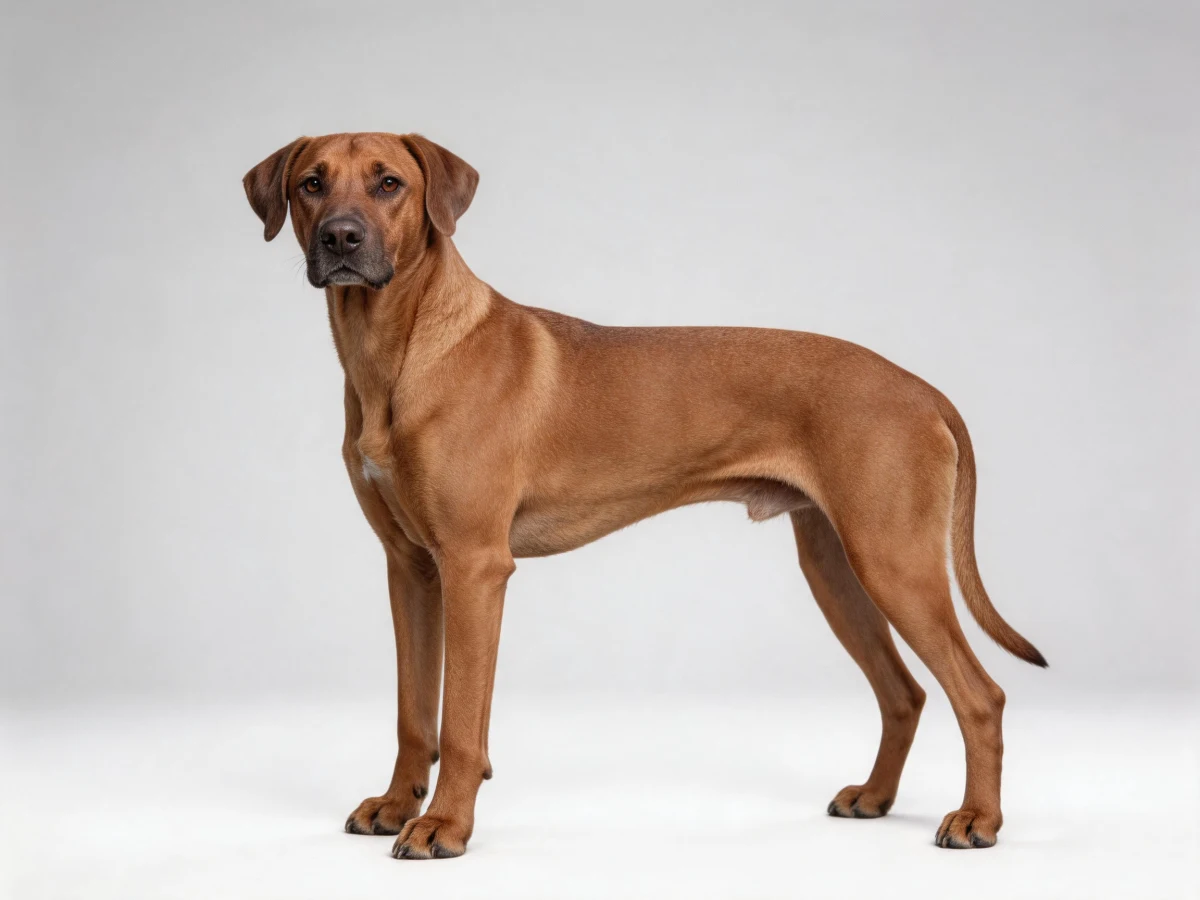
The AKC standard describes the Rhodesian Ridgeback as a handsome, upstanding, athletic hound — strong, muscular, and capable of great endurance with a fair amount of speed, the dog that southern African settlers bred to range the veld and bay big game. The overall impression is of symmetry and balance in outline, with a dignified, even-tempered bearing. The breed's unmistakable hallmark, defined in the standard, is the ridge of hair running along the back in the direction opposite to the rest of the coat, formed by two identical crowns (whorls) directly opposite each other just behind the shoulders and tapering to a point between the hips.
Size, coat, and colour
Mature dogs stand about 25–27 inches at the withers and bitches about 24–26 inches; in weight, dogs run roughly 80–90 lb and bitches about 64–75 lb, in proportion to the frame. The coat is short and dense, sleek and glossy, never woolly or silky, lying close to the body. Colour ranges through the wheaten shades from light to deep red wheaten; a little white on the chest and toes is permissible, while excessive white and a dark muzzle or ears are noted in the standard. The ridge itself is the defining feature and a clearly defined, symmetrical ridge with the correct crowns is required for the show ring.
Head, movement, and temperament
The head is of fair length and flat between the ears, with a well-defined stop, round bright eyes set to reflect the dog's colour, and medium ears set high and carried close to the head. Movement is straight, well-balanced, and efficient, showing the reach and drive of a tireless hunting hound at speed. Temperament is part of the breed's character: dignified, intelligent, and aloof with strangers without showing aggression or shyness — a devoted and even-tempered companion that is naturally reserved toward those it does not know.
🏆 Recognition
Recognized by the American Kennel Club in 1955 as a Hound breed. FCI standard No. 146 (Section 3 — Related breeds (with working trial)), recognized in 1955.
Other registries
Breed clubs
❓ Frequently Asked Questions
Are Rhodesian Ridgebacks good family dogs?
Yes, for the right family. A well-raised Ridgeback is devoted, calm, and affectionate at home and patient with its own children, while staying aloof and watchful with strangers. The caveats are real: it is a large, powerful, strong-willed hound with a high prey drive that needs an experienced, confident owner, early socialisation, secure fencing, and genuine daily exercise. It is not an easy first dog.
Do Rhodesian Ridgebacks shed a lot?
No, not heavily. The short, dense, sleek coat sheds only modestly and has no thick undercoat to "blow" in dramatic seasonal sheds. A weekly going-over with a rubber curry brush or hound mitt captures most loose hair. The breed is clean, low-odour, and about as low-maintenance as the coat gets among large dogs, but it is not hypoallergenic.
How much exercise does a Rhodesian Ridgeback need?
A lot. This is an athletic hunting hound bred to range all day, so an adult needs at least an hour of vigorous daily exercise — a long brisk walk, a run, or free galloping in a securely fenced area. Because of the strong prey drive, off-lead freedom is only safe in genuinely secure or empty spaces, since a Ridgeback in a chase will not respond to a recall.
How long do Rhodesian Ridgebacks live?
Typically 10 to 12 years. As with any large breed, keeping the dog lean, well-exercised, and up to date on veterinary care supports a healthy span, and buying from a breeder who health-tests both parents reduces the odds of the breed-known issues.
Are Rhodesian Ridgebacks easy to train?
They are intelligent but independent, so they are not eagerly obedient the way a retriever is — they learn quickly, then decide whether complying is worth it. Consistent, fair, reward-based training started early works well; harsh, heavy-handed methods backfire. The hardest skill to train is a reliable recall, because the prey drive can override it.
Are Rhodesian Ridgebacks hypoallergenic?
No. No dog is truly hypoallergenic, and although the Ridgeback sheds only modestly, it still sheds short hairs and produces the dander and saliva proteins that trigger allergies. Anyone with a dog allergy should spend extended time around the breed before committing.
How much does a Rhodesian Ridgeback puppy cost?
A well-bred, health-tested puppy from a parent-club breeder typically runs USD 1,700 to 3,500 as of 2024, often with a waiting list of several months. Be wary of puppies priced well below that with no health-testing paperwork, no parent-club connection, and no mention of the neonatal dermoid-sinus check, and of premiums charged for "rare" colours or oversized "types."
📚 Sources & Further Reading
Every load-bearing factual claim on this page is anchored to one of the sources below. iDogNames does not synthesize from secondary aggregators.
- akc breed page Rhodesian Ridgeback — AKC Breed Profile — American Kennel Club (2024)
- fci standard pdf FCI Standard No. 146 — Rhodesian Ridgeback — Fédération Cynologique Internationale (1996)
- kc uk standard pdf Rhodesian Ridgeback — Breed Standard — The Kennel Club (UK)
- breed club official Rhodesian Ridgeback Club of the United States — parent club, breed history & health — Rhodesian Ridgeback Club of the United States
- breed club official The Rhodesian Ridgeback Club of Great Britain — history and breed standard — The Rhodesian Ridgeback Club of Great Britain
- academic paper Duplication of FGF3, FGF4, FGF19 and ORAOV1 causes hair ridge and predisposition to dermoid sinus in Ridgeback dogs — Salmon Hillbertz NHC et al., Nature Genetics 39: 1318–1320 (PMID 17906623) (2007)
- academic paper Genome-wide association analysis reveals a SOD1 mutation in canine degenerative myelopathy that resembles amyotrophic lateral sclerosis — Awano T et al., PNAS 106(8): 2794–2799 (PMID 19188595) (2009)
- academic paper Generalized myoclonic epilepsy with photosensitivity in juvenile dogs caused by a defective DIRAS family GTPase 1 — Wielaender F et al., PNAS 114(10): 2669–2674 (PMID 28223533) (2017)
- wikipedia Rhodesian Ridgeback — Wikipedia — Wikipedia