Doberman Pinscher
✨ Key Takeaways
- The Doberman Pinscher was created by one identifiable man — Karl Friedrich Louis Dobermann (1834–1894), a tax collector and dog-pound keeper in Apolda, Thuringia — who began breeding a personal-protection dog around 1890.
- The dog is named after its maker: after Dobermann died in 1894 the Germans named the breed "Dobermann-Pinscher" in his honour, and Otto Goeller founded the breed's first club in Germany in 1899, with a standard following in 1900.
- The AKC recognised the breed in 1908; the Doberman Pinscher Club of America formed in 1921; The Kennel Club (UK) recognised it in 1948.
- The breed's defining health story is dilated cardiomyopathy (DCM). Wess et al. (2010, J Vet Intern Med) followed 412 Doberman Pinschers and found a cumulative DCM prevalence of 58.2%, rising to 43.6% in dogs aged six to eight years.
- Responsible breeders run a serious panel: annual echocardiogram plus 24-hour Holter from age two, a von Willebrand Disease Type 1 DNA test, an annual thyroid panel, hips, and eyes — the DPCA CHIC list.
- A sound Doberman is a people-bonded, biddable working dog, not the snarling stereotype; Otto Goeller's explicit programme was to temper the early dog's ferocity into a controllable companion.
Quick Facts
Common Names & Variants
Modern aliases
Historical names
Modern variants & lines
⚖️ Pros & Cons
Advantages
Trade-offs
Physical Appearance
Recognized colors
Coat
Other
Ears: Drop (hist. cropped). Tail: Natural (historically docked).
🕰 History
The only major breed with a known inventor
Most breeds emerge from a region, a job, and centuries of undocumented selection. The Doberman is different: it has a named creator, a documented decade, and a stated purpose, which makes its origin one of the most precisely datable in the dog world. The man was Karl Friedrich Louis Dobermann, born 2 January 1834 and died 9 June 1894, a resident of Apolda in what was then the Grand Duchy of Saxe-Weimar-Eisenach, in the German region of Thuringia. He held two jobs that, taken together, explain the entire breed: he was a local tax collector, and he ran the Apolda dog pound.
A protection dog built by a man who needed one
The combination was the design brief. Collecting taxes through 1890s Thuringia meant moving alone, on foot or by cart, carrying money through districts where being robbed was a working hazard. Running the pound gave Dobermann access to a steady, varied population of dogs to breed from. From roughly 1890, following the Franco-Prussian War, he set out to produce a dog that would walk the round with him — one combining, in his own goal, strength, loyalty, intelligence and a controllable sharpness. The breed exists because one specific public servant wanted a bodyguard he could breed rather than buy. The exact crosses are not fully documented — Dobermann left no stud book — but the breeds most consistently named in the breed histories are an early Rottweiler-type "butcher's dog," the German Pinscher, and the black-and-tan terrier, with regional shepherd-type and possibly Weimaraner or sighthound stock variously cited. The honest position is that the recipe is reconstructed, not recorded.
Naming the breed after the man who made it
Dobermann died in 1894 without leaving systematic breeding records. The breed he started outlived him and, in a rare act of attribution, was named for him: German breeders called it the Dobermann-Pinscher — Dobermann's pinscher — folding the creator's surname into the breed name itself. Pinscher was a German term for a terrier-type working dog, reflecting the early dog's terrier input. The naming was a memorial; the dog carries a dead tax collector's name to this day.
Otto Goeller and the deliberate softening
The figure who turned Dobermann's rough prototype into a stable, breedable dog was Otto Goeller, a liqueur manufacturer and fellow Apolda resident. Goeller is widely regarded as the breed's chief architect after its founder: he refined type, fixed the temperament, and — crucially — set out explicitly to temper the early dog's ferocity into something controllable and biddable rather than merely fierce. Goeller founded the breed's first club, the National Dobermann Pinscher Club, in Germany in 1899, and a breed standard followed in 1900, the year the German Kennel Club recognised the breed. The modern Doberman's reputation for trainability over raw aggression is Goeller's design choice, not an accident.
Across the Atlantic, and a parent club
The breed moved fast for one so young. The American Kennel Club recognised the Doberman Pinscher in 1908, placing it in the Working Group, and the Doberman Pinscher Club of America was founded in 1921 and became the AKC parent club for the breed. Britain's Kennel Club recognised the Dobermann in 1948 — comparatively late, after the breed's reputation had been established by its First and Second World War service as a military and sentry dog, most famously with the United States Marine Corps in the Pacific. The FCI standard, N° 143, places the breed in Group 2 among the pinscher and schnauzer type, and modern German practice drops "Pinscher" entirely: in its country of origin the breed is simply the Dobermann.
What's striking about the trajectory
What's striking about the Doberman is how compressed its history is. The Labrador and the Rottweiler took centuries; this breed went from a tax collector's idea to AKC recognition in under two decades. That speed is also why the breed is so genetically scrutinised today — a young breed built from a small, partly undocumented founder base, intensively bred, is exactly the population in which a problem like dilated cardiomyopathy can concentrate. The history and the health story are the same story told twice.
Temperament & Personality
What Goeller built, and what the standard says
The Doberman's temperament is not an accident of breed type — it was an explicit design decision. Otto Goeller's stated programme was to take Karl Dobermann's sharp prototype and breed the controllable, biddable dog out of the fierce one. The FCI standard reflects that target, describing the Dobermann as friendly and calm in the family, devoted, and requiring "medium sharpness" and good trainability with the courage and hardness for working trials. The AKC standard adds the operative word: the breed is "energetic, watchful, determined, alert, fearless, loyal and obedient." Read together, the picture is a sound Doberman as a controllable working dog, not the lunging caricature of film.
The "velcro dog" reality
The single most consistent owner observation across the breed is intensity of attachment. The Doberman is the archetypal "velcro dog" — it bonds hard to its people and physically wants to be with them, following an owner from room to room, leaning, shadowing. This is a strength and a constraint at once: a Doberman left alone in a yard or kennelled away from its family is being kept in exactly the way the breed handles worst, and separation-related behaviour is a common consequence of misjudging this. The breed gives a great deal of itself and asks for company in return.
Sharpness, threshold, and reading the dog right
A correctly bred adult Doberman is watchful rather than reactive: it notices, assesses, and acts deliberately, with a high threshold rather than a hair trigger. The breed's protective behaviour is real but should be a considered response, not nervous defensiveness — fear-based reactivity is a temperament fault, not the breed working as designed. The flip side of the intelligence is sensitivity: Dobermans are widely described as emotionally responsive to their handler's mood and tone, which makes harsh or inconsistent training counterproductive. The breed reads the room, including the human in it.
Day to day, and the hard caveats
In the right home the Doberman is affectionate, comic, intensely loyal, and one of the most trainable dogs available — a working partner that thrives on obedience, IGP, agility, scent work, and service roles. The hard caveats are not about temperament soundness; they are about scale. This is a powerful, fast, intelligent dog whose training failures are consequential. It needs early, consistent socialisation and a handler who can provide structure. It needs real daily exercise and a mental job; a bored Doberman is destructive and anxious. Same-sex dog tolerance can be limited and should be managed. Breed-specific legislation and higher insurance premiums apply in some jurisdictions regardless of the individual dog. None of that makes the Doberman a bad dog. It makes it a working breed that earns its keep only with an owner prepared to do the work first.
🏡 Living With a Doberman Pinscher
The original "velcro dog" — and what that demands
When Karl Friedrich Louis Dobermann set out around 1890 to build himself a sharp, devoted personal-protection dog, he selected hard for a dog that bonds intensely to one person or family and wants to be physically close to them. More than a century later that is still the defining fact of life with a Doberman: this is the original "velcro dog," a guardian that follows its people from room to room and is genuinely unhappy left to its own devices. A Doberman is not a backyard or kennel dog. The short single coat gives it almost no insulation, so it cannot be left outdoors in cold weather, and the deep people-bond means isolation produces anxiety, destructiveness, and barking rather than a calm, self-contained animal. This breed has to live inside, with its family, as a full member of the household.
A working athlete that needs a job
The Doberman was bred to work all day and it carries that engine into the living room. An adult needs a solid hour or more of real exercise daily, and — like most working breeds — it does far better when the activity carries a purpose: a structured walk or run, retrieving, scent games, obedience drilling, or a dog sport such as IGP (protection sport), agility, or rally. Physical exercise alone is not enough; a Doberman that gets a walk but no mental work stays wired and invents its own projects, usually destructive ones. The breed's intelligence is a chore as much as a gift, because a bored Doberman is a problem-solving Doberman. Owners who treat daily training and problem-solving games as non-negotiable get the steady, dignified companion the breed is capable of being.
Family, other pets, and the guardian instinct
A well-socialised Doberman is affectionate, playful, and deeply loyal to its own family, and many are gentle and patient with the children they are raised alongside — though the breed's size and exuberance mean toddlers and a powerful young Doberman need supervision simply on physics. The guardian instinct is real and is the whole point of the breed: a Doberman is naturally watchful and protective, which is exactly why early, broad, positive socialisation is not optional. A Doberman that meets many people, dogs, places, and situations as a puppy grows into a discerning adult that can tell normal from genuinely wrong; one raised in isolation can become reactive or indiscriminately suspicious. With other dogs and pets, raised-together households usually work well, while same-sex dog pairings can be a flashpoint and warrant care.
🎓 Training & Exercise
One of the most trainable dogs alive
The Doberman consistently ranks at the very top of working-and-obedience intelligence, and for good reason: this is the breed that built much of modern police and military K9 work and remains a force in protection sport. It learns fast, retains what it learns, and reads its handler closely. That same brilliance is why a Doberman cannot be trained casually — it learns the wrong lessons just as quickly as the right ones, and an inconsistent owner produces a sharp, pushy, manipulative dog rather than a steady one. The breed rewards an owner who is calm, consistent, and clear, and who starts structured training in puppyhood and never really stops.
What motivates the breed — and what backfires
A Doberman works for engagement with its person far more than for food alone; praise, play, the chance to do a job, and the handler's evident approval are powerful currency. Reward-based methods that channel that drive produce a willing, focused dog. Heavy-handed, harsh, or punitive training is the classic mistake: a Doberman is sensitive to its handler and physically capable, so corrections delivered in anger tend to erode the bond and can create fear-based reactivity in a dog that has the equipment to make that dangerous. The one real catch is that this is a dog that will test boundaries and read any inconsistency as an opening — fairness and follow-through matter more than force.
The commands that matter most
Because the Doberman is large, fast, and protective, the highest-value skills are the ones that give a handler reliable control in the real world: a rock-solid recall, a dependable "leave it" and "place"/settle, loose-lead walking, and calm, polite greetings so an eager 90-pound dog does not bowl people over. Impulse-control work — waiting at thresholds, settling on a mat, taking food gently — pays off across the dog's whole life. For owners drawn to the breed's protective heritage, channelling it through a structured sport under a qualified club is the responsible route; ad-hoc "guard training" at home tends to create an unpredictable liability rather than a controllable protector.
✂️ Grooming & Coat Care
A wash-and-wear coat that still sheds
Grooming is one area where the Doberman is genuinely low-maintenance. The breed wears a short, smooth, single coat that lies close to the body and needs no clipping, stripping, or trimming. A weekly once-over with a rubber curry brush, a grooming mitt, or a soft bristle brush lifts loose hair and keeps the coat sleek and shining, and a bath every couple of months or when the dog is actually dirty is plenty. The single thing owners are sometimes surprised by is that "short coat" does not mean "no shedding" — Dobermans shed steadily, and those short, stiff hairs weave into upholstery and clothing, so regular brushing and vacuuming stay part of the routine even though there is no seasonal undercoat blow to manage.
The cold-weather caveat
That same thin single coat carries no insulating undercoat, which is the reason a Doberman feels the cold acutely. In chilly or wet weather the breed genuinely needs a coat or sweater for walks, should not be exercised hard in the cold without warming up, and must never be housed outside in winter. Skin is generally easy, but because the coat is so short, owners should check it over during the weekly brush for any lumps, scrapes, or irritation that a longer coat would hide.
Ears, nails, teeth — and a note on cropping
Routine husbandry is straightforward: trim nails every two to three weeks so they do not click on the floor, brush the teeth several times a week from puppyhood, and check the ears regularly, drying them after baths or swims. A point worth stating plainly: the upright, pointed ears people associate with the breed are the result of cosmetic ear cropping and tail docking, surgical alterations performed for appearance rather than health. These procedures are now banned or restricted in much of the world, including across the United Kingdom, Europe, and Australia, and a Doberman's natural ears are drop ears and its natural tail is long. A natural-eared, undocked Doberman needs no special ear care beyond the usual checks.
🍖 Diet & Nutrition
Feeding a lean, deep-chested athlete
A Doberman should be kept lean and muscular, never heavy — extra weight burdens the joints and, more importantly in this breed, gives the heart more work to do, which matters in a breed with a serious cardiac record. Feed a complete diet matched to a large, active working dog, in measured meals against the dog's ideal body condition rather than free-feeding, and learn to feel for ribs and a clear waist rather than judging by the scale alone. Treats should come out of the day's ration, and because so much of a Doberman's training relies on food and engagement, using part of the measured meal as training rewards keeps calories honest.
Growing a large-breed puppy
Doberman puppies grow fast into large adults — males reaching roughly 88–99 lb and females about 70–77 lb — and they should be raised on a diet formulated for large-breed growth, fed to grow steadily rather than as quickly as possible. Pushing maximum growth or over-supplementing calcium is linked to developmental joint problems, so the aim is a lean, evenly growing puppy. Most Dobermans settle into twice-daily adult feeding once growth slows, with portions set by ideal adult weight and activity and adjusted over time by body condition. Make any diet change gradually across a week to avoid stomach upset.
Bloat: the deep-chest emergency
As a deep-chested large breed, the Doberman carries a meaningful risk of bloat and gastric torsion (GDV) — a sudden, life-threatening twisting of the stomach. The standard, practical precautions are to split the daily food into two meals rather than one large one, avoid hard exercise in the hour either side of eating, and use a slow-feeder bowl if the dog bolts its food. Every Doberman owner should know the warning signs — a swelling or distended belly, unproductive retching, drooling, pacing and obvious distress — and treat them as an immediate veterinary emergency, not something to watch overnight. Some owners discuss preventive stomach-tacking (gastropexy) with their vet, often at the time of spaying or neutering.
🐶 Buying & Adopting a Doberman Pinscher
Start with the parent club, not a classified ad
The Doberman Pinscher Club of America (DPCA) is the AKC parent club and the right place to begin a search. It maintains a breeder code of ethics, a breeder-referral resource, and a national rescue network. A breeder worth buying from will register litters with the AKC, health-test both parents, provide a written contract and health guarantee, raise the puppies in the home, and talk openly about the breed's hard health realities rather than insisting their lines are simply "healthy." Because the Doberman's most serious problem is a heart disease that can strike dogs from sound-looking lines, a breeder's willingness to discuss cardiac health frankly is one of the clearest signals of integrity.
The health screening to ask a breeder for
The single most important fact a prospective Doberman owner should know is that dilated cardiomyopathy (DCM) is alarmingly common in this breed and is its leading cause of death. Responsible breeders screen for it with an annual echocardiogram plus a 24-hour Holter monitor, ideally read by a board-certified cardiologist, starting from about age two — a single normal exam early in life is not a clearance, because the disease develops over time. Ask to see current cardiac results on the parents, and ask about DCM in the wider pedigree. Beyond the heart, the breed's CHIC screening profile covers a DNA test for von Willebrand disease type 1 (an inherited bleeding disorder), an autoimmune thyroiditis panel, a hip evaluation (OFA or PennHIP), and an eye examination by a boarded veterinary ophthalmologist (ACVO). Some lines also use DCM1/DCM2 genetic markers. The breed is additionally prone to wobbler syndrome (cervical vertebral instability) and hypothyroidism, both reasonable to ask about. A breeder who produces this paperwork and discusses heart disease candidly is the one to trust; "our dogs are healthy, no testing needed" is the answer to walk away from. (This is consumer guidance on what to ask for, not veterinary advice.)
Rescue and the realities of rehoming
Doberman rescue is well-organised, coordinated through the DPCA and a network of regional breed-rescue groups. Because the breed is powerful, demanding, and frequently underestimated by first-time owners, rescues regularly take in adolescents and young adults surrendered when the exercise, training, and companionship needs proved more than an owner expected. For an adopter who genuinely wants the breed and can offer structure, exercise, and an indoor home with company, an adult Doberman with a known temperament is an excellent and ethical route — and a reputable rescue will be honest about each dog's history and suitability around children or other pets.
Price, waiting lists, and red flags
A well-bred Doberman Pinscher puppy in the United States runs roughly USD 1,500–3,500 as of 2024, depending on region, lineage, and parent titles, and good breeders often keep waiting lists of several months. The patterns to walk away from are the familiar ones: puppies priced well below that with immediate availability, no cardiac or other health-testing documentation, and no parent-club connection. Be wary, too, of sellers marketing oversized "king" or "warlock" Dobermans or unusual colours at a premium — these are marketing labels, not recognised types, and the colour-dilution shades in particular can carry skin and coat problems. A fair price from a health-testing, DPCA-connected breeder, even after a wait, is far cheaper than the lifetime cost of a poorly bred dog from a breed where the headline risk is the heart.
📜 Breed Name Etymology — iDogNames original research
A breed named for a dead tax collector
The Doberman is one of a tiny set of breeds named after a specific, identifiable person rather than a place or a job. The name is the surname of Karl Friedrich Louis Dobermann (1834–1894), the Apolda tax collector and dog-pound keeper who started the breed around 1890. He did not name it after himself. After his death in 1894 German breeders named it for him as a memorial — Dobermann-Pinscher, "Dobermann's pinscher" — the rare case of a breed name functioning as an epitaph. The double "n" of "Dobermann" is the original German spelling and remains standard in Germany, the FCI, and the UK; American usage dropped one "n" to "Doberman," which is why both spellings are correct depending on which side of the Atlantic and which registry you are reading.
What "Pinscher" actually means
The second half of the name is a common German working-dog term, not a surname. Pinscher was the German label for a terrier-type dog — a sharp, alert, vermin-and-guard worker — and it was attached because the early Doberman carried black-and-tan terrier blood and that working character. Its further etymology is debated: it is often connected to the English "pinch," via the terrier habit of seizing prey, though German lexicographers do not treat that derivation as settled, and the honest answer is that the deep root of "Pinscher" is not definitively established. The German Pinscher and the Miniature Pinscher carry the same term independently of the Doberman; "Pinscher" classifies a type, it does not link those breeds to Dobermann the man.
Why Germany dropped half the name
In its country of origin the breed is now simply the Dobermann. German breeders and the FCI dropped "Pinscher" decades after the breed's founding on the reasoning that the modern dog — refined by Otto Goeller into something larger and more elegant — no longer resembled a terrier-type pinscher in any meaningful way. The United States kept the older full form, "Doberman Pinscher," which is why the AKC parent club is still the Doberman Pinscher Club of America while the German club is the Dobermann-Verein. The name therefore encodes a small transatlantic split: same dog, two registry conventions, two spellings, and one optional second word.
The clippings, and the labels to distrust
Dobe and Dobie are the universal English clippings, used interchangeably with the full name in breed-club and veterinary contexts. Treat size-marketing labels with suspicion: "Warlock Doberman," "King Doberman," and "Goliath Doberman" are seller language for oversized dogs, not registry terms — the FCI and AKC standards cap height, and bigger is a fault, not a premium grade. The only substantive provenance distinction is "European" or "FCI" Doberman (bred to FCI 143, typically with stronger working drive and a working-temperament test) versus an "American" Doberman bred to the AKC standard for the show ring and home — and even that is a breeding-program statement, not a separate breed.
Name forms at a glance
| Name | Role | Origin | Literal meaning | First recorded |
|---|---|---|---|---|
| Doberman Pinscher | primary | German (eponym + working-type term) | Dobermann's pinscher | 1899 |
| Dobermann | origin country native | German (original spelling, "Pinscher" dropped) | the Dobermann (dog) | — |
| Pinscher | historical | German (working-dog type term; deep root debated) | terrier-type / "pincher" working dog | — |
| Dobe / Dobie | alias | English (clipping) | short form of Doberman | — |
| Karl Friedrich Louis Dobermann | historical | German (the creator's personal name) | the man the breed is named after | 1834 |
🏛 Naming Traditions — iDogNames original research
A German registry tradition, exported and split
The Doberman's naming culture is structured, German at the root, and — like the breed itself — split across an Atlantic divide. Because the breed was consolidated early by a single dominant German club (Otto Goeller's, founded 1899) and a national stud book, its formal naming follows the German Zwinger (kennel) convention, while its call-name culture drew on two further streams: the breed's literal namesake heritage, and an American working-and-guardian register that grew up around the breed's 20th-century police and military fame.
The German Zwinger convention
A pedigree Dobermann's full registered name follows the German kennel system: [Given name] vom/von [Zwinger], where the Zwinger affix is the breeder's permanent identity and the given name is the dog's. Historically significant German Doberman kennels — affixes such as vom Furstenfeld, von der Bismarcksaule, or the early von Thuringen associated with Goeller's own breeding — carry weight in pedigrees the way a vintage carries weight on a wine label. The German litter-letter convention applies as in other German working breeds: an entire litter is themed to one letter (an "F" litter is all Falko, Fedor, Freya, Fee), which lets the stud book place a dog by birth year and litter at a glance. German given names in this system run to short, hard, single names that pair cleanly with an affix: Bodo, Falk, Greif, Asta, Cita.
The namesake-and-origin layer
This is the layer the iDogNames audience comes for, and it is unusually rich for the Doberman because the breed's name is itself a heritage hook. Names that nod to the breed's literal origin — its creator, his town, his trade — are the most defensible heritage choice: Apolda (the Thuringian town where the breed was made), Karl or Louis (after Karl Friedrich Louis Dobermann), Goeller or Otto (after Otto Goeller, the breed's refiner), and Thüring / Thuringia for the region. Almost no other breed lets an owner name a dog directly after the documented person who invented it; for the Doberman that is not a gimmick, it is the single most historically literate naming route available.
The American working-and-guardian register
The breed's 20th-century reputation as a police, sentry, and war dog — the United States Marine Corps' Pacific "Devil Dogs" of the Second World War — produced a distinct American call-name register: strong, deliberate, slightly martial names that suit the breed's working image without tipping into cliché. Kaiser, Zeus, Apollo, Maximus, Diesel, Rommel, Cooper — the pattern is recognisable enough that an experienced handler can often guess from a Doberman's call name whether it descends from a German import line (German given name, vom-affix paperwork) or an American working/show kennel (English power name, frequently no nobiliary particle).
What this means for naming a Doberman today
The breed offers three coherent, lineage-backed routes and one trap. A short German given name in the Zwinger tradition (Bodo, Falk, Asta) matches the breed's German registry culture and suits an import or show line. A namesake-or-origin name (Apolda, Louis, Otto, Thuringia) is the most historically literate choice and unique to this breed among the major working dogs. A measured American power name (Zeus, Maximus, Kaiser) sits squarely in the breed's 20th-century working tradition. The trap is the menacing-cliché name — Killer, Satan, Cujo — which leans into exactly the snarling stereotype Otto Goeller spent his career breeding out of the dog and the DPCA spends its time correcting.
🐾 Themed Names for Your Doberman Pinscher — iDogNames original research
Namesake and origin names — unique to this breed
Names drawn from the breed's documented creator, his refiner, and his Thuringian town. Almost no other breed can be named directly after the person who invented it; for the Doberman this is the deepest heritage route.
- Louis — for Karl Friedrich Louis Dobermann, the breed's creator
- Karl — the founder's first name; clean and period-true
- Otto — for Otto Goeller, who refined and stabilised the breed
- Goeller — the refiner's surname; an insider heritage nod
- Apolda — the Thuringian town where the breed was created
- Thuring — short for Thuringia, the breed's home region
- Weimar — for Saxe-Weimar-Eisenach, the breed's birth state
- Schnuppe — a documented early Doberman bitch in the breed's foundation
- Pinsch — a wry clip of "Pinscher," the breed's dropped second name
- Dobe — the breed's own universal nickname turned given name
German Zwinger / registry-tradition names
Short, hard German given names that pair naturally with a vom-/von-prefixed registered name. Best for import lines and show dogs.
- Bodo — classic German working-dog male name
- Falk — "falcon"; short, sharp, German registry-true
- Greif — "griffin"; weighty and traditional
- Asta — recurring German Doberman dam name
- Cita — compact German female call name
- Arko — strong two-syllable German given name
- Hexe — "witch"; long-used German working-line female name
- Bero — short German male name; pairs cleanly with an affix
- Quanto — recurring German working-pedigree name
- Freya — Germanic; common in litter-letter "F" litters
Working and guardian names — the American register
Strong, deliberate names from the breed's 20th-century police, sentry, and war-dog era — confident without tipping into the menacing cliché the breed's clubs warn against.
- Kaiser — German "emperor"; the breed's most-used power name
- Zeus — scale-appropriate without being a pun
- Maximus — commanding, ages well
- Apollo — classical, dignified, fits the breed's lines
- Diesel — American working-line favourite
- Rommel — period-martial; ties to the breed's war-dog era
- Cooper — modern, grounded, popular in US homes
- Athena — strong classical female; a guardian name
- Juno — Roman goddess; short, female, dignified
- Major — service register; fits the breed's military heritage
Devil Dog / Marine Corps heritage names
The Doberman was the official war dog of the United States Marine Corps in the Pacific theatre; the first USMC war-dog cemetery on Guam honours these dogs. Names from that documented chapter.
- Kurt — the first Marine Doberman killed in action on Guam, 1944
- Guam — site of the USMC war-dog cemetery and memorial
- Andy — a decorated Marine Corps Doberman scout dog
- Cappy — a Marine war Doberman credited with saving Marines
- Sentry — the breed's core wartime job; one hard syllable
- Scout — the Doberman's primary USMC working role
- Devil — from "Devil Dogs," the USMC Doberman nickname
- Recon — short, on-heritage, easy as a recall
- Semper — from Semper Fidelis; the loyalty the breed embodies
- Pacific — the theatre where the breed earned its war reputation
Coat and colour names — black-and-rust and the dilutes
The breed comes in four colours — black, red (brown), blue, and fawn (Isabella) — each with sharp rust points. Names that work that palette without the obvious "Blackie."
- Onyx — for the black-and-rust dogs; show-line gravity
- Rust — the literal name of the breed's points; wry and accurate
- Copper — for the rust markings; warm and short
- Sienna — for the red (brown) dogs
- Mahogany — the deep red of a rich red-and-rust coat
- Slate — for the blue (dilute) Dobermans
- Isabella — the breed's own name for the fawn dilute colour
- Fawn — direct, for the lightest dilute coat
- Ember — black ground read with rust at the edges
- Pitch — deep black; one hard syllable, easy to call
📋 Breed Standard at a Glance
General appearance
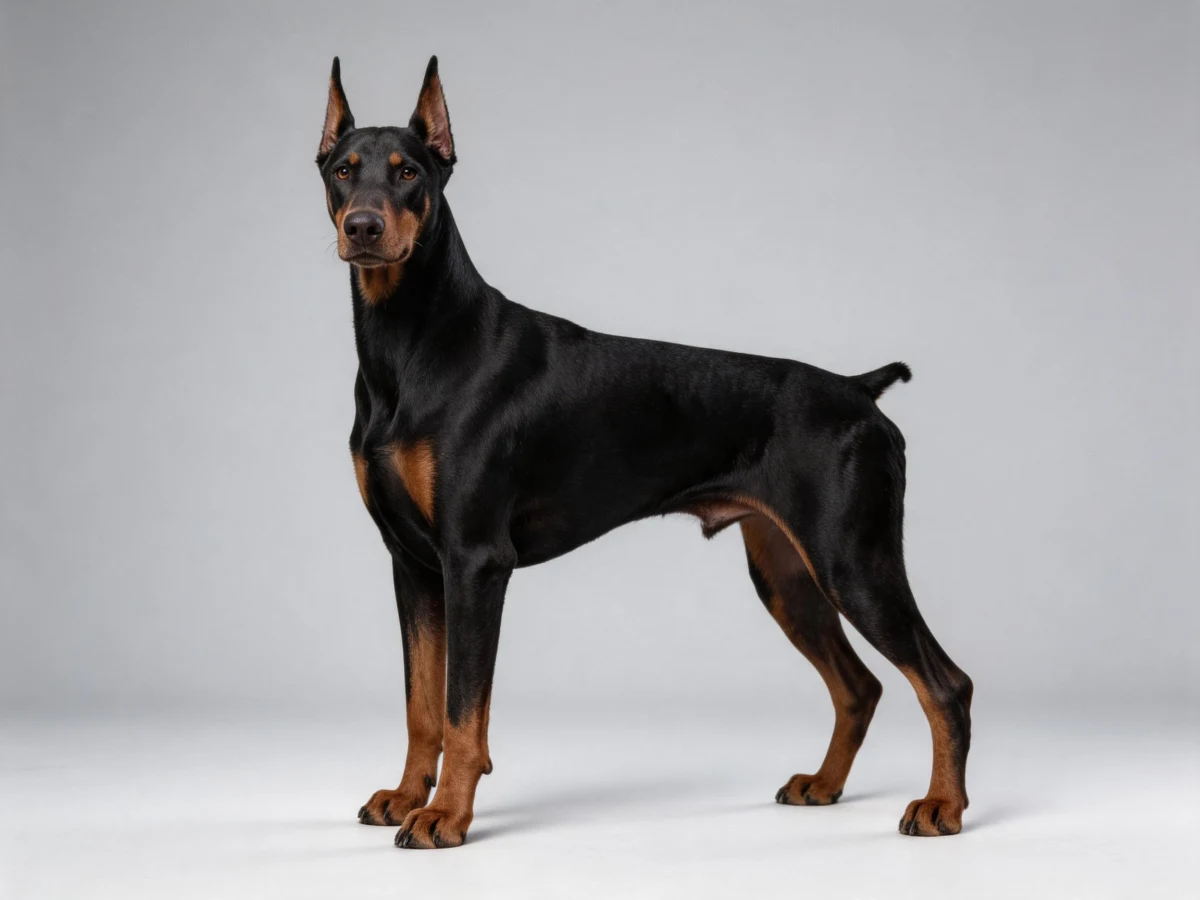
The breed standard describes the Doberman Pinscher as a dog of medium-to-large size with a compact, square, muscular body — its height at the withers roughly equalling its length — combining great nobility, elegance, and power. The impression is of an alert, energetic, fearless working dog of compact build: clean in outline, proudly carried, and built for speed and endurance rather than bulk. Recognised as a Working breed by the AKC, the Doberman should look every bit the capable guardian its history demands.
Size, coat, and colour
Males stand about 26.5–28 inches at the withers and weigh roughly 88–99 lb; females stand about 25–27 inches and weigh about 70–77 lb, giving a clearly larger, heavier dog than a casual observer expects. The coat is short, hard, thick, and smooth, lying close to the body, with no undercoat — a true single coat. The recognised colours are black, red (brown), blue, and fawn (Isabella), each with sharply defined rust markings above each eye, on the muzzle, throat, chest, legs, and beneath the tail.
Head, movement, and temperament
The head is long and clean, a blunt wedge from front and side, with almond-shaped dark eyes giving a keen, energetic expression. The breed is naturally drop-eared and long-tailed; the upright cropped ears and docked tail long associated with the breed are cosmetic alterations now banned or restricted in many countries. Movement is free, balanced, and vigorous, with good reach and powerful drive. Temperament is part of the standard: the Doberman should be energetic, watchful, determined, alert, fearless, loyal, and obedient — sharpness and viciousness toward people, like shyness, are faults.
🏆 Famous Doberman Pinschers
Notable real dogs of the breed profiled on iDogNames.
🏆 Recognition
Recognized by the American Kennel Club in 1908 as a Working breed. FCI standard No. 143 (Section 1 — Pinscher and Schnauzer type), recognized in 1955.
Other registries
Breed clubs
❓ Frequently Asked Questions
Are Doberman Pinschers good family dogs?
Yes, for the right family. A well-socialised, well-trained Doberman is affectionate, loyal, and devoted to its people, and many are gentle with children raised alongside them. The breed bonds intensely and dislikes being left alone, so it suits an active household that wants the dog indoors as a full family member and can commit to early socialisation and ongoing training. Its size and energy mean young children and a powerful Doberman should always be supervised together.
Do Doberman Pinschers shed a lot?
Less than a double-coated breed, but more than people expect. The Doberman has a short, single coat with no undercoat, so there is no heavy seasonal blow, but it sheds steadily year-round and the short stiff hairs work into clothing and upholstery. A weekly brush with a rubber curry or grooming mitt and regular vacuuming keep it manageable. The coat needs no clipping or trimming.
How much exercise does a Doberman Pinscher need?
A lot. As a working breed bred for stamina, an adult Doberman needs at least an hour of real exercise a day, and it does best when that activity has a purpose, such as a structured walk or run, retrieving, scent work, obedience, or a dog sport. Mental work matters as much as physical exercise: a bored, under-worked Doberman becomes restless and destructive.
How long do Doberman Pinschers live?
Typically 10 to 12 years. The breed average is pulled down by dilated cardiomyopathy (DCM), a heart disease that is unusually common in Dobermans and is the leading cause of death. This is why responsible breeders screen breeding dogs with an annual echocardiogram plus Holter monitor from about age two.
Are Doberman Pinschers easy to train?
Very. The Doberman ranks among the most trainable breeds and is a classic police, military, and protection-sport dog. It learns fast and reads its handler closely, so calm, consistent, reward-based training suits it well. The flip side is that it learns bad habits just as quickly, and harsh or punitive handling backfires in a sensitive, powerful dog.
Are Doberman Pinschers hypoallergenic?
No. Although the coat is short and single, the breed still sheds and is not considered hypoallergenic. Anyone with a dog allergy should spend extended time around the breed before committing to one.
How much does a Doberman Pinscher puppy cost?
A well-bred, health-tested puppy from a parent-club breeder typically runs USD 1,500 to 3,500 as of 2024, often with a waiting list of several months. Be wary of puppies priced well below that with no cardiac or other health-testing paperwork, and of premiums charged for oversized "king" or "warlock" dogs or unusual colours, which are marketing labels rather than recognised types.
📚 Sources & Further Reading
Every load-bearing factual claim on this page is anchored to one of the sources below. iDogNames does not synthesize from secondary aggregators.
- akc breed page Doberman Pinscher — AKC Breed Profile — American Kennel Club (2024)
- akc breed page Doberman Pinscher History: Where the Breed Originated — American Kennel Club (2023)
- fci standard pdf FCI Standard No. 143 — Dobermann — Fédération Cynologique Internationale (2015)
- breed club official The Kennel Club (UK) — Dobermann breed information (recognised 1948) — The Kennel Club (UK)
- breed club official Doberman Pinscher Club of America — Health & CHIC requirements — Doberman Pinscher Club of America
- academic paper Prevalence of dilated cardiomyopathy in Doberman Pinschers in various age groups — Wess G et al., J Vet Intern Med (2010)
- health registry Doberman Pinscher CHIC requirements (cardiac, vWD, thyroid, hips, eyes) — OFA — Orthopedic Foundation for Animals (OFA / CHIC)
- wikipedia Dobermann — Wikipedia — Wikipedia
- book The Dobermann Pinscher: History and Development of the Breed — Philipp Gruenig (trans. by D. P. Schmidt) (1939)