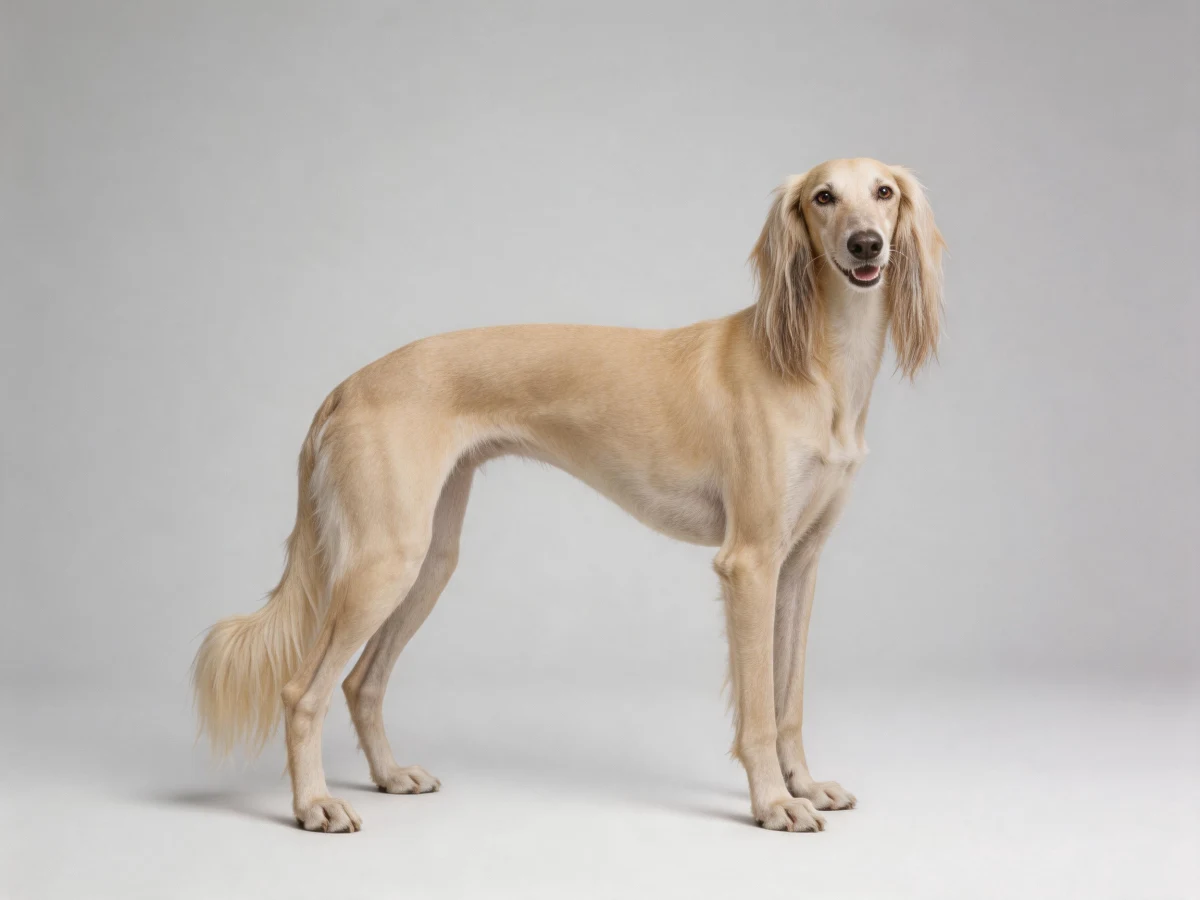
Greyhound
✨ Key Takeaways
- The Greyhound is the fastest dog breed, reaching about 72 km/h (45 mph), the product of millennia of selection to hunt by sight — it is the archetypal sighthound, and "gazehound" is the older English word for exactly that.
- Formal coursing began with George Walpole, 3rd Earl of Orford, founding the Swaffham Coursing Club in 1776; the Waterloo Cup ran from 1836 to 2005, and the closed Greyhound Stud Book opened under the National Coursing Club in 1882.
- There are effectively two Greyhounds: the taller, heavier AKC/KC show dog and the lighter NGA-registered racing dog — a parallel stud lineage bred purely for sprint — and a century of separate selection has made them recognisably different.
- Greyhounds have a genuinely distinct clinical physiology: high PCV and red-cell count, low platelets and low T4 are normal, so they need breed-specific reference intervals (Zaldívar-López et al., 2011) or healthy dogs get misdiagnosed.
- Two surgical risks are real and well-studied: slow recovery from thiobarbiturate anaesthetics tied to low body fat and a CYP2B11 difference (Martinez et al., 2020), and delayed postoperative bleeding controlled by epsilon-aminocaproic acid (Marín et al., 2012).
- The "only dog named in the Bible" claim rests on one disputed King James reading of Proverbs 30:31; the Hebrew is uncertain and most modern translations render it "strutting rooster," not greyhound.
Quick Facts
Common Names & Variants
Modern aliases
Historical names
Modern variants & lines
⚖️ Pros & Cons
Advantages
Trade-offs
Physical Appearance
Recognized colors
Coat
Other
Ears: Rose. Tail: Long-tapering.
🕰 History
The fastest dog on earth, selected for one thing for millennia
A healthy Greyhound clears roughly 72 kilometres an hour — about 45 miles an hour — and reaches it in a handful of strides, which makes it the fastest dog breed and the second-fastest land animal over a short course after the cheetah. Nothing about that is accidental. The breed is the archetypal sighthound: a dog selected for thousands of years to find its quarry by sight, not scent, and to run it down across open ground. The double-suspension gallop, the deep flexible chest, the long loin and the rotating spine that lets the back legs reach past the front — every line of the animal is a sprint specification. Short-coated sighthounds of this general shape appear in Mediterranean and Eurasian art for millennia, but the dog that carries the name Greyhound today is a specifically British refinement, shaped by the English coursing field and a closed studbook.
From the medieval leash to a gentleman's sport
Through the Middle Ages the Greyhound was a dog of rank. English forest law and the Forest Charters restricted who could keep one, and the breed carried a long association with European nobility — the coursing of hare and deer was an aristocratic pursuit, and a fast hound was a status object as much as a working animal. The sport became an organised, rule-bound activity in 1776, when George Walpole, the 3rd Earl of Orford, founded the Swaffham Coursing Club in Norfolk: twenty-six members, each entitled to one dog, each naming his greyhound after a different letter of the alphabet. That club is the conventional founding moment of formal coursing under written rules, and it set the template — judged matches between two dogs slipped together at a hare, scored on the turn and the run rather than the kill.
The Waterloo Cup and the closed studbook
Coursing's great event, the Waterloo Cup, was inaugurated in 1836 by William Lynn, proprietor of the Waterloo Hotel in Liverpool, on land at Great Altcar belonging to the Earl of Sefton. It grew into a three-day, sixty-four-dog knockout that drew tens of thousands of spectators and was, for a century, the Derby of the dog world. Out of that culture came the recordkeeping that defines the modern breed: the Greyhound Stud Book opened in 1882 under the newly formed National Coursing Club, closing the breed to outside blood and fixing the English Greyhound as a pedigree population. The Kennel Club had already recognised the breed in 1873; the American Kennel Club followed in 1885, placing it in the Hound group.
Two breeds inside one name: show and racing
The 20th century split the Greyhound into two parallel lineages that rarely interbreed. Track racing — dogs chasing a mechanical lure around an oval — was made practical by Owen Patrick Smith's artificial-lure patent and the first circular track at Emeryville, California, in 1919, and it spread fast through Britain, Ireland, Australia and the United States. Racing greyhounds are registered not by the AKC but by the National Greyhound Association (NGA), founded in 1906, which keeps its own stud book on the basis of performance. The result is a genuine divergence: the NGA racing greyhound is lighter, leaner and bred purely for sprint, while the AKC and Kennel Club show greyhound is taller and heavier-boned, bred to a conformation standard. They share an origin and a shape, but a century of separate selection — one for the clock, one for the ring — has made them recognisably different dogs.
The decline of the track and the adoption movement
Commercial track racing peaked in the mid-20th century and has been in steep decline since. Welfare campaigns, falling attendance and a string of legislative bans hollowed out the industry: Florida, once the centre of American greyhound racing, voted in 2018 to end it, and most US tracks have now closed. That collapse produced one of the largest breed-specific rehoming efforts in the world. Thousands of sound, retiring track dogs — typically aged two to five, having finished or never started a racing career — pass each year through adoption groups, and the retired racing greyhound (RRG) is now the form most people meet. The welfare history of the track is real and contested, and an honest account of the breed has to hold both things at once: the sport built and sustained the modern Greyhound population, and the same sport generated the welfare concerns that ended it across much of the English-speaking world.
The genetics of speed — and a careful caveat
The Greyhound's sprint physiology is a real, selected trait: high red-cell mass for oxygen delivery, a large heart, fast-twitch musculature and very low body fat all stack toward one job. It is tempting to attach this to the famous myostatin story — the MSTN "double-muscling" variant that produces unusually muscular "bully whippets" — but that work was done in Whippets (Mosher et al., 2007), the Greyhound's smaller relative, and should not be transplanted onto the Greyhound as though it were the breed's own speed gene. The Greyhound's athleticism is the cumulative product of centuries of coursing and racing selection across many genes, not a single tidy mutation. Where the science is firmest is in the breed's distinctive clinical physiology, which is documented in detail below.
Temperament & Personality
The 45-mile-an-hour couch potato
The single most useful thing to know about Greyhound temperament is the gap between reputation and reality. People expect a hyperactive athlete and meet, instead, one of the calmest companion dogs in the large-breed world. The sprinter's body is built for short, explosive effort, not endurance, and outside of a few minutes of all-out running the breed defaults to lying down. A well-exercised adult Greyhound sleeps eighteen hours a day, leans into people for affection, and is famously content in a flat or a small house. "45-mile-an-hour couch potato" is the adoption-group cliché precisely because it is accurate.
Gentle, sensitive, and quietly independent
The breed is gentle, sweet-natured and notably non-confrontational. It is a poor guard dog — most Greyhounds will watch a stranger walk in and ask for a stroke — and it is generally tolerant of children and other dogs, though its size and thin skin mean it is easily knocked about by rough handling. There is an independent, slightly aloof streak inherited from the coursing field, where a dog had to make split-second decisions running a hare without waiting for instruction. That independence reads as a soft stubbornness rather than defiance: the Greyhound is biddable but not eager-to-please in the Border Collie sense, and it responds to calm, reward-based handling and shuts down under harshness. The breed is also notably quiet — it rarely barks without cause, and many owners describe living with a Greyhound as closer to keeping a large, dignified cat than a typical dog.
The prey drive is not a quirk — it is the breed
The one trait an owner cannot wish away is the sight-triggered prey drive. This is a dog bred for ten thousand years to chase a small fast-moving animal the instant it sees one, and in many individuals that wiring is fully intact. A squirrel, a cat across a road, a small dog breaking into a run — any of these can trigger an explosive, single-minded chase that no recall will interrupt once it is under way. Prey drive varies a great deal between individuals (many retired racers live happily with cats after proper introduction; some never can), but the safe default is unambiguous: a Greyhound is exercised off-lead only inside secure fencing, and a reliable recall around live prey should never be assumed.
The retired racer's particular adjustment
Most pet Greyhounds are ex-racers, and they arrive with a specific history. A track dog has lived in a kennel environment, never climbed stairs, never seen a glass door, a television or a tiled floor, and often never been alone in a room. The adjustment is usually quick and the temperament underneath is sound, but new owners should expect a few weeks of learning the basic furniture of a house. They sleep hard — sometimes with eyes open, sometimes "sleep-startling" if touched while dozing, which is worth knowing around children. Given a soft bed, secure fencing, a winter coat for the thin skin and short brisk walks, the breed settles into one of the most undemanding and affectionate large dogs a household can keep.
🏡 Living With a Greyhound
The world's fastest dog is the world's best couch potato
The fact that surprises every first-time Greyhound owner is how little the breed actually does indoors. A dog built to hit 45 miles an hour is, at home, one of the quietest and laziest companions in the canine world — a sighthound sprinter, not a marathoner, that bursts into a few seconds of breathtaking gallop and then sleeps for eighteen hours. The exercise floor is genuinely modest: two or three relaxed lead walks a day plus the chance to open up and run flat-out a couple of times a week in a securely fenced space is enough for most adults. That sprint-and-collapse energy profile is exactly why the breed suits apartments far better than its size suggests. A Greyhound asks for a soft place to lie down and company, not a job and a five-mile hike.
Never off-lead in the open — the one non-negotiable
The flip side of the calm is a prey drive bred in over thousands of years of coursing hare, and it does not switch off because a dog lives on a sofa. A squirrel, a cat across a road, or a small dog breaking into a run can trigger an instant, single-minded chase, and a Greyhound at full speed is uncatchable and deaf to a recall. The practical rules follow directly: a Greyhound is walked on a lead or a long-line, is only ever let loose inside tall, secure fencing it cannot clear, and many individuals need careful cat and small-dog testing before they can share a home with one. Plenty of Greyhounds live happily with cats and toy breeds; the point is that this is verified per dog, not assumed.
Cold-sensitive, thin-skinned, and gentle with everyone
Greyhounds carry almost no body fat and a thin, single coat with no real undercoat, so they feel the cold acutely and genuinely need a coat in winter and on chilly walks — this is breed physiology, not pampering. The same lack of padding means a Greyhound needs soft, supportive bedding, because hard floors raise pressure sores on the elbows, hips, and other bony points. Temperament is the easy part: the breed is gentle, sensitive, quiet, low in aggression, and bonds closely and calmly to its people, which is why it is good with respectful children and rarely a barker. Most pet Greyhounds are ex-racers adopted as calm, house-friendly adults, so the temperament is usually a known quantity from day one rather than a gamble on a puppy.
🎓 Training & Exercise
A sensitive dog that learns through calm, not pressure
Greyhounds are intelligent and perfectly trainable, but they are not the eager, handler-fixated workers a Labrador owner expects, and judging them by that standard sets everyone up to fail. This is a sensitive, somewhat independent sighthound bred to make split-second decisions at speed without waiting for instruction, so it responds to quiet, reward-based, low-pressure handling and shuts down under harsh corrections or a raised voice. Food and gentle praise work; intimidation does not. Keep sessions short and pleasant, and accept that a Greyhound complies because the deal is good, not because it lives to obey — that is the breed, not a flaw.
Recall is the command you train hardest and trust least
The single most important — and most realistic — training truth for this breed is that recall is the hardest skill to build and the one you never fully rely on outdoors. A Greyhound mid-chase is running on instinct far stronger than any cue, which is why the secure-fencing and long-line rules in daily life exist regardless of how good the recall looks in the garden. Train it anyway, with very high-value rewards in safely enclosed spaces, but plan around its limits rather than betting a dog's life on it. The flip side is that loose-lead walking, "wait," and a calm "leave it" are well within reach and pay off every day.
Retired racers come pre-loaded — with gaps
Most pet Greyhounds arrive as ex-racing adults, and that shapes the whole training picture. A retired racer is typically already crate-comfortable, lead-broken, sociable with other Greyhounds, and unfazed by kennels and travel — but it may never have seen stairs, glass doors, a slippery wooden floor, a television, or the inside of a house, and house-training sometimes starts from scratch. The work is patient acclimatisation to domestic life rather than basic obedience: introducing stairs slowly, teaching that a glass door is solid, and building a settled alone-time routine. Reputable adoption groups assess each dog's cat and small-dog tolerance and tell you honestly what you are getting.
✂️ Grooming & Coat Care
The easiest coat in the dog world
Grooming a Greyhound is close to trivial, and that is one of the breed's quiet selling points. The coat is short, smooth, fine, and close-lying, with almost no undercoat, so there is no clipping, no stripping, no de-matting, and no seasonal coat-blow to fight. A quick once-over a week with a rubber curry mitt or a soft bristle brush lifts the modest amount of loose hair, distributes skin oils, and gives the coat its sighthound shine. Shedding is light and low-fuss compared with a double-coated breed, though fine hairs still turn up on furniture. Baths are needed only occasionally — when the dog is genuinely dirty — because the thin coat carries little odour.
Thin skin needs watching, not grooming
The real care task with a Greyhound is the skin, not the coat. The skin is notably thin and the body has little fat padding, so the breed is prone to nicks, tears, and abrasions from rough play or brambles, and to pressure calluses and sores over the elbows, hips, and hocks where bone sits close to the surface. Soft bedding is the main preventive, and a winter coat protects thin-skinned dogs from the cold they tolerate poorly. Check the skin during the weekly brush for lumps, grazes, and bald rub-points, and keep nails short — long nails are common in the breed and change how the dog loads its long feet and toes.
Teeth are the genuine weak spot
If grooming a Greyhound is mostly effortless, dental care is the one place owners cannot coast. Dental disease is notably common in the breed, with tartar and gum disease building quickly, so brushing the teeth several times a week from the start — and acting on veterinary dental advice — is the single highest-value grooming habit a Greyhound owner has. The rose-shaped ears are open and far less infection-prone than a drop-eared breed's, needing only a routine check and an occasional wipe. Trim nails every couple of weeks if walks on hard surfaces are not wearing them down, and check the long, hare-shaped feet for grit and splits after rougher ground.
🍖 Diet & Nutrition
Lean is the standard, not a diet
The headline diet fact for a Greyhound is that a healthy one looks lean to an eye trained on rounder breeds: a few ribs faintly visible, hip bones and a sharp waist tuck showing, and very little body fat. That is the correct, breed-normal condition for an athletic sighthound, and owners new to the breed sometimes overfeed trying to "fill out" a dog that is supposed to be sleek. Feed measured meals against that lean ideal and body-condition-score by feel rather than chasing a heavier look. Carrying extra weight does a Greyhound no favours — it loads joints and undermines the very build the breed is prized for.
Two meals, calm around food, no racing on a full stomach
As a deep-chested large breed, the Greyhound carries a real risk of bloat and gastric torsion (GDV), a sudden, life-threatening emergency, so the sensible feeding routine mirrors that risk: split the daily ration into two meals rather than one large bowl, and avoid hard galloping in the hour before and after eating. Many ex-racers come off a kennel diet and need a gradual week-long transition to a new food to avoid stomach upset. Learn the bloat warning signs — a swelling abdomen, unproductive retching, restlessness and distress — and treat them as an immediate emergency, not something to watch overnight.
The anaesthesia and bleeding profile reaches the food bowl too
Greyhound physiology is genuinely different in ways every owner should understand as fact: the breed runs higher red-cell counts and packed-cell volume, lower platelets, and lower thyroid (T4) values than other dogs, alongside a marked sensitivity to anaesthesia and a tendency to delayed post-operative bleeding. The practical consequence is that routine blood panels must be read against greyhound-specific reference intervals, not standard ones, and that any sedation or surgery should be handled by a greyhound-savvy vet who knows the breed's drug sensitivities. None of this is diet in the strict sense, but it shapes feeding around procedures and is the reason a Greyhound owner chooses their vet as carefully as their food.
🐶 Buying & Adopting a Greyhound
Most Greyhounds come through adoption, not a breeder
The defining reality of acquiring a pet Greyhound is that the great majority are adopted, not bought as puppies. A large, well-organised retired-racer adoption movement rehomes thousands of ex-racing Greyhounds every year as calm, sociable adults whose temperaments are already known, and for most families this is the obvious and ethical route in. Reputable greyhound adoption groups foster and assess each dog, test its tolerance of cats and small dogs, and match it honestly to the home — so an adopter willing to take an adult with an open-book personality rather than wait for a puppy is well served. Adoption fees are modest and usually cover neutering, vaccination, and a dental.
If you go to a breeder, start at the parent club
For a show-line or coursing-line puppy, the Greyhound Club of America (GCA) is the AKC parent club and the right starting point, with breeder referral and a focus on the breed standard. A breeder worth buying from will health-test the parents, register with the AKC, provide a written contract, and talk openly about the breed's known issues rather than claiming their lines are simply trouble-free. A well-bred Greyhound puppy in the United States ran roughly USD 500–2,500 in 2024 — a wide band reflecting how few are bred compared with the adoption supply — and a low price with no paperwork and instant availability is the familiar warning sign.
The health screening to ask for
The CHIC screening profile recognised for the Greyhound centres on three areas a responsible breeder can show on the parents: a cardiac evaluation (the breed has a large athletic heart, so an echocardiogram is read against greyhound ranges), an eye examination by a boarded veterinary ophthalmologist (OFA/ACVO), and a thyroid evaluation interpreted against greyhound-adjusted intervals. Beyond CHIC, ask about greyhound-specific blood work read on breed reference values, an OFA cardiac evaluation, and a buccal mucosal bleeding-time or coagulation check before elective surgery given the breed's bleeding tendency. It is fair to ask a breeder about bloat (GDV), dental disease, and osteosarcoma — a bone cancer seen in some lines — because a breeder who discusses these frankly is the one to trust. None of this is medical advice; it is the consumer fact-checklist a buyer brings to the table.
📜 Breed Name Etymology — iDogNames original research
"Greyhound" has nothing to do with grey
The most persistent myth about the name is that it describes colour. It does not — Greyhounds come black, fawn, red, blue, brindle and white, and the standard recognises any colour. The word descends from Old English grighund, recorded in the Anglo-Saxon period, in which the second element hund is plainly "hound, dog," and the first element grig- is the puzzle. The Oxford English Dictionary treats the grig- element as of obscure origin and explicitly rejects any connection to the colour grey. The leading scholarly proposal links it to Old Norse grey, meaning "a bitch" or, more generally, a dog — which would make the compound a near-tautology, "dog-hound," of the kind that names sometimes become as their first element fades from the living language.
Whatever the precise root, the colour story is folk etymology layered on afterwards. The dog was never the grey hound; it was the grig-hound, and the word was already old when Middle English spelled it grehound and grewhound. By the time English speakers stopped recognising grig-, the visual resemblance to "grey" did the rest, and the false explanation stuck.
Gazehound — the function word
An older and more transparent English term for the type is gazehound: a hound that hunts by gaze, by sight, as opposed to the scent-hounds that hunt by nose. Gazehound names exactly what makes the Greyhound a Greyhound — the whole sighthound category turns on it — and it survives in the modern technical word sighthound, a direct calque of the same idea. Where "Greyhound" preserves a fossil whose meaning is lost, "gazehound" preserves the breed's defining function in plain words.
The same sight-hunting idea drives the breed's names across Europe, but by a different route. The French lévrier, Italian levriero and Spanish lebrel all descend from Latin lepus, "hare" — naming the dog after the quarry it was bred to course rather than after an obscure native root. So Europe split two ways on the same animal: the English and Norse traditions named it for its kind (hound/dog), and the Romance traditions named it for its prey (the hare). Either way, no living language calls it the "grey" dog except by mistake.
A name disputed in the Bible
The Greyhound is often called the only dog mentioned by name in the Bible, on the strength of the King James Version's Proverbs 30:31, which lists among things "comely in going" a "greyhound." This is a popular claim and a shaky one, and it deserves honesty rather than repetition. The underlying Hebrew is zarzir mothnayim, literally something like "girded of loins" — a phrase whose meaning is genuinely uncertain. The 1611 translators read it as a lean-loined hunting dog and chose "greyhound," but most modern scholarship and translations render it "strutting rooster" or "strutting cock," and others have proposed a war-horse or a zebra. So the Greyhound's biblical fame rests on one disputed seventeenth-century rendering of an obscure Hebrew idiom, not on a settled fact. It is a good story; it is not evidence.
Pronunciation and the families of related names
The English name is /ˈɡreɪhaʊnd/, "GRAY-hownd." The breed also anchors a family of sighthound names that mark size and origin rather than the deep grig- root: the Italian Greyhound is the miniature companion form; the Whippet (from an old verb "to whip," to move briskly) is the smaller working sprinter; and the cross-bred sighthounds carry working-language names — the lurcher (from Middle English lurchen, to lurk or pilfer, the poacher's Greyhound cross) and the longdog (a Greyhound crossed to another sighthound). These tell the story the breed's own name has lost: what the dog is for, and where it sits in the family of hounds that hunt with their eyes.
Name forms at a glance
| Name | Role | Origin | Literal meaning | First recorded |
|---|---|---|---|---|
| Greyhound | primary | English (Old English) | grig-hound (the "grig" element is of obscure origin; not "grey") | 1000 |
| Gazehound | historical | English (descriptive) | a hound that hunts by gaze (sight) | 1500 |
| English Greyhound | alias | English | the Greyhound of England | 1873 |
| Racing Greyhound | alias | English (descriptive) | the Greyhound bred for the track | 1906 |
| Lévrier | origin country native | French | hare-courser | 1300 |
🏛 Naming Traditions — iDogNames original research
The alphabet of the coursing field
The Greyhound carries a naming heritage no other breed can claim, and it begins with George Walpole's Swaffham Coursing Club of 1776. Each of the twenty-six founding members was entitled to one dog, and — by the club's rule — each named his Greyhound after a different letter of the alphabet, so that no two dogs shared an initial and the field could be read at a glance. That convention spread through British coursing and shaped centuries of Greyhound names: short, sounded, and chosen for the letter as much as the meaning. It is the deepest naming tradition the breed owns, and it gives a modern owner a genuinely period-true game — pick a letter and find the name that fits it. The historical registers are full of one-word coursing names: Master McGrath, Fullerton, Coomassie, Bit of Fashion — names built to be shouted across a Norfolk field.
The racing name and its rules
The track inherited and formalised the naming culture. A National Greyhound Association or Greyhound Stud Book racing name can be up to a set number of letters and must be unique across the whole register — no two registered racers may ever share a name — which is why track names are so inventive and often so strange: Ballyregan Bob, Mick the Miller, Westmead Hawk, Scurlogue Champ. Many combine a kennel prefix with a punchy second word. For an adopted ex-racer, the registered racing name is a real piece of the dog's history, and a common adoption-world practice is to keep it as a formal name and shorten it to a call-name — a dog registered as Droopys Sydney becoming, simply, Sydney at home. The kennel prefix itself is worth knowing about: prolific racing kennels register hundreds of dogs under one prefix (Droopys, Westmead, Ballyregan), so a litter of pups shares the prefix and differs only in the second word — a system that mirrors, three centuries on, the same need the Swaffham club met with its alphabet rule. The aim has never changed: every dog instantly distinguishable in a register and a roar of a crowd.
Speed, mythology and the sprinter's register
Because the Greyhound is the fastest dog alive, names drawn from speed and the chase sit naturally on it. The classical and mythological hunt is a rich seam: Atalanta, the swift-footed huntress of Greek myth no man could outrun; Artemis or Diana, the goddess of the hunt; Hermes and Mercury, the wing-footed messengers; Hare and Quarry for the breed's ancient business; and the plain speed-words — Dash, Bolt, Comet, Arrow, Flash, Zephyr (the west wind), Sirius (the Dog Star, the fastest-rising). A faster-than-the-eye dog can also wear understated names ironically — the gentle giant called Tank or Pokey — a joke that lands precisely because the breed is both the fastest dog and the laziest housemate.
The English and Irish heritage layer
The breed is British and the coursing world was largely English and Irish, so place- and culture-names from those islands ring true. The great coursing venues themselves make names — Altcar (the Waterloo Cup ground), Swaffham (the founding club), Waterloo (the cup itself). Irish coursing produced the breed's most famous historical dog, Master McGrath, the County Waterford greyhound who won the Waterloo Cup three times in the 1860s and was so celebrated that he was presented to Queen Victoria. English and Irish given names — Nelson, Wellington, Bridget, Seamus, Maeve, Finn — and the noble register the breed long moved in (Duke, Duchess, Earl, Lady, Noble) all suit a dog whose history runs through the aristocracy and the coursing field.
The colour and elegance register
A Greyhound is a study in line and colour, and its coats — black, blue, fawn, red, brindle, white, and broken parti-colours — give descriptive names that fit the dog's elegance. Brindle, Ash, Slate and Smoke for the blues; Sable, Ember and Copper for the reds and fawns; Domino, Patch and Magpie for the broken-coated. The breed's sheer grace also invites names of poise and refinement — Grace, Willow, Slim, Elegant, Cinder, Velvet — which suit the long lines and the quiet, dignified bearing of the dog at rest.
What this means for naming a Greyhound today
The breed offers three distinct, authentic routes, and the best choice depends on the dog's story. For an adopted ex-racer, working with the registered racing name — keeping it formally and finding a call-name inside it — honours a real history and is the adoption-world norm. For a dog with no track past, the coursing alphabet game (pick a letter, in the 1776 Swaffham spirit) or the speed-and-myth register (Atalanta, Comet, Zephyr) ties the name to what makes the breed unique. And the gentle-irony route — naming the fastest dog on earth something slow and soft — works because it is true to the contradiction every Greyhound owner lives with: a 45-mile-an-hour athlete who would rather be asleep on the sofa.
🐾 Themed Names for Your Greyhound — iDogNames original research
The coursing alphabet — Swaffham 1776 style
In the spirit of George Walpole's founding club, where each member named his Greyhound after a different letter. Short, strong, sounded names that carry across a field.
- Fullerton — the great late-19th-century coursing champion, triple Waterloo Cup winner
- Coomassie — a celebrated small coursing bitch of the 1870s; period-true and unusual
- Bran — a classic single-syllable coursing name (and the hound of Irish legend)
- Czarina — the bitch said to be Lord Orford's own great Greyhound
- Snowball — an 18th-century coursing celebrity; a real registered name of the era
- Major — plain, strong, traditional coursing-field name
- Jenny — a homely period bitch name from the early registers
- Brigadier — military-rank names were common in the studbooks
- Wild Eye — a two-word coursing name in the historical pattern
- Lobelia — a flowery period name; coursing bitches often carried them
Speed, myth and the chase
For the fastest dog alive — classical hunters, swift gods, and plain velocity.
- Atalanta — the swift-footed huntress of Greek myth no suitor could outrun
- Artemis — Greek goddess of the hunt (Roman Diana)
- Mercury — the wing-footed Roman messenger god
- Zephyr — the swift west wind
- Comet — fast, bright, and gone
- Sirius — the Dog Star, brightest in the sky
- Bolt — for the explosive double-suspension gallop
- Arrow — straight, fast, single-minded
- Dash — plain speed, easy to call
- Quarry — the thing the sighthound was bred to chase
- Atlanta — the modern spelling of swift Atalanta, for an easier call-name
English and Irish coursing heritage
Place-names of the great venues and the celebrated dogs and figures of the coursing world.
- Altcar — the Lancashire ground of the Waterloo Cup
- Swaffham — the Norfolk town of the 1776 founding club
- Waterloo — the cup, the Derby of coursing, run from 1836
- McGrath — for Master McGrath, the Irish triple Waterloo Cup winner of the 1860s
- Sefton — the Earl on whose land the Waterloo Cup ran
- Orford — for George Walpole, founder of the 1776 Swaffham club
- Maeve — the warrior-queen of Irish legend; for a regal bitch
- Finn — Irish hero Fionn, keeper of the great hounds Bran and Sceolan
- Seamus — a warm Irish given name for a gentle dog
- Bridget — for the Irish saint; classic and soft
The gentle-irony register
Naming the fastest dog on earth something slow, sturdy or sleepy — a joke that works because the breed is the original 45-mile-an-hour couch potato.
- Tank — for a delicate sprinter built like a whip
- Pokey — the irony writes itself
- Tortoise — the fable's slow winner, on the fastest dog alive
- Snail — affectionate nonsense for a couch-potato Greyhound
- Doze — for the eighteen-hours-a-day sleeper
- Lazybones — true to the breed's real domestic character
- Mosey — an unhurried amble, the opposite of the dog's top gear
- Sloth — for the long-limbed dog who would rather not
- Drowsy — describes a settled Greyhound exactly
- Stumble — gentle irony for an animal of perfect balance
Coat, colour and elegance
Descriptive names for the breed's many coats and its long, graceful lines.
- Brindle — the tiger-striped coat the breed wears so well
- Slate — for the blue (grey) Greyhounds
- Smoke — soft and apt for a blue or fawn dog
- Ember — for the red and fawn coats
- Sable — a dark, elegant coat name
- Domino — for a broken black-and-white parti-colour
- Willow — for the long, slender, graceful build
- Slim — plain and true to the lean sighthound frame
- Velvet — for the short, smooth, fine single coat
- Cinder — for a smoky grey or dark-fawn dog
📋 Breed Standard at a Glance
General appearance
The AKC and UK Kennel Club standards describe the Greyhound as the archetypal sighthound: a tall, lithe, deep-chested dog built on long, clean lines for galloping at speed, with a flexible curving topline, a deep brisket, a pronounced tuck-up, and powerful, well-angulated hindquarters that drive the double-suspension gallop. The whole animal reads as generous proportion and graceful curves — strength and substance combined with elegance — rather than bulk. Function is written into every clause; this is a running machine, not an ornament.
Size, coat, and colour
Males stand about 28–30 inches at the shoulder and weigh roughly 64–88 lb; females stand about 27–28 inches and weigh about 60–75 lb. The coat is short, smooth, firm, and close-lying — a fine single coat with almost no undercoat. Colour is immaterial to the standard: the breed appears in black, white, red, blue (grey), fawn, fallow, and brindle, and in any of these broken with white as a parti-colour. No coat colour or pattern is favoured or penalised, which is why a Greyhound is judged on build and movement rather than markings.
Head, movement, and temperament
The head is long and narrow with a barely perceptible stop, dark intelligent eyes set for binocular distance vision, and small, fine rose-shaped ears thrown back and folded except in alertness. The neck is long and muscular, the feet hard and close like a hare's, and the tail long and tapering. Movement is the heart of the standard — a low, free, far-reaching, ground-covering stride with great drive from the rear. Temperament is described as affectionate, even-tempered, and gentle, with the keen, far-focused intensity of a sighthound that hunts by sight rather than scent.
🏆 Famous Greyhounds
Notable real dogs of the breed profiled on iDogNames.
🏆 Recognition
Recognized by the American Kennel Club in 1885 as a Hound breed. FCI standard No. 158 (Section 3 — Short-haired Sighthounds (without working trial)), recognized in 1955.
Other registries
Breed clubs
❓ Frequently Asked Questions
Are Greyhounds good family dogs?
Yes — Greyhounds are gentle, quiet, low-aggression dogs that bond closely and do well with respectful children and calm homes, and most pet Greyhounds are adopted as adult ex-racers with a known, settled temperament. The main caveat is prey drive: small running pets like cats and toy breeds need careful introduction and per-dog testing, which reputable adoption groups assess before placement.
Do Greyhounds shed a lot?
No, not much. The coat is short, fine, and single, with almost no undercoat and no seasonal coat-blow, so shedding is light and grooming is close to trivial — a weekly wipe with a rubber mitt is enough. Fine hairs still appear on furniture, but compared with a double-coated breed the Greyhound is very low-maintenance.
How much exercise does a Greyhound need?
Less than its athletic build suggests. A Greyhound is a sprinter, not an endurance dog: two or three relaxed lead walks a day plus the chance to gallop flat-out a couple of times a week in a securely fenced space suits most adults, who otherwise sleep for much of the day. Because of an uncatchable prey-driven chase instinct, a Greyhound is never let off-lead in open ground.
How long do Greyhounds live?
Typically 10 to 13 years, which is solid longevity for a large breed. Keeping the dog lean, looking after its notably bad teeth, and using a greyhound-savvy vet who understands the breed's distinct blood values and anaesthesia sensitivity all support a long, healthy life.
Are Greyhounds easy to train?
They are intelligent and trainable, but they are sensitive, independent sighthounds rather than eager-to-please workers, so calm, reward-based methods work and harsh corrections backfire. Recall is the hardest skill and should never be fully trusted outdoors against the chase instinct. Retired racers often already crate-train and lead-walk well but may need to learn stairs, glass doors, and house life.
Are Greyhounds hypoallergenic?
No. No dog is truly hypoallergenic, and although the Greyhound's short single coat sheds lightly, it is not an allergy-safe breed. Anyone with a dog allergy should spend extended time around Greyhounds before committing to one.
How much does a Greyhound cost?
Most pet Greyhounds are adopted as retired racers for a modest fee that usually covers neutering, vaccination, and a dental. A well-bred puppy from a parent-club breeder ran roughly USD 500 to 2,500 in 2024. Be wary of cheap puppies with no health-testing paperwork and instant availability.
📚 Sources & Further Reading
Every load-bearing factual claim on this page is anchored to one of the sources below. iDogNames does not synthesize from secondary aggregators.
- akc breed page Greyhound — AKC Breed Profile — American Kennel Club (2024)
- fci standard pdf FCI Standard No. 158 — Greyhound — Fédération Cynologique Internationale (2010)
- kc uk standard pdf Greyhound — Breed Standard — The Kennel Club (UK)
- breed club official Greyhound Club of America — AKC parent club, breed standard & history — Greyhound Club of America
- breed club official The Greyhound Stud Book & National Coursing Club (UK) — origin of the closed studbook (1882) and coursing history — National Coursing Club
- academic paper Clinical pathology of Greyhounds and other sighthounds — Zaldívar-López S et al., Vet Clin Pathol 40(4):414-425 (2011)
- academic paper Pharmacogenomics of poor drug metabolism in Greyhounds: Cytochrome P450 (CYP) 2B11 genetic variation, breed distribution, and functional characterization — Martinez SE et al., Sci Rep 10:69 (2020)
- academic paper Epsilon aminocaproic acid for the prevention of delayed postoperative bleeding in retired racing Greyhounds undergoing gonadectomy — Marín LM et al., Vet Surg 41(5):594-603 (2012)
- wikipedia Greyhound — Wikipedia — Wikipedia