Saluki
✨ Key Takeaways
- The Saluki is one of the most ancient dog types — a desert coursing sighthound of the Fertile Crescent whose lean, long-eared form appears in the art of ancient Egypt, Mesopotamia and Persia. Best given a region, not a country, of origin: it was a landrace kept across the whole Middle East.
- To the nomadic Bedouin it was el hor, "the noble one" — set apart from ordinary dogs, allowed inside the tent, and sometimes carried to the hunt on the saddle to arrive fresh to be slipped at gazelle.
- The Western breed was founded by the Honourable Florence Amherst, who imported a pair from Egypt in 1895, and given its key sire by Brigadier General Lance's Sarona Kelb from Palestine; "Tutmania" helped win UK Kennel Club recognition in 1923, with AKC recognition in 1929.
- Anaesthesia is the breed's most urgent practical risk: like all sighthounds it clears thiobarbiturates slowly (Court 1999; Sams et al. 1985) because of low body fat and reduced hepatic biotransformation — thiopental and thiamylal should be avoided.
- The Saluki has an athlete's heart and its own published echocardiographic reference ranges (Giraut et al. 2019; Seckerdieck et al. 2015): its naturally large left ventricle can be misread as dilated cardiomyopathy against general-dog values. Its blood and thyroid numbers also read differently. It is otherwise long-lived (around 13 years), with cancer the leading cause of death.
- Temperament is cat-like — aloof with strangers, devoted and gentle at home, quiet indoors with a famous off-switch — but with an extreme prey drive and no reliable recall, so it needs securely high-fenced space and cannot be trusted off-lead near small running animals.
Quick Facts
Common Names & Variants
Modern aliases
Historical names
Modern variants & lines
⚖️ Pros & Cons
Advantages
Trade-offs
Physical Appearance
Recognized colors
Coat
Other
Ears: Pendant. Tail: Long, low-set, feathered.
🕰 History
The desert's own coursing hound, older than the kennel
The Saluki is a creature of open sand and bare rock, a sighthound bred by the nomadic peoples of the Middle East to spot game at distance and run it down across country no horse could cross at speed. It belongs to the oldest layer of the dog world — a lean, fine-boned courser shaped by the deserts of the Fertile Crescent rather than by any nineteenth-century stud book, and kept for thousands of years by Bedouin who valued it above almost any other possession. To the Bedouin it was not a dog in the ordinary sense but el hor, "the noble one," an animal so prized that it could be given as a gift but rarely sold, slept inside the tent against the desert cold, and was sometimes carried to the hunting ground on the saddle so it would arrive fresh to be slipped at gazelle. Every elegant, aloof line of the modern dog is the residue of that life.
A face on the tomb walls
The Saluki's antiquity is genuinely deep, even if the popular claim of an unbroken pedigree to the pharaohs is a romance the evidence cannot quite carry. Lean, long-eared coursing hounds of unmistakably Saluki type appear in the art of the ancient Middle East — painted and carved in Egyptian tombs, worked into the imagery of Mesopotamia and Persia — and the type clearly existed in something close to its present form for several thousand years across that whole region. What that art records is not the modern breed as a registered entity but the persistence of a desert sighthound landrace: the same job, the same build, the same long silky ears, recurring for millennia from the Nile to the Persian plateau. The Saluki is one of the dogs in which the ancient and the living overlap most convincingly, without needing the embroidery.
One landrace, many local names
Because the dog ranged across a vast territory and many peoples, it never had a single homeland or a single name. The Bedouin of Arabia, the hunters of Syria and the Levant, the Persians and the peoples of Mesopotamia all kept their own strains, varying in colour, in size and in whether the coat was smooth or feathered, but recognisably one type of hound. Western fanciers later gathered these regional desert hounds under one standard and one name, but the breed's real history is that of a coursing landrace stretched across the Fertile Crescent — which is why "country of origin" for the Saluki is best given as a region, the Middle East, rather than a modern nation.
Florence Amherst and the first Western line, 1895
The Western breed begins with one determined Englishwoman. The Honourable Florence Amherst, daughter of the 1st Baron Amherst of Hackney, saw Salukis on a tour up the Nile and in 1895 imported a breeding pair from the Al Salihah area of Lower Egypt. She kept and promoted the breed almost single-handed for a quarter of a century, in a Britain that had little idea what the dog was, and is rightly regarded as the founder of the Saluki in the West. For years hers was a lonely campaign; the breed needed a wave of wider interest to take hold, and that came out of a war.
Sarona Kelb and the soldiers' homecoming, 1920s
Real popularity arrived in the early 1920s, carried home by British officers who had served in the Middle Eastern theatre of the First World War and the Arab Revolt and had acquired Salukis as companions. Among them was Brigadier General Frederick Lance of the 19th Lancers, who with his wife Gladys brought back hounds from Sarona, near the coast of Palestine where he had been stationed during the post-war occupation. Their imported male, Sarona Kelb, became one of the most influential sires in the Western breed — his name still runs through pedigrees a century later. The Lances and Florence Amherst together pressed the Kennel Club for recognition, and the timing was perfect: Howard Carter opened Tutankhamun's tomb in late 1922, "Tutmania" swept Britain, and a graceful Egyptian-looking hound was suddenly fashionable. In 1923 the Saluki or Gazelle Hound Club was founded and the Kennel Club granted the breed recognition.
America and the modern breed
The Saluki crossed the Atlantic on the same wave. The Saluki Club of America was organised in 1927, and the American Kennel Club recognised the breed in 1929, placing it in the Hound group. From that point the desert hound led a double life: a registered show and coursing dog in Britain, America and Europe, descended chiefly from the Amherst and Sarona imports and their relatives; and, still, a working hunting hound in the Middle East, kept by Bedouin and others much as it had always been. The two streams have never entirely merged, and serious breeders in the West have periodically gone back to fresh desert-bred stock to widen the gene pool. The dog on a modern sofa and the dog slipped at a gazelle in the 1890s are, remarkably, very nearly the same animal.
Temperament & Personality
Reserved with the world, devoted to its own
The Saluki carries itself with a quiet, faraway dignity that owners learn to read as deep attachment rather than coolness. It bonds intensely with its own family and is gentle, sweet and quietly affectionate at home, but it is naturally aloof and suspicious of strangers, and it does not perform for visitors or hand out its trust on demand. This is a hound bred to make decisions alone at thirty-five miles an hour in open desert, and the independence shows in everything it does. A Saluki gives its devotion to a small circle and watches everyone else with the polite reserve of an aristocrat who has nothing to prove.
Sensitive to the point of fragility
For all its toughness in the field, the Saluki is emotionally sensitive and thin-skinned about how it is handled. Harsh corrections, raised voices and rough training simply shut it down — the dog withdraws rather than fights back, and trust once broken is slow to rebuild. It is easily startled, can be timid or spooky if under-socialised, and needs gentle, patient, consistent handling and a calm household. This is not a breed for the heavy-handed or the impatient, and it is not a dog that thrives on conflict or chaos. Early, kind socialisation to people, places and noises pays for itself many times over.
The prey drive does not negotiate
The single most important practical fact about living with a Saluki is its prey drive, which is among the most intense of any breed. It was built to sight a running animal at a distance and give chase instantly, and that sequence fires faster than any recall can interrupt it. A cat across the road, a squirrel, a small dog breaking into a run, a fleeing rabbit on a walk — the Saluki can be gone before its owner has registered what it saw, and at full speed it covers ground faster than almost anything that lives. The breed cannot be trusted off-lead except inside securely, high fenced ground; an ordinary garden fence is no obstacle to a hound that can clear it or dig out from boredom. Households with cats or small pets must be honest that a sighthound and a small fast animal may never be fully safe together, however peaceable the dog seems indoors.
Athlete outside, cat on the sofa inside
The contradiction at the heart of the breed is that this explosive desert athlete is one of the calmest, most undemanding house dogs there is. The energy comes in short, blazing bursts and then switches off completely: a Saluki given a real gallop a few times a week will spend the rest of its day curled in the warmest, softest spot in the house, often half-buried in a blanket, sleeping with the serene self-possession of a cat. It is quiet, not a barker, and not a fidget. What it needs is the chance to run flat-out in safety and the soft, warm resting places its near-bare desert coat craves — a Saluki on a cold tile floor is a miserable Saluki.
Training a hound that thinks for itself
Salukis are intelligent, but it is a self-directed, problem-solving intelligence rather than the eager biddability of a working gundog, and they are widely and fairly described as difficult to train in the conventional obedience sense. They learn quickly what interests them and ignore the rest with calm confidence, and a reliable off-lead recall against a live sighting is, realistically, not achievable. Training works only as a patient, reward-based negotiation with a sense of humour — never as a contest of wills. The owner who respects the Saluki's independence, manages its prey drive with secure fencing and a lead, and gives it warmth, gentleness and a place to gallop will have one of the most graceful and rewarding of all companions.
🏡 Living With a Saluki
A quiet, catlike housemate that bonds to its own people
Indoors, the Saluki surprises people who expect a high-strung racing dog: it is one of the calmest, cleanest, most undemanding companions a home can hold. After a hard run it folds itself onto the softest surface available and sleeps for hours, almost feline in its self-possession. The temperament is gentle, dignified, and deeply devoted — but devoted to its own family, not to the world. With strangers the Saluki is aloof and reserved rather than unfriendly, and it does not seek the approval of people it does not know. This is a sensitive, independent dog that gives its loyalty quietly and dislikes being smothered; it bonds intensely to one household and tends to suffer if shuffled between homes or left isolated for long days. A Saluki wants to be near its people, often draped against them or watching from a high vantage point, and it does best where someone is home much of the time.
Sprint, then lounge — and the secure-fencing law you cannot break
The Saluki is a marathoner-sprinter, bred to course gazelle across open desert at speed and over distance, and its exercise pattern reflects that: short bursts of breathtaking gallop followed by long stretches of rest. An adult needs a genuine daily chance to run flat-out and stretch its stride — not just a plodding lead-walk — but it does not need hours of relentless activity to settle. The non-negotiable is containment. A Saluki tops 35 mph, carries enormous prey drive, and will lock onto a moving cat, squirrel, or rabbit and give chase in a heartbeat, deaf to any recall. It must have a securely fenced area with tall fencing it cannot clear, and outside that fence it stays on a lead at all times. There is no "trained recall" that overrides a sighthound's chase instinct in the open; treating off-lead freedom as achievable is how Salukis are lost under cars.
Children, other pets, climate, and the apartment question
With its own family's children a Saluki is gentle and tolerant, though it is not a rough-and-tumble dog and prefers calm handling to chaos, which suits older, considerate children better than toddlers. It generally coexists well with other dogs, especially fellow sighthounds, but the prey drive makes cats and small pets a real hazard unless the Saluki is raised with them, and even then small fleeing animals outdoors are fair game. The lean build, thin skin, and low body fat mean the Saluki feels the cold and needs a coat in winter and a warm spot indoors. Apartment life can work because the breed is quiet and calm inside, but only if the daily sprinting need is met through secure off-site running. Shedding is light and the dog is notably clean and low-odour.
🎓 Training & Exercise
Independent, not eager to please — train the sighthound, not the retriever
The single most important thing to understand about training a Saluki is that it was never bred to take direction. For thousands of years it hunted at a distance, making its own split-second decisions while running down game far ahead of any human, and that independence is wired deep. A Saluki is intelligent and perfectly capable of learning, but it is not biddable in the way a Border Collie or a Golden is — it weighs whether complying is worth its while. This is normal sighthound temperament, not stupidity or stubbornness, and an owner who expects instant obedience will be frustrated. Set realistic goals, keep sessions short and interesting, and accept that a Saluki cooperates as a willing partner rather than obeying as a subordinate.
Why harsh handling shuts a Saluki down
The Saluki is acutely sensitive, and heavy-handed correction is the fastest way to ruin one. Raise your voice, yank the lead, or use force-based methods and a Saluki does not become more obedient — it withdraws, shuts down, and loses trust, sometimes for a long time. Patient, gentle, reward-based training is the only approach that works: food, calm praise, and a quiet consistent routine. Build cooperation slowly and protect the dog's confidence; a Saluki that trusts its handler will offer far more than one that has learned to fear getting things wrong. Keep frustration out of your voice entirely, because the breed reads tone instantly and remembers it.
The one command that can save its life — and the one that will not
Recall is the Saluki's permanent weak point. You can and should train a recall for everyday use, rewarding it richly, but you must never trust it near an open boundary or a moving small animal: the chase instinct overrides everything once it triggers, and no Saluki is reliably callable off a running rabbit. Plan your management around that fact — secure fencing, a lead in unfenced spaces, a long line for practice. The genuinely high-value skills to drill are a solid "leave it," loose-lead walking (a strong dog that pulls toward prey is a handful), and calm acceptance of handling for grooming and the vet. Lure coursing and racing are the ideal outlets, channelling the chase drive into a sanctioned, fenced sprint where the Saluki gets to do exactly what it was built for.
✂️ Grooming & Coat Care
Two coat types, one of the lowest-maintenance jobs in the dog world
The Saluki comes in two coat varieties, and which one you have sets your whole grooming routine. The smooth Saluki has a short, close, silky coat with no feathering at all — it is genuinely wash-and-wear, needing little more than an occasional wipe with a soft cloth or a quick brush to keep it gleaming. The feathered (or "fringed") variety carries the same short, smooth body coat but adds longer silky feathering on the ears, the backs of the legs, and the underside of the tail. Either way the body coat itself is one of the easiest in dogdom: it sheds lightly, carries little odour, and rarely needs more than a weekly going-over. Bathe only when genuinely dirty; the coat stays clean on its own to a degree that startles owners used to other breeds.
The feathering is where the work and the mats live
On a feathered Saluki, every bit of real grooming attention goes to the fringes. The silky feathering on the ears, the trousers behind the thighs, and the tail tangles and mats if it is left alone, and a mat behind the ear or on the leg feathering can tighten down to the skin and become a sore. Brush or comb through the feathered areas a couple of times a week with a fine comb, working gently from the ends inward, paying special attention to the ear fringes and the long ears themselves where mats hide. A smooth Saluki skips this entirely. Whichever variety you have, never imagine the short body coat needs clipping or stripping — it does not.
Ears, nails, teeth, and a note on the thin skin
The Saluki's long, low-set pendant ears and their fringes trap moisture, so check inside the ears weekly and wipe the visible part with a vet-recommended cleaner, drying carefully. Nails grow fast on this lightly built dog and need trimming every two to three weeks; long nails change the set of those fine hare-feet and the dog's whole stance. Brush the teeth several times a week from puppyhood as the highest-value long-term habit. One thing to watch that is specific to the breed: the Saluki's skin is thin and it carries very little fat over its bony points, so it bruises and grazes more easily than a stockier dog and needs soft, padded bedding to prevent pressure sores on elbows and hips — a hard floor is not a kindness to a sighthound.
🍖 Diet & Nutrition
Lean is the standard, not a problem to fix
The headline nutritional fact for a Saluki is that it is supposed to look lean. A healthy Saluki carries visible hip bones and the last couple of ribs, a deep brisket, and a dramatic tuck-up — a silhouette that alarms owners conditioned by rounder breeds and that draws comments from strangers who think the dog is underfed. It is not: this is correct sighthound condition, and a Saluki kept at the chunky weight that looks "normal" on a Labrador is actually overweight and carrying load its fine joints were never built for. Learn to body-condition-score by feel, feed measured meals against that lean ideal, and ignore the well-meaning advice to "fatten the poor thing up." A genuinely too-thin Saluki has a vet-checkable cause; a fit one simply looks like the running machine it is.
Feeding the puppy and the routine for the adult
Saluki puppies grow into tall, large dogs (litters average around six pups), and like any larger breed they do best on controlled, steady growth rather than being pushed to bulk up fast. Feed a quality growth-appropriate food in measured portions, keep the youngster lean and leggy rather than roly-poly, and make any diet change gradually over about a week to avoid stomach upset. Most adults settle onto two measured meals a day, with portion size set by the dog's activity level and lean body condition rather than by the bag's generic chart. Many Saluki people feed a higher-protein, energy-dense ration that suits a hard-running athlete, adjusting up around heavy coursing or racing and back down in quieter periods.
The sighthound metabolism and the deep-chest caution
Salukis often eat lightly and can be choosy, picky feeders — pushing food on a reluctant Saluki tends to create a fussier dog, not a fatter one, so offer measured meals on a routine and lift what is not eaten rather than free-feeding or hand-tempting. As a deep-chested breed it is sensible to follow the standard precautions that reduce bloat risk: split the day's food into two meals, and avoid hard galloping in the hour either side of eating rather than feeding one big bowl and then turning the dog loose. Keep fresh water available, especially after the sprint-and-rest cycles this breed runs on, and remember the lean frame means there is little reserve — a Saluki that goes off its food noticeably should be looked at sooner rather than later.
🐶 Buying & Adopting a Saluki
Start with the parent club, not a classified ad
The Saluki Club of America (SCOA) is the AKC parent club and the right place to begin a search. It maintains a breeder directory and a code of ethics for member breeders, and it supports Saluki rescue. A breeder worth buying from will be an SCOA member in good standing, will register litters with the AKC, will health-test the parents, will offer a written contract, and will talk frankly about the breed's quirks — the unreliable recall, the absolute need for secure fencing, the aloofness with strangers — rather than selling the Saluki as an easy first dog. Because this is an ancient, relatively uncommon breed, expect a thoughtful breeder to interview you as hard as you interview them.
The health screening to ask a breeder for
The Saluki is generally a healthy, long-lived breed (12–16 years), and a responsible breeder screens for the issues that do occur and can show results on the parents. The CHIC profile for the breed asks for an eye examination by a boarded veterinary ophthalmologist (OFA/ACVO), a cardiac evaluation, and a thyroid evaluation through OFA. Ask specifically about these, and understand two sighthound-specific points so you can have an informed conversation. First, the Saluki's cardiac picture shows an "athlete's heart" effect — the trained sighthound heart is naturally larger and can read as abnormal against generic reference values — so a meaningful cardiac screen is an echocardiogram read against Saluki-appropriate ranges. Second, thyroid results should be interpreted against sighthound-adjusted reference ranges, because the breed's normal baseline differs from typical dogs. Many breeders also screen hips (dysplasia is uncommon in the breed but still checked). None of this is medical advice — it is simply the paperwork a careful buyer asks to see.
The anaesthesia fact every Saluki owner should hand the vet
One practical husbandry fact, not a treatment recommendation: sighthounds including the Saluki are known to be sensitive to anaesthesia, a consequence of their lean build, thin skin, and very low body fat. This is well recognised by veterinarians experienced with the breed, and it is worth flagging to any vet before a procedure so the practice can plan accordingly. A Saluki owner who mentions "sighthound anaesthetic sensitivity" before a routine surgery or dental is doing exactly the right thing; the decisions themselves belong to the veterinarian.
Rescue, price, waiting lists, and red flags
Saluki rescue exists but is small, reflecting how few are bred; SCOA and regional sighthound rescues are the route, and an adult Saluki with a known temperament can be a wonderful fit for someone who can provide secure fencing. A well-bred Saluki puppy in the United States runs roughly USD 1,500–2,500 (2024), and because litters are few and breeders are selective, a waiting list of months is normal and healthy. Walk away from anyone offering immediate availability with no health testing and no parent-club connection, from "rare colour" premiums (the Saluki standard allows a wide range of colours, so no shade is a reason to charge more), and from any seller who waves away the recall and fencing realities. A fair price after a wait, from an SCOA breeder who tests and talks straight, is far cheaper than the lifetime cost of a badly bred dog.
📜 Breed Name Etymology — iDogNames original research
A name argued over for a century
"Saluki" is one of the more contested names in the dog world, and there is no single agreed origin — only a handful of plausible Arabic derivations. The most widely cited links the word to Saluqiyyah, the Arabic name for Seleucia, an ancient city of Mesopotamia, the dog being read as "the hound of Seleucia." A rival and equally respectable tradition among Arab authorities derives it from Saluq, an ancient town in the Yemen famous for its hounds, so that saluqi means simply "a thing or person from Saluq." A third strand connects the word to the verb salaqa, in the sense of running fast or springing forward. All three point in the same direction — an Arabic word naming a swift hound after a place or an action — and the disagreement is over which place, not over the language.
El hor — "the noble"
Alongside the formal name, the Bedouin had their own word for the dog that tells you what it meant to them: el hor, "the noble one." In a culture where most dogs were considered unclean, the Saluki was set apart as a clean and honoured animal, allowed inside the tent and treated almost as a member of the family. El hor was less a breed name than a statement of status — the noble hound, distinct from the common pariah dog of the camp. It is the single best key to the Saluki's temperament and bearing: a dog that has been treated as nobility for three thousand years carries itself accordingly.
Gazelle Hound and the descriptive names
When the breed reached Britain it picked up plain English working names. Gazelle Hound — the name enshrined in the 1923 club, the Saluki or Gazelle Hound Club — records the dog's classic Arabian quarry, the gazelle, which it was slipped to course across the desert. Persian Greyhound and Eastern Greyhound were earlier Victorian labels that simply slotted the exotic newcomer into a familiar category: a greyhound, but from the East. These descriptive names have faded as "Saluki" became universal, but they survive in old sporting books and in the breed's formal British title.
Tazi — the Persian and Central Asian cousin-name
Across Persia and Central Asia the same kind of desert sighthound is called Tazi (or Tāzī), a word meaning roughly "Arab" or "of the Arabs," and the term is sometimes used for the Saluki itself. It is a useful reminder that the dog the West standardised as one breed was, across its huge native range, a family of closely related regional hounds with local names — Saluki in the Arab world, Tazi further east — rather than a single thing with a single word.
Pronunciation
In English the breed is said /səˈluːki/ — "suh-LOO-kee," three syllables, the stress on the middle one. The spelling is stable; the chief variant a buyer will meet is Saluqi, the more directly transliterated Arabic form, which some serious fanciers prefer precisely because it keeps the link to Saluq visible. Whichever spelling is used, the dog underneath is the same noble desert courser.
Name forms at a glance
| Name | Role | Origin | Literal meaning | First recorded |
|---|---|---|---|---|
| Saluki | primary | Arabic | the hound of Seleucia / the thing from Saluq | 1840 |
| el hor | origin country native | Arabic | the noble one; the free one | 1900 |
| Gazelle Hound | historical | English | the hound used to course gazelle | 1923 |
| Persian Greyhound | historical | English | the greyhound from Persia / the East | 1850 |
| Tazi | alias | Persian | the Arab hound | 1900 |
🏛 Naming Traditions — iDogNames original research
A naming heritage drawn from the desert and the ancient world
Few breeds offer a naming tradition with as much genuine depth as the Saluki, because the dog comes attached to the whole ancient Middle East — Arabic, the Bedouin, the deserts it coursed across, the gazelle it hunted, and the civilisations of Egypt, Mesopotamia and Persia whose art records it. An owner who wants a name with real substance has several strong seams to mine: Arabic words and names, the language of the desert and the hunt, the dogs and people of the breed's documented history, and the deities and pharaohs of the ancient world the Saluki moved through. The trick, as with any heritage breed, is to reach for the genuinely Middle-Eastern material rather than a generic "exotic" list — a hound the Bedouin called "the noble one" earns a name that means something.
Arabic names and words
Arabic is the most natural fit and carries exactly the right weight. For the dog's nobility and grace: Amir ("prince"), Malik ("king"), Layla ("night," lovely for a dark bitch), Jamil / Jamila ("beautiful"), Nadira ("rare, precious"), Habibi ("my beloved"). For speed and the chase: Sahm ("arrow"), Barq ("lightning"), Rih ("wind" — famously the name of the mare in the Arabian tales). For the desert itself: Sahara ("desert"), Najm ("star"), Qamar ("moon"), Shams ("sun"), Ramla ("sand"). Each says something true about the breed in its own ancestral language.
The hunt, the gazelle and the falcon
The Saluki was one corner of a whole desert hunting culture — slipped at gazelle, often working alongside the Bedouin falcon — and that world supplies wonderful names. Ghazal is Arabic for the gazelle the dog was built to course; Saqr is the falcon that hunted with it; Sayd means "the hunt" or "quarry." Bedu for the nomads themselves, Khaima for the tent the noble hound slept in, Wadi for the dry desert valley it ran. A Saluki named Ghazal or Saqr is named for the exact world it came from.
Names from the breed's own history
The Saluki has a documented Western history with names worth borrowing. Sarona — after Sarona in Palestine, the source of the Lances' foundation stock, and the prefix of the great sire Sarona Kelb — is a superb heritage choice; Kelb itself is simply Arabic for "dog." Amherst, after the Honourable Florence Amherst who founded the Western breed in 1895, suits a dignified hound. Lance, after Brigadier General Lance, and Salihah, after the Egyptian district Amherst's first imports came from, both tie a dog directly to the breed's real story rather than to borrowed romance.
The ancient world the Saluki walked through
Because the breed's type appears in the art of Egypt, Mesopotamia and Persia, the names of that ancient world fit it as they fit almost no other dog. From Egypt: Anubis (the jackal-headed god), Cleopatra, Nefertiti, Ramses, Isis, Pharaoh. From Mesopotamia and Persia: Babylon, Nineveh, Ishtar, Cyrus, Darius, Seleucia (the city that may have given the breed its very name). These are grand names for a grand and genuinely ancient dog, and unlike most "Egyptian dog name" lists they have a real claim on this particular hound.
Choosing well
The deepest Saluki names are the ones tied to the dog's real world — Sarona, Ghazal, El Hor, Saluq — because they name the hound after the desert, the hunt and the history that made it. A graceful Arabic word for speed, beauty or the night, or a name from the ancient civilisations whose tomb walls the Saluki still resembles, is never wrong for so dignified and ancient a breed.
🐾 Themed Names for Your Saluki — iDogNames original research
Arabic names — male
Dignified Arabic names with the nobility a hound the Bedouin called el hor deserves.
- Amir — "prince"; the natural name for so aristocratic a dog
- Malik — "king"; deep and resonant
- Saqr — "falcon"; the bird that hunted alongside the Saluki
- Rashid — "rightly guided, wise"; calm and steady
- Sahm — "arrow"; for a hound that flies low and straight
- Barq — "lightning"; for the explosive first burst of speed
- Najib — "noble, of fine pedigree"; almost a translation of el hor
- Tariq — "morning star"; bright and easy to call
- Faris — "knight, horseman"; for the dog of the mounted hunt
- Zafir — "victorious"; strong and short
Arabic names — female
Elegant Arabic names to match the breed's grace and its faraway desert dignity.
- Layla — "night"; perfect for a dark or grizzle bitch
- Jamila — "beautiful"; plainly true of the breed
- Nadira — "rare, precious"; how the Bedouin regarded the dog
- Qamar — "moon"; soft and luminous
- Shams — "sun"; bright, for a golden or cream coat
- Zahra — "flower, radiant"; gentle and warm
- Najma — "star"; for a hound under desert skies
- Aisha — "alive, living"; graceful and classic
- Salma — "peaceful, safe"; soft and easy to call
- Yasmin — "jasmine"; pretty and unmistakably Arabic
The desert, speed and the hunt
Arabic words for the land the Saluki ran across and the gazelle it was built to course.
- Ghazal — "gazelle"; the breed's classic quarry
- Sahara — "desert"; the open country the hound was made for
- Rih — "wind"; the famous horse-name of the Arabian tales
- Wadi — the dry desert valley
- Ramla — "sand"; for a pale, sand-coloured dog
- Sayd — "the hunt, the quarry"
- Khaima — "tent"; where the noble hound slept
- Simoom — the hot desert wind
- Dune — the rolling sand the breed coursed over
- Mirage — the desert shimmer, for a fleeting, elegant dog
The breed's own history
Names from the Saluki's documented past — the dogs, people and places that founded the Western breed.
- Sarona — the Palestine source of the Lances' foundation stock; the great sire's prefix
- Kelb — Arabic for "dog"; the second half of Sarona Kelb
- Amherst — Florence Amherst, who founded the Western breed in 1895
- Lance — Brigadier General Lance, who brought Sarona Kelb to Britain
- Salihah — the Egyptian district Amherst's first imports came from
- El Hor — "the noble one," the Bedouin's own word for the breed
- Saluq — the ancient Yemeni town that may have given the breed its name
- Tazi — the Persian and Central Asian name for the same hound
- Bedu — for the Bedouin who kept the dog for millennia
- Tut — for the "Tutmania" of 1923 that made the breed fashionable
The ancient Egyptian world
Names from the Egypt whose tomb walls the Saluki still resembles — grand and genuinely fitting.
- Anubis — the jackal-headed god of the dead; dramatic for a dark dog
- Cleopatra — the last pharaoh; regal for a bitch
- Ramses — the great pharaoh; deep and commanding
- Nefertiti — "the beautiful one has come"; elegant and apt
- Isis — the goddess of magic and motherhood
- Pharaoh — the title itself; grand for so ancient a hound
- Nile — the river up which Florence Amherst first saw the breed
- Sphinx — for a hound with a far-seeing, unreadable gaze
- Osiris — the god of the afterlife; resonant and old
- Bastet — the cat goddess; a wink at the Saluki's cat-like ways
Mesopotamia and Persia
Names from the other ancient civilisations the Saluki's type moved through — including the city that may be its namesake.
- Seleucia — the Mesopotamian city that may have given the breed its very name
- Babylon — the great ancient city; grand and sonorous
- Nineveh — the Assyrian capital; old and evocative
- Ishtar — the Mesopotamian goddess of love and war
- Cyrus — the founder of the Persian empire; strong and clean
- Darius — the great Persian king; dignified for a male
- Persia — the plateau where the dog was called Tazi
- Zara — a soft Persian-Arabic name, "radiance"
- Roxana — "dawn," the Bactrian wife of Alexander; graceful for a bitch
- Sahar — Persian for "dawn"; gentle and bright
📋 Breed Standard at a Glance
General appearance
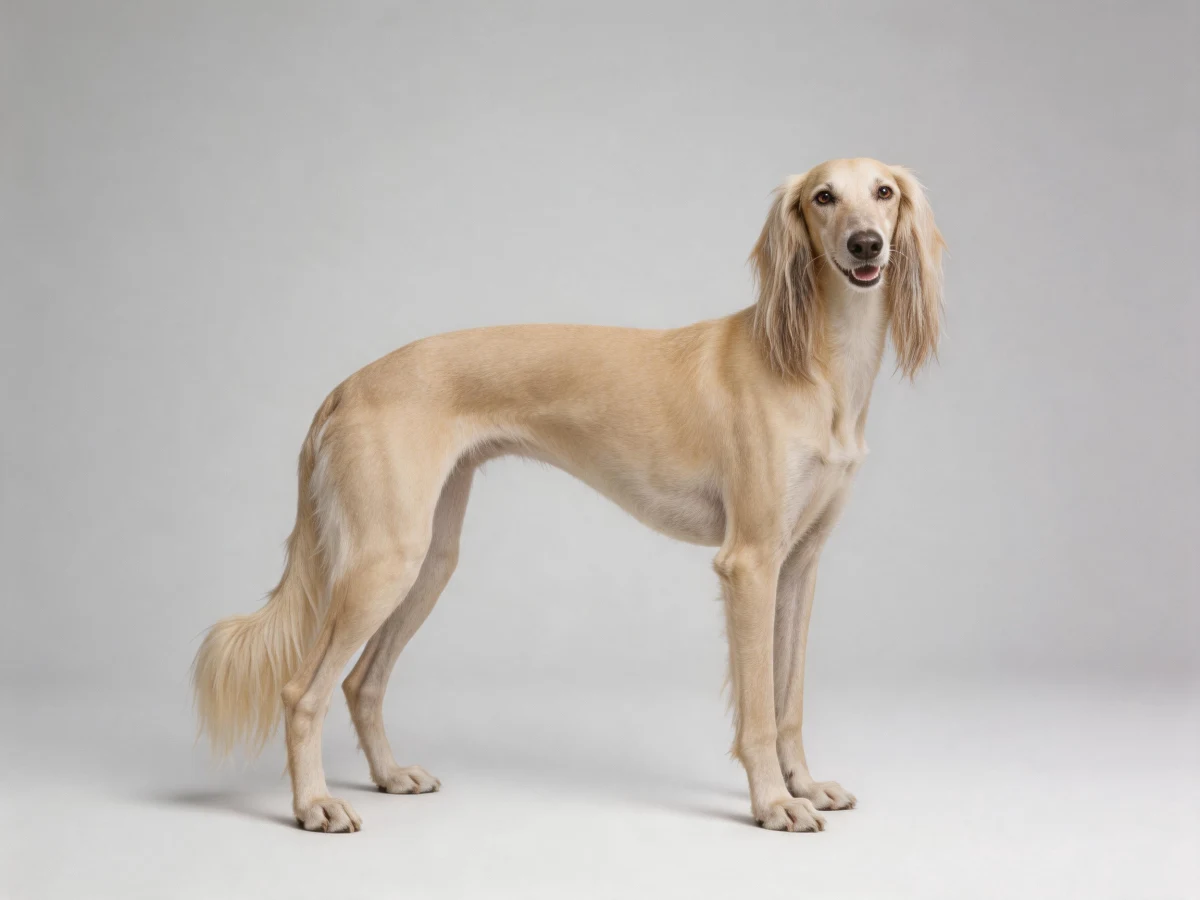
The AKC standard describes the Saluki as the picture of grace and symmetry — a coursing hound built on greyhound-like lines but lighter and more refined, conveying great speed and endurance coupled with strength and activity. The whole impression is of a fleet, elegant desert hound capable of running down quarry over distance: deep through the brisket, drawn up in the loin, and carried with a dignified, faraway expression. Function and antiquity, not exaggeration, define the breed.
Size, coat, and colour
Dogs range from about 23 to 28 inches at the withers, with bitches proportionately smaller, broadly 21 to 26 inches; weight runs roughly 40–60 lb in males and about 31–55 lb in females. The coat is smooth and of a soft, silky texture, short and close on the body. The breed appears in two varieties: the smooth, with no feathering, and the feathered, which carries slight feathering on the ears, the backs of the legs, and sometimes the underside of the tail and the thigh. A wide range of colours is permitted — white, cream, fawn, golden, red, grizzle and tan, black and tan, and tricolour among them — with no colour preferred over another.
Head, movement, and temperament
The head is long and narrow but not coarse, with a moderate stop, dark to hazel eyes that are large and oval with a dignified, gentle expression, and long mobile ears set high and covered (in the feathered variety) with silky hair. Movement is light, smooth, and effortless, showing the reach and drive of a galloping hound that covers ground without apparent effort. Temperament is reserved with strangers but never nervous or aggressive, and deeply attached to its own people — the dignified, sensitive, faintly aloof character that has accompanied the breed since antiquity.
🏆 Recognition
Recognized by the American Kennel Club in 1929 as a Hound breed. FCI standard No. 269 (Section 1 — Long-haired or fringed Sighthounds), recognized in 1956.
Other registries
Breed clubs
❓ Frequently Asked Questions
Are Salukis good family dogs?
For the right family, yes. The Saluki is gentle, clean, quiet indoors, and deeply devoted to its own people, which suits a calm household with older, considerate children better than a chaotic one with toddlers. It is aloof with strangers and sensitive to harsh handling, and its enormous prey drive means cats and small pets need real care. Owners must also be able to provide secure tall fencing and accept that the dog cannot be trusted off-lead in open spaces.
Do Salukis shed a lot?
No — shedding is light and the Saluki is a notably clean, low-odour dog. The smooth variety is essentially wash-and-wear, and the feathered variety only needs the ear, leg, and tail feathering combed a couple of times a week to prevent mats. The Saluki is not, however, considered a hypoallergenic breed.
How much exercise does a Saluki need?
A Saluki is a sprint-then-lounge athlete: it needs a genuine daily chance to run flat-out and stretch its stride, but it settles into long calm rest afterward rather than demanding hours of activity. Crucially, the running must happen in a securely fenced area or through a sport like lure coursing — at 35-plus mph with an overriding chase instinct, the breed is never reliable off-lead in the open.
How long do Salukis live?
Typically 12 to 16 years. The Saluki is one of the more genuinely healthy and long-lived purebred dogs, though responsible breeders still screen for eye, cardiac, and thyroid issues, and owners should be aware that sighthounds are sensitive to anaesthesia.
Are Salukis easy to train?
Not in the conventional sense. The Saluki is intelligent but independent and not eager to please — it was bred to hunt and decide on its own at a distance. It learns through patient, gentle, reward-based training; harsh handling makes a sensitive Saluki shut down. Recall in particular is unreliable around moving prey and should never be trusted near an open boundary.
Are Salukis hypoallergenic?
No. Although the Saluki sheds lightly and is a clean, low-odour breed, it is not considered hypoallergenic. Anyone with a dog allergy should spend extended time around the breed before committing to one.
How much does a Saluki puppy cost?
A well-bred, health-tested Saluki puppy in the United States typically runs about USD 1,500 to 2,500 (2024). Because litters are few and reputable breeders are selective, a waiting list of several months is normal. Be wary of immediate-availability puppies with no health testing and of any premium charged for a "rare" colour, since the standard allows a wide range of colours equally.
📚 Sources & Further Reading
Every load-bearing factual claim on this page is anchored to one of the sources below. iDogNames does not synthesize from secondary aggregators.
- akc breed page Saluki — AKC Breed Profile — American Kennel Club (2024)
- fci standard pdf FCI Standard No. 269 — Saluki — Fédération Cynologique Internationale (2009)
- kc uk standard pdf Saluki — Breed Standard — The Kennel Club (UK)
- breed club official Saluki Club of America — history and breed information — Saluki Club of America
- academic paper Breed-specific reference ranges for standard echocardiographic measurements in salukis — Giraut S, Häggström J, Koskinen LLE, Lohi H, Wiberg M — Journal of Small Animal Practice 60(6):374–378 (PMID 30701551) (2019)
- academic paper Simpson's method of discs in Salukis and Whippets: echocardiographic reference intervals for end-diastolic and end-systolic left ventricular volumes — Seckerdieck M, Holler P, Smets P, Wess G — Journal of Veterinary Cardiology 17(4):271–281 (PMID 26476964) (2015)
- academic paper Anesthesia of the sighthound — Court MH — Clinical Techniques in Small Animal Practice 14(1):38–43 (PMID 10193044) (1999)
- academic paper Comparative pharmacokinetics and anesthetic effects of methohexital, pentobarbital, thiamylal, and thiopental in Greyhound dogs and non-Greyhound, mixed-breed dogs — Sams RA, Muir WW, Detra RL, Robinson EP — American Journal of Veterinary Research 46(8):1677–1683 (PMID 4037494) (1985)
- wikipedia Saluki — Wikipedia — Wikipedia