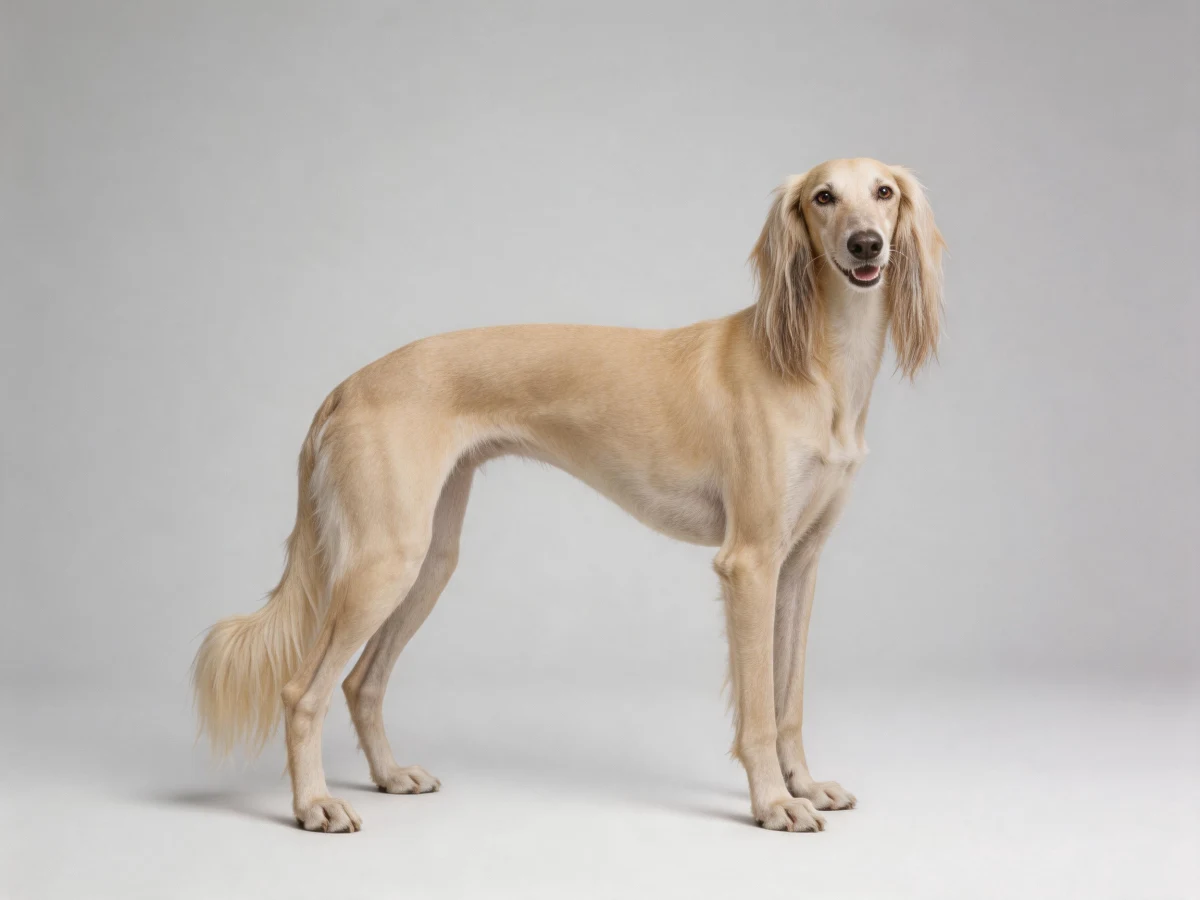
Afghan Hound
✨ Key Takeaways
- The Afghan Hound is an ancient Central-Asian coursing sighthound (the indigenous Tāzī) bred to run down gazelle, hare and even leopard over the mountains and deserts of Afghanistan; its long silky coat, prominent hipbones and large feet were function before they were fashion.
- Its documented Western history begins with one dog: Zardin, brought to England in 1907, who shaped the first British breed standard. The modern breed blends two foundation strains — Mary Amps’ heavy-coated Ghazni mountain dogs from Kabul and the racier Bell-Murray lowland/desert dogs.
- Temperament is independent and aloof rather than biddable: a thinking sighthound with a hardwired chase drive that reaches about 40 mph, so off-lead exercise belongs in securely fenced ground only.
- The breed gave neuropathology a textbook disease — Afghan hereditary necrotizing myelopathy, a fatal recessive spinal-cord degeneration of young dogs (Averill & Bronson 1977; Cummings & de Lahunta 1978) — and is the breed most over-represented in idiopathic chylothorax (Fossum et al. 1986).
- Like all sighthounds, the Afghan is unusually sensitive to anaesthesia; owners must tell any vet the dog is a sighthound before sedation. Eye exams (cataract) and thyroid panels (hypothyroidism) are the key screenable conditions.
- The deepest naming heritage is Afghan and Persian — Dari names (Shah, Soraya, Zardin), Afghan geography (Kabul, Ghazni, Hindu Kush) and the coursing tradition (Tazi, Gazelle) — while the pop-culture well (Snuppy, Picasso’s Kabul, Barbie’s Beauty) names the dog after its fame.
Quick Facts
Common Names & Variants
Modern aliases
Historical names
Modern variants & lines
⚖️ Pros & Cons
Advantages
Trade-offs
Physical Appearance
Recognized colors
Coat
Other
Ears: Drop, feathered. Tail: Ring at tip.
🕰 History
A coursing hound bred for gazelle, mountain and bitter cold
Picture a lean, deep-chested dog standing on a stony Afghan hillside, ribs and hipbones showing through a long silky coat, watching the middle distance for movement — and you have the working animal underneath all the showring glamour. The Afghan Hound is a sighthound: a dog built to spot fast game at a distance, run it down by sheer speed and turning agility, and dispatch it without a gun. For centuries that is exactly what tribesmen across the mountains and deserts of Afghanistan and the wider Hindu Kush used it to do, coursing gazelle and hare across open ground and, by repeated and credible report, helping to hold larger quarry such as leopard at bay until hunters arrived. Almost every feature the show world now prizes as decoration began as function. The long, fine coat was insulation against bitter high-altitude cold. The prominent hipbones and the unusually large feet were the chassis and the tyres of a dog that had to gallop and pivot over rock and scree, not turf. The towering height let it see over scrub. This is one of the rare breeds whose beauty is, almost entirely, the visible record of a hard job in hard country.
How old, and how unknowable
The breed is genuinely ancient as a type, and it is important to be honest about where the evidence stops. The Afghan belongs to the old Central-Asian family of tazi coursing hounds — the same broad current that produced the Saluki to the west — and the dogs were kept and bred by Afghan tribes long before any European wrote anything down. What that does not mean is that the romantic claims attached to the breed are documented. Stories that an Afghan Hound walked off Noah’s Ark, or that the breed is depicted in specific ancient cave paintings, are breed folklore rather than verifiable history; the genetic and archaeological record simply will not bear that weight. The defensible statement is narrower and still impressive: this is a very old landrace coursing hound from a region with a long sighthound tradition, whose detailed pedigree begins only when the dogs reached Britain in the early twentieth century. Before that, the history is real but undocumented.
Zardin, 1907, and the first written standard
The breed’s paper trail opens with a single, named dog. In 1907 a dog called Zardin was brought to England from India by Captain John Barff, and Zardin caused a sensation — he was exhibited, admired, and used as the physical reference point from which the first British written standard for the breed was drawn up. For a breed whose deep history is a fog of tradition, this is the firm anchor: a specific dog, a specific year, a specific person, and a standard built around what that dog looked like. Everything the modern showring rewards traces back, in part, to the impression Zardin made on Edwardian Britain.
Two strains: Ghazni mountain and Bell-Murray desert
The modern breed was built in Britain from two distinct foundation strains brought out of different parts of the region, and the tension between them shaped the dog. The first was the Bell-Murray strain, founded on lighter, racier lowland and desert dogs brought from Baluchistan around 1920 by Major and Mrs Bell-Murray — the "steppe" or desert type, with a sparser coat suited to heat. The second, and ultimately the more influential on coat, was the Ghazni strain: Mary Amps, the wife of an army officer, ran a kennel in Kabul and shipped dogs to England in the mid-1920s, including the famous sire Sirdar of Ghazni. Her dogs were the heavier-coated mountain type. The modern Afghan Hound is essentially the blend of these two strains — the desert dog’s lines crossed with the mountain dog’s coat — and the breed’s history in the West is largely the story of how British and then American breeders combined and then exaggerated them.
Recognition, the showring, and the road to glamour
Both The Kennel Club in Britain and the American Kennel Club recognised the Afghan Hound in 1926, and from there the breed travelled a road that few working sighthounds have. The same coat that had been insulation became, in the show and fashion worlds, an object of pure spectacle. By the mid-twentieth century the Afghan was a high-fashion dog, photographed beside models, bred for ever more flowing and abundant coat, and prized for an aloof, runway elegance that is almost a parody of its hard origins. The breed’s glamour is real and it is also a long way from the stony hillside. The honest reading is that two breeds now share one name: the functional coursing hound of Afghan tribal tradition, and the high-maintenance show and companion animal that British and American fanciers refined out of it across the twentieth century.
From Picasso to the first cloned dog
Few breeds have left so deep a mark on popular culture for a dog so uncommon as a pet. Pablo Picasso kept an Afghan Hound named Kabul, and the dog’s head is generally taken to be the model for the artist’s 1967 sculpture in Chicago. Mattel gave Barbie an Afghan Hound, "Beauty," first sold around 1979, fixing the breed in the minds of a generation of children as the height of canine elegance. And in 2005 a team at Seoul National University produced Snuppy — the first dog ever cloned — and Snuppy was an Afghan Hound, chosen in part because the breed’s distinctive looks would make the clone unmistakable. A coursing dog from the Afghan mountains thus became, by a strange route, a landmark in the history of reproductive biology. The cultural footprint vastly outruns the registration numbers; the Afghan now sits low on the AKC’s popularity list, admired far more often than it is owned.
Temperament & Personality
The aloof aristocrat — and what that label actually means
The Afghan Hound’s reputation is for aloofness, and the reputation is earned, but it is widely misread. This is not a stupid dog and it is not a cold one. It is an independent coursing hound bred for centuries to make split-second decisions at a flat gallop, far from its handler, with no human telling it what to do — and that genetic job description produces a dog that is dignified, self-contained, and selective about its affection rather than eager to please. The aloofness is reserve, not indifference. With its own people an Afghan can be playful, silly, and deeply attached; with strangers it is often distant and unbothered. Owners who want a dog that hangs on their every word are routinely disappointed. Owners who respect a dog with its own opinions are routinely charmed.
A sighthound brain, not a retriever brain
The single most useful thing to understand about Afghan temperament is that the breed is intelligent in a way that obedience tests do not measure. Sighthounds score poorly on the kind of "do this repeatedly because I asked" tasks that make Border Collies look like geniuses, and the Afghan is sometimes unfairly called dim because of it. The reality is that it was bred to think for itself, not to take direction, and it will weigh whether a command is worth obeying. Recall is the classic battleground: an Afghan that sees something worth chasing is, for a few seconds, functionally deaf, because the part of its brain built for the chase has taken over. This is hardwired, not naughtiness, and it has a hard practical consequence covered below.
The chase instinct and the off-lead problem
An Afghan Hound can reach roughly 40 miles per hour and is built to lock onto fast-moving objects and run them down. That prey drive does not switch off because a dog lives in a suburb. A squirrel, a cat, a jogger, a small fast dog — any of these can trigger a flat-out pursuit that no recall will interrupt once it has begun. The settled, near-universal advice among experienced owners is blunt: an Afghan should be exercised off-lead only inside securely fenced ground or a sighthound-safe enclosure. In open or unfenced country it stays on a long line. This is not timidity; it is the realistic management of a 40-mph predator with selective hearing, and treating it casually is how Afghans get lost or killed on roads.
Sensitive, dignified, and easily bruised
Beneath the cool exterior the breed is sensitive and can be genuinely thin-skinned about handling. Harsh corrections, shouting, or rough discipline do not produce a corrected Afghan; they produce a withdrawn, anxious, or sulking one that trusts the handler less. The dog responds to patience, humour, calm consistency and reward, and it has a long memory for unfair treatment. It can also be sensitive to its environment, startling at sudden change and preferring routine. The clownish, comic streak many owners describe — the sudden zoomies, the goofy play — coexists with the dignity and tends to come out most where the dog feels safe.
Living with the breed honestly
An Afghan Hound suits an owner who wants an elegant, quiet, undemanding housemate that will also need a daily hard gallop in a safe space, hours of grooming a week, and a tolerance for being ignored when the dog feels like it. It is generally good with respectful older children and with other sighthounds, more variable with small fast pets the prey drive may target, and a poor fit for anyone whose idea of a dog is a biddable, ever-attentive companion. The breed is moderate indoors — a famous "couch potato" between exercise sessions — but the exercise is non-negotiable, and so is the coat. Matched to the right person, the Afghan returns reserve with a fierce, particular loyalty that feels earned precisely because it is not given freely.
🏡 Living With a Afghan Hound
An aloof housemate, not a shadow
Living with an Afghan Hound means accepting a dog that loves you on its own terms. The breed is famously aloof, dignified, and catlike — devoted to its family but not fawning, and often reserved or standoffish with strangers and visiting dogs. An Afghan will choose a sunny spot across the room as readily as your lap, and it does not pester for attention the way a retriever does. That independence is not coldness; it is the temperament of an ancient hunting hound that worked at a distance from its handler over the Afghan mountains and deserts. Owners who want a velcro dog will be disappointed; those who enjoy a sensitive, comical, slightly inscrutable companion that comes to you because it decides to are the right home for the breed.
Sprint-then-lounge energy and the off-lead rule that is not negotiable
The Afghan runs on a sighthound's energy budget: explosive bursts of speed followed by long hours of elegant lounging. A bored, under-exercised Afghan becomes restless and can be destructive, so the breed needs a real chance to gallop most days — but only inside a securely fenced area, never loose in the open. This is the single most important safety fact about the breed: an Afghan Hound built to course gazelle and hare across rough terrain will spot movement, give chase at speed, and be out of sight and out of earshot before a recall registers. No amount of training makes a sighthound reliable off-lead in an unfenced space. A long, tall, solid fence and a leash in open ground are husbandry requirements, not suggestions, and the calm indoor dog you get in return is one of the breed's great pleasures.
Children, other pets, climate, and the coat reality
An Afghan can do well with respectful older children and with dogs it has grown up alongside, but its sensitive, dignified nature suits a calmer household better than a rowdy one — rough handling or constant chaos wears on the breed. The strong prey drive means small fast pets, including cats it was not raised with, are a genuine risk. The long silky coat was bred to insulate against cold highland nights, so Afghans handle cool weather well but feel heat, and the thin skin and low body fat mean a soft, well-padded bed is a real need rather than a luxury. On shedding the breed surprises people: an Afghan in full coat sheds relatively little hair around the house, but that low shedding is paid for entirely in brushing time, covered in the grooming section.
🎓 Training & Exercise
Independent, not unintelligent — and why the "untrainable" label is wrong
The Afghan Hound has a reputation for ranking near the bottom of obedience-trainability lists, and that reputation badly misreads the dog. An Afghan is not slow; it is independent. This is a breed that hunted by sight, made its own decisions at a flat gallop far from any handler, and was selected for exactly that self-reliance — not for checking back for instructions. Ask an Afghan to do a repetitive obedience drill for its own sake and it will give you a long, unimpressed stare. The work of training an Afghan is patient, gentle negotiation: make the behaviour worth its while, keep sessions short and interesting, and accept that "because I said so" carries no weight with a dog bred to think for itself.
What motivates the breed and what backfires
Reward-based methods are not just preferable for an Afghan — they are the only thing that works. The breed is sensitive and proud, and harsh corrections, heavy-handed tools, or an angry tone produce a shut-down, avoidant dog that simply disengages rather than a more obedient one. High-value food, genuine praise, and the chance to move and run all motivate; drilling and force do not. Keep training varied and end on a win, because an Afghan that grows bored will quietly opt out. Early, positive socialisation matters a great deal for this naturally reserved breed: structured exposure to people, places, and sounds in puppyhood is what produces a confident adult rather than a shy or skittish one.
The one command that actually matters
Given the breed's enormous prey drive and breakaway speed, recall is the command an Afghan owner works on for life — while never trusting it completely off-lead in the open. Train it on a long line with rewards good enough to compete with a moving rabbit, and treat a reliable response as a safety margin rather than a guarantee. "Leave it" and a calm leash manner are the next priorities, since a sighthound that lunges at passing wildlife is both a danger to itself and exhausting to walk. House manners and basic cues come along fine with patience; the realistic goal with an Afghan is a polite, manageable companion, not a competitive obedience star, and an owner who measures success against a Border Collie will only frustrate the dog and themselves.
✂️ Grooming & Coat Care
The signature coat is the breed's biggest commitment
Everything about owning an Afghan Hound comes back to the coat. The long, fine, silky show coat is genuinely beautiful and genuinely high-maintenance — it is the single largest demand the breed makes on an owner's time. Fine silky hair of that length mats fast, and a neglected Afghan coat tangles into tight pelts within days, not weeks. Keeping it right means line-brushing — working in sections down to the skin so no layer is missed — for the better part of several hours across the week, not a quick once-over. The hair must be clean to brush without breaking, so frequent thorough bathing is part of the routine: many owners bathe weekly or fortnightly, condition, and brush the coat through as it dries. This is not a wash-and-go dog, and underestimating the coat is the most common reason Afghans end up in rescue.
The saddle, matting hotspots, and the clip option
One feature confuses new owners: the short, close hair along the back, the "saddle," is normal mature Afghan coat, not a bald patch or a grooming failure — the long flowing furnishings are everywhere else. Mats form fastest at the friction points: behind and beneath the ears, in the armpits, on the trousers and the backs of the thighs, and anywhere a collar or harness rubs. Those spots need daily attention, because a mat left to tighten pulls on thin skin and becomes a sore. Pet owners who cannot commit to the full coat may keep their Afghan in a shorter clip, which is a legitimate and humane choice for a companion dog — but it sacrifices the breed's defining silhouette, and the coat is the whole visual point of an Afghan, so it is a trade-off to make with eyes open.
Ears, skin, nails, and teeth
The long pendant ears and the hair around them trap moisture and need regular checking and gentle cleaning, with careful drying after every bath. The breed's thin skin and low body fat make it sensitive to nicks, pressure sores, and rough surfaces, so brush gently and provide soft bedding. Nails grow quickly on a fast-moving dog and need trimming every two to three weeks — nails that click on the floor are already too long and change how the dog stands and runs. Brushing the teeth several times a week from puppyhood is the highest-value long-term habit any owner can build. Check the long feathering on the feet and legs for grass seeds and grit after country walks, since debris works into the fine hair easily.
🍖 Diet & Nutrition
Lean by design — feed to keep it that way
The Afghan Hound is built like the sighthound it is: a deep but narrow chest, a tucked-up waist, long fine bone, and naturally low body fat. A correctly conditioned Afghan looks lean, with the last ribs faintly visible and a pronounced waist — a build that alarms owners used to rounder breeds but is right for this one. Feed measured meals matched to the dog's activity and learn to body-condition-score by feel, because the long coat hides the outline almost completely and you cannot judge weight by eye on an Afghan in full coat. Quality counts for a breed carrying a heavy coat: an adult-maintenance diet with enough protein and good fats supports both condition and the coat that takes up so much of the owner's effort.
Puppy growth on a large-breed frame
Afghans are a large breed — adult males stand 27 to 29 inches and females 25 to 27 inches — and puppies should be raised to grow steadily rather than as fast as possible. Controlled, even growth on an appropriate diet protects developing joints; a roly-poly large-breed puppy is not the goal. Most Afghans move from several puppy meals to twice-daily adult feeding once growth slows, with portions set against ideal adult weight (broadly 44 to 60 lb depending on sex and frame) and adjusted by body condition over time. Any change of food should be made gradually across a week to avoid digestive upset, and fresh water should always be available, especially given how much the coat demands of bathing routines.
Mealtime routine and the anaesthesia note for your vet
Splitting the daily ration into two meals suits the breed and avoids one large heavy feed. Feed in a clean, quiet spot where a dignified, sometimes finicky dog can eat without being crowded — some Afghans are picky and do better with a calm routine than with constant menu changes. One sighthound fact belongs in the diet and veterinary conversation rather than the bowl: the breed's lean build and low body fat affect how it handles anaesthesia, and sighthounds are known to be sensitive to it, so make sure any veterinarian treating your Afghan knows it is a sighthound before sedation or surgery. That is a husbandry detail to flag, not a treatment you manage at home.
🐶 Buying & Adopting a Afghan Hound
Start with the parent club, not a classified ad
The Afghan Hound Club of America (AHCA) is the AKC parent club and the right starting point. It maintains breeder-referral resources, a code of ethics for member breeders, and connections to Afghan rescue. A breeder worth buying from will register litters with the AKC, health-test both parents, offer a written contract, and talk frankly about the breed's real demands — the coat above all, the off-lead limits, and the temperament — rather than selling the glamorous show silhouette and skipping the work that maintains it. A breeder who glosses over how much grooming the coat takes is not preparing you for the dog you are actually buying.
The health screening to ask a breeder for
The Afghan Hound's CHIC health-screening profile covers four areas, and a responsible breeder can show results on both parents for all of them: an eye examination by a boarded veterinary ophthalmologist (OFA/ACVO), screening for juvenile and hereditary cataract among other eye conditions; an OFA thyroid evaluation, because autoimmune hypothyroidism is recognised in the breed; an OFA hip evaluation; and an OFA cardiac evaluation. Buyers should also know that chylothorax — a chest-fluid condition — is a concern noted in the breed, and that the lean sighthound build carries the anaesthesia sensitivity mentioned earlier; both are fair topics to raise with a breeder. Naming these conditions is consumer fact-finding, not a diagnosis or a prediction for any individual dog. The breeder who hands over OFA paperwork and discusses the breed's record openly is the one to trust; "our lines are just healthy, no testing needed" is the answer to walk away from.
Rescue and the truth about why Afghans get surrendered
Afghan rescue exists precisely because the breed is so often acquired for its looks and relinquished when the coat and the temperament prove to be more than expected. The AHCA can point toward breed-rescue contacts, and adopting an adult Afghan with a known personality is an excellent, ethical route for the right home — an adult's character is already an open book, and many are surrendered through no fault of their own. Anyone adopting should go in clear-eyed about the same grooming commitment a puppy buyer faces.
Price, waiting lists, and the red flags
A well-bred Afghan Hound puppy in the United States runs roughly USD 1,000–2,500 (2024 figures), depending on region, lineage, and parent titles, and good breeders often keep waiting lists. The patterns to walk away from are familiar: puppies priced well below that range with immediate availability, no health-testing documentation, and no parent-club connection. Be especially wary of anyone marketing "rare" colours at a premium, since the Afghan standard already allows a wide range of colours and no shade is a separate or superior type. A fair price from a health-testing, parent-club breeder — even after a wait — is far cheaper over a dog's life than a poorly bred one, and on this breed the grooming reality matters more than the purchase price anyway.
📜 Breed Name Etymology — iDogNames original research
A dog named for a country, in the country’s own newer name
The breed name is, on its surface, the simplest kind there is: Afghan Hound means "the hound of Afghanistan," a straightforward geographic label fixed in English when the dogs reached Britain and were registered there in the 1920s. Afghan is the demonym for the people and the country, and hound is the old English word for a hunting dog, narrowed over time to mean specifically the scent- and sight-hunting breeds. So the modern name is a Western, English-language coinage describing where the dog came from — which is exactly why it tells you nothing about what the people who actually bred it called it.
Tāzī — the name the breed wore at home
In Afghanistan and across Central Asia the coursing sighthounds were and are known by versions of the word tāzī (also written tazi). The word is widely linked to the sense of "swift" or "runner" and historically also carried the meaning "Arab" or "of the Arabs" in Persian, reflecting an old association between these fast hounds and the lands to the west. The same root names a whole family of related Central-Asian and Middle-Eastern sighthounds, the Saluki among them. This is the breed’s true indigenous name, and it describes the dog by what it does — run — rather than by where a foreign registry decided it was from. An owner who wants an authentic, origin-true name for the breed has it ready-made in Tāzī.
The pile of colonial-era aliases
Before the English-speaking world settled on "Afghan Hound," the breed collected a remarkable heap of names, each revealing how little outsiders understood its origin. It was called the Persian Greyhound and the Eastern Greyhound — sighthound-shaped, therefore "a kind of greyhound from somewhere east." It was the Barukhzy Hound, after the Barakzai, the ruling Afghan dynasty, in early British accounts. It was the Kabul Hound after the city, and the Baluchi or Baluchistan Hound after the region the desert strain came from. These names are a fossil record of European confusion: the breed was filed under the nearest familiar category ("greyhound") and the nearest known place-name, until the dogs themselves, and the country, gave the registries a single agreed label in 1926.
What "hound" actually carries
The second half of the name deserves its own note, because it is doing real classificatory work. Hound descends from Old English hund and Proto-Germanic hundaz, cognate with German Hund and Dutch hond, and originally meant simply "dog." English later narrowed it: a "hound" became specifically a hunting dog, and the kennel clubs narrowed it further into a formal group. Within that Hound group the Afghan is a sighthound (or gazehound) — a dog that hunts by sight and speed — as opposed to the scent hounds that hunt by nose. So "Afghan Hound" is precise in a way the casual ear misses: it names a sight-hunting dog from Afghanistan, and the FCI files it exactly there, in Group 10, the long-haired and fringed sighthounds.
Pronunciation
In English the name is /ˈæfɡæn haʊnd/ — "AF-gan HOWND," stress on the first syllable of "Afghan," the gh sounded as a hard g. The indigenous tāzī is roughly "TAH-zee." Owners who lean on the geographic name often shorten it affectionately to simply "the Afghan," which is how most of the dog world refers to the breed in conversation.
Name forms at a glance
| Name | Role | Origin | Literal meaning | First recorded |
|---|---|---|---|---|
| Afghan Hound | primary | English | the hunting hound of Afghanistan | 1920 |
| Tāzī | origin country native | Persian / Dari | the swift one / the runner | 1800 |
| Persian Greyhound | historical | English | the greyhound of Persia / the East | 1880 |
| Barukhzy Hound | historical | English (from Pashto/Dari) | the hound of the Barakzai | 1880 |
| Ghazni | alias | English (from Afghan place-name) | the Ghazni-strain Afghan | 1925 |
🏛 Naming Traditions — iDogNames original research
Four honest naming wells for an Afghan Hound
Because the Afghan Hound is genuinely a dog of a specific place and a specific culture, its best names come from real wells rather than generic "exotic dog name" lists. There are four that fit the breed honestly: Afghan and broader Persian/Dari given names and vocabulary, the geography and culture of Afghanistan itself, the breed’s own documented history (Zardin, Ghazni, the famous foundation dogs), and the wider Central-Asian sighthound and coursing tradition the dog belongs to. A fifth, lighter well — the breed’s pop-culture fame, from Picasso’s Kabul to Barbie’s Beauty to the cloned Snuppy — is real and usable, but it names the dog after its myth rather than its origin. The deepest names lean on the first four.
Afghan, Persian and Dari names and words
The truest layer is the language of the breed’s homeland. Dari (Afghan Persian) and Pashto give beautiful, meaning-rich options that sit naturally on the dog. For a regal male: Shah ("king"), Sultan, Sher ("lion"), Zarif ("elegant, refined"), or Zardin itself, the 1907 founder, whose name plausibly relates to zar, "gold," perfect for a golden coat. For a female: Laleh ("tulip," the flower of the Persianate world), Soraya ("the Pleiades"), Mahtab ("moonlight"), Yasmin ("jasmine"), Parizad ("fairy-born"), or Naaz ("grace, coquetry"). Colour and quality words travel well onto a sighthound: Zar ("gold"), Simin ("silvery"), Tundar ("thunder"), Saba ("the gentle east wind"). Each of these names the dog in the actual idiom of the country it came from.
The geography and culture of Afghanistan
The second well is the country’s map and heritage. Place-names make grounded, evocative calls: Kabul (the capital, and Picasso’s own Afghan’s name), Ghazni (the city that named the mountain strain), Herat, Kandahar, Balkh (the ancient city), Bamyan, and Hindu Kush or simply Kush for the mountain range the breed coursed across. The great rivers and features give Oxus (the classical name of the Amu Darya), Helmand, and Panjshir. Cultural touchstones add depth: Rumi (the poet born in Balkh), Khorasan (the historical region), Lapis (after the lapis lazuli mined in Afghanistan for millennia), and Silk (for the Silk Road that crossed the country). These root the dog in its real homeland rather than a vague "Orient."
The breed’s own founders and history
The third well is unusually rich for this breed, because the foundation history has named characters. Zardin, the 1907 import that shaped the first standard, is the obvious heritage name. Sirdar honours Sirdar of Ghazni, the famous Mary Amps import; Ghazni names her whole mountain strain; Barff remembers Captain John Barff, who brought Zardin to England; and Amps or Sirdar nod to the Kabul kennel that built the modern coat. Barakzai (or Barukhzy) recalls the dynasty the breed was once named for. For owners who know the breed’s story, these names carry real documentary weight — they name the dog after the specific people and dogs who created it in the West.
The Central-Asian coursing and sighthound tradition
The fourth well places the dog in its working family. Tazi (or Tāzī), the breed’s own indigenous name, is the deepest pick of all. The coursing life gives Gazelle and Chinkara (the Indian gazelle) for the quarry, Falcon and Saqr (Arabic for falcon) for the hunting partners of the Central-Asian nobility, and Khan, Amir and Begum for the rank of the people who kept these dogs. Speed and the chase suggest Tundar ("thunder"), Tofan ("storm"), Saba ("east wind") and Tir ("arrow"). These names describe the dog by what it was bred to be — a swift, noble hunting hound of the steppe and the mountains.
The famous-Afghans well — use knowingly
The pop-culture layer is genuinely fun and entirely defensible, as long as the owner knows it names the dog after its fame rather than its roots. Kabul works on both counts — it is a real Afghan city and the name of Picasso’s own Afghan Hound, the model for his 1967 sculpture. Beauty honours Barbie’s Afghan Hound, the toy that made the breed every 1980s child’s idea of elegance. Snuppy commemorates the first cloned dog, an Afghan produced at Seoul National University in 2005 — a quietly extraordinary name for a breed that bridged the ancient hunt and modern biotechnology. Picasso itself suits a dog whose looks are a work of art. These are knowing, affectionate choices; the heritage names above run deeper.
🐾 Themed Names for Your Afghan Hound — iDogNames original research
Dari and Persian names — male
Meaning-rich male names from the breed’s own Dari, Persian and Pashto idiom — the truest heritage layer.
- Shah — "king"; regal and short, fitting the breed’s aloof dignity
- Sher — "lion"; a classic Persianate name of courage
- Zardin — the 1907 founder dog; likely from zar, "gold"
- Zarif — "elegant, refined"; almost a description of the dog
- Sultan — a ruler’s title; carries weight and history
- Amir — "prince, commander"; the rank of the breed’s old keepers
- Tundar — "thunder"; suits a 40-mph coursing hound
- Rumi — the poet born in Balkh; soulful and Afghan
- Zar — "gold"; perfect for a golden or fawn coat
- Tir — "arrow"; fast and clean off the tongue
Dari and Persian names — female
Graceful female names drawn from the flowers, sky and poetry of the Persianate world.
- Soraya — "the Pleiades"; a starry, elegant name
- Laleh — "tulip"; the signature flower of the region
- Mahtab — "moonlight"; luminous and soft
- Yasmin — "jasmine"; fragrant and timeless
- Parizad — "fairy-born"; for an otherworldly-looking dog
- Naaz — "grace, coquetry"; captures the breed’s diva streak
- Saba — "the gentle east wind"; airy and quick
- Simin — "silvery"; for a blue or grey coat
- Begum — a lady of high rank; dignified and regional
- Gul — "flower" in Dari and Pashto; sweet and simple
Afghanistan — places and heritage
The country’s map and culture, the real homeland the breed coursed across.
- Kabul — the capital, and the name of Picasso’s own Afghan Hound
- Ghazni — the city that named the mountain foundation strain
- Kandahar — the historic southern city; strong and rolling
- Herat — the western city of poets and gardens
- Balkh — one of the oldest cities on earth, Rumi’s birthplace
- Bamyan — the valley of the great cliffs; gentle-sounding
- Kush — for the Hindu Kush, the range the breed ran
- Oxus — the classical name of the Amu Darya river
- Panjshir — the dramatic valley north of Kabul
- Lapis — after the lapis lazuli mined in Afghanistan for millennia
The coursing and sighthound tradition
Names from the breed’s working family — the quarry, the hunt and the swift hound itself.
- Tazi — the breed’s own indigenous name; the deepest pick of all
- Gazelle — the classic quarry of the coursing Afghan
- Chinkara — the Indian gazelle the hounds chased
- Falcon — the hunting partner of Central-Asian nobility
- Saqr — Arabic for falcon; sharp and exotic
- Khan — the rank of the people who kept these dogs
- Tofan — "storm"; for a fast, dramatic dog
- Saba — "east wind"; speed in a single breath
- Sirdar — after Sirdar of Ghazni, a key foundation sire
- Barakzai — the dynasty the breed was once named for
Coat, colour and elegance
Names that play on the breed’s flowing silky coat and runway glamour.
- Silk — for the fine silky coat and the Silk Road alike
- Saffron — the golden spice; perfect for a fawn dog
- Brindle — the breed’s striking striped pattern
- Domino — the banded sighthound coat pattern
- Cashmere — soft, luxurious, regionally apt
- Velvet — for the smooth saddle and silky feathering
- Topaz — a golden gem for a golden coat
- Pearl — for a cream or white Afghan
- Sable — a rich coat-colour name
- Ember — for a red or fawn dog with a glowing coat
Famous Afghans — the pop-culture well
Names from the breed’s outsized cultural footprint; charming, if more myth than origin.
- Snuppy — the first cloned dog, an Afghan made in Seoul in 2005
- Picasso — the artist who kept an Afghan named Kabul
- Beauty — Barbie’s Afghan Hound, sold from around 1979
- Pablo — a nod to Picasso for an artistic-looking dog
- Sirdar — doubling as history and fame; the famous Ghazni sire
- Zelda — a stylish, jazz-age name for a glamorous hound
- Garbo — after the aloof, beautiful film star; very on-brand
- Couture — for the breed’s fashion-runway career
- Diva — affectionate truth about Afghan temperament
- Vogue — for a dog that has graced fashion shoots for decades
📋 Breed Standard at a Glance
General appearance
The AKC and Kennel Club standards describe the Afghan Hound as an aristocratic sighthound of striking, almost exotic appearance — a dog of dignity and aloofness carried with a proud, level gaze fixed into the distance. The hallmarks are a long, fine, silky coat, a prominent hipbone, large feet, and a ring or curve at the end of the tail; the overall impression is of elegance and strength combined, a coursing hound capable of great speed and agility over rough country rather than a purely decorative show dog. The expression is often described as "Oriental," looking through and past rather than at the observer.
Size, coat, and colour
Males stand about 27 inches at the withers and females about 25 inches under the AKC standard, with mature dogs broadly in the range of 27 to 29 inches for males and 25 to 27 inches for females and weighing roughly 50 to 60 pounds; the breed is classed as large. The coat is long, fine, and silky over most of the body, with the characteristic short, smooth "saddle" of close hair along the back in the mature dog and long topknot. All colours are permissible under the standard, and no single colour or pattern is favoured as a separate or superior type.
Head, movement, and temperament
The head is long and refined with a long topknot of silky hair, a slight prominence of the nasal bone, dark or dark-rimmed eyes set obliquely, and long ears carried close to the head and feathered with silky hair. Movement is the breed's signature: a smooth, springy, powerful gait with a notable overreach and elasticity that lets the hound cover ground and turn at speed, the head and tail carried high. Temperament is explicitly aloof and dignified yet gay, and the standard treats this independent, distant character — not the fawning friendliness of other groups — as correct for the breed.
🏆 Famous Afghan Hounds
Notable real dogs of the breed profiled on iDogNames.
🏆 Recognition
Recognized by the American Kennel Club in 1926 as a Hound breed. FCI standard No. 228 (Section 1 — Long-haired or fringed Sighthounds), recognized in 1961.
Other registries
Breed clubs
❓ Frequently Asked Questions
Are Afghan Hounds good family dogs?
They can be, in the right home. The Afghan is devoted to its family but aloof and independent rather than fawning, and its sensitive, dignified nature suits a calmer household and respectful older children better than a rowdy one. The strong prey drive also makes small, fast pets a real risk. For owners who want a quiet, elegant, slightly catlike companion rather than a constant shadow, the breed fits well.
Do Afghan Hounds shed a lot?
An Afghan in full coat actually sheds relatively little hair around the house — but that is paid for entirely in grooming time. The long, fine, silky coat mats fast and needs line-brushing for the better part of several hours a week plus frequent bathing. Low shedding does not mean low effort; the coat is the single largest commitment the breed asks of an owner.
How much exercise does an Afghan Hound need?
An Afghan has sprint-then-lounge energy: it needs a real chance to gallop most days, but only inside a securely fenced area. As a coursing sighthound it is not reliable off-lead in the open — it will chase moving prey at speed and outrun any recall — so tall secure fencing and a leash in open ground are safety requirements. Given that outlet, the breed is calm and easy indoors.
How long do Afghan Hounds live?
Typically 12 to 14 years. As with any breed, longevity is helped by keeping the dog lean, maintaining the coat and skin, dental care, and buying from a breeder who health-tests the parents.
Are Afghan Hounds easy to train?
They are independent rather than unintelligent. The Afghan was bred to hunt by sight and make its own decisions far from its handler, so it does not work for obedience the way a herding breed does. Training is a patient, gentle, reward-based negotiation; harsh methods backfire on this sensitive breed. The realistic goal is a polite companion, not a competitive obedience star.
Are Afghan Hounds hypoallergenic?
No breed is truly hypoallergenic. The Afghan sheds relatively little loose hair, which some allergy sufferers tolerate better, but it still produces the dander and saliva proteins that trigger most dog allergies. Anyone with a known allergy should spend extended time around the breed before committing.
How much does an Afghan Hound puppy cost?
A well-bred, health-tested puppy from a parent-club breeder typically runs USD 1,000 to 2,500 (2024 figures), often with a waiting list. Be wary of puppies priced well below that with no health-testing paperwork, and of anyone charging a premium for "rare" colours — the standard already permits a wide range of colours.
📚 Sources & Further Reading
Every load-bearing factual claim on this page is anchored to one of the sources below. iDogNames does not synthesize from secondary aggregators.
- akc breed page Afghan Hound — AKC Breed Profile — American Kennel Club (2024)
- fci standard pdf FCI Standard No. 228 — Afghan Hound — Fédération Cynologique Internationale (2010)
- kc uk standard pdf Afghan Hound — Breed Standard — The Kennel Club (UK)
- breed club official Afghan Hound Club of America — parent club, breed history and health — Afghan Hound Club of America
- academic paper Inherited necrotizing myelopathy of Afghan hounds — Averill DR Jr, Bronson RT, J Neuropathol Exp Neurol 36:734–747 (PMID 886368) (1977)
- academic paper Hereditary myelopathy of Afghan hounds, a myelinolytic disease — Cummings JF, de Lahunta A, Acta Neuropathol 42:173–181 (PMID 676666) (1978)
- academic paper Chylothorax in 34 dogs — Fossum TW, Birchard SJ, Jacobs RM, J Am Vet Med Assoc 188:1315–1318 (PMID 3721989) (1986)
- health registry Afghan Hound — recommended health testing (CHIC) — Orthopedic Foundation for Animals / CHIC (2024)
- wikipedia Afghan Hound — Wikipedia — Wikipedia