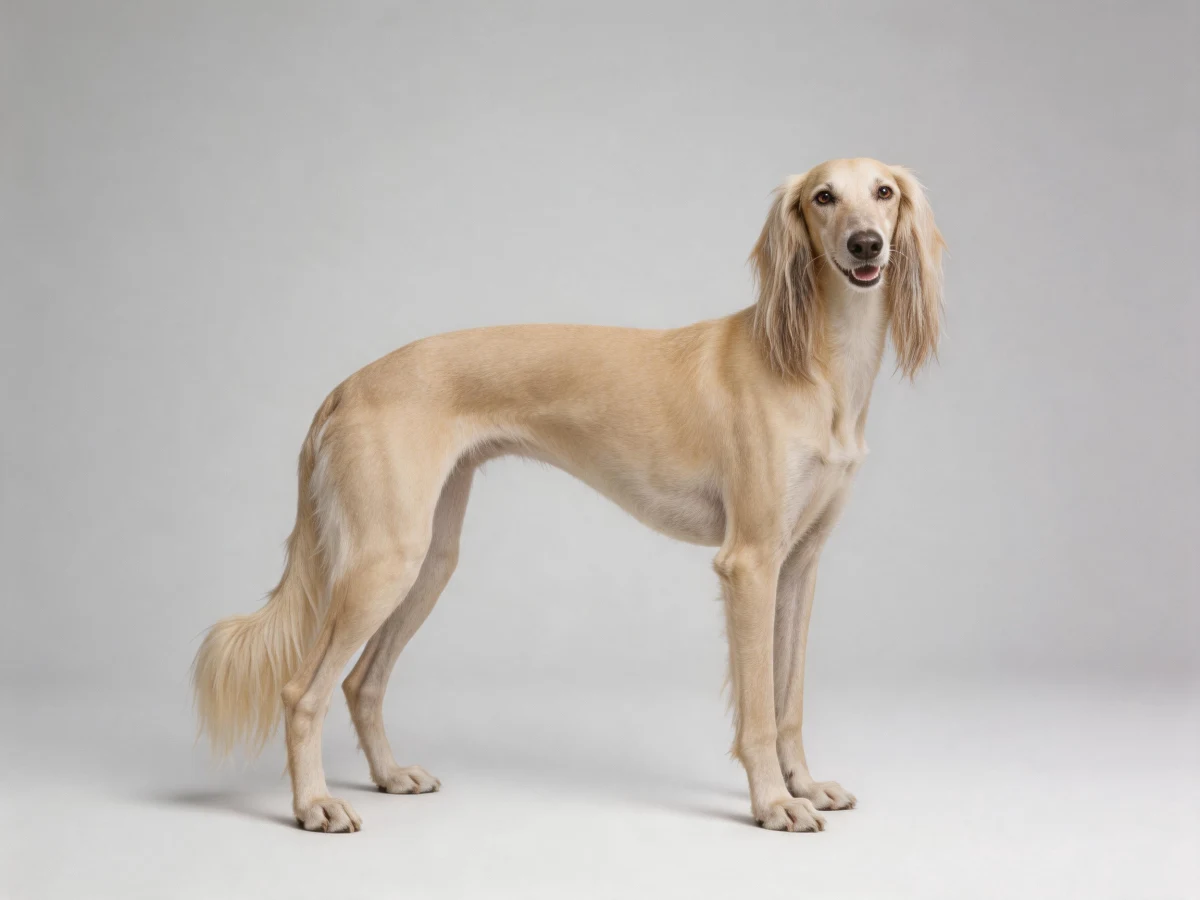
Borzoi
✨ Key Takeaways
- The Borzoi was bred for the Tsarist Russian wolf hunt to do something unusual: not kill the wolf but pin it alive, slipped in matched pairs or threes to seize and hold it until the mounted huntsman could bind its jaws — every elegant line of the breed is a residue of that violent aristocratic purpose.
- Its proper name is Russkaya Psovaya Borzaya — borzaya means "swift," psovaya (from psovina) means "silky-coated" — so the full name reads "Russian silky-coated sighthound." It was called the Russian Wolfhound in English until the American club adopted Borzoi in 1936.
- The breed's peak was the Perchino kennel of Grand Duke Nikolai Nikolaevich, which held around 130 adult Borzoi; the 1917 Revolution scattered and destroyed the aristocratic kennels, and the breed's future passed to dogs already exported west — notably Joseph B. Thomas's 1903 Valley Farm imports from Perchino and Woronzova.
- Anaesthesia is the breed's most urgent practical risk: like other sighthounds the Borzoi clears thiobarbiturates and propofol slowly (Court 1999; Sams et al. 1985) because of low CYP2B11 activity and minimal body fat — thiopental and thiamylal should be avoided.
- A Borzoi's normal blood values read "wrong" on a standard lab report — higher red cells, lower white cells and platelets, and a naturally low T4 that can be misdiagnosed as hypothyroidism (Uhríková et al. 2013). The breed also has its own eye lesion, Borzoi chorioretinopathy (Storey et al. 2005), plus documented cardiac disease (Sykes et al. 2023), osteosarcoma and bloat risk.
- Temperament is cat-like: aloof, fastidious, independent and quiet indoors with a famous off-switch, but with a prey drive that fires faster than any recall — a Borzoi needs a securely fenced place to gallop and cannot be trusted off-lead near small running animals.
Quick Facts
Common Names & Variants
Modern aliases
Historical names
Modern variants & lines
⚖️ Pros & Cons
Advantages
Trade-offs
Physical Appearance
Recognized colors
Coat
Other
Ears: Rose. Tail: Long, sickle.
🕰 History
A dog bred to pin a wolf, not to kill it
The Borzoi was engineered for one of the strangest blood sports the European aristocracy ever devised: the mounted Russian wolf hunt, in which the dog's job was not to kill the wolf but to catch it alive. On the great estates of Imperial Russia a hunting party would ride out across open country with leashed sighthounds held in matched pairs or threes — usually two dogs and a bitch, identical in size and colour — and when a wolf was driven from cover the hounds were slipped together. They were bred to overtake the wolf, seize it by the neck and throat from both sides at once, and hold it pinned and thrashing on the ground until the mounted huntsman arrived to bind its jaws. The wolf was then taken alive. To do that against an animal that could kill a single dog outright, the Borzoi had to be enormous, blindingly fast over a short burst, and brave to the point of recklessness. Everything elegant about the breed today is the residue of that violent and aristocratic purpose.
Russkaya Psovaya Borzaya: the long-coated hound of the Russian estates
The breed's proper name in Russian is the Russkaya Psovaya Borzaya — the Russian long-coated sighthound. The coursing hound is an old type in Russia, described in hunting manuals from at least the 17th century and probably built over generations from native Russian and Tatar coursing dogs crossed with longer-legged sighthounds of the Saluki and Arabian Greyhound kind, and with long-coated northern dogs that gave the silky jacket and the tolerance for a Russian winter. Documentation of the earliest crossings is thin and much of it is reconstructed from later breed-club tradition rather than from anything resembling a stud book. What is firmly attested is the social fact: by the 18th and 19th centuries the psovaya borzaya was the prized possession of the landowning nobility, kept in private kennels by the dozen and hunted with an elaborate ritual that had something medieval about it.
Perchino — the grandest kennel in Russia
The high point of that culture had an address. In the late 1880s the Grand Duke Nikolai Nikolaevich, uncle of the last Tsar, bought the estate of Perchino, roughly 125 miles south of Moscow, and set out to build the most spectacular Borzoi establishment in the world. He dispatched his kennel manager to comb the remote provinces for dogs of the old coursing type, which decades of careless breeding had begun to dilute, and reassembled what he called the "ancient type" on his own terms. At its peak Perchino held something on the order of 130 adult Borzoi plus sixty puppies, around fifteen English Greyhounds, a hundred foxhounds and harriers, eighty-odd horses bred to a single shade of strawberry roan, and the staff of huntsmen to run it all — turned out in the Grand Duke's green livery on padded Cossack saddles. Perchino, and the rival kennel at Woronzova owned by Artem Boldareff, became the twin reservoirs of the best blood in the country.
1917 and the near-extinction of the bloodlines
The Borzoi was bound up so tightly with the aristocracy that the Revolution very nearly finished it. After 1917 the great private kennels were broken up, the dogs scattered, killed or simply starved, and a hound that had been a symbol of the landowning class was an awkward thing to be feeding through a civil war. Perchino did not survive the collapse of the order that built it. The breed's genetic future, it turned out, lay not in Russia at all but in the dogs that had already been exported west — which is why a sport invented for Russian noblemen is now carried on by show and coursing fanciers in Britain and the United States, while the native Russian hunting hound followed its own separate path.
Joseph B. Thomas and the Valley Farm imports
The American line traces to a single determined importer. In 1903 Joseph B. Thomas Jr., of Valley Farm kennels in Simsbury, Connecticut, travelled to Perchino in search of stock to lift the modest quality of the breed in America. He came away with the white-and-brindle dog Bistri of Perchino, then went on to Boldareff's Woronzova kennel and acquired the white bitches Sorva and Atamanka; the following year he returned with his brother and took home more dogs of what he too called the "ancient type." Those Perchino and Woronzova imports became the foundation of American Borzoi breeding, and Thomas later wrote a detailed account of the dogs and the hunt. The breed had reached the United States earlier — the AKC recognised it as the Russian Wolfhound in 1891 — but it was the Valley Farm imports that gave the American gene pool its quality and its direct, documented link back to the imperial kennels.
From Russian Wolfhound to Borzoi
For its first decades in the English-speaking world the breed was simply called the Russian Wolfhound, and the American parent club was founded in 1903 as the Russian Wolfhound Club of America. The name was formally changed to Borzoi in 1936, adopting the Russian word that had always described the dog at home. In Britain the breed had been taken up by the nobility too — the Duke and Duchess of Newcastle were central to founding the Borzoi Club there in 1892, one of the oldest breed clubs affiliated to the Kennel Club. The dog that the West now keeps for its looks and its grace was, in every line of its body, designed for a hunt that no longer exists.
Temperament & Personality
A cat in the body of a wolfhound
People who live with Borzoi reach almost unfailingly for feline comparisons, and the comparison is exact. This is an aloof, fastidious, self-contained dog that is affectionate on its own terms, dislikes fuss, keeps itself scrupulously clean, and would generally rather drape itself elegantly on the most comfortable furniture in the house than perform for anyone. The breed standard's word is dignity, and the dog has it. A Borzoi will bond deeply with its own family and remain politely indifferent to most of the rest of the human race. None of this is coldness; it is the temperament of an animal bred to make its own split-second decisions at full gallop, far from any handler's voice.
The sighthound mind — independent, not stupid
The wolf-coursing hound was slipped and then left to work the problem out for itself at thirty-five miles an hour, and the modern dog still thinks that way. The Borzoi is intelligent in a sideways, self-directed fashion that owners of biddable breeds often misread as dullness or stubbornness. It learns quickly what it wants to learn and ignores the rest with serene confidence. Obedience training is possible but it is a negotiation, not a command structure, and it works only through patience, reward and a sense of humour. Anyone hoping for the eager, anxious-to-please responsiveness of a retriever is buying the wrong dog.
The prey drive does not switch off
The single most important practical fact about the breed is its prey drive. A Borzoi was built to spot movement at distance, lock on, and run a fleeing animal down — and that instinct fires faster than any recall can override it. A squirrel, a cat across the street, a small dog breaking into a run, a jogger: the sighting-and-chase sequence can trigger before the owner has registered what the dog has seen, and a galloping Borzoi covers ground at a speed that makes calling it back academic. The breed is best handled as a dog that cannot be trusted off-lead except inside a securely fenced space, and households with cats or small pets need to be honest about whether a sighthound and a small fast animal can ever be fully safe together. Some Borzoi live peaceably with the family cat they grew up with and would still course a strange one.
The famous off-switch
For all that explosive speed, the Borzoi is one of the great house dogs, because the energy is deployed in brief, intense bursts and then switched off completely. A hard sprint or two, and the dog is content to spend the rest of the day asleep, taking up an improbable amount of sofa with quiet grace. The breed is generally calm, quiet and undemanding indoors — it is not a barker, not a fidget, and not a dog that needs hours of structured activity. What it needs is the chance to gallop flat-out a few times a week in a safe enclosure, and the company of its people the rest of the time. Deny it the run and you get a frustrated, under-exercised athlete; deny it the company and you get a quietly miserable one.
Sensitive, gentle, and not for the heavy-handed
Beneath the aristocratic reserve the Borzoi is a sensitive, soft-natured dog that does not cope with harsh handling or a chaotic household. It is gentle with people it trusts, usually good and patient with considerate children, and not given to aggression, but it can be timid or spooky if poorly socialised, and it shuts down rather than fights back when bullied. The breed suits a calm adult home, an owner who respects its independence rather than fighting it, and a securely fenced place to let it do the one thing it was built across four centuries to do.
🏡 Living With a Borzoi
A sprinter that lives like a houseplant
The day-to-day reality of a Borzoi surprises most newcomers: a dog tall enough to rest its chin on the dinner table spends the overwhelming majority of its life asleep on the softest surface in the house. The breed's energy comes in short, violent deposits, not a steady drip — a couple of all-out gallops a week empty the tank, and the rest of the time the Borzoi is a quiet, clean, undemanding companion that takes up an improbable share of the sofa with serene entitlement. This is why a giant sighthound can genuinely suit an apartment that a far smaller terrier would wreck: floor space matters less than the willingness to provide a safe place to run flat out. What the breed cannot tolerate is being treated as a yard ornament or left alone for long working days; bred to course in matched pairs alongside its people, it is affectionate on its own aloof terms and wants their company even when it is doing nothing at all.
The exercise it needs is not the exercise you think
A Borzoi does not want an hour of plodding lead-walks; it wants to reach close to thirty-five miles an hour for thirty seconds and then nap. The husbandry headline is that this dog needs a few bursts of hard, off-lead running in a securely enclosed space — a fenced field, a hired secure dog paddock, a fenced sport ground — and then very little else beyond a daily lead-walk for sniffing and mental change of scene. Lure coursing and the sport of straight racing are the breed's natural outlets and a joy to watch. A Borzoi denied that gallop becomes a frustrated, restless athlete in a giant body, but the answer is access to a safe sprint, not more miles of leash work, which it tolerates rather than enjoys.
Children, other pets, and the prey-drive line
With its own family the Borzoi is gentle, sensitive and patient, and it is usually good with considerate older children who respect a dog that dislikes rough handling and fuss. The hard limit is the sighthound chase drive, which does not switch off: a Borzoi can live in genuine peace with the cat it was raised beside and still course a strange cat, a small dog or a fleeing rabbit on sight. Toddlers who run and shriek and small fast pets both deserve honest thought before bringing this breed home. On climate, the long silky coat is a winter coat — Borzoi are comfortable in cold weather and need shade, water and dawn-or-dusk timing of any hard running in heat and humidity, which they handle poorly.
🎓 Training & Exercise
Training a Borzoi is a negotiation, not a command
The Borzoi was bred to be slipped and then to solve the problem of a running wolf alone, at a gallop, far from any human voice — and four centuries of selecting for that independence are written into how the modern dog learns. It is intelligent in a sideways, self-directed way that owners of biddable breeds routinely misread as stupidity or stubbornness. A Borzoi learns quickly what it sees the point of and declines the rest with perfect composure. The reputation for being "selectively deaf" is earned: this is not a retriever that lives to please, and anyone hoping for snappy, anxious-to-please obedience has bought the wrong dog. Training works as a patient, reward-based negotiation with a sense of humour, in short sessions, with food and praise the dog actually values.
What backfires, and the one command that matters most
Heavy-handed methods are not merely less effective on a Borzoi — they break it. The breed is soft and sensitive beneath the aristocratic reserve; harsh corrections, raised voices and confrontational tools produce a shut-down, spooky, slower-learning dog rather than a more obedient one. The single command worth the most effort is a solid sit-stay and lead manners, because the one command you can never rely on is recall. A Borzoi's sighting-and-chase sequence fires before the owner has registered what the dog has seen, and a galloping sighthound covers ground at a speed that makes calling it back academic. You manage that fact with hardware, not faith.
Why "off-lead in the open" is never on the table
The governing rule of owning this breed is simple and absolute: a Borzoi is walked on lead and exercised inside secure, tall fencing, and is never trusted loose in open country, however good its day-to-day manners look. Recall trained on a long line is worth building for everyday control, but it is a courtesy, not a safety net — the moment a deer, a cat or a jogger triggers the chase, the dog is gone at thirty-five miles an hour into roads and danger and is physically not listening. Early, gentle socialisation to people, places and noises pays off for life, because a well-socialised Borzoi is calmly confident while a sheltered one can stay timid and spooky. Build the habits patiently in puppyhood and accept the leash-and-fence rule as permanent, not a phase to train out of.
✂️ Grooming & Coat Care
A long silky coat that is easier than it looks
The Borzoi's glory is a long, silky coat — flat, wavy or in large curls, never woolly — with a profuse frill on the neck, heavy feathering on the backs of the legs, the breeches and the tail, and a shorter coat on the head and front of the legs. It reads as a high-maintenance show coat, but for its length it is genuinely manageable: the silky texture sheds dirt and does not hold odour, and the dog grooms itself with near-feline fastidiousness. A thorough brush-out two or three times a week, working a pin brush and a comb all the way down to the skin, keeps the coat clean and lets an owner check for problems. A bath every six to eight weeks or when actually dirty is plenty; over-bathing dulls the coat's natural sheen.
Where the mats form and the seasonal blow
Tangles do not appear on the smooth body coat — they form in the soft, fine feathering, and always in the same places: behind and beneath the ears, in the deep neck frill, in the armpits, on the breeches at the back of the thighs, and along the underside of the tail. Those spots earn a comb a few times a week because a neglected mat tightens to the skin and turns into a sore. On top of routine shedding, a Borzoi blows coat seasonally, the bitches often dramatically after a season, and during that window daily brushing is the difference between a managed coat and drifts of silky hair through the house. Light tidying of the feet and hocks is traditional; the body coat is never clipped down.
Ears, nails, teeth, and the lean-dog extras
The Borzoi's small rose ears fold back against the neck and are far better ventilated than a heavy drop ear, but the long hair around them still wants a weekly check and a gentle wipe of the visible ear, with careful drying after a bath. Nails grow fast on a dog that spends most of its day lying down and need trimming every two to three weeks — nails that click on the floor are already changing how this fine-boned dog stands. Brush the teeth several times a week from puppyhood. Two extras follow directly from the breed's build: with almost no body fat over the long bones and prominent points, a Borzoi needs genuinely soft, well-padded bedding to prevent pressure sores and calluses, and the same thin skin nicks easily, so check the legs and the long tail for cuts after a run.
🍖 Diet & Nutrition
Bloat is the headline, not waistline
For most large breeds the great dietary worry is creeping obesity; for the deep, narrow-chested Borzoi the headline risk is the opposite end of the day — gastric dilatation-volvulus, or bloat, the sudden twisting of a gas-filled stomach that is a true life-or-death emergency. The Borzoi's build puts it squarely in the high-risk group, and feeding routine is the main lever an owner controls. The standard, sensible precautions are to split the daily ration into two meals rather than one large one, to leave a clear gap of an hour or more between hard exercise and eating in both directions, and to slow a dog that bolts its food with a slow-feeder bowl. Every Borzoi owner should know the warning signs cold — a swelling abdomen, unproductive retching, drooling, restlessness and obvious distress — and treat them as an immediate emergency, because hours matter.
Feeding a body with no reserve
A Borzoi is meant to look lean — ribs easily felt, a deep tuck-up, a body with almost no spare fat — and that is the correct condition for the breed, not a sign of underfeeding. The error to avoid is reading a healthy racing-lean sighthound as too thin and padding it with food, which loads the joints and raises bloat risk without doing any good. Feed measured meals against ideal body condition rather than free-feeding, and use part of the daily ration for training rewards so treats do not pile on top. The same lean build that confuses owners matters in the clinic too: with very little body fat to buffer fat-soluble drugs, this is a breed whose anaesthetic dosing is calculated with the sighthound physique in mind — a fact for the vet, not the dinner bowl.
Raising a giant puppy slowly
Borzoi puppies grow into very large dogs and should do it slowly and evenly on a food formulated for large-breed growth, kept lean rather than roly-poly. Pushing maximum growth with excess calories and calcium during the long-bone building stage is linked to developmental orthopaedic problems, so controlled, steady growth is the goal for a breed whose adults can reach the upper end of 75-106 lb in males and 60-90 lb in bitches. Most Borzoi settle onto twice-daily adult feeding once growth slows, with portions set by ideal weight and activity and adjusted by feel over time. Make any food change gradually across a week to avoid the loose stools that a sudden switch brings.
🐶 Buying & Adopting a Borzoi
Start at the Borzoi Club of America
The Borzoi Club of America (BCOA) is the AKC parent club and the right first stop for a puppy or a rescue dog. It maintains a breeder-referral resource and a Code of Ethics for member breeders, and it coordinates Borzoi rescue. A breeder worth buying from will be a BCOA member in good standing, will register litters with the AKC, will health-test both parents, will offer a written contract, and will talk openly about the breed's real quirks — the prey drive, the unreliable recall, the anaesthetic sensitivity — rather than promising a giant dog that behaves like a Labrador. Because litters are not large, averaging around seven puppies, and good breeders are few, expect to wait.
The health screening to ask a breeder for
This is consumer fact-finding, not medical advice: the screening to ask any Borzoi breeder to show on both parents follows the breed's known issues. The CHIC profile for the Borzoi calls for an advanced cardiac evaluation — an echocardiogram read by a veterinary cardiologist, not just a stethoscope listen — because cardiac disease, including dilated cardiomyopathy and ventricular arrhythmia, is the breed's best-documented internal problem; an eye examination by a boarded ophthalmologist (OFA/ACVO), which screens for the breed's own retinal condition, Borzoi chorioretinopathy, among other lesions; and an OFA thyroid panel, read against sighthound reference ranges because a healthy Borzoi's naturally low T4 can otherwise be mistaken for disease. Many breeders add an OFA hip evaluation and, where their lines warrant, the degenerative myelopathy (SOD1) DNA test. A breeder who produces this paperwork and discusses the breed's anaesthetic sensitivity is the one to trust; "our dogs are just healthy, no testing needed" is the answer to walk away from.
Rescue and the realistic route to a dog
Borzoi rescue is organised through the BCOA and a network of regional sighthound and breed-rescue groups, and it periodically takes in adolescents and adults surrendered by owners who underestimated the prey drive, the leash-and-fence reality, or simply hit a life change. For an adopter willing to take an adult with a known temperament rather than wait for a puppy, a reputable breed rescue is an excellent and ethical path — and an adult Borzoi's character is usually already settled and readable.
Price, waiting lists, and the red flags
A well-bred Borzoi puppy in the United States runs roughly USD 1,500–3,000 (2024 data), depending on region, lineage and the parents' show or coursing titles, and a good breeder will keep a waiting list of months rather than handing a puppy over on demand. The patterns to avoid are the usual ones: a giant sighthound advertised cheap with immediate availability, no health-testing documentation, and no parent-club connection. Be wary of sellers pricing puppies on rare colour or extreme size rather than soundness and health-tested parents. A fair price from a health-testing BCOA breeder, even after a wait, is far cheaper over fourteen years of ownership than the cost of a poorly bred dog of this size.
📜 Breed Name Etymology — iDogNames original research
A word that simply means "fast"
The name is a plain description that turned into a proper noun. Borzoi comes from the Russian adjective borzaya (feminine; borzoy masculine), an old word meaning swift, quick or fast — so at its root the breed name says nothing more than "the fast one." The word is genuinely archaic in Russian, surviving in modern usage chiefly as the name of this dog, which gives it the same slightly antique flavour that "sighthound" or "courser" carries in English. In Russian the plural of borzaya is borzye, so the English habit of saying "two borzois" is, strictly, a foreign construction laid over a Russian word — though it is universal in English and there is no point fighting it.
Russkaya Psovaya Borzaya, unpacked
The full formal name, Russkaya Psovaya Borzaya, is worth taking apart because each word does real work. Russkaya is simply "Russian." Borzaya is "swift," as above. The middle word, Psovaya, is the interesting one: it derives from psovina, a word for a long, silky, wavy coat, so psovaya borzaya means "the silky-coated swift hound" — the long-haired courser, as distinct from the smooth-coated sighthounds of the south. The full name therefore reads as "Russian silky-coated sighthound," and every part of it is descriptive: nationality, coat and function. There is a folk etymology that links psovaya to pyos ("dog"), but the coat-word derivation is the one the breed authorities give.
Russian Wolfhound — the job title that became a name
For most of its English-speaking history the dog was not called the Borzoi at all but the Russian Wolfhound, after the quarry it was built to pin. The AKC registered it under that name in 1891, and the American parent club was founded in 1903 as the Russian Wolfhound Club of America. The switch to Borzoi came in 1936, when the club adopted the dog's own Russian word — a quiet act of accuracy, since "wolfhound" describes only one of the things the breed was used for and shares a confusing surface resemblance with the unrelated Irish Wolfhound. The older name still surfaces, and it remains a true description of what the dog once did.
Pronunciation and spelling
In English the usual pronunciation is /ˈbɔːrzɔɪ/ — "BOR-zoy," two syllables, stress on the first. The original Russian is closer to bar-ZOY, with the stress on the second syllable and a softened first vowel ([bɐrˈzoj]), but the anglicised front-stressed form is standard in English-speaking kennels and is not worth correcting. The spelling is stable; the chief variant a buyer will meet is the German Barsoi, which is the same word filtered through German orthography. Whatever the spelling, the meaning underneath never changes: this is, and has always been, simply "the swift one."
Name forms at a glance
| Name | Role | Origin | Literal meaning | First recorded |
|---|---|---|---|---|
| Borzoi | primary | Russian | the swift one; fast | 1650 |
| Russkaya Psovaya Borzaya | origin country native | Russian | Russian silky-coated swift hound | 1888 |
| Russian Wolfhound | historical | English | the Russian hound used on wolves | 1891 |
| Russian Hunting Sighthound | alias | English | the Russian hunting sighthound | 1956 |
| Barsoi | alias | German | the swift one (German orthography) | 1900 |
🏛 Naming Traditions — iDogNames original research
A Russian naming heritage with real depth behind it
Few breeds offer a richer or more specific naming tradition than the Borzoi, because the dog comes attached to a whole vanished aristocratic world — the Russian language, the imperial court, the great hunting estates, and a body of names that real Borzoi actually carried in real kennels. An owner who wants a name with substance has five strong seams to mine: Russian given names, the documented dogs and places of the hunt itself (Perchino, Bistri, the Grand Duke), the Russian words for speed and the hunt, the imperial and Romanov register, and the dog's own colours and physical grace rendered in Russian. The trick, as with any heritage breed, is to reach for the genuinely Russian material rather than a generic "exotic dog name" list — the breed earns it.
Russian given names
Russian personal names are the most natural fit and carry the right weight for so dignified a dog. For males the deep, resonant choices work best: Boris, Dmitri, Mikhail, Nikolai (after the Grand Duke himself), Sasha (the affectionate form of Alexander, and unisex), Pyotr, Yuri and Alexei. For females the language is full of elegant possibilities: Tatiana, Natasha, Anastasia (the most famous Romanov name of all), Sonja, Mila, Katya, Irina and Nadia. The diminutive system is part of the charm — a formal Mikhail becomes Misha at home, Anastasia becomes Nastya — which gives an owner a grand registered name and a soft daily one from the same root.
The hunt and the imperial kennels
This is the seam unique to the Borzoi, and the most evocative. The dogs of Perchino had names, and they make superb heritage choices: Bistri (the white-and-brindle dog Joseph Thomas imported in 1903 — and a near-pun, since the Russian bystry means "fast"), Sorva and Atamanka (the Woronzova bitches that founded the American line), and Perchino itself for the estate that produced them. Tsar and Tsarina, Romanov, Cossack (after the saddles the huntsmen rode), Troika (the matched team of three in which the dogs were slipped), and Volk (Russian for "wolf," the breed's ancient quarry) all carry the breed's own history rather than borrowed romance. A name like Perchino or Bistri tells anyone who knows the breed exactly what the dog is.
Speed, the hunt, and the Russian winter
Because the breed was built for one explosive purpose, the Russian vocabulary of speed and the open country fits it perfectly. Strela means "arrow"; Veter is "wind"; Bystro is "quickly"; Molniya is "lightning." From the landscape and the season the dog ran in: Zima ("winter"), Sneg ("snow"), Mróz / Moroz ("frost"), Vólga (the great river), Tundra and Sibir ("Siberia"). These translate the dog's function and home into single clean syllables an owner can actually call across a field — which, for a breed that lives to gallop, is exactly the point.
Colour and grace, in Russian
The Borzoi's most striking feature is its elegant, silvered, flowing coat, and Russian gives lovely colour and quality words for it. Belka ("squirrel," but also evoking a silvery grey), Seryy ("grey"), Zolotse ("little gold," a term of endearment, ideal for a gold-sable dog), Snezhana ("snowy," for a white bitch), and Zhemchug ("pearl"). For the dog's temperament and bearing: Knyaz ("prince"), Knyaginya ("princess"), Graf ("count") and Dusha ("soul"). Each names the dog after a real Russian quality rather than a generic descriptor, and each suits the breed's air of quiet aristocracy.
Choosing well
The deepest Borzoi names are the ones tied to the dog's real story — Perchino, Bistri, Nikolai, Troika — because they name the dog after the world that made it. A grand two- or three-syllable Russian name with a soft diminutive for daily use mirrors the way these dogs were actually named on the estates, and it suits a hound that is itself formal in public and gentle at home. A name borrowed from the speed it was bred for, or the snow it ran across, is never wrong for this breed.
🐾 Themed Names for Your Borzoi — iDogNames original research
Russian names — male
Strong, resonant Russian male names with the weight a large, dignified hound deserves.
- Boris — an old Slavic name meaning "battle" or "glory"; deep and unmistakably Russian
- Nikolai — after Grand Duke Nikolai Nikolaevich, founder of the Perchino kennel
- Dmitri — a classic Russian name, from the goddess Demeter; carries gravity
- Mikhail — the Russian Michael; softens to the affectionate Misha at home
- Sasha — the diminutive of Alexander; warm and easy to call (unisex)
- Pyotr — the Russian Peter, "rock"; the name of Russia's great tsar
- Yuri — the Russian George; bright and quick on the tongue
- Alexei — "defender"; a Romanov name with imperial weight
- Vladimir — "ruler of the world"; grand for a grand dog
- Igor — an old Norse-Russian name, "warrior"; short and strong
Russian names — female
Elegant Russian female names, several of them imperial, to match the breed's aristocratic air.
- Anastasia — the most famous Romanov name; "resurrection," with the soft Nastya for daily use
- Tatiana — a graceful classical Russian name, immortalised by Pushkin
- Natasha — the warm form of Natalia; the heroine of War and Peace
- Sonja — the Russian Sophia, "wisdom"; gentle and period-true
- Mila — "dear, gracious"; short, modern and easy to call
- Katya — the affectionate form of Ekaterina (Catherine)
- Irina — "peace"; smooth and dignified
- Nadia — from nadezhda, "hope"; soft and bright
- Galina — "calm, serene"; fitting for so composed a dog
- Vera — "faith"; one clean Russian syllable
The hunt and the imperial kennels
Names from the Borzoi's own documented history — the dogs, the estate, and the world of the Russian wolf hunt.
- Perchino — the Grand Duke's estate, the grandest Borzoi kennel ever built
- Bistri — the dog Joseph Thomas imported in 1903; the name puns on bystry, "fast"
- Atamanka — one of the foundation Woronzova bitches of the American line
- Troika — the matched team of three the hounds were slipped in
- Tsar — the imperial title; grand for a male
- Tsarina — the empress; its female counterpart
- Romanov — the imperial dynasty the breed was bound to
- Cossack — after the padded saddles the Perchino huntsmen rode
- Volk — Russian for "wolf," the breed's ancient quarry
- Boldareff — the owner of the rival Woronzova kennel
Speed, wind, and the Russian winter
Russian words for the speed the dog was bred for and the open, frozen country it ran across.
- Strela — "arrow"; for a dog that flies low and straight
- Veter — "wind"; what a coursing Borzoi seems made of
- Molniya — "lightning"; for the explosive first burst of speed
- Bystro — "quickly"; the root of the breed's own name
- Zima — "winter"; the season the breed was built to hunt in
- Sneg — "snow"; perfect for a white dog
- Moroz — "frost"; cold, clean and Russian
- Sibir — "Siberia"; the vast cold east
- Volga — the great Russian river
- Tundra — the open frozen plain
Colour, grace and rank
Russian words for the breed's flowing silver coat, its bearing, and its quiet aristocracy.
- Zolotse — "little gold," a term of endearment; ideal for a gold-sable coat
- Snezhana — "snowy"; lovely for a white bitch
- Zhemchug — "pearl"; for a pale, lustrous coat
- Seryy — "grey"; plain and fitting for a silvered dog
- Knyaz — "prince"; for a male of obvious bearing
- Knyaginya — "princess"; its female match
- Graf — "count"; aristocratic and short
- Dusha — "soul"; a tender Russian endearment
- Belka — "squirrel," but evoking a silvery grey
- Mishka — "little bear"; affectionate and warm
Literature, dance and the Russian arts
For owners who want a name from Russia's cultural rather than its hunting past — fitting for so theatrical a dog.
- Pushkin — Russia's national poet; dignified and instantly Russian
- Tolstoy — the novelist of War and Peace, set among the very class that bred the dog
- Chekhov — the playwright; crisp and literary
- Onegin — Pushkin's aristocratic anti-hero; aloof, like the breed
- Nureyev — the ballet dancer; for a male of extraordinary grace
- Pavlova — the prima ballerina; airy and elegant for a bitch
- Faberge — the imperial jeweller; opulent and Romanov-era
- Rasputin — the notorious court figure; dramatic for a striking dog
- Lara — the heroine of Doctor Zhivago; soft and snowy
- Yuri — Zhivago himself; a name that doubles as a plain Russian given name
📋 Breed Standard at a Glance
General appearance
The AKC and FCI standards describe the Borzoi as a large, elegant coursing hound of aristocratic bearing, built on greyhound lines but clothed in a long silky coat. The whole dog reads as graceful curves and quiet power: a long, lean head, a deep but narrow chest reaching to the elbow, a pronounced tuck-up, and an arched loin that uncoils into a flying gallop. The standard prizes balance, substance without coarseness, and an unmistakable air of dignity and self-possession rather than any exaggerated feature.
Size, coat, and colour
This is one of the tallest breeds. Dogs stand roughly 29.5–33.5 inches at the shoulder and weigh about 75–106 lb; bitches stand around 26.5–30.5 inches and weigh roughly 60–90 lb, and the standard frames them as smaller and more refined than the dogs. The coat is long and silky — flat, wavy or in large curls, never woolly — short and smooth on the head, ears and front of the legs, with a profuse neck frill and long feathering on the hindquarters, tail and chest. Every colour and colour combination is acceptable under the standard, from pure white through gold, red, sable, brindle, grey and black, whole-coloured or particoloured.
Head, movement, and temperament
The head is long, lean and narrow, the skull slightly domed, the muzzle long and tapering with a Roman finish, carrying small fine rose ears folded back along the neck and dark, almond-shaped, soft-expressioned eyes. Movement is the heart of the breed: at the trot it is effortless and far-reaching, and at speed the Borzoi covers ground in the long, low double-suspension gallop of a true sighthound. Temperament in the standard is quiet and dignified — sensitive and reserved with strangers, never nervous or aggressive — a courser bred to think and run for itself.
🏆 Recognition
Recognized by the American Kennel Club in 1891 as a Hound breed. FCI standard No. 193 (Section 1 — Long-haired or fringed Sighthounds), recognized in 1956.
Other registries
Breed clubs
❓ Frequently Asked Questions
Are Borzois good family dogs?
For the right family, yes. With its own people a Borzoi is gentle, calm and affectionate on its own aloof terms, and it is usually good with considerate older children who respect a dog that dislikes rough handling. The serious caveats are its strong prey drive — it may chase a fleeing cat, small dog or running toddler — and its need for a secure place to gallop, so it suits a calm adult home more than a chaotic one with very young children or small pets.
Do Borzois shed a lot?
Yes, but the long silky coat is easier to manage than its length suggests. It sheds steadily year-round and blows heavily once or twice a year, the bitches often dramatically after a season. Brushing two or three times a week keeps it under control, rising to daily during the seasonal blow. The silky texture resists dirt and odour and the body coat is never clipped down.
How much exercise does a Borzoi need?
Less than people expect, but of a specific kind. A Borzoi needs a couple of bursts of hard, off-lead sprinting a week in a securely fenced space — it can reach close to 35 mph — plus a daily lead-walk, and is then content to sleep most of the day. It is never reliable off-lead in the open because its chase instinct overrides recall, so all loose running happens inside secure fencing.
How long do Borzois live?
Typically 9–12 years, which is respectable for a dog of this size. Owners should be aware of the breed-linked health issues — bloat (gastric dilatation-volvulus), cardiac disease, the breed-specific eye condition Borzoi chorioretinopathy, and a sighthound sensitivity to certain anaesthetics — and choose a breeder who screens the parents for them.
Are Borzois easy to train?
No, not in the obedient-retriever sense. The Borzoi is an independent sighthound bred to make its own decisions at a gallop, and it learns slowly through patient, gentle, reward-based methods rather than commands. Harsh handling backfires on this sensitive breed. Recall in particular stays unreliable for life, which is why a Borzoi is managed with a leash and secure fencing rather than trained to be trusted loose.
Are Borzois hypoallergenic?
No. The Borzoi has a long coat that sheds and is not considered hypoallergenic. Anyone with a dog allergy should spend extended time around the breed before committing to one.
How much does a Borzoi puppy cost?
A well-bred, health-tested puppy from a parent-club breeder typically runs about USD 1,500–3,000 (2024 figures), usually with a waiting list of several months because litters are not large and good breeders are few. Be wary of giant sighthounds advertised cheap with immediate availability and no health-testing paperwork on the parents.
📚 Sources & Further Reading
Every load-bearing factual claim on this page is anchored to one of the sources below. iDogNames does not synthesize from secondary aggregators.
- akc breed page Borzoi — AKC Breed Profile and History — American Kennel Club (2024)
- fci standard pdf FCI Standard No. 193 — Borzoi (Russian Hunting Sighthound) — Fédération Cynologique Internationale (2010)
- breed club official Borzoi Club of America — parent club, history and rescue — Borzoi Club of America
- academic paper Anesthesia of the sighthound — Court MH, Clinical Techniques in Small Animal Practice 14:38–43 (PMID 10193044) (1999)
- academic paper Comparative pharmacokinetics and anesthetic effects of methohexital, pentobarbital, thiamylal, and thiopental in Greyhound dogs and non-Greyhound, mixed-breed dogs — Sams RA et al., American Journal of Veterinary Research 46:1677–1683 (PMID 4037494) (1985)
- academic paper A multicenter, retrospective study of cardiac disease in Borzoi dogs — Sykes KT et al., Frontiers in Veterinary Science 10:1102494 (PMID 36777677) (2023)
- academic paper Multifocal chorioretinal lesions in Borzoi dogs — Storey ES et al., Veterinary Ophthalmology 8:337–347 (PMID 16178845) (2005)
- academic paper Haematological and biochemical variations among eight sighthound breeds — Uhríková I et al., Australian Veterinary Journal 91:452–459 (PMID 24571299) (2013)
- wikipedia Borzoi — Wikipedia — Wikipedia