Vizsla
✨ Key Takeaways
- The Vizsla is the Magyar landowning class's yellow pointer: the FCI traces its ancestors to dogs that entered the Carpathian Basin with the nomadic Hungarian tribes, with written and pictorial references appearing in 14th-century Hungarian documents.
- The breed twice came near to vanishing — after the First World War and again at the end of the Second, when a post-war survey found only about a dozen Vizslas of the true type left in Hungary and refugees carried surviving dogs out ahead of the Soviet takeover.
- American recognition was late: the AKC admitted the Vizsla on 25 November 1960 as its 115th breed, after the Vizsla Club of America (1953) had built up a registered population from imports such as Sari, brought via Rome.
- It is a velcro dog. The Vizsla bonds intensely, dislikes being kennelled or left alone, and the FCI standard names "willingness to keep contact with his master while working" as an essential breed quality — separation distress is the predictable failure mode in the wrong home.
- The breed-defining health risks are neurological and immune-mediated: idiopathic epilepsy (Patterson et al., 2003), Vizsla inflammatory polymyopathy (Tauro et al., 2015), and hyperuricosuria via the SLC2A9 mutation (Bannasch et al., 2008) — all with published literature and, for HUU, a direct DNA test.
- Russet gold is the only correct colour. FCI Standard 57 recognises shades of russet gold and dark sandy gold; "silver," "black," and "white Vizsla" are not the breed, and a wirehaired Vizsla is a separate FCI breed, not a coat variety.
Quick Facts
Common Names & Variants
Modern aliases
Historical names
Modern variants & lines
⚖️ Pros & Cons
Advantages
Trade-offs
Physical Appearance
Recognized colors
Coat
Other
Ears: Drop. Tail: Natural (historically docked 1/4).
🕰 History
A dog that rode in with the Magyars
The Vizsla's story starts on horseback, not in a kennel. The breed standard issued by the Fédération Cynologique Internationale — FCI Standard N° 57, the document Hungarian judges score against — opens its history with a single sentence that anchors everything: "The ancestors of the Hungarian Vizsla came into the Carpathian Basin with the nomadic Hungarian tribes." Those tribes, the Magyars, settled the Hungarian Plain in the late ninth century, and the dogs that travelled with them were working partners for a horse-and-falcon culture — fast enough to keep up with mounted hunters, biddable enough to work close. The FCI is careful with its claim: it says ancestors, not the modern breed, and it does not pretend the line is unbroken. Centuries of Turkish and Transylvanian hounds were absorbed along the way.
The earliest hard evidence is pictorial and textual rather than genealogical. The standard records that "written descriptions and graphic illustrations are found in documents of the 14th century already." The reference breed historians point to most often is the Illustrated Vienna Chronicle — the Képes Krónika — commissioned around 1357 under King Louis I of Hungary, which contains a hunting scene with a yellow pointing-type dog. Breed tradition also cites the Carmen Miserabile, Master Roger's 13th-century lament on the 1242 Mongol devastation of Hungary, as referencing the hunting dogs of the period. That second link is club lore more than verified philology, and it should be read that way: the documentary record for the medieval Vizsla is thin, and honest breed histories say so.
The yellow pointer of the landed class
What is solid is the social fact. For centuries the Vizsla was the gun dog of the Hungarian landowning aristocracy and the warlord class — the people with the estates, the game, and the leisure to refine a pointing dog. The golden-rust colour, distinctive enough that Hungarians called the dog the sárga vizsla, the "yellow pointer," became the breed's signature. Vizsla itself is an old Hungarian word for a pointing, searching dog. By the close of the 19th century the breed was competing successfully in organised Hungarian pointing-dog trials, and from the 18th century onward, the standard notes, "his importance as a hunting dog has been increasing steadily."
Twice to the edge of extinction
Being the aristocracy's dog became a liability. The First World War, the collapse of Austria-Hungary, and the land redistributions that followed gutted the estate culture the breed depended on, and Vizsla numbers fell hard. A deliberate reconstruction began in 1920 — the standard dates "the specific modern breeding" to that year — and it worked well enough that the FCI granted the Short-Haired Hungarian Vizsla recognition in 1936. Then the Second World War undid it again, and worse. As the Red Army advanced and Hungary fell behind the Soviet line, the Vizsla's century-old association with the aristocracy turned it into a marked dog. The recovery effort that followed found almost nothing left: by the AKC's account, a post-war search of Hungary and a poll of Hungarian sportsmen "revealed only about a dozen Vizslas of the true type still alive in the country." The modern breed is descended from that handful.
Carried out in suitcases and refugee columns
The breed survived because individual Hungarians refused to leave their dogs behind. As people fled the Soviet occupation, Vizslas went with them — into Austria, into the displaced-persons networks of post-war Europe, and onward. The Vizsla Club of America's own breed history records the route that mattered for the United States: a refugee carried a bitch named Sari to Rome, where Emmett Scanlon, an American working at the U.S. State Department there, became involved with the breed. Sari and two of her offspring reached Kansas City around 1950, and Frank Tallman, a Kansas City dog man, became the first president of the Vizsla Club of America when it was founded in 1953. The smuggling-out is not a romantic flourish bolted onto the breed's marketing; it is the literal reason the population exists.
Late, deliberate American recognition
American development was slow and documented rather than rushed. The Vizsla Club of America built a registered population through the 1950s, and the American Kennel Club admitted the breed on 25 November 1960 as its 115th breed — a date the AKC and Wikipedia both record precisely. In Britain the breed arrived in the 1950s as well; the Hungarian Vizsla Club was established in 1968, recognised by The Kennel Club, and the breed was awarded Challenge Certificate status in 1971. What's striking about the Vizsla's modern history is the inversion: a dog that nearly died because it belonged to a vanished aristocracy now thrives precisely because it makes such an intense, unaristocratic companion.
Temperament & Personality
The standard's word is "contact"
The single most useful sentence anyone has written about Vizsla temperament is in FCI Standard 57, and it is not about hunting drive. The standard lists the breed as "lively, friendly, evenly tempered, to be trained easily," and then adds the line that explains the breed to anyone who has lived with one: "His outstanding willingness to keep contact with his master while working is one of his essential qualities." That is a working-dog description, but it doubles as a personality diagnosis. A Vizsla is built to stay psychologically tethered to its person. In the field that produces a close-working pointer; in the house it produces the dog that follows you to the bathroom.
Velcro, and why the cliché is accurate
"Velcro dog" is the breed's universal nickname among owners, and unlike most breed clichés it is precise rather than affectionate shorthand. The Vizsla seeks physical contact — leaning, lap-claiming despite its size, resting a chin on a knee — and it tracks its person's location in the home continuously. For an owner who wants that, there is no better breed. For an owner who travels, works long hours away from the dog, or wants an independent animal that settles alone, the same trait is the central problem. Separation-related distress is the predictable failure mode, and it is a temperament feature working as designed in the wrong environment, not a training defect.
Soft, and what that demands of a handler
The standard is unusually blunt about handling: the breed "cannot bear rough treatment and must be neither aggressive nor shy." Read that as an instruction. A Vizsla trained with corrections, intimidation, or inconsistency does not toughen up — it shuts down, becomes anxious, and stops offering behaviour. The breed responds to clear, upbeat, reward-based training and to a handler who can be patient with a sensitive, sometimes theatrical dog. Vizslas are also notably vocal: they whine, groan, and "talk," and they are demonstrative about their feelings in a way more stoic breeds are not.
Day to day, honestly
An adult Vizsla in a matched home is affectionate to the point of comedy, biddable, athletic, and emotionally transparent — a dog with very little poker face. The caveats are real and the breed clubs do not hide them. This is a high-energy bird dog that needs genuine aerobic exercise and mental work daily; a Vizsla exercised only on lead walks becomes frantic and destructive. It is poor at being alone and a bad choice for an absentee household. It is sensitive enough that a heavy hand backfires. None of that makes the Vizsla difficult — it makes it specific. The breed gives an enormous amount of companionship and asks, in return, that you actually be there.
🏡 Living With a Vizsla
The "velcro Vizsla" is the whole story
Nothing about life with a Vizsla makes sense until you accept the nickname the breed earned for itself: the velcro Vizsla. This is a dog bred over centuries by Hungarian sportsmen to hunt in close partnership — pointing and retrieving within gun range rather than ranging off alone — and that closeness became hardwired into the temperament. A Vizsla does not want to be near you; it wants to be physically on you. It will follow you from room to room, lean its full weight against your leg, climb into your lap at forty-five pounds, and burrow under the duvet. For the right owner this devotion is the breed's greatest gift. For the wrong household it is a daily problem, because a Vizsla that cannot be with its person does not cope — it unravels.
One of the most separation-anxiety-prone breeds there is
Pair that intense bonding with the breed's other defining trait — very high energy and athletic stamina — and you get a dog that is genuinely among the most separation-anxiety-prone breeds in existence. A Vizsla left alone for long working days, shut in a yard, or kept in a low-activity home is not merely bored; it becomes anxious, destructive, and vocal, chewing through doors and crates and crying or howling until someone returns. This breed is a poor fit for a nine-hour empty house and an even poorer fit for anyone who wants a low-maintenance, independent dog. It thrives where someone is home much of the day, where it can be brought along rather than left behind, and where daycare or a walker fills any gap. A Vizsla needs companionship, daily hard exercise, and a job — remove any one of those and the dog suffers.
Exercise floor, kids, other pets, and the cold caveat
The exercise requirement is real and non-negotiable: an adult Vizsla needs well over an hour of genuine aerobic work every day — running, retrieving, scent games, a long off-lead gallop, or a dog sport — not just a stroll around the block. Meet that floor and you have an affectionate, gentle, surprisingly mellow housemate; miss it and you have a frantic, mouthy, destructive one. Vizslas are loving with children and generally sociable with other dogs, though their bird-dog drive means small fast-moving pets need sensible introductions. Apartment living can work only if the exercise and companionship needs are fully met. One climate caveat matters: with a short single coat and almost no body fat, the Vizsla feels the cold acutely. It is not an outdoor or kennel dog — it needs a coat in winter, sleeps indoors, and belongs by the fire, not on a chain in the yard.
🎓 Training & Exercise
Eager, sensitive, and quick — but soft
The Vizsla is a highly intelligent, eager-to-please working gundog, and that combination makes it very trainable in the right hands. It learns quickly, reads its handler closely, and genuinely wants the partnership to work. The catch is sensitivity: this is one of the softest of the sporting breeds, emotionally tuned to its person and easily hurt by harshness. A raised voice, a hard correction, or a heavy-handed tool does not produce a more obedient Vizsla — it produces a worried, shut-down dog that shies away and learns more slowly. Gentle, positive, reward-based methods are not a stylistic preference for this breed; they are the only approach that works. Patience and consistency from a calm handler bring out a dog that is a joy to train.
What backfires, and what to give it instead
The thing that ruins a Vizsla is not stubbornness — it is unmet need. A Vizsla denied exercise, company, and mental work does not become calm; it becomes anxious and frantic, and no amount of obedience drilling fixes a dog that is simply under-stimulated and lonely. Train the underlying need first: a tired, fulfilled Vizsla is a trainable Vizsla. Lean into the breed's working heritage by giving it a job — formal field work, agility, scent work, dock diving, or a structured retrieve routine all suit it beautifully and channel the energy that would otherwise turn destructive. The mouth is busy in this breed too, so a "hold," "give," and "leave it" routine pays off early.
Recall, the long adolescence, and the bird-dog brain
Because the Vizsla is a pointing breed with a strong prey drive, a reliable recall is the single most important skill you will build — a Vizsla locked onto a scent or a flushing bird can switch off the rest of the world, so recall must be trained patiently on a long line and reinforced for life with high-value rewards before any off-lead freedom is trusted. Expect a long, bouncy adolescence through the first eighteen months or so, when energy outruns judgement and a previously polite puppy tests every boundary. The answer is the same as it is for everything with this breed: more exercise, calm consistency, and reward-based repetition rather than escalation. Start a positive puppy class early and keep socialising through the teenage months.
✂️ Grooming & Coat Care
A short single coat — genuinely low grooming
Grooming is the easiest part of Vizsla ownership. The breed wears a short, smooth, dense single coat — golden rust in colour, with no woolly undercoat and no feathering — and that simplicity translates into minimal upkeep. A quick going-over once a week with a rubber curry brush or a grooming mitt lifts the loose hair and brings up the coat's natural sheen, and that is essentially the whole routine. The Vizsla also keeps itself notably clean and carries little of the "doggy" odour heavier-coated breeds have, so baths are infrequent — every couple of months, or when the dog has genuinely rolled in something, is plenty. There are no mats to fight, no skin folds, and no profuse seasonal coat-blow to manage.
Sheds lightly, but feels the cold and the sun
A single-coated dog still sheds — short, stiff rust-coloured hairs that weave into upholstery and clothing — but the volume is modest and a weekly brush keeps it well in check, far below what a double-coated breed deposits. The trade-off for that low-maintenance coat is thermal: with no insulating undercoat and very little body fat, the Vizsla has almost no buffer against cold or sun. In winter it genuinely needs a fitted coat for walks and should never be left outside in low temperatures. In strong summer sun the thin coat and pink-skinned areas can sunburn, so shade, sensible timing, and a vet-approved sunscreen on exposed spots are worth keeping in mind. The same lean physiology that makes the Vizsla a tireless athlete leaves it poorly insulated at both ends of the thermometer.
Ears, nails, teeth, and feet
The Vizsla's thin, pendant (drop) ears hang close to the head and trap warmth and moisture, so a weekly check and a wipe of the visible ear with a vet-recommended cleaner — and careful drying after every swim or bath — keeps infections at bay. Nails grow quickly on an active dog and need trimming every two to three weeks; if you can hear them clicking on a hard floor they are already too long and are changing how the dog stands. Brushing the teeth several times a week from puppyhood is the highest-value long-term habit for any breed. After field or country walks, check the feet and ears for grass seeds and grit, which the breed's working life among cover makes a recurring nuisance.
🍖 Diet & Nutrition
Fuelling a lean, hard-working athlete
The Vizsla's headline diet issue is the opposite of most popular breeds: rather than guarding against obesity, the challenge is keeping enough condition on a high-octane athlete that burns calories all day. A working or heavily exercised Vizsla has a fast metabolism and a lean, muscular, almost greyhound-like frame in which you should be able to see a hint of the last rib and a clear tucked waist — that is correct condition for the breed, not thinness to be "corrected" with extra food. Feed a good-quality diet with enough protein and fat to match the dog's genuine activity level, and adjust by body condition over time. That said, a Vizsla that is under-exercised and over-fed can still gain weight, so portion to the dog in front of you and let activity, not the bowl, set the budget.
Puppy growth and the HUU diet note
Vizsla puppies are raised on a quality growth diet fed to support steady, even development rather than the fastest possible gain; most move to twice-daily adult feeding once growth slows. Portion against the dog's ideal lean adult weight — broadly 40–66 lb depending on sex and frame — and activity level, and make any diet change gradually over about a week to avoid digestive upset. One breed-specific nutritional flag is worth knowing: the Vizsla carries hyperuricosuria (HUU), a recessive condition affecting how some dogs handle uric acid and predisposing affected dogs to urate stones. A dog's HUU genetic status (from the breeder's DNA testing) can inform a vet's diet and water recommendations, which is a reason the test result is worth having on file.
Feeding routine and bloat awareness
The Vizsla is a deep-chested, athletic breed, which carries some risk of bloat and gastric torsion (GDV) — a sudden, genuinely life-threatening emergency. The sensible precautions are practical rather than alarming: split the daily ration into two meals rather than one large one, avoid hard exercise in the hour before and after eating (easier said than done with this breed, so build in a wind-down), and slow a fast eater with a slow-feeder bowl. Owners should learn the warning signs — a distended abdomen, unproductive retching, restlessness and obvious distress — and treat them as an immediate veterinary emergency rather than something to watch overnight. Always keep fresh water available, particularly given the breed's enormous daily output of exercise.
🐶 Buying & Adopting a Vizsla
Start at the parent club, not a classified ad
The Vizsla Club of America (VCA) is the AKC parent club and the right place to begin. It maintains a Code of Ethics for member breeders, a breeder-referral resource, and a national rescue network for the breed. A breeder worth buying from will be a VCA member in good standing, will register litters with the AKC, will health-test both parents, will offer a written contract and health guarantee, and — crucially for this breed — will quiz you hard about your lifestyle, because a responsible Vizsla breeder knows the breed's energy and separation needs make it a poor match for an absent, low-activity household and will turn away the wrong home rather than sell to it.
The health screening to ask for
The CHIC health-screening profile for the Vizsla covers four areas, and a responsible breeder can show results on both parents for all of them: an OFA hip evaluation, an eye examination by a boarded veterinary ophthalmologist (OFA/ACVO), an OFA thyroid evaluation screening for autoimmune thyroiditis (a condition the breed is notably prone to), and a hyperuricosuria (HUU) DNA test. Many breeders add a cardiac evaluation as well. The Vizsla is generally a healthy, long-lived breed, but it is fair to ask a breeder openly about the conditions that do appear in the lines — autoimmune thyroiditis, hip dysplasia, certain cancers, and epilepsy among them — and a good breeder will discuss them frankly. A breeder who produces the OFA paperwork and the HUU DNA result is the one to trust; "all our dogs are healthy, no need for tests" is the answer to walk away from.
Rescue and the breed's surrender problem
Vizsla rescue is active and well-organised through the VCA and regional breed-rescue groups, and it exists for a sad and avoidable reason: this is a breed people fall for on looks and then surrender when the reality of the energy and the velcro attachment overwhelms them. Rescues regularly take in adolescents and young adults given up by owners who underestimated the exercise need or could not cope with the separation anxiety. For an adopter who genuinely has the active, home-much-of-the-day lifestyle the breed demands, rescue is an excellent and ethical route — and an adult Vizsla's temperament and energy are usually already an open book.
Price, waiting lists, and the red flags
A well-bred Vizsla puppy in the United States runs roughly USD 1,500–3,500 (2024), depending on region, lineage, and parent titles, and the better breeders keep waiting lists of several months. The patterns to walk away from are familiar: puppies well under that range advertised with immediate availability, no health-testing documentation, and no parent-club connection. Be cautious of any seller marketing exotic "colours" or "wirehaired" crosses at a premium — the Smooth Vizsla and the Wirehaired Vizsla are separate recognised breeds, and within the Vizsla itself the golden-rust coat is a defining standard feature, not a rare upsell. A fair price from a health-testing, VCA-affiliated breeder, even after a wait, is far cheaper than the lifetime cost of a poorly bred or poorly matched dog.
📜 Breed Name Etymology — iDogNames original research
"Vizsla" is a job description in Old Hungarian
Unlike the many breeds named after a place or a founder, the Vizsla is named after what it does. Vizsla is an old Hungarian common noun for a pointing, searching, tracking dog — a working term, not a proper name, the way "pointer" or "setter" describes an action in English. The word predates the modern breed by centuries; it appears in Hungarian usage as a category of hunting dog long before any kennel club fixed a standard. When Hungarians say vizsla, they are not invoking a brand. They are saying "the searching dog," and the modern breed inherited the category label as its name.
There is a folk etymology worth flagging precisely because it is wrong: Vizsla is not derived from the Hungarian víz ("water"), despite the breed's genuine fondness for water work. The vowel length and root differ, and Hungarian lexicographers treat the dog-word as its own old term. It is a clean example of a plausible-sounding origin that the language itself does not support — and a useful reminder that breed-name etymologies attract invented stories.
The full native name, and what each part does
The complete Hungarian name on the FCI standard is Rövidszőrű Magyar Vizsla. It decomposes cleanly: rövidszőrű = "short-haired," magyar = "Hungarian/Magyar," vizsla = "pointing dog." The phrase is doing taxonomic work, distinguishing the short-haired breed from the separate wirehaired Hungarian pointer (Drótszőrű Magyar Vizsla, FCI Standard 239) — which is a different FCI breed, not a coat variety of this one. English keeps only the middle and last words, "Hungarian Vizsla," or drops to the bare "Vizsla," because outside Hungary the coat distinction is carried by separate breed registries rather than by the name.
The colour name: sárga vizsla
Before the kennel-club name there was a colour name. Hungarians called the breed the sárga vizsla — the "yellow pointer" — after the russet-gold coat that FCI Standard 57 still defines as the only correct colour: "various shades of russet gold and dark sandy gold (semmelgelb)." Sárga is Hungarian for yellow; semmelgelb, the German loan the standard itself uses, means "bread-roll yellow," the warm tan of a baked Semmel. The colour is so central to the breed's identity that it functioned as the breed's informal name for generations.
Pronunciation, and the aliases that signal trouble
In Hungarian the word is [ˈviʒlɒ] — roughly "VEEZH-law," with a soft zh in the middle and a short, dark final vowel, no hard "-la." English settles on /ˈviːʒlə/, "VEEZH-luh." Both are accepted; the Hungarian form is the one the breed's home registry uses. The aliases to watch are colour-based marketing terms. "Silver Vizsla," "black Vizsla," and "white Vizsla" are not the breed — Standard 57 disqualifies parti-colour and off-colour dogs — and a "wirehaired Vizsla" advertised as a variety of this breed is, registrationally, a different breed entirely. The only legitimate name layers are Vizsla, Magyar Vizsla, and Hungarian Vizsla; everything else is either a colour myth or a different dog.
Name forms at a glance
| Name | Role | Origin | Literal meaning | First recorded |
|---|---|---|---|---|
| Vizsla | primary | Hungarian (common noun for a pointing dog) | pointing, searching dog | 1357 |
| Rövidszőrű Magyar Vizsla | origin country native | Hungarian | Hungarian short-haired pointing dog | — |
| sárga vizsla | historical | Hungarian (colour epithet) | the yellow pointer | — |
| Hungarian Pointer | alias | English (descriptive) | the pointing breed from Hungary | — |
| Magyar Vizsla | alias | Hungarian/English | Magyar pointing dog | — |
🏛 Naming Traditions — iDogNames original research
A Hungarian naming culture, not a German one
The Vizsla's naming heritage is distinctively Magyar, and that is the whole point of naming one well. Where German gundog breeds carry a kennel-affix registry culture, the Vizsla's deepest naming layer is the Hungarian language itself — the names of the people, places, rivers, and historical figures of the Carpathian Basin. A Vizsla wearing a real Hungarian name is wearing its actual heritage; a Vizsla called "Buddy" could be any breed. There are three coherent, lineage-backed layers to draw from: the Magyar given-name tradition, the Hungarian landscape and aristocracy, and the field-dog working register.
The Magyar given-name layer
Hungarian personal names are the truest fit, because the breed was the personal dog of Hungarian families for centuries. Hungarian given names are distinctive, sonorous, and almost never used on other breeds, which makes them both authentic and unusual. Strong male choices include Bandi and Béla (the Árpád-dynasty kings), Zoltán, Levente, Géza, and Árpád himself — the chieftain who led the Magyars into the Carpathian Basin. For females the tradition offers Csilla ("morning star," a literary coinage now common), Ilona (Hungarian Helen), Zsófia, Réka (traditionally Attila's queen), and Sári — which carries extra weight, since Sari was the name of the bitch the Vizsla Club of America credits with re-founding the American line out of post-war Rome.
The land, the rivers, and the aristocracy
The second layer reaches for the geography and the social history the breed comes from. The Hungarian Plain — the Puszta — and the rivers that cross it give grounded, place-true names: Puszta itself, Tisza and Duna (the Danube) and Dráva for the rivers, Buda and Eger and Tokaj for the towns and the famous wine. The aristocratic heritage — the landowning class that preserved the breed — supports names with a deliberate, estate-bred weight: Bács, Csárda (the country inn of the plains), Hortobágy (the great Hungarian grassland and national park), or the family names of the old Hungarian magnate houses. These suit a dog whose history is, literally, the history of who owned the land it hunted.
The field and the golden coat
The third layer is occupational and descriptive, and it speaks Hungarian rather than translating into generic English gundog clichés. Because the breed's informal historical name was the sárga vizsla, the "yellow pointer," colour names in Hungarian sit squarely in the heritage: Sárga ("yellow"), Arany ("gold"), Réz ("copper"), Méz ("honey"), Búza ("wheat"). The working register adds Vadász ("hunter"), Sólyom ("falcon," for the falconry roots), Nyíl ("arrow," for the breed's speed), and Szél ("wind"). Each is a real Hungarian word doing the same job the German working breeds do with German nouns — naming the dog in the language of the people who made it.
What this means for naming a Vizsla today
The breed offers something most gundogs do not: a coherent, single-language naming heritage that is also genuinely uncommon. A Magyar given name (Béla, Csilla, Árpád) is the deepest and most personal choice, with Sári carrying a documented breed-history resonance. A landscape or aristocratic name (Tisza, Puszta, Tokaj) ties the dog to the country that nearly lost it and brought it back. A Hungarian colour or field word (Arany, Sólyom, Nyíl) honours the yellow-pointer working identity. The names with no Vizsla resonance are the German ones borrowed from its lookalike — calling a Vizsla after a Weimaraner naming convention misses, by a whole country, the heritage that makes this breed itself.
🐾 Themed Names for Your Vizsla — iDogNames original research
Magyar names — male
Hungarian given names from the Árpád dynasty and the Magyar tradition. Distinctive, period-true, and almost never used on other breeds.
- Árpád — the chieftain who led the Magyars into the Carpathian Basin; the deepest possible heritage name
- Béla — recurring name of medieval Hungarian kings; short, strong, easy to call
- Zoltán — classic Hungarian male name; "Zoli" as a call name
- Levente — old Magyar warrior name; clean two syllables
- Géza — Árpád-line grand prince; compact and distinctly Hungarian
- Bandi — affectionate Hungarian form of Andrew; warm and informal
- Lehel — the legendary Magyar horn-blowing chieftain
- Csaba — son of Attila in Hungarian legend; punchy
- Zsolt — early Árpád ruler; short, modern-sounding
- Bence — common contemporary Hungarian name; friendly
Magyar names — female
Hungarian female names with literary and dynastic roots, including the breed-history name Sári.
- Sári — the bitch credited with re-founding the American line from post-war Rome; the single most heritage-loaded name for this breed
- Csilla — "morning star"; a Hungarian literary coinage, now widely used
- Ilona — Hungarian form of Helen; soft and traditional
- Réka — by tradition the queen of Attila; strong and short
- Zsófia — Hungarian Sophia; "Zsófi" as a call name
- Emese — the legendary ancestress of the Árpád dynasty
- Boróka — "juniper"; a nature name that suits the russet coat
- Hajna — "dawn"; warm, golden association
- Tünde — "fairy"; a Hungarian literary name
- Kincső — "my treasure"; affectionate and unusual
Hungarian landscape and rivers
Place-true names from the Puszta plain, the rivers, and the towns the breed hunted across.
- Puszta — the great Hungarian plain; the breed's home ground
- Tisza — Hungary's second great river; flows beautifully as a name
- Duna — the Danube in Hungarian; weighty and grounded
- Tokaj — the famous golden Hungarian wine region; ties to the coat colour
- Eger — historic Hungarian town; short and crisp
- Buda — half of Budapest; clean single syllable
- Hortobágy — the great grassland national park of the plain
- Balaton — the large Hungarian lake; good for a water-loving dog
- Dráva — a Hungarian border river; uncommon and authentic
- Mátra — Hungary's highest mountain range; strong for a male
The yellow pointer — colour and field
Hungarian words for the breed's russet-gold coat and its falconry-and-field working identity.
- Arany — "gold"; the literal heritage colour, "Aranka" as a female form
- Sárga — "yellow"; the historical informal breed name itself
- Réz — "copper"; for the deeper russet shading
- Méz — "honey"; warm, sweet-toned, suits a female
- Búza — "wheat"; the sandy-gold (semmelgelb) end of the standard
- Sólyom — "falcon"; the breed's falconry roots in one word
- Vadász — "hunter"; the plain occupational name
- Nyíl — "arrow"; for the breed's reach and speed
- Szél — "wind"; carries well as a recall
- Láng — "flame"; the russet coat read as fire
History and legend
Names from the Magyar past — the conquest, the legends, and the figures the breed's owning class would have known.
- Attila — the most recognisable name of the steppe heritage; commanding
- Hunor — legendary co-founder of the Hungarian people (with Magor)
- Magor — the eponymous Magyar ancestor of legend
- Turul — the mythic falcon of the Árpád dynasty; ties to falconry
- Mátyás — King Matthias Corvinus, the Renaissance Hungarian king
- Hunyadi — the great Hungarian military house
- Rákóczi — the princely family of the Hungarian independence war
- Botond — a legendary Magyar warrior of enormous strength
- Koppány — the chieftain who resisted Stephen I; a bold choice
- Csaba — legend's returning prince; doubles as a modern given name
📋 Breed Standard at a Glance
General appearance
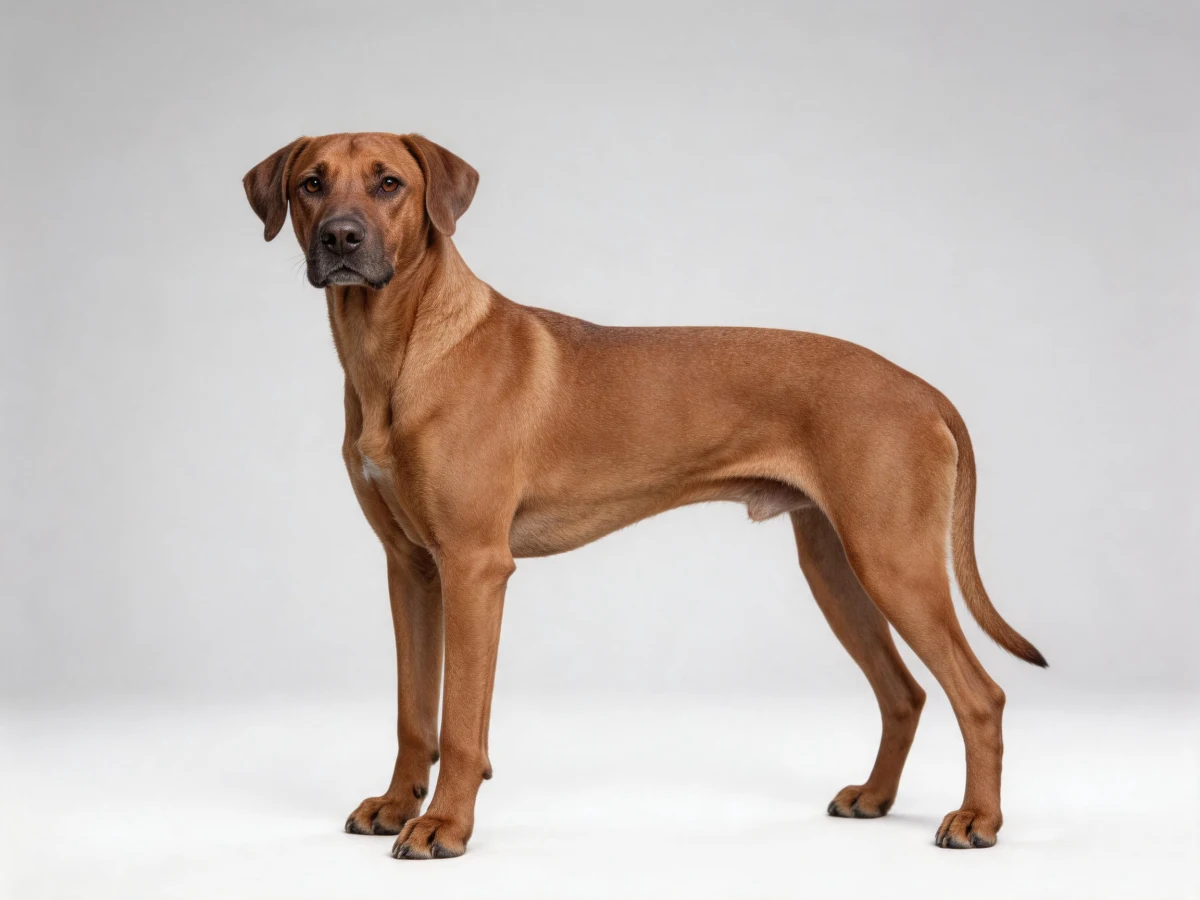
The AKC breed standard describes the Vizsla as a medium-sized, short-coated hunting dog of distinguished appearance and bearing — robust but rather lightly built, the very picture of a versatile pointer-retriever developed by Hungarian sportsmen for work on the field, in forest, and in water. The overall impression is of an aristocratic, lean, muscular athlete built for endurance and agility rather than bulk, carrying itself with an alert, lively, and affectionate expression. Form follows function throughout: this is a working gundog standard, not a show exaggeration.
Size, coat, and colour
Males stand roughly 23–25 inches at the withers and weigh about 44–66 lb; females stand about 21–24 inches and weigh roughly 40–55 lb. The coat is short, smooth, dense, and close-lying, with no woolly undercoat — a single coat that gives the breed its sleek outline and its minimal grooming needs. Colour is the breed's signature: a solid golden rust in shades from sandy gold to a deeper russet, the standard preferring an even, self-coloured coat. Solid dark mahogany or pale yellow are faulted, and small white marks on the chest or toes are tolerated but not sought. The nose, eyes, and nails harmonise with the coat colour.
Head, movement, and temperament
The head is lean and muscular with a moderate stop, a square-ended muzzle roughly equal in length to the skull, and thin, silky pendant ears set fairly low. Movement is far-reaching, light-footed, graceful, and smooth, covering ground with the easy efficiency of an endurance hunter. Temperament is explicit in the standard: the Vizsla is gentle-mannered, demonstrably affectionate, sensitive, and eager — lively but obedient — and timidity or over-aggression are faults. The breed standard's emphasis on a biddable, people-oriented nature reflects exactly the velcro attachment that defines life with the dog.
🏆 Recognition
Recognized by the American Kennel Club in 1960 as a Sporting breed. FCI standard No. 57 (Section 1 — Continental Pointing Dogs (with working trial)), recognized in 1936.
Other registries
Breed clubs
❓ Frequently Asked Questions
Are Vizslas good family dogs?
Yes, for the right family. Vizslas are gentle, deeply affectionate, and good with children, and they bond intensely with the whole household. The catch is that they need a great deal of daily exercise and dislike being left alone, so they suit active families where someone is home much of the day rather than a busy household that is out for long working hours.
Can a Vizsla be left alone?
Not for long. The Vizsla is nicknamed the "velcro dog" for its need to be physically with its person, and it is among the most separation-anxiety-prone breeds there is. Left alone for long stretches it can become anxious, destructive, and vocal. It does best where someone is home most of the day, or with daycare or a walker to fill the gap.
How much exercise does a Vizsla need?
A lot. An adult Vizsla needs well over an hour of genuine aerobic exercise every day — running, retrieving, scent work, or a dog sport — not just a walk around the block. Bred as an all-day Hungarian hunting dog, it has high energy and real stamina, and a Vizsla that does not get enough activity becomes frantic and destructive.
How long do Vizslas live?
Typically 12–14 years. The Vizsla is generally a healthy, long-lived breed, though autoimmune thyroiditis, hip dysplasia, hyperuricosuria, and some cancers and epilepsy appear in certain lines, which is why responsible breeders health-test their dogs.
Are Vizslas easy to train?
Yes, in gentle hands. Vizslas are intelligent, eager to please, and quick to learn, but they are also one of the softest sporting breeds and very sensitive to harshness. Reward-based, positive methods work well; raised voices and hard corrections backfire and shut a Vizsla down. A reliable recall is the most important skill, given the strong bird-dog prey drive.
Do Vizslas shed a lot?
No, not much. The Vizsla has a short single coat with no undercoat, so grooming is minimal — a weekly going-over with a rubber brush — and shedding is light compared with double-coated breeds. The trade-off is that the thin coat offers little insulation, so a Vizsla feels the cold and needs a coat in winter, and is not an outdoor dog.
How much does a Vizsla puppy cost?
A well-bred, health-tested puppy from a parent-club breeder typically runs USD 1,500–3,500 (2024), often with a waiting list of several months. Be wary of puppies priced well below that with no health-testing paperwork or parent-club connection, and of sellers charging a premium for supposedly "rare" colours.
📚 Sources & Further Reading
Every load-bearing factual claim on this page is anchored to one of the sources below. iDogNames does not synthesize from secondary aggregators.
- akc breed page Vizsla — AKC Breed Profile — American Kennel Club (2024)
- akc breed page Vizsla History: From Swift Hungarian Hunting Dog to Versatile Sporting Companion — American Kennel Club (2023)
- fci standard pdf FCI Standard No. 57 — Hungarian Short-Haired Pointer (Vizsla) — Fédération Cynologique Internationale (2000)
- kc uk standard pdf Hungarian Vizsla — Breed Information — The Kennel Club (UK)
- breed club official Vizsla Club of America — breed history & parent club — Vizsla Club of America
- academic paper Clinical characteristics and inheritance of idiopathic epilepsy in Vizslas — Patterson EE et al., J Vet Intern Med 17(3):319-25 (2003)
- academic paper Clinical features of idiopathic inflammatory polymyopathy in the Hungarian Vizsla — Tauro A et al., BMC Veterinary Research 11:97 (2015)
- academic paper Mutations in the SLC2A9 Gene Cause Hyperuricosuria and Hyperuricemia in the Dog — Bannasch D et al., PLOS Genetics (2008)
- wikipedia Vizsla — Wikipedia — Wikipedia
- book Versatile Vizsla — Marion I. Coffman (Alpine Publications) (1992)