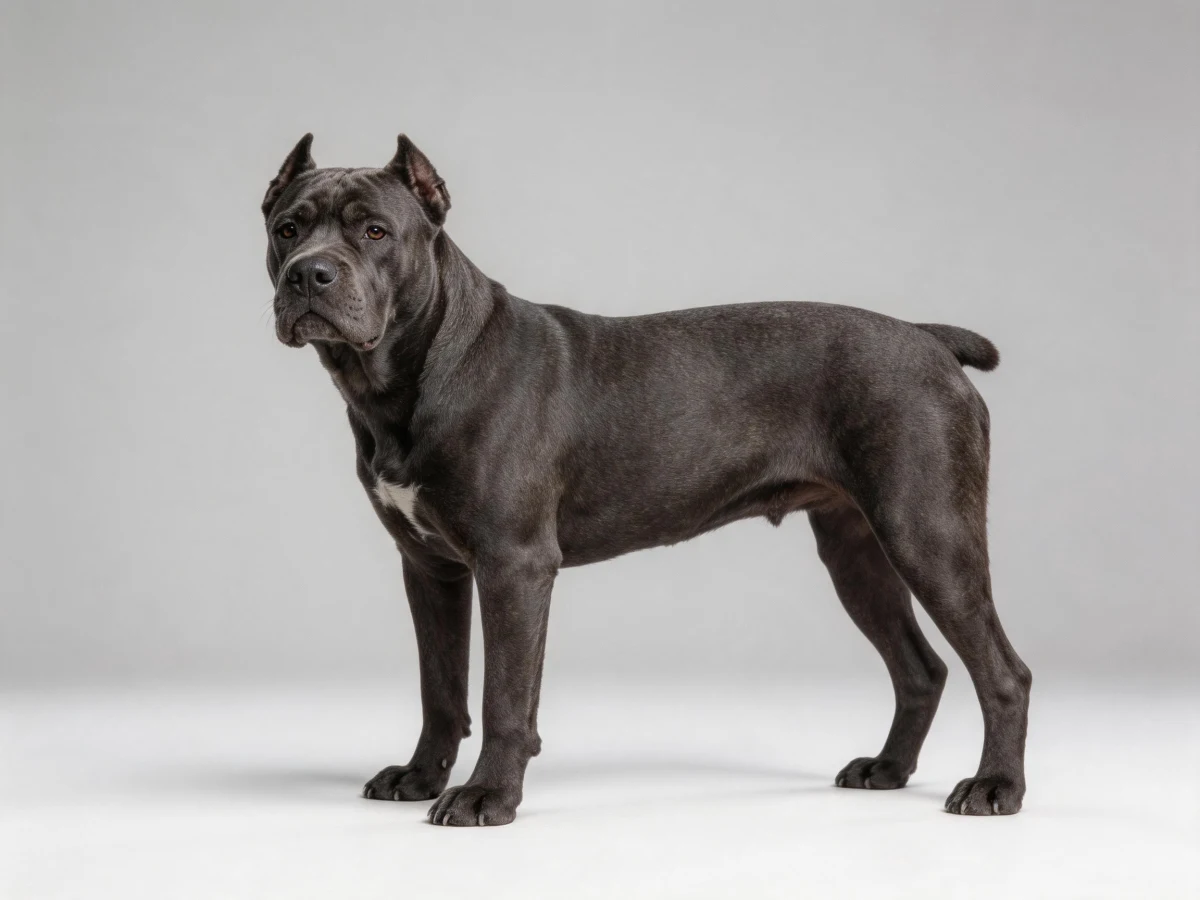
Great Dane
✨ Key Takeaways
- The Great Dane is a German breed — the Deutsche Dogge — developed from estate boarhounds; the English name "Great Dane" comes from the French "grand danois" and has no connection to Denmark.
- The name was settled at a Berlin judges' meeting in 1880 chaired by Dr. Bodinus, which fixed "Deutsche Dogge" over rivals such as Ulmer Dogge, Saupacker, and Bismarckdogge; the Deutscher Doggen Club followed in 1888.
- Otto von Bismarck's lifelong attachment to the breed — his Danes Tyras and Sultan were near-constant companions in the Reich era — cemented its association with the German state.
- Bloat is the breed's defining welfare story: Glickman et al. (2000, JAVMA) put the Great Dane's lifetime risk of gastric dilatation-volvulus near 42%, the highest of any breed studied.
- Lifespan is the hard trade-off for the size — roughly 7 to 10 years, with dilated cardiomyopathy, osteosarcoma, and Wobbler syndrome the other major killers.
- The Great Dane Club of America CHIC panel (hips, heart, eyes, thyroid) plus a prophylactic-gastropexy conversation is the buyer's checklist; the breed needs space, a lean body, and slow controlled growth, not maximum size.
Quick Facts
Common Names & Variants
Modern aliases
Historical names
Modern variants & lines
⚖️ Pros & Cons
Advantages
Trade-offs
Physical Appearance
Recognized colors
Coat
Other
Ears: Drop. Tail: Natural (historically docked).
🕰 History
A German boarhound with a borrowed name
The single most repeated fact about the Great Dane is wrong: it is not Danish. The breed is German, developed in the German states across the 18th and 19th centuries, and its own home club calls it by the only correct name — the Deutsche Dogge, the German mastiff. The English label is an import error. French speakers called the dog grand danois, "big Danish (dog)," for reasons that even the breed's official histories admit are not well documented and probably had more to do with continental politics than with any breeding work done in Denmark. English took the French phrase and translated it literally. The Deutscher Doggen Club's own history attributes the foreign naming to political rivalry rather than Danish provenance. Two centuries later the misnomer is unkillable, so it is worth saying plainly at the top: a Great Dane is a German dog wearing a French mistranslation on an English collar.
The Saupacker on the estate
The working ancestor was a boarhound. German nobility ran large hunting estates, and the wild boar — fast, armoured, and capable of killing dogs and horses — needed a specific kind of dog to corner and hold it until the hunters arrived. These were the Saupacker ("boar-grabbers") and Hatzrüden, big mastiff-and-sighthound-type dogs bred for the courage to seize a boar and the speed to catch one. The same dogs, brought indoors, became Kammerhunde and Leibhunde — chamber dogs and bodyguard dogs — sleeping in the bedchambers of the aristocracy as a last line of personal protection. The AKC's breed history traces exactly this lineage: a "savage, swift, and powerful" boarhound that was, over generations, deliberately bred away from its ferocity as boar hunting declined and the dog moved from the forest to the drawing room.
Documentation for the early type is genuinely thin. There was no single founding kennel and no continuous studbook before the 1880s — the breed was assembled regionally from German hunting stock, with the white-and-black spotted Ulmer Dogge developing in the south around Württemberg and blue and fawn dogs more typical of the northern lines, refined with English Mastiff substance and Greyhound-type speed and head. Anyone claiming a precise crossing recipe is reconstructing, not citing.
1880, Berlin, and the end of seven names
By the mid-19th century the same dog was being shown under at least eight names depending on the region and the breeder — the Deutscher Doggen Club's history lists Saupacker, Hatzrüde, Fanghund, Danish Mastiff, Ulmer Dogge, Tigerdogge, Englische Dogge, and Bismarckdogge. That is not a breed; that is a naming argument. A breeders' meeting in 1879 began the work of agreeing common standards, and the decisive moment came in 1880 at a judges' meeting in Berlin, chaired by Dr. Bodinus, where the name Deutsche Dogge was formally fixed and the rivals retired. The Deutscher Doggen Club was founded in 1888, published its breed standard in 1891, and opened its first studbook volume in 1897 with 538 registered dogs. The breed went from a regional argument to a registered German breed inside two decades.
Bismarck's dogs
One of the discarded names — Bismarckdogge — points at why the breed reads as so emphatically German. Otto von Bismarck, the chancellor who unified Germany, was a lifelong Great Dane owner; his dogs Tyras and Sultan were such constant companions through the imperial years that the breed became publicly fused with the figure of the German state. The association was strong enough that some 19th-century breeders simply called the dog the Bismarck mastiff. The 1880 Berlin meeting deliberately chose the neutral national name over the political one, but the Bismarck connection is the reason a German breed ended up positioned, in the public imagination, as the national dog of Germany.
Across the Atlantic and the Channel
The breed reached both Britain and the United States in the late 19th century. The Kennel Club in the UK recorded the breed in the 1880s, and the American Kennel Club entered it in its registry in 1887, placing it in the Working Group. American fanciers organised early: a club formed in 1889 and was reconstituted as the Great Dane Club of America in 1891, making the GDCA one of the oldest breed parent clubs in the country. English and American breeders refined the dog further — English lines crossed in Greyhound type for a more elegant head and outline, American breeders worked toward level toplines and the imposing-but-clean show dog — but the registry name everywhere outside German-speaking countries stayed "Great Dane," and the error became permanent.
From boar forest to gentle giant
What is striking about the modern Great Dane is how completely the breed was redesigned away from its job. The boarhound was bred for the nerve to grab a charging animal; the show and companion Dane was bred, deliberately and over many generations, for the opposite — a dog steady enough to live in a house with children, with the ferocity selected out and the "Apollo of Dogs" build kept. The result is a giant whose temperament is almost the inverse of its origin story, and a breed whose central modern problem is not aggression but the brutal biological cost of being that large.
Temperament & Personality
The gentle giant, on the record
The Great Dane Club of America describes the breed in one phrase that has stuck because it is accurate: a gentle giant. The FCI standard frames the temperament as "friendly, loving and devoted to its owner, especially with children," and "self-assured, fearless, easily handled," with aggressiveness explicitly listed as a fault. This matters as documentation, not marketing — it is the official behavioural target the breed has been bred toward for more than a century, and it represents a deliberate reversal of the boarhound ancestor's working ferocity. A correct adult Dane is affectionate, people-seeking, and notably tolerant; it leans its considerable weight against people it trusts and treats itself as a lapdog with a sizing error.
Steady, not soft
Gentle is not the same as passive. The breed retains a watchful, protective streak — its history as a Leibhund, a bodyguard dog sleeping in the chamber, did not vanish entirely. A well-bred Dane notices a stranger at the door and registers it; the value is that it registers calmly rather than reactively. Nervousness, sharpness, and fear-based reactivity are temperament faults under the standard, not the breed working as designed. The sheer scale means a Dane does not need to do much to be a deterrent, which is precisely why temperament soundness matters more here than in a small breed: a frightened or poorly socialised 70-kilogram dog is a serious problem in a way a frightened terrier is not.
The puppyhood mismatch
The hardest behavioural fact about Danes is developmental, not temperamental. The dog grows to enormous size long before its brain catches up: an eight-month-old Dane can weigh 45 kilograms and still have the impulse control of a puppy, because that is exactly what it is. Early, consistent, force-appropriate training is not optional — a behaviour that is charming in a spaniel puppy (jumping up, mouthing, pulling) is dangerous when the puppy outweighs an adult. The breed is biddable and wants to please, which makes the training tractable, but the window in which to install manners closes against a very fast clock.
Day to day, and the real caveats
An adult Dane in the right home is calm indoors, genuinely good with children when raised with them, and far less demanding of exercise than its dimensions suggest — two substantial walks and it is content. It is sensitive to its people's mood and does poorly isolated; this is a velcro breed despite the size, and a Dane left alone in a yard becomes anxious and destructive. The caveats are honest ones. Same-sex dog tolerance varies and needs management. The tail is a coffee-table-clearing liability and "happy tail" injuries are routine. And the breed's shortest sentence is the truest: you will not have it for long. A Dane owner signs up for an intense seven-to-ten-year relationship, and the temperament is sound enough that the brevity is the only thing most owners would change.
🏡 Living With a Great Dane
A giant that lives indoors, in the room with you
The Great Dane is a gentle giant, and the word that organises everything about life with one is scale, not energy. Despite the name this is a German breed — the Deutsche Dogge, bred as a boar-hound and estate guardian, not a Danish dog at all — and centuries of working beside people left it deeply attached to its family. A Dane is an indoor dog that happens to weigh as much as an adult human: males commonly run 140–175 lb and stand 30–34 inches at the shoulder, so when this dog leans against your leg, climbs onto the sofa, or decides it is a lap dog, the household has to be built around that fact. Danes bond hard and tolerate isolation poorly; left alone for long working days a Dane is prone to separation distress and, given the size, genuinely destructive boredom. This is a breed for a home where someone is around much of the day.
Moderate exercise, and why you do not run a young one
For its size the adult Great Dane is surprisingly low-key — a couple of moderate walks and some calm play meet the need of most adults, and a well-exercised Dane is content to be a large, affectionate floor ornament for the rest of the day. The critical caveat is the puppy and adolescent. A giant breed's growth plates stay open far longer than a small dog's, and forced running, repetitive jumping, stairs, and hard play on slick floors during that long growth window load joints that are not finished forming. Free movement at the puppy's own pace is right; structured jogging, agility jumps, and roadwork are not, until the skeleton has matured well past a year. Keep play on grass and traction, not tile, and let a growing Dane set its own tempo.
Space, kids, other pets, drool, and the heat caveat
A Dane is excellent with children and usually sociable with other dogs and household pets, but the sheer mass makes supervision around small children and frail adults a practical matter — a friendly tail or an excited turn can knock a toddler flat without a trace of aggression. The breed needs space simply to exist: room to turn around, a bed big enough for a person, a car that can carry it, and clearance for a sweeping tail that clears coffee tables. Danes can adapt to a roomy apartment if the exercise floor is met and there is a lift, but the realities are hair (a single short coat still sheds steadily) and drool — the loose flews mean a Dane slings saliva after drinking and in warm weather. The short single coat also gives little insulation, so Danes feel both cold snaps and summer heat and need a coat in winter and shade and water in summer.
🎓 Training & Exercise
A sensitive giant you must train early, because size is the catch
Great Danes are intelligent and people-pleasing, but the reason training matters so much is not difficulty — it is consequence. A 30 lb dog that never learned not to pull, jump, or barge is an annoyance; a 150 lb dog with the same gaps is unmanageable and can be dangerous by accident. The one real catch with the breed is therefore time, not temperament: manners that are optional in a small dog are mandatory here, and they must be installed in puppyhood while the dog is still light enough to physically manage. Danes are also sensitive and somewhat soft — they read tone and respond to reward, and they shut down or grow anxious under harsh, heavy-handed corrections. Reward-based methods, started the day the puppy comes home, are the breed's path.
Loose-lead walking and "off" are the load-bearing skills
The two highest-value behaviours for a Great Dane are a reliable loose-lead walk and a solid "off." A Dane that pulls can tow an adult off their feet, and a Dane that jumps up in greeting can flatten a guest, so these are safety skills rather than polish. Teach them before the puppy hits 70–80 lb, when correction is still a matter of guidance rather than wrestling. A settled "place" or "down-stay" is the third pillar — a dog this large needs a trained off-switch so it can lie quietly in a busy room rather than loom over the dinner table. Early, generous socialisation to people, traffic, surfaces, and other dogs builds the calm, unflappable adult the breed is meant to be; an under-socialised giant that startles easily is a real liability.
Patience through a long adolescence
Giant breeds mature slowly in mind as well as body, and a Dane can stay mentally adolescent past two years even as it reaches full size well before that — a disconcerting combination of a puppy's brain in an enormous frame. Expect a stretch where a previously biddable youngster tests boundaries and seems to forget its lessons; the answer is calm, consistent repetition and continued reward, not escalation that a sensitive dog will only resent. Short, frequent training sessions suit the breed better than long drills. Because Danes are gentle and eager rather than driven, motivation rarely fails — what fails is consistency on the human side, so the household must agree on the rules and enforce them the same way every time.
✂️ Grooming & Coat Care
An easy single short coat — with a drool tax
Grooming is one of the genuinely light parts of Great Dane ownership. The breed wears a single, short, smooth coat with no insulating undercoat, so there is no seasonal "blow," no matting, and no trips to a groomer for clipping. A weekly going-over with a rubber curry brush or a grooming mitt lifts loose hair, spreads skin oils, and keeps the coat glossy; during heavier sheds a second weekly session keeps the hair down. Baths are occasional — every couple of months or when the dog is genuinely dirty — and the practical limitation is logistics, because bathing a 150 lb dog is a two-person, walk-in-shower or garden-hose job rather than a sink affair. The real daily maintenance is not the coat but the drool: keep a "slobber towel" by the water bowl and the door, because loose flews fling saliva after drinking and during heat or excitement.
Nails, the giant frame, and skin checks
Nail care matters more on a Dane than on most breeds because so much weight rides over those feet — overgrown nails splay the toes and change the angle the leg loads, which a giant skeleton cannot afford. Trim or grind every two to three weeks and aim for nails that never click on the floor. Because Danes are so large and lie on hard surfaces, check the elbows and hocks for pressure calluses and give the dog a thick, supportive bed to spread its weight. Run your hands over the whole dog during the weekly brush to catch lumps, hot spots, or sore points early, simply because a problem on a body this size is easy to miss until it is large.
Ears, teeth, and the wrinkle-free face
Most modern Great Danes carry natural drop ears (ear cropping is now banned or out of fashion in much of the world), and pendant ears trap warmth and moisture, so a weekly look and a wipe of the visible ear with a vet-recommended cleaner is a sensible habit, with extra drying after a bath. The Dane's clean, tight face has no deep skin folds to manage, but the lips and jowls hold moisture and food, so wiping the muzzle keeps things fresh. Dental care is the same high-leverage habit it is for any dog — brush several times a week from puppyhood — and it is worth establishing while the dog is small enough to hold still, because asking a fully grown Dane to accept a new handling routine for the first time is a far harder negotiation.
🍖 Diet & Nutrition
Bloat (GDV) is the headline, and feeding routine is the front line
No nutritional fact about the Great Dane matters more than gastric dilatation-volvulus, or bloat — the deep, narrow chest that gives the breed its noble outline is the exact anatomy that predisposes it to GDV, and bloat is the leading killer of the breed. The feeding routine is built around lowering that risk: split the daily ration into two or three smaller meals rather than one large one, use a slow-feeder bowl or a puzzle feeder if the dog gulps, and keep the dog calm with no vigorous exercise for roughly an hour before and after eating. Owners must know the emergency signs cold — a swelling or distended abdomen, repeated unproductive retching that brings nothing up, drooling, pacing and obvious distress — and treat them as an immediate, get-in-the-car veterinary emergency, because GDV can turn fatal within hours. So many Dane owners and breeders elect a prophylactic gastropexy — a surgical tacking of the stomach, often done at the time of spay or neuter — that it is a standard conversation to have with the vet rather than an exotic one.
Slow, controlled giant-breed growth is non-negotiable
A Great Dane puppy must be raised on a food formulated specifically for large- or giant-breed growth, and the goal is to grow the puppy slowly and lean — never as big or as fast as possible. A giant skeleton that grows too quickly, or that receives excess calcium, is set up for developmental orthopaedic disease such as hypertrophic osteodystrophy (HOD), panosteitis, and joint problems that a slower, controlled curve avoids. Resist the urge to "fill out" a leggy adolescent with extra food or supplements; a slightly lean, evenly growing Dane puppy is exactly right, and a roly-poly one is a warning sign. Keep the puppy on the giant-breed growth formula for the extended period the bag and your vet specify, not the shorter timeline a small breed would follow, because a Dane is still growing long after a Labrador has finished.
Adult feeding, weight, and a giant grocery bill
Once grown, a Dane eats a lot in absolute terms but should still be fed to a lean body condition — you want to feel ribs easily and see a waist, because every extra pound is carried by joints and a heart that already work hard on a giant frame with a short 7–10-year life expectancy. Set portions by ideal weight and activity and adjust by body condition over time, keeping treats inside the daily calorie budget. Prospective owners should go in clear-eyed about cost: food, preventives, and any medication are all dosed and priced by body weight, so a Dane's grocery and veterinary bills are a multiple of a medium dog's, and that giant-scale running cost is a permanent feature of the breed, not a surprise.
🐶 Buying & Adopting a Great Dane
Start at the Great Dane Club of America, not a classified ad
The Great Dane Club of America (GDCA) is the AKC parent club and the right place to begin a search. It publishes a Code of Ethics for member breeders, maintains breeder-referral resources, and supports breed rescue. A breeder worth buying from will be a GDCA member in good standing, will register litters with the AKC, will health-test both parents, will offer a written contract and health guarantee, and will talk openly about the breed's hard realities — the short giant-breed lifespan, the bloat risk, and the heart and growth issues — rather than promising that their lines are trouble-free. Because Danes are expensive to raise correctly, a good breeder will also question you closely about your space, time, and readiness for a giant dog.
The health screening to ask a breeder for
The CHIC health-screening profile for the Great Dane covers four areas, and a responsible breeder can show results on both parents: an OFA hip evaluation; a congenital cardiac examination by a board-certified cardiologist (an echocardiogram screening for dilated cardiomyopathy, or DCM, which is common in the breed); an eye examination by a boarded ACVO ophthalmologist (OFA/CAER); and an OFA autoimmune thyroid (thyroglobulin autoantibody) panel. Many breeders also discuss prophylactic gastropexy as part of GDV risk management — a procedural rather than genetic measure, but a standard part of the breed conversation. It is fair and useful to ask which heart screening was done and by whom, and to ask about longevity in the breeder's lines, given the breed's short lifespan. A breeder who produces the OFA paperwork and speaks frankly about bloat, the heart, and Wobbler syndrome (cervical vertebral instability) is the one to trust; "all our dogs are healthy, no testing needed" is the answer to walk away from.
Rescue and the giant-dog reality
Great Dane rescue is active, much of it coordinated through GDCA-affiliated and regional breed-rescue groups. Danes are surrendered for predictable reasons — owners underestimate the space, the cost, the drool, or how much dog a "puppy" becomes — so rescues regularly place adolescents and adults whose temperament is already a known quantity. For an adopter who wants a gentle giant without raising one through the demanding growth stage, breed rescue is an excellent route, and an adult Dane's calm character is usually plain to read from the first meeting.
Price, waiting lists, and the red flags
A well-bred Great Dane puppy in the United States runs roughly USD 1,500–3,500 (2024), depending on region, lineage, colour, and parent titles, and good breeders keep waiting lists. The patterns to avoid are puppies priced well below that range with immediate availability, no health-testing documentation, and no parent-club connection. Be especially cautious about breeders charging premiums for fashionable colours or "double-merle" pairings: breeding merle to merle can produce serious deafness and eye defects, and an ethical breeder will not do it. The purchase price is also the smallest cost of a Dane — a fair price from a health-testing breeder, even after a wait, is trivial next to the lifetime giant-scale cost of feeding, medicating, and equipping the dog.
📜 Breed Name Etymology — iDogNames original research
A name that is wrong in three languages
"Great Dane" is one of dog naming's great mistranslations, and unpicking it is the whole etymology. The breed is German. Its only correct name is Deutsche Dogge — "German Dogge," where Dogge is the German term for a large mastiff-type dog (cognate with English "dog" but narrowed in German to the mastiff sense, the same root behind "dogo" and "dogue"). The English name does not derive from Deutsche Dogge at all. It came through French: French breeders and writers called the dog grand danois, literally "big Danish (one)." Why "Danish"? The breed's own histories are honest that this is not well explained — the Deutscher Doggen Club attributes it to continental political rivalry rather than to any Danish breeding, and the AKC's history says flatly that "it's unknown why the French chose to call the dogs" Danish. English then translated grand danois word-for-word into "Great Dane," importing the error wholesale. The chain is: a German boarhound, called Danish by the French for unclear reasons, then translated literally into English. Nothing in it points at Denmark.
What "Deutsche Dogge" actually says
Deutsch is "German." Dogge is the operative word, and it is worth dwelling on because it is the breed's real identity. In German, Dogge does not mean "dog" generally (that is Hund); it specifically denotes a large, heavy mastiff-type. The same root produces the German Dogge family — Deutsche Dogge, and the Bordeaux Dogue, and the Spanish Dogo. So the native name reads as "the German Mastiff," which is also the breed's English alternate name and the one that is actually accurate. When German cynology refers to the breed today, it is always Deutsche Dogge; "Great Dane" is, to a German breeder, a foreign nickname for their national dog.
The discarded names, and what they recorded
Before the 1880 Berlin meeting standardised Deutsche Dogge, the breed answered to a small library of regional and occupational names, each of which preserved a piece of its history. Saupacker — "sow-grabber" — and Hatzrüde recorded the boar-hunting job. Ulmer Dogge recorded the southern German, Württemberg-area type around Ulm. Kammerhund and Leibhund recorded the indoor bodyguard role. And Bismarckdogge recorded the chancellor's famous attachment to the breed. The 1880 judges deliberately chose the neutral national name and retired the rest, which is why a single tidy "Deutsche Dogge" today sits on top of an unusually well-documented stack of older, more descriptive names.
The aliases in use now
"Great Dane" is the universal English registry name despite being wrong. "German Mastiff" is the accurate English alternate and appears in older British literature. Apollo of Dogs — after the Greek sun god — is the breed's affectionate epithet, coined for its imposing, statuesque build and used by the GDCA itself. Grand Danois survives in French and a few other languages. Watch for marketing labels that are not registry terms: "Euro Dane," "European Great Dane," and similar phrases are seller language for heavier, oversized stock, not recognised types — the FCI Standard 235 describes a balanced dog, and "bigger" is a fault risk, not a premium.
Name forms at a glance
| Name | Role | Origin | Literal meaning | First recorded |
|---|---|---|---|---|
| Great Dane | primary | English (calque of French grand danois) | big Danish (dog) — a misnomer; the breed is German | — |
| Deutsche Dogge | origin country native | German | German Mastiff | 1880 |
| Saupacker / Hatzrüde | historical | German (occupational) | boar-grabber / boar-hunt dog | — |
| Bismarckdogge | historical | German | Bismarck's mastiff | — |
| Apollo of Dogs | alias | English (epithet) | affectionate epithet for the breed's statuesque build | — |
🏛 Naming Traditions — iDogNames original research
Three heritage layers, one statuesque dog
Because the Great Dane is a German breed with a German registry tradition, an English misname, and an "Apollo of Dogs" reputation, its naming culture pulls coherently from three distinct wells: the German Zwinger kennel system the breed shares with every German breed; the classical and heraldic register the breed's regal build invites; and the German hunting-and-guard vocabulary of its boarhound origin. These layers are distinguishable to anyone who knows the breed, and choosing within one of them — rather than reaching for a generic "big dog" name — is what gives a Dane's name a documented heritage rather than an accidental one.
The German Zwinger convention
A pedigree German Dogge's full registered name follows the German kennel system: [Given name] von/vom [Zwinger], where the Zwinger (kennel) affix carries the breeder's permanent identity and the von/vom ("of the / from the") is the nobiliary-style particle the system borrowed. The Deutscher Doggen Club's studbook tradition, running back to that first 1897 volume, also follows the German litter-letter convention: every dog in a litter is registered with a name beginning with the same assigned letter, so an "F" litter might be Falk, Fenja, Freya, Fado. For an owner, this means a German given name that pairs cleanly with an affix — Falk, Greta, Bruno, Hella, Arko — sits squarely inside the breed's own registry culture, and an import's call name often already follows it.
The classical / Apollo register
The breed's nickname is not decorative — the GDCA uses "Apollo of Dogs" deliberately, and it points at the most heritage-true naming vein the Dane has. A dog bred over a century specifically to be statuesque and imposing carries a classical or mythological name the way few breeds can without it reading as a stretch: Apollo itself, Zeus, Atlas, Juno, Athena, Titan, Hera. The famous record-holding Danes lean exactly this way — the tallest dog ever recorded was a black Great Dane named Zeus — and the convention is old enough and consistent enough that a classical name on a Dane reads as the breed's own tradition, not a default. The heraldic adjacent vein works for the same reason: a breed bred on noble estates wears Duke, Baron, Kaiser, Regent, Countess as a nod to the Kammerhund who slept in the lord's chamber.
The boarhound / German working layer
The oldest layer is occupational and German. Before it was the gentle giant, the dog was the Saupacker — the boar-grabber — and that history supports a register of hard German nouns and hunting words: Jäger (hunter), Eber (boar), Wald (forest), Sturm (storm), Donner (thunder), Bär (bear). These are not generic tough-dog names; they are period-correct for a German hunting estate and they tie a modern companion back to the specific job the breed was built for. A Dane given a one- or two-syllable German hunting noun is, quietly, wearing its Hatzrüde heritage.
Choosing a Great Dane name with intent
The breed offers three lineage-backed routes that do not blur together. A German given name in the Zwinger tradition (Falk, Greta, Bruno) matches the Deutscher Doggen Club registry culture and suits an import or show dog. A classical or heraldic name (Apollo, Atlas, Juno, Duke) honours the "Apollo of Dogs" identity and the breed's noble-estate past. A German hunting noun (Jäger, Eber, Wald) reaches back to the Saupacker. The one move the heritage argues against is the irony name — a Great Dane called "Tiny" or "Killer" leans on exactly the size-spectacle and false-ferocity clichés the breed's careful 140-year redesign was meant to retire.
🐾 Themed Names for Your Great Dane — iDogNames original research
German registry names — the Zwinger layer
German given names that pair naturally with a von-/vom-prefixed kennel affix in the Deutscher Doggen Club tradition. Best for import lines and show dogs.
- Falk — German for "falcon"; short, strong, classic stud name
- Bruno — long-used German Dogge call name; "brown," fitting a fawn
- Greta — clean German female given name; works without an affix
- Arko — strong two-syllable German pedigree name
- Hella — compact German female name; carries as a recall
- Cäsar — German spelling of Caesar; common in old Dogge lines
- Senta — traditional German working-dog female name
- Hasso — recurring German given name in large-breed pedigrees
- Frieda — German "peace"; gentle, period-correct
- Lex — short German call name that pairs with any affix
Apollo / classical names
The breed's "Apollo of Dogs" identity makes a classical or mythological name the single most heritage-true vein the Great Dane has.
- Apollo — the breed's own epithet; the obvious heritage name
- Zeus — borne by the tallest dog ever recorded, a Great Dane
- Atlas — the Titan who holds up the sky; scale-appropriate
- Juno — Roman queen of the gods; dignified female name
- Athena — strength and strategy; suits a watchful female
- Titan — pre-Olympian giant; on-theme without being a pun
- Hera — regal Greek goddess; short female call name
- Helios — the sun itself; pairs with the Apollo register
- Diana — Roman goddess of the hunt; nods to the boarhound past
- Orion — the giant hunter constellation; a quiet boarhound reference
Heraldic and noble-estate names
For the breed's history as the Kammerhund of the German nobility — the bodyguard dog of the estate.
- Duke — the classic Great Dane noble name; estate heritage
- Baron — German title; fits the noble-chamber past
- Kaiser — "emperor"; German, ties to the Bismarck era
- Regent — a ruler in waiting; stately and uncommon
- Countess — titled female name; estate register
- Saxon — a German people; heraldic without a title
- Bismarck — the chancellor whose Danes named the "Bismarckdogge"
- Sultan — name of one of Bismarck's own Great Danes
- Tyras — Bismarck's famous Dane; documented heritage name
- Royal — plain and stately; fits the breed's bearing
German boarhound / hunting names — the Saupacker layer
Hard German hunting nouns from the breed's origin as an estate boar-hound. These tie a modern Dane to the specific job it was built for.
- Jäger — German for "hunter"; the breed's original trade
- Eber — "boar"; a direct nod to the Saupacker past
- Wald — "forest"; the boarhound's workplace
- Sturm — "storm"; common in German working lines
- Donner — "thunder"; carries well as a recall command
- Bär — "bear"; classic German large-dog name
- Fels — "rock"; understated and immovable
- Wolf — universal, strong, period-correct for a German breed
- Hatz — from Hatzrüde, the boar-hunt dog itself
- Greif — "griffin"; heraldic-hunting crossover, distinctly German
Coat and color names
The Great Dane comes in a defined palette — fawn, brindle, blue, black, harlequin, and mantle. These names work the colours without the obvious "Spot."
- Harlequin — for the white-and-torn-black pattern; on-name and apt
- Domino — for the harlequin / mantle black-and-white
- Sterling — for the blue (steel-grey) coat; refined
- Slate — another clean read on the blue Dane
- Ember — for the warm fawn; understated
- Tiger — English for the old Tigerdogge brindle name
- Onyx — for the solid black; show-line gravity
- Pepper — for the speckled harlequin; lighter register
- Sable — heraldic black; pairs with the noble-estate names
- Mantle — for the black-and-white "mantle" pattern itself
📋 Breed Standard at a Glance
General appearance
The AKC standard calls the Great Dane the "Apollo of dogs," a giant working breed that combines great size and a powerful, well-formed, smoothly muscled body with elegance and dignity of carriage. The German breed — the Deutsche Dogge, developed to hunt boar and guard estates rather than anything Danish — should look like a blend of strength and grace, never coarse and never weedy, with the unmistakable look of quality and a regal, square outline. Faults that pull a dog away from that balanced, imposing type are penalised in the ring.
Size, coat, and colour
This is a giant breed. Males stand from about 30 inches at the shoulder (the standard sets a 30-inch minimum and prefers 32 or more) and commonly weigh 140–175 lb; females stand from about 28 inches and weigh roughly 110–140 lb, figures consistent with the recorded 76–86 cm and 71–81 cm heights for males and females. The coat is short, thick, smooth, and glossy — a single coat with no woolly undercoat. The standard recognises a defined set of colours: fawn, brindle, blue, black, harlequin, and mantle, with merle a more recent AKC addition; colours and markings outside the recognised patterns are faulted.
Head, movement, and temperament
The head is rectangular, long, and finely chiselled, carried high, with a strong, deep, well-defined muzzle; ears today are most often natural drop ears as cropping declines. Movement should be long, easy, and springing, powerful and ground-covering, with strong drive from behind and no rolling or pacing — striking in a dog of this scale. Temperament is part of type: the Great Dane should be spirited, courageous, friendly, and dependable — "the apollo" with a gentle, never timid or vicious nature — and the lifespan recorded for the breed, about 7–10 years, reflects the shorter life common to giant breeds.
🏆 Famous Great Danes
Notable real dogs of the breed profiled on iDogNames.
🏆 Recognition
Recognized by the American Kennel Club in 1887 as a Working breed. FCI standard No. 235 (Section 2.1 — Molossian type, Mastiff type), recognized in 1955.
Other registries
Breed clubs
❓ Frequently Asked Questions
Are Great Danes good family dogs?
Yes. The Great Dane is a gentle giant — affectionate, patient with children, and usually easygoing with other pets — which is why it earns its "gentle giant" reputation despite its imposing size. The main caution is mass: a friendly Dane can knock over a toddler or a frail adult by accident, so supervision and early manners matter, and the household needs space and time for a dog that bonds closely and dislikes being left alone.
Do Great Danes shed a lot?
Moderately. The single, short, smooth coat has no undercoat, so there is no seasonal "blow" and no matting, but a Dane is a large dog and still sheds steadily year-round, so expect to vacuum regularly. A weekly going-over with a rubber curry brush or grooming mitt keeps loose hair down. The bigger daily mess is drool rather than hair, thanks to the breed's loose flews.
How much exercise does a Great Dane need?
Less than its size suggests. A couple of moderate daily walks and some calm play satisfy most adults, who are happy to relax indoors the rest of the day. The important rule is for puppies and adolescents: avoid forced running, repetitive jumping, and stairs while the growth plates are still open, because a giant skeleton that is over-exercised young is set up for joint problems. Let a young Dane move at its own pace on good footing.
How long do Great Danes live?
About 7–10 years. Like most giant breeds, the Great Dane has a shorter life expectancy than smaller dogs, and bloat (gastric dilatation-volvulus) and heart disease such as dilated cardiomyopathy are leading causes of death. Keeping a Dane lean, feeding split meals, and following a vet's screening and feeding guidance are the practical ways owners support a long life.
Are Great Danes easy to train?
Generally yes — Danes are intelligent and people-pleasing, and they respond well to reward-based training. The reason training is non-negotiable is size, not difficulty: manners that are optional in a small dog are mandatory in one that can reach 175 lb, so loose-lead walking and a reliable "off" should be taught early while the dog is still light enough to manage. Danes are sensitive, so harsh corrections backfire.
Are Great Danes hypoallergenic?
No. Great Danes shed year-round and produce a good deal of drool, and they are not considered a hypoallergenic breed. Anyone with a dog allergy should spend extended time around the breed before committing to one.
How much does a Great Dane puppy cost?
A well-bred, health-tested puppy from a parent-club breeder typically runs USD 1,500–3,500 (2024), often with a waiting list. Be wary of puppies priced well below that with no health-testing paperwork, and of premiums for fashionable colours or "double-merle" pairings, which an ethical breeder avoids. The purchase price is the smallest cost of a Dane — feeding, medicating, and equipping a giant dog is the real lifetime expense.
📚 Sources & Further Reading
Every load-bearing factual claim on this page is anchored to one of the sources below. iDogNames does not synthesize from secondary aggregators.
- akc breed page Great Dane — AKC Breed Profile — American Kennel Club (2024)
- akc breed page Great Dane History: Where the Breed Originated — American Kennel Club (2023)
- fci standard pdf FCI Standard No. 235 — Great Dane (Deutsche Dogge) — Fédération Cynologique Internationale (2012)
- breed club official Deutscher Doggen Club 1888 e.V. — history of the Deutsche Dogge — Deutscher Doggen Club 1888 e.V.
- breed club official Great Dane Club of America — CHIC / health-testing requirements — Great Dane Club of America
- academic paper Incidence of and breed-related risk factors for gastric dilatation-volvulus in dogs — Glickman LT et al., Journal of the American Veterinary Medical Association (2000)
- academic paper Non-dietary risk factors for gastric dilatation-volvulus in large and giant breed dogs — Glickman LT et al., Journal of the American Veterinary Medical Association (2000)
- wikipedia Great Dane — Wikipedia — Wikipedia
- book The World of the Great Dane — Jill Swedlow / classic breed literature (TFH) (2000)