
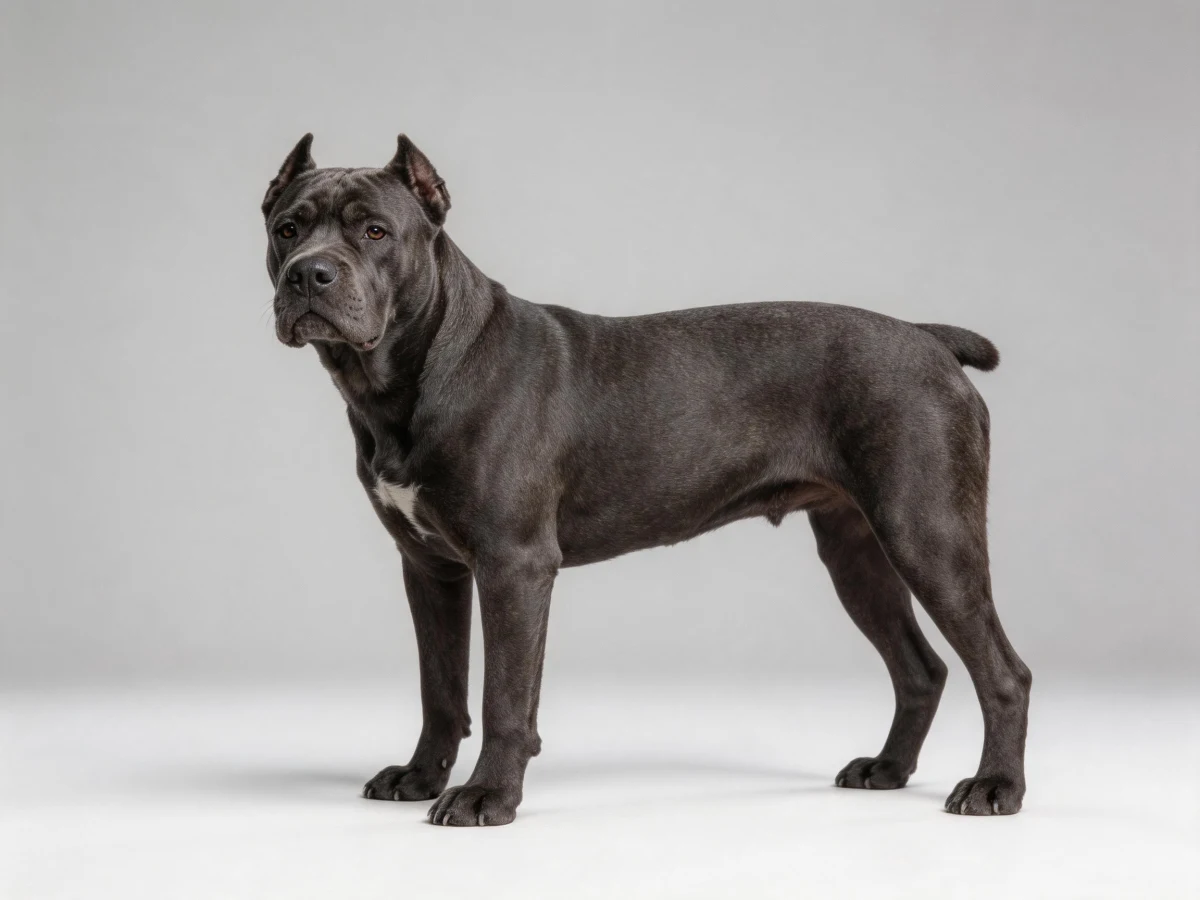
Cane Corso
✨ Key Takeaways
- The Cane Corso descends from the old Roman Molossian — the canis pugnax war-and-farm dog of the Italian peninsula — and survived into the 20th century only as a remnant working population in Puglia and adjacent southern regions, not as a maintained breed.
- It nearly disappeared as Italian sharecropping (mezzadria) collapsed after World War II; the modern breed exists because Dr Paolo Breber acted on a 1973 tip about surviving dogs and published a 1976 article in the ENCI magazine that drew fanciers in.
- The Società Amatori Cane Corso (SACC) was founded on 18 October 1983 in Mantova; ENCI recognised the breed in 1994, the FCI gave provisional acceptance in 1996 (full in 2007) under Standard N° 343, and the AKC recognised it in 2010.
- The FCI standard states the name derives from the Latin "cohors," meaning "protector, guardian of the farmyard" — the etymology is genuinely disputed (cohors vs. Greek kòrtos vs. the old adjective corsus), and the breed clubs do not all agree.
- The Korec et al. (2017) study of 232 dogs put median lifespan at 9.29 years, with black-brindle dogs living notably longer (median 10.30 years) — a documented coat-colour longevity effect, not folklore.
- A Corso is a serious large guardian, not a beginner mastiff: power, drive, and a low stranger threshold demand experienced ownership, early structured socialisation, and the OFA hip/elbow/cardiac/eye panel cleared before purchase.
Quick Facts
Common Names & Variants
Modern aliases
Historical names
Modern variants & lines
⚖️ Pros & Cons
Advantages
Trade-offs
Physical Appearance
Recognized colors
Coat
Other
Ears: Drop (uncropped). Tail: Natural, set high (historically docked).
🕰 History
The dog the legions left behind on the farm
Where the Neapolitan Mastiff became the heavy, loose-skinned line of the old Roman Molossian, the Cane Corso became the lean one — the dog that stayed useful. The FCI breed standard, N° 343, is unusually blunt about the lineage: "Its direct ancestor is the old Roman Molossian." This is the canis pugnax, the war-and-farm dog the Romans used on the battlefield and then, far more durably, on the farm: catching cattle and boar, guarding the courtyard, holding the herd. When Rome's institutions dissolved, the heavy molossoid drifted toward the mastiff that would become the Neapolitan, and the lighter, tighter-skinned, more athletic working dog stayed on the farms of southern Italy doing exactly what it had always done.
For roughly fifteen centuries that is the entire story, and the documentation is honestly almost nonexistent. There is no continuous studbook from the legions to the 20th century — the Roman-ancestor account is reconstructed from type, function, regional persistence, and the shared root with the Neapolitan Mastiff rather than from records. What is solid is the geography: by the recent past the breed survived only in Puglia (Apulia) and the adjacent regions of the deep Italian south, as a working tool of the rural estate.
Near-extinction by economics
The Corso did not nearly die out from war or disease. It nearly died out from a change in farming. The breed's survival was tied to the mezzadria — the Italian sharecropping system of large rural estates that needed a dog to guard the courtyard, drive stock, and catch game. As that system collapsed across southern Italy after the Second World War, mechanisation and depopulation removed the dog's job. By the start of the 1970s the population had fallen to a remnant of working dogs in isolated rural pockets, unrecognised by official Italian dog-fancy circles and very close to gone.
Breber's tip, and the 1976 article
The revival has a precise pivot. In 1973 a note from Professor Giovanni Bonatti hinted that original Corso-type dogs still survived in the south. Dr Paolo Breber, an enthusiast and researcher of Italy's rural traditions, followed the lead into Puglia, found and documented surviving dogs, and — decisively — published an article in 1976 in the magazine of the ENCI, the Italian Kennel Club, that put the breed in front of the official dog world for the first time. That article is the hinge on which the breed's modern existence turns. Without it the type would in all likelihood have dissolved into the general southern-Italian farm-dog population.
The Malavasi line and the founding of SACC
Recovery moved from articles to breeding. In Mantova, the Malavasi family — Giancarlo and Luciano, working from a German Shepherd background — produced a foundational early litter from the recovered stock at the turn of the 1980s. The organisational milestone followed: on 18 October 1983, in Mantova, a group including Giovanni Bonatti, the Malavasi brothers, and others founded the Società Amatori Cane Corso (SACC) to collect surviving dogs and run a structured breeding programme, with Breber himself central to the field side of the recovery. Honest caveat: the exact attribution of early credit — Breber versus the Malavasi line versus other recovery breeders — is contested in the breed's own literature, and the clubs tell it slightly differently.
From SACC to the AKC, 1983–2010
Recognition came in a clear sequence once the breeding base existed. The ENCI, the breed's country-of-origin authority, recognised the Cane Corso Italiano in 1994. The Fédération Cynologique Internationale granted provisional acceptance in 1996 and full acceptance in 2007, listing the breed as Standard N° 343 in Group 2, Section 2.1 (Molossian, mastiff type, with working trial). The American Kennel Club recognised the Corso in 2010 and placed it in the Working Group. The modern dog is, in registry terms, very young — barely four decades from a remnant population to a top-fifteen AKC breed.
Why the revival story holds up
The Cane Corso is the inverse of a breed with a romantic myth and no paper. Its ancient half is reconstructed and openly admitted to be so; its modern half is unusually well dated, because it happened recently and in print — a 1973 tip, a 1976 ENCI article, a 1983 founding meeting in Mantova, 1994/1996/2010 recognitions. The genuinely uncertain parts (the Latin etymology, the precise division of revival credit) are flagged by the breed bodies rather than smoothed over, which is exactly the standard a careful reference should hold.
Temperament & Personality
An athlete wearing a mastiff's body
The first thing to unlearn about the Cane Corso is the word "mastiff." The breed shares a molossoid root with the Neapolitan, but where the Neo is heavy and loose, the Corso is lean, rectangular, and built to move — the FCI standard specifies a long-striding extended trot and calls the dog "extremely agile and responsive." Temperament follows structure. This is a guardian with the working speed and reactivity of a far lighter breed, which is precisely what makes it formidable and precisely what makes it a poor match for an owner expecting a placid couch mastiff.
The guardian threshold
The FCI standard defines the breed's role in one line: "Guardian of property, family and livestock." A correctly bred Corso is territorial and watchful, deeply attached to its own people, and reserved-to-suspicious with strangers on its ground. The trait that matters is the threshold. A sound dog assesses before it acts; it watches the unfamiliar visitor, takes its cue from its handler, and escalates deliberately, not reflexively. Nervous, indiscriminate reactivity is a temperament fault — the FCI lists "aggressive or overly shy dogs" as a disqualifying fault — not the breed working as designed.
Biddable, which is the saving grace
What separates the Corso from the more aloof guardian breeds is trainability. It is responsive to a consistent handler, takes direction willingly, and works in obedience, protection sport, tracking, and conformation. This is the lever that makes the breed manageable: the same dog that will guard a property hard will also take a recall and a stand-down from a person it respects. The corollary is unforgiving — a Corso that has not been given clear, consistent leadership and structure does not become a softer dog; it becomes a large dog making its own decisions about who is and is not a threat.
What ownership actually demands
With its family the Corso is affectionate, physically present, and intensely loyal — it wants to be with its people and patrols where they are. The caveats are not soft-pedalled here because the breed does not allow it. Early, sustained socialisation is mandatory, not advisable. Dog-to-dog tolerance, especially same-sex, frequently needs lifelong management. Breed-specific legislation, housing restrictions, and higher liability insurance apply in many jurisdictions regardless of the individual animal. Matched to an experienced owner who provides leadership, work, and structure, the Cane Corso is one of the most capable guardian companions in the working group — and it gives almost nothing of that away to an owner who is not.
🏡 Living With a Cane Corso
A guardian that bonds to one family and watches everyone else
The Cane Corso descends from the Roman canis pugnax and centuries of work as an Italian farm and estate guardian, and that history defines daily life with the breed. A Corso attaches itself intensely to its own people — it wants to be in the same room, leaning against a leg, tracking where each family member is — and it extends that loyalty into open territoriality. The same dog that is affectionate and almost clingy indoors is naturally suspicious of strangers and protective of its property and its people. This is not a breed you bring home to be a casual, social, everybody's-friend pet. It needs an experienced owner who provides calm, consistent leadership and who genuinely wants a serious guardian, not someone hoping the protectiveness will simply mellow out on its own.
Athletic for a mastiff — a yard is not exercise
A Corso is built lighter and faster than the giant mastiffs, a working catch-dog historically used on wild boar (cinghiale), and it carries real athletic drive that a large fenced yard does not satisfy on its own. An adult needs structured daily physical exercise — a long brisk walk or two, a jog, controlled fetch, weight-pull or other working sports — paired with mental work, because a bored, under-exercised guardian breed redirects that energy into pacing, destructive chewing, obsessive fence-running, and escalating reactivity at the boundary. A Corso with a job and a tired body is a settled house dog; a Corso left to invent its own job in a backyard becomes a liability. Plan for the exercise floor before acquiring one, not after.
Kids, other pets, climate, and the apartment question
With its own family's children a well-raised Corso is typically gentle and tolerant, but its sheer size and power mean small children should never be left unsupervised with it, and its protectiveness can misread rough play between visiting kids. Same-sex dog aggression and a strong prey drive toward cats and small animals are common in the breed; multi-pet households work best when the Corso is raised with the other animals and managed honestly. The short single coat tolerates moderate climates but offers little insulation against hard cold and little protection against heat, so a Corso needs shelter and shade and should not be worked in midday summer heat. Apartment life is possible only for a committed owner who meets the full exercise and socialisation load — this is a large, vocal, territorial dog, and close neighbours change the equation.
🎓 Training & Exercise
An intelligent dog that tests an inconsistent handler
The Cane Corso is highly intelligent and trainable, but trainability here does not mean eager-to-please biddability — it means a thinking, independent guardian that constantly reads whether its handler is actually in charge. A Corso respects calm, fair, consistent leadership and will work willingly for an owner it regards as credible; it will quietly take over the household from an owner who is permissive, erratic, or intimidated by it. Reward-based methods build the relationship and the obedience, but they must be paired with clear, unwavering rules and boundaries enforced every single time. This is squarely why the breed is not a first-time-owner dog: the margin for error with a 100-plus-pound protective animal is small, and the consequences of getting leadership wrong are serious.
Socialisation is the whole job, started early
The single most important training task with a Corso is early and extensive socialisation, and it is not optional. From puppyhood the dog needs deliberate, ongoing, positive exposure to many different people, places, sounds, dogs, and normal daily situations, so its natural suspicion of the unfamiliar is anchored to confidence rather than fear. A well-socialised Corso can tell a genuine threat from an ordinary visitor; an under-socialised one treats every stranger and every novel situation as a problem to manage with its mouth. This work runs through the entire first two years and never fully stops. Harsh, punitive, dominance-based handling backfires badly — it produces a defensive, distrustful, more dangerous dog rather than a controlled one.
The non-negotiable commands and the public-handling reality
A reliable recall, a rock-solid leash manners foundation built before the puppy grows into its strength, and instant responses to "leave it," "place," and a settle command are the high-value skills for this breed, because they are the controls you depend on in the real world. Train loose-leash walking and impulse control early, while you can still physically manage the dog. Owners should also reckon with the public-perception and legal reality as fact: the Cane Corso is a large, powerful guardian that appears on some breed-specific legislation (BSL) lists and on many home-insurance restricted-breed lists, and members of the public will react to it with caution. A Corso that is obedient and controlled in public is both safer and the breed's best ambassador.
✂️ Grooming & Coat Care
A short single coat that is easy to groom but still sheds
The Cane Corso wears a short, stiff single coat over a light vitreous undercoat, and grooming is genuinely low-effort compared with most large breeds — there is no feathering to mat and no heavy double coat to blow out. A weekly going-over with a rubber curry brush or a grooming mitt lifts dead hair, distributes skin oils, and keeps the coat glossy; a bath every couple of months or when the dog is actually dirty is plenty. What "easy coat" does not mean is "no shedding." A Corso sheds steadily year-round and a bit more heavily in spring and autumn, and because the hairs are short and stiff they work into upholstery and clothing. A short weekly brush keeps the loose hair in the brush rather than on the sofa.
The loose-skinned head: wrinkles, eyes, and skin folds
The breed's most particular grooming need comes from its head. The Corso has a broad muzzle, jowls (flews), and loose facial skin, and those folds and the drooping lower lips trap moisture, food, and drool, so they need wiping and drying to stay clean and free of irritation. The loose eyelids are why the breed is prone to entropion and ectropion (lids that roll in or sag out) and to cherry eye — owners should make a habit of checking the eyes are clean, clear, and comfortable, and treat any persistent redness, discharge, or rubbing as a reason to see the vet rather than wait. Demodectic mange (demodicosis) also turns up in the breed, so any patchy hair loss or scaly skin warrants a check rather than home guesswork.
Ears, nails, teeth, and the drool factor
Many Corsos are seen with cropped ears, but cropping is a cosmetic owner choice, increasingly restricted by law and rejected by many breeders; a natural-eared Corso simply needs the ears checked and gently wiped weekly, with extra attention after swimming. The breed's nails are thick and strong and grow quickly, so plan on trimming or grinding every couple of weeks — overgrown nails on a heavy dog change its stance and stress the toes. Brush the teeth several times a week from puppyhood. And be honest with yourself about drool: the Corso is less of a slobberer than the giant mastiffs, but the jowls do throw drool after drinking and in heat, so keep a towel handy.
🍖 Diet & Nutrition
Lean weight protects the joints and the heart
The headline diet issue for a Cane Corso is keeping this large, heavy, athletic dog lean — carrying extra weight loads joints already predisposed to hip and elbow dysplasia and adds strain to a breed with a known cardiac risk profile. Feed measured meals matched to the dog's ideal working condition rather than free-feeding from a full bowl, and learn to body-condition-score by feeling for the ribs and seeing a waist rather than trusting the eye on such a big frame. Treats count toward the daily calories; use part of the measured ration for training. A lean Corso moves like the athlete it is meant to be, and keeping it that way is one of the most effective things an owner controls for its long-term soundness.
Slow, controlled growth in a large-breed puppy
Corso puppies should be raised on a diet formulated for large-breed growth and fed to grow steadily and slowly, not as fast and as big as possible. Overfeeding and excess calcium during the rapid large-breed growth phase are linked to developmental joint and bone problems, so the goal is a lean, evenly growing puppy rather than a heavy, fast-stacking one. Most Corsos move from three or four puppy meals a day down to two adult meals as growth slows, with portions set by projected adult weight (broadly in the 88–110 lb range depending on sex and frame) and activity level, and adjusted by body condition over time. Make any food change gradually across a week to avoid digestive upset.
Bloat risk in a deep-chested breed
As a large, deep-chested dog, the Cane Corso carries real risk of bloat and gastric dilatation-volvulus (GDV), a sudden, genuinely life-threatening emergency. The standard sensible precautions apply: split the daily food into two meals rather than one large one, avoid hard exercise in the hour before and after eating, raise the dog from gulping with a slow-feeder bowl if it bolts food, and keep stress around mealtimes low. Owners should know the warning signs — a swelling or distended belly, unproductive retching, drooling, restlessness, and obvious distress — and treat them as an immediate emergency-vet situation, never something to monitor overnight.
🐶 Buying & Adopting a Cane Corso
Start at the parent club, and be honest about whether this is your breed
The Cane Corso Association of America (CCAA) is the AKC parent club and the place to begin. A breeder worth buying from is a CCAA member who breeds to the standard, health-tests both parents, registers litters with the AKC, offers a written contract and health guarantee, and screens buyers as hard as you should be screening them — a serious Corso breeder asks about your experience, your home, your fencing, and your plans for socialisation and training, and turns away unsuitable homes. Be candid with yourself first: a Cane Corso is a large, powerful, territorial guardian that demands an experienced owner, real daily exercise, lifelong socialisation, and an awareness of the BSL, insurance, and public-perception realities that come with the breed. It is not a first-time-owner dog or a passive-household dog.
The health screening to ask a breeder for
For the Cane Corso, ask a breeder to show health-screening results on both parents, naming the breed's known risk areas as plain consumer fact rather than as medical advice. The CHIC profile for the breed centres on four areas: an OFA hip evaluation and an OFA elbow evaluation (hip and elbow dysplasia are well-documented in the breed), an advanced cardiac evaluation by a board-certified veterinary cardiologist (the breed has a recognised cardiac risk), and an eye examination by a boarded ophthalmologist (OFA/ACVO), which matters in a loose-eyelidded head prone to entropion, ectropion, and cherry eye. Many breeders also obtain an OFA patella evaluation and relevant DNA tests. A breeder who produces the OFA paperwork and talks frankly about the breed's joint, cardiac, eyelid, and bloat issues is the one to trust; "our line is healthy, no testing needed" is the answer to walk away from.
Rescue and the realities of rehoming a guardian
Breed rescue exists for the Cane Corso, coordinated through CCAA-affiliated and regional rescue groups, and it regularly takes in adolescents and adults surrendered by owners who underestimated the size, the exercise need, or the seriousness of a guardian temperament. Adopting an adult can be a sound, ethical route for an experienced home, because an adult Corso's temperament is largely an open book rather than a gamble. With this breed in particular, an honest rescue assessment of the individual dog's socialisation history and behaviour with people and other animals matters enormously, and a good rescue will be frank about it.
Price, waiting lists, and the red flags
A well-bred Cane Corso puppy in the United States runs roughly USD 1,500–4,000 (2024), depending on region, lineage, and parent titles, and reputable breeders typically keep waiting lists. The patterns to walk away from are familiar: large litters always available with no wait, no health-testing documentation, no parent-club connection, and prices either suspiciously low or inflated with marketing about "rare" colours or oversized "king" or "XL" Corsos bred away from the standard for bulk. A fair price from a health-testing, buyer-screening, parent-club breeder — even after a wait — is far cheaper over a Corso's life than the cost of a poorly bred guardian dog with health or temperament problems.
📜 Breed Name Etymology — iDogNames original research
A name whose own breed clubs do not fully agree on
The honest place to begin with this breed's name is the disagreement. "Cane" is uncomplicated — straightforward Italian for "dog," from the Latin canis. "Corso" is the problem, and it is a genuine philological dispute rather than a settled fact. The FCI breed standard, N° 343, takes a clear position: the name "derives from the Latin 'cohors', which means 'protector, guardian of the farmyard'." The AKC's own gloss runs parallel — it renders the name as roughly "bodyguard dog." But other authorities trace "corso" to the Greek kòrtos (an enclosure or courtyard), to the old adjective corsus meaning "strong, sturdy, rustic," or to a Celtic root cors. A careful reference does not pick a winner the linguists have not picked.
The cohors reading — the registry's choice
The dominant, institution-backed reading is the Latin cohors. In Roman usage a cohors was both a military unit and, crucially, a walled farmyard or enclosure — the same root that gives English "court" and "cohort." Under this reading the Cane Corso is literally the "courtyard dog" or "guardian of the enclosed farm," which maps exactly onto the breed's documented function on the southern-Italian rural estate. This is the etymology the FCI standard endorses and the one most breed clubs lead with, precisely because the meaning and the job line up so cleanly.
The corsus reading — the working-dog counter-argument
The competing tradition derives "corso" from corsus, an old adjective meaning robust, sturdy, rustic — a description of the dog itself rather than the place it guarded. Under this reading the name is closer to "the strong dog" or "the rugged dog." It is harder to document than the cohors chain but it has a logic the registry reading lacks: working people more often named a dog for what it was than for the architecture it patrolled. Both readings are defensible; neither is proven, and the breed's literature carries both.
Cane Corso Italiano — the full registered form
The breed's complete official name is Cane Corso Italiano, and the "Italiano" is not decoration. It was added to anchor the breed to its country of origin during recognition, distinguishing the dog from any generic "corso" usage and asserting Italian patronage of the standard through the ENCI and FCI. In formal registry and FCI documents the full trinomial is correct; in everyday use the breed is "Cane Corso," and among people who own them, simply "Corso."
Pronunciation, and what English does to it
In Italian the breed is [ˈkaːne ˈkɔrso] — roughly "KAH-neh KOR-so," with a clear final vowel on both words and no English "kayn." English speakers routinely flatten it to "KAH-nay KOR-so" or, less correctly, "kayn corso." The Italian form is the one used by the ENCI and at the breed's home shows. The plural, for the pedantically inclined, is properly Cani Corsi in Italian, though English usage almost always keeps "Cane Corsos."
Name forms at a glance
| Name | Role | Origin | Literal meaning | First recorded |
|---|---|---|---|---|
| Cane Corso | primary | Italian / Latin (disputed) | guardian / courtyard dog (per FCI: from Lat. cohors) | — |
| cohors (Latin) | historical | Latin | enclosure; guardian of the farmyard | — |
| corsus (old adjective) | historical | Late Latin / Old Provençal (proposed) | the strong / rugged dog | — |
| Cane Corso Italiano | origin country native | Italian | the Italian Cane Corso | 1983 |
| Corso | alias | Italian (clipping) | short form of Cane Corso | — |
🏛 Naming Traditions — iDogNames original research
A naming culture built on Rome, not on a kennel club
The Cane Corso's naming tradition is unusual because the breed itself is unusual: an ancient Roman working dog reconstructed by a recent Italian revival. That produces a two-source naming culture with almost nothing in the middle. There is a deep classical-Latin layer drawn from the breed's documented Roman ancestry, and a modern Italian layer that arrived with the SACC-era revival and the Italian kennel system. Unlike the German breeds, there is no centuries-old continuous registry convention bridging the two — the gap is the fifteen undocumented centuries, and the naming reflects it.
The Roman and Latin layer
The strongest, most heritage-accurate layer leans directly on the canis pugnax ancestry the FCI standard names. This is the register of the Roman military and the Roman farm: Maximus, Brutus, Caesar, Augustus, Nero, Romulus, Cato, Magnus for the dogs; Roma, Juno, Diana, Vesta, Livia for the bitches. These are not generic "tough" names — they are period-correct to the breed's actual documented origin as a Roman war-and-farm dog, which is exactly what makes them defensible rather than clichéd. A Corso named Romulus or Cato is wearing its canis pugnax lineage, not a film reference.
The Italian revival layer
The second living layer is straightforward Italian, and it carries the breed's modern, southern-Italian, SACC-era identity. This is the register of names that an Italian breeder in Puglia or Mantova would actually use: Bruno, Enzo, Marco, Dante, Gino, Rocco, Leone ("lion"), and feminine Bella, Luna, Stella, Gia, Nera ("black one," for the dominant coat). Place and concept words from the breed's homeland sit here too — Puglia, Roma, Sole ("sun"), Forte ("strong"), Vita ("life"). This layer is the one that connects a modern dog to the actual revival, not just to the Empire.
The kennel-prefix system
Pedigree Corsos carry an ENCI- or AKC-registered kennel affix that travels with the breeder — Italian kennels typically register an allevamento name that prefixes the dog's given name on its papers. There is no German-style compulsory vom/von particle and no universally enforced litter-letter rule, though many Italian kennels do theme litters and use an "of [kennel]" / "di [kennel]" construction. As with most breeds, the registered name is the paperwork and the call name is what the dog answers to — and the call name almost always comes from the Roman or the Italian layer.
Naming a Corso with the grain of the breed
The heritage offers two coherent, well-grounded routes and one to avoid. A classical Latin or Roman name (Romulus, Cato, Livia, Augustus) is the most defensible — it ties directly to the documented canis pugnax ancestry the FCI standard itself cites. A modern Italian name (Enzo, Rocco, Luna, Nera) honours the breed's actual revival in 1970s–1980s southern Italy. The route to avoid is the generic "intimidating guardian" naming — the Killer, Demon, Tank register — which works against the careful, well-documented breeding the SACC and the parent clubs spend their time defending, and which mislabels a discerning guardian as a weapon.
🐾 Themed Names for Your Cane Corso — iDogNames original research
Roman and Latin names — the canis pugnax layer
Period-correct to the breed's documented Roman war-and-farm-dog ancestry, which the FCI standard itself cites. Heritage-accurate, not generic "tough."
- Romulus — founder of Rome; ties directly to the breed's origin myth
- Cato — terse Roman statesman name; suits a serious guardian
- Augustus — the first Roman emperor; weighty and dignified
- Brutus — classic Roman name; strong without being a pun
- Caesar — the canonical Roman power name; ages well
- Magnus — Latin for "the great"; short and commanding
- Nero — Roman, and a nod to the dominant black coat
- Livia — Roman empress name for a female; elegant and period-correct
- Juno — Roman protector goddess; short, female, apt for a guardian
- Vesta — Roman goddess of the hearth and home; a guardian name
Modern Italian names — the revival layer
The names an Italian breeder in Puglia or Mantova would actually use. These connect the dog to the breed's real 1970s–1980s recovery.
- Enzo — quintessentially Italian, strong, easy on a recall
- Rocco — Italian, hard-edged; very common on Corsos
- Bruno — Italian for "brown"; classic working-dog name
- Dante — literary Italian; carries gravity
- Leone — Italian for "lion"; size-appropriate without a pun
- Marco — plain, strong Italian male name
- Luna — "moon"; the most popular Italian female dog name
- Bella — "beautiful"; common Italian bitch name
- Stella — "star"; soft but distinctly Italian
- Gia — compact Italian female call name
Coat and colour names
The Corso comes in black, the greys ("blue"), fawn, stag red, and brindle. These work the breed's actual FCI-standard palette.
- Nera / Nero — Italian "black one"; for the dominant black coat
- Grigio — Italian "grey"; for the lead- and slate-grey "blue" dogs
- Brindle — names the standard's black- or grey-brindle pattern
- Fulvo — Italian "fawn"; for the light and dark fawn coats
- Cervo — Italian "stag"; a nod to the stag-red colour
- Ash — for the grey-blue dogs; soft and short
- Slate — the slate-grey "blue" coat; one hard syllable
- Smokey — for the grey ground colour; carries on a recall
- Tigre — Italian "tiger"; for a strongly brindled dog
- Ember — for the warm stag-red coat; works for a female
Southern-Italian heritage names
The land the breed actually survived in — Puglia and the deep Italian south — and the people who recovered it.
- Puglia — the region where the remnant population survived
- Apulia — the Latin name of the breed's last stronghold
- Roma — the breed's ancient origin; works for either sex
- Sole — Italian "sun"; warm and southern
- Forte — Italian "strong"; the corsus etymology in one word
- Vita — Italian "life"; apt for a revived breed
- Breber — for Dr Paolo Breber, who led the 1970s recovery
- Mantova — the city where the SACC was founded in 1983
- Salento — the southern Puglian heel where the dogs held on
- Bari — the Puglian port city; short and regional
Guardian and working-trait names
Names that describe what the breed is — a discerning protector — without the "weapon" register the parent clubs warn against.
- Sentinel — the breed's actual job, stated plainly
- Custode — Italian "guardian / keeper"; heritage-accurate
- Vigil — Latin for the watch; terse and apt
- Guardia — Italian "guard"; the FCI-standard role
- Scudo — Italian "shield"; protective without aggression
- Atlas — the bearer; size-appropriate and dignified
- Lupo — Italian "wolf"; classic Italian working-dog name
- Ercole — Italian "Hercules"; strength, heritage-grounded
- Onore — Italian "honour"; an editorial nod to the breed's bearing
- Valente — Italian "valiant / capable"; describes the temperament target
📋 Breed Standard at a Glance
General appearance
The AKC breed standard describes the Cane Corso as a large, muscular, and athletic dog of ancient Italian molossoid type, descended from the Roman canis pugnax and developed as a guardian and catch-dog. The overall impression is of substance and power without coarseness or clumsiness — a dog noble, majestic, and powerful, almost as long as it is tall, built for the working endurance of a guardian rather than for exaggeration. Vigour and a steady, confident bearing are written into the standard.
Size, coat, and colour
Males stand roughly 25–27 inches at the withers and females about 23.5–25 inches, with weight in proportion to height — males around 99–110 lb and females around 88–99 lb. The coat is short, stiff, and shiny, lying close over a light undercoat; it is easy-care but not non-shedding. Accepted colours include black, various shades of grey (often called "blue"), fawn, and red, along with brindle versions of these; a black or grey mask is typical, and small white patches on the chest, throat, toes, or chin are permitted. Lifespan is generally about 9–12 years.
Head, movement, and temperament
The head is large and distinctive — a broad skull and a deep, wide muzzle roughly one-third the length of the head, with loose facial skin, well-developed flews, and a slight to moderate stop. Ears may be natural or cropped, though cropping is increasingly restricted by law. Movement is free, effortless, and powerful, with good reach and drive and a level topline. Temperament is part of the breed's identity: the standard frames the Corso as a confident, intelligent, deeply loyal guardian, reserved with strangers and devoted to its family — a dog that demands a capable, experienced owner.
🏆 Recognition
Recognized by the American Kennel Club in 2010 as a Working breed. FCI standard No. 343 (Section 2.1 — Molossian, Mastiff type (with working trial)), recognized in 1996.
Other registries
Breed clubs
❓ Frequently Asked Questions
Are Cane Corsos good family dogs?
For the right family, yes — a well-raised Cane Corso is deeply loyal, affectionate, and protective of its own people. But it is a large, powerful guardian that is naturally suspicious of strangers and needs an experienced owner, calm consistent leadership, and extensive early socialisation. It is not a first-time-owner dog, and young children should never be left unsupervised with a dog of this size and protectiveness.
Do Cane Corsos shed a lot?
The short single coat is very low-maintenance, but the breed still sheds steadily year-round and a little more heavily in spring and autumn. The hairs are short and stiff and work into upholstery and clothing. A weekly going-over with a rubber curry brush or grooming mitt keeps loose hair under control.
How much exercise does a Cane Corso need?
A lot — and a yard alone does not count. As an athletic working guardian and former boar-hunting catch-dog, an adult needs structured daily physical exercise such as long brisk walks, jogging, fetch, or working sports, paired with real mental work. A bored, under-exercised Corso channels that energy into destructive and reactive behaviour.
How long do Cane Corsos live?
Typically about 9 to 12 years, which is fairly normal for a giant-sized working breed. Keeping the dog lean, screening the parents for hip, elbow, cardiac, and eye conditions, and managing bloat risk all support a Corso living a full, sound life.
Are Cane Corsos easy to train?
They are highly intelligent and trainable, but not in the eager-to-please way of a retriever. A Corso is an independent guardian that constantly tests whether its handler is genuinely in charge, so it needs reward-based training paired with firm, consistent, calm leadership and clear rules. Harsh or dominance-based handling backfires, and inconsistent owners quickly lose control of the dog.
Are Cane Corsos hypoallergenic?
No. The Cane Corso sheds year-round and is not considered hypoallergenic. Anyone with a dog allergy should spend extended time around the breed before committing to one.
How much does a Cane Corso puppy cost?
A well-bred, health-tested puppy from a parent-club breeder typically runs around USD 1,500–4,000 in 2024, often with a waiting list. Be wary of always-available litters with no health-testing paperwork or parent-club connection, and of premiums charged for "rare" colours or oversized "king" or "XL" Corsos bred away from the standard.
📚 Sources & Further Reading
Every load-bearing factual claim on this page is anchored to one of the sources below. iDogNames does not synthesize from secondary aggregators.
- akc breed page Cane Corso — AKC Breed Profile — American Kennel Club (2024)
- akc breed page Cane Corso History: From Ancient Italy to the Brink of Extinction — American Kennel Club (2023)
- fci standard pdf FCI Standard No. 343 — Cane Corso Italiano (25.09.2023) — Fédération Cynologique Internationale (2023)
- breed club official Società Amatori Cane Corso (SACC) — revival club & breed history — Società Amatori Cane Corso (SACC)
- breed club official Cane Corso Association of America — CHIC / health-testing requirements — Cane Corso Association of America
- academic paper Longevity of Cane Corso Italiano dog breed and its relationship with hair colour — Korec E et al., Open Veterinary Journal (2017)
- health registry Orthopedic Foundation for Animals (OFA) / CHIC — Cane Corso breed requirements — Orthopedic Foundation for Animals (OFA)
- wikipedia Cane Corso — Wikipedia — Wikipedia
- book The Cane Corso — Vincenzo Stamato / breed monograph (2012)


