Boerboel
✨ Key Takeaways
- The Boerboel is the great South African farm-guardian mastiff, bred to protect the isolated Boer homestead, family and stock against intruders and predators — a calm, confident, family-devoted guardian of formidable size and power.
- Its Afrikaans name joins boer (farmer) and boel (from boelhond, a mastiff/bulldog type), meaning in effect ‘the farmer’s mastiff’; it is also called the South African Mastiff.
- It descends from the large mastiff- and bulldog-type dogs the Dutch brought to the Cape from 1652, later shaped by Bullmastiffs that De Beers is reported to have imported to guard its diamond fields in the 1920s.
- Nearly lost as a recognisable type by the mid-twentieth century, the breed was deliberately gathered and standardised from the 1980s; the South African Boerboel Breeders’ Society (SABBS) is its principal registry.
- The AKC took it into Foundation Stock in 2006 and gave full recognition in 2015 in the Working Group; it is recognised in South Africa by KUSA and SABBS, but is not fully recognised by the FCI.
- A giant guardian needing an experienced, confident owner, secure fencing and lifelong socialisation; health watch-points include hip and elbow dysplasia, bloat, entropion/ectropion and dilated cardiomyopathy, with a lifespan around nine to eleven years.
Quick Facts
Common Names & Variants
Modern aliases
Historical names
⚖️ Pros & Cons
Advantages
Trade-offs
Physical Appearance
Recognized colors
Coat
Other
Ears: Drop. Tail: High-set; natural or docked.
🕰 History
A guardian forged on the African frontier
The Boerboel is the great farm-guardian mastiff of South Africa — a dog bred not for the show ring or the hunt but for the hard, lonely work of protecting an isolated homestead and the people on it. On a remote farm far from any neighbour, the dog was the first and often the only line of defence: it stood between the family and intruders, it warned off and faced down dangerous predators, and it was expected to do so on its own judgement, without a handler at its side. Everything about the breed answers that brief — great size and bone, a heavy head and powerful jaw, a deep watchful temperament, and an unshakeable bond to the family it guards. It is one of the most purely functional guardian breeds ever developed, shaped by survival rather than fashion.
From the Cape settlers to the “Boer dog”
The breed’s story begins with the Dutch settlement of the Cape of Good Hope. When Jan van Riebeeck established the Dutch East India Company’s station at the Cape in 1652, the settlers brought large mastiff- and bullenbeisser-type dogs with them, and as further European colonists arrived over the following two centuries they added more big working dogs to the mix. On the spreading frontier farms these dogs were crossbred for one thing above all — the ability to guard, and to survive — and the rugged result became known simply as the Boerhond or “Boer dog”, the farmer’s dog. Boer is the Afrikaans word for farmer, and this was the all-purpose dog of the Boer homestead: a guardian first, but also a dog that would hunt and work as needed across the harsh interior.
The diamond fields and the Bullmastiff cross
A second strand of blood entered the breed in the twentieth century. In the 1920s the De Beers diamond company is widely reported to have imported Bullmastiffs from Britain to patrol and guard its diamond fields around Kimberley, and these powerful, blocky guard dogs were crossed into the local Boer-dog population. Breed historians generally credit this Bullmastiff influence with much of the heavy bone, broad blocky head and substance of the modern Boerboel. The dog that emerged was larger and more uniform than the old loose frontier type, but it kept the same job and the same temperament — a calm, confident, family-bonded guardian of formidable physical power.
Near loss and a deliberate revival
For most of its history the Boerboel was never a formally bred or registered animal; it was simply the working dog of the farm, propagated by function and reputation rather than by any studbook. By the mid-twentieth century, as South Africa urbanised and the old farming way of life changed, the purebred farm dog grew scarce and the type was at real risk of being swallowed up by random crossbreeding. From the early 1980s a concerted effort began to find, gather and breed the surviving good representatives of the old type and to set down a written standard, rescuing the breed as a recognisable purebred. The South African Boerboel Breeders’ Society and related bodies were founded to register the dogs, appraise them against a standard and protect the breed’s future.
Onto the world stage
From its South African base the Boerboel travelled. It is recognised at home by the Kennel Union of Southern Africa and registered through the South African Boerboel Breeders’ Society, the breed’s principal custodian. In the United States the American Kennel Club took the breed into its Foundation Stock Service in 2006, moved it to the Miscellaneous Class in 2010, and granted full recognition in 2015, placing it in the Working Group; the United Kennel Club recognises it as the South African Boerboel. It has not, however, been given full recognition by the Fédération Cynologique Internationale, so the Boerboel’s formal international standing rests chiefly with the South African and American kennel bodies. From a near-lost frontier dog it has become a sought-after — and, in some places, controversial — guardian breed around the world.
Temperament & Personality
A devoted, dominant family guardian
The Boerboel is, at heart, a protector, and the defining feature of its character is an intense, almost reverent devotion to its own family. With its people — and especially with the children of its household, whom it tends to regard as its charges — it is affectionate, gentle, calm and deeply loyal, content to lie quietly at the centre of family life and to follow its favourite person from room to room. It is also a confident, dominant, self-assured dog with a strong will of its own, bred for centuries to make decisions independently on a farm with no one to tell it what to do. That combination — loving devotion at home and a powerful, self-directed guarding drive — is the essence of the breed, and it is what makes the Boerboel both magnificent and demanding.
Watchful, territorial and discerning
A good Boerboel is not a reactive or indiscriminate dog; the standard calls for a guardian that is watchful and discerning rather than nervous or savage. It is naturally suspicious of strangers and strongly territorial, and it will assess a newcomer carefully and take its cue from its owner. Properly raised and socialised, it can learn to accept welcomed guests and to distinguish a friend from a threat — but its instinct is always to guard, and it can be reserved or aloof with people outside the family. It is alert to anything out of the ordinary on its property and is quick to position itself between its family and a perceived danger. This is a dog that takes its job seriously every day of its life.
An owner the dog respects
Because the Boerboel is so large, so powerful and so naturally dominant, it needs an owner who can be a calm, confident and consistent leader from the very first day. This is emphatically not a breed for a timid, busy or first-time owner: a Boerboel that does not respect its handler, or that is allowed to make its own rules, becomes a serious management problem simply by virtue of its size and strength. Early, thorough and ongoing socialisation — exposing the puppy to many people, places, dogs and situations — is non-negotiable, as is patient, fair, reward-based training begun young. The dog is intelligent and eager to please the person it respects, and it learns quickly; what it needs is firm, kind guidance, not force.
Other animals and daily life
With other dogs the Boerboel can be challenging, particularly between same-sex adults, where its dominance and guarding instinct can lead to conflict; careful introductions and management are wise. Raised with the family’s own cats and stock it can be reliable, but its size and prey awareness mean care around smaller animals. In the home it is, perhaps surprisingly, a relatively calm and undemanding companion once its needs are met — it does not have the restless energy of a working herding dog — but it does need a securely fenced property, sensible daily exercise, and a real job in the form of attention, training and inclusion in family life. A bored, under-led, under-exercised Boerboel of this size and power is a genuine liability.
Who the breed suits
The Boerboel suits an experienced, physically capable, dog-savvy owner who wants a serious guardian, has a securely fenced home with space, and is prepared to commit to lifelong leadership, socialisation and training. It rewards such an owner with extraordinary loyalty, a steady calm presence and a genuine sense of protection. It is a poor and potentially dangerous choice for a first-time owner, an apartment, a household that cannot guarantee secure containment and firm management, or anyone wanting an easy, sociable, low-responsibility pet. Prospective owners must also check local law, as some jurisdictions restrict or ban the breed. Matched to the right, committed home, it is one of the most devoted and impressive guardian dogs in the world.
🏡 Living With a Boerboel
A guardian in the home
Living with a Boerboel is, day to day, a study in contrasts: a dog of immense physical presence that is, indoors, often calm, quiet and content simply to be near its family. It is not a restless or hyperactive breed; once its exercise and mental needs are met it will settle and lie watchfully at the heart of the household, following its favourite people from room to room. But the sheer scale of the animal shapes everything — a relaxed Boerboel taking up the hallway, a heavy tail clearing a coffee table, a dog that can put its paws on a counter without stretching. This is a breed for a house with space and a sturdy, securely fenced garden, not for an apartment or a home without room for a giant to live comfortably.
Space, fencing and security
A secure, robust fence is non-negotiable. The Boerboel is strongly territorial and will patrol and defend its property, and a dog of this size and strength must be reliably contained both for its own safety and for the safety of visitors, delivery people and passers-by. Owners should think carefully about how guests, tradespeople and children’s friends are managed — a controlled introduction and a settled routine for welcoming people onto the property prevent a guarding dog from having to make its own decisions about a stranger at the gate. Many owners also consider liability insurance, and all should check that their local laws and their rental or housing agreements permit the breed before taking one on.
Children, weather and the daily round
With its own family’s children a well-raised Boerboel is typically gentle, patient and protective, but its size alone means small children should always be supervised around it — an affectionate lean or a swinging tail can knock a toddler flat without any ill intent. The short coat means the breed feels cold easily and is far better suited to a warm or temperate climate than to harsh winters, where it will want shelter and warmth. The daily round suits an owner who is home and involved: a Boerboel does best woven into family life, included, exercised and given a sense of purpose, rather than left alone in a yard, where boredom and under-stimulation in a dog this powerful quickly become a problem.
🎓 Training & Exercise
Training a powerful, independent guardian
Training is not optional for a Boerboel — it is a safety requirement. A dog that will mature to seventy or ninety kilograms, that is naturally dominant and bred to make its own decisions, must be reliably under control and well-mannered, and that control is built through early, consistent, fair training begun the day the puppy comes home. The good news is that the Boerboel is intelligent and genuinely wants to please the person it respects, and it learns quickly. The key word is respect: this breed responds to a calm, confident, consistent handler who sets clear and fair rules and enforces them kindly every time, and it does not respond well to harshness, bullying or physical force, which can damage the bond and provoke a powerful dog.
Socialisation above all
If one thing matters more than any other in raising a Boerboel, it is socialisation. From puppyhood the dog should be exposed, positively and repeatedly, to as many people, places, sounds, dogs and everyday situations as possible, so that it grows into a stable, discerning adult that can tell a genuine threat from an ordinary visitor. A Boerboel that is under-socialised and left to its own guarding instincts can become indiscriminately suspicious or reactive — a serious matter in a dog this size. Puppy classes, careful and ongoing exposure, and a relaxed confidence on the owner’s part all help produce the steady, watchful, controllable guardian the breed is meant to be.
Foundation manners and lifelong consistency
Practical training should prioritise the foundations that keep a giant dog safe and pleasant to live with: a reliable recall, walking calmly on a lead without pulling, settling on command, and polite greetings that do not involve jumping up. These are taught most successfully with reward-based methods — food, praise and play — in short, positive sessions, and reinforced consistently by every member of the household so the dog is never confused about the rules. Because the Boerboel is independent and will test boundaries, training is not a puppy-only project but a lifelong habit of clear, fair leadership. An owner who is new to large, dominant breeds is well advised to work with an experienced trainer who understands guardian dogs.
✂️ Grooming & Coat Care
One of the lowest-maintenance coats in dogdom
For all its imposing size, the Boerboel is refreshingly simple to groom. Its coat is short, dense, smooth and close-lying, and it needs no clipping, stripping or trimming whatever. A weekly going-over with a rubber curry mitt or a soft bristle brush is enough to lift out dead hair, spread the skin’s natural oils and keep the jacket clean and glossy; it doubles as a chance to run your hands over a very large dog and check for lumps, sores or parasites. The breed sheds moderately and steadily rather than in dramatic seasonal blow-outs, and bathing is an occasional affair — every couple of months, or when the dog has rolled in something — rather than a routine.
Face, ears, nails and the practicalities of bulk
The loose skin and folds about the Boerboel’s heavy head deserve attention: wipe the facial wrinkles and the area around the eyes clean and dry to prevent moisture-trapped irritation, and check the drop ears regularly, cleaning them with a vet-approved solution to head off the wax build-up and infection that pendulous ears invite. Nails on a dog this heavy must be kept short, as overgrown claws are painful and alter the gait — plan on a trim every few weeks. Teeth benefit from regular brushing. None of this is difficult, but the sheer scale of the dog means each task is a substantial dog to handle, and it pays enormously to accustom a Boerboel puppy to being groomed, handled, nail-trimmed and examined from the very start.
Exercise, space and the working mind
The Boerboel is not a high-energy breed by the standards of a working herder, but it is a big, strong dog that needs genuine daily exercise to stay fit, lean and content — a brisk walk or two and free movement in a securely fenced space, with the joints of a young dog protected from over-strenuous work until it has matured. Just as important is mental occupation: this is an intelligent guardian that needs a job, structure and close involvement in family life, and it does far better with consistent training and a sense of purpose than left idle. A secure, robust fence is essential for a territorial dog of this size, and the breed is best suited to a house with a yard rather than a flat.
🍖 Diet & Nutrition
Feeding a giant breed for slow, steady growth
Nutrition matters more for a Boerboel than for most dogs, because the single biggest dietary mistake an owner can make — pushing a giant-breed puppy to grow fast — directly harms the joints for life. A Boerboel puppy should be raised on a complete, balanced food formulated for large- or giant-breed growth, with carefully controlled calcium and energy levels, fed to keep the puppy lean and growing slowly and steadily rather than as quickly and large as possible. Over-feeding and over-supplementing a fast-growing giant puppy is strongly linked to hip and elbow problems and to developmental orthopaedic disease, so feed to a lean body condition and follow veterinary guidance on diet and growth rate.
The adult dog and weight control
An adult Boerboel needs a good-quality complete diet appropriate to its size, age and activity level, fed in measured meals rather than left down all day. Keeping the dog lean throughout life is one of the most valuable things an owner can do for it: every excess kilogram on a frame this heavy adds load to vulnerable hips, elbows and the heart, and obesity shortens the life of a giant breed. You should be able to feel the ribs easily under a light covering and see a visible waist. Portion sizes guided by the food’s feeding chart and the dog’s body condition, adjusted as the dog ages and slows, keep a Boerboel in the trim, muscular condition the breed should carry.
Bloat-aware feeding and clean water
Because the deep-chested Boerboel is at real risk of bloat, how it is fed matters as much as what. Many owners of deep-chested giants split the daily ration into two or more smaller meals rather than one large one, avoid vigorous exercise immediately before and after eating, and discourage frantic gulping with a slow-feeder bowl. Constant access to fresh, clean water is essential for a heavy dog, particularly in the heat. As always, any major change of diet should be made gradually over several days to avoid digestive upset, and a Boerboel with a sensitive stomach or any chronic condition should be fed under veterinary guidance.
🐶 Buying & Adopting a Boerboel
Choosing a responsible Boerboel breeder
With a dog of the Boerboel’s size, power and guarding drive, the breeder you choose matters more than with almost any other breed — you are trusting them to have bred for sound temperament and sound health, not merely for size or appearance. Look for a breeder who registers their dogs with a recognised body (the South African Boerboel Breeders’ Society in South Africa, the American Kennel Club through the American Boerboel Club in the United States), who has both parents formally health-screened, and who breeds for the calm, discerning, family-devoted temperament the standard describes rather than for exaggerated bulk or aggression. A good breeder will question you as closely as you question them, will let you meet the dam and see the puppies in a home environment, and will be candid about the demands and the legal status of the breed.
Health screening and paperwork to insist on
Before you commit, ask to see documented health testing on both parents: formal hip and elbow evaluations (OFA or PennHIP), an eye examination clear of entropion and ectropion, and a cardiac evaluation given the breed’s predisposition to dilated cardiomyopathy. Ask about temperament — meet the parents and judge whether they are stable, confident and approachable in their own home rather than nervous or uncontrolled. A responsible breeder provides registration papers, a written health guarantee, a record of worming and vaccination, and ongoing support, and will take a dog back at any point in its life if you cannot keep it. Be deeply wary of anyone selling “guard-trained” or deliberately sharpened puppies, or producing them in volume without testing.
Adoption, legality and lifelong commitment
Boerboels and Boerboel crosses do end up in rescue, often because owners underestimated the size, strength and management a guardian breed demands; breed-club welfare contacts and large-breed or mastiff rescues can help match an adopter with a suitable adult dog, whose temperament is already known. Before acquiring a Boerboel by any route, check the law where you live — the breed is restricted or banned in some countries, regions and rental properties — and be honest about the lifelong commitment: a securely fenced home, the budget to feed and provide veterinary care for a giant dog, liability insurance where relevant, and the time and resolve to socialise and train it properly for a decade. A Boerboel is a serious responsibility as well as a magnificent companion, and it should only go to a home that fully understands both.
📜 Breed Name Etymology — iDogNames original research
The farmer’s dog, named in Afrikaans
The name Boerboel is pure Afrikaans, the language of South Africa’s Dutch-descended settlers, and it tells you in two short syllables exactly what the dog is and where it comes from. It joins boer — “farmer” — to boel, a colloquial shortening of boelhond, the term for a mastiff- or bulldog-type dog. Put together it means, in effect, “the farmer’s mastiff” or “farmer’s guard dog”: a name that fixes the breed to the Boer homestead and to the guarding job it was bred to do. Few breed names are so plainly occupational, and the Boerboel wears its origin openly every time it is named.
Boer — the farmer and the people
The first element, boer, is the Dutch and Afrikaans word for “farmer”, from a Germanic root meaning to dwell or to till (compare the same root in English in words for a peasant cultivator). In southern Africa Boer came also to name the people themselves — the Dutch-descended Afrikaner farmers of the Cape and the interior — so the word carries both the trade and the community that created the dog. To call the breed the Boerboel is therefore to name it twice over for its makers: the farmers, and the farming life it was born to protect.
Boel — from boelhond, the mastiff
The second element, boel, is the more colloquial part: it is a clipped form of boelhond, an Afrikaans term for a heavy bull- or mastiff-type dog, related to the Dutch and Low-German words behind the English “bulldog” and “bullenbeisser”. The word names the dog’s physical type — broad-headed, deep-bodied, powerful — just as boer names its job. The two elements together describe the animal completely: a mastiff (boel) belonging to and working for the farmer (boer).
The older “Boer dog”
Before the modern compound settled, the breed and its forerunners were known more loosely as the Boer dog or Boerhond — simply “the farmer’s dog” — and sometimes as the Boer hunting dog. These older names referred to the rough, unstandardised farm guardian of the frontier rather than to a fixed breed, much as the early records of many breeds use a descriptive term before a formal one. As the type was gathered, standardised and registered from the 1980s, the single proper noun Boerboel hardened into the breed’s official name.
The name abroad
Outside South Africa the breed is most often called simply the Boerboel, the Afrikaans name carried across borders intact, but it is also widely known descriptively as the South African Mastiff or South African Boerboel in contexts where its origin is not obvious from the name alone. No alternative has displaced the original: the breed is registered everywhere under the name Boerboel, and the Afrikaans word travels almost untranslated, taking its homeland with it wherever the dog goes.
Name forms at a glance
| Name | Role | Origin | Literal meaning | First recorded |
|---|---|---|---|---|
| Boerboel | primary | Afrikaans | the farmer's mastiff / farm guard dog | — |
| boer | origin country native | Afrikaans / Dutch | farmer; also the Afrikaner people | — |
| boel | historical | Afrikaans | a heavy bull- or mastiff-type dog | — |
| Boer Dog | historical | English / Afrikaans | the farmer's dog | — |
| South African Mastiff | alias | English | the mastiff of South Africa | — |
🏛 Naming Traditions — iDogNames original research
Name the dog from its own South African world
The Boerboel offers an owner an unusually rich and specific set of naming wells, far better than any generic big-dog list — because so much about the breed is rooted in one particular place and one particular job. Five of them belong to this dog more than to almost any other: the Afrikaans language and the farm-guardian role it was named for; the South African landscape and wildlife it comes from; its powerful guardian nature; its imposing mastiff size and strength; and the African heritage and history written into its story. Each names the dog after something true about it, which is exactly what a good Boerboel name should do.
Afrikaans and the farm-guardian role
No naming well suits the breed better than its own language and its work. Afrikaans gives warm, breed-true names like Boet (“brother”), Skat (“treasure”), Baas (“boss”), Bliksem (a fond, cheeky “rascal”) and Liefling (“darling”); the guardian’s job gives Sentry, Guard, Warden, Shield and Watchman. For a dog named in Afrikaans for guarding the farm, these names sit on it as naturally as its own dark mask.
South African land and wildlife
The Boerboel is a creature of the South African veld, and the country’s land and animals make superb names. The landscape gives Kalahari, Karoo, Veld, Savannah, Table (for Table Mountain) and Cape; the wildlife the breed once guarded against or worked beside gives Simba, Leo, Rhino, Kudu and Mamba. These names tie the dog to the African ground it came from, and their size and weight match the breed perfectly.
The powerful guardian nature
The Boerboel’s defining quality is its strength of character as a protector, and that makes strong, dignified names. Guardian virtues give Brave, Valor, Titan, Atlas, Magnus and Rex; its calm authority gives Boss, Major, Sarge, Chief and Duke. For a serious working guardian, a name with weight and command suits far better than something small or comic.
Mastiff size and strength
This is one of the great giant breeds, and its sheer scale is a naming gift. Size and power give Goliath, Tank, Bear, Bruno, Hulk, Mufasa and Boulder; the dark mask and rich coats give Mask, Brindle, Rusty, Copper, Sandy and Mahogany. For a dog whose presence fills a doorway, naming it for its bulk and its colour fits perfectly.
African heritage and history
Finally, the breed’s deep South African roots hand you names with real heritage. African languages give Jabu, Kgosi (“king” in Setswana), Tau (“lion”), Zola and Nkosi (“chief”); the settler and frontier history gives Trekker (for the Voortrekkers), Kruger, Pioneer, Diamond (for the Kimberley fields that shaped the breed) and Riebeeck. These heritage names say, without a word of explanation, that this is a proud dog of Africa.
🐾 Themed Names for Your Boerboel — iDogNames original research
Afrikaans and the farm-guardian role
Names from the breed’s own language and the guarding job it was named for.
- Boet — Afrikaans for “brother”; warm and breed-true
- Skat — Afrikaans for “treasure”; affectionate
- Baas — Afrikaans for “boss”; fitting for a confident dog
- Liefling — Afrikaans for “darling”; for the family-devoted side
- Bliksem — a fond Afrikaans word for a cheeky rascal
- Sentry — the guard who stands watch; the breed’s job in one word
- Warden — a keeper and protector; dignified
- Shield — names the dog’s protective role plainly
- Watchman — the homestead guardian; exactly what it is
- Guard — simple, strong and entirely true
South African land and wildlife
Names drawn from the veld, the landscape and the animals of the breed’s homeland.
- Kalahari — the great desert of southern Africa; vast and apt
- Karoo — the semi-desert heart of the Cape interior
- Veld — the open African grassland the breed comes from
- Cape — for the Cape of Good Hope where the story began
- Savannah — the African plain; handsome for a female
- Simba — “lion” in Swahili; bold and fitting
- Kudu — the great African antelope; a strong, local name
- Rhino — for sheer size and African heft
- Mamba — a fast, striking name from the African snake
- Table — for Table Mountain above Cape Town
The powerful guardian nature
Names for the Boerboel’s defining strength of character as a family protector.
- Titan — a giant of myth; weighty and apt
- Atlas — the one who bore the world; for a strong guardian
- Magnus — Latin for “great”; dignified
- Valor — courage; names the guardian’s virtue
- Brave — plain and true of a protector
- Rex — “king”; a classic strong-dog name
- Major — a rank that suits a serious guardian
- Sarge — the watchful, disciplined protector
- Chief — the one in charge; fits the dominant nature
- Duke — noble and commanding; a guardian’s name
Mastiff size and strength
Names for one of the great giant breeds — its bulk, its presence and its rich coat.
- Goliath — the giant; an obvious, fitting choice
- Tank — for sheer mass and power
- Bear — for the big, heavy, lumbering build
- Bruno — a sturdy, classic mastiff name
- Mufasa — the great lion king; African and grand
- Boulder — for a dog of solid, immovable bulk
- Mahogany — for a rich red-brown coat
- Copper — for a warm reddish dog
- Brindle — the breed’s classic striped coat pattern
- Mask — for the dark facial mask of the breed
African heritage and history
Heritage names from the breed’s deep South African roots and frontier past.
- Tau — “lion” in Setswana; strong and local
- Kgosi — “king” in Setswana; a chief’s name
- Nkosi — “chief” or “lord”; dignified and African
- Jabu — a warm South African given name (“joy”)
- Zola — a South African name; “calm”
- Trekker — for the Voortrekker pioneers of the interior
- Pioneer — for the frontier farmers who made the breed
- Kruger — for the famous South African statesman and park
- Diamond — for the Kimberley fields that shaped the breed
- Riebeeck — for Jan van Riebeeck, who landed at the Cape in 1652
📋 Breed Standard at a Glance
A large, impressive, balanced guardian
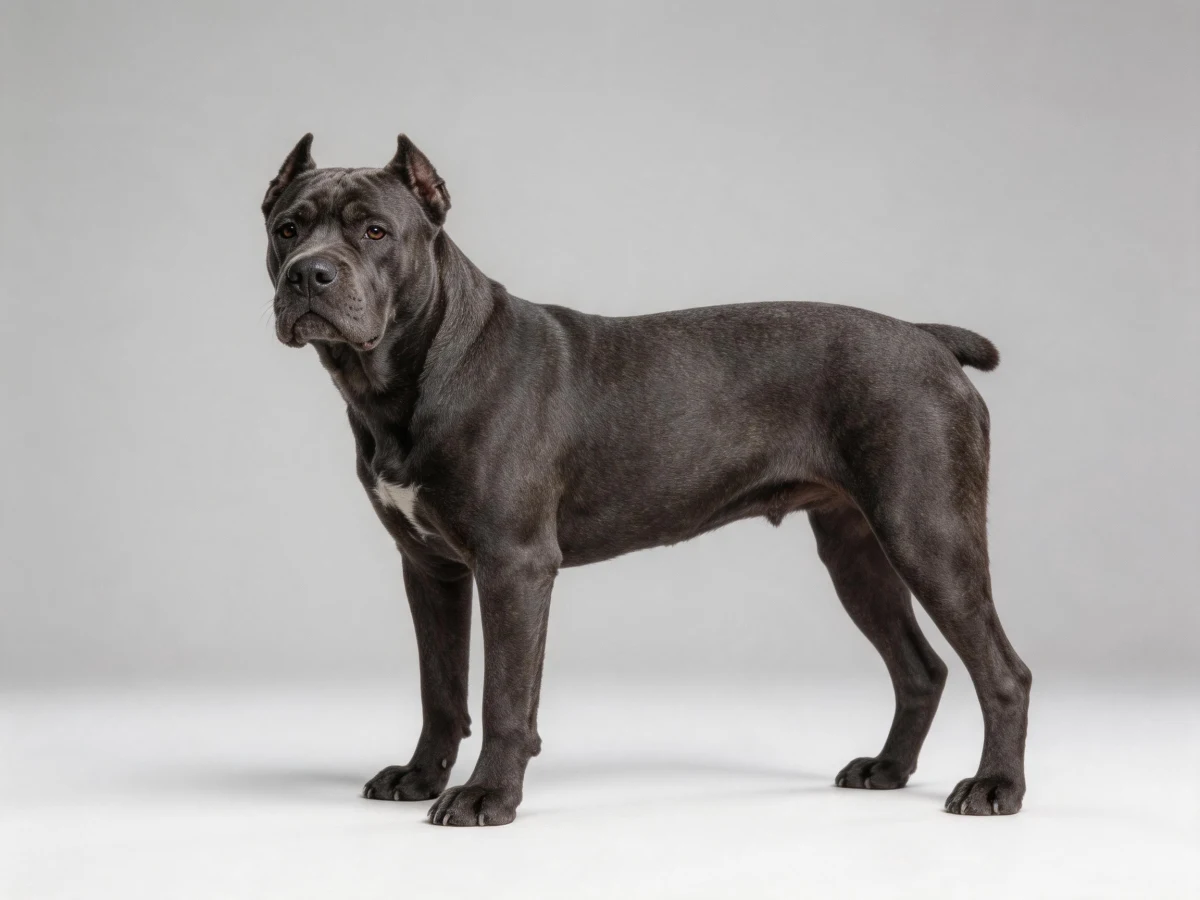
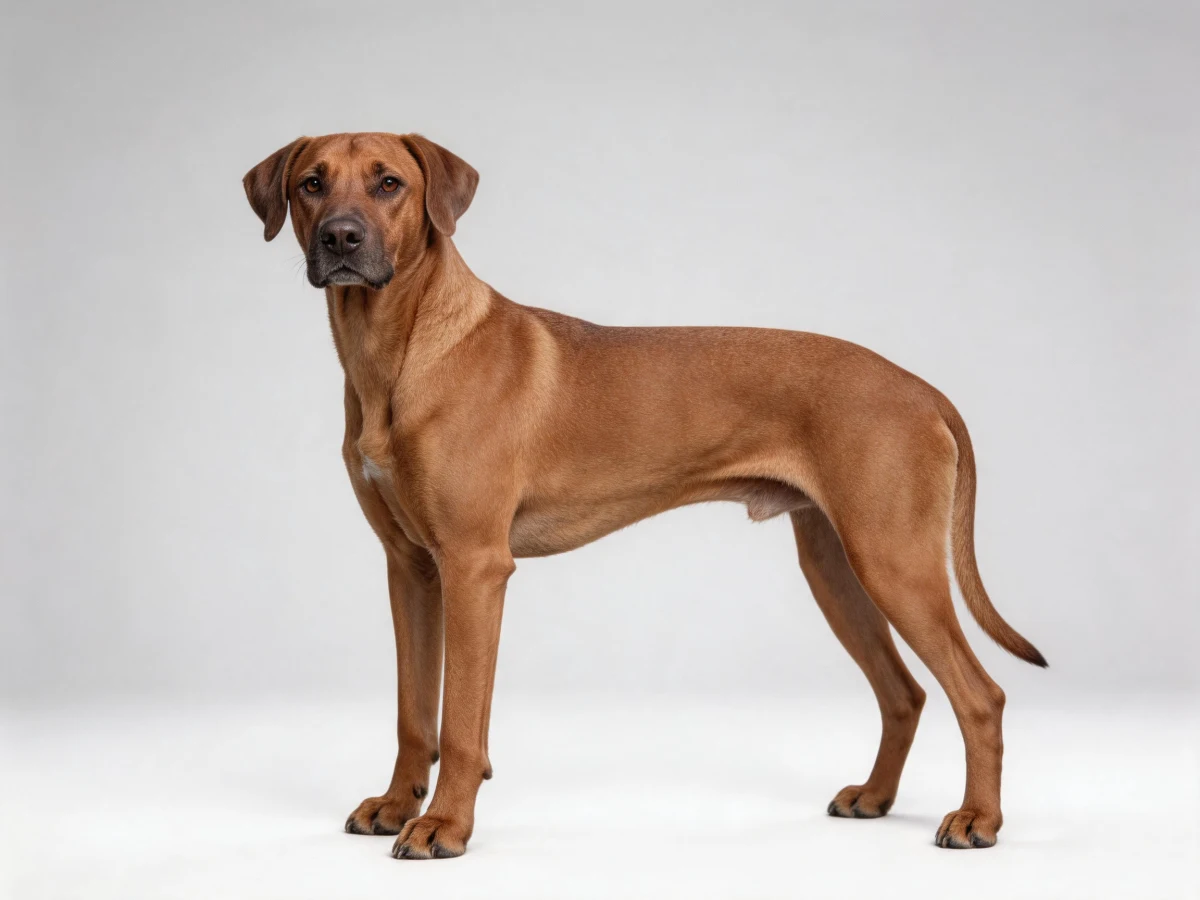
The breed standards describe the Boerboel as a large, strong, impressive dog of mastiff type — powerful and substantial but balanced, agile and free-moving rather than ponderous, with the unmistakable look of a confident guardian. Males are distinctly more masculine than females, and the dog should appear blocky, muscular and well-proportioned, carrying its size with athletic ease. Under the AKC and South African standards the ideal height is around 66 cm for a male and 61 cm for a female, with minimums set somewhat lower; weight is judged in proportion to height rather than to a fixed figure, with mature dogs commonly running from roughly 50 to 90 kilograms depending on sex and frame.
Head, body and coat
The head is a hallmark of the breed — broad, deep, square and blocky, with a short muzzle, well-developed cheeks and a powerful jaw, the whole impressive without being so exaggerated as to impede breathing or movement. The eyes are brown and set well apart, with a horizontal, watchful expression; blue eyes are a disqualification. The ears are medium, V-shaped and drop, carried close to the head. The body is deep and powerful with a strong topline; the tail is set high and may be left natural or, where law allows, traditionally docked. The coat is short, dense and smooth in fawn, red, brown, cream and brindle shades, often with a dark mask; under the AKC standard black is a disqualifying colour, while the South African SABBS registry permits it. Entropion, ectropion and an incorrect bite are also disqualifications, reflecting the standard’s emphasis on a healthy, functional guardian.
🏆 Recognition
Recognized by the American Kennel Club in 2015 as a Working breed.
Other registries
Breed clubs
❓ Frequently Asked Questions
Are Boerboels good family dogs?
With the right owner, yes — the Boerboel was bred on South African farms to guard the homestead and the people in it, and a well-raised one is devoted, gentle, and watchful with its own family, children included. The catch is that this is a 68–90 kg guardian with a strong protective drive, so it needs an experienced, confident owner, very early and extensive socialisation, and constant supervision around young children simply because of its size and territorial instinct. It is not a breed for a first-time dog owner.
Are Boerboels good guard dogs?
Guarding is the breed's entire reason for existing. The name comes from the Afrikaans for "farmer's dog," and the Boerboel was developed to protect an isolated homestead and its family from predators and intruders. It is confident, dominant, and naturally wary and territorial with strangers, which means it needs secure fencing and firm, calm, consistent leadership rather than encouragement. Some regions apply breed-specific legislation, higher insurance premiums, or liability rules to powerful guardian breeds; check your local rules before committing.
How much exercise does a Boerboel need?
More than its mastiff bulk suggests. The Boerboel is athletic for its type and needs daily structured exercise — a long walk plus a job to do, such as obedience work, scent games, or controlled play — to stay balanced. Without an outlet for its energy and its working mind it can become bored and difficult to manage. This is not an apartment breed or a dog-park breed; it does best with a securely fenced yard and an owner who builds activity into every day.
How long do Boerboels live?
Typically 9 to 11 years, which is normal for a giant guardian breed — large dogs simply do not live as long as small ones. Boerboels grow slowly and stay structurally immature for the first couple of years. The known health concerns to be aware of include hip and elbow dysplasia (the leading concern), eyelid problems such as entropion and ectropion, heart disease including dilated cardiomyopathy, and bloat; this is information to discuss with a breeder and vet, not a diagnosis.
Are Boerboels easy to train?
They are intelligent and learn quickly, but they are independent and dominant, so they are not an easy breed for a beginner. A Boerboel respects firm, calm, consistent leadership and reward-based methods; harsh handling tends to backfire with a strong-willed guardian and can damage trust. Early, ongoing socialisation and obedience are not optional — they are the difference between a controllable adult and an unmanageable one. Plan on training as a long-term commitment, not a puppy-class phase.
Do Boerboels shed a lot?
The Boerboel has a short, dense, smooth single coat that is genuinely low-maintenance — a weekly brush and the occasional bath keep it in good order. It does shed, though, so it is not a no-shedding or hypoallergenic breed. Routine care is mostly about the basics: keep the nails trimmed, the ears clean and dry, and the teeth seen to, and check the loose skin around the face and lips, which on a heavy-headed dog can need a little extra attention.
How much does a Boerboel puppy cost?
A well-bred, health-tested Boerboel puppy typically runs USD 1,500–4,500 (2024), with price varying by pedigree, registration, and breeder reputation. Buy from a breeder who screens for the recommended health evaluations — hip and elbow evaluations, an eye examination, and a cardiac evaluation — and who lets you meet the parents and assesses temperament. Be cautious of puppies priced far below that range with no health paperwork, and remember that the lifetime cost of feeding and insuring a giant guardian breed dwarfs the purchase price.
📚 Sources & Further Reading
Every load-bearing factual claim on this page is anchored to one of the sources below. iDogNames does not synthesize from secondary aggregators.
- akc breed page Boerboel — AKC Breed Profile — American Kennel Club (2024)
- akc breed page Boerboel History: Behind the South African Farm Dog — American Kennel Club (2021)
- breed club official Official Standard of the Boerboel — American Kennel Club (2015)
- breed club official South African Boerboel Breeders’ Society (SABBS) — South African Boerboel Breeders’ Society
- breed club official American Boerboel Club (AKC parent club) — American Boerboel Club
- breed club official Breed Standards: South African Boerboel — United Kennel Club
- veterinary org Boerboel (South African Mastiff) Dog Breed Health and Care — PetMD (2023)
- wikidata Boerboel (Wikidata) — Wikidata
- wikipedia Boerboel — Wikipedia — Wikipedia