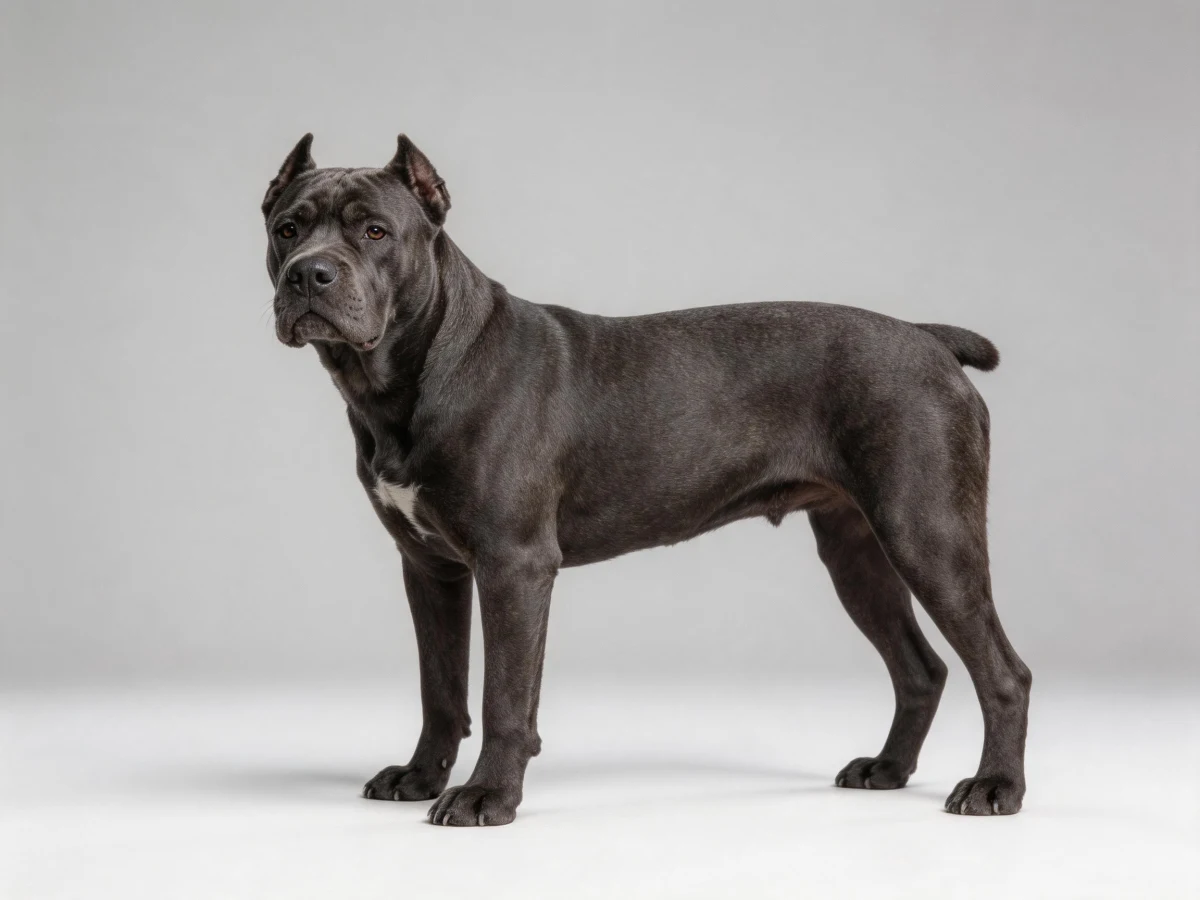
Bullmastiff
✨ Key Takeaways
- The Bullmastiff is a deliberately engineered late-Victorian English breed: built between roughly the 1860s and 1890s by gamekeepers on the great game-keeping estates to apprehend poachers, with a breed-club formula of about 60% English Mastiff and 40% Old English Bulldog by blood.
- The Kennel Club in the United Kingdom — the breed's home registry — recognised the Bullmastiff as a separate breed in 1924; the American Kennel Club followed a decade later in 1934. FCI Standard No. 157 places the dog in Group 2 (Molossoid breeds, Mastiff type).
- S. E. Moseley of Burslem and his Farcroft Kennel are credited with fixing the modern type c. 1900 through a documented multi-generation crossing programme, and William Burton's Thorneywood Kennels in Nottingham produced "Thorneywood Terror," the demonstration dog the breed's public reputation was built around.
- The breed was bred to hold, not to maul: a working nightdog needed to charge a poacher silently, knock him down, and pin him until the gamekeeper arrived. That working pattern explains the modern Bullmastiff's combination of low ambient aggression, hair-trigger response when triggered, and unusual indoor calm.
- The breed-defining health risks are large-Molossoid risks plus one signature inherited disease: subvalvular aortic stenosis (SAS) at very high prevalence in the breed (Stern et al. 2021 give an odds ratio of 52.43 and prevalence of 6.59% — among the highest of any breed), with gastric dilatation-volvulus, hip and elbow dysplasia, cystinuria, and a shortened life expectancy of around 8 to 10 years all on the screening list.
- The deepest naming heritage is late-Victorian and Edwardian English estate culture — gamekeeper occupational names (Keeper, Warden, Ranger, Forester) and the actual surviving Farcroft / Thorneywood pedigree register — not generic English given names.
Quick Facts
Common Names & Variants
Modern aliases
Historical names
Modern variants & lines
⚖️ Pros & Cons
Advantages
Trade-offs
Physical Appearance
Recognized colors
Coat
Other
Ears: Drop. Tail: Tapering (natural, not docked).
🕰 History
A working compromise: 60% Mastiff, 40% Bulldog
The Bullmastiff is one of the few modern breeds whose composition is recorded as a deliberate ratio rather than a vague claim of ancestry. By the second half of the 19th century the great English estates were in a poaching crisis: a series of harsh game-protection statutes — the Black Act of 1723, the Night Poaching Act of 1828, and the Game Act of 1831 — had made the taking of estate game a transportable, sometimes capital offence, and the response from rural workers facing genuine hunger was to poach at night in organised gangs, often armed. The gamekeepers tasked with stopping them were a small, scattered, mostly unarmed workforce on enormous holdings, and they needed a new kind of dog. The mastiff was too slow. The bulldog was too small. The gamekeeping community on estates across Nottinghamshire, Leicestershire, and the south-east of England spent the second half of the 19th century crossing the two — and the breed standard that emerged at the start of the 20th locked in a documented blend of roughly 60% English Mastiff and 40% Old English Bulldog. The number is breed-club tradition rather than a measured pedigree fraction, but it captures the deliberate engineering accurately. The new dog was called, in plain occupational English, "the gamekeeper's night dog."
The working pattern the keepers needed was specific. The dog had to be silent on the track — barking warned the poacher off — fast enough to close a distance across open parkland, and heavy enough to knock down a grown man and pin him to the ground without mauling him. The Mastiff gave the size and the holding instinct. The Bulldog gave the courage to close with an armed man and the willingness to throw weight forward into the charge. The mix gave both: a tracker that closed without warning, hit hard, and waited. Estate gamekeepers refined the type for forty years on real working ground before any kennel-club paperwork caught up.
S. E. Moseley and the Farcroft programme
The fixing of type from a working cross into a standardised breed was largely the work of Samuel Edwin Moseley, an English breeder operating out of the village of Burslem in Staffordshire from around the turn of the 20th century. Moseley\'s Farcroft Kennel ran a documented multi-generation breeding programme that crossed Mastiff with Bulldog, then crossed the offspring with selected Mastiffs and selected Bulldogs in a calculated rotation until the type bred true. The Farcroft prefix appears in the foundation pedigrees of the modern breed; the kennel produced the dogs the early breed clubs used as type-fixers; and Moseley\'s methodology, more than any single dog, is what allowed the gamekeeper\'s working cross to become a registered breed. By the early 1920s the type was stable enough that the question was no longer whether a Bullmastiff existed as a breed, only when the registries would catch up.
Thorneywood Terror, and how a breed earns a reputation
The breed\'s public reputation was built around a single dog, William Burton\'s "Thorneywood Terror" from the Thorneywood Kennels in Nottingham. In the late-Victorian and early-Edwardian period Burton put his dog through staged demonstration trials in which a man wearing protective clothing would attempt to escape from a Bullmastiff turned loose at a hundred yards — and Thorneywood Terror, by the surviving accounts, never lost. The press of the period (in pieces preserved in breed-club histories and reproduced in modern sources such as the National Purebred Dog Day breed essay) treated the dog as something of a celebrity. Some of the contest narrative is dramatised and the precise win-loss record cannot be independently verified at this distance, but the dog was real, the demonstrations were real, and Thorneywood Terror is the closest thing the breed has to a single founding celebrity.
1924 and the move from working dog to registered breed
The Kennel Club in the United Kingdom — the breed\'s home registry, given that the Bullmastiff is unambiguously a British breed — recognised the Bullmastiff as a separate breed in 1924. Recognition mattered: until that point a Bullmastiff registered through the KC had to be filed as a Mastiff or a Bulldog, depending on which parent it more resembled. The American Kennel Club followed in 1934, the same year it admitted the Brittany; the Fédération Cynologique Internationale assigned the breed Standard No. 157 in Group 2 (Molossoid breeds, Mastiff type) and granted formal recognition in 1955. By that point the working role had largely disappeared — poaching had collapsed as the great estates were broken up by death duties and two world wars — and the breed moved into the role it still occupies, as a heavyweight family guardian whose work is to be present rather than to charge.
The diamond mines, and a postscript
One historical footnote is worth recording because it shows the breed\'s working credibility outlived its English context. In 1928 the De Beers diamond company imported Bullmastiffs to South Africa to patrol its mine compounds — large, formidable, calm, and trainable enough to work alongside human security, exactly as English gamekeepers had used them on estates. The 1928 import is well-documented in mining-company records and in breed-club histories. It is the same dog, doing the same job, in a different climate; and it tells you what the gamekeepers had actually built.
Temperament & Personality
"Powerful but docile" — and what each word does
The AKC summarises the breed in three short adjectives — "affectionate, loyal, brave" — and the FCI Standard 157 expands it slightly: "high-spirited, alert and faithful." The American Bullmastiff Association adds the word "powerful but docile." Each of these descriptions is doing work. Docile, in the breed-club sense, does not mean soft. It means proportionate: the dog does not escalate without cause and does not stay escalated once the cause is gone. Powerful is the carrot of the warning — the dog\'s response, when it comes, is decisive. Faithful is the orientation: a Bullmastiff binds to its household and treats outsiders as outsiders by default. The temperament that comes out of all three words combined is the temperament the gamekeepers bred for: low ambient aggression, hair-trigger response when triggered, and unusual indoor calm.
Quiet by design
One trait that surprises new Bullmastiff owners is how little the breed talks. The working nightdog could not bark on the track. The modern Bullmastiff inherited the silence: it is not a stranger-announcer, not a fence-runner, not a nuisance vocaliser. When a Bullmastiff barks, the household should look up. The flip side of that silence is that the breed assesses, in a way most large guard breeds do not. A Bullmastiff watches a new person, processes the situation, and reaches a verdict; the verdict, once reached, is acted on quickly. This is why heavy-handed dog-park introductions or stranger-meets-dog improvisation tend to go badly with the breed. The dog is not slow; it is observant.
The household orientation
Bullmastiffs are described by long-time owners as "leaning dogs." They press into the people they love, sprawl across feet, and treat the family room as the centre of the universe. The breed is patient with children when raised with them — large enough that small children need to be taught to respect the dog\'s mass — and broadly tolerant of other household animals it has grown up with. Strangers entering the home unannounced are a different story, and the breed clubs are explicit that visitors should be introduced calmly by the resident humans rather than left to manage the introduction themselves. The dog is, by design, on guard duty in its own home.
Training, socialisation, and the seriousness of the project
The American Bullmastiff Association is firm: this is not a first dog. A 50-kilogram guardian breed in a household without experience reads situations the household cannot, and a Bullmastiff that has not been carefully socialised in puppyhood — to a wide variety of people, places, sounds, surfaces, and other animals — is not a relaxed adult. The breed responds to clear, calm, consistent handling and to early socialisation work measured in dozens of varied outings, not a single puppy class. Training itself is straightforward; the breed is biddable and not difficult to motivate. The work is in the socialisation and the early relationship-building. A correctly raised Bullmastiff is one of the easiest large dogs to live with. A neglected one is a public-safety problem rather than a training puzzle. The line between the two is the first eighteen months of the dog\'s life.
🏡 Living With a Bullmastiff
A 120-pound shadow that wants to lean on you
The Bullmastiff was built to work quietly at one handler's side, and that shapes everything about daily life with the breed. It bonds hard to a single household and follows its people from room to room, often parking its considerable weight against a leg or across a foot — this is a dog that guards by simply being present rather than by patrolling a fence line. For a calm, confident family it is a wonderful housemate: dignified, even-tempered indoors, and content to lie at the centre of things. But the same one-family loyalty means a Bullmastiff is poorly suited to being passed around, kennelled, or left alone for long working days; isolation and boredom turn that protective focus into anxiety and stubborn, destructive habits. This is emphatically not a first dog for a passive or absent owner.
Powerful, but not a high-energy breed
Unlike the working herders and sporting dogs it is often grouped with, the Bullmastiff has a moderate, easily satisfied exercise need. Two unhurried walks a day plus some yard time keep an adult fit and settled — this is a low-stamina powerhouse, not an endurance athlete, and it will happily doze for much of the afternoon. Growing puppies need particular restraint: forced running, long jogs, repetitive jumping, and stairs should be avoided while the joints are still maturing, because a giant frame laid down too fast is a frame set up for trouble. The single most important rule attached to that exercise is heat. The Bulldog in the breed's makeup left it with a shortish muzzle and real heat intolerance, so exertion on a hot, humid day is genuinely dangerous; work the dog in the cool of early morning or evening and never let it labour in midday sun.
Children, other pets, drool, and space
Raised with children and properly socialised, a Bullmastiff is patient and gentle with its own family's kids, though its sheer mass means it can knock a toddler flat by accident, so supervision is about size as much as temperament. Same-sex dog aggression and a strong response to perceived intruders are realistic with the breed, which makes early, ongoing socialisation non-negotiable. Two housekeeping truths come with the territory: this is a drooler that slings slobber after drinking and in the heat, and a snorer whose breathing you will hear across the room. It can live in a flat if walked and kept cool, but a 110-to-130-pound body needs floor space, and the budget for food, gear, and veterinary care scales with the dog.
🎓 Training & Exercise
An independent thinker that needs a leader, not a drill sergeant
The Bullmastiff was bred to make its own decisions in the dark — to find a poacher, close the distance silently, and act without waiting for a command — and that legacy lives on as a confident, somewhat independent dog that sizes up whether it agrees with you. It is intelligent and capable, but it is not the eager, repetition-loving worker a Border Collie is, and it bores quickly with rote drilling. What it responds to is calm, consistent, genuinely confident leadership established from puppyhood. Rules set early and held without wavering produce a steady adult; rules that bend produce a 120-pound dog that has quietly decided it outranks you. Harsh, confrontational handling is both pointless and risky with a powerful guarding breed — it damages trust and can provoke exactly the defensiveness you want to avoid.
Socialisation is the real training project
For most breeds, socialisation is one item on the puppy list; for a Bullmastiff it is the central one. A dog this large and this naturally protective must learn, through wide and positive early exposure, that visitors, delivery workers, other dogs, and unfamiliar settings are normal and not threats — so that its guarding stays a matter of presence and judgement rather than reaction. A well-socialised Bullmastiff is discerning and unflappable; an under-socialised one is a liability in a body that cannot be physically overpowered. Puppy classes, controlled meetings, and steady real-world outings through the first year build the off switch that the breed's confidence depends on.
The commands that matter most
Keep sessions short, motivating, and food-rewarded — Bullmastiffs are food-driven, which is the lever that makes a stubborn dog cooperative. Loose-lead walking is a priority taught while the puppy is light enough to manage, because no owner out-muscles a grown Bullmastiff that has learned to pull. A reliable "leave it" and a solid "place" or settle give you control over the guarding instinct in the doorway and around guests. Reward calm behaviour heavily, since a relaxed Bullmastiff is the goal, and finish training while you still have the dog's attention rather than grinding on until it disengages.
✂️ Grooming & Coat Care
A short coat that is genuinely low-effort
Grooming is one area where the Bullmastiff is forgiving. The coat is short, dense, and weather-resistant, lying flat and tight to the body, and a once-weekly going-over with a rubber curry or a bristle brush removes loose hair, lifts dander, and keeps the skin healthy while giving you a routine chance to feel for lumps, scrapes, or hot spots on a dog whose size makes problems easy to miss. Despite the short coat the breed does shed — modestly year-round and a little more heavily on a seasonal swing — so a weekly brush plus the occasional extra session during a shed is the whole story; there is no undercoat blow to dread and no professional clipping to budget for. Bathe only when the dog is actually dirty, every couple of months or so; the coat carries its own protective oils and does not need frequent washing, and over-bathing simply dries the skin.
The face is where the work is
The real grooming attention goes not to the coat but to the head. A Bullmastiff carries facial wrinkles and heavy jowls (flews), and any skin fold that traps moisture, food, or saliva can grow sore and infected if it is left damp. Wipe the wrinkles and the folds around the muzzle clean and then dry them on a regular schedule, and check them whenever the dog has been eating or drooling heavily. Those same jowls are why this breed slobbers: keeping a cloth handy and wiping the muzzle after meals and water is simply part of life with a Bullmastiff, and it also keeps the facial skin healthier.
Ears, nails, teeth, and the eyes
Check and gently wipe the ears weekly, since the V-shaped drop ears hold warmth and moisture against the canal, and dry them carefully after baths. A giant breed lays a lot of weight onto its feet, so keep nails trimmed back to where they do not click on the floor — overlong nails change a heavy dog's stance, splay the toes, and stress the joints — and start the habit in puppyhood so a fully grown dog accepts the handling. Brush the teeth several times a week from puppyhood; dental care is one of the highest-value lifelong habits for any dog, and a calm Bullmastiff that has been handled since it was small makes it far easier. Watch the eyes, too: the breed is prone to entropion, an inward-rolling eyelid that turns the lashes against the surface of the eye, so any persistent squinting, redness, pawing, or tearing is worth a veterinary look rather than a wait-and-see.
🍖 Diet & Nutrition
Slow, lean growth is the headline
The defining nutritional issue for a Bullmastiff is how it is grown, not merely how it is fed as an adult. A puppy that will mature past 100 pounds must be raised slowly and kept lean on a diet formulated for large- or giant-breed growth, because excess calories and excess calcium during the growth window are linked to developmental joint and bone problems in big dogs. The aim is steady, controlled growth and a puppy you can feel the ribs on — not the fastest, roundest puppy possible. Plan on a large-breed puppy formula through the extended growth period and follow a breeder's or veterinarian's guidance on when to transition, rather than rushing the dog onto adult food.
Bloat risk shapes the feeding routine
As a deep-chested giant, the Bullmastiff carries a real risk of bloat and gastric torsion (GDV), a sudden, life-threatening emergency, and that risk dictates how meals are run. The standard precautions are practical: feed two or three smaller meals across the day instead of one large one, avoid vigorous activity in the hour before and after eating, and slow a fast eater with a slow-feeder bowl or a food puzzle. Owners should know the warning signs cold — a swelling or distended belly, unproductive retching, pacing and obvious distress — and treat them as an immediate veterinary emergency, not something to watch overnight. Many owners of deep-chested giants discuss a preventive gastropexy with their veterinarian; that is a conversation for the clinic, not the kitchen.
Adult feeding and the weight line
Through adulthood the watchword is keeping the dog lean. Every spare pound on a frame of 90 to 130 pounds presses on hips and elbows already predisposed to dysplasia, so feed measured meals against ideal body condition rather than free-feeding, and budget treats inside the daily ration. Body-condition scoring by feeling for the ribs and a waist beats trusting the eye on a dog this massive. Keep fresh water constantly available, especially in warm weather given the breed's heat sensitivity, and make any diet change gradually over a week to avoid upsetting a large, sensitive gut.
🐶 Buying & Adopting a Bullmastiff
Begin at the parent club
The American Bullmastiff Association (ABA) is the AKC parent club and the right starting point for a puppy or for rescue. The ABA maintains a code of ethics for member breeders, a breeder-referral resource, and a rescue network. A breeder worth your money will be an ABA member in good standing, will register litters with the AKC, will health-test both parents and show you the paperwork, will raise the litter underfoot with early socialisation, and will question you closely about your home — because a responsible Bullmastiff breeder knows the breed is wrong for many buyers and screens for it. Expect a contract, a health guarantee, and a breeder who talks frankly about the breed's hard realities rather than promising trouble-free lines.
The exact health screening to ask for
The CHIC screening profile for the Bullmastiff covers five areas, and a conscientious breeder can produce results on both parents for all of them: an OFA hip evaluation and an OFA elbow evaluation for dysplasia; an OFA cardiac evaluation read by a boarded veterinary cardiologist, which screens for subaortic stenosis (SAS), a heart defect the breed is watched for; an eye examination by a boarded ophthalmologist through OFA/ACVO; and an OFA thyroid panel. Many breeders add a DNA test for cystinuria where it is available for the breed. It is also fair to ask about the breed's cancer record — lymphoma and mast cell tumours are over-represented in Bullmastiffs — and to ask how long the dogs in a line have lived, given a typical lifespan of just 8 to 10 years. A breeder who lays the OFA results on the table and discusses cancer and longevity openly is the one to trust; "our dogs are healthy, they don't need testing" is the answer to walk away from.
Rescue and the realistic costs
Bullmastiff rescue runs through the ABA's rescue network and regional breed-rescue groups, and it regularly takes in adolescents and adults surrendered by owners who underestimated the size, the drool, the cost, or the strength of will. For an adopter who can handle a large guarding breed and wants a dog whose temperament is already an open book, breed rescue is an excellent and ethical route. Whichever path you choose, go in clear-eyed about cost: giant dogs mean giant food bills, heavy-duty gear, larger doses of everything at the vet, and the emotional weight of a short lifespan.
Price, waiting lists, and red flags
A well-bred Bullmastiff puppy in the United States runs roughly USD 1,500–3,500 as of 2024, depending on region, lineage, and the parents' titles and health clearances, and good breeders keep waiting lists. The patterns to avoid are the usual ones: puppies priced well under that range with immediate availability, no OFA or health-testing documentation, no parent-club affiliation, and a seller more interested in the deposit than in vetting your home. A fair price from a health-testing ABA breeder — even after months of waiting — is far cheaper than the bills and heartbreak that follow a carelessly bred giant guarding dog.
📜 Breed Name Etymology — iDogNames original research
The name is a literal trade description
Unlike most breed names, Bullmastiff is not a place, not a founder\'s surname, not a borrowed foreign word — it is a working compound. Bull is the Bulldog parent, Mastiff is the Mastiff parent, and the two together name the cross the gamekeepers spent forty years fixing into a breed. The compound first appears in print in mid-19th-century English sporting writing — earlier as the two-word form "bull and mastiff" or "bull-mastiff," later as the single-word "Bullmastiff" the kennel clubs adopted. By the time The Kennel Club recognised the breed in 1924, the spelling had settled. There is no hidden Latin root, no Saxon survival, no etymological mystery: the dog is named for what was crossed to make it.
The component words themselves carry deeper roots. Mastiff reaches back to Anglo-Norman mastif and Old French mastin, ultimately from Latin mansuetus ("tame, domesticated"), reflecting the fact that the molossoid dogs of antiquity were already a separate class by Roman times. Bulldog is younger and English: a 17th-century coinage for the dogs used in the now-banned sport of bull-baiting. The two etymologies, joined, produce a name that is also a brief history of the dog: a tamed-molossoid line crossed with a bull-baiting line for a job neither could do alone.
The "Gamekeeper\'s Night Dog"
For decades before "Bullmastiff" stabilised as the formal name, the breed went by its occupational nickname: the gamekeeper\'s night dog. The phrase is the most accurate description ever attached to the breed — it identifies the user (the gamekeeper), the working hour (night), and the role (a dog rather than a pack) in eight words. The phrase still appears throughout breed-club literature, in the title of the AKC\'s expert-advice article "Bullmastiff History: From World-Class Protector to Family Companion," and in the National Purebred Dog Day breed essay\'s subtitle. It survives because it is precise.
The Farcroft prefix and the historical pedigrees
One small etymological layer in the breed is the kennel-prefix tradition that fixed the modern type. S. E. Moseley\'s Farcroft Kennel, operating out of Burslem in Staffordshire around 1900, produced foundation dogs that carry the Farcroft prefix in their registered names — Farcroft Fidelity, Farcroft Felons Frayeur, and so on. William Burton\'s Thorneywood Kennels in Nottingham produced the Thorneywood-prefix dogs, most famously the demonstration dog Thorneywood Terror. These prefixes are not breed names in the technical kennel-club sense, but they are historical sub-names that any serious Bullmastiff pedigree will eventually trace through, and they are part of the breed\'s naming heritage in the same way that "the Tweed family" is part of the Golden Retriever\'s.
Pronunciation, and the aliases that signal trouble
In English the breed name is /ˈbʊlˌmæstɪf/ — "BULL-mass-tiff," two equally stressed syllables, no Latin or French overlay. The two-word form "Bull Mastiff" is archaic but not wrong; nineteenth-century sporting writers used it interchangeably with the single-word form, and the AKC, KC and FCI all use the single-word form in current breed-name registers. The aliases worth flagging are commercial: any breeder advertising a "miniature Bullmastiff," a "rare blue Bullmastiff," or an "American Bullmastiff" as a distinct breed is selling something the FCI and KC standards do not recognise. The breed is the breed; it comes in fawn, red, or brindle with a black muzzle, and there are no size or coat varieties beyond that.
Name forms at a glance
| Name | Role | Origin | Literal meaning | First recorded |
|---|---|---|---|---|
| Bullmastiff | primary | English (working compound) | the Bulldog-Mastiff cross | 1924 |
| Gamekeeper's Night Dog | historical | English (occupational) | the dog the gamekeeper used at night | — |
| Bull Mastiff | historical | English (archaic) | bull-and-mastiff cross | — |
| Mastiff | alias | Anglo-Norman / Old French / Latin | the tamed (molossoid) dog | — |
| Bulldog | alias | English (17th century) | the dog used on bulls | — |
🏛 Naming Traditions — iDogNames original research
A late-Victorian English estate naming culture
The Bullmastiff\'s naming heritage is unusually specific because the breed\'s working context was unusually specific. The dogs were bred for a single profession (the English gamekeeper), on a single kind of property (the great game-preserve estate), in a single half-century (the late Victorian and Edwardian periods), and in a single country (England, with a centre of gravity in the Midlands and the south-east). That tight historical focus gives the breed a single, coherent naming culture to draw on — the names of the gamekeepers themselves, the estates they served, the gamekeeping occupation, and the actual surviving pedigree register from Moseley\'s and Burton\'s kennels. A Bullmastiff wearing a Late-Victorian English estate name is wearing its real cultural origin. A Bullmastiff called Buddy or Bella could be any breed in any country. There are four lineage-backed naming layers an owner can draw from.
Gamekeeper occupational names
The first and most lineage-true layer is occupational: the actual job titles and working vocabulary of the late-Victorian gamekeeper. These are short, dignified, English, and they belong to the breed in a way no other naming convention does. Strong choices include Keeper (the simple occupational name; deeply traditional on working estates), Warden (the senior estate role; weighty), Ranger (the open-ground patrol; clean two syllables), Forester (the inland-woods role), Sentinel (the night-watch posture; the breed\'s working stance), Watchman, Bailiff (the legal-enforcement role on estates), and the implements Lantern (the gamekeeper\'s essential nightdog accessory), Beacon, and Tracker. Each is doing genuine work; none feels arbitrary on this breed.
The historical breed register — Farcroft and Thorneywood
The second layer is the documented breed pedigree itself, drawn from S. E. Moseley\'s Farcroft Kennel and William Burton\'s Thorneywood Kennels. Real historical Bullmastiff names from those programmes that survive in published pedigrees include Terror (after the famous Thorneywood Terror, William Burton\'s demonstration dog), Fidelity, Frayeur (French for "fright" — a Farcroft kennel name), Defender, Roger, Athos, Bruno, and the surname-style choices Burton (for William Burton himself) and Moseley (for S. E. Moseley). These are not invented; they appear in the foundation pedigrees the AKC and KC trace the modern breed back through, and they give a Bullmastiff a name with an actual breed-historical referent.
The Victorian English estate register
The third layer reaches for the country houses and the rural-aristocratic culture the breed served. The famous English estate names give grounded, breed-appropriate male and female options: Belvoir (the Duke of Rutland\'s seat in Leicestershire, one of the great hunting estates), Chatsworth (the Devonshire seat in Derbyshire), Sandringham (the royal estate in Norfolk), Knole (the Sackville seat in Kent), Audley, Holkham, Petworth, and Longleat. The Victorian English surname register — the names the keepers themselves and the estate stewards bore — gives short, dignified options like Bramble, Sully, Quigley, Whitcombe, Ashford, and Sherborne. These suit a dog whose entire heritage is the English country estate.
The legal and historical register
The fourth layer reaches into the legal framework that made the breed necessary. The three game-protection statutes — the Black Act of 1723, the Night Poaching Act of 1828, and the Game Act of 1831 — give occasion for the rare male name Black (a legal-historical reference, not a colour), as well as the related vocabulary of the nightdog\'s world: Mosely (after S. E. Moseley), Crown (the legal entity that prosecuted poaching), Marshal, and Constable. For female names from the broader Victorian and Edwardian period the breed clubs\' historical pedigrees give choices like Hester, Maud, Beatrix, Cora, Edith, and Hannah. Each is honestly period-appropriate; none feels imported from a different breed culture.
What this means for naming a Bullmastiff today
The breed offers something that no other Molossoid has: a single, coherent, late-Victorian English estate naming culture with documented pedigree referents. An occupational name (Keeper, Warden, Sentinel) is the deepest and most lineage-true choice. A historical-register name from the actual breed founders (Terror, Frayeur, Burton) ties the dog to the people who built the type. An estate name (Belvoir, Knole, Chatsworth) places the dog in the country culture that made the role real. The names with no Bullmastiff resonance are the borrowed-from-other-breeds choices — Italian Cane Corso names, French Dogue de Bordeaux names, or German Rottweiler names — that flatten the actual English estate heritage that distinguishes this breed from every other large guardian.
🐾 Themed Names for Your Bullmastiff — iDogNames original research
Gamekeeper occupational names
The breed\'s deepest naming layer: the actual working vocabulary of the late-Victorian English gamekeeper. Short, dignified, and lineage-true.
- Keeper — the literal gamekeeper occupational name; the most accurate working name for the breed
- Warden — the senior estate role; carries authority
- Ranger — the open-ground patrol; clean two syllables
- Sentinel — the night-watch posture; the breed\'s working stance in one word
- Forester — the inland-woods role; gentler than Warden
- Bailiff — the legal-enforcement role on estates; archaic but lineage-true
- Watchman — the basic night-watch role; plain and dignified
- Lantern — the gamekeeper\'s essential nightdog accessory; an unusual but real choice
- Beacon — for a fawn or red coat; tied to the night-watch imagery
- Tracker — the breed\'s primary working skill; modern but functional
Historical pedigree register — Farcroft and Thorneywood
Names drawn from the actual published pedigrees of S. E. Moseley\'s Farcroft Kennel and William Burton\'s Thorneywood Kennels. Real, documented breed names.
- Terror — for Thorneywood Terror, William Burton\'s famous demonstration dog of the late Victorian period
- Fidelity — a recorded Farcroft kennel name; one of the dignified breed-historical choices
- Frayeur — French for "fright"; a documented Farcroft kennel name
- Defender — a recurring early Bullmastiff registered name; literal and lineage-true
- Burton — for William Burton of the Thorneywood Kennels in Nottingham
- Moseley — for S. E. Moseley of the Farcroft Kennel in Burslem; the breed-fixer\'s surname
- Thorneywood — the Burton kennel prefix; for a male of dignified bearing
- Farcroft — the Moseley kennel prefix; the breed-historical referent in a single word
- Athos — a Three Musketeers name that appears in early breed pedigrees
- Roger — a recurring early-pedigree name; period-appropriate Victorian
Great English estate names
The estates the gamekeepers actually served. Place-true, weighty, and immediately period-recognisable.
- Belvoir — the Duke of Rutland\'s seat in Leicestershire; a great hunting estate
- Chatsworth — the Devonshire seat in Derbyshire; one of England\'s grandest houses
- Sandringham — the royal estate in Norfolk; for a dog with serious bearing
- Knole — the Sackville seat in Kent; one short, dignified word
- Holkham — the Earl of Leicester\'s estate in Norfolk; severe and historic
- Audley — the famous English country house name; clean and authoritative
- Petworth — the Egremont seat in Sussex; for a female of quiet authority
- Longleat — the Marquess of Bath\'s seat in Wiltshire; lyrical for an estate name
- Burghley — the Cecil family seat in Lincolnshire; the political dynasty\'s house
- Welbeck — the Portland seat in Nottinghamshire; the heart of Bullmastiff country
Victorian English given names
Period-appropriate Victorian and Edwardian given names that belong to the breed\'s home decades.
- Hester — a quintessentially Victorian female name; literary and grounded
- Maud — the Tennyson-poem name; short, dignified, period-true
- Beatrix — Edwardian; for a female of serious presence
- Cora — a Victorian given name that suits a smaller female
- Edith — the Hugh Walpole / Edith Wharton period; soft but authoritative
- Hannah — a Victorian-respectable name that fits the breed\'s steady temperament
- Albert — for Prince Albert; the Victorian-era male anchor
- Edmund — period-appropriate English; lyrical two syllables
- Walter — late-Victorian English; widely used in the gamekeeping families
- Arthur — for a male of bearing; period-true Edwardian
Legal and historical register
Names from the legal framework and the broader Victorian rural world that made the breed economically necessary.
- Black — for the Black Act of 1723, the harsh game-protection statute; legal-historical reference
- Crown — the legal entity that prosecuted poaching; a single dignified word
- Marshal — the rural law-enforcement role; clean two syllables
- Constable — the village officer; period-true English
- Magistrate — the rural justice; for a male of authoritative bearing
- Sheriff — the county officer; weighty and historic
- Justice — the abstract concept made into a working name; bold
- Tudor — the historic dynasty; English and grounded
- Stuart — the royal house; period-historic English
- Wellington — the Iron Duke; the male anchor for a dog of military bearing
📋 Breed Standard at a Glance
General appearance
The AKC standard describes the Bullmastiff as a powerful, symmetrical animal that shows great strength but not clumsiness — substantial and active, with the build of a dog meant to overtake and hold rather than simply intimidate. Originally developed in 19th-century England as the gamekeeper's night dog by crossing roughly 60 percent Mastiff with 40 percent Bulldog, it reads as a compact, square-bodied guardian: deep and broad through the chest, level on the back, and unmistakably a working dog under its calm exterior.
Size, coat, and colour
Males stand about 25 to 27 inches at the withers and weigh roughly 110 to 130 pounds; females stand about 24 to 26 inches and weigh about 90 to 110 pounds. The coat is short, dense, and weather-resistant, lying close to the body. Three colours are accepted — fawn, red, and brindle — and a dark muzzle, the black "mask" fading toward the eyes, is a defining feature of the breed; the FCI standard requires that black mask in all three colours. A small white mark on the chest is permitted, while other white markings are faulted.
Head, movement, and temperament
The head is large and square with a broad, deep skull, a short, broad muzzle, and a fair amount of wrinkle when the dog is alert, set off by dark, medium-sized eyes and V-shaped ears carried close to the cheeks. Movement is free, smooth, and powerful, suggesting the speed the breed once needed to close on a poacher. Temperament is written into the standard: the Bullmastiff should be a fearless yet docile family guardian — confident, devoted, and high-spirited without being aggressive, courageous in defence of its people yet steady and reliable at home.
🏆 Recognition
Recognized by the American Kennel Club in 1934 as a Working breed. FCI standard No. 157 (Section 2.1 — Molossoid breeds, Mastiff type), recognized in 1955.
Other registries
Breed clubs
❓ Frequently Asked Questions
Are Bullmastiffs good family dogs?
Yes, for the right family. A Bullmastiff is a devoted, calm, naturally protective companion that bonds closely to its household and is gentle with its own children when raised with them — though its size means it can knock a small child over by accident, so supervision matters. It is not a good fit for a passive or first-time owner, because this powerful guarding breed needs confident, consistent leadership and early socialisation from the start.
Do Bullmastiffs shed a lot?
Only modestly. The short, dense coat sheds a little year-round and somewhat more on a seasonal swing, and a weekly brush with a rubber curry or bristle brush keeps it under control. The bigger grooming chore is not hair but drool: the breed slobbers and snores, and its facial wrinkles and jowls need regular wiping and drying to stay healthy.
How much exercise does a Bullmastiff need?
Moderate. Despite its power, the Bullmastiff is not a high-energy breed; two unhurried daily walks plus some yard time suit an adult. Avoid forced running, hard jumping, and stairs while a puppy is still growing, and never exercise the dog hard in heat — its shortish muzzle and Bulldog heritage make it heat-intolerant, so work it in the cool of the morning or evening.
How long do Bullmastiffs live?
Typically 8 to 10 years. Like most giant breeds the Bullmastiff is relatively short-lived, and the breed is also watched for cancers such as lymphoma and mast cell tumours, along with hip and elbow dysplasia, bloat, and the heart condition subaortic stenosis. Keeping the dog lean and buying from a health-testing breeder go a long way toward a sound life.
Are Bullmastiffs easy to train?
They are intelligent but independent-minded rather than eager to repeat drills, so they need calm, consistent, confident handling from puppyhood rather than harsh correction. The breed is food-motivated, which makes short, reward-based sessions effective. Early and ongoing socialisation is the most important training project for a dog this large and naturally protective.
Are Bullmastiffs hypoallergenic?
No. The Bullmastiff sheds and drools and is not considered hypoallergenic. Anyone with a dog allergy should spend extended time around the breed before committing, keeping in mind that the slobber and dander come with the territory.
How much does a Bullmastiff puppy cost?
A well-bred, health-tested puppy from a parent-club breeder typically runs about USD 1,500 to 3,500 as of 2024, often with a waiting list. Be wary of puppies priced well below that with immediate availability and no OFA health-testing paperwork, and budget beyond the purchase price: a giant breed means larger food, gear, and veterinary bills for life.
📚 Sources & Further Reading
Every load-bearing factual claim on this page is anchored to one of the sources below. iDogNames does not synthesize from secondary aggregators.
- akc breed page Bullmastiff — AKC Breed Profile — American Kennel Club (2024)
- akc breed page Bullmastiff History: From World-Class Protector to Family Companion — American Kennel Club (2023)
- fci standard pdf FCI Standard No. 157 — Bullmastiff — Fédération Cynologique Internationale (2010)
- kc uk standard pdf Bullmastiff — Breed Information (home registry) — The Kennel Club (UK)
- breed club official American Bullmastiff Association — parent club and health database — American Bullmastiff Association
- academic paper Non-dietary risk factors for gastric dilatation-volvulus in large and giant breed dogs — Glickman LT et al., JAVMA 217(10):1492-9 (2000)
- academic paper Genetics of canine subvalvular aortic stenosis (SAS) — Stern JA et al., Canine Medicine and Genetics (2021)
- wikipedia Bullmastiff — Wikipedia — Wikipedia
- other The Bullmastiff's Name (breed-historical essay) — National Purebred Dog Day
- book The Bullmastiff Manual — Bill Wynn (Ringpress Books) (1999)