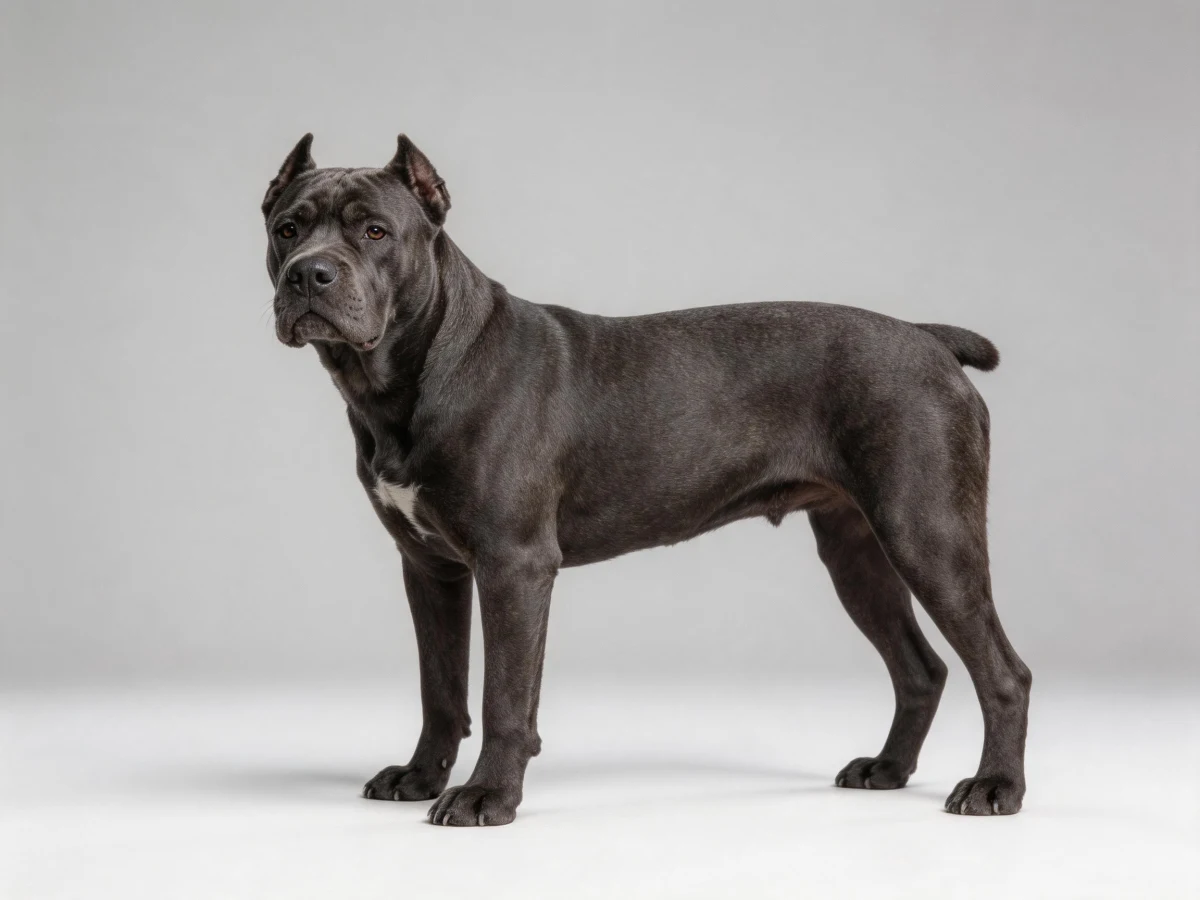
Mastiff
✨ Key Takeaways
- The modern Mastiff was preserved less by a kennel club than by one family: the Leghs of Lyme Hall in Cheshire kept a documented strain for centuries, and that line fed directly into the breed the Old English Mastiff Club fixed in 1883.
- The dog's real working history is blunt — bull-, bear- and lion-baiting and estate guarding — not the "gentle giant" label that came after the 1835 Cruelty to Animals Act ended baiting in Britain.
- The breed was twice nearly lost: from 1906 to 1918 only 24 Mastiffs were registered in the United States, and after the Second World War a single surviving British bitch puppy, Nydia of Frithend, reached maturity. North American — chiefly Canadian — stock rebuilt the breed.
- The American Kennel Club recognised the Mastiff in 1885; the Mastiff Club of America CHIC panel (hips, elbows, heart, eyes, thyroid) is the buyer's checklist today.
- This is a short-lived giant. UK primary-care data puts median longevity around 7–9 years, with cardiac disease, bloat, joint disease and osteosarcoma the dominant end-of-life causes.
- A correct Mastiff is calm, undemonstrative and immovable rather than animated — a guarding dog whose deterrent is presence and judgement, not noise or reactivity.
Quick Facts
Common Names & Variants
Modern aliases
Historical names
Modern variants & lines
⚖️ Pros & Cons
Advantages
Trade-offs
Physical Appearance
Recognized colors
Coat
Other
Ears: Drop. Tail: Natural, tapering.
🕰 History
One family kept the breed alive
Most breed histories thank a kennel club. The Mastiff owes its continued existence, more honestly, to a single English family and one house in Cheshire. The story the Mastiff Club of America and Wikipedia both anchor to begins on a battlefield: when Sir Peers Legh was wounded at Agincourt in 1415, his Mastiff is said to have stood over him through the fighting and was carried home to Lyme Hall, the Legh family seat near Stockport. Whether the Agincourt anecdote is literal or family legend, the consequence is documented and verifiable — the Leghs maintained a recorded strain of Mastiffs at Lyme Hall, the "Lyme Hall Mastiffs," for roughly five centuries, and that pedigree, in the AKC's own words, "figured prominently in founding the modern breed." When clubmen needed foundation stock in the 1880s, the Lyme Hall line was where they went.
Before the Legh strain there is the usual fog. A claim repeated in nearly every Mastiff source is that Caesar's invasions of Britain in 55 and 54 BC produced Roman accounts of large British war dogs, which were shipped back to fight in the arena. It is plausible and it is old, but it is not a pedigree — there is no continuous documented line from a Roman British war dog to the Lyme Hall kennel, and the careful version of the breed's origin starts with the molosser type in medieval England, not with Caesar.
What the dog actually did: the bear gardens
The Mastiff's working past is not gentle, and the breed's history is poorly served by pretending otherwise. From Roman through medieval and Tudor times, mastiff-type dogs in Britain were used in bull-baiting, bear-baiting, lion-baiting and dog fighting, alongside hunting and guarding. The medieval "bandog" — the word survives as a synonym — was the heavy dog kept chained (banded) by day and loosed at night to guard. Henry VIII and the Tudor and Elizabethan courts kept baiting dogs; the London bear gardens were a public industry. This is the genuine working résumé. The breed did not become a guardian and companion until its bloodsport was legislated out of existence: the Cruelty to Animals Act of 1835 ended legal baiting in Britain, and the surviving Mastiff population shifted, over the next two generations, into estate guarding and the show ring.
A standard, a club, and the Crystal Palace
The modern, written breed begins in the Victorian dog-fancy. A meeting of leading Mastiff owners and breeders was called at the Crystal Palace on 19 January 1883, and the Old English Mastiff Club — still the breed's senior club and the oldest Mastiff organisation anywhere — was formed and produced a breed standard that year, amended in 1890. The Kennel Club in Britain had already been registering the breed (the KC was founded in 1873). The naturalist and Mastiff historian M.B. Wynn published The History of the Mastiff in 1886, still the most-cited early monograph on the breed. By the 1880s the Mastiff had a club, a written standard, and a documented foundation in the Lyme Hall line — it was, on paper, secure.
Crossing the Atlantic, and the first collapse
The American Kennel Club recognised the Mastiff in 1885, the year after the AKC itself was founded, making it one of the earliest breeds on the registry. The early American population was thin and grew thinner. From 1906 to 1918 only 24 Mastiffs were registered in the United States, and after 1910 none of those were American-bred — the breed in North America was effectively being topped up from Britain rather than self-sustaining. In 1918 a dog called Beowulf, bred in Canada from the British imports Priam of Wingfield and Parkgate Duchess, was AKC-registered, an early sign that Canadian breeding would later matter more than anyone then expected.
The Second World War nearly finished it
The breed's closest brush with extinction came not from a railway timetable or a fashion cycle but from rationing. British wartime food shortages made keeping a 70-to-100-kilogram dog almost impossible; the AKC's own history notes owners "barely had enough rations to feed themselves, much less dogs," and large breeds were among the first casualties. By the end of the Second World War the Mastiff was nearly extinct in its own country: only a single bitch puppy from the surviving elderly stock, Nydia of Frithend, reached maturity. The rebuild ran the other way across the Atlantic — animals from North America, predominantly from Canada, were imported into Britain to reconstruct the breed. This is where the Mastiff's story and the Newfoundland's diverge sharply: the Newfoundland was carried off its island by export, while the Mastiff had to be carried back to its homeland by re-import.
From baiting dog to placid giant
What's striking about the Mastiff is how completely its public image was rewritten in under two centuries. The dog that the bear gardens bred for is now the byword for a calm, undemonstrative house companion — the same selection for steadiness that made a good estate guard turned out to make a good fireside dog once the baiting stopped. The modern Mastiff is a reconstruction: a centuries-old type, preserved by one Cheshire family, formalised by a Victorian club, gutted twice by war, and rebuilt largely from Canadian stock. It is one of the few breeds whose continuity is genuinely owed to a named house rather than a registry.
Temperament & Personality
The standard asks for dignity, not animation
The Kennel Club and FCI standards describe the Mastiff in words that would be unusual for almost any other working breed: a combination of grandeur and good nature, courageous but docile, calm and dignified rather than lively. That is the temperament target a judge scores against, and it is the opposite of the busy, biddable, eager-to-work profile of a herder or a retriever. A correct Mastiff is undemonstrative. It does not orbit the room or solicit constant interaction; it settles, watches, and stays settled. Owners coming from working breeds often misread this stillness as dullness — it is the breed working exactly as designed.
Guarding by mass and judgement
The estate-guard heritage shows in how the Mastiff threatens, which is mostly by not needing to. The breed's deterrent value is presence and a high reaction threshold: a sound Mastiff assesses a stranger, decides, and acts deliberately rather than reactively. Fearful, noisy, snappy behaviour is a temperament fault, not the guarding instinct functioning. The flip side of this self-possession is a powerful attachment to its own household — this is a dog that wants to be in the same room as its people and that does poorly relegated to a kennel or a yard. Same-sex dog tolerance can be limited in intact adults and is worth managing early.
Slow to mature, sensitive to handling
A giant breed grows for two to three years, and the Mastiff's mind matures on roughly the same slow clock as its skeleton. Puppies are clumsy, soft, and slow to "finish" mentally; heavy-handed correction backfires badly on a sensitive dog this size. The breed responds to calm, consistent, early socialisation and falls apart under harsh or erratic handling. Because an adult outweighs many of its owners, the training window is not optional — a 90-kilogram dog that has not learned manners is not a behaviour problem, it is a logistics problem.
Day to day, and the honest caveats
In the right home an adult Mastiff is quiet, affectionate to its own people, tolerant, and content with measured exercise rather than a job — closer to a steady housemate than a project. The caveats are scale-driven and real. Drool and "slinging" come with the flews. Heat intolerance is genuine. The dog can injure people and furniture simply by turning around. And the hardest one: this is a short-lived breed, and the calm companion an owner falls for arrives on a clock that runs faster than almost any other dog's. None of that makes the Mastiff a poor choice — it makes it a breed that asks the owner to accept its scale and its brief life with open eyes.
🏡 Living With a Mastiff
An indoor dog that happens to weigh as much as you do
The first thing to understand about daily life with a Mastiff is that the giant size and the placid temperament point in the same direction: this is a house dog, not a yard dog. A sound adult is content to spend most of the day lying in the same room as its people, lifting its head when something changes and settling again when it does not. It wants proximity rather than activity, and it does genuinely poorly when banished to a kennel run or left alone for long working days — isolation turns a calm guardian into an anxious, sometimes destructive one. The practical catch is purely physical. A dog of 73–104 kg (160–230 lb) does not tuck neatly into a corner; it needs floor space to turn around, a bed large enough that it does not sleep on bare boards, and an owner who accepts that a wagging tail clears a coffee table and a body roll can move furniture.
Surprisingly little exercise — but on careful terms
For its scale the Mastiff has a low exercise requirement, and this trips up owners who assume "big dog" means "needs to run for miles." An adult is well served by a couple of measured daily walks and a calm chance to potter, not by distance work or hard sprinting. What matters far more than volume is restraint while the dog is growing: a giant breed's bones and joints are still building for two to three years, and forced running, jumping, stairs, and long hikes on a puppy load weight onto open growth plates in a way that does real, permanent harm. The rule for a young Mastiff is free movement on soft ground and self-paced play, never a forced jog beside a bike. Heat is the other hard limit — the heavy frame and short muzzle make this a poor hot-weather dog, so exercise belongs in the cool of early morning or evening, with shade and water always within reach.
Children, other pets, and the drool nobody warns you about
A well-socialised Mastiff is famously gentle and tolerant with the children of its own family, but the danger here is benign and physical rather than temperamental: a dog this size can knock a toddler flat simply by turning, so young children and Mastiffs need supervision for the child's footing, not the dog's mood. The breed generally lives well with dogs it is raised alongside, though same-sex tolerance between intact adults can be limited and is worth managing early. Two daily realities should be stated plainly before anyone commits. This is a heavy drooler — the loose lips (flews) sling saliva after drinking, eating, and shaking, and it lands on walls, clothing, and ceilings. And the short double coat sheds steadily; it is low-maintenance to groom but it is not a low-shedding or apartment-clean breed.
🎓 Training & Exercise
Train the dog while you can still physically out-handle it
The single most important fact about training a Mastiff is the arithmetic of time. A young puppy is manageable; an untrained adult outweighs most of its owners and cannot be muscled into anything. Manners are therefore not a refinement to add later — they are a safety system that has to be installed in the first year, while the dog is still a size you can physically guide. Loose-lead walking, a reliable sit and down, a solid "stay," and calm greetings that do not involve eighty kilograms of enthusiasm against a visitor's chest are the priorities. The good news is that the breed is steady and willing to please its own people; the bad news is that there is no brute-force fallback if the early window is missed.
Calm and consistent, never harsh
The Mastiff is a sensitive, soft-natured dog under the imposing exterior, and it does not respond to the rough handling its appearance might invite. Harsh corrections, shouting, and erratic rules backfire badly: a Mastiff that feels bullied becomes withdrawn or defensive, not more obedient. Calm, low-drama, reward-based methods work — short sessions, clear and unchanging house rules, and a handler who stays unflustered. The breed also matures slowly in mind as well as body, so patience is part of the method; a Mastiff puppy is mentally a puppy for longer than a fast-maturing working breed, and pushing it like one is counterproductive.
Socialisation is the real curriculum
For a natural guardian, the most valuable training is not obedience drills but broad, positive early socialisation. A Mastiff guards by presence and judgement, and a confident, well-socialised adult is discerning and stable; a sheltered or under-socialised one can become wary, suspicious, or fearful, which in a dog this size is a serious liability. Deliberate, gentle exposure to many people, places, surfaces, sounds, and well-mannered dogs through puppyhood builds the steady temperament the breed standard actually asks for. Pair that with a firm "leave it" and a dependable recall — not because the Mastiff is a runner, but because a dog of this mass must be controllable around strangers, other animals, and traffic at all times.
✂️ Grooming & Coat Care
A short double coat: easy brush, constant shed
Grooming a Mastiff is one of the genuinely low-effort parts of ownership. The coat is a short, close-lying outer layer over a denser, shorter undercoat, with no feathering or fringe to mat, so a weekly going-over with a rubber curry or a bristle brush removes loose hair and keeps the coat healthy. The honest caveat is shedding: a short coat is not a non-shedding coat, and a Mastiff drops hair steadily year-round with heavier turnover as the seasons change. Brushing more often during those shed-outs and accepting a robust vacuum routine is the reality. Baths are occasional — every couple of months or when the dog is actually dirty — because over-bathing strips the coat, and a dog this size makes bath day a project best done outdoors or at a facility built for large breeds.
The folds, flews, and drool nobody else has to manage
What replaces coat maintenance in this breed is skin and face care. The Mastiff's wrinkled head, its facial folds, and especially the loose pendulous lips (flews) trap moisture, food, and saliva, and those warm damp creases can grow sore or infected if left alone. Wipe the folds and the inside of the flews clean and dry as a regular habit, not a reaction to a smell. The flews are also the source of the breed's prodigious drool — keeping a "drool rag" to hand is standard Mastiff equipment, and many owners wipe the mouth after every drink. The drop ears trap warmth and moisture too, so a weekly look and a gentle wipe of the visible ear with a vet-recommended cleaner heads off problems before they start.
Nails, teeth, and the weight of the dog itself
Nail care matters more on a giant than on a small dog because every overgrown nail changes how a heavy frame loads its toes and joints; trim every two to three weeks and aim for nails that do not click or splay on the floor. Introduce nail handling in puppyhood, because restraining a reluctant adult of this size for a pedicure is not a fair fight. Brush the teeth several times a week from the start — dental disease is as common in big dogs as small ones, and a cooperative Mastiff is far easier to maintain than one that learned to dread the toothbrush at fifty kilograms. Through all of it, the recurring theme is the same: every grooming task is easier taught to a puppy than imposed on a dog that has become a piece of furniture with opinions.
🍖 Diet & Nutrition
Slow, controlled growth is the whole game in puppyhood
Feeding a Mastiff correctly starts long before the dog is grown, and getting it wrong is one of the few owner errors with lifelong consequences. A giant-breed puppy must be raised on a food specifically formulated for large- or giant-breed growth, fed to grow slowly and stay lean — not as fast or as big as possible. Excess calories and, critically, excess calcium during the growth phase are linked to developmental bone and joint disease in giant breeds, and a Mastiff that grows too fast pays for it in its skeleton. The target is a steady, even climb with ribs you can feel, not a butterball puppy. Resist the instinct to "build" a bigger dog through the bowl; the genetics set the frame, and overfeeding only damages it.
The bloat routine is non-negotiable in a deep-chested giant
The Mastiff is a deep-chested giant, and gastric dilatation-volvulus (bloat/GDV) is a true, sudden, life-threatening emergency that ranks among the breed's leading causes of sudden death. The standard precautions are practical and worth treating as fixed household rules: split the daily ration into two or three smaller meals rather than one large one, use a slow-feeder bowl if the dog bolts its food, and keep the dog calm and resting in the window around eating rather than feeding right before or after vigorous activity. Every Mastiff owner should be able to recognise the emergency on sight — a swelling or hard abdomen, unproductive retching or trying to vomit with nothing coming up, drooling, pacing and obvious distress — and treat it as an immediate dash to a veterinarian, never a wait-and-see.
Adult weight, the cost of the bowl, and keeping the dog lean
An adult Mastiff eats like the giant it is, and prospective owners should budget honestly: food, and later any medications dosed by body weight, scale with a dog of 73–104 kg (160–230 lb) and cost accordingly. Feed measured adult meals set by the dog's ideal weight and body condition rather than free-feeding, and keep treats inside the day's calorie budget. The reason is mechanical, not cosmetic. Every extra kilogram on a Mastiff lands on hips, elbows, and a heart that are already working at the limits of canine scale, so keeping the dog lean for life is among the most effective things an owner can do for its comfort and longevity. Make any food change gradually over about a week to avoid digestive upset in a stomach you would rather keep boring.
🐶 Buying & Adopting a Mastiff
Start at the Mastiff Club of America, not a classified ad
The Mastiff Club of America (MCOA) is the AKC parent club and the right starting point for a puppy. A breeder worth buying from will be a club member in good standing, will health-test both parents and show you the paperwork, will register the litter, will offer a written contract, and will talk openly about the breed's hard realities — the short lifespan, the cancer record, the joint and cardiac concerns — rather than insisting their lines are simply "healthy." Expect to be interviewed yourself; a serious giant-breed breeder wants to know the puppy is going to a home that understands the cost, the drool, and the brief life it is signing up for.
The exact health screening to ask a breeder for
The MCOA maintains a CHIC health panel that doubles as a buyer's checklist, and a responsible breeder can produce results on both parents for every item. Ask to see, on each parent: an OFA hip evaluation (radiographed at 24 months or older); an OFA elbow evaluation (also at 24 months or older); an OFA cardiac evaluation, with an advanced cardiac examination — an echocardiogram by a board-certified cardiologist — preferred over a stethoscope check; an OFA/ACVO eye examination by a boarded ophthalmologist, current within the recommended interval; and an OFA thyroid evaluation. Where a validated DNA test exists for the line, cystinuria and progressive retinal atrophy testing should be available too. This is consumer fact, not medical advice: a breeder who hands over the OFA documentation is one to trust, and "we don't bother with all that, our dogs are healthy" is the answer to walk away from.
Rescue and the realistic alternative to a puppy
Mastiff rescue is organised through MCOA-affiliated and regional giant-breed rescue groups, and it is a genuine route for the right adopter. Mastiffs are surrendered for predictable reasons — owners underestimate the size, the cost, the drool, or simply how much dog they were taking on — which means rescues often have adolescents and adults whose temperament is already a known quantity. For someone who wants a calm adult companion and does not need to raise a puppy through the slow giant-breed growth years, an adult rescue Mastiff with a clear history can be the better and more ethical choice.
Price, waiting lists, and the red flags
A well-bred Mastiff puppy in the United States ran roughly USD 1,500–3,500 in 2024, varying with region, lineage, and the parents' titles, and the better breeders keep waiting lists measured in months rather than days. The warning signs are the familiar ones: puppies priced well below that range with immediate availability, no health-testing documentation, and no parent-club connection. Be wary, too, of sellers marketing "rare" colours or oversized "200-pound-plus" lines at a premium — correct Mastiff colour is fawn, apricot, or brindle within the standard, and breeding deliberately for ever-greater size pushes against the joints, heart, and lifespan the breed can least afford. A fair price from a health-testing club breeder, even after a wait, is far cheaper than the lifetime cost of a poorly bred giant.
📜 Breed Name Etymology — iDogNames original research
"Mastiff" comes through Old French, not from "mass"
A common folk etymology says "Mastiff" comes from the dog's mass. It does not. The English word descends from Middle English mastif, borrowed from Old French mastin (modern French mâtin, a large guard or watchdog), which traces back to Vulgar Latin and ultimately to Latin mansuetus, "tamed" or "accustomed to the hand" — from manus (hand) and suescere (to accustom). The original sense is a dog made tame to a household, i.e. a domesticated guard kept by people, which fits the bandog far better than any reference to bulk. The "mass" reading is a back-formation English speakers reach for because the modern dog happens to be enormous.
The name is also unusual in that "Mastiff," capitalised, is simultaneously a specific breed (the English Mastiff) and the umbrella term for an entire molosser group — Bullmastiff, Neapolitan Mastiff, Tibetan Mastiff, and others. When a British or AKC source writes "the Mastiff" without a qualifier, it means this breed; "English Mastiff" is the disambiguating retronym used precisely because the bare word got borrowed for the whole family.
"Old English Mastiff" and "bandog"
The heritage label Old English Mastiff is not a separate breed — it is the same dog under the name the breed's senior club, the Old English Mastiff Club (1883), still uses. The "Old English" prefix asserts continuity with the pre-Victorian English type rather than describing a distinct variety. Older still is bandog (also band-dog, bondogge): from "band," a tether or chain, plus "dog" — the heavy dog kept banded by day and loosed to guard at night. The word predates the breed standard by centuries and survives today both as a Mastiff synonym and, confusingly, as a modern term for certain guard-dog crosses.
Lyme Hall: a strain named for a house
One historic naming layer is purely geographic: the Lyme Hall Mastiff, the Legh family's documented Cheshire strain. The strain took its identifier from the estate the way the Rottweiler took its name from a town — provenance encoded as place. For a breed whose survival genuinely turned on one family's kennel, "Lyme Hall" functions less like a kennel affix and more like a breed-historical landmark.
What the aliases signal
In practice the names a buyer meets are simple and the differences are real. Mastiff (bare, capitalised) and English Mastiff are the same dog; the longer form is just disambiguation from the wider molosser group. Old English Mastiff is heritage usage, championed by the UK club. Watch for seller language that promises an "Old English" or "giant" Mastiff as if it were a premium oversized sub-type — the breed standards reward correct substance and soundness, not maximum poundage, and the record-holding individual weights quoted in the press are outliers, not a target. The only meaningful distinction a buyer should care about is health-tested versus not.
Name forms at a glance
| Name | Role | Origin | Literal meaning | First recorded |
|---|---|---|---|---|
| Mastiff | primary | Middle English from Old French | a (large) dog accustomed to the hand / household guard | 1885 |
| English Mastiff | origin country native | English (disambiguating retronym) | the Mastiff breed of England | — |
| Old English Mastiff | historical | English (heritage usage) | the old/original English Mastiff type | 1883 |
| Bandog | historical | Middle English | a dog kept chained by day and loosed to guard at night | — |
| Lyme Hall Mastiff | historical | English (toponymic strain name) | the Lyme Hall (Legh-family) strain of Mastiff | 1415 |
🏛 Naming Traditions — iDogNames original research
An English estate-and-kennel naming culture
The Mastiff's naming heritage is English to the bone, and it draws on three real layers: the medieval bandog working layer, the British landed-estate and Victorian kennel-affix system, and the heraldic-and-classical register the Victorian fancy favoured for a "noble" guarding breed. Each layer is documented in pedigrees and breed literature, and each suggests a different, defensible direction for naming a Mastiff today.
The bandog working layer
The oldest layer is functional and blunt. A medieval guard kept on a chain and loosed at night did not need a clever name; it needed one that carried across a courtyard at speed and left no doubt what the dog was for. This layer favours short, hard, plainly English nouns and qualities — Wolf, Bear, Hold, Ward, Stone, Drum, Throng. The logic is identical to the drover's and the fisherman's: a working name is a tool optimised for being shouted, not admired. "Ward" — to guard, to watch — is the single most heritage-true Mastiff name there is, and almost nobody uses it.
The English estate and Victorian kennel-affix layer
The dominant documented layer is the British landed and dog-fancy convention. The Lyme Hall strain set the pattern: a dog identified with the estate that bred it, and the early pedigree dogs that rebuilt the breed carried exactly this construction — Priam of Wingfield, Parkgate Duchess, Nydia of Frithend. The form is [Given name] of [House/Place], the British counterpart to the German vom-affix, where the place is the breeder's permanent identity and the given name is the dog's. Given names in this register run to dignified, slightly grand single names that pair with an estate suffix without sounding comic: Caesar, Duke, Duchess, Regent, Boadicea, Hereward. Victorian and Edwardian Mastiff pedigrees are full of exactly these — the breed's paperwork reads like a peerage.
The heraldic and classical register
The Victorian fancy that wrote the first Mastiff standard liked to frame the breed as ancient, noble and English, and named accordingly. This layer reaches for heraldry and the classical past: Sable and Argent from the language of arms; Caesar, Brutus, Cassius and Hadrian from the Roman war-dog tradition the breed claims; Hereward, Alfred, Boadicea and Aethel- names from the Anglo-Saxon and ancient-British register. These suit a Mastiff because the dog can carry the weight of them — a name like Hadrian is faintly ridiculous on a terrier and entirely at home on a 90-kilogram guardian.
What this means for naming a Mastiff today
The heritage offers three coherent, lineage-backed routes, and they don't blur together. A short, hard English working noun (Ward, Hold, Stone) honours the bandog and reads as understated rather than fierce. An English estate-and-given-name pairing (Caesar of [your kennel/place], Regent, Duchess) matches the Lyme Hall registry culture and suits a pedigree dog. A heraldic or Roman-British name (Hadrian, Sable, Boadicea) leans into the breed's claimed antiquity. The names with no Mastiff resonance are the ironic ones — calling the calmest giant in the dog world "Tiny," "Killer," or "Cujo" is a joke the breed has been quietly outliving since 1835.
🐾 Themed Names for Your Mastiff — iDogNames original research
Bandog working names — the guard layer
Short, hard, plainly English names from the breed's chained-guard heritage. Understated rather than aggressive, and built to be shouted.
- Ward — to guard, to watch; the single most heritage-true Mastiff name
- Hold — a one-syllable command of a name; immovable
- Stone — for the breed's settled, unbudgeable presence
- Bear — period-correct; the dog once baited them
- Wolf — universal English working name, carries at distance
- Drum — deep, short, easy on a recall
- Throng — old English for a guarding press; rare and apt
- Anchor — for a dog whose virtue is not moving
- Fort — the dog as the defended thing itself
- Bandog — the breed's own oldest name, used straight
English estate and kennel-affix tradition
Dignified given names that pair naturally with an "of [House/Place]" suffix — the British counterpart to the German vom system. Best for a pedigree dog.
- Caesar — recurring in Victorian Mastiff pedigrees; ties to the claimed Roman origin
- Duke / Duchess — the breed's paperwork reads like a peerage
- Regent — grand without being comic on a giant
- Priam — for "Priam of Wingfield," a 1918 foundation import
- Nydia — for Nydia of Frithend, the post-war survivor; a heritage female name
- Wingfield — an estate-style name used as a call name
- Sterling — solid, English, pairs cleanly with an affix
- Lyme — for Lyme Hall, the strain that saved the breed
- Marguerite — Victorian-pedigree feminine; ages with dignity
- Bramwell — English surname-style given name; estate register
Heraldic and Roman-British names
Names from heraldry and the antiquity the breed claims — a Mastiff can carry weight a small dog can't.
- Hadrian — the Roman wall; the breed's claimed legion past
- Boadicea — the ancient British warrior queen; a female guardian name
- Hereward — "Hereward the Wake," the Anglo-Saxon resister; literally "guard"
- Sable — heraldic black; pairs with the breed's formal register
- Argent — heraldic silver; for a pale fawn
- Cassius — Roman, terse, fits a serious dog
- Brutus — period-classical; a Victorian-fancy favourite
- Alfred — the Anglo-Saxon king; English antiquity, recall-friendly
- Aethel — Old English "noble"; rare and breed-appropriate
- Wessex — an Anglo-Saxon kingdom as a place-style name
Coat and color names — fawn, apricot, brindle
The standard recognises fawn, apricot and brindle, all with a mandatory black mask. These names work that palette without the obvious "Brownie."
- Fawn — the breed's signature color, used straight
- Apricot — the warmer recognised shade; soft, fits a female
- Brindle — the striped pattern; wry and exactly accurate
- Mask — for the mandatory black facial mask
- Sienna — earthy apricot-fawn; warm, short
- Wheaten — pale fawn read as ripe grain
- Amber — apricot with depth; works for a female
- Tawny — the textbook fawn descriptor
- Russet — deeper apricot edge; uncommon and accurate
- Cinnamon — warm brindle-and-fawn read; one easy syllable to call
More United Kingdom (England) heritage names
- United Kingdom (England) Trail - best for a Mastiff name rooted in United Kingdom (England) rather than generic style
- England — Lyme Hall, Cheshire (Legh family line) Ridge - best for a regional landscape cue tied to the Mastiff story
- Local Line - best for a name that respects local breed history
- Old Route - best for migration, trade, field or pastoral routes behind the breed
- Heritage Note - best for a page where origin should be treated as context, not decoration
- Village Path - best for rustic, local or landrace-style background
- Working Home - best for a dog whose name should remember estate and property guarding; historically bull-, bear- and lion-baiting
- Country Mark - best for a concise country-of-origin cue
More work and purpose names
- Night Watch - best for a Mastiff with guardian or watchdog context
- Visitor Plan - best for safe introductions and household management
- Secure Yard - best for containment that matches size and instinct
- Calm Power - best for a large dog whose steadiness matters
- Boundary - best for property rules, gates and thresholds
- Handler - best for a dog that needs capable guidance
- Respect - best for instincts that should not be minimized or hyped
- Routine - best for predictable work, rest and socialization
More coat and build names
- Fawn - best for a Mastiff whose color or markings deserve a simple call name
- Double Coat - best for the double coat type on this breed
- White Blaze - best for a clear face or chest marking
- Dark Mask - best for a dog with a strong muzzle or face marking
- Weather Coat - best for outdoor or working-dog coat context
- Strong Frame - best for a dog whose build is part of its function
- Bright Eye - best for an alert expression
- Ground Step - best for a name tied to movement and body type
📋 Breed Standard at a Glance
General appearance
The AKC and Kennel Club standards describe the Mastiff as a large, massive, powerful, symmetrical dog of grandeur and good nature — substance and depth of body are everything, with the overall impression one of imposing scale combined with a calm, dignified expression. This is among the heaviest of all breeds by weight; the standard prizes a great, deep, well-knit frame and an air of gravity rather than the agility or refinement asked of lighter working dogs. Soundness and proportion are expected to carry the mass without coarseness.
Size, coat, and colour
The breed standard sets minimum heights rather than a tidy range: males stand from about 30 inches at the shoulder, females from about 27.5 inches, with adult males commonly reaching 30–36 inches and females 27.5–34 inches. Weight is correspondingly enormous — broadly 160–230 lb in males and about 119–170 lb in females — placing large individuals among the heaviest dogs alive. The coat is a short, close-lying outer coat over a denser, shorter undercoat. Recognised colours are fawn, apricot, and brindle (a fawn or apricot ground broken by dark stripes), and a dark mask on the muzzle, ears, and around the eyes is required by the standard.
Head, movement, and temperament
The head is the breed's signature: broad and heavy, with a short, broad, blunt muzzle, a defined stop, drop ears, and the obligatory black mask, the whole giving the grave, watchful expression the standard demands. Movement is powerful and ground-covering when sound, the limbs carrying the great frame with reach and drive rather than flash. Temperament is written into the standard as combining grandeur with docility — courageous, calm, dignified, and good-natured. Both shyness and viciousness are temperament faults; the correct Mastiff is a steady, self-possessed guardian, not a reactive one.
🏆 Famous Mastiffs
Notable real dogs of the breed profiled on iDogNames.
🏆 Recognition
Recognized by the American Kennel Club in 1885 as a Working breed. FCI standard No. 264 (Section 2.1 — Molossoid, Mastiff type), recognized in 1955.
Other registries
Breed clubs
❓ Frequently Asked Questions
Are Mastiffs good family dogs?
Yes, for the right household. A well-socialised Mastiff is calm, devoted, and famously gentle and tolerant with its own family, including children. The catch is purely physical: a dog of 160–230 lb can knock a small child over just by turning, so young children need supervision for footing rather than temperament, and the home needs space, a tolerance for drool and shedding, and an owner prepared for a giant breed.
Do Mastiffs shed a lot?
More than people expect for a short coat. The Mastiff has a short double coat that is very easy to brush but sheds steadily year-round, with heavier turnover as the seasons change. Weekly brushing with a rubber curry or bristle brush keeps it under control, but a Mastiff is not a low-shedding or hypoallergenic dog, and a robust vacuum routine is part of ownership.
How much exercise does a Mastiff need?
Surprisingly little for the size. A couple of measured daily walks and a calm chance to potter suit an adult well; this is not a breed for distance running or hard sprinting. While the dog is growing — and a giant breed grows for two to three years — forced running, jumping, and stairs must be avoided, because the load damages developing joints. Exercise also belongs in the cool of the day, since the breed is heat-intolerant.
How long do Mastiffs live?
About 7 to 10 years, and realistically often at the lower end. Giant breeds are the shortest-lived dogs as a class, and the Mastiff sits at the short end even among large dogs. A prospective owner should plan for a companion measured in single-digit years and treat reaching ten or beyond as a genuine bonus rather than an expectation.
Are Mastiffs easy to train?
They are willing but sensitive, and they mature slowly. The Mastiff is soft-natured and responds to calm, consistent, reward-based training; harsh handling backfires badly. The real urgency is the timeline — manners must be taught in the first year while the dog is still a size you can physically guide, because an adult outweighs most of its owners and cannot be muscled into anything. Early, broad socialisation matters even more than obedience drills.
Are Mastiffs hypoallergenic?
No. The Mastiff sheds year-round and also drools heavily, and saliva and dander are common allergy triggers, so the breed is not considered hypoallergenic. Anyone with a dog allergy should spend extended time around adult Mastiffs before committing to one.
How much does a Mastiff puppy cost?
A well-bred, health-tested puppy from a Mastiff Club of America breeder ran roughly USD 1,500–3,500 in 2024, often with a waiting list of several months. Be wary of puppies priced well below that with no health-testing paperwork, and of premiums charged for "rare" colours or deliberately oversized lines. Remember that the lifetime cost of feeding and caring for a 160–230 lb dog dwarfs the purchase price.
📚 Sources & Further Reading
Every load-bearing factual claim on this page is anchored to one of the sources below. iDogNames does not synthesize from secondary aggregators.
- akc breed page Mastiff — AKC Breed Profile — American Kennel Club (2024)
- akc breed page Mastiff History: Where the Breed Originated — American Kennel Club (2023)
- fci standard pdf FCI Standard No. 264 — Mastiff — Fédération Cynologique Internationale (1955)
- kc uk standard pdf Mastiff — Breed Standard — The Kennel Club (UK)
- breed club official The Old English Mastiff Club (est. 19 January 1883) — breed history — The Old English Mastiff Club
- breed club official Mastiff Club of America — health & CHIC requirements — Mastiff Club of America
- academic paper Dog breeds and body conformations with predisposition to osteosarcoma in the UK: a case-control study — Edmunds GL et al., Canine Medicine and Genetics (2021)
- wikipedia English Mastiff — Wikipedia — Wikipedia
- book The History of the Mastiff — M. B. Wynn (1886)