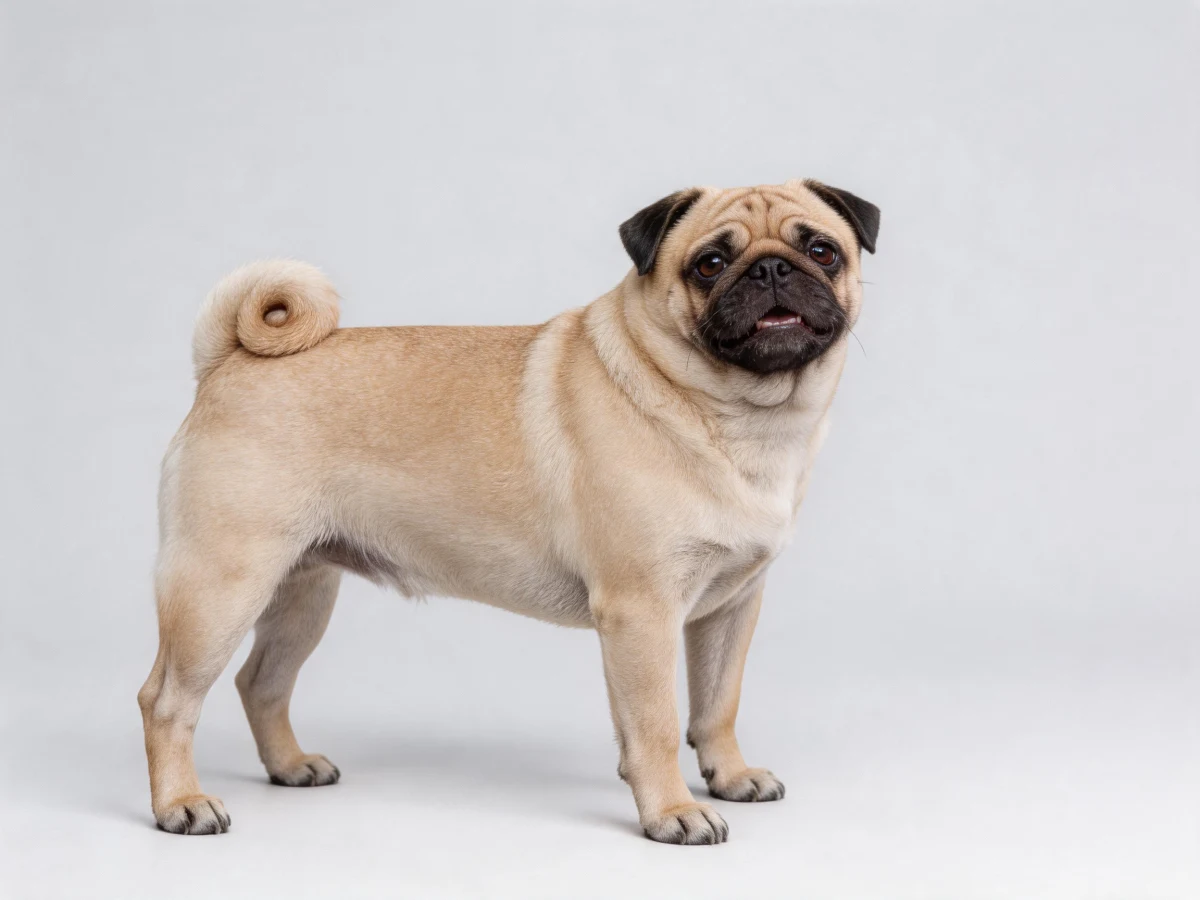
Brussels Griffon
✨ Key Takeaways
- The Brussels Griffon (Griffon Bruxellois) began as the Smousje, a small rough-coated ratter kept by 19th-century Brussels cabmen and coachmen to clear vermin from the stables, not as a pet.
- It was made into a toy by crossing the native stable griffon with the Affenpinscher (wiry coat, bearded face), the Pug (short smooth coat, flat brachycephalic muzzle, the smooth Petit Brabançon variety) and the Ruby/King Charles toy spaniel (domed head, big round eyes, red colour).
- Queen Marie Henriette of the Belgians took up and bred the dog in the 1870s, making it fashionable; by 1880 it had its name and by 1883 a breed standard, with rough and smooth varieties treated as one breed in differing coats.
- The breed was nearly wiped out twice — both World Wars devastated Belgian breeding, and by 1945 almost no Griffons were left in Belgium; British fanciers preserved the stock that rebuilt the modern breed.
- Its most serious health problem is Chiari-like malformation and syringomyelia (CM/SM), found in 65% and 52% of Brussels Griffons in one AKC study; MRI screening of breeding dogs is the responsible standard, alongside brachycephalic-airway, eye and patella care.
- The AKC recognised it in 1910 but it stayed rare until the 1997 film As Good as It Gets, starring a Griffon named Verdell, raised its profile; the deepest naming heritage is Belgian — Brussels, Brabant, Smousje, Henriette and Verdell.
Quick Facts
Common Names & Variants
Modern aliases
Historical names
Modern variants & lines
⚖️ Pros & Cons
Advantages
Trade-offs
Physical Appearance
Recognized colors
Coat
Other
Ears: Small, semi-erect. Tail: Set high, carried up.
🕰 History
The cabmen's ratter of the Brussels mews
This breed began its life in the stables and coach-houses of nineteenth-century Brussels, riding shotgun on the hansom cabs. The Belgian cab-drivers and coachmen of the city kept a small, rough-coated, terrier-like dog called the Smousje to keep down the rats that infested the mews and the feed stores — a working vermin-killer, not a pet, valued for being game, hardy and small enough to stay out of the way. These were the Griffons d'Écurie, the "stable griffons," and they were a fixture of the working horse-trade of the Belgian capital long before anyone thought of them as a breed. The earliest history of the dog now called the Brussels Griffon is therefore not a tale of kennels and stud books but of cobbled yards, harness leather and the constant low war against rats that every horse-keeping city fought.
That working origin still shows in the modern dog. The Griffon is small, dense, surprisingly sturdy under the beard, and carries itself with a cocky, almost human self-importance that reads in the show ring as charm and once read in the stable as the nerve a good ratter needs. The breed kept its terrier directness even after it was made fashionable; an owner who expects a passive lapdog and gets a bold, opinionated little personality is meeting the cabman's dog underneath the fancy coat.
Three crosses that made a toy
The transformation of the stable ratter into the breed we know happened in the middle decades of the nineteenth century through a small number of deliberate crosses, each of which left a visible mark. The native rough griffon was reinforced with the Affenpinscher, the German "monkey terrier," which deepened the wiry coat and the bearded, simian face. The Pug was crossed in around mid-century — the single most consequential outcross — and it brought the short black smooth coat, the compact body, and above all the shortened, upturned, brachycephalic muzzle that gives the breed its flat face. The same Pug blood produced a smooth-coated variety alongside the rough one, the dog the Belgians call the Petit Brabançon. Finally the Ruby and King Charles varieties of the English Toy Spaniel were bred in, contributing the domed skull, the large round prominent eyes and the rich red colour. By the time these crosses had settled, the rat-catcher had become a toy with one of the most distinctive faces in all of dogdom.
Queen Marie Henriette and the road to the show ring
The dog's rise from the stable to the salon owes a great deal to royal favour. In the 1870s Marie Henriette, Queen of the Belgians, took up the breed, kept and bred them herself, and made the scruffy little cabman's dog suddenly fashionable among the Belgian and wider European nobility. Royal patronage did for the Griffon what it has done for many breeds: it pulled the dog out of obscurity, drew the attention of serious breeders, and created a demand that supported a fancy. By 1880 the dog had a settled name — the Griffon Bruxellois — and was being shown; a breed standard followed in 1883, with the smooth Petit Brabançon and the rough Belgian and Brussels Griffons all treated as one breed in differing coats and colours, as the Fédération Cynologique Internationale still does today under standards numbered 80, 81 and 82.
Two wars that nearly ended the breed
The Griffon's twentieth century was a near-death experience, twice over. The breed had reached real popularity in Belgium and Britain by the turn of the century, but the First World War devastated Belgian dog-breeding, and the Second World War came close to finishing the job: by 1945 there were almost no Griffons left in their Belgian homeland. The combination of occupation, food shortage and the collapse of the breeding base that had supported a luxury toy dog was very nearly fatal. What saved the breed was the work of dedicated fanciers abroad, above all in Britain, where enough stock survived in private kennels to rebuild from. The modern Brussels Griffon descends in large part from those British survivors; a Belgian breed was kept alive outside Belgium and handed back. It is a history the breed shares with several small Continental dogs, but few came as close to vanishing entirely.
America, recognition, and a film that changed everything
The breed reached the United States early — the American Kennel Club recognised the Brussels Griffon in 1910 — but it remained a rare, connoisseur's dog for most of the century, never approaching the popularity of the toy spaniels or the Pug it descends from. That changed almost overnight in 1997, when a wiry red Griffon named Verdell co-starred opposite Jack Nicholson in the film As Good as It Gets. The dog's expressive, almost human face on a cinema screen sent enquiries to breeders soaring and gave the Griffon a level of public recognition it had never had. The breed remains uncommon — it sits in the lower-middle of the AKC popularity register rather than near the top — but it is no longer obscure, and the film is the single event most often credited with bringing this Belgian stable ratter to the attention of the wider American public.
Temperament & Personality
A big personality in a four-kilo body
The defining trait of the Brussels Griffon is the sheer outsized force of its personality. Owners and the breed clubs reach for the same phrase again and again — that the dog has "enough personality for ten ordinary dogs" and is comically self-important — and it is accurate. This is a small dog with the bold, busy, opinionated nature of its terrier-ratter ancestry, not the placid passivity people sometimes expect of a toy breed. A Griffon is alert, curious, expressive, and convinced of its own importance in the household, and a good deal of the breed's appeal lies in that mismatch between its tiny frame and its enormous self-regard.
Velcro-close to its person
The Griffon bonds with intense, almost obsessive devotion to its own people, and frequently to one person above the rest. It wants to be on a lap, in a chair, underfoot, or carried; it follows from room to room and watches its person with the famous expressive eyes. That closeness is the breed's great charm, but it carries a real cost: Griffons are prone to separation distress and do badly left alone for long working days. This is a companion dog in the most literal sense — bred down from a working ratter into a creature whose entire job is now to be with you — and it is happiest in a home where someone is around for much of the day and miserable in one where it is not.
Sensitive, and easily wounded by harshness
For all its swagger, the Griffon is a notably sensitive dog that reads its owner's mood closely and takes correction hard. Heavy-handed, punitive training does not produce an obedient Griffon; it produces a sulky, anxious, or shut-down one. The breed responds to patient, upbeat, reward-based methods and to consistency, and it can be genuinely stubborn when it decides a request is unreasonable. Housetraining in particular is often slow and requires real patience — a common and well-attested frustration with the breed. None of this reflects a lack of intelligence; the Griffon is bright and trainable, but it must be trained as a thin-skinned sensitive, not as a robust working dog.
Watchful, reserved, and quick to sound the alarm
The terrier underneath makes the Griffon an alert and vocal little watchdog. It tends to be reserved or wary with strangers and will announce visitors, noises and anything out of the ordinary, which makes early and broad socialisation important if the wariness is not to harden into nervousness or yappiness. A well-socialised Griffon is discriminating rather than fearful — confident enough to assess a newcomer and settle. The breed can be territorial and is sometimes scrappy toward other dogs despite its size, having no apparent idea that it is small, so sensible introductions matter.
Who the Griffon honestly suits
The Griffon suits an owner who wants a clever, characterful, deeply attached companion and who will be home enough to provide the constant company the breed craves. It can be excellent with respectful older children and with other pets it is raised alongside, but its tiny size and its boldness make it a poor match for boisterous toddlers, and its fragility means it needs handling that small children cannot reliably give. It is a poor choice for someone away all day, for anyone wanting a low-maintenance or undemanding dog, or for an owner who will lose patience with slow housetraining and a sensitive temperament. Matched to the right home, though, it is one of the most engaging and affectionate of all the toy breeds — funny, devoted, and impossible to ignore.
🏡 Living With a Brussels Griffon
The original velcro dog
Living with a Brussels Griffon means accepting that you have acquired a small, opinionated shadow. This is a breed that bonds with an intensity out of all proportion to its three-to-five-kilo frame: it wants to be on your lap, in your bed, on the desk while you work, and underfoot the moment you stand up. The flip side of that devotion is poor tolerance of being left alone. A Griffon shut in a crate or an empty house for a full working day is a prime candidate for separation distress — pacing, barking, and frantic greeting rituals — and many bond so tightly to one person that the rest of the household becomes secondary. Households where someone is home much of the day, or that can stagger schedules and use daycare, suit the breed far better than a nine-hour empty flat.
A toy with a big-dog attitude and modest needs
The Griffon's exercise floor is low: a couple of short daily walks plus indoor play and a bit of training comfortably satisfies an adult, which makes the breed a genuinely good apartment dog. What it lacks in stamina it makes up for in self-importance — the Griffon is bold, busy, and convinced it is far larger than it is, which is charming until it tries to face down a Labrador. That same boldness can tip into reactive alert-barking at the door, the window, and the lift, so early exposure to everyday comings and goings matters. Because the face is slightly flat (mildly brachycephalic, with a real if moderate muzzle), the breed is not heat-tolerant: walk in the cool of the morning or evening in summer, never push exercise in midday heat, and watch for laboured breathing.
Children, other pets, and the fragility caveat
A Brussels Griffon does best in a calm adult or older-child home. It is affectionate and playful, but it is also a tiny, structurally delicate dog that can be injured by a jump from the sofa or a misjudged squeeze, and many Griffons are simply too sensitive and self-possessed to enjoy boisterous toddlers. With other dogs and cats it generally lives happily, especially when raised alongside them, though its big-dog confidence means it needs supervision around larger playmates that could hurt it by accident. Shedding is light to moderate — the rough coat in particular sheds little — so hair on the furniture is not the issue here; the Griffon's demands are emotional and social rather than physical.
🎓 Training & Exercise
Bright, willing, and easily wounded
The Brussels Griffon is genuinely intelligent and quick to learn, but it trains on its own terms. This is a sensitive, soft-tempered dog that reads tone acutely; harsh corrections, raised voices, or heavy-handed methods do not produce obedience, they produce a shut-down, timid, or defensively snappy little dog. Reward-based training — food, praise, and play — is not a preference for the Griffon, it is the only approach that works. Keep sessions short and upbeat, because the breed bores quickly and will simply opt out of a drill it finds tedious, then look at you with the famously knowing, almost-human expression that makes owners forgive almost anything.
Housetraining is the real catch
The honest difficulty with the breed is housetraining. Like many toy dogs, the Brussels Griffon can be slow and inconsistent to reliably toilet-train, and a tiny bladder plus a dislike of going out in cold or wet weather works against you. The answer is rigid routine rather than punishment: frequent scheduled trips outside, generous reward the instant the dog performs in the right place, crate or pen management between trips, and patience measured in months rather than weeks. Many owners find an indoor option such as a pee-pad or litter tray a sensible backstop for a small dog in a flat or a harsh climate. Never scold a Griffon for an accident — with this breed it teaches secrecy and erodes the bond, not cleanliness.
Socialisation, manners, and the bark
Early, generous socialisation is the single most important investment for the breed. An under-socialised Griffon becomes the caricature of a bad toy dog — timid, shrill, and quick to snap when overwhelmed — whereas a well-socialised one is bold and friendly. Introduce puppies to varied people, gentle dogs, surfaces, and sounds while they are young, and teach them to accept handling of the face, eyes, and feet for grooming and vet visits. The Griffon is a natural alert-barker, so train a "quiet" cue early and reward calm rather than inadvertently rewarding the barking with attention. A reliable recall and a solid "leave it" are valuable for a curious dog that is light enough to be in trouble before you can reach it.
✂️ Grooming & Coat Care
Two coats, two completely different routines
The Brussels Griffon comes in two coat types, and which one you own changes grooming entirely. The rough coat is harsh and wiry with the breed's signature beard and bushy eyebrows; the smooth coat — the variety known as the Petit Brabançon — is short, glossy, and close-lying. The smooth coat is close to wash-and-wear: a weekly once-over with a soft brush or grooming mitt and the occasional bath keeps it tidy. The rough coat is the labour-intensive one. To keep the correct harsh texture and colour, show dogs are hand-stripped — the dead coat plucked out by hand or with a stripping knife every few months — while most pet owners have the coat clipped instead, which is easier and cheaper but softens the texture over time. Either way, a few brush-throughs a week prevent the wiry coat from matting.
The beard, the face, and those prominent eyes
The rough Griffon's beard is a daily hotspot. It catches food, water, and drool, so it needs wiping and regular cleaning to stay fresh and avoid skin irritation underneath. The slightly flat face and the breed's large, prominent, forward-set eyes call for their own routine: wipe the eye area and any facial creases clean, keep hair trimmed back from the eyes, and watch closely for redness, cloudiness, squinting, or a scratch. Those exposed eyes sit proud of the skull and are genuinely vulnerable to injury and to drying, so day-to-day eye care is part of owning the breed, not an optional extra.
Ears, nails, teeth, and the small-dog dental reality
Check and gently clean the ears weekly, drying carefully after baths. Nails on a light, lap-bound dog do not wear down naturally and grow quickly, so trim every two to three weeks — if you can hear them click on a hard floor they are already too long. Teeth deserve real attention: small and toy breeds are strongly prone to dental crowding and periodontal disease because so many teeth are packed into a little jaw, so brush several times a week from puppyhood and expect professional cleanings to be a normal part of the dog's lifetime care. Get a rough-coated puppy used to having its face, beard, and feet handled early, and grooming stays a non-event for life.
🍖 Diet & Nutrition
Tiny portions, oversized consequences
The headline diet fact for a Brussels Griffon is scale: a dog weighing only three to five and a half kilos eats a very small amount, which means a couple of extra treats or a few scraps from the table represent a huge proportion of its daily calories. Obesity creeps up fast on a small lap dog, and excess weight is hard on a toy breed's delicate joints — particularly the kneecaps, which the breed is already prone to slipping. Measure meals precisely rather than feeding by eye, fold training treats into the daily ration rather than adding them on top, and learn to feel for the ribs and waist so you are managing the dog you have, not the one on the food-bag chart. A lean Griffon moves better and lives more comfortably.
Small mouths, small kibble, and dental-aware feeding
Choose a complete food formulated for small or toy breeds: the kibble is sized for a little mouth, and the calorie density suits a dog this size. Because the breed's crowded little jaw is so prone to dental disease, dental health is a feeding consideration too — many owners use dental-formulated diets or vet-approved dental chews as part of the daily routine alongside tooth-brushing. The slightly flat face means some Griffons eat more comfortably from a shallow dish, and a dog that gulps or struggles a little is worth feeding small, calm meals rather than one large bowl.
Puppy feeding and a watch on blood sugar
Toy-breed puppies are tiny and burn through energy quickly, so very young Griffon puppies are typically fed small meals several times a day, tapering toward two measured adult meals as they grow. Very small puppies can be vulnerable to low blood sugar (hypoglycaemia) if meals are missed or they are over-tired, so keeping young puppies on a steady, frequent feeding schedule matters in the first months. Make any change of food gradually over about a week to avoid stomach upset, keep fresh water available at all times, and set adult portions against the dog's ideal lean weight and activity, adjusting by body condition over time.
🐶 Buying & Adopting a Brussels Griffon
Start at the parent club, and expect a wait
The American Brussels Griffon Association (ABGA) is the AKC parent club and the right starting point: it maintains a breeder-referral resource and a rescue network, and its members work to a code of ethics. Brussels Griffons are not a high-volume breed, and there is a structural reason for that. Litters are very small — averaging only about two puppies — and the breed's relatively large head means many Griffons are delivered by planned caesarean section. The result is that well-bred puppies are genuinely scarce and expensive, and reputable breeders commonly keep waiting lists. Anyone promising an immediate, cheap, always-available litter is a warning sign, not a convenience.
The health screening to ask a breeder for
Ask a breeder to show health-testing results on both parents. The breed's CHIC profile centres on four screens: an OFA patella evaluation (the breed is prone to luxating, or slipping, kneecaps), an eye examination by a boarded veterinary ophthalmologist (ACVO/OFA), an OFA hip evaluation, and a cardiac evaluation. Beyond CHIC, the most serious neurological concern in the breed is Chiari-like malformation and syringomyelia (CM/SM), a condition of skull-and-spinal-cord conformation that is screened by MRI, so it is fair to ask a conscientious breeder what they do about it. Because the breed is mildly brachycephalic with prominent eyes, asking about breathing and eye health in their lines is reasonable too. A breeder who produces the paperwork and discusses these issues openly is the one to trust; "our dogs are healthy, no testing needed" is the answer to walk away from. This is consumer guidance on what to ask, not veterinary advice.
Rescue and rehoming
Because the breed is uncommon, breed-specific rescue exists but moves a smaller number of dogs than the giant popular breeds do. The ABGA rescue network and national Griffon rescue groups take in dogs surrendered through owner life-changes or because people underestimated the breed's neediness and housetraining challenges. For an adopter open to an adult dog with a known temperament rather than a months-long puppy wait, breed rescue is an excellent and ethical route — and an adult Griffon's personality is usually an open book from day one.
Price, scarcity, and the red flags
A well-bred Brussels Griffon puppy in the United States runs roughly USD 1,500–3,500 (2024), reflecting the small litters, the frequent caesareans, and the health testing behind a responsible litter. The patterns to walk away from are familiar: puppies advertised well below that range with instant availability, no health-testing documentation, and no parent-club connection, or sellers pushing "rare" colours or sizes (a "teacup" Griffon is a marketing label, not a recognised or healthy variety). A fair price from a health-testing, parent-club breeder — even after a wait — is far cheaper over a dog's life than the cost of one bought blind.
📜 Breed Name Etymology — iDogNames original research
A griffon, a city, and a Dutch nickname
The breed's name is half geography and half description. Bruxellois simply means "of Brussels," the Belgian capital where the breed was made; the French Griffon Bruxellois and the English "Brussels Griffon" both name the dog for its home city, exactly the way the Belgian Griffon and the Petit Brabançon are named for Belgium and for the duchy of Brabant. The interesting half is the word griffon itself. In French, griffon is a long-standing term for a rough- or wire-coated dog — it names a whole family of European breeds, from the Griffon Vendéen hounds to the wirehaired Korthals pointing griffon — and is generally traced through Old French to Latin and finally to the mythical griffin. Applied to a dog, it describes the harsh, bristly, wiry coat and the bearded, slightly fierce-looking face; the breed's name calls it, in effect, "the rough-coated dog of Brussels."
Underneath the formal French name is the dog's older, humbler nickname. Before it was the Griffon Bruxellois it was the Smousje, a Brussels-Dutch (Flemish) word for a small shaggy dog. The same root sits behind the German Schnauzer family's old name and the Dutch Smoushond; it carries the sense of a small, rough, whiskery terrier — a fitting tag for a stable ratter. The breed thus has two layers of name: the smart French griffon of the show ring and the affectionate Flemish Smousje of the cab-yard it came from.
Brabançon — the smooth cousin's name
The smooth-coated variety carries a different and equally geographical name: the Petit Brabançon, the "little Brabançon," named for Brabant, the historic duchy of which Brussels is the heart. The name marks the variety out from its rough-coated siblings by region rather than by coat in everyday speech, even though the real distinction is the smooth Pug-derived coat. In some registries the three — Brussels Griffon, Belgian Griffon and Petit Brabançon — are treated as separate breeds and in others (notably the FCI and the AKC, which folds the smooth Brabançon in as a coat variety) as one breed in different dress; the names record a family that was never fully agreed to be one breed or three.
Griffon, the rough word across Europe
It is worth dwelling on griffon, because it is the part of the name that travels. The French applied it to any number of harsh-coated working dogs, so that a French speaker hearing "griffon" thinks first of coat texture, not of this particular Belgian toy. The word's descent from the legendary griffin — the eagle-headed lion of myth — is a curiosity rather than a literal claim; no one supposed the dog was part eagle. What carried over was the suggestion of something bristling, fierce-faced and a little fantastical, which suits the Griffon's wiry beard and almost human, faintly comical scowl rather well. The name, in other words, is a description that became a label: a rough-coated, fierce-faced little dog from Brussels.
Saying it, and the everyday short forms
In English the breed is usually said plainly — "BRUSS-elz GRIFF-en," /ˈbrʌsəlz ˈɡrɪfən/ — while the French Griffon Bruxellois runs closer to "gree-FOHN bruk-sel-WAH." In daily use the breed is almost universally shortened to the Griff, a fond clip that the American parent club itself uses, and the plural "Griffs" is standard among owners. Whether one calls the dog a Brussels Griffon, a Griffon Bruxellois, a Petit Brabançon or simply a Griff, the name always points back to the same place — a small rough or smooth dog from the city of Brussels — and the etymology is a tidy little map of the breed: a French word for its coat, a Flemish word for its origins, and a city and a duchy for its home.
Name forms at a glance
| Name | Role | Origin | Literal meaning | First recorded |
|---|---|---|---|---|
| Brussels Griffon | primary | English / French | the rough-coated dog of Brussels | 1880 |
| Griffon Bruxellois | origin country native | French | rough-coated dog of Brussels | 1880 |
| Smousje | historical | Flemish / Brussels Dutch | little shaggy dog | 1850 |
| Petit Brabançon | historical | French | the little Brabançon; the little dog of Brabant | 1880 |
| griffon | historical | French | the rough-coated one; figuratively, the griffin | 1100 |
🏛 Naming Traditions — iDogNames original research
Name the dog for the city that made it
The Brussels Griffon is so completely a Belgian creation — Brussels-born, Flemish-nicknamed, French-named, royal-favoured — that the most fitting names draw on its real heritage rather than on a generic toy-dog list. There are five coherent and genuinely breed-specific veins to mine: Belgian and Brussels places and culture, the French and Flemish names the breed itself carries, the dog's documented history (the cab-yards, Queen Marie Henriette, the film), the breed's famous face and small bold character, and the food, beer and chocolate of Belgium handled as a knowing wink. The first four are real history; the fifth is a joke that only lands if you know you are making it.
Belgian and Brussels places
The home country gives the truest names. Brussels or Bruxelles names the city directly; Brabant and Brabançon honour the duchy that gave the smooth variety its name. Belgian cities and landmarks make crisp, characterful calls — Antwerp, Ghent, Bruges, Liège, Namur, Ostend — and the Atomium or the Grand-Place nod to Brussels itself. Manneken, after the city's famous little statue the Manneken Pis, is a cheeky and very Brussels choice for a cocky little dog. For a breed whose entire identity is its home city, a Belgian place-name is never just decoration.
The French and Flemish names the breed carries
The second vein takes the breed's own languages. From the French side come Griffon itself, Belge (the breed's own colour term and the word for "Belgian"), and the affectionate clip Griff that owners use everywhere. From the Flemish side comes the breed's oldest name, Smousje — "little shaggy dog" — which is as authentic a heritage name as a Griffon can wear, along with Smous as a shorter form. These are names that say what the dog is in the dog's own tongues, and a Griffon called Smousje or Griff is wearing its pedigree out loud.
The breed's real history
The third vein is documentary and specific to this breed. Henriette or Marie-Henriette honours the Queen of the Belgians who made the breed fashionable in the 1870s; Reine ("queen") and Royale nod to that royal patronage. The cab-yard origin gives working names — Cabby, Cobble, Mews, Ratter — that honour the stable ratter the breed once was. And the modern fame gives Verdell, the name of the Griffon who co-starred in As Good as It Gets in 1997 and arguably did more for the breed's profile than any other single dog. A history-minded owner has a ready-made roster here that no generic list can match.
The face and the bold little character
The fourth vein plays on what everyone notices first: the expressive, almost human, faintly comical face and the outsized personality behind it. Names that lean into the swagger suit the breed — Boss, Major, Duchess, Diva, Sir, Madame — because the Griffon genuinely behaves as though it runs the household. The beard and the scowl invite Ewok, Gizmo, Yoda, Wookiee and Chewie, all of which fans reach for thanks to the breed's much-remarked resemblance to small film creatures. Monkey and Affen nod to the Affenpinscher ancestry and the "monkey face," and Grumpy or Scowl affectionately name the expression. These are names earned by the dog's actual appearance and attitude.
Belgian beer, chocolate and a knowing wink
The fifth vein is the one to use sparingly and on purpose. Belgium's great culinary exports write the names themselves — Cocoa, Truffle and Praline for the chocolate; Stella, Leffe, Trappist and Hops for the famous beer; Frites, Gaufre (waffle) and Speculoos for the rest — and they are genuinely charming on a small Belgian dog, provided the owner knows they are leaning on the Belgian-food joke rather than missing it. Praline and Truffle in particular work as elegant names in their own right for a small red or black dog. The deepest, most personal heritage names for a Griffon, though, remain the ones tied to its real story — Smousje, Brabant, Henriette, Verdell, Griff — because they name the dog after the city, the languages, the queen and the moment that actually made it.
🐾 Themed Names for Your Brussels Griffon — iDogNames original research
Belgian and Brussels places
Place-names from the city and country that created the breed — the truest fit of all.
- Brussels — the city the breed is named for; the plainest, most fitting name there is
- Brabant — the historic duchy behind the Petit Brabançon's name
- Bruges — the canal city; pretty and unmistakably Belgian
- Antwerp — the great Flemish port; strong and characterful
- Ghent — short, crisp, and very Belgian
- Liège — the Walloon city; elegant on the tongue
- Namur — the riverside capital of Wallonia; soft and rolling
- Manneken — after Brussels' cheeky little statue; perfect for a cocky small dog
- Atomium — Brussels' space-age landmark; quirky and modern
- Ostend — the Belgian seaside town; breezy and bright
The breed's own French and Flemish names
Names drawn straight from the languages the breed itself carries.
- Smousje — the breed's oldest Flemish nickname, "little shaggy dog"; deep heritage
- Griff — the universal fond clip owners use; easy to call
- Griffon — the French word for the rough coat at the heart of the name
- Belge — "Belgian" and the breed's own colour term
- Smous — the shorter form of Smousje; punchy
- Bruxelles — the French spelling of the home city
- Petit — "little," from the Petit Brabançon; sweet for a tiny dog
- Brabançon — the smooth variety's own name; distinctive
- Rufus — for the red (rufous) coat the breed is known for
- Noir — "black," for the black or Belge-coated dogs
The breed's real history
Names from the documented past — the queen, the cab-yards, and the film that made the breed famous.
- Henriette — Queen Marie Henriette, who made the breed fashionable in the 1870s
- Verdell — the Griffon who co-starred in As Good as It Gets, 1997
- Reine — "queen," for the royal patronage that lifted the breed
- Royale — a nod to the breed's rise from stable to palace
- Cabby — for the Brussels cabmen whose dog this was
- Mews — the stable-yards where the ratter worked
- Cobble — the cobbled streets the cabs ran on
- Ratter — the breed's original honest job
- Marie — for the queen, in its shorter form
- Stella — doubles as a Belgian-beer wink and a pretty name in its own right
The famous face and creature look
Names that play on the expressive, almost human, faintly comical face the breed is famous for.
- Ewok — for the small, bearded, big-eyed creature resemblance
- Gizmo — the wide-eyed film creature; suits the expression perfectly
- Yoda — for the wise, wrinkled, big-eared look
- Chewie — short for Chewbacca; a fond nod to the whiskery face
- Wookiee — for a particularly hairy rough-coated Griff
- Monkey — for the simian "monkey face" of the Affenpinscher line
- Affen — short for Affenpinscher, the monkey-terrier ancestor
- Grumpy — affectionately, for the famous scowl
- Gremlin — small, big-eyed, and full of mischief
- Beard — plain and fond, for the rough coat's whiskers
The bold little personality
Names for a four-kilo dog convinced it runs the household.
- Boss — because the Griffon believes it is
- Major — military bearing in a tiny package
- Duchess — grand and self-important, for a bitch
- Diva — for the breed's theatrical sense of its own importance
- Sir — droll formality for a small swaggerer
- Madame — the feminine equivalent; very Brussels
- Napoleon — big ambition, small stature
- Caesar — imperial confidence in miniature
- Tiny — ironic, for the outsized personality
- Pixie — for the elfin, pixie-faced look the breed is known for
Belgian beer, chocolate and a knowing wink
Names from Belgium's great exports — charming when chosen on purpose.
- Praline — the Belgian chocolate; elegant for a small red dog
- Truffle — the chocolate kind; rich and a little grand
- Cocoa — warm and brown, for a red or Belge coat
- Leffe — the famous Belgian abbey beer
- Trappist — for the monastic Belgian brews
- Hops — short, bouncy, and beer-themed
- Frites — Belgian fries; cheerful and a little silly
- Gaufre — "waffle"; sweet and very Belgian
- Speculoos — the spiced Belgian biscuit; characterful
- Stella — the Leuven lager; doubles as a lovely name
📋 Breed Standard at a Glance
General appearance
The AKC standard describes the Brussels Griffon as a toy dog with a near-human expression — intelligent, alert, and sensitive, sturdy of bone for its size, and thickset and compact rather than dainty. The hallmark is the head: a domed skull, a very short upturned muzzle, and large, dark, wide-set eyes that give the breed its characteristic almost-human, slightly indignant look. It should appear cobby and square in outline, carrying itself with the self-important air of a much larger dog.
Size, coat, and colour
This is a small toy breed standing about 9–11 inches tall and weighing roughly 8–12 pounds. The standard recognises two coat types: the rough coat, which is harsh and wiry with the distinctive beard and bushy eyebrows, and the smooth coat — historically called the Petit Brabançon — which is short, straight, and glossy. Recognised colours are red, belge (a black-and-reddish-brown mix), black and tan, and solid black. Lifespan runs about 12–15 years, and litters are typically small, averaging around two puppies, with caesarean delivery common because of the breed's large head.
Head, movement, and temperament
The skull is large and rounded with a deep stop; the nose is set back between the eyes and the chin is undershot, prominent, and well turned up, with the bite forming part of the breed's signature look. Movement is a free, purposeful trot. Temperament is explicit in the standard: the Brussels Griffon is intelligent, alert, and sensitive, full of self-importance and devoted to its people. The flatter face is moderate — a real short muzzle, not the extreme of some flat-faced breeds — and the prominent eyes are a defining trait owners are expected to protect.
🏆 Famous Brussels Griffons
Notable real dogs of the breed profiled on iDogNames.
🏆 Recognition
Recognized by the American Kennel Club in 1910 as a Toy breed. FCI standard No. 80 (Section 3 — Small Belgian Dogs), recognized in 1954.
Other registries
Breed clubs
❓ Frequently Asked Questions
Are Brussels Griffons good family dogs?
They are devoted, affectionate companions, but they suit calm adult or older-child homes best. A Brussels Griffon is a tiny, structurally delicate dog that can be hurt by rough handling, and many are too sensitive to enjoy boisterous toddlers. They bond intensely with their people and often dislike being left alone, so they fit households where someone is around much of the day.
Do Brussels Griffons shed a lot?
No, shedding is light. The rough wiry coat in particular sheds very little, and the smooth coat is low-maintenance and only a modest shedder. The trade-off is grooming effort rather than vacuuming: the rough coat needs regular brushing and either hand-stripping or clipping, and the beard needs routine cleaning.
How much exercise does a Brussels Griffon need?
Modest. A couple of short daily walks plus indoor play and a little training satisfies an adult, which makes the breed a good apartment dog. Because the face is slightly flat, the breed is sensitive to heat, so exercise in the cool of the day in summer and never push activity in midday heat.
How long do Brussels Griffons live?
Typically 12 to 15 years. As with most small breeds, sensible weight management, dental care, and routine veterinary checks help a Griffon make the most of that long lifespan.
Are Brussels Griffons easy to train?
They are intelligent and quick to learn, but sensitive — harsh methods backfire and reward-based training works best. The real challenge is housetraining, which tends to be slow with this breed and demands a rigid routine and patience. Early socialisation is essential so the dog grows up bold rather than timid or snappy.
Are Brussels Griffons hypoallergenic?
No breed is truly hypoallergenic. The low-shedding rough coat may suit some allergy sufferers better than a heavy-shedding breed, but there are no guarantees. Anyone with a dog allergy should spend extended time around the breed before committing.
How much does a Brussels Griffon puppy cost?
A well-bred, health-tested puppy in the United States typically runs USD 1,500 to 3,500 (2024). Prices are higher than many toy breeds because litters are small — averaging about two puppies — and caesarean deliveries are common, so reputable breeders often keep waiting lists. Be wary of cheap, always-available puppies with no health-testing paperwork and of premiums for "teacup" sizes, which are a marketing label rather than a recognised variety.
📚 Sources & Further Reading
Every load-bearing factual claim on this page is anchored to one of the sources below. iDogNames does not synthesize from secondary aggregators.
- akc breed page Brussels Griffon — AKC Breed Profile — American Kennel Club (2024)
- fci standard pdf FCI Standard No. 80 — Griffon Bruxellois — Fédération Cynologique Internationale (2003)
- breed club official American Brussels Griffon Association — parent club, breed history, health and rescue — American Brussels Griffon Association
- academic paper Chiari-like malformation and syringomyelia in American Brussels Griffon dogs — Freeman AC, Platt SR, Kent M, Huguet E, Rusbridge C, Holmes S — J Vet Intern Med 28(5):1551-1559 (PMID 25145262) (2014)
- academic paper Chiari-like malformation in the Griffon Bruxellois — Rusbridge C, Knowler SP, Pieterse L, McFadyen AK — J Small Anim Pract 50(8):386-393 (PMID 19689665) (2009)
- health registry Brussels Griffon — OFA / CHIC Health Testing Requirements — Orthopedic Foundation for Animals (OFA) (2024)
- akc breed page Brussels Griffon History: From Scruffy Ratter to Beloved House Pet — American Kennel Club
- kc uk standard pdf Brussels Griffon — Breed Standard — The Kennel Club (UK)
- wikipedia Griffon Bruxellois — Wikipedia — Wikipedia