
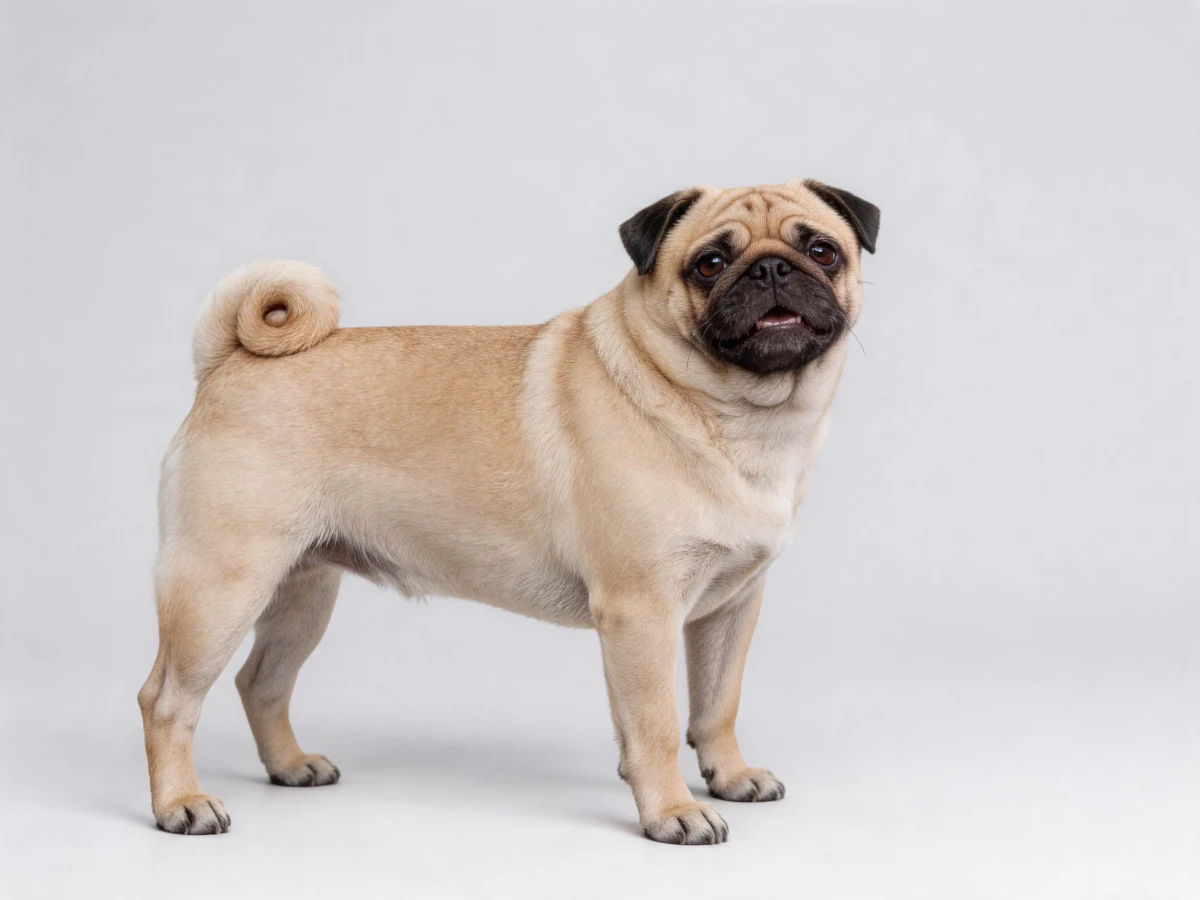
Pug
✨ Key Takeaways
- The Pug is a Chinese imperial dog — the ancient short-mouthed "lo-sze" of the emperors' courts — that reached Europe through Dutch East India Company trade, not a Western lap breed that happened to look oriental.
- Its European fame is dynastic: a dog called Pompey is credited with alerting William the Silent, Prince of Orange, to Spanish attackers at Hermigny in 1572, after which the Pug became the dog of the House of Orange — though the story is repeated by historians, not confirmed by contemporary records.
- The Kennel Club (UK) was established in 1873 and the AKC registered the Pug in 1885; the Pug Dog Club of America was founded in 1931 and is the AKC parent club.
- Health is the defining modern issue: O'Neill et al. (2022, Canine Medicine and Genetics) found the Pug carried 1.86× the odds of having one or more disorders versus non-Pugs, with brachycephalic obstructive airway syndrome at ~54× the odds — the authors concluded the Pug "can no longer be considered as a typical dog" health-wise.
- Pug dog encephalitis (necrotizing meningoencephalitis) is a fatal, near breed-specific autoimmune brain disease tied to the DLA class II region (Greer et al., 2010); a risk-marker DNA test exists and the Pug Dog Club of America references it.
- A Pug is an affectionate, people-fixated, low-exercise companion that snores, sheds heavily, and overheats easily — the temperament is easy, the airway and the cooling are not.
Quick Facts
Common Names & Variants
Modern aliases
Historical names
Modern variants & lines
⚖️ Pros & Cons
Advantages
Trade-offs
Physical Appearance
Recognized colors
Coat
Other
Ears: Button or rose. Tail: Curled (double curl prized).
🕰 History
A dog the Chinese court did not let leave
The Pug was an emperor's dog before it was anyone's pet. Chinese breeders developed three distinct types of short-faced dog in antiquity, and the Pug's documented ancestor is the lo-sze — sometimes glossed as the "Foo dog" — a compact, short-mouthed companion kept in the imperial household and, according to the Pug Dog Club of America and the Old Dominion Pug Dog Club's breed histories, at times guarded by soldiers and afforded the comforts of court life. These were not working animals. They were status objects of a closed aristocracy, and the Chinese restricted their export, which is part of why the breed's early record is genealogically thin: there is no continuous pedigree out of China, only the type and the trade route.
That trade route was Dutch. The Dutch East India Company (the VOC) ran the maritime link between China and Europe across the sixteenth and seventeenth centuries, and its ships are the credited vector for the first Pugs into the Netherlands and on to England. The honest caveat: the precise crossings, dates, and animals are not documented dog by dog. What is solid is the destination, because once the Pug reached the Low Countries it walked straight into a dynasty.
Pompey, Hermigny, and the House of Orange
The breed's European fame rests on a single night and a contested story. During the Dutch revolt against Spain, William I, Prince of Orange — William the Silent — was campaigning when, the account goes, Spanish soldiers approached his tent at Hermigny to kill him in his sleep. His small dog, named Pompey, heard them, barked and scratched, and finally jumped onto his master's face to wake him; the prince escaped. The dog is conventionally dated to 1572 and is, in pug tradition, the reason the Pug became the official dog of the House of Orange. It is worth being precise about the evidence. Wikipedia's own article on Pompey notes the breed is disputed — pug versus Kooikerhondje versus "spaniel" — and that William's contemporary correspondence and allied military journals record Spanish plots but not a dog; the canine version is traced to later writers, an English mercenary's 1618 account among them. The legend is durable and culturally real — Pompey is carved at the prince's feet on his tomb in Delft — but it is a legend reported by historians, not a verified field dispatch.
What is not legend is the association that followed. The Pug became the recognised dog of the Orange-Nassau house, and when William III of Orange and Mary took the English throne in 1688, the breed travelled with the Dutch court into Britain. The Pug arrived in England, in other words, attached to a monarchy.
England refines the dog
The Pug we recognise today is largely an English production line laid over Chinese and Dutch stock. British breeders in the nineteenth century fixed the modern type — the foreshortened muzzle, the deep wrinkle, the tightly curled tail, the fawn coat with its black mask and the forehead "thumb-mark." William Hogarth painted himself in 1745 with his Pug, Trump, a snapshot of how thoroughly the breed had embedded into English domestic life by the mid-eighteenth century. Two named lines did much of the shaping in Victorian England: the Willoughby Pugs of Lord and Lady Willoughby de Eresby and the Morrison line, whose blood sits behind much of the modern fawn population. A separate fresh import of Chinese stock around 1860 reset the gene pool, and the recessive black Pug was popularised in Britain after Lady Brassey brought black dogs back from China; black was being exhibited in England by the late 1880s.
Clubs, registries, and a queen
Institutionalisation followed the dogs. The Kennel Club in Britain was established in 1873 — Queen Victoria's documented enthusiasm for dogs is part of that period's story, and she kept Pugs herself — and The Pug Dog Club (UK) formed in 1883. Across the Atlantic, the American Kennel Club registered the Pug in 1885, one of a small founding cohort of breeds, and the Pug Dog Club of America was founded in 1931 and became the breed's AKC parent club. The FCI publishes the Pug as Standard N° 253, placing it in Group 9 (Companion and Toy Dogs), Section 11, small Molossian type — the registry's way of recording that this lap dog descends, structurally, from mastiff-family stock shrunk to the lap.
From court ornament to popularity problem
The arc of the Pug is the arc of a luxury good becoming a mass-market one. A dog the Chinese court hoarded and the Orange dynasty adopted is now a high-volume companion breed, and that popularity is the source of its modern troubles. The features that made it fashionable — the flat face, the big eyes, the deep folds — are the same features the veterinary literature now flags as welfare costs. The history that makes the Pug interesting is also, read forward, the history that explains its health section.
Temperament & Personality
The standard's two words: multum in parvo
The Pug's official temperament is summarised by its own motto. Multum in parvo — "much in little" — is the phrase the breed standard reaches for, and it is a behavioural claim as much as a physical one: a large, even, comic personality in a very small frame. The FCI standard describes the Pug as great-charm, dignified, even-tempered, with no nervousness or aggression. The AKC profile reduces it to a sentence that is hard to improve on: Pugs live to love and to be loved in return. This is not a guard dog, a sport dog, or a working dog. It is a companion dog that was selected for centuries on exactly one axis — being good company — and it shows.
People-fixated, not independent
The defining trait is attachment. A Pug orients to its people, follows them room to room, and is generally content as long as it is in company. That sociability extends outward: the breed is typically reliable with children, tolerant of other dogs, and easy with strangers, which is why it suits multi-pet and family households and why it rarely produces the reactivity seen in more highly strung toy breeds. The flip side of that bond is a low tolerance for isolation; a Pug left alone for long stretches is a Pug doing badly, not a Pug being independent.
Stubborn, food-driven, and clownish
Trainability is real but has a personality tax. The Pug is intelligent and responds well to reward-based training, but it is also self-amused and can be stubborn in the way small companion breeds bred away from biddability often are — it will do the thing, in its own time, for the right snack. That food drive is a training lever and a health hazard at once; the breed gains weight readily, and an overweight Pug is not a cosmetic problem but an airway and joint one. The clowning is genuine: this is a breed that plays to an audience and seems to know when it has one.
The honest caveats
The temperament is one of the easiest in dogs; the body it comes in is one of the harder ones to manage, and the two should not be discussed separately. A Pug overheats fast — a short, obstructed airway is a poor cooling system, so heat, exertion, and air travel carry real risk. The snoring and snorting are not quirks; they are the audible signature of brachycephalic airway anatomy. The breed sheds far more than its size suggests. None of this changes a sweet, funny, devoted companion — but a prospective owner should choose the Pug for its personality with both eyes open about its respiration, its thermoregulation, and the veterinary attention its face will need.
🏡 Living With a Pug
Bred for the lap, and it never forgot
The Pug was developed for one purpose — companionship — and centuries of breeding as an imperial lap dog show in its daily wiring. This is a Velcro dog that wants to be on you, beside you, or following you from room to room, and it is genuinely unhappy left alone for long. Pugs are people-saturated to a fault: a Pug shut in a yard or crated through a full working day tends toward separation distress, whining, and destructive boredom, because solitude runs against everything the breed was made for. The upside is that a Pug asks for very little space or hardware to be content — a sofa, a warm spot, and a person in the room cover most of its needs. Households that are home much of the day, or can stagger absences, suit the breed far better than an empty house.
A low exercise floor — and a hard heat ceiling
A Pug is a low-energy companion, not an athlete: a couple of short, gentle daily walks plus indoor play meet an adult's needs, and a Pug will happily nap most of the rest of the day. That low requirement comes paired with a non-negotiable safety rule that defines life with the breed. The Pug's flat, brachycephalic face leaves it a short, inefficient airway, so it cannot cool itself by panting the way a normal-muzzled dog does. Pugs overheat fast and overheat dangerously — warm, humid weather and any real exertion are a genuine emergency risk, not a comfort issue. Walk a Pug in the cool of early morning or evening, keep it indoors with air-conditioning on hot days, never let it exert in heat, and treat heavy noisy breathing, a brick-red tongue, or collapse as the urgent danger signs they are.
Kids, other pets, apartments, and the surprising shedding
The Pug is one of the steadiest small breeds with children — even-tempered, comedic, slow to snap, and built to be handled — and it generally gets on well with other dogs and cats, having no guarding or hunting agenda to defend. Its tiny size, low exercise need, and easy affection make it close to an ideal apartment dog and a sound pick for first-time and older owners. One thing newcomers rarely expect: despite being small and short-coated, the Pug carries a double coat and sheds heavily and constantly, with the fawn coat's pale hairs working into upholstery and dark clothing year-round. A Pug is a low-effort dog in most respects, but it is not a low-maintenance one to keep the house clean.
🎓 Training & Exercise
Clever, willing, and run entirely on food
Pugs are brighter than the clownish reputation suggests and they genuinely want to please, but they train on their own terms — and their terms are food. This is one of the most food-motivated breeds alive, so reward-based, treat-led sessions get a Pug's full attention where repetition and pressure get a shrug. Keep sessions short, upbeat, and frequent; a Pug bores of drilling and would rather make you laugh than grind through ten identical repetitions. Harsh corrections backfire badly on a soft, attention-seeking dog: scolding a Pug for clowning often just teaches it that clowning earns a reaction. The catch with treat training is the breed's waistline — a Pug gains weight alarmingly easily, so carve training treats out of the daily food ration rather than adding them on top.
The housetraining catch
The one area where Pugs earn a stubborn label is housetraining, which is genuinely slower than average for the breed. A small bladder, a love of warmth that makes outdoor trips in cold or wet weather unappealing, and a certain selective memory mean Pug puppies often take longer to reliably toilet outside. The answer is not pressure but structure: a strict schedule, frequent supervised trips outdoors, crate or pen management between them, and calm, immediate reward the instant the dog performs in the right place. Patience and consistency get there; frustration and punishment stall progress.
Manners that matter for a flat-faced dog
Because Pugs are friendly and physically unintimidating, owners often skip the basics — and a Pug with no manners becomes a demanding, attention-mugging, food-stealing little dictator. Early socialisation and a puppy class build a confident, settled adult. The highest-value commands for this breed are a reliable "leave it" (a food-mad scavenger that hoovers the floor is an obesity and choking risk) and calm lead manners, since pulling against a collar puts direct pressure on an already-compromised airway — a harness rather than a neck collar is the standard recommendation for the breed. Train the recall and a settled "place" too, but prioritise the food and the throat.
✂️ Grooming & Coat Care
A short double coat that sheds far more than it looks
The Pug wears a short, smooth, glossy double coat, and the great surprise of ownership is how much such a small dog sheds. The dense undercoat throws hair steadily all year and blows out in volume seasonally, and fawn Pugs — the majority — shed pale hair that shows on everything dark. A weekly brush with a rubber curry or bristle brush keeps loose hair under control most of the year, rising to several times a week during the seasonal sheds; a deshedding tool used in moderation helps through the heavy weeks. Bathing every four to six weeks, or when grubby, is plenty. The grooming workload is light per session, but it is relentless if you want the hair off the furniture.
The face folds are a daily, not weekly, job
The wrinkles that give the Pug its charm are also its highest-maintenance feature. The deep folds across the muzzle and forehead trap moisture, food, and debris, and left dirty they quickly turn sore and infected — skin-fold dermatitis is one of the breed's defining husbandry realities. The folds, especially the deep nose roll, need wiping clean and then drying thoroughly several times a week, and for many Pugs daily. Equally daily is the eyes: the Pug's large, prominent, shallow-set eyes are exposed and easily scratched, dried out, or injured, so owners keep them clean, watch for redness, squinting, or cloudiness, and protect the face from brush, claws, and rough play. Eye care is a constant, central theme of living with the breed, not an afterthought.
Ears, nails, teeth, and the tail
The Pug's small folded ears hold warmth and wax, so a weekly check and a gentle wipe of the visible ear with a vet-recommended cleaner keeps infections down. Nails grow fast on a low-mileage dog that does little to wear them naturally, so trim every two to three weeks — clicking on the floor means they are already too long. The crowded teeth in that short jaw make dental disease common, so brushing two or three times a week from puppyhood is one of the highest-value long-term habits an owner can build. Finally, keep an eye on the base of the tightly curled tail, where the skin can crease and trap moisture in the same way the face folds do.
🍖 Diet & Nutrition
Obesity is the headline, and it is dangerous here
No single husbandry choice matters more for a Pug than keeping it lean. The breed is intensely food-motivated, begs convincingly, and burns very few calories on its low-exercise lifestyle — a combination that makes the Pug one of the most obesity-prone dogs there is. Excess weight is not just a longevity issue for this breed; fat layered around an already-compromised airway directly worsens the Pug's breathing, turning a manageable brachycephalic dog into a struggling one. Feed measured meals weighed against ideal weight rather than free-feeding or going by the begging, budget every treat inside the daily calorie allowance (use part of the measured ration for training), and body-condition-score by feeling for ribs and a waist. A lean Pug breathes, moves, and lives better than a heavy one.
Feeding routine and the flat-faced caution
Most adult Pugs do well on two measured meals a day of a quality small-breed food. The breed's flat face makes eating its own small comedy: Pugs can gulp, snort, and swallow air as they eat, so a shallow or slow-feeder bowl and an unhurried, calm feeding spot help. Avoid feeding right before or after exertion or in the heat of the day, when the airway is already working hard. Keep fresh water always available, especially in warm weather when a Pug that cannot pant efficiently relies on it to stay cool. Introduce any diet change gradually over a week to avoid the stomach upset and loose stool that a sudden switch tends to cause in a small dog.
Puppy growth and the lifelong calorie discipline
Pug puppies should eat a food formulated for small-breed growth, divided into three or four small meals a day while young and dropping to two as they mature. The aim is steady, even growth and a lean puppy — a roly-poly Pug puppy is not a healthy goal, and the habit of overfeeding set in puppyhood is the one that produces the overweight adult. Because the breed will eat far past what it needs, portion discipline is a lifelong project rather than a puppy phase, and the daily ration should be adjusted by body condition as the dog ages and slows. The single most useful skill a Pug owner can learn is to read the dog's body condition by hand — ribs easily felt under a thin layer, a visible waist from above — and to trust that over the begging or the bowl size.
🐶 Buying & Adopting a Pug
Start at the parent club, not a classified ad
The Pug Dog Club of America (PDCA) is the AKC parent club and the right starting point. It maintains a breeder-referral resource, a code of ethics for member breeders, and a rescue network. A breeder worth buying from will be a PDCA member in good standing, will register litters with the AKC, will health-test both parents, will offer a written contract and health guarantee, and — crucially for this breed — will talk openly and honestly about the Pug's well-documented health challenges rather than insisting their lines have "no problems." Brachycephalic welfare is a serious, evidence-backed concern: large UK veterinary studies from the Royal Veterinary College's VetCompass programme (the O'Neill et al. work) found that the modern Pug's disease profile now diverges sharply from that of dogs generally, which is exactly why responsible breeding and screening matter so much here.
The health screening to ask a breeder for
The CHIC screening profile for the Pug covers four areas, and a responsible breeder can show results on both parents: a patella (kneecap) evaluation, a hip evaluation, an eye examination by a boarded veterinary ophthalmologist (ACVO/OFA), and the PDE/NME DNA test. That last one is breed-specific and important: Pug Dog Encephalitis (also called necrotising meningoencephalitis) is a serious inflammatory brain disease largely unique to Pugs, and a PDCA-recognised DNA marker test for the DLA-II risk haplotype helps breeders make informed pairings. Increasingly, conscientious breeders also have breeding dogs assessed for respiratory function — a BOAS functional grading that scores how well the dog breathes under mild exertion. Naming these tests is consumer fact, not medical advice: knowing the Pug's airway, eyes, patellas, hips, and PDE risk lets a buyer ask the right questions and read the breeder's answers honestly.
Rescue, and what a screening breeder looks like
Pug rescue is active and well-organised, run through PDCA-affiliated rescue and a network of regional Pug rescue groups. Pugs are popular and frequently rehomed when owners underestimate the shedding, the vet bills, or the care the face and breathing demand, so rescues regularly have adolescents and adults whose temperament is already an open book — an excellent, ethical route for an adopter who does not need a puppy. Whatever the source, the breeder to trust is the one who shows the OFA/CHIC paperwork on both parents, prioritises a more moderate muzzle and open nostrils, and discusses breathing and PDE candidly; the one to walk away from advertises immediate availability, no health testing, "teacup" or other extreme miniature Pugs, or a flatter, more wrinkled "exaggerated" face as a selling point.
Price, waiting lists, and red flags
A well-bred, health-tested Pug puppy from a parent-club breeder in the United States typically runs roughly USD 1,200–3,500 as of 2024, with the better breeders keeping waiting lists of months. The patterns to avoid are familiar: puppies advertised well below that range with instant availability and no health documentation, no PDCA connection, and marketing that leans on "rare" colours, "teacup" sizing, or an extreme flat face. A fair price from a health-testing, parent-club breeder, even after a wait, is far cheaper over the dog's life than the airway, eye, and skin problems that poorly bred Pugs so reliably bring.
📜 Breed Name Etymology — iDogNames original research
"Pug" — a word with no settled origin
The breed name is, unusually, an etymological open question, and the honest answer is that nobody is certain. "Pug" entered English in the seventeenth century as a term of endearment — applied to people and to monkeys before it attached to the dog — and the dominant scholarly guess derives it from Latin pugnus, "fist," on the grounds that the dog's clenched, wrinkled face resembles a closed fist. A competing thread links it to the marmoset monkeys also called "pugs" in the 1700s, kept as pets alongside the dogs, with the name transferring across species. Both are reconstructions. The breed name, in other words, is a nickname whose root the language lost.
Mops and mopshond — the Dutch and German layer
Outside English the Pug carries its Continental history in its names. In German and Dutch the breed is the Mops (Dutch mopshond), from a Low German verb meaning to grumble or pull a sulky face — a name earned by the dog's expression and its low conversational grumble. This is the name layer that records the House of Orange chapter: the dog of the Dutch court was the mopshond, not the "pug," and the German and Dutch fancy still use Mops as the standard term.
Carlin — the French actor and the mask
In French the Pug is the Carlin, and this name has the most precise origin of the three. It comes from Carlin, the stage name of the eighteenth-century Italian-French actor Carlo Bertinazzi, famous in Paris for playing the commedia dell'arte character Harlequin in a black mask. The Pug's black facial mask reminded audiences of his, and the dog took the actor's name. It is a rare case of a breed name with a datable, named human source — and it is why French-speaking fanciers say Carlin where English speakers say Pug.
Lo-sze, and what the names together record
The deepest name layer is the Chinese one: lo-sze, the antique Chinese short-mouthed court dog the breed descends from, recorded in pug breed histories rather than in a living modern usage. Set the four names side by side and they read as an itinerary: a Chinese court dog (lo-sze), carried west, named in the Low Countries for its sulky face (Mops / mopshond), named in France for an actor's mask (Carlin), and named in England with a lost-root term of endearment (Pug). The breed's nomenclature is its migration history written in four languages.
Name forms at a glance
| Name | Role | Origin | Literal meaning | First recorded |
|---|---|---|---|---|
| Pug | primary | English (17th c., disputed root) | fist-faced (proposed) / pet, darling | 1731 |
| Mops / Mopshond | origin country native | Dutch / German (Low German) | grumble-dog / sulky-faced dog | — |
| Carlin | alias | French | (dog like) Carlin's Harlequin mask | — |
| Lo-sze | historical | Chinese | short-mouthed dog ("Foo dog") | — |
| Dutch Mastiff | historical | English (period usage) | the Dutch (small) mastiff-type dog | — |
🏛 Naming Traditions — iDogNames original research
A naming culture inherited from two courts
The Pug's naming heritage is unusual because the breed spent its formative centuries inside aristocratic households — first the Chinese imperial court, then the Dutch and English ones — and its name traditions reflect ornament and pedigree rather than work. There is no shouted-across-a-field working layer here, the way there is for a drover or a gun dog. Instead there are three coherent heritage routes: the Chinese imperial layer, the Dutch House of Orange layer, and the Georgian–Victorian English drawing-room layer. Each is documented, and each suits the breed in a way a random "cute small-dog name" does not.
The Chinese imperial layer
The oldest, and the one most owners overlook, is the breed's origin culture. The Pug was a court dog of the Chinese emperors, kept like the Pekingese and the Lion Dog as a living luxury. Names that honour this layer draw on Chinese imperial vocabulary and the symbolism the court attached to its little dogs: Lo-sze (the breed's own ancient name), Mei ("beautiful"), Bao ("treasure" / "precious"), Jin ("gold"), Lung ("dragon," the imperial emblem), Hu ("tiger"), Tang and Ming (dynasties), Fu ("fortune," as in the "Foo dog" gloss). These are not generic "oriental" labels; they map to the actual milieu the breed came from, and a Pug carrying one is wearing its deepest provenance.
The Dutch House of Orange layer
The second layer is the breed's dynastic adoption. The Pug was the dog of the House of Orange-Nassau, and the Pompey legend ties it specifically to William the Silent. Names from this heritage are Dutch-royal and historically exact: Pompey (the legendary 1572 dog itself — the single most heritage-loaded name a Pug can carry), Willem / William (for William the Silent and William III), Maurits (Maurice of Nassau, William's son), Oranje ("Orange," the dynasty's colour and name), Nassau, Mary (Mary II, who brought Pugs to England with William III in 1688), Delft (where the prince and his carved dog lie), Mops (the breed's own Dutch name). This is the layer that records the chapter that made the Pug famous in Europe.
The Georgian and Victorian English layer
The third layer is the breed's refinement period in Britain. This is where the Pug became a fixture of the drawing room and the painted portrait, and the names that fit it are eighteenth- and nineteenth-century English: Trump (William Hogarth's own Pug, painted with him in 1745 — a documented historical name, not a modern one), Hogarth (the painter who immortalised the breed), Willoughby (for the Willoughby Pug line of Lord and Lady Willoughby de Eresby), Victoria (the Pug-keeping queen of the era The Kennel Club was founded in), Click (a foundational Victorian stud dog in pug pedigrees), Brassey (Lady Brassey, who popularised the black Pug from China). These names place a Pug squarely in the period that produced the modern breed type.
Choosing along the heritage, not against it
Three routes, all lineage-backed: a Chinese imperial name for the origin culture, a Dutch-royal name for the dynastic chapter, a Georgian–Victorian English name for the refinement era. The one mismatch worth naming is the ironic-tough register — calling a six-kilogram court companion "Tank" or "Killer" is a joke that fights everything the breed actually is. The Pug spent two thousand years being a deliberately chosen ornament of people who could have any dog they wanted. Its name can reasonably honour that.
🐾 Themed Names for Your Pug — iDogNames original research
Chinese imperial names — the origin layer
Names drawn from the breed's actual origin: the Chinese imperial court that developed and hoarded the lo-sze. Heritage-exact, not generic "oriental."
- Lo-sze — the breed's own ancient Chinese name; the deepest possible heritage pick
- Bao — "treasure / precious"; exactly how the court regarded these dogs
- Mei — "beautiful"; soft, suits a female
- Jin — "gold"; imperial wealth, short and easy to call
- Lung — "dragon"; the emperor's own emblem
- Fu — "fortune"; ties to the "Foo dog" gloss of the breed's old name
- Ming — an imperial dynasty; clean one-syllable call name
- Tang — another dynasty; period-correct and crisp
- Hu — "tiger"; small dog, big-cat name, very pug
- Lian — "lotus"; court-elegant, gentle for a female
House of Orange / Dutch-royal names
Names from the breed's dynastic chapter — the dog of the House of Orange-Nassau and the Pompey legend. Historically exact, not decorative.
- Pompey — the legendary 1572 dog of William the Silent; the most heritage-loaded name a Pug can wear
- Willem — for William the Silent and William III of Orange
- Oranje — "Orange"; the dynasty's name and colour, fits the fawn coat
- Maurits — Maurice of Nassau, William the Silent's son
- Nassau — the other half of the dynastic name; carries well
- Mary — Mary II, who took Pugs to England with William III in 1688
- Delft — where the prince and his carved dog lie in state
- Mops — the breed's own Dutch and German name
- Hermine — Dutch-royal feminine; nods to Hermigny without naming a battle
- Juliana — a later Orange queen; dignified female name
Georgian & Victorian English names
From the breed's refinement era in Britain — the drawing-room and painted-portrait century that fixed the modern Pug.
- Trump — William Hogarth's own Pug, painted with him in 1745; a documented historical Pug name
- Hogarth — the painter who immortalised the breed
- Willoughby — the Victorian Willoughby Pug line of Lord and Lady Willoughby de Eresby
- Victoria — the Pug-keeping queen of the Kennel Club's founding era
- Click — a foundational Victorian Pug stud name
- Brassey — Lady Brassey, who popularised the black Pug from China
- Albert — period-correct Victorian; pairs naturally with Victoria
- Crufts — the British dog-show institution; wry, very English
- Tilly — soft Victorian female call name; ages well
- Pippin — period English, light and easy to shout
Carlin / French theatrical names
For the French name of the breed and its origin in the masked actor Carlin — names that lean into the harlequin-mask story.
- Carlin — the breed's French name, after the masked actor Carlo Bertinazzi
- Harlequin — the masked role Carlin played; ties to the Pug's black mask
- Pierrot — the commedia dell'arte clown; suits the breed's clowning
- Bertin — from Bertinazzi, the actor's real surname
- Masque — French for "mask"; the Pug's defining facial marking
- Colombine — Harlequin's commedia partner; feminine and theatrical
- Voltaire — Enlightenment-Paris register; the Pug's French salon era
- Mirabeau — period-French, weighty for a small dog
- Fifi — the affectionate French lap-dog cliché, owned knowingly
- Cosette — soft French literary name; gentle for a female
Coat & fold names — fawn, black, and the mask
The Pug comes in fawn, apricot, silver, and black, always with a black mask and forehead mark. These work that palette without "Blackie" or "Fawny."
- Sable — for the black mask and trace; heraldic, dignified
- Apricot — the warm fawn shade, literal and pretty
- Soot — for the black coat; matte, understated
- Biscuit — the classic fawn body colour; soft and apt
- Mask — the breed's signature black face; on-the-nose in a good way
- Olive — silver-fawn read; works for a female
- Onyx — deep black; show-line gravity for a black Pug
- Caramel — apricot-fawn warmth; easy call name
- Smudge — for the forehead thumb-mark; affectionate and exact
- Wrinkle — the breed's defining feature, named with a wink
📋 Breed Standard at a Glance
General appearance
The AKC and UK Kennel Club standards describe the Pug as a square, cobby, thickset little dog of decided "multum in parvo" character — a great deal of dog in a small space — carried with a stable, even-tempered, charming, and mischievous outlook. The breed is meant to look compact and well-knit, hard of muscle and well proportioned, never leggy or lean. The hallmark features are the large round head, the short blunt muzzle, the deep facial wrinkles, the prominent dark eyes, and the high-set tail curled tightly over the hip — ideally a double curl.
Size, coat, and colour
The Pug is a toy breed standing roughly 10 to 13 inches at the withers, with the AKC standard calling for a weight of about 14 to 18 pounds for both dogs and bitches. The coat is short, smooth, soft, and glossy — neither hard nor woolly — over a double coat that sheds noticeably. The recognised colours are fawn and black; on fawn dogs the standard asks for a clearly defined black mask, with the markings (the mask, ears, cheek moles, thumb-mark or diamond on the forehead, and the back trace) as dark and distinct as possible against a clean, even coat.
Head, movement, and temperament
The head is large, massive, and round — not apple-headed — with the deep wrinkles that define the face, a short square blunt muzzle, and big, dark, lustrous eyes full of expression. The small ears are thin and soft, in the preferred "button" or the "rose" form. The gait is meant to be free, self-assured, and jaunty, with a slight roll of the hindquarters and the legs moving true. Above all the standard prizes temperament: the Pug should be even-tempered, stable, outgoing, and loving — the great charm, dignity, and comedy of the breed are written into the standard itself.
🏆 Famous Pugs
Notable real dogs of the breed profiled on iDogNames.
🏆 Recognition
Recognized by the American Kennel Club in 1885 as a Toy breed. FCI standard No. 253 (Section 11 — Small Molossian type dogs), recognized in 1957.
Other registries
Breed clubs
❓ Frequently Asked Questions
Are Pugs good family dogs?
Yes. The Pug is one of the steadiest small companion breeds for families — even-tempered, comedic, patient with children, and friendly toward other pets, with no guarding or hunting agenda. Its small size, low exercise needs, and easy affection also make it a sound choice for apartments and for first-time or older owners. The main caution is health rather than temperament: the flat face means careful heat management and ongoing eye, fold, and weight care.
Do Pugs shed a lot?
Yes, surprisingly so for such a small, short-haired dog. The Pug carries a double coat with a dense undercoat that sheds steadily all year and blows out seasonally. Fawn Pugs shed pale hair that shows on dark clothing and furniture. A weekly brush keeps it manageable most of the year, rising to several times a week during the heavy sheds. Pugs are not hypoallergenic.
How much exercise does a Pug need?
Not much — a couple of short, gentle daily walks plus some indoor play suit an adult Pug, which is happy to nap the rest of the day. The critical rule is heat: the Pug's flat face leaves it unable to cool itself efficiently, so it overheats fast and dangerously. Walk in the cool of the morning or evening, never let a Pug exert in hot or humid weather, and treat heavy laboured breathing or collapse as an emergency.
How long do Pugs live?
Typically 11 to 13 years. Keeping a Pug lean, protecting it from heat, and staying on top of eye, skin-fold, and dental care all support a healthy span. Buying from a breeder who health-tests the parents — and favours a more moderate muzzle and open nostrils — improves the odds of a comfortable life.
Are Pugs easy to train?
Pugs are clever and willing but train on their own terms, and those terms are food — reward-based, short, upbeat sessions work far better than repetition or pressure. The one genuinely slow area is housetraining, which takes extra patience and a strict schedule. Because treats are the main motivator, count them inside the daily food ration to protect the breed's easily-gained waistline.
Are Pugs hypoallergenic?
No. Pugs have a double coat and shed heavily and continuously, so they are not considered hypoallergenic. Anyone with a dog allergy should spend extended time around the breed before committing to one.
How much does a Pug puppy cost?
A well-bred, health-tested Pug puppy from a parent-club breeder in the United States typically runs roughly USD 1,200 to 3,500 as of 2024, often with a waiting list of several months. Be wary of puppies priced well below that with no health-testing paperwork, and of premiums charged for "rare" colours, "teacup" sizing, or an extreme flat face.
📚 Sources & Further Reading
Every load-bearing factual claim on this page is anchored to one of the sources below. iDogNames does not synthesize from secondary aggregators.
- akc breed page Pug — AKC Breed Profile — American Kennel Club (2024)
- fci standard pdf FCI Standard No. 253 — Pug (Carlin / Mops) — Fédération Cynologique Internationale (2009)
- kc uk standard pdf Pug Breed Standard — The Kennel Club (UK) — The Kennel Club (UK)
- breed club official Pug Dog Club of America — breed history & health scheme (AKC parent club) — Pug Dog Club of America
- academic paper Health of Pug dogs in the UK: disorder predispositions and protections — O'Neill DG et al., Canine Medicine and Genetics (2022)
- academic paper Necrotizing meningoencephalitis of Pug Dogs associates with dog leukocyte antigen class II — Greer KA et al., Tissue Antigens (2010)
- wikipedia Pug — Wikipedia — Wikipedia
- wikipedia Pompey (dog) — Wikipedia — Wikipedia
- book Atlas of Dog Breeds of the World — Bonnie Wilcox & Chris Walkowicz (TFH Publications) (1995)


