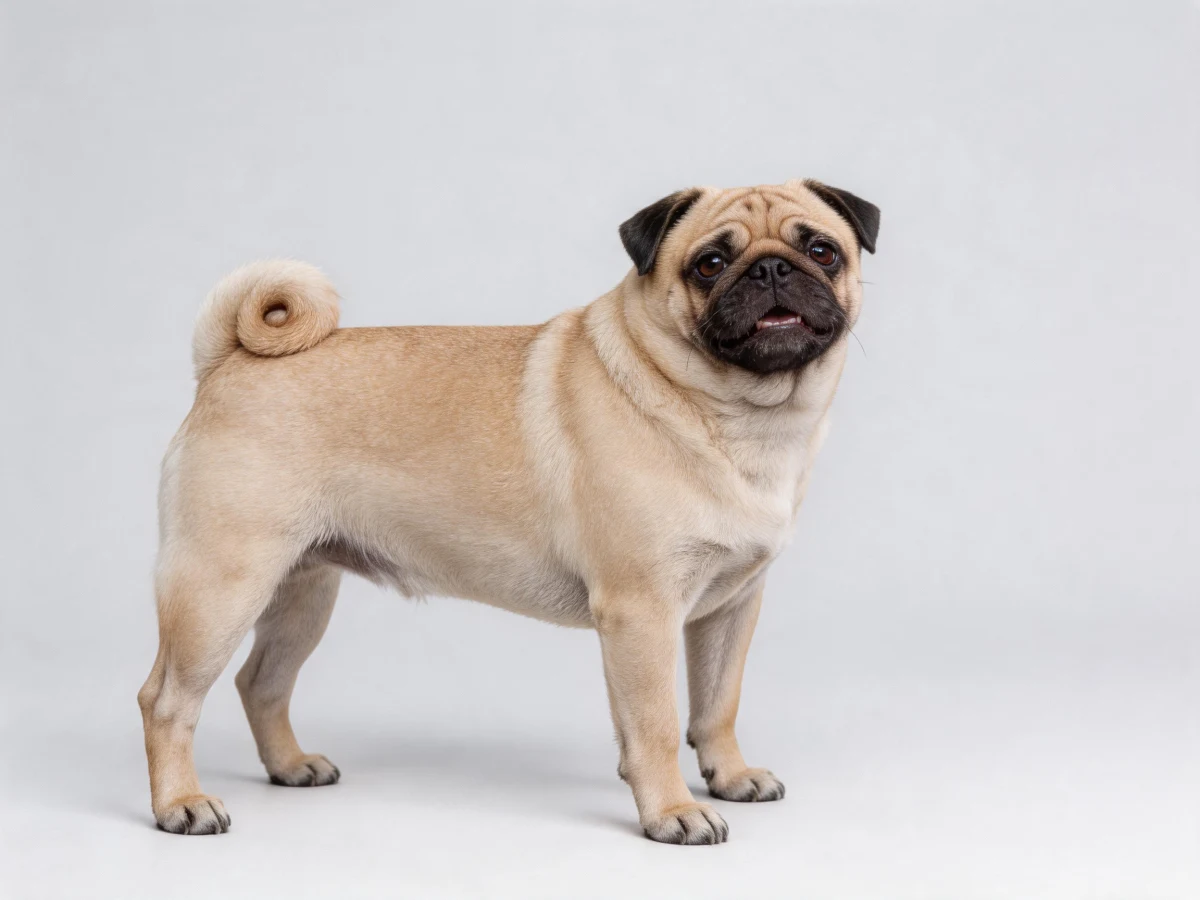
Affenpinscher
✨ Key Takeaways
- The Affenpinscher is an old German toy of pinscher type — its name joins Affe (“monkey/ape”) to Pinscher (“terrier-type dog”) — bred from the 1600s to kill rats and mice in stables, granaries, kitchens and shops before being kept indoors as a companion.
- It is the older German ancestor of the Brussels Griffon, not a Belgian cousin: 19th-century Brussels breeders crossed Affenpinscher-type dogs with pugs and others to make the cab-driver’s griffon, while the Affen stayed in the German pinscher-schnauzer family.
- It is bold, busy, mischievous and clownish — a confident terrier mind in a five-kilo body that believes itself far bigger; loyal and affectionate with its people, territorial and quick to bark, and a poor match for very young children or small prey pets.
- Banana Joe, handled by Ernesto Lara, won Best in Show at the Westminster Kennel Club Dog Show on 12 February 2013, the breed’s first such win and its great moment of public fame.
- Health watch-points are largely those of a small, slightly brachycephalic toy: luxating patella (toy breeds carry several times the risk per O’Neill et al. 2016), Legg-Calvé-Perthes disease, heat intolerance and airway issues from the short muzzle, prominent-eye injuries and cataracts, heart defects and dental disease.
- Recognised by the FCI as Standard No. 186 (Group 2) and by the AKC since 1936 in the Toy Group, it remains one of the rarer breeds; the classic and FCI-only colour is solid black, and the wiry coat sheds little but wants hand-stripping.
Quick Facts
Common Names & Variants
Modern aliases
Historical names
Modern variants & lines
⚖️ Pros & Cons
Advantages
Trade-offs
Physical Appearance
Recognized colors
Coat
Other
Ears: Erect or dropped. Tail: Set high, carried up.
🕰 History
The monkey-faced ratter of the German town
The Affenpinscher began as a working dog with a job nobody romanticised: killing the rats and mice that infested the stables, granaries, kitchens and shops of German towns from the seventeenth century onward. It is one of the older European toy types, and its German name says exactly what people saw in it \u2014 Affe, \u201cmonkey\u201d or \u201cape,\u201d joined to Pinscher, the German word for a terrier-like biting, gripping dog. A small, shaggy, wiry-coated terrier-type with a flat monkeyish face, bushy brows and a jutting beard, the Affenpinscher earned its keep in the rougher corners of household and trade, then was carried indoors to clear the kitchen of vermin and, in time, to warm a bed. The town of L\u00fcbeck and later Munich are among the places associated with its early development, and depictions of small rough-coated ratting dogs of this stamp appear in Northern European art well before any stud book existed.
A pinscher, not a Belgian griffon
It is easy to confuse the Affenpinscher with the Brussels Griffon, because the two share a flat, bearded, monkeyish face \u2014 but the relationship runs the other way round from how it is often told. The Affenpinscher is the older German breed, and it is regarded as an ancestor of the Belgian griffons rather than a cousin of equal age. In nineteenth-century Brussels, small rough-coated dogs of Affenpinscher type were crossed with pugs and other toys to produce the cab-driver\u2019s companion that became the Brussels Griffon. The Affenpinscher, by contrast, stayed a German dog of the pinscher-schnauzer family \u2014 the same broad group that produced the German Pinscher, the Miniature Pinscher and the schnauzers, with an Affen-influenced cross cited among the lines behind the Miniature Schnauzer. So the breed sits at a root of that whole rough-coated toy tradition: a German stable ratter, not a Belgian carriage griffon.
Standardisation in pinscher Germany
As German dog fancy organised itself in the late nineteenth and early twentieth centuries, the Affenpinscher was sorted into the Pinscher-Schnauzer family and given a written standard. It is classified by the F\u00e9d\u00e9ration Cynologique Internationale as Standard No. 186 in Group 2 (Pinscher and Schnauzer type), under German patronage, and the modern standard fixes the small size, the harsh rough jacket, the dark forward-set eyes and \u2014 in the FCI version \u2014 a strictly black coat. The breed remained uncommon even in Germany; it was never a fashion dog, and its numbers stayed small, which is part of why it has kept so close to its old working shape and character rather than being exaggerated by the show ring.
Crossing to America and surviving the war
The Affenpinscher reached the United States in the early twentieth century, and the first American-bred litter is credited to Bessie Mally of Illinois in 1935. The American Kennel Club admitted the breed to its stud book and recognised it in 1936, placing it in the Toy Group. Then the Second World War nearly ended the story: breeding in Europe and America collapsed, the last pre-war American litter is recorded around 1940, and the breed had to be rebuilt in the early 1950s from imported German stock. It has remained one of the rarer toy breeds ever since \u2014 admired by people who know it, largely unknown to everyone else \u2014 sitting near the bottom of the AKC popularity tables not for any fault but simply because so few are bred.
Banana Joe and a moment in the spotlight
For one night the obscure little German ratter was the most famous dog in America. On 12 February 2013, at the 137th Westminster Kennel Club Dog Show in Madison Square Garden, an Affenpinscher named Banana Joe \u2014 handled by Ernesto Lara and owned in the Netherlands \u2014 was chosen Best in Show by judge Michael Dougherty, beating six other group winners. It was the first time the breed had taken the top award at America\u2019s most prestigious dog show, and it put the monkey-faced dog on front pages and television screens overnight. Banana Joe retired immediately afterward, flying home to Europe the next day, but the win remains the Affenpinscher\u2019s great public moment and the reason many people first learned the breed existed.
Temperament & Personality
A big personality in a small, serious package
The Affenpinscher is often described as a thirty-square-inch dog that thinks it is far larger, and the joke is accurate. Bred to confront and kill vermin without backing down, it is confident, bold, busy and almost comically self-important \u2014 a small dog with the bearing of a much bigger one. Owners and the breed clubs reach for the same words: amusing, mischievous, terrier-like, fearless and clownish. It carries itself with a stiff, monkeyish dignity one moment and tumbles into slapstick the next, and that mix of gravity and comedy is the heart of its charm. This is not a placid lap ornament; it is an alert, opinionated little character that runs its household with the certainty that it is in charge.
Loyal, affectionate and intensely bonded
For all its bravado the Affenpinscher is a deeply companionable dog that bonds hard to its people and wants to be in the middle of everything they do. It is affectionate and loyal, often choosing a favourite person to shadow from room to room, and it tends to do best in an adult or older-child household where it is treated as a small dog with big feelings rather than a toy to be carried about. Left out of family life or kennelled away it frets, because the whole point of the modern Affenpinscher is companionship; the ratting is history, the devotion is the job now.
The terrier streak: bold, territorial and quick to bark
The working past shows plainly in the temperament. The Affenpinscher is territorial and quick to sound off, making a surprisingly effective little watchdog that announces every arrival with conviction. It can be possessive of its food, toys and people, and it does not always suffer being teased, grabbed or cornered \u2014 which is why it is usually a poor match for very young children who handle it roughly. With strange dogs it can be fearless to the point of foolishness, ready to challenge animals many times its size, so a sensible owner manages introductions and does not let the dog write cheques its body cannot cash. Its old prey drive is intact too: small fleeing pets may be treated as quarry.
Smart, stubborn and easily bored
The Affenpinscher is intelligent and learns quickly, but it is also independent and stubborn, with a short attention span and a low tolerance for repetition \u2014 a true terrier mind rather than a biddable gundog one. It responds to short, varied, upbeat, reward-based sessions and switches off entirely under heavy-handed drilling. House-training can be slow, as it is with many toy breeds, and the breed is sharp enough to find its own entertainment if bored, which is rarely the entertainment its owner would have chosen. Patience, consistency and a sense of humour get far more out of an Affen than firmness ever will.
Lively but not demanding to exercise
Physically the breed needs less than its energy suggests. It is busy and playful indoors and enjoys games and short walks, but its small size means a couple of modest daily walks and some play satisfy it, and it adapts well to apartment living provided it gets company and mental stimulation. It is curious and a capable little climber and escaper, so a securely fenced space matters more than a large one. The real requirement is engagement, not mileage: an Affenpinscher that is included, talked to and given small jobs is content; one left alone and unstimulated invents mischief.
Who the breed suits
The Affenpinscher suits an owner who wants a small, characterful, low-shedding companion with terrier spirit and is charmed rather than frustrated by stubbornness, barking and a dog that believes itself the equal of any rottweiler. It fits singles, couples and older households, and city living, far better than homes with toddlers or with small pets it might chase. It is for people who want a comedian and a devoted shadow in one wiry little body, and who will meet its independence with patience and its boldness with sensible management.
🏡 Living With a Affenpinscher
A big-dog attitude packed into a four-kilo frame
Living with an Affenpinscher means sharing the house with a small, busy, supremely self-confident dog that has no idea it is small. The name is German for "monkey-like terrier" — the French called it the diablotin moustachu, the moustached little devil — and the breed lives up to both labels: comical, mischievous, fearless, and convinced it runs the household. An Affen wants to be in the thick of family life rather than parked in a basket, and it forms intense, loyal attachments. Unlike a true lap breed, though, it is a terrier-pinscher at heart, an old German ratter bred to clear vermin from kitchens, stables, and shops, so it is happiest with something to investigate, patrol, or pounce on rather than simply being held all day.
Small exercise needs, large alert streak
The Affenpinscher's physical demands are modest: a couple of short daily walks plus indoor play, a bit of training, and a few toys to ambush comfortably satisfy this breed, which makes it a good apartment dog for the right owner. What it lacks in stamina it makes up for in watchfulness. The Affen retains a real prey drive and a hair-trigger alert bark — it will announce the door, the window, and the passing cat with conviction, and may try to chase small scurrying animals — so it works as a tiny watchdog but needs an owner who manages the barking rather than encourages it. That same bold, terrier confidence means an off-lead Affen will happily challenge a dog ten times its size, which is charming and genuinely dangerous, so a secure garden and a lead in open spaces are non-negotiable.
Children, other pets, and the fragility caveat
An Affenpinscher suits an adult or older-child home far better than one with very young children. It is devoted and endlessly entertaining, but it will not tolerate teasing, rough handling, or having its food or toys grabbed, and a small, willful dog pushed too far may snap in self-defence. It is also a structurally delicate toy that a fall from the sofa or a misjudged squeeze can injure. With other dogs and cats it generally coexists well, especially when raised alongside them, though its prey drive means caution around hamsters, birds, and other small pets, and its big-dog bravado needs supervision around larger playmates. Shedding is a non-issue — the harsh wiry coat sheds relatively little — so the Affen's demands are about attention, stimulation, and management rather than hair on the sofa.
🎓 Training & Exercise
Smart, comical, and stubborn in equal measure
The Affenpinscher is clever and genuinely fun to train, but it trains like the terrier-pinscher it is rather than like a biddable gundog. This is an independent, willful dog with a sense of humour and a short attention span: it learns quickly when it sees the point, then grows bored and starts improvising its own entertainment. Keep sessions short, varied, and upbeat, and lean on food, play, and praise — the Affen responds to fun, not to drilling, and never to force. Harsh corrections or a heavy hand backfire badly with a proud, sensitive little dog, producing a defensive or shut-down animal rather than an obedient one. The realistic goal with this breed is a well-mannered companion that knows the rules, not a precision obedience competitor.
House-training takes patience, like most toys
The honest catch with the Affenpinscher is house-training. As with most toy breeds, a tiny bladder, a quick metabolism, and a dislike of going out in cold or wet weather all work against fast results, and an Affen can be slow and inconsistent to toilet-train reliably. The answer is rigid routine rather than punishment: frequent scheduled trips outside, immediate reward the moment the dog performs in the right spot, crate or pen management between trips, and patience measured in months rather than weeks. An indoor pee-pad or litter tray is a sensible backstop for a small dog in a flat or a harsh climate. Never scold an Affen for an accident — it teaches the dog to hide, not to wait.
Early socialisation and the bark
Early, generous socialisation is the highest-value investment an owner makes in this breed. A well-socialised Affenpinscher is bold, comical, and confident; an under-socialised one becomes the caricature of a bad toy dog — shrill, suspicious, and quick to snap when overwhelmed. Introduce puppies to varied people, calm dogs, surfaces, and everyday sounds while they are young, and get them used to having the face, feet, and coat handled for grooming and vet visits. Because the Affen is a natural alert-barker, teach a "quiet" cue early and reward calm rather than accidentally rewarding the noise with attention. A reliable recall and a solid "leave it" matter for a fast, curious dog with prey drive that can be in trouble before you reach it.
✂️ Grooming & Coat Care
The shaggy "monkey" coat is meant to look rough
The Affenpinscher's defining feature is its harsh, wiry, dense coat — roughly an inch long on the body, shaggier and longer around the head, neck, chest, and legs to frame the famous bushy-browed, whiskered, simian face. Crucially, this coat is supposed to look rough and slightly unkempt; the "neglected" shaggy outline is correct breed character, not a sign of poor grooming. To keep the proper harsh texture, show dogs are hand-stripped or plucked — the dead coat pulled out by hand or with a stripping knife — while most pet owners have the coat tidied or clipped instead, which is easier and cheaper but softens the wiry texture over time. Either route, a thorough brush and comb two or three times a week prevents the dense coat from matting close to the skin.
The face furnishings are the daily hotspot
The Affen's glory is its face, and the furnishings there need the most attention. The beard, moustache, and the long hair around the muzzle catch food, water, and debris, so they need regular wiping and cleaning to stay fresh and to avoid irritation of the skin underneath. Keep the hair trimmed back so it does not fall into the eyes, wipe the eye area clean, and watch for redness, cloudiness, or squinting. The bushy eyebrows and the overall shaggy head are part of the breed's charm but they collect grit on walks, so a quick comb-through of the face after outings keeps everything clean and lets you spot problems early.
Ears, nails, teeth, and the toy dental reality
Check and gently clean the ears weekly, drying carefully after baths. Nails on a light, largely indoor dog do not wear down naturally and grow quickly, so trim every two to three weeks — if you can hear them click on a hard floor they are already too long and change how the dog stands. Teeth deserve serious, lifelong attention: toy breeds like the Affenpinscher are strongly prone to dental crowding and periodontal disease because so many teeth are packed into a tiny jaw, so brush several times a week from puppyhood and treat professional cleanings as a normal part of the dog's care. Get a puppy used to having its face, beard, feet, and coat handled early, and the whole grooming routine stays a non-event for life.
🍖 Diet & Nutrition
Tiny portions, easy weight gain
The headline nutritional fact for an Affenpinscher is scale: at roughly four to six kilograms (about nine to thirteen pounds), this is a very small dog, and its daily food requirement is correspondingly tiny. That makes overfeeding remarkably easy — a few extra treats or table scraps that would barely register on a Labrador represent a large share of an Affen's daily calories, and the breed slides into overweight quickly when fed by eye rather than by measurement. Feed a measured amount of a quality food formulated for small or toy breeds, count treats inside the daily ration (use part of the measured food for training), and learn to body-condition-score by feeling for the ribs and waist. Keeping a small dog lean spares the patellas, hips, and heart that this breed is already predisposed to trouble in.
Small mouths, small kibble, and steady puppy growth
A toy breed's tiny jaw and crowded teeth do better with a small-bite kibble sized for the breed, which is also easier on the dental crowding the Affen is prone to. Affenpinscher puppies are small and grow fast, and very small puppies can be vulnerable to low blood sugar (hypoglycaemia) if meals are spaced too far apart, so young puppies are usually fed several small meals a day before settling into twice-daily adult feeding once they mature. Set the adult portion against ideal weight and activity rather than the back-of-bag chart, and make any diet change gradually over about a week to avoid digestive upset in a small, sensitive gut.
A feeding routine that protects teeth and joints
Two measured meals a day suit an adult Affenpinscher better than free-feeding from a bowl left down all day, which encourages grazing and weight gain in a breed that needs so few calories. Fresh water always available, treats kept small and accounted for, and dental-friendly chews can support the tooth-brushing routine rather than replace it. Because even a little extra weight magnifies the strain on a luxating patella or an arthritic hip in a dog this size, disciplined portioning is not cosmetic — it is one of the most practical things an owner can do for an Affen's comfort and longevity across its long 12-to-15-year life.
🐶 Buying & Adopting a Affenpinscher
Start at the parent club, not a classified ad
The Affenpinscher Club of America (ACA) is the AKC parent club and the right place to begin a search. The Affenpinscher is an uncommon breed, so litters are relatively rare and good breeders are worth waiting for. A breeder worth buying from will be active in the parent club, will register litters with the AKC, will health-test both parents, will offer a written contract and health guarantee, and will be openly willing to discuss the breed's known issues rather than insisting their lines are simply "healthy." Because the breed is small and uncommon, be especially alert to high-volume sellers and online "toy puppy" operations that produce fragile, poorly socialised dogs.
The health screening to ask a breeder for
The Affenpinscher's CHIC health profile centres on four screenings, and a responsible breeder can show results on both parents: a patella evaluation for luxating patella (OFA), a hip evaluation that also covers Legg-Calvé-Perthes (OFA), an eye examination by a boarded veterinary ophthalmologist for conditions such as cataracts and progressive retinal atrophy (OFA/ACVO), and a cardiac evaluation screening for issues including patent ductus arteriosus and mitral valve disease. Many breeders also run a thyroid panel for autoimmune thyroiditis. It is also fair to ask about patent fontanelle (an incompletely closed skull opening seen in some toy dogs) and about the breed's dental crowding. Asking for this paperwork is consumer due diligence, not medical advice — a breeder who produces the OFA results and talks frankly about these conditions is the one to trust; "all our dogs are healthy, no need to test" is the answer to walk away from.
Rescue and adoption
Because the Affenpinscher is uncommon, dedicated breed rescue is smaller and less centralised than for popular breeds, but the parent club can point toward Affenpinscher rescue contacts, and toy-breed and small-dog rescues occasionally take Affens or Affen mixes in. Adopting an adult can be an excellent route for someone who would rather take on a dog with a known temperament than wait through a long puppy list, and an adult Affen's bold, comical character is usually an open book by the time it is rehomed. As with any toy, meet the dog, ask about its history with children and other pets, and be honest about whether your home matches its needs.
Price, waiting lists, and red flags
A well-bred Affenpinscher puppy in the United States runs roughly USD 1,500–4,000 (2024 data), depending on region, lineage, and parent titles, and because the breed is rare, expect a waiting list rather than a puppy on demand. The patterns to walk away from are familiar: puppies advertised well below that range with immediate availability, no health-testing documentation, and no parent-club connection, or sellers pushing "teacup" or undersized Affens as a premium — extreme miniaturisation is a marketing gimmick that tends to come with fragile health, not a recognised type. A fair price from a health-testing, parent-club breeder, even after a wait, is far cheaper than the lifetime cost of a poorly bred dog.
📜 Breed Name Etymology — iDogNames original research
Affe + Pinscher \u2014 the monkey terrier
The name is plain, descriptive German and tells you both what the dog looks like and what it does. Affe is German for \u201cmonkey\u201d or \u201cape,\u201d a reference to the flat, bearded, brow-heavy face whose lively dark eyes give the breed an almost simian, almost human expression. Pinscher is the German term for a terrier-type dog \u2014 a small, gripping, biting working dog \u2014 cognate with and probably borrowed from the English \u201cpinch,\u201d describing how such dogs seize and shake their prey. Put together, Affenpinscher means roughly \u201cmonkey terrier\u201d or \u201cape-like pinscher,\u201d and it is one of the rare breed names that is at once a physical description and a job title.
Why \u201cpinscher\u201d and not \u201cterrier\u201d
English speakers often call the breed a \u201cmonkey terrier,\u201d which is a fair translation but a slight category error. Pinscher is the German cousin of the English working-terrier tradition rather than a true terrier in the English sense, and the Affenpinscher is classified by the FCI not among the terriers but in the Pinscher and Schnauzer group \u2014 alongside the German Pinscher, the Miniature Pinscher and the schnauzers. The name therefore places the dog firmly in its German working family. The kennel clubs of the English-speaking world keep the German name untranslated, which is why the breed is \u201cAffenpinscher\u201d on an American or British pedigree just as it is in Germany.
The mustached little devil
The French gave the breed its most colourful nickname: diablotin moustachu, the \u201cmustached little devil.\u201d It captures the other half of the Affen\u2019s character \u2014 not the solemn monkey but the bold, mischievous, faintly demonic imp with a bristling moustache and an outsized sense of its own importance. The French label was always affectionate, a tribute to the breed\u2019s comic, devil-may-care temperament, and it survives as a fond alternative name wherever the breed is known.
Affen, and the family of -pinschers
Owners almost universally shorten the long name to Affen, which has become the everyday word for the breed in English and German alike. The full word also makes the dog\u2019s kinship audible: it shares its second half with the German Pinscher, the Miniature Pinscher (the Zwergpinscher, \u201cdwarf pinscher\u201d) and, by extension, the schnauzers, all members of the same Group 2 family. Hearing \u201cpinscher\u201d in the name is hearing the breed\u2019s pedigree spoken aloud.
The name in the breed standards
On paper the breed keeps its German identity everywhere. The FCI carries it as the Affenpinscher, Standard No. 186 in Group 2, under German patronage; the AKC and the Kennel Club list it the same way, in the Toy Group. There is no anglicised or translated official name the way some breeds acquired \u2014 the dog travels under its German word, monkey face and all \u2014 and that linguistic constancy is itself a small piece of the breed\u2019s history, marking it as a German original rather than a creation of the English or American show ring.
Name forms at a glance
| Name | Role | Origin | Literal meaning | First recorded |
|---|---|---|---|---|
| Affenpinscher | primary | German | monkey terrier; ape-like pinscher | 1840 |
| Pinscher | origin country native | German | a gripping, biting terrier-type dog | 1780 |
| Diablotin Moustachu | alias | French | the mustached little devil | 1900 |
| Monkey Terrier | historical | English | the monkey-faced terrier | 1900 |
| Affen | alias | German | the monkey (dog) | 1950 |
🏛 Naming Traditions — iDogNames original research
Name the dog from its own German, monkey-faced world
The Affenpinscher hands an owner an unusually specific set of naming wells, far better than any generic small-dog list, because almost everything about it \u2014 its German origin, its monkey name, its devilish nickname, its wiry beard, its ratting past and its one great show-ring moment \u2014 points to names rooted in the breed and no other. Five layers are genuinely the Affen\u2019s own: the monkey and ape theme of its very name; the German language and country it comes from; the \u201clittle devil\u201d mischief the French saw in it; its bold, clownish, big-dog-in-a-small-body character; and the real history of the breed, from the stable ratter to Banana Joe. Each names the dog after something true about it, which is what a good Affenpinscher name should do.
The monkey in the name
The most obvious well is the one written into the breed itself. Affe means monkey, and a monkey- or ape-themed name announces the breed\u2019s defining feature \u2014 that flat, bearded, brow-heavy little face. Names like Coco, Bongo, Mojo and Marcel (after the famous television monkey) play the theme lightly; Caesar and Cornelius nod to the apes of film; and Affe itself, or simply Monkey, names the breed outright. Few breeds can wear a monkey name without it seeming arbitrary; on an Affenpinscher it is simply accurate.
German names for a German dog
The breed is German through and through, and German names sit on it with no sense of costume. Classic given names \u2014 Fritz, Greta, Heidi, Otto, Hans, Liesl, Bruno, Gretel \u2014 root the dog in its homeland, while German words for its small bold nature, such as Schatzi (\u201clittle treasure\u201d) or Strudel, add warmth. Naming an Affenpinscher in German is the single easiest way to honour what the breed actually is.
The mustached little devil
The French nickname diablotin moustachu opens a whole mischievous well that suits the breed\u2019s impish streak. Diablo, Gizmo, Rascal, Bandit, Imp, Pixie, Scamp and Trouble all name the comic, faintly demonic character the French saw, and Mo or Mustache nods to the bristling beard. For a dog this self-importantly naughty, a little-devil name is closer to the truth than any sweet one.
Bold names for a big personality
The Affen\u2019s outsized confidence invites names that play on the gap between its tiny body and its enormous opinion of itself. Big, grand or ironic names \u2014 Titan, Goliath, Bear, Hercules, Caesar, Duke, Boss, Napoleon \u2014 are funny and fitting on a five-kilo dog that fears nothing, while Banana Joe, after the breed\u2019s Westminster winner, both honours the history and winks at the bravado.
Names from the breed\u2019s real history
Finally, the documented history offers names with genuine weight. Banana Joe, the 2013 Westminster Best in Show, is the breed\u2019s most famous individual; L\u00fcbeck and Munich name the German towns tied to its origins; Pinscher and Schnauzer nod to its working family; and ratting words like Ratter, Mouser and Pip recall the job it was bred for. These are names that say, without a word of explanation, that the dog wearing them is an Affenpinscher and nothing else.
🐾 Themed Names for Your Affenpinscher — iDogNames original research
The monkey in the name
Names that play on Affe \u2014 \u201cmonkey\u201d \u2014 and the breed\u2019s defining simian face.
- Coco \u2014 a classic monkey name; light and affectionate
- Bongo \u2014 playful and primate, for a busy little dog
- Mojo \u2014 cheeky and apt for a characterful Affen
- Marcel \u2014 after the famous television monkey; knowing and fun
- Caesar \u2014 the ape leader of film; bold for a small dog
- Cornelius \u2014 another film-ape name; dignified and droll
- Monkey \u2014 names the breed\u2019s whole identity outright
- Affe \u2014 the German word itself; the truest Affen name
- Gizmo \u2014 small, hairy and mischievous, like the breed
- Chico \u2014 \u201clittle one\u201d; warm for a tiny monkey-faced dog
German names for a German dog
Names that root the breed in the German towns and households it came from.
- Fritz \u2014 a classic German name; jaunty and apt
- Greta \u2014 a spirited German name for a bold little bitch
- Otto \u2014 short, sturdy and very German
- Heidi \u2014 warm and old-country
- Bruno \u2014 a bigger-sounding name for an outsized personality
- Liesl \u2014 pretty and German for a little dog
- Hans \u2014 plain, friendly and homeland-true
- Schatzi \u2014 German for \u201clittle treasure\u201d; affectionate
- Strudel \u2014 a fond, food-based German name
- Gretel \u2014 storybook German for a small companion
The mustached little devil
Names from the French nickname diablotin moustachu and the breed\u2019s impish streak.
- Diablo \u2014 the \u201clittle devil\u201d outright; bold and fitting
- Rascal \u2014 plainly names the mischief
- Bandit \u2014 for a dog that steals hearts and socks alike
- Imp \u2014 small, quick and faintly demonic
- Pixie \u2014 a mischievous sprite of a name
- Scamp \u2014 fond and accurate for a naughty Affen
- Trouble \u2014 ironic and true for so small a handful
- Mo \u2014 short for the moustache the French admired
- Pepper \u2014 spicy and sharp, like the temperament
- Jinx \u2014 playful and a touch wicked
Bold names for a big personality
Grand, ironic names that play on a tiny dog with an enormous opinion of itself.
- Napoleon \u2014 the classic small-but-mighty name
- Titan \u2014 vast and ironic on a five-kilo dog
- Goliath \u2014 the giant\u2019s name for the fearless mite
- Hercules \u2014 strongman energy in a small body
- Bear \u2014 a big-animal name for a shaggy little dog
- Duke \u2014 grand and self-important, like the Affen
- Boss \u2014 names who really runs the house
- Caesar \u2014 imperial swagger for a tiny ruler
- Tank \u2014 fearless and unstoppable, ironically tiny
- Czar \u2014 another little emperor of a name
Names from the breed\u2019s real history
Names drawn from the Affenpinscher\u2019s documented past \u2014 its towns, its family and its great moment.
- Banana Joe \u2014 the Affenpinscher that won Westminster Best in Show in 2013
- Lübeck \u2014 the German town tied to the breed\u2019s early development
- Munich \u2014 another city associated with the breed\u2019s history
- Pinscher \u2014 the breed\u2019s working family, spoken plainly
- Schnauzer \u2014 the bearded cousin in the same German group
- Ratter \u2014 names the job the breed was bred for
- Mouser \u2014 the kitchen-and-stable work, fondly recalled
- Pip \u2014 small, sharp and ratting-quick
- Bessie \u2014 after Bessie Mally, who bred the first US litter in 1935
- Joe \u2014 short for the breed\u2019s famous champion
📋 Breed Standard at a Glance
General appearance
The AKC standard describes the Affenpinscher as a small, sturdy, shaggy-coated toy terrier-type with a famously monkey-like facial expression — the name is German for "monkey-like terrier." The overall impression is of a balanced, square little dog that carries itself with comical seriousness and a confident, almost human-like air. The harsh "neglected" coat and the bushy-browed, bearded face are not faults to be tidied away but the very essence of correct breed type. An Affen-mix called "Banana Joe" famously took Best in Show at the 2013 Westminster Kennel Club show, a high-profile moment for the breed.
Size, coat, and colour
The Affenpinscher is a true toy: it stands roughly 25–30 cm (about 10–12 inches) at the withers and weighs around 4–6 kg (about 9–13 pounds), with the standard calling for a sturdy, square dog rather than a fine-boned one. The coat is dense, rough, harsh, and wiry, about an inch long over the body and shaggier and longer around the head, neck, chest, and legs to form the characteristic mane and the monkey-like furnishings of the face. The AKC standard favours black as the preferred colour, while also accepting grey, silver, red, black-and-tan, and beige; in some other registries black is the only colour allowed.
Head, movement, and temperament
The head carries the breed's signature: a domed forehead, bushy eyebrows and a beard, dark round eyes, and a short muzzle, combining into the alert, comical, monkey-like expression that defines the Affenpinscher. Movement is light, free, and confident. Temperament is written into the standard — the Affen should be confident, fearless, lively, and stubbornly comical, a "big dog in a small body" that is intensely loyal to its family, alert as a watchdog, and never timid. Shyness or aggression toward people falls well outside correct breed character.
🏆 Recognition
Recognized by the American Kennel Club in 1936 as a Toy breed. FCI standard No. 186 (Section 1.2 — Pinscher (small)), recognized in 1955.
Other registries
Breed clubs
❓ Frequently Asked Questions
Are Affenpinschers good family dogs?
They are devoted, comical companions best suited to an adult or older-child home. The Affenpinscher will not tolerate teasing or rough handling and is a small, delicate dog that young children can injure, so it is not an ideal match for households with toddlers. With calm older children, single owners, and seniors it can be a wonderful, entertaining family member.
Do Affenpinschers shed a lot?
No — the harsh, wiry coat is relatively low-shedding, so hair on the furniture is not a major issue with this breed. The trade-off is coat maintenance: the rough coat needs regular brushing and either hand-stripping or clipping to keep its texture and prevent matting.
How much exercise does an Affenpinscher need?
Modest. A couple of short daily walks plus indoor play and a little training comfortably satisfy this lively toy, which makes it a good apartment dog. It is busy and playful rather than high-stamina, but it does keep an alert, watchdog streak and a real prey drive, so a secure garden and a lead outdoors are important.
How long do Affenpinschers live?
Typically 12 to 15 years. Like many small breeds the Affenpinscher is generally long-lived, though it has known predispositions — including luxating patella, hip and Legg-Calve-Perthes issues, eye and cardiac conditions, and the dental crowding common to toy dogs — that responsible breeders screen for.
Are Affenpinschers easy to train?
They are clever but independent and willful, so they train on their own terms. Short, fun, varied reward-based sessions work best; the breed bores easily and shuts down under harsh handling. House-training in particular takes patience, as it does with most toy breeds. The realistic goal is a well-mannered companion rather than a precision obedience dog.
Are Affenpinschers hypoallergenic?
No dog is truly hypoallergenic, but the Affenpinscher is low-shedding, which some allergy sufferers tolerate better than heavy-shedding breeds. Anyone with a dog allergy should spend extended time around the breed before committing, since reactions are to dander and saliva, not just shed hair.
How much does an Affenpinscher puppy cost?
A well-bred, health-tested puppy from a parent-club breeder typically runs about USD 1,500 to 4,000 (2024 data), and because the breed is uncommon you should expect a waiting list rather than a puppy on demand. Be wary of puppies priced well below that with no health-testing paperwork, and of "teacup" Affens marketed at a premium.
📚 Sources & Further Reading
Every load-bearing factual claim on this page is anchored to one of the sources below. iDogNames does not synthesize from secondary aggregators.
- akc breed page Affenpinscher — AKC Breed Profile — American Kennel Club (2024)
- fci standard pdf FCI Standard No. 186 — Affenpinscher — Fédération Cynologique Internationale (2009)
- kc uk standard pdf Affenpinscher — Breed Standard — The Kennel Club (UK)
- breed club official Affenpinscher Club of America — AKC parent club — Affenpinscher Club of America
- other Affenpinscher — UKC Breed Standard — United Kennel Club (2014)
- academic paper The epidemiology of patellar luxation in dogs attending primary-care veterinary practices in England — O'Neill DG, Meeson RL, Sheridan A, Church DB, Brodbelt DC — Canine Genetics and Epidemiology 3:4 (PMID 27280025) (2016)
- academic paper Longevity of companion dog breeds: those at risk from early death — McMillan KM, Bielby J, Williams CL, Upjohn MM, Casey RA, Christley RM — Scientific Reports 14:531 (PMID 38302530) (2024)
- book The New Complete Dog Book — American Kennel Club (2017)
- wikipedia Affenpinscher — Wikipedia — Wikipedia