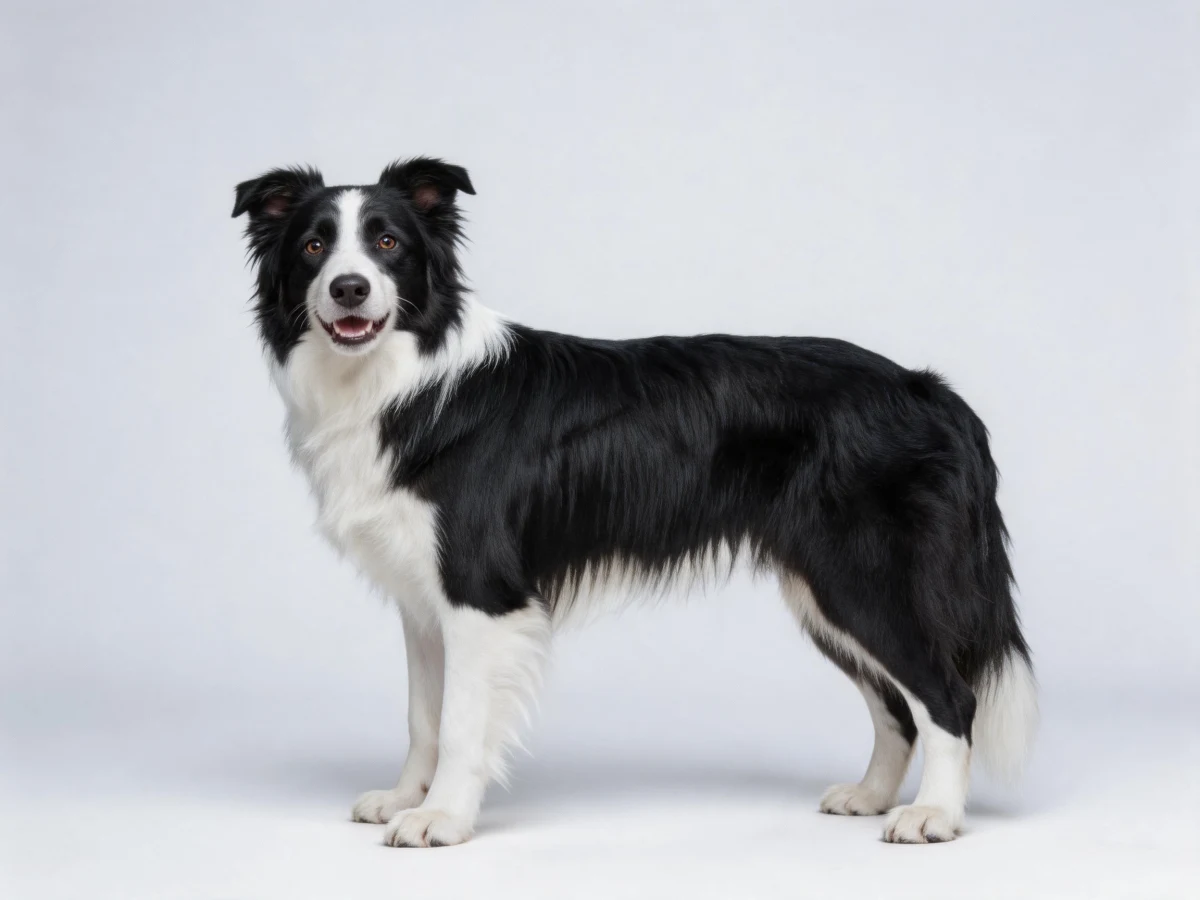
Collie
✨ Key Takeaways
- The word "collie" is older and broader than this breed: it named any Scots hill sheepdog for centuries, and the Border Collie, Bearded Collie and Shetland Sheepdog all descend from the same landrace — the unqualified "Collie" is the elegant, long-headed show and companion dog the world calls the Lassie collie.
- Queen Victoria turned a working farm dog into a fashionable breed almost single-handedly: charmed by the collies she met at Balmoral in 1860, she brought them to Windsor and kept a Collie Court, and royal enthusiasm moved the dog from the shepherd's heel to the show bench within a few years.
- The breed comes in two coats under one name — the long Rough Collie (FCI Standard 156) and the short Smooth Collie (FCI Standard 296) — that are otherwise the same dog; the AKC recognised the Collie in 1885, one of its earliest breeds.
- The Collie is the namesake of canine multidrug sensitivity: a 4-base-pair deletion in the MDR1/ABCB1 gene (Mealey et al., 2001) leaves affected dogs unable to keep drugs like ivermectin out of the brain — "white feet, don't treat" — and a cheek-swab DNA test should be run before any worming.
- Two further inherited diseases are gene-mapped and DNA-testable: Collie Eye Anomaly, a 7.8-kb NHEJ1 deletion (Parker et al., 2007), and grey collie syndrome, an AP3B1 mutation causing fatal cyclic neutropenia (Benson et al., 2003). Responsible breeding screens for all three.
- The deepest naming heritage is Scottish, not generic: Gaelic given names (Angus, Skye, Hamish), Highland landscape (Balmoral, Glen, Lomond) and the shepherd's own vocabulary (Shep, Lass, away, come-bye) name the dog after the country and work that made it, while Lassie names it after its myth.
Quick Facts
Common Names & Variants
Modern aliases
Historical names
Modern variants & lines
⚖️ Pros & Cons
Advantages
Trade-offs
Physical Appearance
Recognized colors
Coat
Other
Ears: Semi-prick. Tail: Long, carried low.
🕰 History
A farm dog the word "collie" is older and bigger than
The word collie is older than the breed it now names, and broader. For centuries it described any of the working sheepdogs of Scotland and the north of England — a loose family of hill dogs, drovers' dogs, and yard dogs that varied from glen to glen and were named for a job, not a pedigree. The Border Collie, the Bearded Collie, the Smooth and Rough Collies, and the Shetland Sheepdog all grew out of that same Scots herding stock. So the breed described on this page — the elegant, long-headed, full-coated dog the world calls the "Lassie collie" — is one descendant of the collie landrace, refined in the second half of the 19th century into a show and companion animal. The honest version of the story keeps that distinction front and centre: there was a collie before there was a Collie.
The working ancestor was a medium, hardy, weather-proof dog kept on thin upland pasture, expected to gather and move sheep across miles of open hill in foul weather and to live cheaply on a shepherd's wage. It came in rough and smooth coats — sometimes in the same litter — and the smooth was often preferred as the drover's dog, trotting cattle and sheep down to market, while the rough kept the sheep on the hill. Those two coats survive intact in the modern breed, which is the rare case of a single registered Collie existing in two coat varieties that are otherwise the same dog.
Queen Victoria, Balmoral, and the day the dog became fashionable
The single event that turned the Scotch farm dog into a fashionable breed has a date. In 1860 Queen Victoria visited Balmoral, her Highland estate, met the local collies, and was charmed by their looks and gentleness; she brought collies south to Windsor and established what amounted to a "Collie Court" within the Royal Kennels. Royal enthusiasm did to the collie what royal enthusiasm always did in Victorian Britain — it made the dog aspirational. Within a few years the collie had moved from the shepherd's heel to the show bench. Collies were entered at the Birmingham dog show around 1860, and a handful were registered and shown there by 1863. The breed that had been valued for what it could do on a hill was suddenly being valued for how it looked standing still.
Old Cockie and the making of the modern head
The refinement that followed was deliberate and traceable. The sire generally credited as the fountainhead of the modern Collie is Old Cockie, whelped in 1867 — a sable-and-white dog at a time when most collies were black or black-and-tan. Old Cockie is said to lie behind almost every modern Collie pedigree, and he helped fix the sable colour that the public now thinks of as the default. Late-Victorian show breeders then pushed the head in a particular direction: longer, narrower, more refined, with the flat skull and clean foreface the breed is known for. Some of that refinement came, by repute, from outcrosses to the Borzoi, the Russian wolfhound, brought in to lengthen and narrow the head. The result is a dog whose elegant profile is a Victorian aesthetic achievement, not a working necessity — a point Border Collie people, who kept selecting for work, never tire of making.
Two coats, one breed, and the kennel clubs
The Kennel Club in Britain recognised the collie early — the breed was registered there from the 1870s, and a breed club for the rough collie was organised in 1881. The American Kennel Club recognised the Collie in 1885, making it one of the earliest breeds on the AKC register, and the Collie Club of America followed in 1886. The Fédération Cynologique Internationale eventually split the dog by coat into two standards under the same name: the Rough Collie as Standard N° 156 and the Smooth Collie as Standard N° 296, both in Group 1, Section 1, the sheepdogs. In Britain and America the two coats are usually treated as varieties of one breed; under the FCI they carry separate standard numbers. The dog underneath is identical apart from the jacket.
Sunnybank, Lassie, and the fame that fixed the type
No 20th-century breed owes more of its public image to fiction than this one. The American author Albert Payson Terhune, writing from his Sunnybank estate in New Jersey, produced a long run of collie novels and stories from the 1910s onward — Lad: A Dog (1919) chief among them — that sold in the millions and planted the noble, self-sacrificing collie in the American imagination. Then came Eric Knight's Lassie Come-Home, published as a novel in 1940, the MGM film in 1943 (which made a star of the male collie Pal, who played the female Lassie), and the long-running television series that followed. Between Terhune and Lassie, the sable-and-white rough collie became the default mental image of a "faithful dog" for two generations of English-speaking children. The fame was real and so was its cost: the breed's popularity peaked in the 1950s and 1960s and then settled, and the dog now sits around 39th on the AKC's register — admired, recognisable, and far less common than its cultural footprint suggests.
It is worth being clear about the limits of the evidence here. The early landrace history is reconstructed from scattered references and breed-club tradition rather than stud books, and claims like the Borzoi outcross are widely repeated breed lore rather than pedigree-documented fact. What is firmly dated is the Victorian arc — Balmoral in 1860, Old Cockie in 1867, KC and AKC recognition in the 1870s and 1885 — and the literary fame of the following century. That arc is the breed's real story: a hill dog made elegant by royalty and made famous by fiction.
Temperament & Personality
The sensitive end of the herding group
The Collie sits at the gentle, sensitive end of the herding breeds, and that is the most useful single thing to know about its character. Where the Border Collie is an intense work-obsessed athlete and the Australian Shepherd a high-drive ranch dog, the Collie was bred — and then re-bred by Victorian fanciers — toward biddability, soft handling, and an attachment to people that is closer to a companion breed than to a hard-driving stock dog. The standards describe a dog of dignity, intelligence, and gentleness, and that is broadly accurate. This is not a dog that needs a flock to be sane, but it is a dog that needs its family.
Bonded, watchful, and famously good with children
The breed's reputation as a child's dog is not purely Lassie-marketing. Collies tend to be patient, tolerant, and naturally protective of the household's children, and the herding instinct usually expresses as watchfulness and gentle shadowing rather than the nipping seen in some stock breeds. The dog wants to know where its people are. It will follow you from room to room, station itself where it can see the household, and treat a closed door as a personal affront. That deep attachment is the breed's great charm and its main vulnerability: a Collie left alone for long working days, without company or occupation, is a candidate for separation distress.
The barking is a feature, not a bug — usually
Collies are vocal. The hill dog was supposed to announce things, and the modern dog still does: visitors, vehicles, the postman, a leaf moving in a way it disapproves of. For an alert, environment-aware household this is a useful early-warning system. For an apartment with thin walls it is a liability that needs early, consistent management, because a Collie that has learned that barking works will keep doing it. The trait responds well to training precisely because the dog is so handler-sensitive, but it has to be addressed early rather than ignored into a habit.
Herding instinct in a living room
The stock-working drive did not vanish when the breed moved indoors; it just lost its sheep. A Collie with no flock will often herd whatever it has — children at a run, joggers past the fence, the family cat. The expression is gentle by herding-group standards, more circling and shadowing than the hard eye and crouch of a Border Collie, and it rarely tips into nipping in a well-raised dog. But it is real instinct rather than habit, and it is best given an outlet: a ball to gather, a recall game, a long walk with jobs in it. A Collie that gets to use its head and its feet daily is a calm dog at home; one that gets neither becomes a fretful, pacing, vocal one. The breed is intelligent enough to invent its own work, and the work it invents is rarely what the owner would have chosen.
Soft to train, easy to over-correct
Few breeds are easier to train with kindness or quicker to wilt under harshness. The Collie is intelligent, eager to please, and reads its handler closely, which makes positive, reward-based work very effective. The same sensitivity means a heavy hand backfires: shout at a Collie and you get an anxious, hesitant, sometimes shut-down dog rather than a corrected one. Day to day the breed is moderate in energy by herding-group standards — it needs real daily exercise and mental engagement, but not the relentless hours a Border Collie demands. The honest failure modes are loneliness, boredom-barking, and a softness that punishes rough handling. Matched to a family that wants a gentle, devoted, people-centred dog and will train it kindly, the Collie is one of the most genuinely companionable members of the herding group.
🏡 Living With a Collie
A devoted shadow that wants to be near its people
The Collie is a deeply people-oriented dog, and the central fact of sharing a home with one is the closeness of the bond. This is a sheepdog bred to work in partnership with a single shepherd across open Scottish hill country, and that history shows up in the house as a dog that follows its person from room to room, settles wherever the family settles, and is happiest with children, visitors, and other pets folded into its circle. A Collie left alone for long working days is a Collie at risk of loneliness, anxious pacing, and the kind of boredom that turns into barking. Households with someone home much of the day, or with the means to arrange company and a midday break, suit the breed far better than a quiet, empty house.
Moderate exercise, but a working mind that needs a job
A Collie is not the relentless, never-tire athlete of the Border Collie; it is a gentler dog with a moderate-to-high need that is met by a good hour or so of varied activity a day. What matters more than raw mileage is purpose. A Collie wants to think — to learn a routine, follow a sequence of tasks, work out a puzzle — and a structured walk, a game of fetch, scent work, or a short training session leaves the dog far more settled than aimless yard time. The breed's herding heritage also surfaces as a tendency to watch, circle, and sometimes try to "gather" children, joggers, or other animals, so a Collie that gets real mental engagement is the calm companion the breed is famous for, while an under-stimulated one invents its own work.
Children, climate, apartments, and the voice
The Collie's reputation as a gentle, trustworthy family dog is well earned: it is patient with children, sociable with other dogs, and far more inclined to alert and supervise than to confront. That same watchfulness comes with a voice — Collies can be notably vocal, announcing arrivals, movement, and anything out of place, which makes them fine watchdogs but a poor fit for owners who need silence. The rough variety's dense double coat handles cold and damp well but feels the heat, so hot, humid weather calls for early or late activity and shade; the smooth variety manages warmth a little more easily. A Collie can live in an apartment if its exercise, company, and barking are managed, but it is a large, coated dog that thrives with room and access to the outdoors.
🎓 Training & Exercise
A soft, clever dog that learns fast and feels everything
Collies are intelligent and quick to learn, and the breed has earned its place as a working sheepdog, a film and television performer, and a reliable family companion on the strength of that trainability. The key to it is sensitivity: a Collie reads tone, body language, and mood acutely, and it works for connection and approval as much as for food. Reward-based methods are not just the kinder choice for this breed — they are the only ones that work well. Harsh corrections, shouting, or heavy-handed tools land hard on a soft dog and tend to produce a worried, shut-down, slower learner rather than a more obedient one. Calm, consistent, encouraging handling brings out a Collie that is eager to please and genuinely keen to get things right.
The herding instinct and the one real catch
The Collie's working brain is the trait an owner must channel rather than fight. Many Collies show classic herding behaviour — watching intently, circling, nipping at heels, trying to gather moving children or pets — and the answer is to give that instinct a legitimate outlet through trick training, obedience, scent games, or dog sports such as herding trials, rally, or agility. The one real catch with the breed is its voice: Collies are predisposed to bark, and a clever, under-occupied Collie can teach itself that barking is entertaining. Training an "enough" or "quiet" cue early, rewarding calm silence, and meeting the dog's mental needs are far more effective than trying to suppress the bark after it has become a habit.
Socialisation and the commands that matter most
Because the Collie is sensitive and naturally reserved with strangers, early and positive socialisation is the highest-value work an owner can do — a well-socialised Collie is confident and friendly, while an under-socialised one can become shy or skittish. Expose a Collie puppy gently and positively to people, places, sounds, and handling during its formative weeks, and keep new experiences upbeat. The commands that earn their keep in this breed are a reliable recall (the herding drive can pull a dog toward movement), a solid "leave it" for the chase instinct, and a clear "quiet" for the bark. Puppy classes early and continued reward-based work through adolescence keep a Collie's keen mind pointed in the right direction.
✂️ Grooming & Coat Care
Two coats, two very different grooming jobs
The Collie comes in two varieties of one breed, and the coat is the practical difference between them. The Rough Collie — the long-coated "Lassie" dog — carries a profuse double coat: a harsh, straight outer coat over a soft, dense undercoat, with a dramatic mane and frill around the neck and chest and feathering on the legs and tail. It needs real, regular work: a thorough brush-out several times a week, taken right down to the skin with a pin brush and an undercoat comb so the dense undercoat does not pack into mats. The Smooth Collie wears the same dense double coat in a short, flat form and is far easier — a weekly brushing keeps it in good order. Both varieties stay cleaner than they look, and a bath every several weeks or when genuinely dirty is plenty.
Heavy seasonal shedding and the matting hotspots
Both varieties shed, and both "blow" their undercoat heavily once or twice a year, typically in spring and again before winter, when loose undercoat comes out in volume for a couple of weeks. Daily brushing through that window is the difference between a managed coat and drifts of hair through the house — and on the Rough Collie it is essential, because shed undercoat trapped under the long topcoat is exactly where mats begin. On the rough coat the trouble spots are predictable: behind and beneath the ears, in the dense mane and frill, in the armpits, and on the feathering behind the legs and on the trousers. Work these areas specifically, because a neglected mat tightens to the skin and turns sore. A Collie should never be shaved down to fight shedding; the double coat insulates against both cold and heat and can regrow patchy and damaged after clipping.
Ears, eyes, nails, teeth, and feet
The Collie's semi-prick ears are less moisture-trapping than a pendant ear, but a weekly look and a gentle wipe with a vet-recommended cleaner remains a sensible habit, with careful drying after baths. Eyes deserve a regular glance given the breed's known eye conditions — any persistent redness, cloudiness, or discharge is worth a veterinary check rather than a wait. Nails grow steadily and need trimming every two to three weeks; if they click on a hard floor they are already too long. Brushing the teeth two or three times a week from puppyhood is the single highest-leverage long-term care habit. Trim the hair between the foot pads for traction on smooth floors, and check the feathered feet for grass seeds and debris after country walks.
🍖 Diet & Nutrition
Feed to the working frame, not to the begging eyes
The Collie is a lean, athletic, deep-chested working dog, and the headline diet goal is to keep it that way: at a trim, fit weight where you can feel the ribs easily and see a waist, with the abundant rough coat hiding nothing from your hands. The breed is not the relentless food-hound some retrievers are, but a large dog with a moderate appetite and an owner who feeds by the eye rather than by measure still drifts to overweight, and surplus pounds load joints, strain the heart, and shorten an otherwise long-lived breed's good years. Feed measured meals matched to the individual dog's ideal weight and activity, keep treats inside a daily budget (use part of the ration for training), and body-condition-score by feel rather than trusting a coat-padded silhouette.
Steady growth for a large-breed puppy
A Collie is a large breed, and its puppies should be raised on a food formulated for large-breed growth, fed to keep the youngster lean and growing at a steady, even pace rather than as fast as possible. Pushing rapid growth or oversupplying calcium during the large-breed puppy stage is linked to developmental joint problems, so controlled, gradual growth — not a roly-poly puppy — is the aim. Most Collies move to twice-daily adult feeding once growth slows, with portions set by ideal adult weight (broadly 51–75 lb depending on sex and frame) and activity level and adjusted by body condition over time. Any change of food should be made gradually across a week to avoid digestive upset.
The MDR1 fact that touches diet, and deep-chest care
One feeding-adjacent fact is specific to this breed: the Collie has a very high frequency of the MDR1 (ABCB1) gene variant that affects how the body handles certain drugs and substances, which is exactly why some flavoured chews, dewormers, and medications carry breed-relevant cautions — an owner should know the dog's MDR1 status and keep the veterinarian informed rather than guessing. This is a fact to act on with a vet, not a dosing instruction. As a deep-chested large breed the Collie also carries some risk of bloat and gastric torsion (GDV), so the practical, widely advised habits apply: split the day's food into two meals rather than one large one, avoid hard exercise in the hour either side of eating, slow a fast eater with a slow-feeder bowl, and treat a distended abdomen, unproductive retching, and obvious distress as an immediate veterinary emergency.
🐶 Buying & Adopting a Collie
Start at the Collie Club of America, not a classified ad
The Collie Club of America (CCA) is the AKC parent club and the right starting point for a buyer. It maintains a breeder-referral resource, a code of ethics for member breeders, and connections to Collie rescue across the country. A breeder worth buying from will be a CCA member in good standing, will register litters with the AKC, will health-test both parents, will offer a written contract and health guarantee, and will talk openly about the breed's known genetic conditions — its eye and drug-sensitivity issues in particular — rather than insisting their lines are simply "clear" with no testing to show for it.
The exact health screening to ask a breeder for
The Collie's CHIC screening profile gives a buyer a concrete checklist, and a responsible breeder can show results on both parents: an eye examination by a boarded veterinary ophthalmologist (OFA/ACVO), an MDR1 (ABCB1) DNA test, a Collie Eye Anomaly (CEA/NHEJ1) DNA test, and a hip evaluation (OFA). Two of these define the breed. Collie Eye Anomaly is so closely tied to this breed that it was first described and named in collies and is found at high frequency in the population, so a CEA DNA result on both parents — and ideally an early puppy eye exam — is something to ask for directly, not skip. The MDR1 drug-sensitivity variant is likewise very common in collies; knowing a puppy's MDR1 status lets an owner tell any future veterinarian which medications warrant caution. Many breeders also run a Progressive Retinal Atrophy (rcd2) DNA test and screen for Cyclic Neutropenia (Grey Collie Syndrome). Asking for this paperwork is consumer due diligence, not medical advice — "our dogs are healthy, no testing needed" is the answer to walk away from.
Rescue and the two varieties
Collie rescue is well organised, coordinated through the CCA and a network of regional breed-rescue groups that regularly take in adolescents and adults surrendered through owners' changed circumstances. For an adopter open to an adult dog with a known temperament rather than the wait for a puppy, breed rescue is an excellent and ethical route. Whichever way you go, remember that Rough and Smooth are the same breed and may even appear in the same litter — choose the variety by the grooming commitment you want rather than treating the smooth coat as a lesser or separate dog.
Price, waiting lists, and the red flags
A well-bred Collie puppy in the United States runs roughly USD 800–2,500 (2024), depending on region, lineage, variety, and the parents' titles, and the better breeders keep waiting lists of several months. The patterns to walk away from are the familiar ones: puppies advertised well below that range with immediate availability, no health-testing documentation — especially no MDR1 or CEA results — and no parent-club connection. Be wary, too, of sellers charging a premium for an unusual colour as though it were a rare type; coat colours such as sable, tricolour, blue merle, and white are recognised variations within the standard, not separate or superior breeds. A fair price from a health-testing, CCA-affiliated breeder, even after a wait, is far cheaper over a 12-to-14-year life than the cost of a poorly bred dog.
📜 Breed Name Etymology — iDogNames original research
A Scots word for a working dog
The name collie is a Scots and northern-English word, and its origin is genuinely uncertain — which is itself worth saying plainly, because a great deal of confident nonsense is written about it. The word is recorded from at least the 17th and 18th centuries as the ordinary term for a shepherd's dog in Scotland, and it was spelled in several ways: colley, coll, coaly, coally. It named the type of dog long before any kennel club fixed a breed, so the word's history is the history of a job, not of a pedigree.
The two leading etymological theories both have respectable support and neither is settled. The first connects collie to the Anglo-Saxon and Scots word col, "coal," giving the sense "coaly" or "black" — a description of the dark-coated hill dogs that were common before Old Cockie fixed the sable colour in the 1860s. On this reading the collie is simply "the black dog." The second connects the word to the Scots colley or coilley meaning a sheep with a black face or black markings (the "colley" sheep), so that the collie is "the dog that works the colley sheep." Lexicographers have not chosen between these, and an honest etymology entry leaves both standing rather than picking the prettier one.
Why "collie" names a family, not just this breed
The most important fact about the name is that it is broader than the breed on this page. Because collie originally meant any Scots herding dog, the word now sits at the front of several distinct breeds: the Border Collie, the Bearded Collie, the Smooth and Rough Collies, and — at one remove — the Shetland Sheepdog. When the kennel clubs began registering breeds in the 1870s and 1880s, the elegant show dog refined from the landrace simply kept the bare word "Collie," while its working cousin became the "Border Collie" (named for the Anglo-Scottish border country where it was developed). This is why a great deal of public confusion exists: the unqualified "Collie" of the AKC and KC registers is the Lassie dog, but the unqualified word in ordinary speech can mean any of the family.
Scotch Collie, Lassie, and the modern aliases
The breed has carried several names. Scotch Collie and Scottish Collie were the standard 19th- and early-20th-century names, marking the dog's Highland origin and still used by the working-revival breeders who keep the old farm type. Rough Collie and Smooth Collie are the coat-variety names, and under the FCI they are formally separate standards (156 and 296). The most powerful modern alias is not a breed name at all: Lassie dog, after Eric Knight's 1940 novel and the films and television that followed, is how a large part of the public actually identifies the breed. It is an alias born entirely of fiction, and it has done more to fix the sable-and-white rough collie in the popular mind than any stud book.
The colley sheep, and a word that may have crossed species
The black-faced-sheep theory is worth dwelling on, because it points at something unusual. In several Scots dialects a colley, coilley, or coally was the sheep with a black or dark face — a colour-word applied to livestock. If the dog took its name from the sheep it worked, then the breed name is a rare case of a working animal named after its quarry-of-care rather than after its own appearance or its task. The two leading theories, in other words, may not be rivals at all: a dark-coated dog working dark-faced sheep would answer to "the coaly one" on both counts at once, and the word may simply have settled on whichever sense a given glen found obvious. The Oxford and Scots dictionaries record the uncertainty rather than resolving it, and so should anyone writing about the breed honestly.
Pronunciation
In English the name is /ˈkɒli/ — "COLL-ee," with a short first vowel as in "collar," not "coal." The pronunciation is the same across the family, so a Border Collie and a Bearded Collie share the second word exactly. The Scots spellings colley and coaly point at the same single-syllable-plus-ee shape that the modern spelling preserves, and the older Scots stress fell, as it still does, on that first short syllable.
Name forms at a glance
| Name | Role | Origin | Literal meaning | First recorded |
|---|---|---|---|---|
| Collie | primary | Scots / Northern English | the black dog, or the dog of the colley sheep | 1700 |
| Scotch Collie | origin country native | English (Scots descriptive) | the collie of Scotland | 1800 |
| Rough Collie | historical | English (descriptive) | the long-coated Collie | 1880 |
| Smooth Collie | historical | English (descriptive) | the short-coated Collie | 1880 |
| Lassie dog | alias | English (fictional) | the Lassie dog | 1940 |
🏛 Naming Traditions — iDogNames original research
A Scottish naming heritage, kept honest
The Collie's naming heritage is Scottish to its roots, and the most fitting names draw on the actual culture of the Highlands and the Lowlands rather than on generic "dog name" lists. There are five coherent layers an owner can work from: Scottish Gaelic given names, the landscape and place-names of the hill country the breed came from, the breed's own documented history (Balmoral, Old Cockie, the show fanciers), the herding and shepherding vocabulary the dog was bred to obey, and — handled with a light touch — the literary fame of Lassie and Sunnybank. The trick is to lean on the first four, which are genuine breed heritage, and to use the fifth knowingly.
The Scottish Gaelic given-name layer
Scottish given names are the truest fit, because this was a Scottish shepherd's dog for centuries before it was anything else. Strong male choices include Angus (from the Gaelic Aonghas, "one strength"), Hamish (the vocative form of Seumas, the Scots Gaelic James), Lachlan ("from the land of lakes"), Callum (from Latin columba, "dove," via Saint Columba of Iona), Duncan (Donnchadh, "brown warrior"), Fergus ("man of vigour"), Alasdair (the Gaelic Alexander), and Bran (the legendary hound of Fionn mac Cumhaill in Gaelic myth — a name with real dog pedigree). For females the language gives Bonnie (Scots for "pretty," and a genuine Scotticism rather than an Americanism), Isla (after the Hebridean island and the river), Skye (the great Hebridean island), Maisie (a Scots diminutive of Margaret), Ailsa (after Ailsa Craig, the granite island in the Firth of Clyde), Catriona (the Gaelic Catherine, immortalised by Robert Louis Stevenson), Greer (a Scots surname-name), and Iona (the holy island off Mull). Each plants the dog firmly in its home culture.
The land — Highlands, islands, and rivers
The second layer reaches for the Scottish landscape the breed actually came from. The hills and glens give grounded, working-true names: Glen itself, Ben (Gaelic beinn, "mountain," as in Ben Nevis), Cairn (a stone hill-marker), Heather and Bracken (the moorland plants the dog ran through), Tor, and Munro (the Scots word for a peak over 3,000 feet). The place-names carry weight: Balmoral — the single most apt landscape name for this breed, since it was Victoria's 1860 visit there that made the collie fashionable — plus Braemar, Lomond (after the loch and the bens), Nevis, Arran, Mull, and Kintyre. The rivers add Tay, Spey, Dee, and Clyde. For a hill sheepdog these are not decorative; they are the actual country the breed was selected to work.
The breed's own history as a naming source
The third layer is unusual and specific to this breed: the documented history gives ready-made names. Cockie, after Old Cockie, the 1867 sable sire behind nearly every modern pedigree, is a real heritage name with a real founder behind it. Victoria and Albert nod to the royal couple whose Balmoral enthusiasm launched the breed's fashion. Windsor recalls the Royal Kennels where Victoria kept her Collie Court. Sunnybank honours Albert Payson Terhune's New Jersey estate and the collie novels written there. Birmingham marks the show where the breed first appeared around 1860. These are names with genuine documentary anchors, and they let an owner who knows the breed's story name the dog after it.
The shepherd's working vocabulary
The fourth layer is occupational, and for a herding breed it is the most authentic of all. The shepherd's commands and tools make crisp, functional names: Shep (the oldest plain shepherd's-dog name in Britain), Lass and Laddie (the Scots terms of address that gave Lassie and Laddie their names long before the films), Tam (the Scots Tom, as in Burns's Tam o' Shanter), Crook (the shepherd's staff), Fleece, Tweed (the border river and the cloth), and the herding directions themselves — Away (the command to cast left) and Bye (short for "come-bye," the command to cast right). A working Collie answering to a real herding command is wearing its job description.
Lassie and the fiction layer — use knowingly
The fifth layer is the famous one, and it deserves a clear-eyed note. Lassie is the most recognisable dog name on earth, and a sable rough collie can carry it with total justification — but the owner should know it is a fictional name from Eric Knight's 1940 novel and the 1943 MGM film, and that the original screen Lassie was in fact a male collie named Pal. Lad, after Terhune's 1919 Lad: A Dog, is the literary alternative for a male. Pal itself honours the real dog who played Lassie. These names are fine choices, but they name the dog after its myth rather than its origin, which is the opposite of what the Gaelic and landscape layers do. The deepest, most personal heritage names for a Collie are Scottish — Angus, Skye, Balmoral, Shep — because they name the dog after the country and the work that actually made it.
🐾 Themed Names for Your Collie — iDogNames original research
Scottish Gaelic names — male
Gaelic and Scots male names with deep Highland roots — the truest heritage layer for a Scottish shepherd's dog.
- Angus — from Gaelic Aonghas, "one strength"; a clan name and a county
- Hamish — the vocative of Seumas, the Scots Gaelic James; warm and unmistakably Scottish
- Lachlan — "from the land of lakes"; a strong, full-mouthed name
- Callum — from Latin columba, "dove," via Saint Columba of Iona
- Duncan — Donnchadh, "brown warrior"; a king's name in Scots history
- Fergus — "man of vigour"; an old Gaelic royal name
- Alasdair — the Gaelic Alexander; dignified and historic
- Bran — the legendary hound of Fionn mac Cumhaill in Gaelic myth; a true dog name
- Rory — from Ruairidh, "red king"; suits a sable coat
- Finlay — Fionnlagh, "fair hero"; soft and Highland
Scottish names — female
Gaelic and Scots female names drawn from the islands, the saints, and the literature of Scotland.
- Bonnie — Scots for "pretty"; a genuine Scotticism, not an Americanism
- Isla — after the Hebridean island and the river; clean two syllables
- Skye — the great Hebridean island; short and evocative
- Ailsa — after Ailsa Craig, the granite island in the Firth of Clyde
- Catriona — the Gaelic Catherine, immortalised by Robert Louis Stevenson
- Maisie — a Scots diminutive of Margaret; bright and easy to call
- Iona — the holy island off Mull; gentle and historic
- Greer — a Scots surname-name; crisp and modern
- Elspeth — the Scots form of Elizabeth; period-true
- Mhairi — the Gaelic Mary (pronounced "VAH-ree"); deeply regional
The Highland landscape
Hills, islands, and rivers from the country the breed was bred to work.
- Balmoral — Victoria's Highland estate; the place that made the collie fashionable in 1860
- Glen — a Scots valley; the plainest, most fitting landscape name
- Ben — Gaelic beinn, "mountain," as in Ben Nevis
- Cairn — a stone hill-marker; short and rugged
- Heather — the moorland flower the dog ran through
- Bracken — the hill fern; a working-country name
- Lomond — after the loch and the bens; smooth and grand
- Arran — the island in the Firth of Clyde
- Mull — the Hebridean island; one crisp syllable
- Munro — the Scots word for a peak over 3,000 feet
The shepherd's working vocabulary
Herding commands, tools, and shepherd's-dog names — the most authentic register for a herding breed.
- Shep — the oldest plain shepherd's-dog name in Britain
- Lass — the Scots term of address that gave Lassie her name
- Laddie — the male counterpart of Lass; warm and Scots
- Tam — the Scots Tom, as in Burns's Tam o' Shanter
- Crook — the shepherd's staff; short and functional
- Tweed — the Border river and the cloth; a herding-country name
- Fleece — the sheep's wool the dog tended
- Away — the herding command to cast left around the flock
- Bye — short for "come-bye," the command to cast right
- Drover — the trade the smooth collie was bred for
The breed's own history and fame
Names drawn from the documented Collie story — its royal patrons, its founding sire, and its 20th-century fiction.
- Lassie — the most famous dog name on earth, from Eric Knight's 1940 novel and the 1943 film
- Cockie — after Old Cockie, the 1867 sable sire behind nearly every modern pedigree
- Pal — the real male collie who played Lassie on screen
- Lad — after Terhune's 1919 collie novel Lad: A Dog
- Victoria — the queen whose Balmoral enthusiasm launched the breed's fashion
- Albert — the Prince Consort; the male counterpart to Victoria
- Windsor — the Royal Kennels where Victoria kept her Collie Court
- Sunnybank — Terhune's New Jersey estate and the home of his collie novels
- Sable — the breed's signature coat colour, fixed by Old Cockie
- Merle — the marbled blue coat pattern; a colour name with breed meaning
📋 Breed Standard at a Glance
General appearance
The AKC and UK Kennel Club standards describe the Collie as a lithe, strong, responsive, active dog of great beauty, standing with dignity and showing no trace of either nervousness or aggression. It is a herding dog built for endurance over hill country rather than for exaggeration, balanced and clean in outline, with a smooth, effortless way of moving. The breed comes in two varieties — Rough and Smooth — judged to the same standard in everything but coat, the Rough carrying the long, profuse coat of the familiar "Lassie" type and the Smooth a short, flat coat.
Size, coat, and colour
Males stand about 24–26 inches at the shoulder and weigh roughly 60–75 lb; females stand about 22–24 inches and weigh about 51–64 lb. Both varieties carry a dense double coat — a soft, close undercoat beneath the outer coat — differing only in length: the Rough coat is long, straight, and harsh to the touch with an abundant mane and frill and feathering on the legs and tail, while the Smooth coat is short, flat, and dense. Four colours are recognised: sable and white, tricolour, blue merle, and white (the white dog usually marked with sable, tricolour, or blue merle on the head).
Head, movement, and temperament
The head is a defining feature — a smooth, well-balanced, blunt wedge, lighter in proportion to size than in any other breed, with a flat skull, a slight stop, almond-shaped eyes giving the characteristic sweet expression, and semi-prick ears carried about three-quarters erect with the tips folding forward. Movement is sound and effortless, with good reach and drive and a level topline on the move. Temperament is written into the standard: the Collie should be a gentle, friendly, sensitive companion, devoted to its family and naturally inclined to watch over children — neither shy nor sharp.
🏆 Famous Collies
Notable real dogs of the breed profiled on iDogNames.
🏆 Recognition
Recognized by the American Kennel Club in 1885 as a Herding breed. FCI standard No. 156 / 296 (Section 1 — Sheepdogs (without working trial)), recognized in 1955.
Other registries
Breed clubs
❓ Frequently Asked Questions
Are Collies good family dogs?
Yes — the Collie is one of the classic family breeds, gentle and patient with children, sociable with other pets, and naturally inclined to watch over its household. It bonds closely and dislikes being left alone for long stretches, so it suits a home where it has company for much of the day. The breed is more of a devoted companion and alert watchdog than a guard dog.
Do Collies shed a lot?
Yes, both varieties shed and both blow their dense undercoat heavily once or twice a year, usually in spring and again before winter. The Rough (long-coated) Collie needs brushing several times a week — daily during a shed — to prevent matting in the mane and feathering. The Smooth (short-coated) Collie sheds just as much undercoat seasonally but is far easier, needing only a weekly brush.
How much exercise does a Collie need?
A Collie has a moderate-to-high need met by about an hour of varied activity a day. It is gentler than the tireless Border Collie, but as a herding breed it wants a job for its mind — a structured walk, fetch, scent games, training, or a dog sport leaves it far more settled than aimless yard time.
How long do Collies live?
Typically 12–14 years. The Collie is a fairly long-lived large breed, and keeping the dog lean, well exercised, and up to date on its breed-specific eye and genetic screening supports a full, healthy life.
Are Collies easy to train?
Yes. Collies are intelligent, quick to learn, and eager to please, which is why they have long worked as sheepdogs and performers. They are sensitive, so reward-based methods work best; harsh corrections backfire on a soft dog. The main training projects are channelling the herding instinct and teaching a "quiet" cue, since the breed can be vocal.
Are Collies hypoallergenic?
No. Both the Rough and Smooth Collie carry a dense double coat that sheds heavily, especially during seasonal coat blows, so the breed is not considered hypoallergenic. Anyone with a dog allergy should spend extended time around the breed before committing to one.
How much does a Collie puppy cost?
A well-bred, health-tested Collie puppy in the United States typically runs USD 800–2,500 (2024), depending on region, lineage, variety, and the parents' titles, often with a waiting list of several months. Be wary of puppies priced well below that with no MDR1 or Collie Eye Anomaly testing paperwork and no parent-club connection.
📚 Sources & Further Reading
Every load-bearing factual claim on this page is anchored to one of the sources below. iDogNames does not synthesize from secondary aggregators.
- akc breed page Collie — AKC Breed Profile — American Kennel Club (2024)
- fci standard pdf FCI Standard No. 156 — Collie (Rough) — Fédération Cynologique Internationale (2012)
- kc uk standard pdf Collie (Rough) — Breed Standard — The Kennel Club (UK)
- breed club official Collie Club of America — parent club, breed history and health — Collie Club of America
- academic paper Ivermectin sensitivity in collies is associated with a deletion mutation of the mdr1 gene — Mealey KL et al., Pharmacogenetics 11:727–733 (PMID 11692082) (2001)
- academic paper Breed relationships facilitate fine-mapping studies: a 7.8-kb deletion cosegregates with Collie eye anomaly across multiple dog breeds — Parker HG et al., Genome Research 17:1562–1571 (PMID 17916641) (2007)
- academic paper Mutations causing severe congenital neutropenia and cyclic hematopoiesis disrupt intracellular transport of neutrophil elastase — Benson KF et al., Nature Genetics 35:90–96 (PMID 12897784) (2003)
- academic paper Collie History: From Queen Victoria to Lassie & Beyond — American Kennel Club (2021)
- wikipedia Rough Collie — Wikipedia — Wikipedia