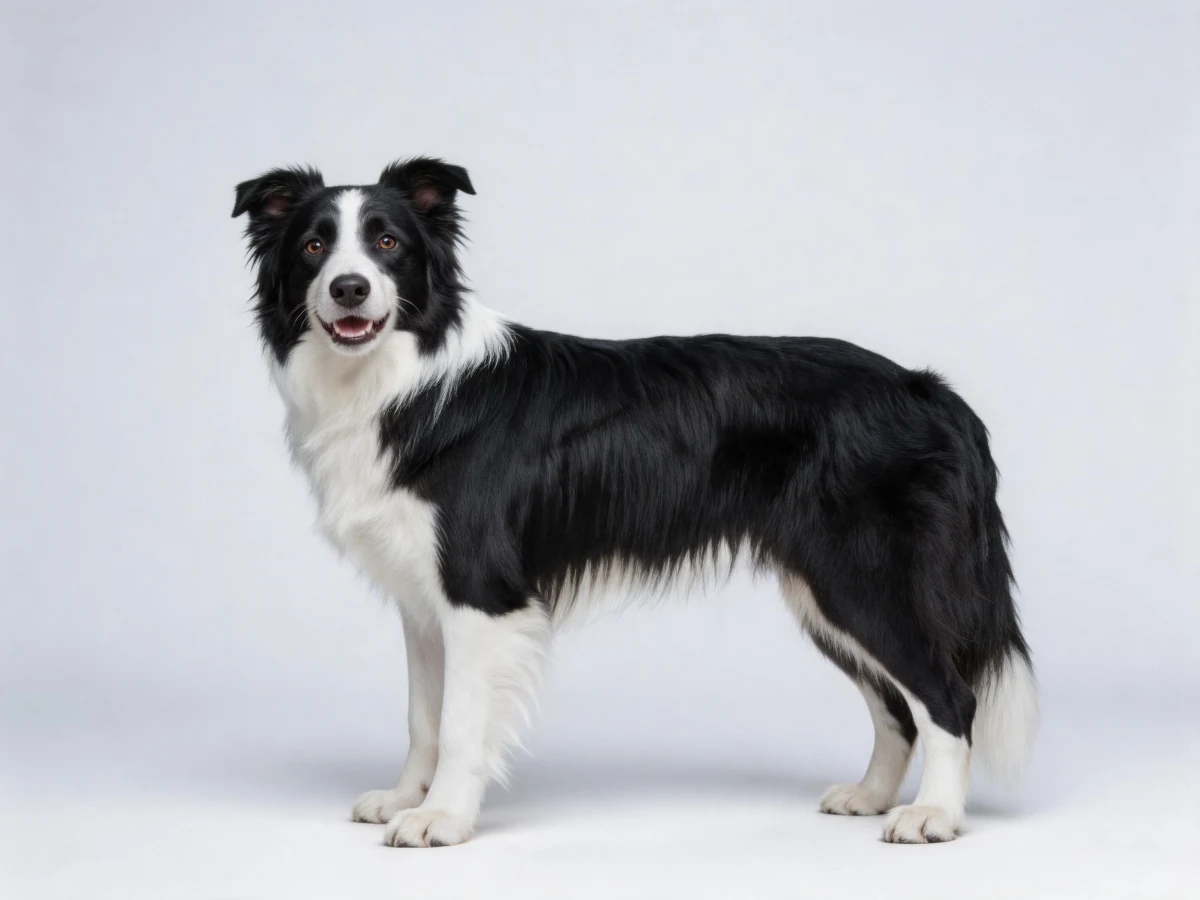
Australian Shepherd
✨ Key Takeaways
- The name is a misnomer — the breed was developed in the western United States, not Australia. The label stuck because American ranchers associated the dogs with sheep flocks shipped in from Australia in the 1800s.
- A 2017 genome-wide study (Parker et al., Cell Reports) places the Aussie firmly in the British "UK Rural" clade alongside the Collie and Border Collie — the genetics contradict the name, not the heritage story.
- MDR1/ABCB1 drug-sensitivity is central to this breed: a defective gene (Mealey et al., 2001) makes ivermectin and several common drugs dangerous at normal doses. A simple cheek-swab DNA test is non-negotiable before any treatment.
- Two merle dogs should never be bred together. Double-merle ("double dilute") puppies are frequently born deaf, blind, or both — a documented, preventable outcome, not bad luck.
- Rodeo trick-dog handler Jay Sisler did more than any breeder to make the Aussie visible to the American public in the 1950s; the breed had no kennel-club paperwork until ASCA was founded in 1957.
- This is a working dog with a job-shaped temperament. Without daily physical and mental work it does not relax — it redirects the herding drive onto children, bicycles, and the household.
Quick Facts
Common Names & Variants
Modern aliases
Historical names
Modern variants & lines
⚖️ Pros & Cons
Advantages
Trade-offs
Physical Appearance
Recognized colors
Coat
Other
Ears: Button. Tail: Natural-bobtail.
🕰 History
A breed named for a country it never came from
No dog in Australia was ever called an Australian Shepherd. The breed took shape on the ranches and sheep ranges of the western United States, and the name is a piece of mistaken shorthand that hardened into a registry title. The American Kennel Club's own breed history is blunt about it: observant Americans, not Australians, applied the label, after noticing the herding dogs that arrived alongside flocks of sheep shipped to the United States from Australia and New Zealand in the 1800s. The dogs were associated with the imported sheep, the sheep were Australian, and the name transferred. The animals themselves had no Australian ancestry to speak of.
The genetics back this up cleanly. A 2017 genome-wide analysis of 161 breeds by Heidi Parker, Dayna Dreger, and colleagues at the National Institutes of Health (Parker et al., Cell Reports, 2017) placed the Australian Shepherd inside what the authors named the "UK Rural" clade — the same tight genetic cluster as the Collie, the Border Collie, the Shetland Sheepdog, and the Welsh Corgis. The Aussie's deep relatives are British herding dogs. The name points at the wrong continent.
Spanish missions, the Gold Rush, and Basque shepherds
The breed's working ancestry is older than the United States. Spanish colonists moving north into California brought hardy sheep and the small, energetic pastoral dogs that managed them — stock of the type that survives in Spain today as the Carea Leonés of the León region. These were the dogs of the mission flocks. Documentation from this period is thin and the exact lineage is undocumented; what survives is the pattern, not a pedigree.
The California Gold Rush of 1849 changed the math. A torrent of miners needed feeding, demand for mutton and wool spiked, and flocks were driven west from the Midwest and East — accompanied by British-derived farm collies that had been tending them for generations. From roughly the 1870s onward, Basque shepherds emigrating from the western Pyrenees found work running sheep across the Mountain West, and they brought their own dogs and their own stockmanship into the mix. The precise contribution of the Basque dogs to the modern breed is debated and not pinned down by records; the popular notion that the Aussie is "the Basque shepherd's dog" is more romantic than documented. What can be said with confidence is that the breed coalesced in the western U.S. from Spanish-derived and British-derived herding stock, selected by working ranchers for stamina and biddability rather than appearance.
Jay Sisler and the rodeo arena
For most of its existence the Aussie was an anonymous ranch tool with no club, no standard, and no audience. That changed because of one man and a horse arena. Jay Sisler, an Idaho rodeo rider, performed trick-dog acts at western rodeos and fairs through the 1940s and 1950s with a string of blue and red Aussies — dogs named Stub, Shorty, and Queenie among them. The act traveled, it appeared in Disney films, and for the first time large American audiences saw the breed and asked what it was. Sisler did not create the Australian Shepherd, but he made it visible. Demand for his line of dogs is a recurring thread in the breed's own oral history.
From ranch dog to registered breed
The first formal structure came in 1957, when the Australian Shepherd Club of America (ASCA) was founded as an independent breed registry — still the largest single-breed club in the United States. ASCA wrote and maintained the breed standard for decades and built the breed's working-stockdog program. American Kennel Club recognition came much later and along a separate track: the United States Australian Shepherd Association (USASA) was formed in 1990 as the AKC parent club, the AKC recognized the breed on September 1, 1991, and admitted it to the Herding Group on January 1, 1993. The United Kennel Club had recognized the Aussie earlier, in 1979. Internationally, the Fédération Cynologique Internationale issued FCI Standard No. 342, with the current standard dated 26 March 2009 and published 5 June 2009, classifying the breed in Group 1 (Sheepdogs and Cattledogs), Section 1 (Sheepdogs), without working trial.
The split between ASCA and AKC registration left a mark that persists. Working-bred Aussies from the stockdog tradition tend to be lighter-framed, more intense, and bred for instinct on stock; conformation-bred Aussies are heavier-coated and selected partly for the show ring. Both are the same breed on paper. In the field they can feel like two different dogs, and a buyer should know which tradition a litter comes from before committing.
The Miniature American Shepherd footnote
Breeders in California in the late 1960s began selecting the smallest Aussies for a downsized version, originally sold as the Miniature Australian Shepherd. The AKC recognized this as a distinct breed in 2015 under the name Miniature American Shepherd — pointedly dropping "Australian," partly to settle a long dispute with the Aussie parent club over whether the small dogs were a size variety or a separate breed. They are now genetically and administratively their own breed, descended from the Australian Shepherd but no longer the same animal.
Temperament & Personality
A job-shaped mind
The Australian Shepherd's temperament was assembled by a century of ranchers who culled any dog that could not work all day and think for itself. The result is a dog with a strong, self-directing herding drive, high biddability toward a trusted handler, and a low tolerance for boredom. The AKC standard describes the breed as "intelligent, active, with an even disposition; good natured, seldom quarrelsome," and notes that the dog "may be somewhat reserved in initial meetings." That reserve with strangers, paired with intense attachment to its own people, is the breed's social signature — this is not a Labrador that loves everyone equally.
What this looks like day to day
A typical adult Aussie shadows its owner from room to room, watches the household for cues, and looks for something to manage. Given a real job — stockwork, agility, structured training, scent games — it is focused and settled. Given no job, the herding instinct does not disappear; it redirects. Untrained Aussies gather running children, nip at cyclists' heels, chase cars, and patrol fence lines obsessively. None of this is malice or a behavioral disorder. It is the breed doing precisely what it was bred to do, aimed at the wrong target. The fix is occupation and training, not correction after the fact.
Energy is the deciding factor
More Aussies are surrendered for being "too much dog" than for any health or aggression problem. The breed's exercise and stimulation needs are genuinely high and they are not optional. A daily walk is maintenance, not satisfaction. Households that fail with this breed almost always fail on the same point: they bought the dog's striking merle coat and intelligence and underestimated the workload attached to both. Working-line dogs need substantially more than conformation-line dogs to reach the same calm.
One temperament caveat is worth stating plainly. The breed's reserve can tip into shyness or fear-based reactivity if a puppy is poorly socialized — the standard itself flags "shyness, fear or aggression" as a serious fault. Early, broad socialization is not a nicety for this breed; it is structural.
🏡 Living With a Australian Shepherd
A working dog that needs a real job, not a yard
The single most important fact about living with an Australian Shepherd is that it is a stockdog, bred on the American West to move livestock all day, and it arrives in your home wired for that work whether or not you keep sheep. An Aussie is not a calm companion breed that happens to be energetic; it is a high-drive herding dog whose energy and intelligence have to go somewhere. Given a genuine outlet — herding, agility, flyball, disc, obedience, scent work, structured training games, a long active hike — an Aussie is focused, biddable, and a superb partner. Denied that outlet, the same dog turns its drive inward and becomes a behavioural problem: pacing, barking, spinning, shredding furniture, and inventing its own jobs around the house. An under-stimulated Aussie is not a couch dog waiting to relax; it is a frustrated employee with no work, and that is where most surrendered Aussies come from.
The herding instinct shows up indoors
That stockdog wiring does not stay on the trail. Aussies commonly try to herd whatever moves — running children, the family cat, joggers, other dogs — by circling, staring, and nipping at heels, because that nip is exactly how the breed moves stubborn stock. It is instinct, not aggression, but in a home with young kids it has to be managed and redirected from puppyhood with training and an alternative outlet, not punished after the fact. Aussies are intensely loyal and famously "velcro" — they bond hard to their people, follow you room to room, and want to be involved in everything. That devotion is wonderful, and it also means the breed does poorly when isolated; an Aussie left alone in a yard or crated through long working days is a recipe for separation distress and destruction.
Climate, apartment fit, and the shedding reality
With early socialisation an Aussie is good with respectful children and with other pets it is raised alongside, though the herding habit means supervision and management are wise around toddlers and small animals. The breed can technically live in an apartment, but only if you are honest that you must replace the missing acreage with hours of daily activity and mental work — this is one of the harder breeds to keep happy in a small space. The dense double coat gives reasonable cold tolerance but limited heat tolerance, so summer exercise belongs in the cool of early morning or evening with shade and water. And be realistic about hair: the medium double coat sheds steadily year-round and heavily during seasonal coat blows, so a vacuum and a brush are permanent fixtures of Aussie ownership.
🎓 Training & Exercise
Brilliant, fast, and a step ahead of you
The Australian Shepherd is one of the most trainable breeds going, and the reason is raw problem-solving intelligence paired with a strong work ethic — this is a dog that genuinely wants a task and learns new behaviours in remarkably few repetitions. That same intelligence is the catch. An Aussie that is not being taught something is teaching itself something, usually a habit you did not want, such as opening doors, herding the kids, or barking at every car. The breed thrives on reward-based training with clear structure and a steady supply of new challenges; mindless drilling of the same command bores it, and boredom in a smart herding dog turns into invented mischief. Channel the brain on purpose with trick training, shaping games, puzzle feeders, and a real dog sport, and you get a calm, focused partner instead of a self-employed troublemaker.
Sensitive and biddable — harsh handling backfires
For all its drive, the Aussie is a sensitive, handler-focused dog that reads your tone and body language closely. Harsh corrections, intimidation, or heavy-handed tools do not produce a more obedient Aussie; they produce a worried, shut-down, or reactive one, because the breed was built to take subtle direction from a shepherd, not to be bullied. Positive, consistent, fair methods are not just nicer here, they work demonstrably better. Start socialisation early and broadly — Aussies can be naturally reserved and watchful with strangers, which makes them alert watchdogs but also means under-socialised dogs may become shy or sharp. Wide, positive exposure to people, places, dogs, and noise in the first months pays off for life.
Manage the nip, build the recall
The highest-value training priorities for this breed flow straight from its instincts. Address heel-nipping and herding of children and pets early by interrupting the chase, rewarding an alternative behaviour, and giving the drive a legitimate outlet, rather than waiting for it to escalate. Teach a rock-solid recall and a reliable "leave it" and "settle," because a fast, driven dog that ignores a recall near livestock, traffic, or wildlife is a dog in danger. Aussies excel when given a job title — a herding instinct test, an agility class, a flyball team, or formal obedience — and that structured outlet does more for household manners than any amount of correction. A trained, working Aussie is easy to live with; an idle one is not.
✂️ Grooming & Coat Care
A medium double coat built for the range
The Australian Shepherd carries a weather-resistant double coat of medium length and texture: a soft insulating undercoat beneath a straight-to-wavy outer coat, with a mane and frill around the neck and chest (heavier in males), and feathering on the backs of the legs. It is a practical working coat, not a high-maintenance show coat, and routine care is moderate. A thorough brush-out once or twice a week through most of the year — working a slicker brush and an undercoat rake all the way down to the skin — keeps the coat clean, controls shedding, and gives you a weekly chance to check the skin underneath. Bathe only every couple of months or when genuinely dirty; over-bathing strips the coat's natural protective oils.
Seasonal blow and the matting hotspots
Twice a year, usually spring and autumn, an Aussie "blows" its undercoat and sheds heavily for a couple of weeks, and daily brushing through that window is the difference between a managed coat and drifts of undercoat across the house. Mats form in the feathering and the dense areas: behind and under the ears, in the armpits, on the trousers and the backs of the thighs, around the britches, and in the tail and frill. Those spots need targeted attention because a neglected mat tightens against the skin and turns into a sore. Do not shave an Aussie to control shedding — the double coat insulates against both heat and cold and can grow back patchy or sun-vulnerable after clipping. Light neatening of feet and around the rear is fine; shaving the body is not.
Ears, nails, teeth, and feet
Check the ears weekly and wipe the visible part with a vet-recommended cleaner, drying carefully after swims or baths, since trapped moisture invites infection. Nails grow steadily and need trimming every two to three weeks — if you can hear them click on the floor they are already long enough to change how the dog stands and moves. Brushing the teeth several times a week from puppyhood is the highest-leverage long-term habit for any dog. Trim the hair between the foot pads to keep traction on smooth floors, and after country runs check the feathered feet and legs for grass seeds, burrs, and grit. Owners of merle-coated and white-marked Aussies should also keep an eye on pink skin and lightly pigmented areas for sun exposure.
🍖 Diet & Nutrition
Feed the work, not the begging
The Australian Shepherd is an athletic, medium working dog, and the headline diet issue is matching calories to a workload that can swing wildly. A herding-trial or sport Aussie running hard several days a week burns far more than a same-sized pet Aussie getting moderate walks, and the most common mistake is feeding the working ration to a dog whose activity has dropped — at which point a lean athlete drifts to overweight, and the extra load falls on hips and elbows already worth protecting in this breed. Feed measured meals against the dog's ideal body condition rather than free-feeding, fold training treats into the daily calorie budget (an Aussie will happily work for part of its own kibble), and learn to body-condition-score by feeling for ribs and waist instead of guessing. Keeping an Aussie lean and muscled is the most useful everyday thing you can do for its joints and longevity.
Puppy growth and feeding routine
Aussie puppies grow into a medium adult and should be raised on a complete, appropriately balanced growth food, fed to keep the puppy lean and growing at a steady, even pace rather than as fast as possible — overfeeding a fast-growing puppy stresses developing joints. Most Aussies settle into twice-daily adult feeding once growth slows, with portion size set by ideal adult weight (broadly 40–65 lb depending on sex and frame) and adjusted up or down by how hard the dog is actually working. Make any diet change gradually over about a week to avoid digestive upset, and keep fresh water available, especially around exercise.
The breed-specific caution: the MDR1 gene
The Australian Shepherd has an unusually high frequency of the MDR1 (ABCB1) gene variant, which affects how an individual dog processes certain common medications, including some used routinely for parasites and anaesthesia. This is a factual reason to have your dog DNA-tested for MDR1 and to share that result with your veterinarian, who can take it into account when choosing and dosing medications — it is not a feeding instruction and not advice you should act on yourself. Knowing an Aussie's MDR1 status before a routine deworming or a surgery is simply responsible ownership of this breed, and reputable breeders increasingly test their lines for it.
🐶 Buying & Adopting a Australian Shepherd
Start at the parent club, not a classified ad
The United States Australian Shepherd Association (USASA) is the AKC parent club and the right place to begin, alongside the long-established Australian Shepherd Club of America (ASCA). A breeder worth buying from belongs to a breed club, registers litters, health-tests both parents, offers a written contract and health guarantee, and will talk openly about the breed's known issues rather than insisting their lines are simply "healthy." Because the Aussie is a demanding working breed, a good breeder will also ask you hard questions about your time, your activity level, and your plan for giving the dog a job — and a breeder who does not care where the puppy goes is a warning in itself.
The health screening to ask for
The CHIC health-screening profile for the Australian Shepherd covers three core areas, and a responsible breeder can show results on both parents: an OFA hip evaluation, an OFA elbow evaluation, and an eye examination by a boarded veterinary ophthalmologist (OFA/CAER, ideally current within the year). Beyond those, the breed has well-established DNA tests that good breeders run, and it is fair to ask for them: the MDR1/ABCB1 drug-sensitivity test, Collie Eye Anomaly (CEA), hereditary cataract (HSF4), and PRA-prcd, plus OFA autoimmune thyroiditis screening. There is one piece of breeding genetics every Aussie buyer should understand: the merle coat pattern. Breeding two merle dogs together (merle to merle) can produce "double merle" puppies at high risk of blindness and deafness, so an ethical breeder never makes that pairing. Asking how a breeder handles merle pairings tells you a great deal about whether they breed for health or for flashy coats; a breeder who shows OFA paperwork and explains their merle decisions is the one to trust.
Rescue and the high return rate
Aussie rescue is active and, sadly, busy, coordinated through breed-club rescue networks and regional Australian Shepherd rescues. A large share of surrendered Aussies are adolescents and young adults given up by owners who underestimated the exercise and mental-work demand and ended up with a bored, destructive, or nippy dog — which means breed rescue is full of fundamentally good dogs that simply landed in the wrong home. For an adopter who genuinely has the time and activity to offer, taking on an adult with a known temperament is an excellent and ethical route, and the dog's energy needs are usually already an open book.
Price, waiting lists, and the red flags
A well-bred Australian Shepherd puppy in the United States runs roughly USD 800–2,500 as of 2024, depending on region, lineage, and parent titles, and better breeders keep waiting lists. The patterns to walk away from are familiar: puppies advertised with immediate availability and no health-testing documentation, no parent-club connection, and especially any breeder charging a premium for "rare" colours produced by risky merle-to-merle pairings. Be wary, too, of confusion with the Miniature American Shepherd, which is now a separate AKC breed — a "mini Aussie" or "toy Aussie" is not simply a small Australian Shepherd. A fair price from a health-testing, club-affiliated breeder, even after a wait, is far cheaper than the lifetime cost of a poorly bred, poorly socialised dog.
📜 Breed Name Etymology — iDogNames original research
The name is a geographic error that became official
"Australian Shepherd" describes neither the country the breed comes from nor, originally, a fixed type of dog. The breed was developed in the western United States. The "Australian" half of the name is a transferred association: in the 19th century, sheep were imported to the United States from Australia and New Zealand, and the herding dogs working those flocks on arrival were lumped together by Americans as the dogs that came with the Australian sheep. The label moved from the cargo to the dogs. By the time the breed had a registry, the misnomer was fixed in print — the Australian Shepherd Club of America adopted it in 1957, the AKC ratified it in 1991, and the FCI carried it into Standard 342 in 2009, each one cementing a name that the breed's own genetics (Parker et al., 2017) flatly contradict.
The "Shepherd" half is the only accurate part. It is a literal occupational term — a dog that shepherds, that tends and moves sheep. Unlike "German Shepherd," there is no underlying foreign-language compound being translated; "Shepherd" here is plain English for the dog's job.
Earlier and regional names
Before the breed was standardized it carried whatever name the local stockmen used. Spanish Shepherd and Pastor Dog reflected the Spanish-mission and Basque-herder side of the ancestry, and were common in California and the Southwest. Bob-Tail and Bob-Tailed Sheepdog described the breed's most visible trait — the natural bobtail that occurs in a meaningful share of the population — and was used loosely for any short-tailed ranch herder. New Mexican Shepherd and California Shepherd were regional tags. The dogs were also confusingly called Blue Heelers in some areas, a name that properly belongs to the Australian Cattle Dog and which created decades of identification confusion that the breed clubs spent considerable effort untangling.
How the name travels in other languages
Most languages keep the English name or translate it literally rather than correcting the geography. French uses berger australien ("Australian shepherd," translated word-for-word, error intact). German uses Australian Shepherd unchanged. Spanish uses Pastor Australiano — a literal rendering, "Australian shepherd/pastor," which is mildly ironic given that the breed's deepest Old World roots are in Spanish pastoral dogs. The FCI's official standard title is simply "Australian Shepherd" with the country of origin listed, accurately, as the U.S.A. — the one place the documentation gets the geography right.
Name forms at a glance
| Name | Role | Origin | Literal meaning | First recorded |
|---|---|---|---|---|
| Australian Shepherd | primary | English (transferred geographic misnomer) | a sheep-herding dog associated with Australian-imported flocks | 1957 |
| Aussie | alias | English (clipping) | short form of Australian Shepherd | — |
| Pastor Australiano | origin country native | Spanish | Australian shepherd (literal translation) | — |
| Bob-Tail / Bob-Tailed Sheepdog | historical | American English | short-tailed herding dog | — |
| Spanish Shepherd / Pastor Dog | historical | American English / Spanish | the shepherd's dog of Spanish-derived stock | — |
🏛 Naming Traditions — iDogNames original research
A working-dog naming culture, not a kennel-club one
The Australian Shepherd's naming heritage is unusual because the breed had no formal registry for the first century of its existence. There were no kennel prefixes, no studbook conventions, no pedigree-name formula — because there was no studbook until 1957. Aussie naming grew out of American ranch practice, where a stockdog's name was a tool first and an identity second. That working culture, not a British show-ring convention, is the breed's authentic naming tradition, and it still shapes how Aussies are named today.
The ranch-name convention
On a working ranch a dog's name had to function as a command across open ground, often into wind, over the noise of stock. The constraints were practical: one or two syllables, a hard or distinct consonant, and a sound that did not collide with the names of the other dogs or the horses. Surviving accounts of working strings — including the dogs in Jay Sisler's 1950s rodeo act, Stub, Shorty, and Queenie — show the pattern clearly. Short, plain, and carrying: Stub, Tip, Gyp, Pete, Jess, Roy, Belle. These are not decorative names. They are recall tools that happen to belong to dogs.
The color-and-coat tradition
Because the breed's coat is its most distinctive feature, color-descriptive names run deep in Aussie culture — and they predate the registry. Ranchers routinely called a dog by its pattern: a blue-merle dog was Blue, a red dog was Red or Copper, a black-and-white dog was Smut or Pepper. This is the oldest living Aussie naming tradition and the most breed-specific one. A merle Aussie named Blue or Slate sits in a direct line back to the unregistered ranch dogs of the 1900s. The convention is so ingrained that the regional misnomer "Blue Heeler" arose partly from it.
The registered-name era
After ASCA (1957) and later AKC (1991) registration, Aussies acquired the two-name structure common to registered dogs: a longer registered name often built around a breeder's kennel identity, plus a short call name for daily use. Unlike the British retriever tradition, the kennel-prefix culture here is young and stockdog-flavored — registered names frequently reference working ability, ranch geography, or the breed's western origins rather than aristocratic estates. The call name, though, almost always reverts to the old ranch convention: short, hard-edged, easy to shout.
What this means for naming an Aussie today
The breed's heritage offers three coherent and genuinely Aussie-specific directions. A short ranch-style working name (Tip, Gyp, Stub, Jess) honors the unregistered stockdog century and still functions as a real recall command. A color name tied to the merle or red coat (Blue, Slate, Copper, Cinder) follows the oldest documented Aussie convention. A western-American place or work name (Sierra, Reno, Boone, Dakota) sits in the breed's American-frontier story. What does not fit the breed are dainty toy-dog names or names that fight the dog's working seriousness — not because they are wrong, but because they carry no Aussie resonance. A name that could not be shouted across a sheep pasture is, for this breed, slightly out of character.
🐾 Themed Names for Your Australian Shepherd — iDogNames original research
Ranch and stockdog working names
Short, hard-edged names from the breed's unregistered working century — built to function as recall commands across open range. These suit any color and carry the breed's authentic heritage.
- Stub — after one of Jay Sisler's 1950s rodeo Aussies; doubles as a bobtail reference
- Tip — classic stockdog name; the white tail-tip a working dog often has
- Gyp — old American farm-collie call name; one syllable, carries well
- Jess — traditional ranch name, works for males and females
- Shorty — another of Sisler's act dogs; period-correct
- Roy — plain, hard "r," easy to shout over stock
- Belle — common 19th–20th-century working-bitch name
- Pete — unfussy, period-American ranch dog name
- Cap — short for Captain; old herding-dog convention
- Queenie — Sisler's female lead; traditional working name
Merle and coat-color names
The oldest and most breed-specific Aussie naming tradition — naming the dog for its blue-merle, red-merle, black, or red coat, the way ranchers did before the registry existed.
- Blue (blue merle) — the original, the prototype Aussie color name
- Slate (blue merle) — the gray-blue of a clean merle coat
- Merle (any merle) — naming the dog for the pattern itself
- Copper (red) — the warm liver-red of a red Aussie; also nods to the tan points
- Cinder (black) — warmer than "Coal," fits a black tricolor
- Smut (black) — old ranch term for a black-marked dog
- Pepper (black merle / mottled) — for the flecked, salt-and-pepper merling
- Rusty (red merle) — the muted orange-red of a red merle coat
- Cocoa (red) — softer red-name option; suits a female
- Indigo (blue merle) — deeper, formal version of "Blue"
Western American place and frontier names
Names from the breed's true homeland — the sheep ranges of California and the Mountain West where the Aussie was actually developed.
- Sierra — the Sierra Nevada; classic western range country
- Reno — Nevada sheep-country town; short and usable
- Dakota — open-range frontier name; works for either sex
- Boone — for Daniel Boone; American, outdoor, masculine
- Mesa — Southwest landform; clean two-syllable call name
- Cheyenne — Wyoming rodeo and ranch heritage
- Aspen — Rocky Mountain reference; light and modern
- Cody — Buffalo Bill / Wyoming; a working-dog-appropriate name
- Juniper — high-desert plant of the breed's range; "Junie" as a call name
- Sage — sagebrush of the western sheep country; unisex
Rodeo, herding, and heritage names
Names drawn from the breed's path to recognition — the rodeo arena that made it visible and the stockwork that made it.
- Sisler — for Jay Sisler, the rodeo handler who put the breed on stage
- Rodeo — direct nod to the arena where the Aussie became known
- Wrangler — a stock-handler name; fits the working drive
- Dally — a roping term; short and rhythmic as a call name
- Buck — ranch and rodeo register; one syllable, carries
- Maverick — an unbranded range animal; suits an independent-minded dog
- Sundance — western, with a working-dog cadence
- Rancher — the breed's whole reason for existing
- Pastor — Spanish for "shepherd," nodding to the breed's mission-dog roots
- Basque — for the Pyrenean shepherds woven through the breed's origin story
More American heritage names
- American Trail - best for a Australian Shepherd name rooted in United States rather than generic style
- Western United States (California and the Mountain West) Ridge - best for a regional landscape cue tied to the Australian Shepherd story
- Local Line - best for a name that respects local breed history
- Old Route - best for migration, trade, field or pastoral routes behind the breed
- Heritage Note - best for a page where origin should be treated as context, not decoration
- Village Path - best for rustic, local or landrace-style background
- Working Home - best for a dog whose name should remember sheep herding, ranch and stock work, all-day droving
- Country Mark - best for a concise country-of-origin cue
More work and purpose names
- Flockline - best for a Australian Shepherd rooted in sheep herding, ranch and stock work, all-day droving
- Gatewise - best for a dog who learns field, yard and gate routines
- Stock Sense - best for controlled work around livestock
- Steady - best for calm pressure instead of frantic chasing
- Boundary - best for fences, roads and household rules
- Marker - best for precise reward-based training
- Partner - best for a cooperative handler-dog relationship
- Settle - best for a working dog learning home calm
More coat and build names
- Blue Merle - best for a Australian Shepherd whose color or markings deserve a simple call name
- Double Coat - best for the double coat type on this breed
- White Blaze - best for a clear face or chest marking
- Dark Mask - best for a dog with a strong muzzle or face marking
- Weather Coat - best for outdoor or working-dog coat context
- Strong Frame - best for a dog whose build is part of its function
- Bright Eye - best for an alert expression
- Ground Step - best for a name tied to movement and body type
📋 Breed Standard at a Glance
General appearance
The AKC standard describes the Australian Shepherd as an attentive, animated, lithe, and agile herding dog of medium size and bone — solid, muscular, and slightly longer than tall, built for a full day of work without exhaustion. Despite the name, the breed was developed in the western United States as a stockdog, and the standard reflects that working origin: this is a balanced, athletic dog whose proportions and movement serve a job rather than the show ring. The natural or docked bobtail is a recognised hallmark of the breed.
Size, coat, and colour
Males stand roughly 20–23 inches at the withers and typically weigh about 50–65 lb; females stand about 18–21 inches and weigh around 40–55 lb, with quality and proportion valued over raw size. The coat is a weather-resistant double coat of medium texture and length, straight to wavy, with a mane and frill and feathering on the legs. Four coat colours are recognised — black, red (liver), blue merle, and red merle — each with or without white and/or copper (tan) trim. White should not dominate the head or the body, and merle patterning is a defining feature of the breed's distinctive appearance.
Head, movement, and temperament
The head is clean and strong with a moderate stop; the eyes are notably expressive and may be brown, blue, amber, or any combination, including flecks and marbling, which is normal and accepted in the breed. Movement is smooth, free, and balanced with good reach and drive, the dog covering ground efficiently. Temperament is written into the standard: the Aussie should be intelligent, an exceptional and versatile working dog, reserved with strangers but not shy, with a strong herding and guarding instinct — and aggressiveness or extreme shyness toward people is faulted.
🏆 Recognition
Recognized by the American Kennel Club in 1991 as a Herding breed. FCI standard No. 342 (Section 1 — Sheepdogs), recognized in 2007.
Other registries
Breed clubs
❓ Frequently Asked Questions
Are Australian Shepherds good family dogs?
They can be excellent family dogs for active households, being loyal, affectionate, and devoted to their people. The important caveat is energy and instinct: an Aussie needs serious daily exercise and mental work, and its herding drive can lead it to circle and nip at running children, so it suits busy, active families who will train and channel that drive rather than households wanting a calm, low-effort pet.
Do Australian Shepherds shed a lot?
Yes. The medium double coat sheds steadily year-round and heavily during two seasonal coat blows in spring and autumn. Plan on brushing once or twice a week most of the year, rising to daily during the blow, and on regular vacuuming. Shaving the coat is not a fix and can damage how it grows back.
How much exercise does an Australian Shepherd need?
A lot — this is a working herding breed that needs both serious physical exercise and real mental work every day. A long walk alone is not enough; Aussies thrive on jobs such as herding, agility, flyball, fetch, disc, or training games. An under-exercised, under-stimulated Aussie commonly becomes restless, destructive, and nippy.
How long do Australian Shepherds live?
Typically 12 to 15 years. As an active, generally hardy medium breed, a well-bred and well-cared-for Australian Shepherd often reaches the upper end of that range, helped by keeping the dog lean and physically fit throughout its life.
Are Australian Shepherds easy to train?
Very. Aussies are highly intelligent and quick to learn, which makes them stars in obedience and dog sports. They are also sensitive, so reward-based methods work best while harsh corrections backfire. The flip side of that intelligence is that a bored Aussie teaches itself unwanted habits, so they need consistent training and a steady supply of new challenges.
Are Australian Shepherds hypoallergenic?
No. The breed has a shedding double coat and is not considered hypoallergenic. Anyone with a dog allergy should spend extended time around the breed before committing to one.
How much does an Australian Shepherd puppy cost?
A well-bred, health-tested puppy from a club-affiliated breeder typically runs about USD 800 to 2,500 as of 2024, often with a waiting list. Be wary of puppies with no health-testing paperwork, of premiums charged for "rare" colours produced by risky merle-to-merle pairings, and of "mini" or "toy Aussies," which are a separate breed (the Miniature American Shepherd).
📚 Sources & Further Reading
Every load-bearing factual claim on this page is anchored to one of the sources below. iDogNames does not synthesize from secondary aggregators.
- akc breed page Australian Shepherd — AKC Breed Profile — American Kennel Club (2024)
- akc breed page Official Standard of the Australian Shepherd (AKC) — American Kennel Club (2009)
- fci standard pdf FCI Standard No. 342 — Australian Shepherd — Fédération Cynologique Internationale (2009)
- kc uk standard pdf Breed Standard — Australian Shepherd (The Kennel Club, UK) — The Kennel Club (UK) (2025)
- breed club official The Australian Shepherd — United States Australian Shepherd Association — United States Australian Shepherd Association
- breed club official Australian Shepherd Club of America (ASCA, est. 1957) — Australian Shepherd Club of America
- health registry CHIC Requirements — Australian Shepherd — Australian Shepherd Health & Genetics Institute / OFA
- academic paper Ivermectin sensitivity in collies is associated with a deletion mutation of the mdr1 gene — Mealey KL et al., Pharmacogenetics 11(8):727–733 (2001)
- academic paper Genomic Analyses Reveal the Influence of Geographic Origin, Migration, and Hybridization on Modern Dog Breed Development — Parker HG, Dreger DL et al., Cell Reports 19(4):697–708 (2017)
- wikipedia Australian Shepherd — Wikipedia — Wikipedia
- book All About Aussies: The Australian Shepherd from A to Z — Jeanne Joy Hartnagle-Taylor (Alpine Publications) (2010)