
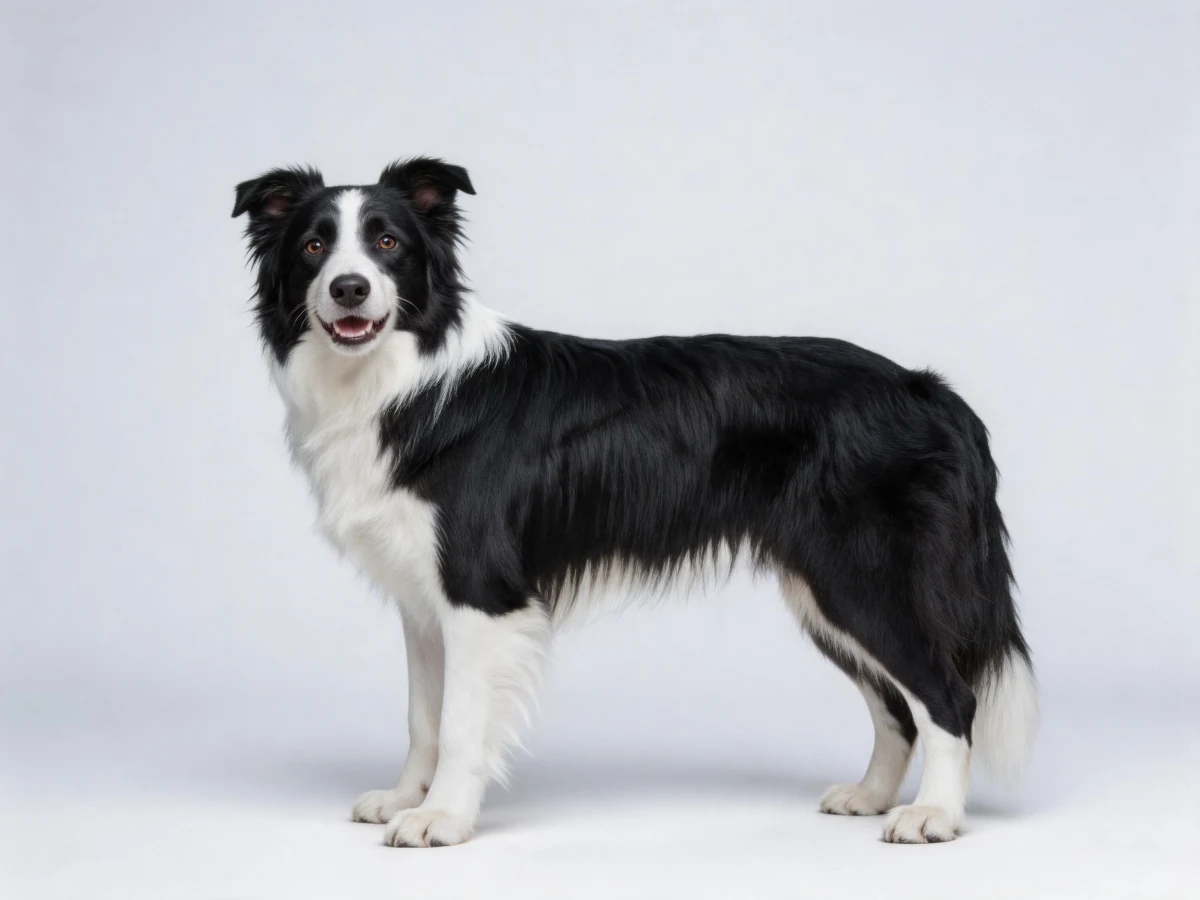
Border Collie
✨ Key Takeaways
- The breed has a single, documented foundation sire: Old Hemp, born September 1893 in Northumberland, bred by Adam Telfer. Modern Border Collies trace back to him.
- It was defined by trial culture, not a show ring. The International Sheep Dog Society, founded in 1906 by handlers dissatisfied with the Kennel Club's focus on appearance, ran the stud book on working ability.
- The name was an ISDS administrative coinage: secretary James Reid used "border collie" in 1915 to distinguish ISDS-registered working dogs from the broader collie population.
- Kennel-club recognition came late and was contested — the UK Kennel Club recognised the breed in 1976 and the AKC in 1995, the latter actively opposed by the ABCA, which deregisters dogs that take an AKC conformation title.
- The trademark working style is "the eye": a crouched, controlled stare that moves stock by intimidation rather than by force — the trait the ISDS bred for and that defines a correct Border.
- It is not a pet for an average household. The drive that makes a Border a world-class stock and sport dog becomes destructive and neurotic without daily, structured mental and physical work.
Quick Facts
Common Names & Variants
Modern aliases
Historical names
Modern variants & lines
⚖️ Pros & Cons
Advantages
Trade-offs
Physical Appearance
Recognized colors
Coat
Other
Ears: Semi-erect to erect. Tail: Natural, low-set, moderate length.
🕰 History
One dog, born in 1893, sits behind all of them
Most breeds reconstruct their origins from working type and trade routes because no founder is recorded. The Border Collie is the rare exception: it has a documented foundation sire, with a name, a birth date, a breeder, and a place. Old Hemp was born in September 1893 in Northumberland, in the Anglo-Scottish border country, bred by a shepherd named Adam Telfer out of a dog called Roy and a bitch called Meg. Hemp was not famous for being fast or flashy. He was famous for the opposite — a quiet, powerful, almost hypnotic way of moving sheep without fuss or force. He was so dominant a worker and so sought-after at stud that virtually every Border Collie alive can be traced back to him. The breed does not begin with a kennel. It begins with one dog and a shepherd's eye for what that dog was doing differently.
The honest caveat: Old Hemp did not appear from nothing. He was the standout product of generations of unregistered landrace working collies on the hill farms of Northumberland, the Scottish Borders, and Cumbria — dogs bred by shepherds purely for whether they could gather sheep off open ground. Hemp consolidated a type that already existed in scattered form. What makes him the foundation is that the breed's later record-keeping starts from him.
The country made the dog
The border hill country is not gentle ground, and it explains the dog. Sheep on these hills are not penned; they range over rough, broken, often weather-hammered open land, and a shepherd may need a dog to leave him, run a wide arc out of sight, find a scattered flock, and bring it back under control with almost no commands. That landscape selected for a specific kind of brain: independent enough to work far from the handler, biddable enough to take a whistle a quarter-mile away, and built to keep doing it through a wet Northumbrian winter. The Border Collie's defining trait — "the eye", a crouched, intense, controlled stare that moves stock by sheer presence — is a hill-country adaptation. It lets one dog dominate a flock without ever touching it.
The ISDS: a stud book run on work, not looks
The institution that turned a landrace into a breed was not a kennel club. In 1906 a group of leading shepherds and trial handlers founded the International Sheep Dog Society, explicitly because they distrusted the Kennel Club's emphasis on appearance over working ability. The ISDS ran sheepdog trials, kept a stud book based on what a dog could do with sheep, and from its first International trials onward made the working test the thing that defined the dog. This is the central fact of the breed's history and the source of every later argument about it: the Border Collie was bred for a job and registered on that job for decades before any conformation standard described what it should look like.
The name was paperwork
The breed's name is younger than the breed and entirely administrative. In 1915, James Reid, the secretary of the ISDS, needed a term to distinguish the society's registered working dogs from the wider, looser population of "collies", and used "border collie" — the working collie of the border country. It was a registry label that stuck, not a romantic coinage. For decades before 1915 the same dogs had simply been working collies or Scotch sheep dogs; the name pinned them to the ISDS stud book and the region that produced Old Hemp.
Recognition, and the schism it caused
Kennel-club acceptance came late and was fought over, which is unusual enough to be the most interesting part of the modern history. The Kennel Club in Britain did not recognise the Border Collie until 1976, after the ISDS stud book was made available to it. The American Kennel Club did not grant full recognition until 1 October 1995. That AKC step was opposed, vehemently and on principle, by the American Border Collie Association — the working registry's position being that breeding to a conformation standard for the show ring necessarily dilutes the working ability the ISDS spent a century protecting. The ABCA will deregister a dog that earns an AKC conformation championship. The result is a breed that genuinely exists in parallel populations — working, sport, and show — to a degree few other breeds match.
What the split actually means
What is striking about the Border Collie's history is that the conflict at its centre was never resolved, only formalised. The dog the ISDS bred is selected on a behaviour — the gather, the outrun, the controlled approach, the eye. The dog a conformation ring rewards is selected on a silhouette. The breed clubs on each side are not being precious about this; they are describing a real divergence that a buyer has to understand before choosing a puppy. The Border Collie is the clearest living case study in dogdom of what happens when "what it does" and "what it looks like" are bred toward by different institutions for a hundred years.
Temperament & Personality
The drive is the dog
It is tempting to lead with "the most intelligent breed", and the claim gets repeated everywhere. That framing is also misleading, because it sells the Border Collie as a clever pet rather than as what it is: a high-drive working stockdog whose intelligence is the means, not the marketing. The temperament that wins International trials is a specific package — intense focus, a powerful instinct to gather and control movement, sensitivity to subtle direction, and a near-bottomless need to be working at something. Drop that package into a home with no job for it and the same traits become the breed's most-cited problems.
"The eye" and the herding sequence, indoors
The Border works stock through a behaviour chain — orient, eye, stalk, chase, control — and that chain is hardwired, not taught. In a pet home with no sheep, the dog runs the chain anyway, on whatever moves: children, joggers, cyclists, cars, the vacuum, shadows, the flicker of light off a watch. Light- and shadow-chasing in particular can tip into a genuine compulsive disorder in this breed specifically, because the eye-fixation that is functional on sheep has no off switch and nothing legitimate to lock onto. None of this is the dog being bad. It is a working animal with the volume turned up and nothing to point it at.
Sensitive, biddable, and easily overwhelmed
A well-bred, well-raised Border is extraordinarily responsive — it reads body language and tone at a level most breeds do not, takes correction softly, and learns long behaviour chains fast. The flip side of that sensitivity is real: the same nervous system that reads a shepherd's whistle at distance can over-read a chaotic household, and lines not selected for stability can develop noise phobia and motion reactivity. This is not a robust, let-it-roll temperament. It rewards calm, consistent, structured handling and is degraded by chaos and inconsistency.
The honest fit assessment
With a job, the Border Collie is among the most rewarding dogs a person can own — endlessly trainable, deeply engaged, tireless, and genuinely good company for an active, structured handler. Without one, it is a recipe for a frustrated, neurotic, often destructive dog and an overwhelmed owner, and it is among the breeds most frequently surrendered for exactly this reason. A daily walk is not a job. Herding, herding-style training, advanced obedience, agility, scent work, or a real sport commitment is. The breed does not need a big house; it needs a handler who will give it work every day for its whole life. That is the single most important sentence anyone considering this dog should sit with.
🏡 Living With a Border Collie
A working athlete that needs a job, not a sofa
The single most important thing to understand before living with a Border Collie is that it was bred for one of the most demanding jobs any dog has ever been asked to do: gathering and controlling livestock over open hill ground, all day, reading both the stock and the shepherd at a distance. That drive does not switch off because the dog now lives in a house. A Border Collie carries an almost limitless appetite for physical activity paired with an equally large need for mental work, and it expects a purpose to point that at. Met properly, it is a dazzlingly responsive, devoted companion. Left under-stimulated in an ordinary pet home, the same dog turns its problem-solving brain on the household instead — and that goes badly. This is not a casual family pet you fit around a busy life; it is a working dog you build a life around.
What an under-stimulated Border Collie becomes
A bored Border Collie does not simply lie around looking sad. The breed's herding wiring redirects onto whatever moves: it will stalk, circle, and nip at running children, cyclists, and cars, and chase shadows, reflections, and flickering light to the point of fixation. Under-exercised dogs commonly develop genuine compulsive behaviours — spinning, tail-chasing, obsessive shadow- and light-chasing, flank-sucking, relentless repetitive barking — alongside the destruction that a frustrated, highly intelligent animal causes when it invents its own work. These are not quirks to laugh off; they are the predictable cost of putting a hill-bred working dog into a life with no outlet, and they are far easier to prevent than to unwind. A daily floor of an hour or two of hard physical exercise plus structured mental work — training, scentwork, fetch with rules, puzzle feeders, trick chains, ideally a real dog sport — is the baseline this breed needs, not the extra.
Bonded to one person, intense with kids, wrong for an idle apartment
Border Collies bond hard, often most intensely to one person, and want to be working partners rather than background pets — they read mood and body language uncannily and can be sensitive and reactive in a chaotic environment. With children they are loving but complicated: the herding instinct to control movement means an unmanaged Border Collie may circle and nip at running, shrieking kids, so households with young children need active management and outlets rather than wishful thinking. The medium double coat sheds steadily and blows heavily twice a year, and the breed handles cold and damp far better than heat. A Border Collie can technically live in an apartment if — and only if — its owner delivers serious daily exercise and a job; without that, four walls and a quiet life are a recipe for a neurotic, destructive dog.
🎓 Training & Exercise
The most trainable brain in dogdom — and what that really means
The Border Collie is widely regarded as the most intelligent dog breed, and on any trainability measure it sits at or near the top: it learns new commands in remarkably few repetitions and reads subtle handler cues that other breeds miss entirely. For an experienced, committed owner that is a gift — Border Collies dominate competitive obedience, agility, flyball, disc, and of course sheepdog trials. But raw intelligence cuts both ways. A dog this quick learns the things you did not mean to teach just as fast as the ones you did, and it will learn its own self-rewarding games — chasing, herding, barking — if you do not give it better ones first. The breed does not train itself by being smart; it needs a handler smart and consistent enough to stay one step ahead of it.
A soft, sensitive dog that needs reward-based handling
For all its drive, the Border Collie is a sensitive, soft-natured dog that works best with gentle, reward-based training and crumbles under heavy-handed correction. Harsh tones, physical corrections, or an angry handler do not produce a sharper dog — they produce an anxious, shut-down, hesitant one that stops offering behaviour, which is the opposite of what this breed is for. Build on motivation: many Border Collies are intensely toy- and movement-driven (a ball or a tug can outrank food), and channelling that drive into the training game is the whole craft. Keep sessions short, varied, and upbeat, reward generously, and end while the dog still wants more. Early, thorough socialisation matters especially here, because a clever, sensitive dog under-exposed to the world can tip into noise-sensitivity and reactivity.
The real catch: the eye, the stalk, and the off-switch
The breed's signature working style — "the eye," the low crouching stalk used to move stock by sheer intensity of gaze — is hardwired, and the genuine difficulty in pet life is that this predatory motor pattern has no sheep to point at. Teaching a reliable interrupter ("leave it," a strong recall, a settle on a mat) and actively building an off-switch is more important for a Border Collie than another fancy trick, because the dog's instinct is to keep working until it drops. The highest-value lessons are a rock-solid recall, an early-trained calm settle, and clear rules around chasing so the herding drive is steered into legitimate outlets (a flirt pole, herding-balls, disc, or actual stockwork) rather than aimed at cars, joggers, and the family cat.
✂️ Grooming & Coat Care
Two coats, rough or smooth, both double
The Border Collie comes in two coat varieties — rough (medium-length, with feathering on the legs, chest, underside, and tail) and smooth (shorter and coarser all over) — but both are weather-resistant double coats built for a working dog out in hill weather, and neither is low-maintenance in the sense pet buyers hope. For most of the year a thorough brush-out once or twice a week keeps a Border Collie's coat clean and free of tangles; a slicker brush plus an undercoat rake reaches the dense insulating undercoat where loose hair collects. Baths are occasional — every couple of months or when the dog is genuinely dirty after fieldwork or mud — since over-bathing strips the coat's natural weatherproofing oils. A working coat is meant to shed dirt on its own once dry.
Steady shedding and a heavy seasonal blow
This is a shedding breed. The double coat drops hair steadily year-round and then "blows" the undercoat heavily over a few weeks in spring and again in autumn, and through those windows daily brushing is the difference between a managed coat and drifts of undercoat across the floors and furniture. The rough variety holds mats where the feathering sits — behind and below the ears, in the armpits, on the trousers at the backs of the thighs, and along the tail — so those spots earn extra attention before a tangle tightens against the skin. As with other double-coated breeds, shaving a Border Collie to fight shedding is a mistake: the coat insulates against both cold and heat, and clipping it can leave it patchy and slow to recover.
Ears, nails, teeth, and feet for an active dog
Ear set varies across the breed (erect, semi-erect, or dropped), so check ears weekly and wipe the visible part with a vet-recommended cleaner, drying carefully after a swim or a wet day's work. A dog this active wears its nails somewhat on rough ground, but most still need trimming every two to three weeks — if you hear them click on the floor they are too long and will change how the dog moves. Brush the teeth several times a week from puppyhood, since dental care is one of the highest-leverage long-term habits for any dog. Trim the hair between the foot pads for traction on smooth floors, and after country or trail outings check the feathered feet and legs for grass seeds, burrs, and grit.
🍖 Diet & Nutrition
Fuel the work, then keep the dog lean
Feeding a Border Collie is really about matching intake to a genuinely high workload and then holding the dog at a trim, athletic weight. A working or hard-playing Border Collie burns serious energy and needs a quality diet with enough protein and fat to support that effort, but the same dog kept as a lower-activity pet over-feeds easily, and excess weight is hard on a breed built to run and turn all day. Feed measured meals set against the dog's ideal body condition rather than free-feeding, and learn to body-condition-score by feeling for ribs and a clear waist — a lean Border Collie should look like the athlete it is. Because many of these dogs are obsessively toy- and food-motivated, treats are best drawn from the daily ration and spent as training currency rather than added on top.
Steady puppy growth and an even keel
Border Collie pups are typically raised on a complete diet appropriate for a medium-breed puppy, fed to grow steadily rather than to pile on size. As a medium dog the breed does not carry the giant-breed growth cautions, but the principle still holds — even, controlled growth on a balanced food beats a fat, fast-grown puppy. Pups usually eat three or four small meals a day, tapering to two meals as adults, with portions set by ideal adult weight (broadly 26–44 lb depending on sex and frame) and real activity level, then adjusted by body condition over time. Make any food change gradually across a week to avoid digestive upset, and keep fresh water available, especially around exercise.
Feeding around a high-drive dog's day
Split the daily food into two meals to keep energy steady through a busy day, and separate hard exercise from meals — feed after the dog has rested and settled rather than right before or after a flat-out run or training session. A high-drive Border Collie that lives to chase and fetch can be so focused on activity that it skips or rushes food when over-aroused, so a calm routine and a settled feeding spot help. One genuinely breed-relevant point belongs to the owner, not the bowl: a share of Border Collies carry the MDR1/ABCB1 gene variant that affects how some drugs are processed, so it is worth knowing your dog's MDR1 status and telling your veterinarian — that is a fact to relay to the vet, not a dosing decision to make at home.
🐶 Buying & Adopting a Border Collie
Start with the parent club and the working registries
The Border Collie Society of America (BCSA) is the AKC parent club and the right first stop for finding a responsible breeder, understanding the breed, and reaching breed rescue. The Border Collie is unusual in that it has long been bred for working ability through stockdog registries — the International Sheep Dog Society (ISDS) lineage traces to Old Hemp, the 1893 dog regarded as the breed's foundation sire — as well as for the conformation ring. That history matters to a buyer: a high-drive dog from intense working lines may be more than a typical pet home can handle, so be honest with a breeder about your lifestyle and let them steer you toward a pup whose drive matches your life. A breeder worth buying from health-tests both parents, offers a written contract, raises pups in the home, and asks you as many hard questions as you ask them.
The health screening to ask a breeder for
The Border Collie has a recognised CHIC health-screening profile, and a responsible breeder can show results on both parents. Ask to see, as a matter of consumer fact: an OFA hip evaluation; an eye examination by a boarded veterinary ophthalmologist (OFA/ACVO); a Collie Eye Anomaly (CEA/CH) DNA test; a Trapped Neutrophil Syndrome (TNS) DNA test; and a Neuronal Ceroid Lipofuscinosis (NCL/CL) DNA test. Many breeders also run additional DNA tests offered for the breed — MDR1/ABCB1 drug-sensitivity, Imerslund-Gräsbeck Syndrome (IGS/CblD), and others. These are the documents to ask for and to see in writing; naming them is consumer information about what a careful breeder screens, not medical advice. A breeder who produces the paperwork is the one to trust; "our dogs are healthy, no need to test" is the answer to walk away from.
Rescue and the surrender problem
Breed rescue is busy for a sad and predictable reason: Border Collies are widely surrendered by owners who bought a brilliant dog without grasping the work it demands, then found themselves with a destructive, obsessive, or anxious animal once boredom set in. BCSA-affiliated rescue and regional Border Collie rescues regularly place adolescents and adults whose drive simply outran their previous home. For an adopter who genuinely has the time, energy, and outlets, an adult rescue with a known temperament can be an excellent and ethical route — and matching an existing dog's energy level to your life is easier than gambling on a puppy.
Price, waiting lists, and the red flags
A well-bred Border Collie puppy in the United States runs roughly USD 800–2,500 (2024), varying with region, lineage, and whether the parents carry working or conformation titles, and good breeders typically keep waiting lists. The familiar red flags apply: pups advertised with instant availability and no health-testing documentation, no parent-club or registry connection, and sellers who cannot discuss the breed's real demands. Be wary, too, of anyone marketing "mini" Border Collies or charging a premium for unusual colours or merle patterning as if rarity equalled quality — coat colour is cosmetic, and breeding merle to merle in particular carries known welfare concerns. A fair price from a health-testing, honest breeder, even after a wait, is far cheaper than the lifetime cost of a poorly matched or poorly bred dog.
📜 Breed Name Etymology — iDogNames original research
A name an administrator wrote down in 1915
Unlike most breed names, the Border Collie's has a date and an author. The dogs existed, working, for generations before they had this name; they were "working collies", "Scotch sheep dogs", or simply "collies". The specific compound "border collie" was put into use in 1915 by James Reid, secretary of the International Sheep Dog Society, who needed a term that separated the ISDS's registered working dogs from the broad, undifferentiated mass of collies. It is, in origin, a registry label — bureaucratic rather than poetic — and that is exactly why it is worth getting right: the name encodes the breed's founding argument, that these were the working dogs of a particular place, registered on what they could do.
"Border" — a real, specific place
The "Border" is not generic. It is the Anglo-Scottish border country: Northumberland on the English side, the Scottish Borders to the north, with Cumbria to the west — the hill-farming landscape that produced Old Hemp in 1893 and the trial culture that defined the breed. The word is doing geographic work, pinning the dog to the ground that shaped it. A Border Collie is, etymologically, the collie of that frontier hill country, not a collie that lives near any border.
"Collie" — older, and contested
"Collie" is the genuinely old part of the name and its etymology is honestly unsettled. The leading proposals trace it either to Scots colley (and the dialect sense of "coaly", i.e. black, after the colour of the sheep or the dogs), or to a Scots/Gaelic word for something useful or for the sheepdog itself; some authorities connect it to coll, an old word linked to herding stock. The truth is that the word predates the documentation that would settle it, and reputable references present the competing derivations side by side rather than picking one. That uncertainty is worth stating plainly — it is more honest than the single confident answer the question usually gets.
Pronunciation and the everyday short form
The breed is /ˈbɔːrdər ˈkɒli/ — "BOR-der COL-ee", with the British short "o" in collie. In conversation the dog is almost always just "a Border" among people who work and trial them; "collie" alone is ambiguous, since it also covers the Rough and Smooth Collie of the Lassie type, which are separate breeds with a different history. Among shepherds and trialists the working register is often simply "the dog" or "a good bitch" — the breed name disappears entirely because, on a hill, there is only one kind of dog that matters.
Name forms at a glance
| Name | Role | Origin | Literal meaning | First recorded |
|---|---|---|---|---|
| Border Collie | primary | English / Scots (place + breed term) | the working collie of the border country | 1915 |
| collie | origin country native | Scots / Northern English (etymology contested) | sheepdog (possibly "the black one") | — |
| Working Collie / Working Sheepdog | historical | English (occupational) | the collie kept for stock work (pre-1915 usage) | — |
| Scotch Sheep Dog / Scotch Collie | historical | English (regional) | the Scottish-type sheep dog | — |
| Border | alias | English (clipping) | short form of Border Collie | — |
🏛 Naming Traditions — iDogNames original research
The most functional naming culture in dogs
No breed has a naming tradition as ruthlessly practical as the Border Collie's, and it comes straight from the job. A shepherd commands a dog by voice and whistle across open hill ground, often into wind, sometimes against the noise of a flock — and frequently with two or three dogs working at once. The name is not decoration; it is a recall signal that has to cut through weather and not be confused with another dog's name or with a command word. Out of that constraint comes the single strongest convention in dog naming: the classic working Border Collie name is one short, hard, carrying syllable. This is the layer everything else sits on.
The shepherd's working layer
Look at the names of the breed's foundational dogs and the pattern is immediate: Hemp, Roy, Meg, Cap, Moss, Glen, Spot, Nell, Bess, Jed, Sweep, Fly, Jess, Tweed, Ben. Every one is one beat. Every one ends or carries in a way you can shout from a quarter-mile and hear come back. Old Hemp himself, the 1893 foundation sire, sat squarely in this convention — a single hard syllable. So did his parents, Roy and Meg. A Border given a name like this is not wearing a costume of the heritage; it is using the breed's actual operating system. For a working or trial prospect this is not merely the most authentic choice — it is the functionally correct one.
The ISDS / trial layer
The International Sheep Dog Society stud book, kept since 1906, adds a second layer with its own texture. Trial dogs carry registered names, and the names of famous trial and Supreme Champion dogs become a kind of canon that breeders nod to — short stockdog names, often handed down or echoed across generations of a working line. Naming a dog after a notable trial dog, or simply in the tight ISDS register (single syllable, classic stockdog vocabulary), places it in the working tradition the way a kennel affix places a show dog. The ISDS convention is essentially the shepherd's convention, formalised by a stud book that cared about work and not appearance — which is why it stayed so plain.
The sport and show layers
Modern agility, flyball, and disc Borders, and the conformation lines, have loosened the rule. Sport homes still tend to favour short, punchy call names because a fast recall matters on a course, but the registered names get longer and more creative, and themed litters (a letter, a concept) appear the way they do in other kennel-club breeds. There is nothing wrong with this — but it is worth knowing it is a departure from, not a continuation of, the breed's own tradition. The heritage-correct instinct, even for a sport or pet dog, is to keep the call name short and carrying. The breed earned that convention on a hill, and it still works on a field.
What this means for naming a Border today
The breed gives a namer one dominant, documented rule and a clear set of heritage routes inside it. The rule: short and carrying beats long and clever, because the entire naming culture was built around a sound that had to travel. Inside that, a classic shepherd's monosyllable (Moss, Glen, Cap, Nell) honours the working line directly; a Border-country place or river name (Tweed, Cheviot, Yarrow) ties the dog to the ground that made it; and an ISDS-canon name nods to the trial culture that defined it. The names that fit this breed worst are the long, ironic, or pop-culture ones — not because they are in poor taste, but because they fight a hundred years of a tradition that was engineered, deliberately, to be heard.
🐾 Themed Names for Your Border Collie — iDogNames original research
Classic shepherd's working names — one carrying syllable
The breed's true heritage layer: short, hard, single-beat names a handler can shout across a hill. These are the names of the breed's foundational dogs and they remain the functionally correct choice for any Border.
- Hemp — Old Hemp (1893), the documented foundation sire of the entire breed
- Roy — Old Hemp's sire; a true foundation-line name
- Meg — Old Hemp's dam; classic shepherd's bitch name
- Moss — quintessential working-collie name; carries perfectly
- Glen — short, hard, period-correct; also a Border-country landscape word
- Cap — one of the most common stockdog names ever used
- Nell — traditional working bitch name; cuts through wind
- Sweep — classic, descriptive of the gather; one beat
- Jed — short and hard; also nods to Jedburgh in the Borders
- Fly — a famous stockdog name; sharp and carrying
Border-country place & river names
Names from the actual Anglo-Scottish border landscape that produced the breed — geographic heritage that still scans as a callable name.
- Tweed — the great Borders river; one of the most fitting Border names there is
- Cheviot — the border hills, and a border sheep breed; deep heritage
- Yarrow — a Scottish Borders river and valley; soft but carrying
- Coquet — a Northumberland river near Old Hemp's home ground
- Esk — short, hard border-river name; ideal one-syllable call
- Reiver — the Border Reivers, the frontier riders of the same country
- Kielder — the Northumberland forest and hill country
- Till — a Northumberland river; crisp and short
- Carter — Carter Bar, the border crossing itself
- Border — the breed wearing its own provenance, kept plain
ISDS trial & sheepdog-heritage names
Names rooted in the trial culture and stockwork vocabulary the ISDS has registered since 1906 — for a working or sport prospect.
- Trial — the institution that made the breed; used wryly as a name
- Whistle — the shepherd's command tool; affectionate and apt
- Gather — the core ISDS trial element the dog is bred to do
- Outrun — the wide arc that opens every trial run; distinctive
- Shed — a trial task (splitting the flock); short and sharp
- Pen — the final trial element; one hard beat, easy to call
- Drove — for the driving phase of stock work
- Telfer — Adam Telfer, the shepherd who bred Old Hemp; a heritage tribute
- Wiston — after Wiston Cap, one of the most influential trial sires
- Supreme — the ISDS Supreme Championship; ambitious but heritage-true
"The eye" & working-instinct names
Names that nod to the breed's signature working behaviour — the crouched, controlling stare — without slipping into cliché.
- Stalk — the controlled approach of a Border working stock
- Crouch — the breed's distinctive working posture
- Focus — the single-minded attention the eye represents
- Lock — for the fixed stare that holds a flock
- Steady — also a real stockwork command; doubles as a name
- Creep — the slow, low advance on sheep
- Hawk — for the predatory intensity of the eye
- Shadow — the dog that never leaves the flock's edge
- Flank — the side-to-side balancing move; a true working term
- Quick — the breed's defining trait, kept to one beat
Coat-color names — the merles, blacks and reds
The breed comes in black-and-white, tricolour, red, blue and red merle, sable and dilutes. These work the palette without an obvious "Blackie".
- Merle — the literal name of the marbled pattern; clean and accurate
- Slate — for a blue merle or dilute-coated dog
- Sable — one of the recognised coat patterns; a tidy one-word name
- Smoke — for a blue or lilac dilute; soft and short
- Soot — for the deep black of a classic black-and-white
- Rua — Scots/Gaelic-flavoured "red"; for a red or red-merle dog
- Brock — old word linked to badger-marking; fits a tricolour
- Patch — for the bold white markings; plain and working
- Flint — grey-blue dilute; hard, short, carrying
- Bracken — russet of the border hillsides; for a red dog, a coat-and-place name in one
📋 Breed Standard at a Glance
General appearance
The AKC and UK Kennel Club standards describe the Border Collie as a medium-sized working dog of great quality, grace, and balance, combining hard muscular substance with enough agility to be quick and nimble. The standard is unusually explicit that the breed is first a working stockdog: it should give the impression of effortless movement and tireless ability, free of any exaggeration, and is faulted for anything that detracts from its capacity to work sheep. Outline and athleticism matter more than refinement, and a keen, alert, intelligent expression is central to type.
Size, coat, and colour
Males stand roughly 19–22 inches at the withers and weigh about 30–44 lb; females stand around 18–21 inches and weigh about 26–42 lb, with substance and balance valued over sheer size. The breed carries a weather-resistant double coat in two varieties — rough (medium-length with feathering) and smooth (shorter and coarser) — both with a soft, dense undercoat. A wide range of colours and markings is accepted; the long-standing convention is that no single colour or pattern takes precedence over working ability, so colour is cosmetic rather than a measure of quality.
Head, movement, and temperament
The head is moderate with a clearly defined stop, oval dark eyes (wall or odd eyes permitted in merles) set to give an intelligent, alert expression, and ears carried erect or semi-erect. Movement is the heart of the breed: free, smooth, and tireless, with the famous ability to drop into a stealthy, crouching, cat-like gather and to change direction instantly. Temperament is part of type — keen, alert, responsive, and intelligent, neither nervous nor aggressive — and the standard treats a willingness and aptitude to work as the defining quality of the Border Collie.
🏆 Famous Border Collies
Notable real dogs of the breed profiled on iDogNames.
🏆 Recognition
Recognized by the American Kennel Club in 1995 as a Herding breed. FCI standard No. 297 (Section 1 — Sheepdogs), recognized in 1977.
Other registries
Breed clubs
❓ Frequently Asked Questions
Are Border Collies good family dogs?
They can be devoted family dogs, but only in active homes that can meet their needs. The herding instinct means an unmanaged Border Collie may circle and nip at running, noisy children, so households with young kids need real exercise, training, and management rather than wishful thinking. This is a working breed first and a casual family pet a distant second.
Do Border Collies shed a lot?
Yes. Both the rough and smooth coats are double coats that shed steadily year-round and blow heavily for a few weeks each spring and autumn. Plan on brushing once or twice a week most of the year, rising to daily during the seasonal blow, and do not shave the coat to manage it.
How much exercise does a Border Collie need?
A great deal. An adult needs one to two hours of hard physical activity every day plus substantial mental work — training, scentwork, puzzles, or a dog sport. The mental side is not optional: an under-stimulated Border Collie commonly develops obsessive and destructive behaviours, so the brain needs a job as much as the body needs a run.
How long do Border Collies live?
Typically 12–15 years. The Border Collie is a generally hardy, long-lived breed, and a fit, lean, well-exercised dog from health-tested parents has good odds of reaching the upper end of that range.
Are Border Collies easy to train?
The Border Collie is widely considered the most intelligent and trainable breed, learning commands in very few repetitions. The catch is that the same quick brain learns unwanted habits just as fast, and the dog is sensitive — gentle, reward-based training works, while harsh correction backfires. It needs a consistent handler, not just a smart dog.
Are Border Collies hypoallergenic?
No. The Border Collie has a shedding double coat and is not considered hypoallergenic. Anyone with a dog allergy should spend extended time around the breed before committing.
How much does a Border Collie puppy cost?
A well-bred, health-tested puppy in the United States typically runs about USD 800–2,500 (2024), depending on region, lineage, and whether the parents carry working or conformation titles. Be wary of pups sold with no health-testing paperwork, and of premiums charged for "mini" dogs or unusual colours.
📚 Sources & Further Reading
Every load-bearing factual claim on this page is anchored to one of the sources below. iDogNames does not synthesize from secondary aggregators.
- akc breed page Border Collie — AKC Breed Profile — American Kennel Club (2024)
- akc breed page Border Collie History: Behind the Workaholic of the Dog World — American Kennel Club (2023)
- fci standard pdf FCI Standard No. 297 — Border Collie — Fédération Cynologique Internationale (2010)
- kc uk standard pdf The Kennel Club (UK) — Border Collie Breed Standard — The Kennel Club (UK)
- breed club official International Sheep Dog Society (ISDS) — history & stud book — International Sheep Dog Society (ISDS)
- breed club official American Border Collie Association (ABCA) — registration & AKC position — American Border Collie Association (ABCA)
- academic paper Life tables of annual life expectancy and mortality for companion dogs in the UK — Teng KT, O'Neill DG et al., Scientific Reports (2022)
- wikipedia Border Collie — Wikipedia — Wikipedia
- book Border Collies — Iris Combe (Faber & Faber) (1978)


