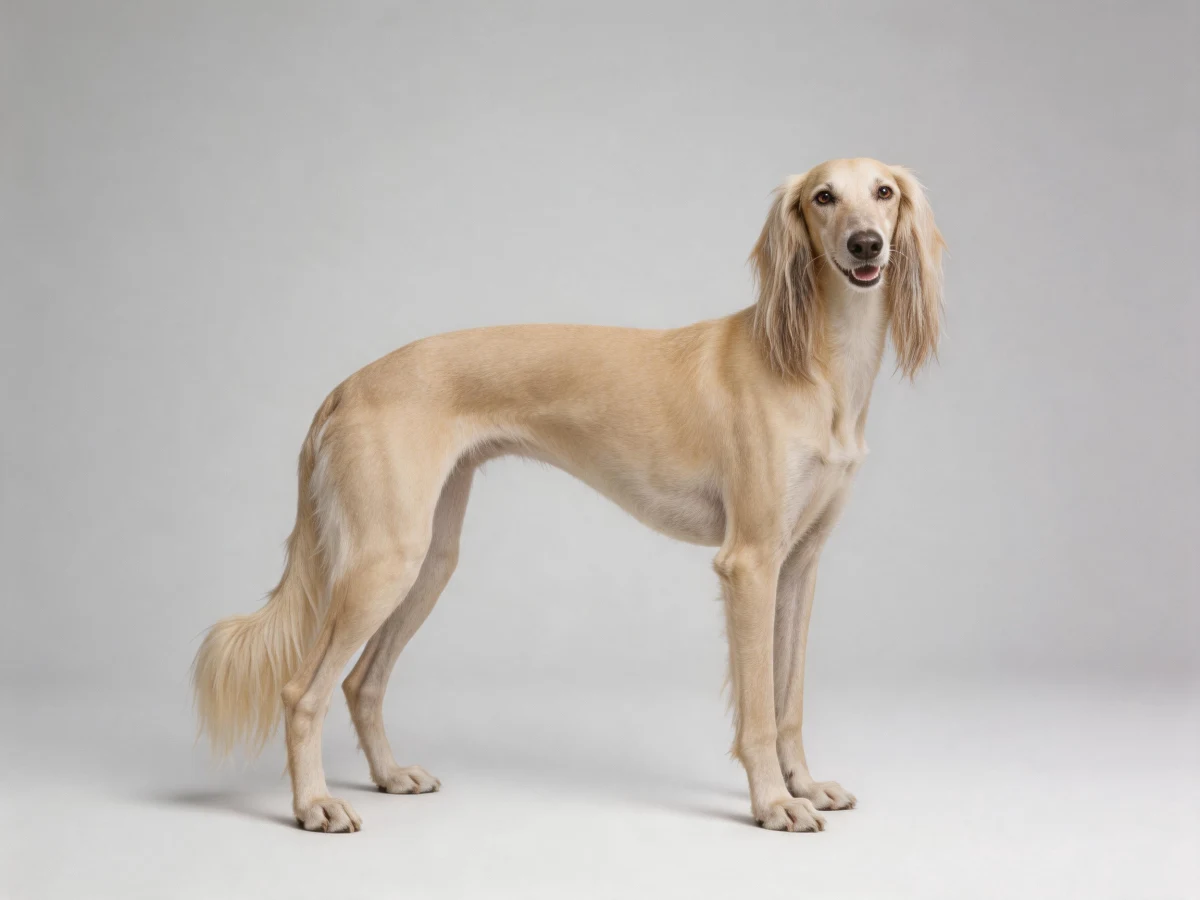
Silken Windhound
✨ Key Takeaways
- A modern American silk-coated sighthound, small-to-medium in size (about 47-60 cm / 18.5-23.5 in at the shoulder), created by Francie Stull at her Kristull Kennel in Austin, Texas, with the first litter whelped in 1985
- Built mainly from Borzoi and Whippet, plus Whippet-based lurchers that carried Shetland Sheepdog and Collie ancestry -- the route by which the MDR1 and CEA mutations entered the breed
- Bred deliberately as a smaller, silkier, robustly healthy alternative to the Borzoi: gentle, affectionate, intelligent and notably good with families and children, while remaining a fast, drive-driven lure-coursing sighthound
- Recognised by the UKC (2011) and managed by the International Silken Windhound Society, which runs a DNA-verified closed studbook; accepted for ASFA and NOFCA coursing and added to the AKC Foundation Stock Service in 2026, but not a fully AKC-recognised or FCI breed
- Two openly acknowledged inherited conditions -- the MDR1 drug-sensitivity mutation and Collie Eye Anomaly -- are managed by DNA testing; owners should always tell the vet the dog MDR1 status before treatment
- A long-lived breed, typically reaching the middle to late teens, with a low-maintenance silk coat that needs only weekly brushing and a real need for safe space to gallop
Quick Facts
Common Names & Variants
Modern aliases
Historical names
⚖️ Pros & Cons
Advantages
Trade-offs
Physical Appearance
Recognized colors
Coat
Other
Ears: Small, fine, folded. Tail: Long, flexible, sweeping curve.
🕰 History
A Texas Borzoi breeder sets out to shrink her favourite hound
The Silken Windhound began not in a hunting field or a peasant village but in a Borzoi kennel in Austin, Texas, in the mid-1980s, as one breeder's deliberate answer to a gap she saw in the sighthound world. Francie Stull, a successful exhibitor and breeder of show and performance Borzoi (and Scottish Deerhounds) at her Kristull Kennel, wanted a dog that kept the flowing silk coat and graceful sweep of the Borzoi but in a smaller, handier, more robustly healthy package -- something close to a Whippet in size yet long-coated, sound, and suited to family life as well as the coursing field. The first litter she identified as Silken Windhounds was whelped at Kristull in 1985, and that litter is the documented starting point of a genuinely modern American breed: not a rediscovered ancient type, but a planned creation with a known founder, a known motive and a paper trail.
Borzoi crosses, Whippet-based lurchers and a second kennel
Stull built the breed from two main streams. The first was her own champion Borzoi lines, which contributed the silk coat, the elegant outline and the larger-dog refinement. The second was a group of small Whippet-based lurchers, several of them tracing to Walter A. Wheeler Jr's Windsprite kennel, which contributed the reduced size, the coursing drive and a long-coated sighthound type of their own. Crossing the two gave Stull the medium silky sighthound she was aiming for. Later DNA studies of the breed have confirmed this composite ancestry rather than overturning it: the genetic signal in the Silken Windhound resolves chiefly to Borzoi and Whippet, with a measurable Shetland Sheepdog (and through it, Collie) contribution carried in through the lurcher side. That Sheltie thread is not a footnote -- it is the route by which two inherited conditions, described below, entered the lines, and the breed's founders have been unusually open about it.
A society, a standard and a closed studbook
What separates the Silken Windhound from the many informally bred sighthound crosses of the late twentieth century is the speed with which its supporters built a formal structure around it. The International Silken Windhound Society (ISWS) was chartered in 1999; in the same year it approved a written breed standard and held the first national specialty, Silkenfest, in Austin. In 2000 the ISWS closed the studbook and required that every registered dog have its parentage confirmed by DNA, with only carefully monitored, society-sanctioned outcrosses to foundation stock permitted thereafter to widen the gene pool and lower inbreeding. The breed standard itself was adopted in 2001. Within roughly fifteen years of the first litter, in other words, the Silken Windhound had a parent club, a DNA-verified studbook, a written standard and a national show -- the apparatus of an established breed rather than a backyard project.
From coursing field to kennel-club recognition
Recognition by the wider dog world followed through the performance side first, which fits a breed bred to run. The American Sighthound Field Association (ASFA) accepted the Silken Windhound for limited-stakes lure coursing in 2009, and the National Open Field Coursing Association (NOFCA) followed in 2010. Conformation recognition came when the United Kennel Club admitted the breed to its Sighthound and Pariah Dog Group on 18 March 2011. Several European registries, including German and Dutch kennel clubs, also recognise the breed, and in 2026 the American Kennel Club admitted it to its Foundation Stock Service -- the AKC's recording register for breeds working toward full recognition, which is a recording status and not full AKC breed recognition. The honest summary is that the Silken Windhound is recognised by the UKC and a number of national bodies and is the subject of an active, well-organised parent club, but it is not a fully AKC-recognised breed and is not registered by the FCI.
A young breed with an unusually clear record
Because the Silken Windhound was created within living memory, its history carries none of the romantic fog that surrounds ancient landraces. Its founder is named, its foundation crosses are documented, its inherited health risks are openly acknowledged, and its early registrations are DNA-verified. That transparency is itself the breed's defining historical feature. The Silken Windhound is best understood as a modern, purpose-built American silk-coated sighthound -- smaller and far more numerous outside the show ring than the Borzoi it descends from, longer-coated than the Whippet it resembles in size -- whose short, well-recorded history is one of deliberate design followed by disciplined club management rather than centuries of obscure regional breeding.
Temperament & Personality
A gentle sighthound bred for the house as much as the field
The Silken Windhound was selected from the start to be a sound, even-tempered companion as well as a courser, and its temperament reflects that dual brief. The breed standard and the breed's keepers describe a gentle, affectionate, devoted dog -- people-oriented, eager to be involved in family life, and notably good with children. This is not the aloof, one-person hound that some sighthounds can be; the Silken Windhound generally seeks out human company, settles happily indoors, and forms strong attachments to its household. Many owners keep several together, and the breed's sociability with its own kind is one of its pleasanter traits. Intelligence is part of the picture too: bred in part from Borzoi and carrying Shetland Sheepdog blood, the Silken Windhound is a thinking dog that reads its people closely and learns quickly when motivated.
The sighthound underneath the silk
For all its softness in the home, the Silken Windhound remains a true sighthound with a real prey drive, and an honest account of the breed has to keep both halves in view. A dog this athletic, this fast and this visually triggered will mark and chase moving things -- squirrels, rabbits, cats it does not know, sometimes a jogger or a cyclist -- and a Silken in full flight after a lure or live quarry is a spectacular, single-minded animal. That drive is exactly what makes the breed superb at lure coursing, the sport for which much of its modern population is bred and shown, but it also means the gentle indoor companion and the hard-running courser are the same dog wearing two faces. Owners who understand and provide for the chasing instinct get a calm, biddable housemate; those who ignore it find the drive expresses itself in less convenient ways.
Friendly, alert, and a poor guard
The Silken Windhound is typically friendly and trusting toward people, including strangers, which makes it a delightful companion but a thoroughly unreliable guard dog. It is alert and will often announce a visitor, but the temperament behind the bark is curiosity rather than suspicion, and the breed's gentleness with humans is one of its most consistent qualities. This sociability extends to a sensitivity that owners should respect: the Silken Windhound responds to calm, kind handling and tends to wilt under harshness or a chaotic, tense household. Given affection, gentle structure and enough exercise to satisfy the sighthound in it, the breed is one of the easier silk-coated hounds to live with -- affectionate, playful, biddable and genuinely suited to family life in a way its larger Borzoi ancestor is not always credited with being.
🏡 Living With a Silken Windhound
A house dog that needs a real run
The Silken Windhound suits indoor life better than many sighthounds, but it is still an athletic courser and its exercise needs are real. A daily routine of brisk walks plus regular opportunities to gallop at full stretch in a safely enclosed space keeps the breed physically and mentally content; the chance to course a lure, chase a flirt pole, or simply run flat-out in a fenced field is close to a necessity rather than a luxury. A Silken that gets that release is famously calm and undemanding in the house -- a quiet, draped-on-the-sofa companion for most of the day. A Silken that does not can become restless and frustrated. The breed's moderate size means it can live comfortably in a smaller home, including some flats, provided the owner reliably supplies the off-lead running the dog cannot get on the lead.
Fencing, recall and the chase instinct
Because the Silken Windhound is fast and sight-triggered, secure fencing and sensible off-lead judgement are central to living with one safely. A dog that locks onto a squirrel or a distant runner can cover ground at remarkable speed and may become temporarily deaf to recall, so open, unfenced areas near roads, livestock or wildlife are a genuine hazard. Solid perimeter fencing for the garden and a long line or enclosed ground for free running are the standard precautions. With small household pets the picture is mixed: a Silken raised with a cat from puppyhood often accepts that particular cat, but the prey drive toward unfamiliar small animals does not switch off, and households with rabbits, guinea pigs or strange cats should manage introductions and supervision accordingly.
Family life, other dogs and warmth
With its own family the Silken Windhound is affectionate, playful and reliably good with children, and it is generally sociable with other dogs -- many homes keep several Silkens together happily. Its gentle, people-loving nature makes it a poor candidate for being left alone for very long stretches; this is a breed that wants to be with its people and can fret in prolonged isolation. As a lean, fine-skinned, single-coated sighthound it also feels the cold: it appreciates soft, warm bedding, dislikes lying on hard floors, and benefits from a coat in genuinely cold or wet weather despite its feathering. None of this is onerous, but it adds up to a dog that does best as a fully included member of an active, attentive household rather than a kennelled or frequently solitary one.
🎓 Training & Exercise
A willing, sensitive pupil
The Silken Windhound is one of the more trainable sighthounds, a reflection of the Borzoi and Shetland Sheepdog intelligence in its background and the breed's strong desire to please its people. It takes well to reward-based, positive-reinforcement methods -- food, play and praise -- and learns house manners, basic obedience and a range of tricks readily. What it does not take well to is harshness: this is a sensitive, soft-tempered dog that shuts down under heavy correction or an angry handler, so the productive path is calm, consistent, upbeat training that keeps the dog engaged and confident. Early, broad socialisation to people, dogs, places and everyday noise pays the usual dividends, producing the settled, friendly adult the breed is known for.
Recall and the limits of the sighthound brain
Recall is the honest frontier of Silken Windhound training, as it is for every sighthound. A Silken that responds beautifully in the garden can become effectively unreachable the instant a rabbit breaks cover or a lure starts to move, because the chase is hardwired and, for a few seconds, overrides everything the dog has learned. This is not disobedience or a training failure; it is the breed working as designed. The practical answer is the standard sighthound regime: build recall patiently in low-distraction settings, reward it lavishly, proof it gradually against harder distractions, and default to a long line or securely enclosed ground wherever live game or open roads are a factor. Owners who accept that an absolute off-lead recall near moving prey may never be fully reliable, and who manage the environment accordingly, get the best and safest out of the breed.
Channelling the drive into sport
The kindest and most effective training an owner can offer a Silken Windhound is a legitimate outlet for its chasing instinct. Lure coursing is the obvious one -- the breed was largely shaped for it and excels at it -- but Silkens also do well at agility, flyball, obedience, rally and therapy work, all of which give the dog a structured job and turn its drive and intelligence into cooperative engagement. A Silken with a real sport in its week is calmer, more focused and easier to live with than one whose energy and instinct have no approved direction. Matching the activity to the dog's natural talents, rather than fighting its sighthound nature, is the through-line of training this breed well.
✂️ Grooming & Coat Care
A silk coat that asks less than it looks
The Silken Windhound carries a soft, silky, single coat -- straight, slightly wavy or curly depending on the dog -- with attractive feathering along the back of the legs, the brisket, the hindquarters, the neck and the tail. It looks like a high-maintenance coat and is not. Because it is a single coat without a dense woolly undercoat, it sheds only moderately and does not mat the way a heavy double coat can. A thorough brush and comb once or twice a week is enough for most dogs to keep the coat clean, tangle-free and looking its best, with particular attention paid to the longer feathering, which is where the occasional knot forms -- behind the ears, in the leg fringes, under the tail. The coat is naturally fairly clean and not strongly odorous, so bathing is occasional rather than routine, done when the dog is genuinely dirty using a mild dog shampoo that keeps the coat soft.
Feathering, ears and the weekly routine
The practical grooming task in this breed is staying ahead of the feathering rather than fighting the body coat. Working through the fringes with a comb once or twice a week catches small tangles before they tighten into mats, and a light trim around the feet and for tidiness is all the scissoring most owners do; the breed is not clipped or stripped. As a hound whose folded ears sit against the neck, the Silken benefits from a regular check of the ears for wax, redness or odour and a gentle clean of the outer ear with a veterinary-approved product when needed, though its ear carriage is more open than a heavy drop ear and tends to be lower-risk.
Nails, teeth and skin
Nails should be checked roughly monthly and trimmed before they grow long enough to alter the dog's gait, since a coursing sighthound depends on sound feet. Dental care matters as much here as in any breed: regular tooth-brushing with a canine toothpaste is the most effective guard against the periodontal disease that otherwise becomes near-universal in adult dogs. The Silken's fine, thin sighthound skin deserves a little care too -- it tears and bruises more easily than the tougher hide of many breeds -- so brushing should be gentle and any cuts or grazes picked up after vigorous running deserve prompt attention. None of this amounts to a demanding grooming load; the Silken Windhound is, for a long-coated sighthound, a notably low-maintenance dog to keep looking good.
🍖 Diet & Nutrition
Feeding a lean athletic sighthound
The Silken Windhound is a lean, fine-boned sighthound, and its feeding should respect that natural physiology rather than fight it. A good-quality complete dog food matched to the dog's life stage -- puppy, adult or senior -- and to its activity level is the sensible baseline, fed in measured amounts rather than left down all day. Owners new to sighthounds often worry that the breed looks too thin: a fit Silken in correct condition shows a clear waist, a defined tuck-up behind the ribs, and ribs that are easily felt and may be faintly visible. That is normal and healthy for the type, not undernourishment, and the goal is to maintain it rather than to feed the dog up to a rounder outline. Hands-on body-condition scoring is the reliable everyday measure; the feeding guide on the bag is a starting point, not a prescription.
Matching intake to the work
A Silken that courses, competes or runs hard burns considerably more energy than the same dog resting through a quiet stretch, and the ration should rise and fall with that workload rather than sitting at a single year-round figure. The commonest feeding mistake with any athletic breed is to keep feeding at the working rate once the activity has dropped, letting weight creep on unnoticed; in a sighthound, even a modest excess of fat blurs the breed's natural outline and adds avoidable load to its joints. Measured meals, restraint with table scraps, and counting any training or coursing treats inside the daily ration rather than on top of it are the habits that keep a Silken in trim. Fresh water must always be available, with demand rising sharply on hot days and after hard running.
Schedule and the deep-chested precaution
Adult Silken Windhounds are usually fed twice a day, morning and evening, rather than in one large meal. As a reasonably deep-chested breed, the Silken is sensibly treated with the same caution advised for deep-chested dogs generally: split the daily food into two meals, and leave a gap of roughly an hour or two between a full meal and hard exercise rather than feeding and immediately running the dog, since bloat (gastric dilatation-volvulus) is a risk worth respecting in any deep-chested animal even where it is not common. Puppies need more frequent, smaller meals appropriate to their age, transitioning to the adult pattern as they mature. Any specific dietary concern -- a sensitive stomach, an allergy, a weight problem -- is best worked through with a veterinarian rather than guessed at.
🐶 Buying & Adopting a Silken Windhound
A young breed best approached through its parent club
The Silken Windhound is a modern, closely managed breed, and the single most useful thing a prospective owner can do is go through its parent organisations rather than around them. The International Silken Windhound Society maintains the DNA-verified studbook and is the natural first point of contact for finding ethical breeders, understanding the breed's health-testing expectations and locating litters; regional and national clubs, including those in the United Kingdom and continental Europe, serve the same role outside the United States. Because the breed runs a closed studbook with required parentage DNA and monitored outcrossing, a registered Silken comes with a degree of documentary assurance that informally bred sighthound crosses do not, and that paperwork is part of what a buyer is paying for.
What a responsible breeder will show you
Given the breed's two known inherited conditions, health transparency is the heart of buying a Silken Windhound well. A responsible breeder will volunteer the parents' MDR1 and CEA test results, will be able to discuss the eye examinations and the relatedness of the litter, and will talk frankly about the breed's strengths and limitations rather than selling a fantasy. Expect the questioning to run both ways: a good Silken breeder will want to know about your home, your fencing, your experience with sighthounds and your ability to provide the running and company the breed needs, and will often place puppies on a contract. A seller who cannot produce health-test results, who dismisses MDR1 or CEA as unimportant, or who offers a puppy on demand with no questions asked is a warning sign rather than a convenience, and the breed's small, well-networked community makes such sellers relatively easy to avoid.
Rescue, fit and the honest question
Breed-specific rescue exists within the Silken Windhound community, coordinated through the parent clubs, though the breed is uncommon enough that purpose-bred puppies are the more usual route to ownership; occasional adult dogs do need rehoming, and the clubs are the place to ask. Whether buying or adopting, the deciding question is the same: can you provide a gentle, fast, people-loving sighthound with daily exercise, safe space to gallop, secure fencing, warm comfort and the company it craves, and can you commit to knowing and respecting its MDR1 status at the vet for its whole life? For an active, affectionate household that can answer yes, the Silken Windhound is a sound, elegant and rewarding companion -- one of the easier silk-coated sighthounds to live with. For a home that wants a guard dog, an outdoor kennel dog, or a hound it can let run free anywhere, it is the wrong choice, and recognising that before the purchase is a kindness to the dog above all.
📜 Breed Name Etymology — iDogNames original research
A name that describes the dog, not a place
Unlike most established breeds, whose names point to a region, a quarry or a founding family, the Silken Windhound carries a name that simply describes what the dog is. It is a modern English coinage, chosen by the breed's American founders, that pairs two plain descriptive words. Silken names the breed's defining feature -- the soft, silky single coat inherited from its Borzoi ancestry -- while windhound is an old, evocative term for a sighthound, a dog that hunts by sight and runs swift as the wind. The whole name reads as a small piece of marketing as much as taxonomy: it tells a prospective owner, in two words, that this is a silk-coated coursing hound, and it does so without borrowing the name of any older breed.
Windhound: an old word for a sighthound
The word windhound deserves a closer look, because it is older and more international than the breed that now bears it. It is a direct echo of the German Windhund and the Dutch windhond -- literally wind-dog -- the standard continental term for the sighthound group, from the same imagery that gives English the running hounds their speed-of-the-wind reputation. By choosing windhound rather than the more usual English greyhound or sighthound, the breed's founders gave their creation a name that sits naturally alongside the European sighthound tradition while remaining distinctly its own. It is a deliberate, literate choice for a deliberately created breed, and it has helped the Silken Windhound find acceptance among the German and Dutch registries whose own language the term comes from.
Silken: the coat as the breed's signature
Silken, the first half of the name, fixes attention on the trait that most separates this hound from the Whippet it resembles in size: a long, soft, silky coat where the Whippet is smooth. The word was chosen precisely because coat was the point -- Francie Stull set out to make a smaller sighthound that kept the Borzoi's silk -- and naming the breed for it announces the founding intention. There is no deeper etymological mystery here, and that plainness is itself characteristic of the breed: where an ancient hound's name has to be excavated from old dialects and lost strains, the Silken Windhound's name is exactly as transparent as the modern, documented breed behind it.
Name forms at a glance
| Name | Role | Origin | Literal meaning | First recorded |
|---|---|---|---|---|
| Silken Windhound | primary | English (modern descriptive coinage) | the silk-coated wind-hound -- a swift, silky sighthound | 1985 |
| Silken | alias | English (short form) | the silky one | — |
| Windhound | historical | English (from German Windhund / Dutch windhond) | wind-dog -- the continental term for a sighthound | — |
| Kristull | historical | English (kennel name) | of the Kristull Kennel, the breed founding line | 1985 |
| Silken Windsprite | historical | English (related early/parallel name) | the silk-coated windsprite -- a related long-coated sighthound name | — |
🏛 Naming Traditions — iDogNames original research
Naming a modern silk-coated American sighthound
Because the Silken Windhound is a young American breed without a deep regional folklore of its own, owners naming one are free to draw on the threads that actually made the dog -- and there are several rich ones. The breed's Borzoi heritage opens the door to Russian names, the tradition from which its silk coat and elegant outline descend: names such as Sasha, Misha, Nikolai, Tasha or Czar nod to the aristocratic gazehound behind the Silken. The breed's defining coat suggests another natural vein -- names drawn from silk, softness and shine, such as Silk, Satin, Velvet or Pearl -- that ties the dog's name directly to its most distinctive feature.
The sighthound's two great qualities, speed and grace, offer a third direction: names like Swift, Dash, Comet, Zephyr or Breeze suit a dog built to run like the wind, and indeed echo the windhound half of the breed's own name. Owners who lean toward the breed's coursing purpose sometimes choose names with motion and lightness built in, while those who prize its gentle companion side reach instead for soft, affectionate names that match the dog on the sofa. Any of these directions fits, because the Silken Windhound is genuinely both things at once -- a fast, graceful courser and a silk-coated, people-loving housemate -- and the strongest names are the ones that capture whichever side of the breed an owner loves most.
🐾 Themed Names for Your Silken Windhound — iDogNames original research
Russian and Borzoi-heritage names
- Sasha -- a classic Russian name nodding to the breed's Borzoi ancestry
- Misha -- warm and Russian, a fond name for an affectionate hound
- Nikolai -- aristocratic Russian, fitting for a Borzoi-descended sighthound
- Tasha -- a soft Russian name suited to a gentle female
- Anya -- a graceful Russian name for an elegant bitch
- Czar -- regal, evoking the imperial Russian gazehound tradition
- Volga -- the great Russian river, for a dog with flowing lines
- Lukas -- a continental name nodding to the breed's European recognition
Silk, coat and colour names
- Silk -- the breed's signature coat, made plain
- Satin -- another smooth, lustrous fabric for a silky hound
- Velvet -- soft and rich, for the breed's feathered coat
- Pearl -- for the sheen of a fine silk coat
- Sable -- a coat colour name, since all colours are permitted
- Cinnamon -- a warm shade for a red or fawn dog
- Ivory -- for a pale, cream-coated Silken
- Onyx -- a striking name for a black-coated dog
Speed, wind and grace names
- Swift -- the essence of a sighthound, plainly stated
- Dash -- bright and quick, for a born courser
- Comet -- for a dog that streaks across a coursing field
- Zephyr -- a gentle wind, echoing the windhound name
- Breeze -- light and swift, suited to the breed's airy gait
- Arrow -- straight and fast, for a hound in full flight
- Willow -- graceful and flowing, for an elegant Silken
- Grace -- the quality the breed standard prizes above all
Companion, gentle and playful names
- Whisper -- for the breed's soft, gentle nature
- Sunny -- bright and friendly, matching the breed's temperament
- Aspen -- airy and graceful, a nature name for a light hound
- Juniper -- a soft botanical name for an affectionate dog
- Echo -- gentle and evocative, for a quiet companion
- Hazel -- warm and friendly, for a fawn or red Silken
- Pippin -- playful and light, for a lively young dog
- Lacey -- delicate and fine, evoking the breed's feathering
- Coco -- a soft, easy companion name
- Bree -- short and light, a gentle name for a swift hound
Additional wind and sighthound names
- Silk Sprint - best for a Silken Windhound with light, smooth speed
- Windrose - best for an elegant dog with directional grace
- Longstride - best for a sighthound gait name
- Lure Line - best for a dog who enjoys lure coursing
- Slip Lead - best for a careful sighthound handling name
- Field Run - best for safe open-field exercise
- Soft Speed - best for a gentle dog with athletic movement
- Curve - best for a dog who corners gracefully at speed
Additional Borzoi and Whippet context names
- Borzoi Link - best for readers comparing with the Borzoi
- Whippet Link - best for comparison with the Whippet
- Sighthound Soft - best for a gentle temperament plus hound type
- Mini Wind - best for a compact windhound idea without size claims
- Companion Racer - best for a pet who still needs safe running
- Silk Coat - best for the breed coat and name together
- Feather Tail - best for a dog with a silky tail plume
- Quiet Chase - best for prey-drive awareness in a calm-sounding name
Additional companion-training names
- Recall - best for a sighthound whose freedom must be earned
- Focus - best for handler attention around movement
- Settle - best for the calm indoor side of a fast dog
- Secure Run - best for fenced running opportunities
- Warm Coat - best for cold-weather care in a fine-coated dog
- Gentle Lead - best for polite leash handling
- Routine - best for exercise and rest balance
- Partner - best for a cooperative companion relationship
📋 Breed Standard at a Glance
UKC standard -- a graceful medium sighthound
The Silken Windhound is recognised by the United Kennel Club in its Sighthound and Pariah Dog Group, the breed having been admitted on 18 March 2011, and is also described by the International Silken Windhound Society standard adopted in 2001. The picture both paint is of a small-to-medium, elegant, well-balanced sighthound -- clearly built on classic sighthound lines but smaller than the Borzoi from which much of its type derives. Dogs and bitches stand from about 18.5 to 23.5 inches (47 to 60 cm) at the shoulder, with bitches at the lower end and dogs the taller; weight is moderate and proportionate, the breed being a light, agile animal rather than a heavy one. The overall impression is of grace, soundness and athletic balance, with no exaggeration in any feature.
Head, coat and colour
The head is long and lean in true sighthound fashion, with a gentle, intelligent expression. The ears are small and fine, normally folded back along the neck at rest and rising to a prick or semi-prick carriage when the dog is alert. The coat is the breed's signature: soft and silky in texture, straight, slightly wavy or curly, with feathering along the back of the forelegs, the brisket, the hindquarters, the neck and the tail. Crucially, the standard permits every colour and marking -- there is no preferred or disqualifying colour in the Silken Windhound, and a class of the breed can show almost any coat pattern a sighthound can carry.
Body, tail and movement
The body shows the classic sighthound construction: a deep chest for lung room, a defined tuck-up, a flexible back and the well-angulated, muscular hindquarters that power the gallop. The tail is long and flexible, free of kinks, falling in a sweeping curve and reaching past the hock. Movement is the test of the whole dog -- the standard calls for a light, free, ground-covering gait that reflects the breed's coursing purpose, efficient and effortless rather than showy. Taken together the standard describes exactly what its founder set out to make: a sound, graceful, silk-coated sighthound of moderate size, bred to run and to be a pleasant companion, with health and balance valued above any single point of fashion.
🏆 Recognition
Other registries
Breed clubs
❓ Frequently Asked Questions
What is a Silken Windhound temperament like?
The Silken Windhound is a gentle, affectionate and devoted sighthound, bred from the start to be a sound family companion as well as a courser. It is people-oriented, sociable with its household and other dogs, notably good with children, and intelligent enough to be one of the more trainable sighthounds. That softness in the home sits alongside a genuine sighthound prey drive: a Silken will mark and chase moving things and is single-minded in pursuit, which is what makes it superb at lure coursing. It is friendly and trusting toward people, including strangers, so it makes a delightful companion but a poor guard dog, and it responds best to calm, kind handling rather than harshness.
How big does a Silken Windhound get?
The Silken Windhound is a small-to-medium sighthound. Dogs and bitches stand from about 18.5 to 23.5 inches (47 to 60 cm) at the shoulder, with bitches at the lower end and males taller, and weight is moderate -- roughly 10 to 25 kg (about 22 to 55 lb) depending on size and sex. It was deliberately bred to be much smaller than the Borzoi it descends from while keeping that breed silk coat and elegant outline, giving a light, agile, graceful dog rather than a heavy one.
What health problems do Silken Windhounds have?
The Silken Windhound is generally a healthy, long-lived breed, typically reaching the middle to late teens, but it has two well-documented inherited conditions that came in through its Collie/Shetland Sheepdog ancestry and that the breed community manages openly with DNA testing. The first is the MDR1 (ABCB1) mutation, which makes some dogs dangerously sensitive to certain drugs -- including high-dose ivermectin and some other antiparasitics, loperamide, and some chemotherapy and sedative agents -- so owners should DNA-test the dog and tell the vet its MDR1 status before treatment. The second is Collie Eye Anomaly, an inherited eye disorder detected by DNA test and ophthalmic examination. Responsible breeders test for both. As a lean sighthound the breed also shares the family sensitivity to some anaesthetics. This is general educational information, not veterinary advice.
Are Silken Windhounds good family dogs?
Yes -- the Silken Windhound is one of the more family-friendly sighthounds, gentle and affectionate with its people and reliably good with children it is raised among. It is sociable with other dogs and adapts well to indoor and even smaller-home life, provided it gets daily exercise and regular chances to gallop safely off-lead. The qualifications are the usual sighthound ones: a strong prey drive means secure fencing and careful management around small pets and unfenced open ground, and the breed feels the cold and dislikes being left alone for long stretches. For an active, attentive household that can give it running, warmth and company, it is a sound and rewarding family companion.
How much grooming does a Silken Windhound need?
Less than its long silk coat suggests. Because the coat is a soft single coat without a heavy double undercoat, it sheds only moderately and resists matting; a thorough brush and comb once or twice a week keeps it clean and tangle-free, with extra attention to the feathering on the legs, neck, chest and tail where the occasional knot forms. The breed is not clipped or stripped, and bathing is only occasional, when the dog is genuinely dirty. Round out the routine with regular ear checks, monthly nail trimming, and regular tooth-brushing, and bear in mind the breed thin sighthound skin calls for gentle handling.
How much exercise does a Silken Windhound need?
A Silken Windhound needs daily walks, play, training and safe chances to run, ideally in secure areas. Like other sighthounds, it may be calm indoors but still needs speed outlets and management around small fast-moving animals. Recall should be trained carefully and not assumed.
📚 Sources & Further Reading
Every load-bearing factual claim on this page is anchored to one of the sources below. iDogNames does not synthesize from secondary aggregators.
- breed club official UKC Breed Standard -- Silken Windhound — United Kennel Club (2011)
- breed club official International Silken Windhound Society (ISWS) — International Silken Windhound Society (1999)
- breed club official History of the Breed -- Silken Windhound Club of America — Silken Windhound Club of America (2023)
- wikipedia Silken Windhound -- Wikipedia — Wikipedia
- breed club official UK Silken Windhound Club -- Breed Information — UK Silken Windhound Club (2023)
- veterinary org Multidrug Sensitivity in Dogs (MDR1/ABCB1) — Merck Veterinary Manual (2024)
- veterinary org Collie Eye Anomaly -- overview — Merck Veterinary Manual (2024)
- breed club official Washington State University -- MDR1/ABCB1 testing — WSU Veterinary Clinical Pharmacology Laboratory (2024)
- book The Encyclopedia of Dog Breeds — Barron Educational Series (2005)