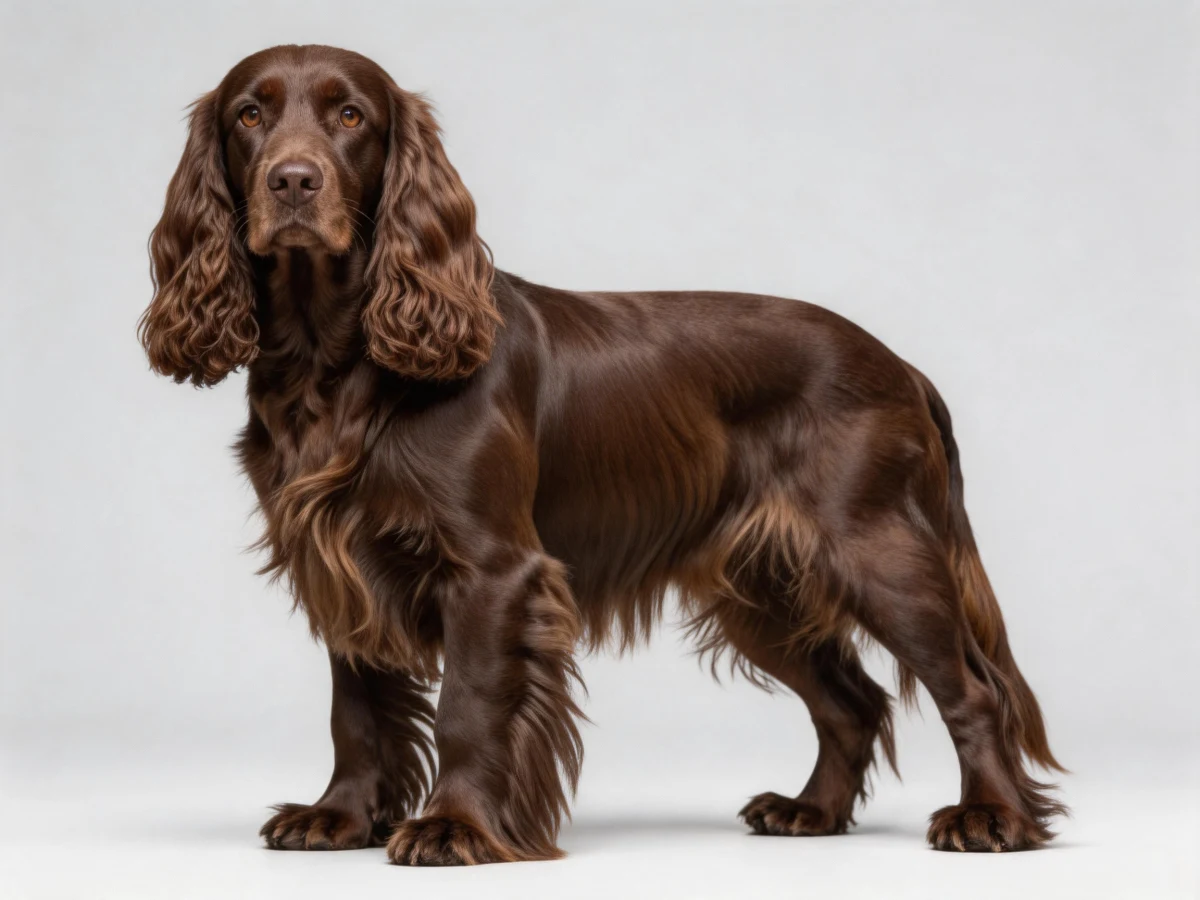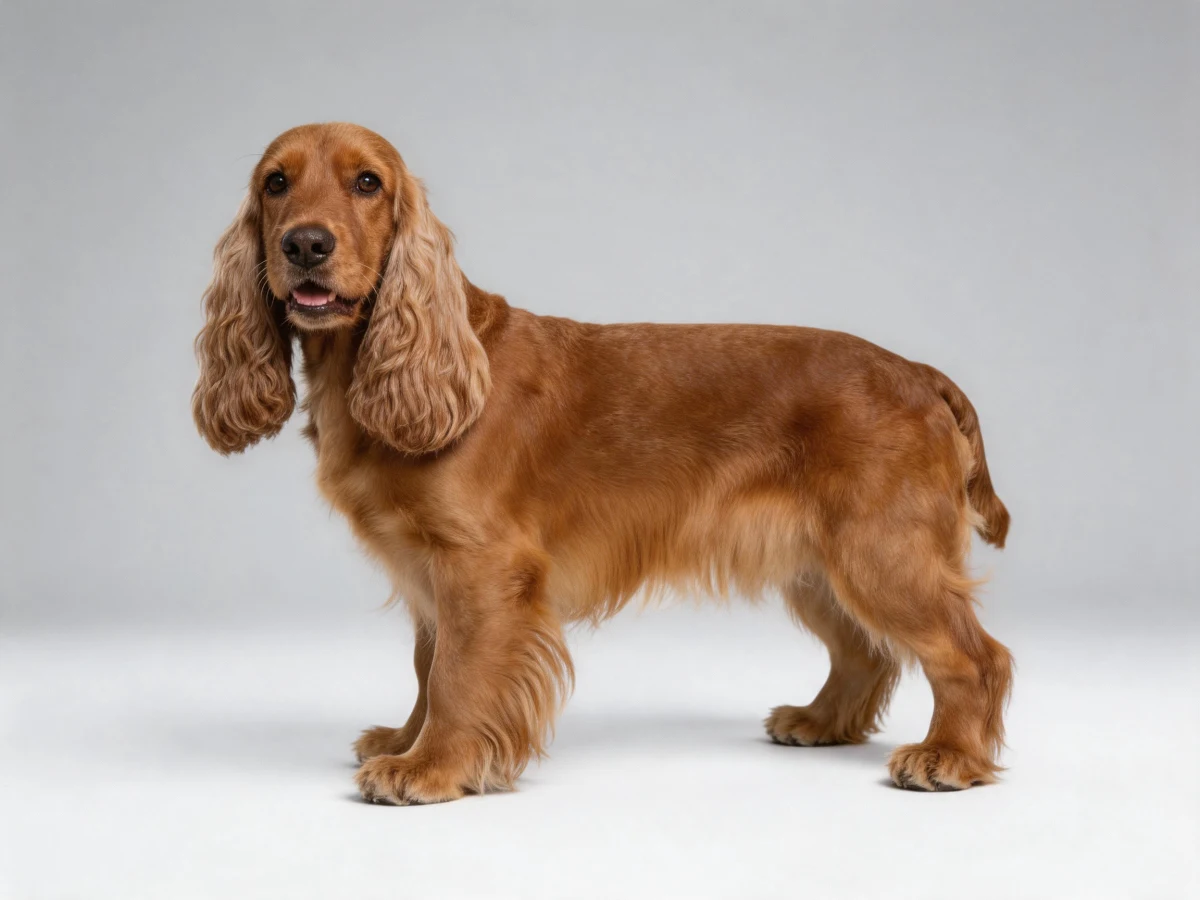
Cocker Spaniel
✨ Key Takeaways
- In the US, "Cocker Spaniel" means the American Cocker — the smallest dog in the AKC Sporting Group, separated from the English Cocker as a distinct breed by the AKC in 1946.
- The breed name records a job: the "cocking" spaniel was the smallest of the land spaniels, the one worked to woodcock, as set out in Sydenham Edwards' 1801 "Cynographia Britannica."
- Ch. Obo (whelped 1879) sits behind the modern lines; his son Ch. Obo II is the foundation sire of the American line, and the two types diverged in build and coat through the early 20th century.
- The American Cocker was the most-registered breed in the US during the 1940s–50s and again in the 1980s — popularity that drove both its lavish coat and a wave of poorly bred stock.
- The defining health load is the pendulous-ear otitis the long lobular ear invites, plus inherited eye disease: progressive rod-cone degeneration (prcd-PRA) has a DNA test, as does familial nephropathy.
- "Rage syndrome" is a real but contested label; the best evidence (Podberscek & Serpell, 1990s, on English Cockers) links owner-reported aggression to solid coat colour and is not a reason to avoid a well-bred, well-screened dog.
Quick Facts
Common Names & Variants
Modern aliases
Historical names
Modern variants & lines
⚖️ Pros & Cons
Advantages
Trade-offs
Physical Appearance
Recognized colors
Coat
Other
Ears: Pendulous. Tail: Natural (historically docked).
🕰 History
The spaniel that was named after a bird
The Cocker Spaniel is, etymologically, a job description. Spaniels are old — "spaynels" appear in 14th-century English writing, and the type is generally traced to Spain, though the deep origin is genuinely uncertain and the breed's own histories say so. What turned a vague old class of bird dogs into the Cocker was a split within the land spaniels, and the cleanest documentary anchor for it is Sydenham Edwards' Cynographia Britannica of 1801, which divides the Land Spaniel into two working types: the larger springing or "springer" spaniel that flushed game, and the smaller "cocking" or cocker spaniel, the one small and quick enough to work the dense cover where woodcock — "cock" — hid. The breed is named after the bird it was bred to find. Everything else in the Cocker's story is a series of arguments about how small, how fancy, and on which side of the Atlantic.
Obo, and the dog behind the modern dog
The modern Cocker has a single near-universal ancestor, and his name was Obo. Ch. Obo was whelped in 1879 — a low, long, short-legged dog by modern eyes, recorded at about 10 inches at the withers and roughly 22 pounds — and he is regarded by breed historians as the fountainhead of the modern Cocker type. The transatlantic fork runs directly through his pedigree: the English line traces to Ch. Obo himself, while the American line descends from his son, Ch. Obo II, whose dam, by the often-told account, was shipped to the United States while in whelp. From one stud dog, two breeds eventually grew.
The American divergence
American breeders did not keep the English dog as they received it. Two pressures pulled the American Cocker away from its parent stock through the early 20th century. The functional one: the American woodcock is a smaller bird than its European cousin, so American sportsmen selected a smaller spaniel to work it. The aesthetic one, which came to dominate, was the show ring — American fanciers favoured a more stylish dog, with a rounder, more domed head, a shorter back, and progressively more profuse coat. By the 1920s the American and English types were visibly different animals sharing a name. The American Spaniel Club, organised in 1881, is among the oldest breed clubs in the country, and the AKC had registered the first Cocker — a dog recorded as Captain — back in 1878.
1946: one name, two breeds
The naming problem became untenable as the two types stopped being interchangeable. The American Kennel Club resolved it in 1946 by formally recognising the English Cocker Spaniel as a breed separate from the native American dog. From that point "Cocker Spaniel" in the United States means the American Cocker; the English Cocker is its own breed with its own standard. Britain's Kennel Club mirrored the split from the other direction, recognising the American type as a distinct breed in 1970. This is the single most important fact for anyone reading about the breed: a "Cocker Spaniel" article written for an American audience and one written for a British audience are, strictly, about two different dogs.
The most popular dog in America, twice
What is striking about the American Cocker is how thoroughly fashion shaped it. The breed was the single most-registered dog with the AKC through much of the 1940s and 1950s and again in the 1980s. Ch. My Own Brucie, a black American Cocker, won Best in Show at Westminster in 1940 and 1941 and was, by the obituaries of the day, among the most photographed dogs in the world — a celebrity that helped drive the breed to the top of the registry. Popularity was a mixed inheritance: it locked in the lavish "moptop" show coat and it produced, predictably, a large volume of carelessly bred dogs with the temperament and health problems that follow any breed through a popularity spike. The careful modern Cocker — field or show — is a recovery from that, not a continuation of it.
From woodcock cover to family room
The throughline from the 1801 cocking spaniel to the dog on the sofa is real but stretched. Working and field-bred Cockers still flush and retrieve, with lighter coats and more drive. The mainstream Cocker is a companion whose sporting heritage survives as biddability, a soft mouth, and a love of carrying things, rather than as a working job. Both are legitimate; they are just no longer the same dog doing the same thing.
Temperament & Personality
The "merry cocker," and what that phrase carries
The breed's reputation has a fixed adjective: merry. The AKC describes the Cocker as gentle, smart, and happy, and the "merry cocker" tag is old enough to function as breed shorthand. It is largely accurate. A well-bred American Cocker is affectionate, soft-tempered, people-attached, and notably biddable — among the more emotionally sensitive sporting breeds, which is both its charm and its handling instruction: this is a dog that wilts under harsh correction and works for warmth and reward.
Soft, sensitive, and sometimes too much so
The flip side of the soft temperament is that the Cocker can be a worrier. The breed is prone to submissive and excitement urination in poorly socialised or over-corrected dogs, is sensitive to household tension, and bonds tightly enough that some individuals struggle with being left. None of this is pathology — it is the predictable behaviour of a sensitive companion dog that has been bred for closeness — but it means the Cocker rewards calm, consistent handling and punishes the heavy hand. Early, gentle, thorough socialisation is the single highest-leverage thing an owner does for this breed's temperament.
The aggression question, handled honestly
The Cocker carries a contested reputation for sudden, idiopathic aggression — "rage syndrome" or "cocker rage." The honest position is that the label is real in usage but disputed in the science, and the careful owner should understand it rather than either dismiss or fear it. The most cited evidence base is the Cambridge work of A. L. Podberscek and J. A. Serpell in the 1990s on English Cocker Spaniels, which surveyed owners through the UK Kennel Club and found that reported aggression was significantly higher in solid-coloured dogs than in particolours, and higher in males than in females, with the data suggesting a heritable and possibly neuroendocrine component to within-breed differences. Subsequent behaviourists have argued that much of what is called "rage" is better explained as severe but ordinary resource-guarding or dominance-related aggression rather than a distinct neurological syndrome. Two practical points survive the debate intact: the colour-and-sex pattern is worth a direct conversation with any breeder, and a well-bred, well-socialised Cocker from temperament-tested lines is not a dog a buyer should be afraid of.
Living with one
Day to day, an American Cocker in the right home is an easy, affectionate housemate: moderate energy, content with a good walk and some play, genuinely good with children when raised with them, and happiest underfoot rather than alone. It is a sensitive dog in a working dog's body — enough drive to enjoy a job, soft enough that the job has to be taught kindly. The realistic caveats are the grooming and the ears, not the temperament; with sound breeding and gentle, consistent handling, the "merry cocker" is the dog you actually get.
🏡 Living With a Cocker Spaniel
A small dog with a large need to be with you
The American Cocker Spaniel is the smallest dog in the AKC Sporting Group, and its temperament is the merry, soft, affectionate one that made it a household fixture through the mid-twentieth century. This is a velcro companion: a Cocker wants to be on the sofa, on the bed, and at your feet, and it forms an intense attachment to its people. That devotion is the breed's charm and also its main caution — a Cocker left alone for long stretches is prone to separation anxiety, and the breed does best in a home where someone is around for much of the day rather than one that empties out for nine hours. The flip side of that softness is that some lines, especially those bred for looks during the breed's popularity boom, can be timid or reactive, which is why temperament of the parents matters as much as coat.
Moderate exercise, not a couch ornament
A Cocker reads as a lapdog because of its size and silky coat, but it descends from working land spaniels flushed into the field for woodcock — the bird that gave the breed its name. An adult needs genuine daily exercise: a good walk or two plus play, scent games, or a romp in a secure yard, on the order of thirty to sixty minutes a day. Cockers love to use their nose and retrieve, and a short fetch or a sniffy walk satisfies far more than pacing a living room. Without that outlet the breed gains weight quickly and can become yappy and demanding. The exercise need is moderate, not athletic — this is not a Border Collie — but it is real.
Kids, other pets, climate, and apartment life
A well-bred, well-socialised Cocker is gentle and patient and makes a fine family dog, though its small size and at-times sensitive disposition mean interactions with very young children should be supervised so the dog is not frightened or handled roughly. Cockers generally live happily with other dogs and cats. The breed suits apartment living well given its size and moderate exercise need, and it adapts to most climates, but the heavy ears and dense coat make hot, humid weather a reason to schedule activity for cooler hours and to keep the dog from overheating. The double coat sheds moderately year-round — less dramatically than a Golden, but the long feathering catches and holds shed hair, so brushing is what actually controls the mess.
🎓 Training & Exercise
Soft, willing, and quick — with a sensitive streak
The American Cocker is an intelligent, people-pleasing dog that learns quickly when training is kind. As a flushing spaniel bred to work cooperatively near the gun, it is wired to take direction and to stay tuned to its handler. Food and praise are powerful motivators, and short, upbeat sessions get results fast. The defining catch is sensitivity: the Cocker is a soft breed that wilts under harsh corrections, raised voices, or heavy-handed tools. Pushed too hard, a Cocker does not get tougher — it gets anxious, shut down, and in some individuals defensive. Reward-based methods are not a preference here; they are the approach that actually works with the temperament.
Housetraining, noise, and "submissive" wetting
Two breed-typical training challenges deserve a plan from day one. First, Cockers can be slower to housetrain than some breeds, so a consistent crate-and-schedule routine with generous reward for going outside pays off. Second, some Cockers — particularly soft or under-confident ones — are prone to excitement or submissive urination when greeted enthusiastically; the fix is calm, low-key greetings and never scolding the dog for it, which only worsens the anxiety driving it. The breed can also be vocal, so rewarding quiet and not inadvertently reinforcing demand-barking keeps the merry Cocker from becoming a yappy one.
Socialisation is the highest-value work
Because the breed's long popularity produced some shy and reactive lines, early and ongoing socialisation is the most important training investment a Cocker owner makes. A puppy gently exposed to many people, dogs, surfaces, sounds, and handling — especially having its ears, feet, and coat touched, which it will endure for a lifetime of grooming — grows into the confident, merry dog the breed should be. A puppy class started early builds that foundation and gives the soft Cocker positive experiences with other dogs. Reliable "leave it," "off," and a solid recall round out the practical commands; the recall matters because a nose-driven spaniel will follow a scent if given the chance.
✂️ Grooming & Coat Care
The headline: a profuse silky coat that mats
Grooming is the single biggest commitment of Cocker ownership, and prospective owners should understand it before anything else. The American Cocker carries a long, profuse, silky coat — short and fine on the head, medium-long on the body, and extravagantly feathered on the ears, chest, legs, and belly. Left alone, that coat mats badly and fast. A show-condition coat demands near-daily line-brushing down to the skin; the realistic answer for most pet homes is frequent brushing — several times a week at minimum — plus a professional groomer roughly every six weeks. Many pet owners ask the groomer for a "cocker clip," a shorter trim that keeps the breed's look while making the coat genuinely manageable at home. A bath every few weeks keeps the silky coat and skin clean, with thorough drying afterward.
The ears: the number-one recurring job
If the coat is the headline, the ears are the chronic task. The Cocker's long, heavy, low-set, densely feathered ears hang over the canal and trap warmth and moisture, which makes the breed one of the most ear-infection-prone dogs there is. Routine ear care is not optional maintenance — it is the recurring job that defines the breed. Check the ears regularly, keep the hair on and around the ear leather trimmed, clean with a vet-recommended product on the schedule your veterinarian advises, and dry the ears carefully after every bath or swim. Many owners feed and water from narrow or weighted bowls, or clip the ears back at mealtimes, to keep the long ears out of the food and water.
Eyes, feet, nails, and teeth
The Cocker's large, prominent eyes and its facial folds need a gentle daily wipe to clear normal discharge and prevent tear-staining and skin irritation below the eyes. The heavily feathered feet pick up grass seeds, mud, and debris, so check and trim the hair between the pads and keep the feet tidy. Nails grow quickly under all that feathering and are easy to overlook — trim every two to three weeks, before they click on the floor. Brush the teeth several times a week from puppyhood, as small breeds are especially prone to dental disease. None of these tasks is hard; the point is that a Cocker is a high-maintenance grooming breed across the board, and the owner who is not prepared for that workload should choose another dog.
🍖 Diet & Nutrition
Weight gain is the headline diet issue
The American Cocker loves food and gains weight easily, and obesity is the most common preventable health problem the breed faces. A small dog needs surprisingly few calories, so it is easy to overfeed a Cocker — and every extra pound on a small frame strains joints, taxes the heart, and shortens life. Feed measured meals against the dog's ideal weight rather than topping up a bowl, account for treats inside a daily calorie budget (using part of the measured ration for training rewards), and learn to body-condition-score by feeling for the ribs and a visible waist rather than judging by the abundant coat, which hides a thickening waistline. Keeping a Cocker lean is the most effective everyday thing an owner does for the dog's longevity.
Puppy growth and feeding routine
Cocker puppies do well on a complete diet formulated for small or medium breeds, fed in several small meals a day while young and settling to twice-daily feeding as an adult. Because the breed is small, portion control matters from the start — a small puppy overfed into a roly-poly shape is being set up for an overweight adulthood. Set portions by the dog's ideal adult weight (broadly 22–31 lb depending on sex and frame) and activity level, and adjust by body condition over time rather than by the bag's generous guideline. Make any diet change gradually over about a week to avoid stomach upset.
Breed-specific cautions
A few Cocker particulars shape feeding. The long ears mean narrow, deep, or weighted bowls (or clipping the ears back at mealtimes) keep the feathering out of the food and reduce the mess and moisture that feed ear problems. Because the breed can be prone to certain inherited issues including some autoimmune and kidney conditions, any diet questions tied to a diagnosed health concern belong with your veterinarian rather than a feeding chart. Fresh water should always be available, and treats kept modest — a food-loving small dog is one whose owner has to be the disciplined one.
🐶 Buying & Adopting a Cocker Spaniel
Start at the American Spaniel Club, not a classified ad
The American Spaniel Club (ASC) is the AKC parent club for the American Cocker Spaniel and the right starting point. It maintains a breeder-referral resource, a code of ethics for member breeders, and breed-rescue contacts. This matters more for the Cocker than for most breeds: the Cocker's enormous popularity from the 1950s through the 1990s — fuelled by the glamorous show coat and by cultural icons such as Lady from Lady and the Tramp — drove heavy commercial overbreeding, and that era left a legacy of poorly bred lines with temperament and health problems. Buying carefully from a health-testing, parent-club breeder is the way to get the merry, sound Cocker the breed is supposed to be rather than a nervous or unhealthy one.
The health screening to ask a breeder for
A responsible Cocker breeder health-tests both parents and will show you the paperwork. The CHIC profile for the breed centres on a hip evaluation (OFA), an eye examination by a board-certified veterinary ophthalmologist (OFA/CAER), and a patellar luxation evaluation (OFA), with two DNA tests recommended: prcd-PRA (progressive rod-cone degeneration, a form of inherited blindness) and Familial Nephropathy (FN, an inherited kidney disease). Many breeders add an OFA autoimmune thyroid panel. These tests exist because the breed has a known record of eye disease — prcd-PRA, cataracts, glaucoma, and cherry eye — alongside familial nephropathy, autoimmune conditions, luxating patella, and the ear problems already covered. Naming these is consumer fact-finding, not a diagnosis: a breeder who produces current OFA and DNA results and discusses these issues openly is the one to trust, and "our dogs are healthy, we don't need to test" is the answer to walk away from.
Rescue, price, and the red flags
Cocker rescue is active and well-organised through the ASC and a network of regional breed-rescue groups, and because the breed is so popular, rescues regularly take in adults whose owners underestimated the grooming workload or the ear care. For an adopter happy with an adult of known temperament, breed rescue is an excellent route. A well-bred, health-tested American Cocker puppy in the United States runs roughly USD 1,200–3,000 (2024), and good breeders often keep a waiting list. The patterns to avoid are the familiar ones: puppies priced well below that with immediate availability, no health-testing documentation, no parent-club connection, and parents you are not allowed to meet. A fair price after a wait from a breeder who tests and stands behind their dogs costs far less than a lifetime with a poorly bred one.
📜 Breed Name Etymology — iDogNames original research
Named for the woodcock
"Cocker" is not a person, a place, or a kennel — it is a bird, abbreviated. The breed's name comes directly from the woodcock, the small, long-billed game bird that hides in dense low cover and was the specialised quarry of the smallest land spaniels. The verb that did the work was "to cock" / "cocking," meaning to hunt woodcock; the dog that did the cocking became the cocking spaniel and then, by ordinary clipping, the Cocker Spaniel. The earliest clean documentary fix for the word as a type rather than a loose habit is Sydenham Edwards' Cynographia Britannica (1801), which separates the Land Spaniel into the larger "springing, springer" spaniel and the smaller "cocking, cocker" spaniel. The name therefore encodes the exact division of labour that created the breed.
What "spaniel" carries
The second half of the name is older and geographically loaded. "Spaniel" derives, by the long-standing and most widely cited etymology, from the Old French espaigneul — "Spanish (dog)" — pointing to an Iberian origin for the spaniel type generally. It is fair to flag that this origin is traditional rather than archaeologically settled; the breed's own histories tend to say the deep origin is uncertain and that "spaynels" simply appear in English texts by the 14th century. So the full name decomposes as "woodcock (dog), of the Spanish-type spaniel family" — a job word bolted onto an old type word.
"American" — the part the US drops
The breed's formal name in most of the world is American Cocker Spaniel. Inside the United States the "American" is silently dropped: "Cocker Spaniel" on a US registration, in US conversation, and on this page means the American Cocker. This is the direct linguistic fallout of the AKC's 1946 separation of the English and American breeds — the country that developed the American type treats it as the default Cocker, and qualifies the English one instead. A British speaker does the mirror image. The unqualified word "Cocker" is genuinely ambiguous across the Atlantic, which is itself a piece of the breed's etymology.
The aliases in use
Cocker is the universal clipped form, used interchangeably with the full name in club and veterinary writing. Merry Cocker is the affectionate epithet drawn straight from the standard's temperament language and is old enough to function as a near-name. American Cocker Spaniel is the formal international name and the disambiguating one. There are no legitimate "rare colour" or "type" marketing labels for this breed the way there are for some — a buyer should be wary of any seller language that invents one.
Name forms at a glance
| Name | Role | Origin | Literal meaning | First recorded |
|---|---|---|---|---|
| Cocker Spaniel | primary | English (occupational + Old French) | the spaniel that works woodcock | 1801 |
| American Cocker Spaniel | origin country native | English | the American type of cocker spaniel | 1946 |
| Cocking Spaniel | historical | English (occupational) | the spaniel used for cocking (woodcock hunting) | 1801 |
| spaniel (espaigneul) | historical | Old French (from a Spanish-origin tradition) | Spanish(-type) dog | — |
| Merry Cocker | alias | English (epithet) | affectionate epithet for the breed's cheerful temperament | — |
🏛 Naming Traditions — iDogNames original research
A field-sport breed with an English naming spine
The Cocker Spaniel's naming culture sits on three coherent foundations, all of which trace to its working and pedigree history rather than to a national kennel system the way a German breed's does. The first is the English field-sport register the breed shares with every gundog. The second is the English bench-and-pedigree convention, the Obo-era studbook tradition the modern dog literally descends from. The third is the soft, classic companion register the "merry cocker" reputation invites. Choosing within one of these — rather than reaching for a generic small-dog name — is what gives a Cocker's name a documented heritage.
The field-sport layer
The Cocker is, by name, a working bird dog, and the oldest naming vein is the English shooting-field one. Gundog people name for the work and the country it is done in: Scout, Briar, Reed, Fenn, Heath, Teal, Pike, Bramble, Willow, Marsh. The logic is the same logic that named the retrievers — a working call name should carry across a wet field, be unmistakable on a windy day, and ideally sit in the landscape the dog works. A Cocker given a terse English field or game-bird name is wearing its 1801 cocking-spaniel heritage on its collar, and field-bred lines still name almost entirely this way.
The Obo-era pedigree layer
Because the entire modern breed descends from one documented dog — Ch. Obo, whelped 1879 — the Cocker has an unusually traceable show-pedigree naming tradition. Victorian and Edwardian bench Cockers were registered with short, dignified given names that read well in a studbook and in a catalogue: the foundation dog himself was simply Obo; the first AKC-registered Cocker was Captain; the most famous show dog in the breed's history was Ch. My Own Brucie, whose call name, Brucie, became a breed touchstone in its own right (the "Red Brucie" line of red and buff Cockers carries the name forward). For an owner, this supports a register of period-correct, slightly formal English pedigree names — Brucie, Captain, Duchess, Major, Lady, Toby — that sit squarely inside the breed's own studbook history rather than alongside it.
The "merry cocker" companion layer
The breed's softest and most-used modern layer follows its temperament. The "merry cocker" is, by design and by standard, a warm, affectionate, gentle companion, and the names that fit it lean classic, friendly, and unpretentious rather than martial: Honey, Buddy, Daisy, Charlie, Biscuit, Maggie, Buttons, Cookie. These are not heritage names in the field or pedigree sense, but they are true to what the breed was deliberately shaped into, and they pair naturally with the buff and golden coats the breed is most associated with in the public mind. There is a defensible heritage argument here too: the Cocker was redesigned, through the 20th century, specifically into a companion, and a warm companion name honours that redesign rather than ignoring it.
Choosing a Cocker name with intent
The breed offers three lineage-true routes that stay distinct. A terse English field or game-bird name (Reed, Teal, Briar) honours the 1801 cocking spaniel and suits a field-bred dog. A short, dignified English pedigree name (Brucie, Captain, Duchess) sits inside the Obo-era studbook tradition and suits a show line. A warm classic companion name (Honey, Buddy, Daisy) is true to the "merry cocker" the breed was deliberately shaped into. The name the heritage argues against is the tough or ironic one — a soft, sensitive, woodcock-flushing spaniel called "Tank" or "Killer" fights both the breed's working history and its temperament at once.
🐾 Themed Names for Your Cocker Spaniel — iDogNames original research
English field-sport names — the cocking-spaniel layer
Terse English shooting-field and game-bird names from the breed's origin as the small woodcock spaniel. Best suited to a field-bred or working Cocker.
- Teal — a small game duck; a gundog-field classic
- Reed — the wetland cover the spaniel works; short and clean
- Briar — the dense thorn cover woodcock hide in
- Fenn — fenland; an English field name with no fuss
- Heath — open shooting country; carries well as a recall
- Willow — wet-ground tree; soft but field-true (female-leaning)
- Bramble — thicket cover; period-correct and characterful
- Pike — terse, sharp, English; reads as a working name
- Marsh — the spaniel\'s wet workplace; one hard syllable
- Snipe — a long-billed marsh game bird like the woodcock; heritage-deep
Obo-era pedigree names
Short, dignified Victorian/Edwardian studbook names in the tradition the modern breed literally descends from. Best for a show or bench line.
- Brucie — after Ch. My Own Brucie, the breed\'s most famous show dog
- Obo — the foundation sire himself; the deepest pedigree name there is
- Captain — the first AKC-registered Cocker (1878)
- Duchess — classic English bench female name
- Major — period-correct, dignified, easy to call
- Lady — Edwardian pedigree female name; ages well
- Toby — old English studbook call name; friendly but formal
- Duke — titled, dignified, common in old Cocker pedigrees
- Countess — bench-show female register; titled and traditional
- Rufus — "red"; period-true for a red or buff Cocker
"Merry cocker" companion names
Warm, classic companion names true to the gentle, affectionate dog the breed was deliberately shaped into.
- Honey — for the buff/golden coat; the breed\'s warm-natured tag
- Buddy — plain, friendly, the archetypal Cocker call name
- Daisy — soft classic female name; suits the merry temperament
- Charlie — easy, friendly, ages with the dog
- Biscuit — for the buff coat; warm and unpretentious
- Maggie — homely classic female name
- Buttons — soft, characterful, fits a small merry spaniel
- Cookie — warm companion register; pairs with golden coats
- Sunny — for the buff coat and the cheerful temperament
- Bramwell — soft English name with a field echo
Coat and color names
The Cocker\'s recognised palette runs black, black-and-tan, the ASCOB buff and red and brown, plus parti-color, tricolor, and roan. These names work the colours without the obvious "Blackie."
- Sable — for the solid black; dignified, bench-true
- Buff — the breed\'s own colour term for the pale gold
- Cinnamon — for the red / ASCOB coat; warm and accurate
- Russet — for the red Cocker; period English colour word
- Mocha — for the chocolate / brown coat
- Roan — the breed\'s own term for the ticked parti pattern
- Domino — for a parti-color black-and-white
- Amber — for the golden buff; soft female-leaning name
- Cocoa — for the brown coat; warm companion register
- Ginger — for the red coat; classic and unfussy
More United States (from English land-spaniel stock) heritage names
- United States (from English land-spaniel stock) Trail - best for a Cocker Spaniel name rooted in United States (from English land-spaniel stock) rather than generic style
- United States (English Cocker foundation; New England fanciers) Ridge - best for a regional landscape cue tied to the Cocker Spaniel story
- Local Line - best for a name that respects local breed history
- Old Route - best for migration, trade, field or pastoral routes behind the breed
- Heritage Note - best for a page where origin should be treated as context, not decoration
- Village Path - best for rustic, local or landrace-style background
- Working Home - best for a dog whose name should remember flushing and retrieving game birds — historically the small "cocking" spaniel worked to woodcock
- Country Mark - best for a concise country-of-origin cue
More work and purpose names
- Field Note - best for a Cocker Spaniel whose name should point to flushing and retrieving game birds — historically the small "cocking" spaniel worked to woodcock
- Soft Mouth - best for a retrieving dog expected to carry gently
- Search Cast - best for quartering fields or cover in a controlled way
- Reed Fetch - best for water-edge retrieving or marsh imagery
- Feather Find - best for bird-dog heritage without overstating modern use
- Steady - best for a gundog learning calm around birds and movement
- Check Cord - best for careful field training in open places
- Partner - best for a cooperative handler-dog working relationship
More coat and build names
- Black - best for a Cocker Spaniel whose color or markings deserve a simple call name
- Double Coat - best for the double coat type on this breed
- White Blaze - best for a clear face or chest marking
- Dark Mask - best for a dog with a strong muzzle or face marking
- Weather Coat - best for outdoor or working-dog coat context
- Strong Frame - best for a dog whose build is part of its function
- Bright Eye - best for an alert expression
- Ground Step - best for a name tied to movement and body type
📋 Breed Standard at a Glance
General appearance
The AKC standard describes the American Cocker Spaniel as the smallest member of the Sporting Group: a sturdy, compact, well-balanced dog with a refined, chiselled head and a body short enough to be put together for hard daily work in the field. The Cocker should be merry and free in action, standing well up at the shoulder, with a sloping topline and an overall look of substance carried on a small frame. The breed diverged from the English Cocker Spaniel and is registered as a separate breed; the American is smaller, has a more domed and rounded head with a pronounced stop, and carries a more profuse coat.
Size, coat, and colour
Ideal height at the withers is about 15 inches for males (36–39 cm in the breed data) and about 14 inches for females (34–37 cm); dogs noticeably over those heights are penalised. Weight runs roughly 24–31 lb for males (11–14 kg) and 22–29 lb for females (10–13 kg). The coat is silky, flat or slightly wavy, short on the head and medium-long on the body, with profuse feathering on the ears, chest, legs, and belly. Recognised colour varieties are Black (including black-and-tan), ASCOB (Any Solid Colour Other than Black), and Parti-Color.
Head, movement, and temperament
The head is the breed's hallmark: a rounded, domed skull, a deep, square, broad muzzle, large dark expressive eyes, and long, low-set, heavily feathered lobular ears that reach the nose tip. Movement should be smooth and effortless with strong rear drive and matching front reach, the topline held level on the move. Temperament is written into the standard — the Cocker is to be equable, merry, and free of timidity or aggression — a clause that matters given the shy and reactive lines the breed's long popularity left behind.
🏆 Famous Cocker Spaniels
Notable real dogs of the breed profiled on iDogNames.
🏆 Recognition
Recognized by the American Kennel Club in 1878 as a Sporting breed. FCI standard No. 167 (Section 2 — Flushing Dogs), recognized in 1959.
Other registries
Breed clubs
❓ Frequently Asked Questions
Are Cocker Spaniels good family dogs?
A well-bred, well-socialised American Cocker Spaniel is a merry, gentle, affectionate family dog that bonds closely with its people. Because the breed is small and can be sensitive, play with very young children should be supervised, and because the breed dislikes being left alone for long, it suits homes where someone is around much of the day. Buying from a health-and-temperament-testing breeder matters, as the breed's long popularity left some shy or reactive lines.
Do Cocker Spaniels shed a lot?
They shed a moderate amount year-round. The bigger reality is the coat itself: the long, silky, profuse feathering catches shed hair and mats quickly, so grooming, not shedding, is the real workload. Frequent brushing several times a week plus a professional groom about every six weeks keeps the coat under control.
How much exercise does a Cocker Spaniel need?
Moderate — about thirty to sixty minutes a day of walks plus play, fetch, or scent games. Despite its lapdog looks, the Cocker descends from working flushing spaniels and needs a real daily outlet for its energy and nose. Without it the breed gains weight easily and can become vocal and demanding.
How long do Cocker Spaniels live?
Typically 10 to 14 years. Keeping the dog lean, staying on top of the breed's routine ear care, and buying from a breeder who health-tests for the breed's eye and kidney conditions all support a long, healthy life.
Are Cocker Spaniels easy to train?
Yes, with the right approach. The Cocker is intelligent and eager to please, so it learns quickly with short, upbeat, reward-based sessions. It is a soft, sensitive breed, so harsh corrections backfire. Housetraining can take patience, and early socialisation is the single most valuable training investment for the breed.
Are Cocker Spaniels hypoallergenic?
No. The American Cocker Spaniel sheds and is not considered a hypoallergenic breed. Anyone with a dog allergy should spend extended time around the breed before committing.
How much does a Cocker Spaniel puppy cost?
A well-bred, health-tested American Cocker Spaniel puppy in the United States typically runs about USD 1,200 to 3,000 (2024 data), often with a waiting list. Be wary of puppies priced well below that with immediate availability and no health-testing paperwork or parent-club connection.
📚 Sources & Further Reading
Every load-bearing factual claim on this page is anchored to one of the sources below. iDogNames does not synthesize from secondary aggregators.
- akc breed page Cocker Spaniel — AKC Breed Profile — American Kennel Club (2024)
- akc breed page Cocker Spaniel History: From Hunting Companions to Popular Pets — American Kennel Club (2023)
- fci standard pdf FCI Standard No. 167 — American Cocker Spaniel — Fédération Cynologique Internationale (1999)
- breed club official American Spaniel Club — parent club, breed & ASC history — American Spaniel Club
- breed club official The Kennel Club (UK) — Spaniel (Cocker) DNA testing services — The Kennel Club (UK)
- academic paper Aggressive behaviour in English cocker spaniels and the personality of their owners — Podberscek AL & Serpell JA, Veterinary Record (1997)
- academic paper The English Cocker Spaniel: preliminary findings on aggressive behaviour — Podberscek AL & Serpell JA, Applied Animal Behaviour Science (1996)
- wikipedia American Cocker Spaniel — Wikipedia — Wikipedia
- book Cynographia Britannica — Sydenham Edwards (1800–1805) (1801)