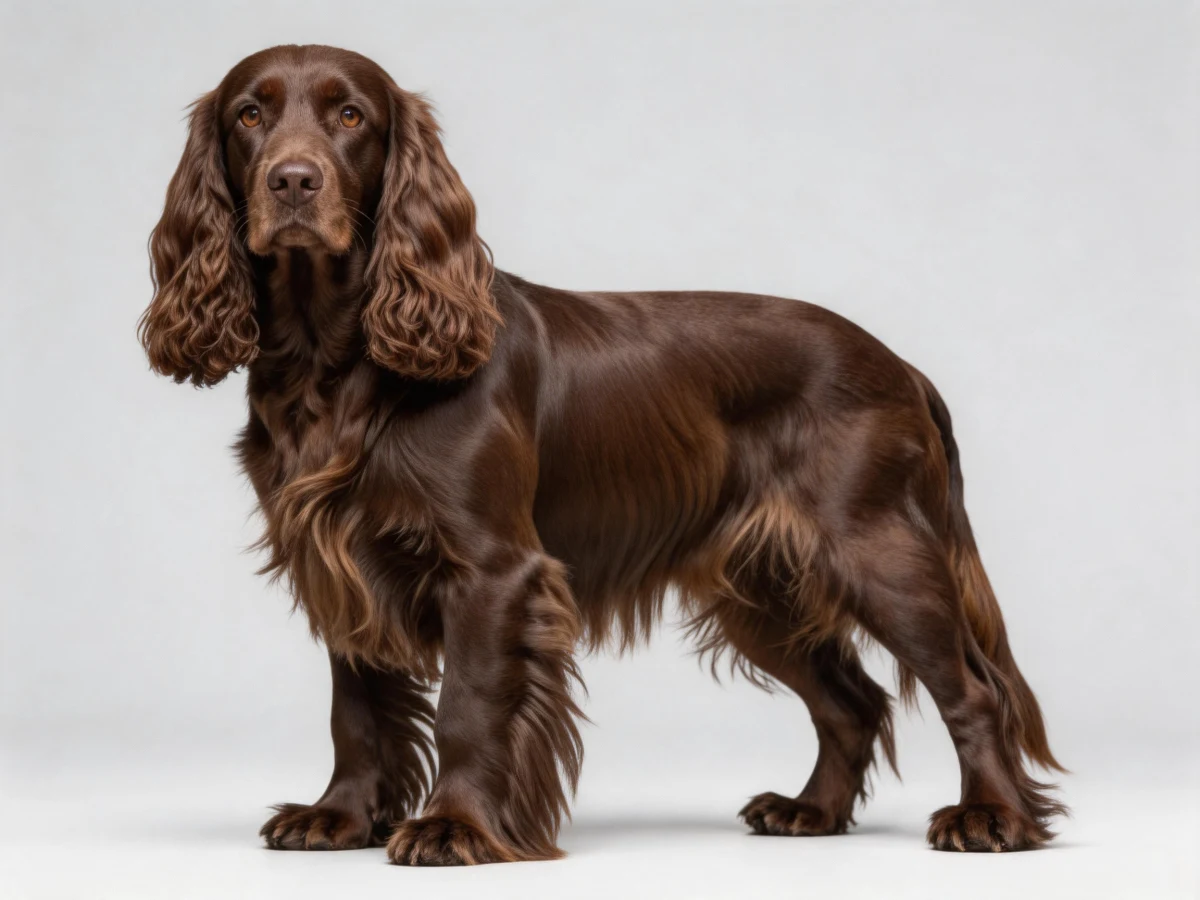
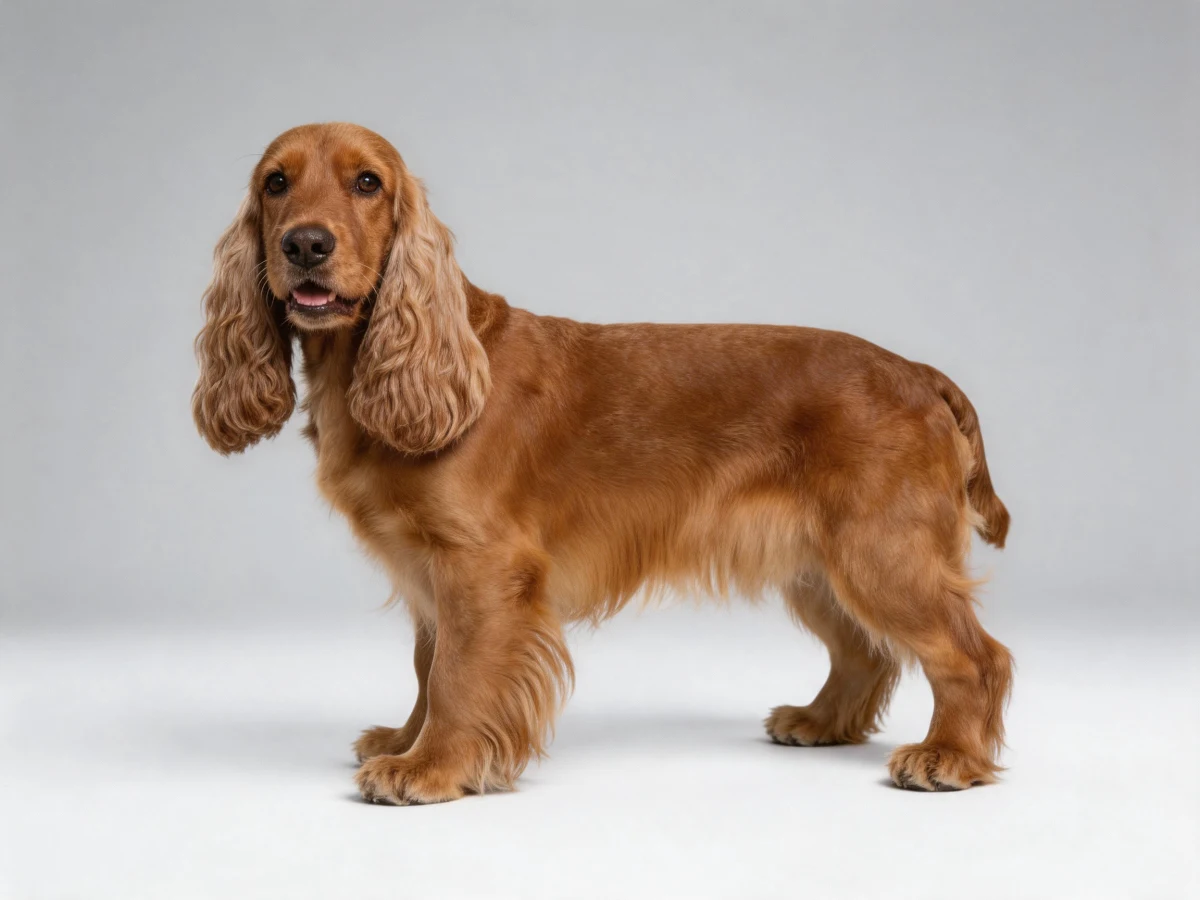
English Springer Spaniel
✨ Key Takeaways
- The English Springer Spaniel is the larger half of the old land-spaniel split: in a single litter, the smaller pups that hunted woodcock became "cockers" and the larger pups that sprang (flushed) game became "springers" — function, not pedigree, drew the first line between the breeds.
- The documented breed line runs through the Boughey family of Aqualate in Shropshire, whose Aqualate Stud Book traces a continuous strain from the dog Mop I, whelped about 1812; Sir Thomas Boughey bred the early field champion Velox Powder in 1903 from that line.
- The Kennel Club (UK) granted the English Springer separate breed status in 1902 (the same year the Welsh Springer split off); the AKC registered the breed in 1910 and the ESSFTA, formed in 1924, held the first US field trial that October on Fishers Island.
- The breed is split into two near-separate populations — a wiry, short-coated field/working type and a heavily feathered bench/show type — with gene pools largely segregated for over 70 years; a buyer should choose the type that matches the intended job.
- Health screening centres on hips, eyes (with the PRA cord1 DNA test), and the breed-defining phosphofructokinase (PFK) deficiency, an autosomal-recessive enzyme defect for which a direct DNA test makes the condition fully preventable.
- A well-bred Springer is one of the most biddable and tireless of the gundogs; under-exercised and under-employed, that same drive turns into a busy, anxious, vocal dog that struggles in a sedentary home.
Quick Facts
Common Names & Variants
Modern aliases
Historical names
Modern variants & lines
⚖️ Pros & Cons
Advantages
Trade-offs
Physical Appearance
Recognized colors
Coat
Other
Ears: Drop, pendulous. Tail: Natural low-set (historically docked).
🕰 History
One litter, two jobs
The English Springer Spaniel did not begin as a separate breed — it began as the bigger pups in the basket. For most of the spaniel's long working history in Britain there was no Springer and no Cocker, only "land spaniels" that flushed game for the net, the falcon, and the greyhound long before the gun. Within a single litter, a sportsman kept the smaller, lighter dogs to work the dense cover where woodcock sat — these were the "cocking" spaniels — and the larger, leggier dogs to spring (flush) the heavier game birds into the open. Sydenham Edwards made the split explicit in print in his Cynographia Britannica around 1801, writing that the land spaniel should be divided into two kinds. The line between Springer and Cocker, in other words, was drawn by what the dog could do, not by where it came from.
Documentation before the 19th century is genuinely thin. Spaniels appear in ancient Welsh law and in 16th- and 17th-century paintings, but there is no continuous studbook from the falconry era to the modern breed. The first solid, traceable thread is a Shropshire family.
Aqualate, the Boughey family, and Mop I
The breed's documented spine runs through the Boughey family of Aqualate, an estate in Shropshire, England. The English Springer Spaniel Club's breed-history records that the Boughey strain was kept across successive generations of the family for more than a century, and that the family maintained the Aqualate Stud Book — the earliest known stud book for the breed — from the time of a dog called Mop I, whelped about 1812. Mop I is conventionally cited as the first dog of recognisably modern Springer type, though the early dogs were heavier and more Clumber-like than today's animal. The continuity is the point: when Sir Thomas Boughey bred the early field-trial champion Velox Powder in 1903, that dog's pedigree traced back through the same Aqualate book to Mop I almost a century earlier. Few British gundog breeds can show that long a paper trail.
Becoming a breed on paper
The 1870s put Springers in the show ring at the earliest British dog shows, but the formal separation came in 1902, when the Kennel Club in England granted the English Springer Spaniel breed status distinct from the Cocker — and, the same year, recognised the Welsh Springer Spaniel as its own breed as well. The combined push came from two bodies with different priorities: the Spaniel Club of England, which cared about conformation, and the Sporting Spaniel Society, which cared about field ability. The breed that resulted carried both standards from the start, which set up the divergence to come.
Across the Atlantic and into the field
The American Kennel Club registered its first English Springer Spaniel in 1910. The breed's American working culture organised quickly: the English Springer Spaniel Field Trial Association (ESSFTA) was formed in 1924 and held the first English Springer field trial in the United States that October on Fishers Island, New York. The ESSFTA remains the AKC parent club. The first British field trial champion of the breed, FTC Rivington Sam, dates to 1914 — a marker of how fast the working side professionalised once the breed had a name.
The split that defines the modern breed
What is striking about the English Springer is that, having been unified on paper in 1902, it promptly divided again — this time by purpose. Field trialers selected for nose, drive, biddability, and a wiry, low-maintenance coat. Show breeders selected for the standard's outline, a longer and more profuse coat, and heavier ear leather. The two populations have bred almost entirely apart for the better part of a century; the gene pools have been described as essentially segregated for at least seventy years. A field-bred Springer and a bench-bred Springer can look like different breeds and behave differently enough that choosing the wrong type for the intended life is the single most common mistake a Springer buyer makes. Both are correct English Springer Spaniels. They are simply answers to two different questions the breed was asked to do at once.
Temperament & Personality
"Merry" is in the standard for a reason
The Kennel Club and FCI descriptions of the English Springer reach for the same word: a "friendly, happy disposition," biddable, with timidity and aggression both flagged as serious faults. That word "merry" is breed shorthand. A correct Springer is busy, soft, sociable, and almost relentlessly cheerful — a tail that does not stop, a dog that wants to be doing something with you. The flip side of merry is that the breed does not switch off easily, and a Springer with nothing to do invents work, usually loud and usually involving your furniture.
Two temperaments, not one
Because the field and show lines bred apart for generations, "the Springer temperament" is really two. The field-bred dog is the higher-octane animal: faster to arousal, harder driving, with a hunting motor that needs daily, structured discharge. The show-bred dog is generally calmer and more biddable as a companion, though still a sporting spaniel with real exercise needs. Neither is a low-energy pet. A buyer who reads "good with families" and pictures a placid lapdog has read half the breed.
People-soft, not independent
Springers are notably handler-focused. The breed was built to work in close partnership with a gun, reading direction at distance and checking back constantly, and that wiring shows in the home as a dog that follows you room to room and does poorly with long isolation. Separation-related behaviour is common in under-stimulated Springers. The same softness makes the breed responsive to reward-based training and quick to fold under heavy-handed correction — a hard hand produces a worried, shutdown spaniel, not a compliant one.
The "rage" caveat, read carefully
No honest Springer profile skips this. "Rage syndrome" — sudden, intense, owner-directed aggression with no clear trigger, sometimes followed by the dog appearing disoriented — has long been associated with spaniels. The most rigorous behavioural work, Podberscek and Serpell's 1996 study in Applied Animal Behaviour Science, was conducted on the English Cocker Spaniel and concluded the phenomenon was better explained as an extreme of social-dominance aggression with a likely genetic and neuroendocrine basis than as a discrete neurological "syndrome." Its prevalence in the English Springer specifically is lower, contested, and not well quantified in primary literature. The practical takeaway is unglamorous and correct: this is uncommon, it is not a reason to avoid the breed, and it is a reason to buy from a breeder who screens temperament and will discuss line history honestly.
🏡 Living With a English Springer Spaniel
A velcro gundog that bonds hard
The English Springer Spaniel was bred to work a few yards in front of a handler all day, reading body language and staying connected, and that closeness is the central fact of living with one. A Springer is an intensely affectionate, people-oriented dog — the "velcro spaniel" nickname is earned — that wants to follow you room to room and lean against your leg. The cost of that devotion is that Springers bond tightly enough to struggle with being left, and a Springer routinely shut alone for long working days is a candidate for separation distress, destructive chewing, and barking born of loneliness rather than bad temperament. This breed fits a household where someone is home much of the day, or that can arrange daycare or a walker, far better than a nine-hour empty house.
The exercise floor is real, not optional
Springers carry the stamina of a dog built to quarter cover and flush game from dawn to dusk, and an adult needs a genuine hour or two of real activity a day — not a stroll around the block. They want a job attached to the exercise: retrieving, scent games, a long off-lead ramble, gundog or working trials, agility, or flyball. The split between the two strains matters here. Field-bred (working) Springers are lighter, shorter in coat, and frankly relentless — they need the most outlet of all. Show-bred (bench) Springers are heavier and a touch steadier but still a high-drive sporting breed. A Springer that does not get enough physical and mental work does not become calm; it becomes a frantic, mouthy, counter-surfing dog that invents its own jobs.
Kids, other pets, climate, and the coat reality
A well-socialised Springer is merry, gentle with children, and generally sociable with other dogs, which makes it a poor guard dog and a good family one. The flushing instinct means small fast-moving pets and birds can trigger chase, so introductions to cats and small animals want care. The moderately feathered double coat sheds steadily year-round and more heavily in seasonal moults, so hair on floors, furniture, and clothing is a permanent condition of ownership. The breed adapts to apartment life only if the exercise need is genuinely met, and the dense coat means hot, humid weather calls for early-morning or evening activity, shade, and water rather than midday exertion.
🎓 Training & Exercise
Why Springers train so readily — and the catch
The English Springer Spaniel is one of the more biddable sporting breeds: a soft, eager-to-please, handler-focused dog that genuinely wants to work with you, which is exactly why the breed excels at gundog work, sniffer and detection roles, and obedience. Reward-based methods are not just preferable but necessary. A Springer is sensitive enough that harsh corrections, heavy hands, or an angry tone produce a worried, shut-down dog that learns slower, not a more obedient one. The catch is the mirror image of stubbornness: a Springer is so keen and so quick that it learns whatever it is actually being rewarded for, so an inconsistent owner who laughs at a jumping puppy or rewards excitement teaches bad manners just as fast as good ones.
Channelling the flush and the busy nose
Everything a Springer does traces back to the job of finding game and springing it into flight, so the nose and the urge to quarter are always running. Give that drive a legitimate outlet — structured retrieves, "hunt the kibble" scent games, a reliable "hold" and "give," gundog dummy work, or formal scent classes — and you get a focused, settled dog. Deny it and the Springer self-employs: following scent on walks and ignoring you, bolting after birds, or obsessively patrolling the garden. Teach a rock-solid recall early on a long line and reinforce it for life with high-value rewards, because a scent-locked spaniel that will not come back is both a frustration and a road-safety problem.
The adolescent surge and steady consistency
Expect an exuberant adolescence from roughly six to eighteen months, when a previously attentive puppy seems to forget its training and treats recall as a suggestion. This is normal and it passes; the answer is patient, consistent, reward-based repetition rather than escalation, which only frightens a soft dog. Channel the adolescent energy into a class or a sport so the brain is tired as well as the body. Because Springers are quick and food-motivated, short frequent sessions beat long ones, and the highest-value commands to lock in early are recall, a settled "place" or "settle," and "leave it" for the dog that wants to investigate every scent and bird it meets.
✂️ Grooming & Coat Care
A moderately feathered double coat
The Springer carries a medium-length double coat — a weatherproof, close body coat over an insulating undercoat — with moderate feathering on the ears, chest, legs, and belly. Routine maintenance is moderate rather than light. A thorough brush-out two or three times a week with a slicker brush and a comb keeps the body coat clean and works through the feathering before it tangles, and it gives the owner a weekly chance to check skin, feet, and especially ears. A bath every six to eight weeks, or when genuinely dirty after fieldwork, is usually enough; over-bathing strips the coat's natural water resistance. Field-bred Springers carry noticeably less coat and feathering and are lower-maintenance than the heavier show coat.
The feathering mats, and the show coat needs trimming
The feathering is where mats actually form: behind and under the ears, in the armpits, on the backs of the thighs, the belly, and the trousers. A neglected mat tightens against the skin and turns into a sore, so these soft-coated areas need specific attention with comb and thinning shears rather than a quick once-over of the back. Show-strain Springers are conventionally hand-stripped and trimmed to shape the coat, neaten the head and ears, and tidy the feet; many pet owners instead keep a pet Springer in a lower, tidied trim through a groomer every six to ten weeks. After country or water work, check the feathering and feet for grass seeds, burrs, and grit that can burrow into skin.
Those long ears are a recurring job
The Springer's long, low-set, heavily feathered pendulous ears are the breed's signature and its single biggest husbandry task. They hang over the canal and trap warmth and moisture, and they drag through grass, water, and food, which makes the breed genuinely prone to ear infections — managing the ears is an ongoing routine, not a one-off. Check inside the ear weekly, wipe the visible part with a vet-recommended cleaner, keep the hair around the canal tidy, and dry the ears carefully after every swim or wet walk. Nails need trimming every two to three weeks — clicking on the floor means they are already too long — and brushing the teeth two or three times a week from puppyhood is the highest-leverage long-term dental habit. Trim the hair between the foot pads for traction on smooth floors.
🍖 Diet & Nutrition
Easy keepers that gain weight quietly
Springers are enthusiastic, food-motivated eaters, and the headline nutritional issue for the breed is creeping weight gain — easy to miss under a feathered coat and easy to cause with a heaping bowl and a generous treat hand. Excess weight loads the hips and elbows and shortens an otherwise long-lived dog's working life and comfort. Feed measured meals matched to the dog's ideal weight rather than free-feeding, keep treats inside a daily calorie budget by using part of the measured ration for training, and learn to body-condition-score by feeling for ribs and a waist rather than trusting the eye through the coat. A working field Springer in hard condition will need more fuel than a pet bench Springer, so set portions to the individual dog and adjust by condition over time.
Puppy growth and the move to adult feeding
As a medium breed, the Springer puppy is usually raised on a good-quality puppy or all-life-stages food, fed across three to four meals a day in early puppyhood and dropping to twice daily as it grows. The goal is steady, even growth and a lean puppy rather than a fat, fast-growing one. Set portions by the expected adult weight — broadly 40–55 lb depending on sex, frame, and strain, with field dogs often lighter — and adjust by body condition. Make any change of food gradually across about a week to avoid digestive upset, and keep fresh water available, especially around the heavy exercise this breed demands.
Feeding routine and practical cautions
Split the daily ration into two meals rather than one large bowl, and avoid hard exercise in the hour either side of eating — sensible practice for an athletic, deep-bodied dog. A slow-feeder bowl helps the Springer that bolts food in its usual hurry. Because this is a working nose on legs, be deliberate about scavenging: Springers will hoover up fallen food, compost, and roadside finds on a walk, so a trained "leave it" and an eye on what the dog is sniffing out are part of feeding management. Treats earned in training should be small and counted against the day's calories so the rewards that make a Springer so trainable do not quietly make it overweight.
🐶 Buying & Adopting a English Springer Spaniel
Start at the parent club, and decide field or show first
In the United States the parent club is the English Springer Spaniel Field Trial Association (ESSFTA), the AKC parent club, and it is the right place to begin — it maintains breeder referral, a breed code of ethics, and rescue contacts. Before you contact breeders, decide honestly which strain fits your life: a field-bred (working) Springer is lighter, shorter-coated, and built for relentless drive and fieldwork, while a show-bred (bench) Springer carries more coat and is generally a touch steadier as a pet. A breeder worth buying from registers litters, health-tests both parents, offers a written contract, and will talk openly about the breed's known issues rather than insisting their lines are simply "healthy."
The health screening to ask a breeder for
This is consumer fact, not medical advice: a responsible Springer breeder can show health-screening results on both parents. The breed's CHIC profile centres on a hip evaluation (OFA, with the BVA/KC scheme used in the UK), an eye examination by a boarded veterinary ophthalmologist (OFA/ACVO, ideally current within the year), and a phosphofructokinase (PFK) deficiency DNA test — PFK deficiency is a well-documented inherited condition in the breed and the DNA test lets a breeder avoid producing affected puppies. Many breeders add the cord1 (PRA) DNA test for a form of progressive retinal atrophy, plus DNA tests for fucosidosis and acral mutilation syndrome that exist for the breed, and optional cardiac and patella checks per parent-club guidance. Springer rage syndrome — episodes of sudden-onset aggression historically discussed in some show lines — is uncommon and its causes are debated rather than settled, but it is fair to ask a breeder about temperament and to meet the parents and see a stable, friendly dam. A breeder who produces the paperwork and talks frankly is the one to trust; "no need for tests, our dogs are healthy" is the answer to walk away from.
Rescue and the merry-dog mismatch
Springer rescue is active, run through ESSFTA's rescue network and regional breed-rescue groups, and it regularly takes in adolescents and adults surrendered by owners who underestimated the exercise need, the velcro attachment, or the coat. For an adopter happy to take an adult with a known temperament rather than wait for a puppy, breed rescue is an excellent and ethical route, and an adult Springer's energy level and sociability are usually already an open book. Field-bred Springers in particular sometimes land in rescue when bought as pets without the workload to match their drive.
Price, waiting lists, and red flags
A well-bred English Springer Spaniel puppy in the United States runs roughly USD 1,200–3,000 (2024), depending on region, strain, lineage, and parent titles, and the better breeders keep waiting lists. The litter averages around six puppies, so good litters are spoken for quickly. The patterns to avoid are familiar: puppies advertised well below that range with immediate availability, no health-testing documentation, and no parent-club connection. Be wary of sellers who cannot tell you whether their dogs are field or show stock, who have not run the PFK or eye tests, or who dodge questions about temperament. A fair price from a health-testing, parent-club breeder — even after a wait — is far cheaper than the lifetime cost of a poorly bred dog.
📜 Breed Name Etymology — iDogNames original research
The name is a job description
"Springer" is not a place, a founder, or a kennel — it is a verb the breed performed. To "spring" game meant to flush it: to drive birds and ground game up out of cover so a falconer's hawk, a netter's net, a coursing greyhound, or later a gun could take them. The dog that did this was the "springing spaniel," and the participle hardened into a noun. The first half of the name does the geographic work: "English" distinguishes the breed from the Welsh Springer Spaniel, which the Kennel Club recognised as a separate breed in the same year, 1902. "Spaniel" is the deep root — from Old French espaigneul, "Spanish (dog)," reflecting the medieval belief that the spaniel type came from Spain. So the full name unpacks as: the English flushing dog of the Spanish-type sporting family. Every word is functional; none is decorative.
What "Cocker" tells you about "Springer"
The two names are a matched pair and only make sense together. The Cocker is the "cocking" spaniel, the smaller littermate kept to work woodcock; the Springer is the larger littermate kept to spring heavier game. The breed name therefore encodes the original size-and-function split directly — to know why the breed is called "Springer" is to know the breed's entire origin story in one word. This is unusual. Most breeds are named for a place (Rottweiler, Newfoundland) or a person (Doberman, Plott); the Springer is named for the precise field task that separated it from its own siblings.
The older English names
Before "English Springer Spaniel" was standardised, the larger land spaniel went under regional and kennel labels. "Norfolk Spaniel" and "Shropshire Spaniel" both attached to the type — the Shropshire association tying neatly to the Boughey family's Aqualate strain. These names were not separate breeds so much as regional populations of the same springing spaniel, folded into one breed name when the Kennel Club formalised it in 1902.
Aliases and what they signal
Springer and English Springer are the universal short forms, used interchangeably in field-trial reports, kennel-club records, and veterinary notes. The meaningful modern distinction is not an alias at all — it is "field-bred" versus "show-bred" (or "bench"), and unlike marketing labels in other breeds this one is real: the two describe genuinely divergent populations within the single recognised breed. There is no "English vs American Springer" breed split — the English Springer is one breed; the American Cocker / English Cocker divergence is a different story in a different breed entirely.
Name forms at a glance
| Name | Role | Origin | Literal meaning | First recorded |
|---|---|---|---|---|
| English Springer Spaniel | primary | English (functional + Old French root) | the English flushing dog of the Spanish-type sporting family | 1902 |
| spaniel | origin country native | Old French / Latin | Spanish (dog) | — |
| springing spaniel | historical | English (occupational) | the spaniel that springs (flushes) game | 1801 |
| Norfolk Spaniel | historical | English (regional) | land spaniel of the Norfolk type | — |
| Springer | alias | English (clipping) | short form of English Springer Spaniel | — |
🏛 Naming Traditions — iDogNames original research
A naming culture written in the field-trial book
The English Springer's naming tradition is one of the most legible of any gundog because it grew up inside two documentation systems at once: the British shooting field and the kennel-club studbook. From the Boughey Aqualate Stud Book onward, a working Springer's name had two halves with two purposes — a kennel affix that placed the dog's breeding, and a call name short and sharp enough to be shouted across a beating line into the wind. Modern Springer naming still pulls from three coherent layers: the field-sport working layer, the British country-estate layer, and the kennel-affix registry layer.
The field-sport working layer
This is the oldest and most authentic layer, and it is ruthlessly practical. A gun dog's call name has to carry over distance, over gunfire, and over excited dogs, and it has to be distinct from common field commands ("hi-lost," "get on," "leave"). The result is a tradition of one- and two-syllable names with a hard consonant the dog can pick out: Sam (as in FTC Rivington Sam, the breed's first field champion, 1914), Flash, Bracken, Pip, Drake, Scout, Belle. Gundog people will tell you a name that ends in a clear vowel or hard stop recalls better than a soft, trailing one — which is why so many working spaniels through history are Jet, Tess, Gus, and Meg rather than anything ornate.
The British country-estate layer
The second layer is landscape. The Springer is an English fieldsport dog to its bones, and its traditional names read like an Ordnance Survey map of shooting country: Bracken, Heather, Fern, Moss, Reed, Willow, Teal, Snipe, Quill. These are not generic "nature names" — each one belongs to the wet, wooded, rough cover the Springer was bred to hunt: the bracken it pushes through, the reed bed it flushes a duck from, the teal and snipe it was built to find. A Springer named Reed or Teal is wearing its job on its collar in the same way a Rottweiler named after a hard German noun is wearing the Metzgerhund's.
The kennel-affix registry layer
The third layer is the formal studbook convention the Boughey Aqualate book began and the Kennel Club institutionalised. A pedigree Springer's registered name is typically [Kennel affix] [given name] — historically significant affixes such as Rivington and Velox sit in front of the call name, the affix being the breeder's permanent identity and the given name the dog's. British field-trial litters are also frequently themed, with a litter sharing an initial or a motif so the registry can place a dog by its breeding at a glance. The practical upshot: a Springer's full registered name is a provenance statement (which kennel, which line), while its call name is a working tool (short, hard, recallable).
What this means for naming a Springer today
The breed offers three lineage-true routes, and they do not conflict. A short, hard working call name (Sam, Pip, Gus, Tess) honours the field-trial heritage and is genuinely the easiest to train a recall to. An English shooting-country name (Bracken, Teal, Reed, Heather) ties the dog to the exact landscape the breed was made for. A name paired with a kennel-style structure suits a show or pedigree dog. The names that fit the Springer least are the ironic or oversized ones — a 20-kilogram flushing spaniel called "Tank" or "Diesel" is fighting its own heritage, which is all spring, nose, and partnership rather than bulk.
🐾 Themed Names for Your English Springer Spaniel — iDogNames original research
Field-trial working names
Short, hard-edged call names from the British gundog tradition — built to carry across a beating line and to train a clean recall to. The most heritage-true choice for a field-bred Springer.
- Sam — for FTC Rivington Sam, the breed's first field champion (1914)
- Pip — one hard syllable; a classic working-spaniel call name
- Gus — short, vowel-and-stop, recalls cleanly over gunfire
- Tess — traditional working bitch name across British gundogs
- Flash — speed-and-drive name; period-correct for a field Springer
- Drake — wildfowling nod; sharp and easy to shout
- Meg — compact, hard, a staple in shooting kennels
- Scout — working register; suits a quartering, questing dog
- Jet — for a black-and-white dog; one clean syllable
- Belle — traditional field bitch name; carries well
English shooting-country names
Names drawn from the exact wet, wooded, rough cover the Springer was bred to hunt — not generic nature words but the specific landscape of British rough shooting.
- Bracken — the fern the breed pushes through; the archetypal Springer name
- Teal — the small duck a Springer flushes from reed beds
- Reed — the cover itself; short and field-true
- Snipe — wetland game bird; a working wildfowler's nod
- Heather — moorland cover; classic for a liver-and-white bitch
- Moss — boggy ground; soft sound, strong heritage
- Fern — woodland undergrowth; a quiet field name
- Willow — riverside cover; suits a water-working line
- Quill — a feather; wry nod to the flushed bird
- Wren — small, quick, English; fits a fast little field bitch
Kennel-heritage and historic-line names
Names that echo the breed's documented studbook history — the Aqualate strain, the early champions, and the kennel affixes that shaped the breed.
- Mop — for Mop I, the c. 1812 founder of the Aqualate line
- Aqualate — the Boughey estate; an affix-style heritage name
- Boughey — the family that kept the line over a century
- Velox — for FT Ch Velox Powder (1903), bred by Sir Thomas Boughey
- Powder — the other half of Velox Powder; sharp and field-fitting
- Rivington — historic field-trial kennel affix
- Sydenham — for Sydenham Edwards, who split the land spaniel in print (c. 1801)
- Shropshire — the breed's home county; a regional heritage name
- Norfolk — an old name for the larger land spaniel type
- Trial — a nod to the field-trial culture that built the working line
Liver-and-white and black-and-white coat names
The breed's recognised colours are liver-and-white and black-and-white, sometimes with tan points. These names work that palette without the obvious "Spot."
- Liver — the literal coat colour; wry and accurate
- Chestnut — for the rich liver patching
- Cocoa — soft brown; suits a liver-and-white pup
- Inky — for a black-and-white dog; light-footed sound
- Domino — the breed's broken black-and-white pattern
- Freckle — for the ticked, roan flecking common in the coat
- Roan — the literal name of the ticked coat pattern
- Hazel — the breed-standard eye colour of liver dogs
- Tawny — for the tan points on tricolour dogs
- Patch — plain, period, and honest for a parti-coloured spaniel
More United Kingdom (England) heritage names
- United Kingdom (England) Trail - best for a English Springer Spaniel name rooted in United Kingdom (England) rather than generic style
- Shropshire, England (Aqualate, Boughey estate) Ridge - best for a regional landscape cue tied to the English Springer Spaniel story
- Local Line - best for a name that respects local breed history
- Old Route - best for migration, trade, field or pastoral routes behind the breed
- Heritage Note - best for a page where origin should be treated as context, not decoration
- Village Path - best for rustic, local or landrace-style background
- Working Home - best for a dog whose name should remember springing (flushing) game for net, falcon, greyhound, and later the gun
- Country Mark - best for a concise country-of-origin cue
More work and purpose names
- Field Note - best for a English Springer Spaniel whose name should point to springing (flushing) game for net, falcon, greyhound, and later the gun
- Soft Mouth - best for a retrieving dog expected to carry gently
- Search Cast - best for quartering fields or cover in a controlled way
- Reed Fetch - best for water-edge retrieving or marsh imagery
- Feather Find - best for bird-dog heritage without overstating modern use
- Steady - best for a gundog learning calm around birds and movement
- Check Cord - best for careful field training in open places
- Partner - best for a cooperative handler-dog working relationship
More coat and build names
- Liver And White - best for a English Springer Spaniel whose color or markings deserve a simple call name
- Double, Moderately Feathered Coat - best for the double, moderately feathered coat type on this breed
- White Blaze - best for a clear face or chest marking
- Dark Mask - best for a dog with a strong muzzle or face marking
- Weather Coat - best for outdoor or working-dog coat context
- Strong Frame - best for a dog whose build is part of its function
- Bright Eye - best for an alert expression
- Ground Step - best for a name tied to movement and body type
📋 Breed Standard at a Glance
General appearance
The AKC and UK Kennel Club standards describe the English Springer Spaniel as a medium-sized, compact, well-balanced sporting spaniel — the largest of the British land spaniels that were originally bred to find game and "spring," or flush, it into the open for the net, falcon, and later the gun. The impression is of an upstanding, workmanlike dog built for endurance and agility in the field, with a friendly, eager expression. A practical divergence runs through the breed: lighter, shorter-coated field (working) lines bred for hunting drive, and heavier, fuller-coated show (bench) lines, which differ noticeably in build and coat while sharing the same standard.
Size, coat, and colour
Males stand roughly 19–21 inches at the withers (48–53 cm) and weigh about 44–55 lb (20–25 kg); females stand roughly 18–20 inches (46–51 cm) and weigh about 40–51 lb (18–23 kg), giving a medium dog slightly longer than tall. The coat is a medium-length double coat — a flat or wavy, weather-resisting outer coat over a close undercoat — with moderate feathering on the ears, chest, legs, and belly. Recognised colours are black or liver with white, blue or liver roan, or those colours with tan markings; the typical lifespan is 12–14 years and litters average around six puppies.
Head, movement, and temperament
The head is impressive without being heavy, with a fairly broad, slightly rounded skull, a medium-length muzzle, kind dark eyes, and long, low-set, well-feathered ears that hang close to the cheeks. Movement should be free and effortless from the shoulder, with a smooth, ground-covering, driving gait that reflects the breed's working endurance. Temperament is written into the standard: the Springer should be friendly, eager to please, and biddable, neither shy nor aggressive — the affable, merry disposition is considered as essential to the breed as its physical type.
🏆 Famous English Springer Spaniels
Notable real dogs of the breed profiled on iDogNames.
🏆 Recognition
Recognized by the American Kennel Club in 1910 as a Sporting breed. FCI standard No. 125 (Section 2 — Flushing Dogs (with working trial)), recognized in 1954.
Other registries
Breed clubs
❓ Frequently Asked Questions
Are English Springer Spaniels good family dogs?
Yes. A well-socialised Springer is merry, affectionate, and gentle with children, and generally sociable with other dogs, which is why it is a long-standing family favourite. The trade-offs are real, though: the breed needs genuine daily exercise and a job, bonds so tightly that it dislikes being left alone for long stretches, and its flushing instinct means introductions to cats and small pets want care.
Do English Springer Spaniels shed a lot?
Yes, moderately. The medium-length double coat sheds steadily year-round and more heavily during seasonal moults, so expect hair on floors and furniture and plan to brush two or three times a week. Field-bred Springers carry less coat and feathering than the heavier show coat, so they shed and mat a little less.
How much exercise does an English Springer Spaniel need?
A lot. As a sporting breed built to quarter cover all day, an adult needs at least one to two hours of real activity daily, ideally with a job attached such as retrieving, scent games, gundog work, or a long off-lead ramble. Field-bred lines need the most. A Springer that is under-exercised becomes frantic and mouthy rather than calm.
How long do English Springer Spaniels live?
Typically 12 to 14 years. Keeping the dog lean, staying on top of the long ears to head off recurring ear infections, and buying from health-tested parents all help a Springer live out its natural span in good health.
Are English Springer Spaniels easy to train?
Yes — the breed is biddable, quick, and eager to please, which is why it excels at gundog work, detection roles, and obedience. Reward-based methods work best; this is a soft dog, and harsh corrections backfire and slow a sensitive learner down. The main work is channelling the busy nose and the flushing drive into legitimate outlets.
Are English Springer Spaniels hypoallergenic?
No. The Springer sheds and is not considered hypoallergenic. Anyone with a dog allergy should spend extended time around the breed before committing to one.
How much does an English Springer Spaniel puppy cost?
A well-bred, health-tested puppy from a parent-club breeder typically runs USD 1,200 to 3,000 (2024), depending on region, strain, lineage, and parent titles, often with a waiting list. Be wary of puppies priced well below that with no health-testing paperwork and no parent-club connection, and of sellers who cannot tell you whether their dogs are field or show stock.
📚 Sources & Further Reading
Every load-bearing factual claim on this page is anchored to one of the sources below. iDogNames does not synthesize from secondary aggregators.
- akc breed page English Springer Spaniel — AKC Breed Profile — American Kennel Club (2024)
- akc breed page English Springer Spaniel History — American Kennel Club (2023)
- fci standard pdf FCI Standard No. 125 — English Springer Spaniel — Fédération Cynologique Internationale (1998)
- kc uk standard pdf Spaniel (English Springer) — Breed Standard & profile — The Royal Kennel Club (UK) (2024)
- breed club official Breed History — The English Springer Spaniel Club (UK) — The English Springer Spaniel Club (UK)
- breed club official Phosphofructokinase Deficiency — ESSFTA Health & Genetics FAQ — English Springer Spaniel Field Trial Association
- academic paper The English Cocker Spaniel: preliminary findings on aggressive behaviour — Podberscek & Serpell, Applied Animal Behaviour Science (1996)
- health registry Phosphofructokinase (PFK) Deficiency — PennGen genetic test — PennGen, University of Pennsylvania School of Veterinary Medicine
- wikipedia English Springer Spaniel — Wikipedia — Wikipedia