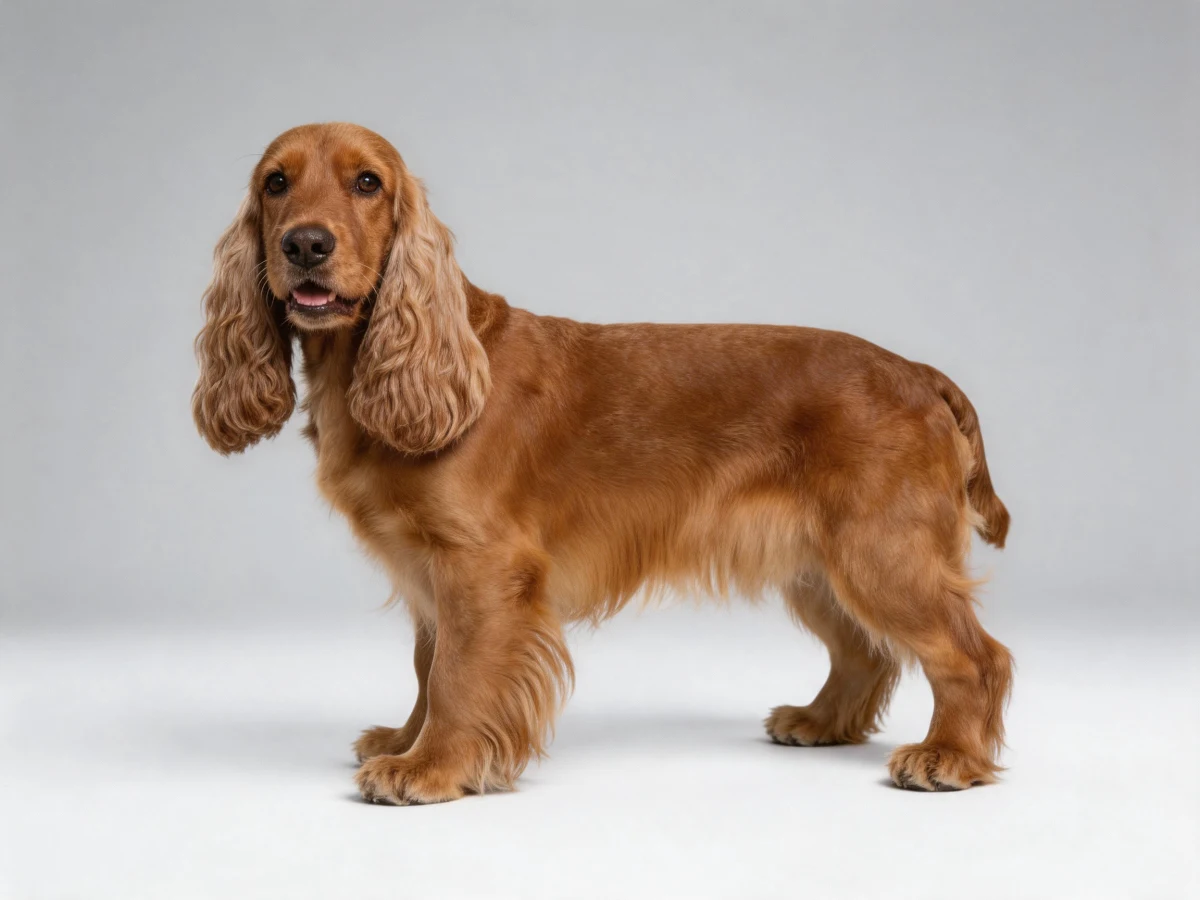
Brittany
✨ Key Takeaways
- The Brittany is a Breton pointing dog, not a flushing spaniel: the breed traces to the smallholdings of the Brittany peninsula, with the first written standard drafted in Nantes in 1907 by Arthur Enaud and adopted at Loudéac the following year.
- In 1982 the American Kennel Club dropped "Spaniel" from the breed name at the request of the American Brittany Club, which had argued since its founding in May 1942 that a dog that points rather than flushes should not carry the spaniel label — France had long since stopped using the equivalent in everyday speech.
- It is the smallest of the FCI pointing breeds (Standard N° 95) and was bred for the Breton small farmer rather than the great-estate sportsman, which is why it is shorter-legged, lighter-built, and far more biddable in a small home than its English pointing relatives.
- The breed has two well-documented inherited diseases with peer-reviewed literature behind them: canine multifocal retinopathy 1 (CMR1), a BEST1 stop-codon mutation described by Guziewicz et al. in 2007, and complement component 3 (C3) deficiency, characterised in Brittanys by Blum et al. in 1985. Both have direct DNA tests today.
- The natural bobtail is a defining feature, not a cosmetic preference: a proportion of Brittany puppies are born with a tail of one to ten centimetres or none at all, a heritable trait the breed selected for over a century before tail-docking bans made it commercially convenient.
- The deepest naming heritage is Breton, not generic French: the dog's home culture has its own Celtic language, its own saints, and its own place-names, and a Brittany wearing a Breton name (Yann, Soizic, Brocéliande) is wearing its actual regional identity rather than a marketing one.
Quick Facts
Common Names & Variants
Modern aliases
Historical names
Modern variants & lines
⚖️ Pros & Cons
Advantages
Trade-offs
Physical Appearance
Recognized colors
Coat
Other
Ears: Drop. Tail: Natural-bobtail.
🕰 History
The smallholder's pointing dog, not the duke's
Most pointing breeds come out of a great-estate culture — the German aristocracy in the Weimaraner, the Hungarian magnates in the Vizsla, the English landed class in the pointer. The Brittany did not. The breed grew up on the smallholdings of the Breton peninsula, the part of north-western France where Celtic-speaking farmers worked thin acid soil in small fenced fields, and where a hunting dog had to be compact enough to live in a stone cottage and versatile enough to point woodcock in a hedgerow on Tuesday and retrieve a poached hare on Thursday. That social fact shaped the dog. The Brittany is the smallest of the Fédération Cynologique Internationale's pointing breeds — Standard N° 95, Group 7, Section 1.2 — and it is the only one designed around the working life of a peasant, not a gentleman.
The documentary record of the early breed is thinner than the dukes' breeds because the Breton farmers who kept these dogs were not writing kennel-club minutes. The earliest substantive French reference is generally credited to the Comte Le Couteulx de Canteleu, the 19th-century French gundog authority who compiled lists of regional French breeds and mentioned an épagneul breton as a distinct local pointing-and-retrieving spaniel of the Brittany region. Beyond that, breed historians acknowledge that mid-19th-century English sportsmen who came to Brittany for the woodcock shooting may have left some pointing or setter blood behind, and the famous "naturally short-tailed" trait is sometimes attributed to that crossing. The English-setter outcross is widely repeated and probably not invented, but it is breed-club lore rather than a pedigree fact.
The Loudéac assembly and the 1907 standard
The breed became a kennel-club animal in a single recorded year. On 7 June 1907 a draft standard, drawn up in Nantes by Arthur Enaud — a Breton sportsman, horseman, and serial breeder of working animals — was presented at the first General Assembly of the Club de l'Épagneul Breton in the small town of Loudéac, in central Brittany. The Loudéac standard, adopted that day, fixed the type as a small, compact, square-built pointing spaniel with a naturally short or docked tail and either an orange-and-white or liver-and-white coat. The first dog registered against the new standard was an orange-and-white male recorded simply as "Boy." From that single founding meeting the modern breed dates: every subsequent FCI revision of Standard 95 traces back to Enaud's Nantes draft and the Loudéac vote.
America, and the slow argument about the name
The Brittany reached the United States in the 1920s and 1930s with returning sportsmen, and the American Kennel Club admitted the breed in 1934 — the same year, as it happens, that it recognised the Bullmastiff. American breeders organised the American Brittany Club in May 1942, and from the start the club refused to put the word Spaniel into its own name. Their argument was specific and stubborn. A spaniel, in the working English sense, is a flushing dog: it works close, drives the bird out of cover, and lets the gun take it on the wing. The Brittany does not flush. The Brittany points — locks on, holds, and waits for the handler. To call it a spaniel, the ABC argued, was to mislabel the dog's job. The AKC refused at first; the breed was registered as the "Brittany Spaniel" for forty-eight years. The argument was finally won in 1982, when the AKC officially dropped the spaniel suffix and registered the breed as, simply, the Brittany. The French parent club had been using épagneul breton all along, but in everyday French and in field-sport publications "spaniel" had long since faded from the breed's daily name.
Two countries, two slightly different dogs
The modern breed exists in two recognised variants. The American Brittany, bred under the AKC standard, is the taller, lighter-boned, longer-legged form — selected for the bigger American shooting cover and for showring style as well as field. The French Brittany, bred under FCI Standard 95, is the smaller, denser, closer-coupled original — the dog the Loudéac assembly described in 1907. Both are the same breed; both win field trials; and the choice between them is mostly about what kind of country you intend to hunt. The Club de l'Épagneul Breton in France remains the global parent club and the keeper of the original type; the American Brittany Club holds the AKC parent-club role and runs one of the densest dual-champion programmes in the sporting group.
Why the breed survived the 20th century cleanly
Unlike the eastern European pointing breeds — the Vizsla, the Pudelpointer, the German Wachtelhund — the Brittany did not nearly die in either World War. The peninsula was occupied during the Second World War, and breeding was disrupted, but the breed never collapsed to a handful of survivors. By the 1950s French and American populations were both healthy, the FCI had granted formal recognition in 1954, The Kennel Club in Britain followed in 1976, and the breed has been steadily one of the AKC's top sporting dogs ever since — currently ranked around 31st overall and consistently inside the top five for field-trial wins. The Brittany did not have to be rebuilt from a dozen dogs in a Hungarian cellar. It just kept doing the job.
Temperament & Personality
"Happy, alert and friendly" — and the asterisk
The American Brittany Club summarises the breed's temperament in four words: "happy, alert and friendly." FCI Standard 95 adds "particularly affectionate" and "very obedient on condition that his education has begun early." Those descriptions are accurate and slightly misleading at the same time. Yes, the dog is happy. Yes, it is friendly to a fault. But the same standard insists on early socialisation and consistent training for a reason: a Brittany that has not had its energy and its sensitivity channelled correctly is not a relaxed family dog. It is a frantic, anxious, vocal, sometimes shut-down dog. The breed gives back exactly what is put in, with very little buffering.
Soft, in the gundog-handler sense of the word
British and French field-trial handlers describe the Brittany as a "soft" breed, and the word means something specific. A soft dog cannot absorb harsh corrections. It does not toughen up under pressure; it shuts down. The Brittany trains beautifully on clear, upbeat, reward-based methods and falls apart on the opposite — and that includes both heavy-handed obedience work and the household equivalent, which is inconsistent rules and raised voices. The breed responds to a calm, patient handler and to predictable structure. Stress accumulates in this dog quickly, and the visible signs are subtle until they are not: a slight crouch, a flicker of avoidance, a refusal to engage. Read those early and back off, and the Brittany is one of the most rewarding training projects in the sporting group.
The energy is real, and the form it takes
The American Brittany Club is blunt: this is a high-energy bird dog that needs serious daily aerobic work. A walk around the block is not exercise. The breed runs, casts wide, hunts with its nose up, and given a job will go all day; given a sofa it becomes destructive, vocal, and obsessive about leaving the house. The energy is also social — the Brittany follows its person around the home, leans, asks for contact, and bonds intensely with one or two handlers. Left alone for a working day in a household that did not work it that morning, a Brittany will find a project, and the project will be expensive.
Day to day, honestly
An adult Brittany in a matched home is affectionate, biddable, light on its feet, comically expressive, and very involved in the family's daily life. It tracks who is upstairs and who is in the kitchen. It is good with children if raised with them, friendly to other dogs, generally not dog-aggressive, and not a guard dog in any useful sense — the breed will bark at a stranger and then offer them a paw. The clear failure modes are absentee households (separation distress), under-exercise (frantic destructive behaviour), and heavy-handed training (shutdown and avoidance). For a household that can give the breed real daily work and consistent, kind training, the Brittany is one of the most easily-lived-with sporting breeds in the world. For a household that cannot, it is one of the easiest to get wrong.
🏡 Living With a Brittany
An athlete that needs a job, not a couch
The single most important fact about living with a Brittany is energy. This is a compact French pointing gun dog bred to quarter big country at a gallop all day and still have gas in the tank at dusk, and that engine does not idle just because it has moved into a family home. A Brittany needs serious daily exercise — think a hard hour or more of running, hiking, fetch, or fieldwork, not a polite stroll around the block — plus something to occupy its busy mind. Give it that and you get a happy, biddable, surprisingly tidy housemate. Withhold it and the same dog turns hyper, mouthy, and destructive, inventing its own jobs out of your shoes, your sofa, and your fence line. A Brittany that gets a real outlet for its bird drive settles beautifully indoors; a bored one is a genuine handful.
Kids, other pets, and the apartment question
Brittanys are affectionate, people-oriented dogs that bond hard to their family and generally do well with children and with other dogs, particularly when raised with them. They are sociable rather than aloof, which makes them poor guard dogs and good companions. The breed is not, however, a realistic apartment dog for most owners: it is built for space and stamina, and a small home with no easy access to off-lead running tends to magnify every demand it makes. A Brittany suits an active household with a yard, a rural or suburban setting, or an owner committed to dog sports or hunting. Sensitive by nature, it does not cope well with being left alone for long working days and can develop separation distress if isolated.
Climate, coat, and shedding reality
The Brittany carries a moderate, flat-or-wavy coat of medium length with some feathering, which is far less coat than a setter and makes the breed reasonably weather-hardy for fieldwork in cool and temperate conditions. It is comfortable working in the cold and copes with heat better than the heavy-coated breeds, though like any hard-running dog it still needs shade and water and should not be pushed in midday summer heat. Shedding is moderate and seasonal rather than dramatic — expect some hair around the house and a heavier drop in spring and autumn, but nothing like the year-round volume of a double-coated retriever. For an active owner, the coat is one of the easier parts of Brittany ownership.
🎓 Training & Exercise
Soft, eager, and quick — handle the sensitivity
The Brittany is a biddable, eager-to-please dog that wants to work with its handler, and that makes it genuinely quick to train in the right hands. The catch is temperament: this is a soft, sensitive breed, and a fair number of Brittanys are a touch timid or shy. Harsh handling, heavy corrections, shouting, or an angry tone do not produce a more obedient Brittany — they produce a shut-down, hand-shy, anxious one that learns slower and trusts less. Positive, reward-based training is not a stylistic preference for this breed; it is the method that actually works. Keep sessions upbeat and short, build confidence deliberately, and you will find a Brittany absorbs new skills fast and stays keen to do more.
Socialise early to head off the shyness
Because the breed leans sensitive and some lines run shy, early and generous socialisation is the highest-value thing an owner can do in the first year. A Brittany puppy that meets a wide range of people, dogs, surfaces, sounds, and situations in a calm, positive way grows into a confident adult; one kept sheltered can become startled, spooky, or reactive in new settings. Pair socialisation with a puppy class that uses reward-based methods, and keep introducing novelty well into adolescence. This investment pays off directly in the field and at home, because a confident Brittany is a steady, trainable one.
Channel the bird drive into the work
A Brittany is a pointing dog to its core — it locates birds and freezes on point rather than flushing them — and that instinct needs an outlet or it will leak out as obsessive scenting, chasing, and general restlessness. The most satisfied Brittanys have a real job: hunting, field trials, hunt tests, agility, flyball, scent work, or structured retrieve-and-fetch games. Teach a rock-solid recall early and reinforce it for life, because a Brittany hot on a scent can range fast and far and will tune you out if recall was never properly built. The breed's quickness and softness reward an owner who trains little and often with rewards, and who gives that busy brain a defined task rather than leaving it to improvise.
✂️ Grooming & Coat Care
An easy-care feathered coat
One of the practical pleasures of the breed is that its coat is genuinely low-maintenance by gun-dog standards. The Brittany wears a flat or wavy coat of medium length, never curly and never silky, with light feathering on the ears, the back of the legs, and the underline. There is far less of it than a setter or spaniel carries, so a thorough brush once or twice a week keeps it clean, removes loose hair, and lets you check the skin underneath. Baths are needed only every couple of months or after a muddy day in the field; over-bathing strips the coat's natural oils and is unnecessary for a coat this practical.
Feathering, ears, and field hazards
The feathering is where the modest grooming attention concentrates. Light feathering on the ears, legs, and underside can pick up burrs, grass seeds, mud, and the occasional small mat, so after country walks and fieldwork it is worth running your hands and a comb through those areas. The breed's drop ears trap warmth and moisture and are a sensible thing to check and wipe weekly — and to dry carefully after swimming or a wet day's work — because pendant-eared sporting dogs are prone to ear problems. Trim stray feathering tidily if it collects debris, but the coat needs no elaborate clipping or stripping.
Nails, teeth, and the working body check
Nails grow quickly on an active dog and need trimming every two to three weeks; nails you can hear clicking on the floor are already long enough to change how the dog moves and stands. Brush the teeth two or three times a week from puppyhood — the highest-leverage long-term habit any dog owner can keep, and easy to build into the routine of a dog that enjoys handling. Because the Brittany is a hard-running field dog, get into the habit of a quick once-over after exercise: check the pads and between the toes for grass seeds, thorns, and cuts, the ears for debris, and the feathering and underline for ticks and burrs picked up in cover. On a breed that spends its happiest hours pushing through brush and long grass, this hands-on field check matters more than any cosmetic grooming — it catches the small problems while they are still small, and it doubles as the daily contact that keeps a sensitive dog comfortable being touched all over.
🍖 Diet & Nutrition
Fuel the engine without overfilling the tank
The Brittany's headline diet issue is the opposite of the couch breeds: this is a lean, high-output athlete, and feeding has to track its real workload. A Brittany in heavy field season or sport training burns serious calories and needs a quality, energy-dense food to hold condition; the same dog in the off-season, or one that for any reason is exercising less, will gain weight on the in-season ration. Feed measured meals matched to the dog's current activity and ideal body condition rather than by a fixed scoop year-round, and learn to body-condition-score by feeling for the ribs and a clear waist. A working Brittany should look athletic and trim, never soft.
Puppy growth and routine
Brittany puppies grow into a medium-sized adult — broadly 30–44 lb depending on sex and frame — so they should be raised on a balanced food appropriate for that size and kept lean and steadily growing rather than chunky. Most Brittanys do well on twice-daily meals into adulthood, with portion size set against ideal adult weight and activity and adjusted by body condition over time. Build feeding around the exercise schedule rather than against it, and make any change of food gradually over about a week to avoid digestive upset in a dog that is otherwise eager to eat and go.
Hydration and timing around work
A hard-working dog needs steady access to clean water, and a Brittany run hard in warm weather should be cooled and watered sensibly rather than gorged immediately after exertion. As with any active dog, it is wise to separate vigorous exercise from large meals by an hour or so on either side, feeding the bulk of the ration after the dog has rested and settled rather than right before a run. During heavy field or sport days, many owners split the food into smaller portions and offer water frequently in small amounts rather than letting an overheated dog tank up all at once. None of this is exotic — it is simply matching an honest, hungry working dog's food to the rhythm of its day, and adjusting the daily total up in season and back down again when the workload eases so the dog holds an athletic, trim condition all year.
🐶 Buying & Adopting a Brittany
Start at the parent club
The American Brittany Club (ABC) is the AKC parent club and the right starting point for a well-bred puppy. A breeder worth buying from will be an ABC member in good standing, will register litters with the AKC, will health-test both parents, will offer a written contract and health guarantee, and will be openly willing to discuss the breed's known issues rather than insisting their lines are simply problem-free. Because the Brittany is fundamentally a working gun dog, good breeders typically prove their dogs in the field, in hunt tests, or in field trials, and they will want to know that a pet buyer understands the breed's exercise needs before they place a puppy.
The health screening to ask a breeder for
The Brittany is generally a healthy, long-lived breed for its size, but responsible breeders still screen, and you should ask to see results on both parents. The recommended screening for the breed covers hip evaluation (OFA hip X-rays), an eye examination by a boarded veterinary ophthalmologist (OFA/ACVO), a cardiac evaluation (OFA), and two breed-relevant DNA tests: Canine Multifocal Retinopathy 1 (CMR1) and Complement Component 3 (C3) deficiency. The CHIC profile for the breed centres on hips, eyes, the CMR1 DNA test, and a cardiac evaluation. Asking for this paperwork is a consumer-fact question, not medical advice — a breeder who can produce current OFA results and DNA-test certificates on the parents is doing their job; "our dogs are healthy, no need for testing" is the answer to walk away from.
Rescue and the off-the-shelf adult
Brittany rescue is active in the United States, run through the ABC's rescue network and regional breed-rescue groups, and it is a genuinely good route for the right home. A fair number of Brittanys end up in rescue precisely because a household underestimated the energy and the need for a job, so an adopter who can offer real exercise and structure is exactly what these dogs need. The advantage of an adult is that its temperament and energy level are already an open book, which suits an owner who wants a known quantity rather than the gamble of a puppy.
Price, waiting lists, and red flags
A well-bred Brittany puppy in the United States ran roughly USD 800–2,500 in 2024, depending on region, lineage, and whether the parents carry field or show titles, and the better breeders keep waiting lists. The patterns to avoid are the usual ones: puppies advertised well below that range with immediate availability, no health-testing documentation, and no parent-club connection. Be wary of anyone marketing "rare" colours or "miniature" Brittanys at a premium, and of sellers who cannot or will not show the parents' OFA and DNA results. A fair price from a health-testing, field-proving, parent-club breeder — even after a wait — is far cheaper than the lifetime cost of a poorly bred, poorly socialised dog of a breed this sensitive and this driven.
📜 Breed Name Etymology — iDogNames original research
"Brittany" is a place, not a job
Unlike "pointer" or "setter," which describe what the dog does, Brittany is a regional name. It refers to the Brittany peninsula of north-western France — Bretagne in French, Breizh in the local Celtic language — and it identifies the breed by the country that made it rather than by its work. The full French name, épagneul breton, says the same thing more precisely: épagneul is the French generic for spaniel-type dogs, and breton means "of Brittany," exactly the way bourguignon means "of Burgundy" or normand means "of Normandy." The dog is, in plain translation, the Breton spaniel.
The deeper etymology of épagneul itself is the same as the English spaniel: both come, through Old French, from medieval Latin hispaniolus, "Spanish, of Spain" — a reference to the peninsula where spaniel-type dogs were believed to originate. That medieval Iberian connection is shared with every European spaniel breed and is not specific to the Brittany, but it explains why a dog from a Celtic French peninsula carries a name whose deepest layer is Latin.
Why the AKC dropped "Spaniel" in 1982
The breed's most documented act of self-renaming was the American Kennel Club's 1982 decision to drop "Spaniel" from the breed name. The argument behind it had been the American Brittany Club's official position since the club's founding in May 1942. A spaniel, in working English usage, is a flushing dog — it works close, pushes the game out of cover, and is steady to the flush. The Brittany does not work that way. The Brittany points, locks on, holds, and waits for the gun. To call it a spaniel by name is to file it under the wrong job. The ABC asked the AKC to change the name in 1944; the request was refused. The argument was repeated, in slightly varied form, by every ABC committee for the next four decades. In 1982 the AKC finally agreed, and the breed has been registered simply as the Brittany ever since. France had never quite had the problem in the same form — the everyday French phrase had always been épagneul breton, in which breton already did the heavy lifting — but in English the renaming was real and the breed-club argument is documented in the ABC's published history.
The original Loudéac name, and why it survived
The very first formal club name registered at Loudéac in 1907 was the Club de l'Épagneul Breton à Queue Courte Naturelle — "the club of the Brittany Spaniel with the Naturally Short Tail." The mouthful matters historically because the natural bobtail was a defining heritable trait of the original Breton dogs, and the founders wanted the kennel-club name to lock in that selection. Within a few years the club shortened its name to the modern Club de l'Épagneul Breton, but the original phrase preserved a piece of breed identity that countries with tail-docking bans have since rediscovered: a meaningful proportion of Brittany puppies are still born tailless or with tails of one to ten centimetres, exactly as the 1907 founders selected for.
Pronunciation, and the aliases that signal trouble
In English the breed name is /ˈbrɪtəni/ — "BRIT-uh-nee," same as the woman's given name; in French épagneul breton is roughly [epaɲœl bʁətɔ̃]. The aliases worth flagging are mostly historical and mostly harmless: Brittany Spaniel is the pre-1982 AKC name and still in everyday use among older American sportsmen; French Brittany distinguishes the smaller European type from the American Brittany; épagneul breton is the parent-club name in France and used worldwide in field-trial contexts. The aliases to watch are commercial: any breeder advertising a "miniature Brittany," a "teacup Brittany," or a "rare blue Brittany" is selling something the FCI standard does not recognise — the Brittany is already small, and its colours are orange, liver, black (FCI only), and tricolour, with the various roan patterns built into the standard.
Name forms at a glance
| Name | Role | Origin | Literal meaning | First recorded |
|---|---|---|---|---|
| Brittany | primary | English (place-name) | the dog of Brittany | 1934 |
| Épagneul Breton | origin country native | French | Breton spaniel | 1907 |
| Brittany Spaniel | historical | English (descriptive) | spaniel of Brittany | 1934 |
| French Brittany | alias | English (modern descriptive) | the Brittany of the French (FCI) standard | — |
| Breton | alias | French / Breton (Brezhoneg) | the Breton (dog) | — |
🏛 Naming Traditions — iDogNames original research
A Breton naming culture, not a generic French one
The Brittany's naming heritage is Breton, and the distinction from generic French matters. Brittany is one of the six historic Celtic nations; it has its own language (Brezhoneg), its own saints, its own folklore, and its own place-names that look and sound nothing like Parisian French. A Brittany called Pierre or Marie is wearing a generic French name. A Brittany called Yann, Soizic, or Brocéliande is wearing the actual culture that bred the dog. There are four coherent, lineage-backed layers a Brittany owner can draw from: Breton given names, Breton landscape and place-names, the breed's own working and colour register, and the wider French royal-hunt tradition the breed eventually entered.
The Breton given-name layer
Breton personal names are the truest fit, because the breed was the dog of Breton families for centuries and the names are distinctive enough that almost no other breed wears them. Strong male choices include Yann (the Breton form of John, the most common male name in Brittany), Erwan (Breton form of the patron saint of Brittany, Saint Yves), Loïc (Breton-French diminutive of Louis), Gwenaël ("white-blessed," a Breton saint), Tanguy (an old Breton name meaning "warrior of fire"), Hervé (a sixth-century Breton saint), Goulven (another Breton saint), and Maël ("prince" or "chief" in Breton). For females the language gives Soizic (Breton form of Françoise), Anaïs (Provençal-Breton form of Anne, popular across modern France), Iseult (the Breton-Arthurian heroine of Tristan and Iseult), Morgane (a Breton-Arthurian name from mor = sea), Gaëlle (the feminine of Gwenaël), Nolwenn (a Breton saint of Plouhinec), Enora (a Breton martyr's name, popular in modern Brittany), and Maïwenn (a compound of Mari + gwenn, "white Mary"). Each is unambiguously Breton, in a way Parisian French names are not.
The land — Argoat, Armor, and the coastline
The second layer reaches for the Breton landscape itself. Brittany divides itself culturally into two halves: Armor, "the country of the sea," meaning the coast and its fishing ports, and Argoat, "the country of the woods," meaning the inland forest. Both make first-rate dog names. The famous towns give grounded, place-true choices: Brest (the great Atlantic naval port), Quimper (the Breton-language capital), Vannes (the medieval ducal seat), Lorient (a younger port town), Saint-Malo (the corsair-walled city), Carnac (the standing-stone alignments older than Stonehenge), Roscoff, Concarneau, and Auray. The geographic departments give heavier names: Finistère (literally "land's end," the western tip of Brittany), Morbihan ("little sea"), Côtes-d'Armor ("coasts of the sea"), and Ille-et-Vilaine. For a forest-bred pointing dog, Brocéliande — the legendary Breton forest of Arthurian myth, identified with the modern Forêt de Paimpont — is the single most evocative landscape choice.
The royal hunt and the French aristocratic register
Although the Brittany itself grew up among smallholders, the breed's spaniel ancestors were the dogs of the French royal hunt for centuries, and the literary and aristocratic French naming tradition is part of the breed's adjacent heritage. King Henri IV (Henry the Fourth, 1553–1610), the Bourbon king who is generally credited with elevating French pointing-and-retrieving spaniels into formal hunting kennels, gives the most famous male anchor — though the modern Brittany did not exist in his time, his royal hunt is part of the breed's family tree. From the same register: Diane (the Roman goddess of the hunt, the standard French hunting kennel-name across centuries), Vénerie (the French art of the hunt), Dauphin (the heir to the French throne, traditionally a hunting man), Capet (the founding French royal dynasty), Valois (the second royal house), and the great hunting-château names — Chambord, Chenonceau, Fontainebleau. These suit a Brittany given a slightly more formal French (rather than Breton) identity.
The working register — orange and white in Breton
The fourth layer is occupational and descriptive, and it speaks both Breton and French. Because the breed's signature coat colours are orange-and-white and liver-and-white, colour names sit squarely in the heritage: Roux (French for russet), Brun (brown), Foie (liver), Orange itself, and in Breton Gell (brown) and Gwenn (white). The working register gives Chasseur ("hunter"), Bécasse ("woodcock," the breed's signature quarry in Brittany), Perdrix ("partridge"), Lièvre ("hare"), and the field-call commands Allons ("let's go") and Arrêt ("the point"). Each is a real word doing the same job the German pointing breeds do with their German nouns: naming the dog in the language of the people who made it.
What this means for naming a Brittany today
The breed offers something most pointing dogs do not: a coherent, single-region naming heritage that is genuinely distinct from generic French. A Breton given name (Yann, Soizic, Tanguy) is the deepest and most personal choice; the language is dying in everyday Brittany and the breed is one of the cultural carriers keeping its names alive. A Breton landscape name (Brocéliande, Finistère, Carnac) ties the dog to the country that made it. A working-register name (Bécasse, Chasseur, Roux) honours the bird-dog identity in the dog's own field language. The names with no Brittany resonance are the German ones borrowed from its eastern-European pointing cousins — calling a Brittany after a Vizsla or Weimaraner naming convention misses, by a whole country and a whole language, the heritage that makes this breed itself.
🐾 Themed Names for Your Brittany — iDogNames original research
Breton given names — male
Breton-language male names with deep regional and saintly roots. Distinctive, period-true, and almost never used on other breeds.
- Yann — Breton form of John; the single most common Breton male name, simple to call
- Erwan — Breton form of Saint Yves, the patron saint of Brittany and of lawyers
- Loïc — Breton-French diminutive of Louis; soft two syllables
- Gwenaël — "white-blessed"; a sixth-century Breton saint and abbot of Landévennec
- Tanguy — an old Breton name meaning "warrior of fire"; punchy and rare
- Hervé — a blind sixth-century Breton saint and bard; one of Brittany's most beloved names
- Goulven — Breton saint and the name of a coastal village in Finistère
- Maël — Breton for "prince" or "chief"; clean single syllable
- Brieuc — Breton saint and the founder of Saint-Brieuc city
- Ronan — a Breton-Irish saint who gave his name to Locronan in Finistère
Breton given names — female
Breton-language female names with literary and dynastic roots, including the names that survived from Arthurian Brittany.
- Soizic — Breton form of Françoise; warm and traditional
- Iseult — the heroine of Tristan and Iseult, the great Breton-Arthurian romance
- Morgane — from Breton mor ("sea"); the Arthurian enchantress, popular in modern Brittany
- Anaïs — Provençal-Breton form of Anne; one of the top Breton female names of the modern era
- Gaëlle — feminine of Gwenaël; clear two syllables
- Nolwenn — a saint of Plouhinec in Morbihan; melodic and unusual
- Enora — a Breton martyr; widely used in contemporary Brittany
- Maïwenn — a compound of Mari + gwenn, "white Mary"
- Azilis — Breton form of Cécile; deeply regional, almost never heard elsewhere
- Tifenn — Breton form of Théophanie; uncommon and distinctly Breton
Breton landscape — Argoat, Armor, and the coast
Place-true names from the Breton peninsula's forests, ports, and standing-stone country.
- Brocéliande — the legendary Breton forest of Arthurian myth; identified with the modern Forêt de Paimpont
- Finistère — "land's end," the western tip of Brittany; heavy, dignified
- Carnac — the Neolithic alignments older than Stonehenge; one short, dignified word
- Brest — the great Atlantic naval port; short and crisp
- Quimper — the Breton-language capital in Finistère
- Vannes — the medieval ducal seat in Morbihan
- Lorient — a younger port; flows beautifully
- Saint-Malo — the corsair-walled city; the breed's seafaring heritage in one name
- Morbihan — "little sea"; a Breton place-name that suits a water-tolerant dog
- Armor — the Breton word for "country of the sea"; uncommon and authentic
The Breton coat — colour and field
Breton and French words for the breed's orange-and-white or liver-and-white coat and its bird-dog working identity.
- Roux — French for russet; the breed's signature orange-and-white
- Foie — French "liver"; for the chestnut-coated dogs
- Gwenn — Breton for "white"; the breed's other half
- Gell — Breton for "brown"; pure regional vocabulary
- Bécasse — French for "woodcock"; the breed's signature quarry in Brittany
- Perdrix — French for "partridge"; soft and field-true
- Chasseur — French for "hunter"; the plain occupational name
- Arrêt — French for "the point"; the moment the dog locks on
- Allons — French for "let's go"; a working recall
- Lièvre — French for "hare"; the breed's secondary quarry on Breton smallholdings
French royal hunt and aristocracy
Names from the broader French hunting tradition the spaniel-type dogs entered before the Breton smallholders refined them.
- Henri — for Henri IV of France, the Bourbon king who formalised French hunting kennels in the late 16th century
- Diane — the Roman goddess of the hunt; the standard French hunting-kennel name for centuries
- Dauphin — the heir to the French throne, traditionally a hunting man
- Chambord — the great Loire hunting château commissioned by François I in 1519
- Chenonceau — the Loire château famously held by hunting queens
- Fontainebleau — the royal forest and palace south of Paris
- Vénerie — the French art of hunting with hounds
- Capet — the founding French royal dynasty
- Valois — the second French royal house; weighty and historic
- Bourbon — the third French royal house, the one that brought spaniel-style pointing dogs into fashion
📋 Breed Standard at a Glance
General appearance
The AKC standard describes the Brittany as a compact, closely knit dog of medium size, leggy without being rangy, and built for agility and stamina rather than bulk — the lightest and leggiest of the pointing breeds. Function is written through the standard: this is a working gun dog meant to cover ground efficiently, so a heavy, cumbersome, or low-set dog is faulted. Many Brittanys are born with a natural bobtail, and the tail is otherwise short or docked. The dog was long called the "Brittany Spaniel," but the AKC dropped "Spaniel" in 1982 because the breed points and works like a setter rather than flushing like a spaniel.
Size, coat, and colour
Both sexes stand roughly 18.5–20.5 inches at the withers (the standard sets 17.5–20.5 inches, measured to the ground), with males typically 18.5–20.5 inches and females 18.5–19.5 inches, and adults weigh about 30–44 lb. The coat is dense, flat or wavy, and of medium length, never curly and never silky, with light feathering on the ears and legs; the standard penalises an overly heavy or profuse coat that would burden a field dog. Recognised colours include orange and white and liver and white, in clear or roan patterns, with tricolour also permitted.
Movement, head, and temperament
Movement is the heart of the breed: an efficient, ground-covering gait with good reach and drive, smooth and tireless, reflecting a dog meant to hunt all day. The head is of medium length with a gently sloping stop, expressive eyes well protected by the brow, and high-set, fairly short triangular ears. Temperament is part of the picture — the Brittany should be a happy, alert, eager worker, neither mean nor overly timid, though the standard acknowledges the breed's characteristic sensitivity. Lifespan typically runs 12–14 years.
🏆 Recognition
Recognized by the American Kennel Club in 1934 as a Sporting breed. FCI standard No. 95 (Section 1.2 — Continental Pointing Dogs, Spaniel type (with working trial)), recognized in 1954.
Other registries
Breed clubs
❓ Frequently Asked Questions
Are Brittanys good family dogs?
Yes, for an active family. The Brittany is affectionate, people-oriented, and generally good with children and other dogs, especially when raised with them. The condition is exercise: this is a high-energy hunting breed that needs a serious daily outlet and dislikes being left alone for long stretches, so it suits a busy, outdoorsy household far better than a sedentary one.
Do Brittanys shed a lot?
Only moderately. The flat-or-wavy medium coat sheds some hair year-round and a bit more heavily in spring and autumn, but nothing like a double-coated retriever. A brush once or twice a week keeps it under control. By gun-dog standards the Brittany is an easy-coat breed.
How much exercise does a Brittany need?
A lot. As a pointing gun dog bred to range and hunt all day, a healthy adult needs at least an hour or more of hard activity daily — running, hiking, fetch, or fieldwork — plus mental work. A Brittany that gets only short walks tends to become hyper and destructive. Dog sports, scent work, or hunting are ideal outlets.
How long do Brittanys live?
Typically 12 to 14 years. The Brittany is generally a healthy, hardy, long-lived breed for its size, which is one of its appeals as a long-term active companion.
Are Brittanys easy to train?
Yes, with the right approach. Brittanys are biddable, quick, and eager to please, but they are soft and sensitive — sometimes a little timid — so harsh corrections backfire and slow them down. Upbeat, reward-based training plus early, generous socialisation produces a confident, capable dog.
Are Brittanys hypoallergenic?
No. The Brittany sheds and is not considered a hypoallergenic breed. Anyone with a dog allergy should spend extended time around the breed before committing.
How much does a Brittany puppy cost?
A well-bred, health-tested puppy from a parent-club breeder ran roughly USD 800 to 2,500 in 2024, depending on region, lineage, and parent titles, often with a waiting list. Be wary of puppies priced well below that with no health-testing paperwork, and of premiums charged for "rare" colours or "miniature" Brittanys.
📚 Sources & Further Reading
Every load-bearing factual claim on this page is anchored to one of the sources below. iDogNames does not synthesize from secondary aggregators.
- akc breed page Brittany — AKC Breed Profile — American Kennel Club (2024)
- fci standard pdf FCI Standard No. 95 — Epagneul Breton (Brittany) — Fédération Cynologique Internationale (2003)
- kc uk standard pdf Brittany — Breed Information — The Kennel Club (UK)
- breed club official The American Brittany Club — parent club, breed history & dual-champion register — The American Brittany Club
- breed club official Club de l'Épagneul Breton (France) — history of the breed and FCI standard — Club de l'Épagneul Breton
- academic paper Bestrophin Gene Mutations Cause Canine Multifocal Retinopathy: A Novel Animal Model for Best Disease — Guziewicz KE et al., IOVS 48: 1959–1967 (2007)
- academic paper The clinical manifestations of a genetically determined deficiency of the third component of complement in the dog — Blum JR et al., Clin Immunol Immunopathol (1985)
- academic paper Molecular Analysis of the Third Component of Canine Complement (C3) and Identification of the Mutation Responsible for Hereditary Canine C3 Deficiency — Ameratunga R et al., J Immunol 160(6):2824 (1998)
- wikipedia Brittany (dog) — Wikipedia — Wikipedia
- book The New Complete Brittany — Maxwell Riddle (Howell Book House) (1984)