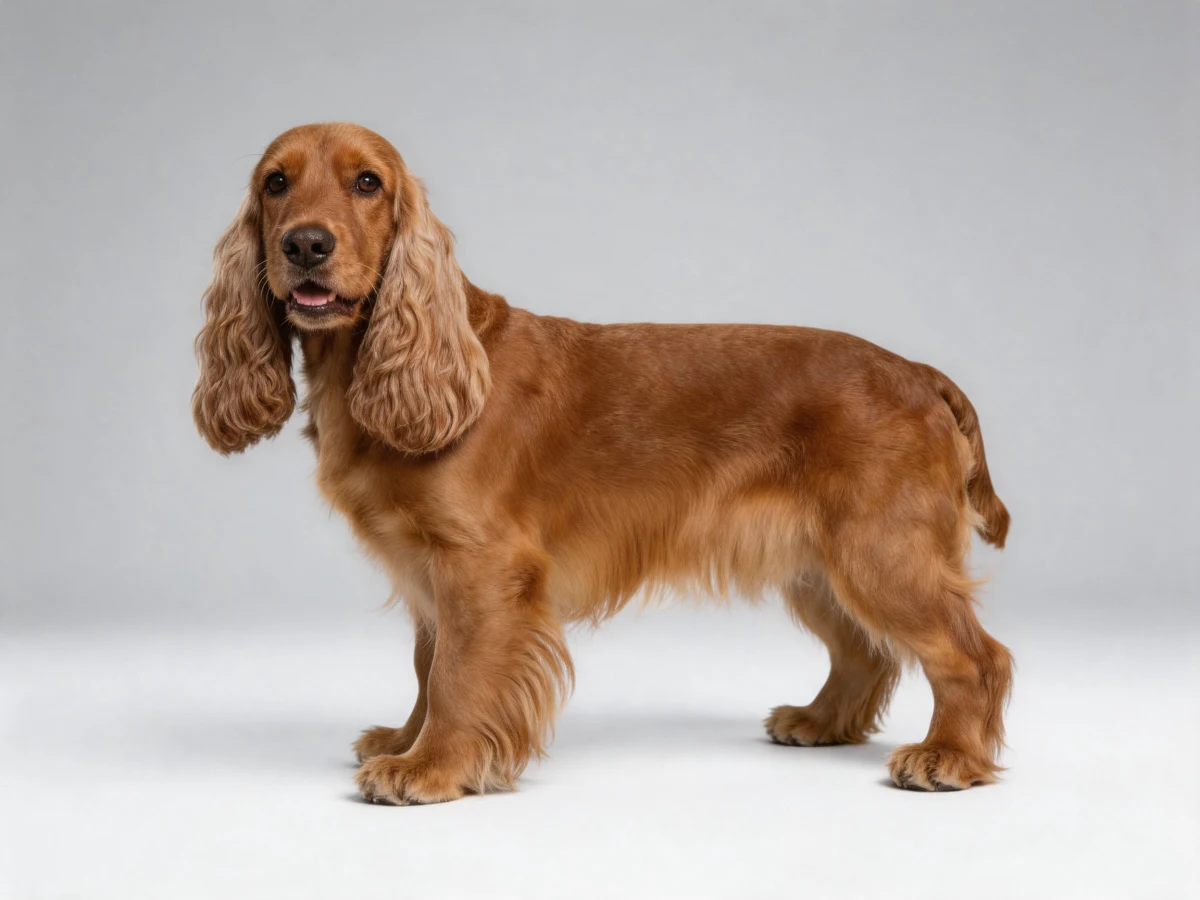
Russian Spaniel
✨ Key Takeaways
- A planned post-war Soviet gundog, fixed from English Cocker and Springer Spaniels with the first standard set in 1951.
- Longer in body and longer in leg than a show English Cocker, with a tighter, close-lying coat -- a distinct breed, not a Cocker variant.
- Cheerful, affectionate, energetic and biddable; good with children and a popular family-and-field dog in its homeland.
- A keen flushing-and-retrieving spaniel that needs daily vigorous exercise and a scent-work or hunting outlet.
- Numerous in Russia and the former Soviet states but rare abroad; not recognised by the FCI or AKC, only by smaller registries.
- Watch the waistline and the ears: the breed gains weight easily and, as a drop-eared water dog, is prone to ear infections.
Quick Facts
Common Names & Variants
Modern aliases
Historical names
⚖️ Pros & Cons
Advantages
Trade-offs
Physical Appearance
Recognized colors
Coat
Other
Ears: Drop, long. Tail: Docked to about half length.
🕰 History
A post-war answer to a Russian hunting problem
The Russian Spaniel was built to solve a practical problem of the Soviet field: the imported English spaniels that Russian sportsmen had taken up since the late nineteenth century were too low-slung and too varied to suit the long marshes, dense uplands and big game-cover of the Russian hunt. The fix was deliberate and recent. Working from a mixed population of English Cocker and English Springer Spaniels — and other spaniel blood that had drifted into Russian kennels — Soviet cynologists set out after the Second World War to fix a single, more uniform flushing-and-retrieving gundog with a longer body and noticeably longer leg than a show Cocker, a tighter coat, and the stamina to quarter heavy ground all day. The first breed standard was approved in 1951, and that date, rather than any misty antiquity, is the true birth of the breed.
From a Grand Duke's Cocker to a working population
Spaniels reached Russia as the sporting fashion of the aristocracy. The dog usually cited as the country's first was a black Cocker owned by Grand Duke Nikolai Nikolaevich in the closing decades of the nineteenth century, and through the early twentieth century imported Cockers and Springers were kept and bred by Russian hunters, chiefly around Saint Petersburg and Moscow. These dogs worked, but they did not breed true to a single type, and their short legs were a real handicap in the rough, wet terrain and tall cover where Russians wanted to hunt marsh, field and upland birds and hares. Breeders began selecting for a longer-legged, longer-bodied spaniel well before there was a standard to name it, so the raw material for the breed accumulated for decades before it was formally shaped.
Standardised by committee, not by a single kennel
What distinguishes the Russian Spaniel from older spaniels is that it is a planned, twentieth-century breed rather than the slow product of one estate or family. The crossing programme that fixed it was carried out under Soviet cynological authority, with the goal stated plainly: a versatile native spaniel for the country's hunters. The 1951 standard drew a line under the experimental crossing and defined the type — a strong, slightly elongated, relatively long-legged gundog of medium size with a close coat and a docked tail. The standard was revised in 1966 and again in 2000 as the population settled and the Russian Kennel Federation took over its maintenance. Because the breed coalesced from a known recipe within living memory, its origins are unusually well documented for a hunting dog: there is a date, a purpose and a deliberate cross, not a legend.
Longer, taller-legged, and its own animal
It is easy to mistake the Russian Spaniel for a plain Cocker, and the comparison matters because the breed was created specifically to not be one. Where the English Cocker is compact and close to the ground, the Russian Spaniel is built on a frame slightly longer than it is tall — the standard fixes an elongation index of roughly 1.10 to 1.16 — and it stands on relatively long legs that lift it clear of wet grass and let it cover open marsh at a working pace. The coat is shorter and tighter than a show Cocker's flowing jacket, with feathering confined to the ears, chest, underline and the backs of the legs. These are not cosmetic differences: every one of them was selected to make a dog that could do in Russia what the parent breeds could not, and they are why the Russian Spaniel is treated as a distinct breed in its homeland rather than a regional Cocker variant.
A national gundog with limited recognition abroad
In Russia and across the former Soviet states the Russian Spaniel is a popular and thoroughly established working and companion dog, registered and maintained by the Russian Kennel Federation and run by hunters on birds and hares across a wide range of country. Its standing outside that region is another matter. The breed is not recognised by the Fédération Cynologique Internationale and not by the American Kennel Club; the recognition it holds abroad comes from smaller registries such as the Continental Kennel Club, and dedicated breed clubs in North America keep small populations. The honest position is that this is a numerous, valued and well-defined breed at home and a rare, club-level breed everywhere else — a national hunting spaniel that has only begun to travel.
Temperament & Personality
A cheerful gundog wired to please
The Russian Spaniel's temperament is the friendly, biddable spaniel character distilled and put to work. This is a cheerful, affectionate, energetic dog that bonds closely with its family and genuinely wants to cooperate — the breed was selected for a willing, easily handled field dog, and that good nature carries straight over into the home. It is people-oriented to the point of devotion, lively and playful, and far more interested in being part of the household than in any solitary pursuit of its own. Owners describe an even-tempered, optimistic dog that is rarely sharp or nervous, the kind of spaniel that meets the day with its tail going.
Good with children, sociable by default
Within the family the Russian Spaniel is typically gentle and patient, and the breed has a solid reputation as a companion for children, matching their energy in play while staying soft-mouthed and tolerant. Properly socialised it is generally amiable with other dogs and with household pets, lacking the dog-to-dog edge seen in some hunting breeds. It is alert and will announce a visitor, which makes it a useful watchdog, but it is not a guard: its instinct is to greet rather than to confront, and it reserves its voice rather than barking idly. This combination — affectionate, child-friendly, reasonably quiet and socially easy — is much of the reason the breed has grown beyond the hunt into a popular family dog at home.
The nose and the energy behind the smile
Underneath the agreeable manner is a real gundog, and an owner who ignores that gets a frustrated dog. The Russian Spaniel has a keen nose, a strong drive to search and flush, and an inborn willingness to retrieve that appears early and needs little coaxing; this is a dog built to quarter cover energetically for hours. Denied an outlet, that drive does not vanish — it turns into a restless, vocal, sometimes destructive dog that follows its nose on walks and ignores its owner near birds. The breed also tends to put on weight readily, which makes the exercise question a health one as well as a behavioural one. Give a Russian Spaniel real activity, scent-work or actual hunting and the cheerful, devoted companion is exactly what the breed promises; treat it as an ornament and the keen working spaniel underneath becomes the problem.
🏡 Living With a Russian Spaniel
An adaptable spaniel that still needs a job
The Russian Spaniel is one of the more adaptable hunting breeds for ordinary life, which is a large part of why it has become a popular companion in Russia and not only a hunter's tool. It is medium-sized, clean in the house, affectionate and content to live close to its people, and it copes with apartment life better than a large pack hound would — provided the exercise is genuinely there. The non-negotiable is daily, vigorous activity: long walks at a real pace, off-lead running in safe ground, fetch and, ideally, scent-work or field training that uses the nose the breed was bred around. A Russian Spaniel that gets that settles into a calm, easy housemate; one that does not becomes restless and vocal regardless of the square footage it lives in.
Family fit and other animals
This is a breed that genuinely suits family life. It is gentle and playful with children, sociable with visitors, and generally tolerant of other dogs and of cats it has grown up alongside, so a busy multi-pet household is well within its range when introductions are handled sensibly. The caution that comes with any gundog still applies outdoors: a strong flushing and prey instinct toward birds and small game means recall near wildlife is a project rather than a given, and a Russian Spaniel off-lead in bird country will follow its nose. The same drive that makes it a delight in the field is the thing to manage on a walk past a hedgerow full of pheasant.
Climate, company and the weight trap
Bred for the Russian field, the dog handles cold and wet without complaint and enjoys water, though its close coat offers less protection in extreme cold than a heavy double coat would, and like any drop-eared water-loving dog its ears need drying after a swim. It is a sociable animal that does not do well left alone for long stretches and is happiest woven into the daily life of the household. The single most common living-with mistake is dietary: the breed gains weight easily, and an owner who feeds generously while exercising lightly will have a soft, overweight spaniel within a season. Matching food to a genuinely active routine, rather than to the dog's enthusiasm at the bowl, keeps a Russian Spaniel in the trim, athletic condition it is meant to carry.
🎓 Training & Exercise
Eager, quick and easy to start
Few gundogs are as straightforward to train as the Russian Spaniel. The breed was selected for a willing, biddable field dog that begins work young and needs comparatively little instruction, and that shows in everyday training: it is intelligent, attentive and strongly motivated to please its handler, picking up basic obedience and house manners quickly. Its natural retrieving instinct appears early and rarely has to be built from scratch. The breed responds best to upbeat, reward-based methods — praise, food and play — and a soft, affectionate spaniel can sour or shut down under heavy-handed correction, so consistency and encouragement do far more than pressure ever will.
Recall, the nose and realistic limits
The honest training challenge is the same one every flushing spaniel sets: recall in the presence of scent. A Russian Spaniel that responds perfectly in the garden can become selectively deaf the moment it winds a bird, because following that line is precisely what it was bred to do. The answer is the standard gundog programme — build recall early and reward it lavishly, proof it in gradually more distracting settings, and use a long line or enclosed ground wherever birds are likely until the response is genuinely reliable. Treating a scent-driven break as defiance misreads the dog; channelling the drive into a controlled flush-and-retrieve is what actually works.
Socialisation and the watchful streak
Early, broad socialisation pays the usual dividends. A puppy introduced to a wide range of people, dogs, places and household animals in its first months grows into the easy, confident adult the breed is known for, while one raised narrowly can become over-attached or unsure. The Russian Spaniel's alert, announce-the-visitor tendency is an asset rather than a problem so long as it is shaped early, so that the dog learns to flag arrivals and then settle rather than to bark on indefinitely. Because the breed is sensitive and people-focused, the most effective training is simply consistent, fair and woven into daily life.
Giving the drive somewhere to go
A Russian Spaniel is at its best with a real outlet for its working instincts, and the kindest training an owner can offer is a job that uses the nose. In the field the breed flushes and retrieves marsh, upland and waterfowl birds and hares with stamina and persistence; for owners who do not hunt, gundog-style retrieving games, tracking, mantrailing and structured nose-work give the same satisfaction and turn the breed's strongest instinct into focused, cooperative engagement. It also takes well to canine sports that reward biddability and energy, such as rally and lower-level agility. The principle is consistent: match the activity to a keen, willing flushing spaniel and it thrives; leave the drive idle and it finds its own, less convenient outlets.
✂️ Grooming & Coat Care
A close coat that asks for a weekly brush
The Russian Spaniel wears a practical, moderately long, soft, straight coat that lies close to the body, with the longer feathering of a spaniel confined to the ears, the underside of the neck and chest, the backs of the legs and the tail. It is a far lower-maintenance jacket than a show Cocker's, needing no clipping or professional grooming to keep its working shape. A weekly going-over with a slicker or bristle brush, and a comb through the feathered areas, lifts dead hair, prevents the feathering from matting and keeps the coat clean and weatherproof. The breed sheds moderately, more heavily during the spring and autumn moults, when brushing every second or third day keeps loose hair under control in the home. Bathing is occasional — when the dog is genuinely dirty or smells of the field — using a mild dog shampoo that does not strip the coat's natural water resistance.
Ears and feet: the working priorities
For this breed the ears outrank the coat as a grooming concern. The long, low-set, pendulous ears trap warmth and moisture and are the breed's main vulnerability, and a dog that swims and works wet cover is exposed constantly. Inspect both ears weekly for redness, discharge or odour, clean the outer canal gently with a veterinarian-approved cleaner on a cotton pad — never pushing anything down into the canal — and dry the ears thoroughly after swimming, bathing or a wet day afield. Trimming the long hair around the ear opening and on the feet helps air reach the canal and stops debris collecting between the toes. Catching the early signs of irritation and acting on them is what keeps a minor problem from becoming a chronic one.
Nails, teeth and the after-work check
Nails should be checked monthly and trimmed before they grow long enough to alter the dog's gait, more often for a dog exercised mostly on soft ground that does not wear them down. Dental care matters as much here as in any medium breed: regular tooth-brushing with a canine toothpaste is the most effective guard against the periodontal disease that is otherwise near-universal, supported by appropriate dental chews. Because the Russian Spaniel works in cover and water, a hands-on check after every outing belongs in the routine — running the hands over the skin and feathering, feeling between the toes and under the earflaps for grass seeds, ticks or thorns, and glancing at the eyes — alongside the brush, the comb and the nail clippers.
🍖 Diet & Nutrition
Feeding an easy-keeping working spaniel
Diet is where the Russian Spaniel most needs an attentive owner, because the breed's defining nutritional trait is how readily it gains weight. A good-quality complete dog food matched to the dog's life stage — puppy, adult or senior — and to its real activity level is the sensible baseline, but the portion matters more than the brand. This is a food-motivated, easy-keeping dog, and the feeding guide on the bag is a starting point rather than a prescription; hands-on body-condition scoring is the more reliable everyday measure. A Russian Spaniel in good condition has ribs easily felt under a thin covering, a waist visible from above and a clear tuck-up behind the ribs from the side. If those are disappearing, the ration is too large no matter what the chart says.
Watching for food sensitivities
The breed is noted relatively often for food sensitivities, so diet is not only a quantity question. An individual that shows persistent itchy skin, recurrent ear or paw irritation, or digestive upset may be reacting to something in its food, and the correct response is a methodical veterinary-guided elimination diet to identify the trigger rather than a scattershot run through novelty foods. Once a dog is settled on a diet that suits it, abrupt changes are best avoided; introduce any new food gradually over several days to let the gut adjust. For a breed with a reputation for sensitivities, a steady, well-tolerated diet is worth more than variety for its own sake.
Schedule, water and the working season
Adult Russian Spaniels are normally fed twice a day, morning and evening, rather than in a single large meal, which steadies the dog and suits a moderately deep-chested breed. Fresh water must always be available, and demand rises on working days and in warm weather. A dog that hunts will burn far more during the season than the same dog resting out of it, and the ration should rise and fall with the workload rather than sit at a year-round level — but the easy-keeping owner's temptation to keep feeding at the working rate once the work stops is exactly how the weight creeps on. Count training treats inside the daily total, be sparing with scraps, and let a hard-running spaniel cool and rest before its main meal rather than feeding immediately before vigorous work. Puppies need more frequent, smaller meals appropriate to their age, transitioning to the adult pattern as they mature.
🐶 Buying & Adopting a Russian Spaniel
Common at home, rare abroad
The Russian Spaniel presents an unusually split buying picture. In Russia and the former Soviet states it is a popular, well-established breed with an active hunting and companion following, registered through the Russian Kennel Federation, and a buyer there has real choice among working and show lines. Outside that region the same breed is genuinely scarce — not recognised by the FCI or the AKC, kept by a small number of dedicated breeders and clubs, and registered abroad mainly through smaller bodies such as the Continental Kennel Club. A prospective owner in North America, the UK or western Europe should set expectations accordingly: finding a well-bred Russian Spaniel may mean a waiting list, travel, or importing a dog from its homeland, with the veterinary checks, paperwork and transport that an international placement involves. There is no standardised global price for the breed, and any source advertising ready availability at an ordinary pet-shop price deserves scepticism.
Choosing a responsible breeder
Wherever the breeder is, the marks of a responsible one are the same. A good breeder of an active spaniel raises the puppies underfoot, can speak to the temperament and working ability of the parents, and screens breeding stock for the conditions sensible in cocker-and-springer-derived dogs — hips, and the eye conditions of the spaniel family — sharing the results rather than waving the question away. They will ask the buyer searching questions in return: about exercise, time at home, experience and whether the dog will get a real outlet for its drive, because the breed is keen and people-dependent and does badly understimulated or left alone. A breeder who offers a puppy on demand, cannot discuss the parents' health testing, or seems uninterested in where the dog is going is a warning sign rather than a convenience, at home or abroad.
Adoption and a realistic fit
Breed-specific rescue is plentiful for the breed in Russia, where it is numerous, and effectively non-existent elsewhere simply because so few dogs are present; outside the homeland, a Russian Spaniel in need of a home is most likely to surface through general spaniel or gundog rescue, often as a dog whose drive outran a household that expected a quiet pet. Whether buying or adopting, the honest question is the one the breed always poses: can you give an energetic, affectionate, scent-driven flushing spaniel daily vigorous exercise, real engagement, a watch on its waistline and the company it needs? For an active family or a hunter who can, the Russian Spaniel is a cheerful, biddable and rewarding companion. For a household wanting a low-energy ornament, it is the wrong dog, and recognising that before the purchase is a kindness to everyone — the dog most of all.
📜 Breed Name Etymology — iDogNames original research
A name that states the recipe
The breed's name is plainly descriptive in both its languages, and that plainness is itself revealing. In English it is the Russian Spaniel; in its homeland it is the Russky Okhotnichy Spaniel — literally the "Russian Hunting Spaniel" — and both forms simply state what the dog is: a spaniel, of Russia, for hunting. There is no founder's surname, no estate and no poetic flourish, because the breed was created by committee for a stated purpose, and its name records exactly that. Where an old landrace carries a name worn smooth by centuries, the Russian Spaniel wears a label assigned to a deliberate twentieth-century creation, the national hunting spaniel of a country that did not previously have one.
Where "spaniel" comes from
The word spaniel is far older than the breed that bears it and points to a country other than Russia. It descends through Middle English and the Old French espaigneul — modern French épagneul — from a Vulgar Latin form meaning "Spanish (dog)", and behind that from Hispania, Spain. The name reflects the long-held belief that the spaniel type reached the rest of Europe from or by way of Spain, a tradition older than reliable record and still debated by historians of the dog. When Russian breeders adopted English spaniels and then built their own, they inherited this ancient, Spain-pointing word along with the dogs, so that a planned Soviet gundog carries in its name a medieval French reference to the Iberian peninsula — a small fossil of the spaniel's long European journey.
Reading the Russian form
The native name Русский охотничий спаниель transliterates as Russky Okhotnichy Spaniel, with okhotnichy meaning "hunting" or "of the hunt" from okhota, the Russian word for hunting, and Russky meaning "Russian". The middle word is the working heart of the name: this is not merely a Russian spaniel but specifically a hunting one, the qualifier insisting on the field purpose the breed was designed around. In everyday Russian usage the dog is often simply the spaniel, the fuller form reserved for the standard and the studbook, much as English speakers say "spaniel" and let context supply the rest. The English name drops the "hunting" element and keeps only the nationality, but the homeland name preserves the breed's whole defining idea in three words.
Name forms at a glance
| Name | Role | Origin | Literal meaning | First recorded |
|---|---|---|---|---|
| Russian Spaniel | primary | English (descriptive breed name) | the Russian spaniel | 1951 |
| Russky Okhotnichy Spaniel | origin country native | Russian (full native standard name) | Russian Hunting Spaniel | 1951 |
| Русский охотничий спаниель | origin country native | Russian (Cyrillic spelling) | Russian Hunting Spaniel (Cyrillic) | — |
| spaniel (the type word) | historical | Old French / Vulgar Latin | Spanish (dog) | — |
| Russkiy Spaniel | alias | Russian/English (common short form) | the Russian spaniel (short form) | — |
🏛 Naming Traditions — iDogNames original research
Russian names for a Russian hunting spaniel
Because the Russian Spaniel is so completely a creature of its homeland, owners who want a name that fits the breed reach naturally for Russia. The country offers a deep well of warm, familiar dog names — affectionate diminutives and classic given names that sit easily on a cheerful family gundog: think of names such as Sasha, Misha, Tonya or Lada, or the homely Russian habit of the short, vowel-rich call-name that carries across a field. Traditional Russian names tied to the breed's character work just as well, from Druzhok ("little friend") for an affectionate companion to Zhemchug ("pearl") or Yagoda ("berry") for a richly marked dog, each rooting the name in the language and country that made the breed.
The breed's coat and field purpose give two further rich veins. The varied colouring invites colour names — the Russian Chern for a black dog, Ryzhik for a red one, or simple English Pearl, Inky or Sable to match the markings — while the breed's whole reason for being suggests names drawn from the hunt: the marsh, the birds it flushes, the rivers it swims and the stamina it carries. Whichever direction an owner takes, the strongest Russian Spaniel names are the ones that reflect what the dog actually is — a cheerful, hard-working Russian flushing spaniel, bred for the field and devoted to its people.
🐾 Themed Names for Your Russian Spaniel — iDogNames original research
Russian names and affectionate call-names
- Sasha -- a warm, classic Russian name that suits either sex
- Misha -- the friendly Russian short form, easy to call in the field
- Lada -- a bright Russian female name, light and quick to say
- Tonya -- a homely Russian given name for a devoted companion
- Druzhok -- Russian for "little friend", for an affectionate spaniel
- Zhemchug -- Russian for "pearl", for a clean, prettily marked dog
- Yagoda -- Russian for "berry", a fond name for a small lively dog
- Boris -- a sturdy, traditional Russian name with character
Coat and colour names (black, red, roan, white)
- Chern -- from the Russian for "black", for a solid black dog
- Ryzhik -- Russian for a red or ginger one, for a red spaniel
- Sable -- for a dark, richly shaded coat
- Inky -- a plain English name for a black-marked dog
- Pearl -- for the clean white ground of a bicolour
- Roan -- for the ticked, roaned coat the breed often carries
- Freckle -- a fond name for a speckled, ticked spaniel
- Tawny -- for a warm brown or red-and-white dog
Hunt, field and water names
- Marsh -- for the wetland the breed was built to work
- Reed -- for the marsh cover a flushing spaniel pushes through
- Snipe -- for one of the marsh birds the breed flushes
- Teal -- a small wild duck, fitting for a waterfowl spaniel
- Flush -- for the breed's defining job of putting up game
- Volga -- the great river of Russia, for a water-loving dog
- Birch -- the iconic tree of the Russian forest the breed hunts
- Taiga -- the vast Russian woodland, a strong name for a field dog
Cheerful, spirited and companion names
- Spark -- for the breed's lively, energetic nature
- Jolly -- for the cheerful temperament the breed is known for
- Sunny -- for an optimistic, tail-wagging family dog
- Gusto -- for the relish with which the breed throws itself at life
- Scout -- for a keen-nosed dog that loves to search
- Pippin -- a bright, friendly name for a small lively spaniel
- Robin -- a cheerful, field-flavoured name that suits either sex
- Comrade -- a fond nod to the breed's Soviet-era origin and loyalty
- Buddy -- plain English for a devoted companion gundog
- Echo -- for a dog that loves the open marsh and field
More Russian heritage names
- Russian Trail - best for a Russian Spaniel name rooted in Russia rather than generic style
- Russia / former Soviet Union; concentrated early around Saint Petersburg and Moscow Ridge - best for a regional landscape cue tied to the Russian Spaniel story
- Local Line - best for a name that respects local breed history
- Old Route - best for migration, trade, field or pastoral routes behind the breed
- Heritage Note - best for a page where origin should be treated as context, not decoration
- Village Path - best for rustic, local or landrace-style background
- Working Home - best for a dog whose name should remember compact flushing-and-retrieving gundog created after WWII from English Cocker and Springer Spaniels to flush a
- Country Mark - best for a concise country-of-origin cue
More work and purpose names
- Field Note - best for a Russian Spaniel whose name should point to compact flushing-and-retrieving gundog created after WWII from English Cocker and Springer Spaniels to flush a
- Soft Mouth - best for a retrieving dog expected to carry gently
- Search Cast - best for quartering fields or cover in a controlled way
- Reed Fetch - best for water-edge retrieving or marsh imagery
- Feather Find - best for bird-dog heritage without overstating modern use
- Steady - best for a gundog learning calm around birds and movement
- Check Cord - best for careful field training in open places
- Partner - best for a cooperative handler-dog working relationship
More coat and build names
- Solid Black - best for a Russian Spaniel whose color or markings deserve a simple call name
- Soft, Straight, Close-lying Coat - best for the soft, straight, close-lying coat type on this breed
- White Blaze - best for a clear face or chest marking
- Dark Mask - best for a dog with a strong muzzle or face marking
- Weather Coat - best for outdoor or working-dog coat context
- Strong Frame - best for a dog whose build is part of its function
- Bright Eye - best for an alert expression
- Ground Step - best for a name tied to movement and body type
📋 Breed Standard at a Glance
General appearance and size
The Russian Spaniel is defined by the standard of the Russian Kennel Federation as a strong, balanced gundog of medium size, slightly longer in body than it is tall and standing on relatively long legs — the very features that separate it from the lower-slung English Cocker it partly descends from. Males stand about 40 to 45 cm at the withers and females about 38 to 43 cm, with a body-length-to-height (elongation) index of roughly 1.10 to 1.16, and weight typically in the region of 9 to 16 kg. The overall impression is of a mobile, athletic, well-muscled flushing spaniel built for endurance over marsh, field and upland cover rather than for show-ring extravagance. It is not recognised by the FCI or the AKC; the standard is maintained in its homeland.
Head, coat and colour
The head is dry and moderately long, with the cranium and muzzle of roughly equal length and a moderate stop, carried with the friendly, alert spaniel expression. The eyes are oval, moderately large and dark, and the ears are long, wide, set low and hanging close to the cheeks — the classic pendant ear of the type. The coat is moderately long, soft, straight and close-lying over the body, with longer feathering on the ears, the underside of the neck and chest, the backs of the legs and the tail. Colour is varied: solid black, brown or red; bicolours of white with black, brown or red markings, often ticked or roaned; and tricolour combinations, with or without tan points. The whole effect is of a clean, workmanlike spaniel rather than a heavily coated one.
Body, tail and movement
The body is that of a working stayer: a deep, well-developed chest for lung room, a strong straight back, a muscular loin and well-angulated, powerful hindquarters built to drive the dog through cover for hours. The tail is traditionally docked to about half its length and carried roughly level with the back in work, lively in action. Movement is free, balanced and ground-covering, the efficient working gait of an endurance flushing dog. The standard describes a sound, functional hunting spaniel throughout, and the breed is bred and judged in its homeland for the field qualities — nose, stamina, persistence and an inborn willingness to retrieve — that it was created to provide.
🏆 Recognition
Other registries
Breed clubs
❓ Frequently Asked Questions
What is a Russian Spaniel's temperament like?
The Russian Spaniel is a cheerful, affectionate, energetic gundog that bonds closely with its family and is genuinely eager to please. It is gentle and patient with children, generally sociable with other dogs and pets, and even-tempered rather than sharp or nervous. As an alert dog it will announce visitors, which makes a useful watchdog, but it is no guard -- its instinct is to greet. Underneath the agreeable manner is a real working spaniel with a keen nose, a strong drive to search and flush, and an early willingness to retrieve, so it needs daily exercise and a scent-work or hunting outlet to be at its best.
How big does a Russian Spaniel get?
The Russian Spaniel is a small-to-medium gundog. Under the Russian Kennel Federation standard males stand about 40 to 45 cm at the withers and females about 38 to 43 cm, with weight typically in the region of 11 to 16 kg. It is built slightly longer in body than it is tall and stands on relatively long legs -- the features that distinguish it from the lower, more compact English Cocker Spaniel it partly descends from.
What health problems do Russian Spaniels have?
The Russian Spaniel is generally a sound, hardy breed with a typical lifespan of about 13 to 15 years, though as a club-level breed outside Russia it has little formal, breed-specific health data. The two most consistently noted concerns are within the owner control: a strong tendency to gain weight, which makes portion control and real exercise important, and food sensitivities that some dogs need managed by diet. As a drop-eared, water-loving spaniel it is also prone to ear infections (otitis externa), managed by weekly cleaning and careful drying. Because it descends from English Cocker and Springer Spaniels, screening breeding stock for hip dysplasia and the eye conditions of the cocker family is sensible. This is general educational information, not veterinary advice.
Are Russian Spaniels good family dogs?
Yes -- a Russian Spaniel is one of the more family-friendly hunting breeds and is a popular companion in its homeland, not only a hunter dog. It is affectionate, gentle and playful with children, sociable with visitors and tolerant of other pets it is raised with, and at medium size with a clean coat it adapts well to home and even apartment life. The condition is exercise: it is an energetic flushing spaniel that needs daily vigorous activity and ideally a scent-work or hunting outlet, and it does badly left alone for long stretches. It also gains weight easily, so its diet needs watching. Given activity and company it is a cheerful, biddable family dog; left understimulated it becomes restless and vocal.
How much grooming does a Russian Spaniel need?
Moderate, and simpler than a show Cocker. The moderately long, soft, close-lying coat needs a weekly brush and a comb through the feathered ears, chest, legs and tail to lift dead hair and prevent matting, with more frequent brushing during the spring and autumn moults; occasional bathing when the dog is genuinely dirty is enough, and no clipping or stripping is required. The real priority is the long pendant ears, which trap warmth and moisture and are prone to infection: inspect and clean them weekly and dry them after every swim or wet day afield. Nails need monthly checking and teeth benefit from regular brushing, with a hands-on check for grass seeds and ticks after work in cover.
How much exercise does a Russian Spaniel need?
A Russian Spaniel needs exercise that matches its history and build. Plan for daily movement, training and mental work connected to compact flushing-and-retrieving gundog created after WWII from English Cocker and Springer Spaniels to flush a. The right amount depends on age, health and individual temperament, so owners should balance activity with rest rather than relying on a one-size routine.
📚 Sources & Further Reading
Every load-bearing factual claim on this page is anchored to one of the sources below. iDogNames does not synthesize from secondary aggregators.
- wikipedia Russian Spaniel -- Wikipedia — Wikipedia
- breed club official Russian Spaniel Breed Standard — Russian Spaniel Club of America (2000)
- breed club official Russian Spaniel Club of America — Russian Spaniel Club of America (2024)
- breed club official Russian Kennel Federation (RKF) — Russian Kennel Federation (2024)
- wikidata Russian Spaniel -- Wikidata entity Q39103 — Wikidata
- other Russian Spaniel Dog Breed Information — Continental Kennel Club (2024)
- book The New Encyclopedia of the Dog — Dorling Kindersley (2000)
- veterinary org Otitis Externa in Dogs -- overview and management — Merck Veterinary Manual (2024)
- veterinary org Hip Dysplasia -- evaluation and screening — Orthopedic Foundation for Animals (2024)