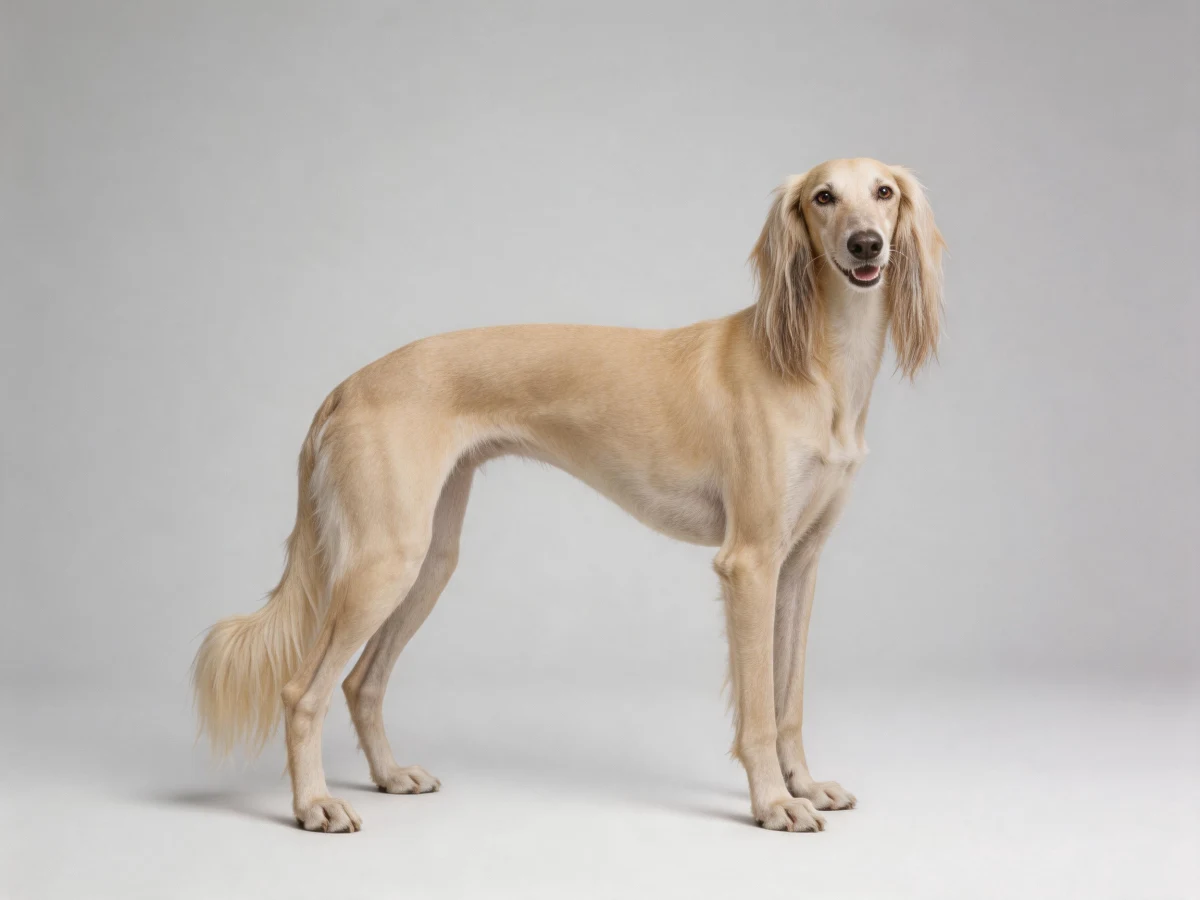
Kanni
✨ Key Takeaways
- A rare indigenous South Indian sighthound from the Tirunelveli, Virudhunagar and Thoothukudi districts of Tamil Nadu, bred over centuries by village and farming families to course Indian hare and other fast game by sight
- Named for the Tamil word kanni, meaning pure or maiden -- the breed was traditionally given to a young woman at her wedding as a guardian, earning it the epithet Maiden's Beastmaster
- Medium-sized and built for speed: roughly 64-74 cm at the withers and 16-22 kg, with a straight topline, narrow deep chest, tucked-up abdomen, golden eyes, a black nose and a short close coat
- The black-and-tan and dark-sable hound; by the common convention and Kennel Club of India practice it is the dark-coated counterpart of the solid fawn/cream Chippiparai, the two often regarded as colour varieties of one indigenous stock though some hold them distinct
- Reserved and even shy with strangers but deeply loyal to its family, watchful and protective at home, intelligent and trainable through trust, and well known for reading subtle hand signals in the field
- Recognised within India by the Kennel Club of India but not by the AKC, FCI or UK Kennel Club; genuinely rare and the focus of conservation efforts by enthusiasts and Tamil Nadu veterinary institutions
Quick Facts
Common Names & Variants
Modern aliases
Historical names
⚖️ Pros & Cons
Advantages
Trade-offs
Physical Appearance
Recognized colors
Coat
Other
Ears: Erect to dropped. Tail: Long, fine, semi-curved.
🕰 History
A wedding gift on four legs
The Kanni began not as a sporting dog bred for a kennel but as a living part of a marriage custom in the dry country of southern Tamil Nadu, where for generations a family would present a pair of these lean black-and-tan hounds to a daughter on her wedding day. The dog went with the bride into her new household as a guardian and a token of the family's regard, and the practice is bound up in the breed's very name: Kanni, the Tamil word for "pure" or "maiden". A breed that enters the record through a dowry rather than a hunt is unusual, and it tells you that the Kanni was valued as much for what it represented as for what it could do — though it could do a great deal, being a true coursing sighthound of the Indian plains.
An indigenous sighthound of the southern districts
The Kanni is one of a small cluster of native South Indian sighthounds developed over centuries by village and farming communities across the districts of Tirunelveli, Virudhunagar and Thoothukudi in southern Tamil Nadu. These are landrace dogs in the truest sense: shaped by local need, climate and quarry rather than by a written standard or a closed studbook, and maintained by the families who used them rather than by any formal breeding establishment. The hot, arid, scrub-and-farmland landscape of the southern Tamil country selected for a light, fast, heat-tolerant hound that could course game across open ground on sight, and the Kanni is the result — a regional type rather than a manufactured breed, with all the variation and all the toughness that landrace origins imply.
Bred for the course, not the show ring
From the beginning the working purpose of the Kanni was coursing: pursuing fast game, above all the Indian hare, by sight across open country. A coursing hound is judged by its eye, its acceleration and its agility on the turn rather than by its nose alone, and the Kanni carries the classic sighthound build that purpose demands — a straight topline, a deep but narrow chest, long clean legs and a sharply tucked-up abdomen, the whole frame stripped of anything that does not serve speed. Reliable accounts credit the breed with bursts of real pace in pursuit, and working Kannis are described as reading subtle hand signals from a handler at a distance, a refinement that fits a dog used to hunt cooperatively with people who could not always call out without alerting the quarry. The breed's sharp eyesight and keen scenting ability were both put to use, but it is the eye and the speed that define it as a sighthound.
The Kanni and the Chippiparai — one stock, two names
No account of the Kanni is honest without addressing its close kinship with the Chippiparai, the fawn-and-cream sighthound of the same southern Tamil districts. The two are so alike in build, origin and use that many authorities treat them as colour varieties of a single indigenous stock rather than as wholly separate breeds: in the most widely repeated convention the black-and-tan and dark sable dogs are called Kanni and the solid fawn, cream or silver-grey dogs are called Chippiparai. The Kennel Club of India registers them under the two names along these colour lines. Other experienced breeders insist the two are genuinely distinct breeds with their own histories, and the question is not settled. The honest position is that the Kanni and the Chippiparai are at the very least extremely close relatives drawn from the same regional sighthound population, distinguished in practice chiefly by coat colour, and that a reader should be wary of any source that states the relationship with more certainty than the evidence allows.
Recognition, rarity and an uncertain future
The Kanni is recognised within India by the Kennel Club of India, the country's principal national registry, but it holds no international recognition: it is not an AKC, FCI or UK Kennel Club breed, and outside India it is almost unknown. Within its homeland it has become genuinely rare. The decline of traditional village hunting, the spread of imported foreign breeds as status pets, and the slow erosion of the wedding-gift custom that once sustained it have all thinned the breed's numbers, and conservation-minded breeders, veterinary colleges in Tamil Nadu and a handful of enthusiasts now work to document and preserve it. The Kanni's survival, like that of several Indian native breeds, rests on a small and dedicated community rather than on broad popularity — a precarious footing for a hound that carried real cultural meaning long before any kennel club wrote its name in a book.
Temperament & Personality
Reserved with strangers, devoted at home
The Kanni's temperament reflects its history as a one-family guardian rather than a sociable kennel pack hound. The characteristic disposition is reserved, even shy, with people outside the household, combined with deep loyalty and attachment to its own family. This is a dog that bonds intensely with the people it lives among and that will defend its home and its handler when the need genuinely arises, but that does not seek out or warm easily to strangers. The reserve is temperamental, not timid in the sense of nervous instability — a well-raised Kanni is a calm, watchful, dignified dog rather than a fearful one — but it does mean the breed reveals its affectionate side only to those it trusts.
A sighthound's drives under a quiet surface
Beneath the composed exterior the Kanni carries the full set of sighthound instincts. The prey drive is strong and visually triggered: a Kanni that catches sight of a hare, a cat or another small running animal is primed to give chase, and the same speed that made it valuable on the course makes off-lead reliability around moving game a real consideration. The breed is alert and quick to notice change, with the keen distance vision its work demanded, and it tends to be sensitive to its handler's mood and signals — a trait that working dogs turned into the cooperative, hand-signal-reading partnership prized in the field. None of this makes the Kanni a busy or frantic dog indoors; like most sighthounds it is capable of long, quiet stretches of rest and becomes active chiefly when there is a reason to be.
Loyal, sensitive and easily bruised by harshness
Owners and regional accounts consistently describe the Kanni as faithful, intelligent and trainable for those who earn its trust, but also as sensitive — a dog that responds to calm, fair handling and shuts down or grows wary under heavy-handed correction. Its loyalty is to individuals rather than to all comers, so the breed does not generalise its affection the way a gregarious gundog might. With its own children and family it is gentle and protective; with the unfamiliar it stays aloof until properly introduced. This combination of devotion, watchfulness and reserve is exactly what the breed's guardian-and-courser background would predict, and it is the key to understanding the dog: the Kanni is a private animal that gives its whole heart to a few and keeps a measured distance from the rest.
🏡 Living With a Kanni
Space to run, not a kennel for show
The Kanni is a coursing sighthound, and the single biggest factor in living with one well is whether you can satisfy its need to run. This is an athletic dog built for speed over open ground, and it needs regular, vigorous exercise — daily free galloping in safely enclosed space alongside its walks — to stay sound in body and settled in mind. A securely fenced area where the dog can stretch out at full pace is far more valuable to a Kanni than mileage on a lead, because the breed's gift is acceleration and agility rather than plodding endurance. An under-exercised Kanni, denied the chance to use itself, becomes restless and frustrated in a way that no amount of indoor attention fully replaces. Given its run, though, the breed is a calm and undemanding housemate that settles quietly between bouts of activity.
Heat, climate and the indoor sighthound
Bred for the hot, dry plains of southern Tamil Nadu, the Kanni is a heat-tolerant dog with a short, close coat and a lean frame, well suited to warm climates and poorly insulated against real cold. In cool or wet weather it needs shelter, a warm dry place to sleep and, in genuinely cold conditions, a coat for outdoor exercise — its thin coat and low body fat give it little natural protection. Like most sighthounds it is fundamentally an indoor dog that exercises hard outdoors and then comes inside to rest with its family; it is not suited to being kennelled alone outside, both because of the climate question and because the breed's deep attachment to its people means isolation makes it miserable.
Family, other pets and the prey-drive question
With its own household the Kanni is loyal, gentle and good with children it has been raised among, and its watchful, defensive streak makes it a natural home guardian. The complications are the ones the breed's instincts dictate. The strong visual prey drive means cats and small pets are a genuine consideration: a Kanni raised from puppyhood alongside a household cat may accept it as family, but small animals it does not know are liable to be seen as quarry, and the breed's reserve with strangers extends to a wariness that needs careful, positive socialisation to keep it within friendly bounds. This is a dog that does best in an active home with space, an experienced and patient hand, and an understanding of what a reserved coursing hound is and is not.
🎓 Training & Exercise
Trainable through trust, not pressure
The Kanni is an intelligent, sensitive dog that working accounts describe as easy to train for a handler it respects, and the breed's documented ability to read subtle hand signals in the field is proof of how much partnership it is capable of. The qualification is the same one that applies to most sighthounds and to most reserved breeds: the Kanni works for someone it trusts, not for anyone, and it does not tolerate harsh correction. Heavy-handed methods make a sensitive dog wary and shut it down rather than sharpen it. Calm, consistent, reward-based handling that builds the relationship first and the obedience second is what brings out the breed's real cooperativeness.
Early socialisation for a naturally aloof dog
Because reserve with strangers is built into the Kanni, early and thorough socialisation does as much work as any obedience drill. A puppy that meets a wide range of people, dogs, places and household animals during its first months grows into a settled, discerning adult that is watchful without being unmanageably suspicious, while one raised in isolation can become over-bonded to its family and difficult around the unfamiliar. Socialisation does not aim to turn the Kanni into a gregarious dog — that is against its nature — but to ensure its natural caution stays friendly and stable rather than tipping into fearfulness.
Recall, the long line and the sighthound limit
Recall in the presence of moving game is the honest limit of Kanni training, exactly as it is for the whole sighthound family. A dog that recalls perfectly in the garden may become momentarily deaf the instant a hare breaks from cover, because chasing fast-moving quarry on sight is precisely the behaviour the breed was selected for over centuries. The practical answer is the standard sighthound one: build recall patiently in progressively more distracting settings, reward it richly, and rely on a long line or fully enclosed ground wherever there is live game about rather than expecting gundog reliability the breed was never bred to give.
Channelling the drive into a job
The kindest training an owner can offer a Kanni is a legitimate outlet for its speed and prey drive. Where it is lawful and appropriate, lure coursing and other sighthound sports let the dog do the very thing it was made for in a controlled setting, turning a difficult-to-manage instinct into satisfying, structured work. Regular hard running, recall games and engagement that respects the dog's sensitivity all help; what frustrates both dog and owner is treating a coursing hound as a sedentary companion and then being surprised by the restlessness and chase instinct that two centuries of selection put there on purpose.
✂️ Grooming & Coat Care
A short coat that asks almost nothing
The Kanni wears one of the lowest-maintenance coats in the dog world. It is short, fine and close-lying — a practical jacket suited to a hot climate rather than anything that needs sculpting — and it requires no clipping, stripping or professional grooming whatsoever. A weekly going-over with a soft brush, a grooming mitt or a rubber curry comb lifts the modest amount of dead hair, spreads the skin's natural oils and keeps the coat clean and glossy. Shedding is light year-round and the breed has no heavy seasonal moult to speak of. Bathing is occasional — when the dog is genuinely dirty rather than on any schedule — using a mild dog shampoo; over-bathing a thin-coated sighthound does more harm than good by stripping the skin of its protective oils.
Skin, sun and the thin-coated dog
What the Kanni's coat asks of an owner is less brushing than awareness of the skin beneath it. The fine coat and low body fat give the breed little protection from extremes, so the grooming routine should include a regular look over the skin for the cuts, grazes and parasites a hard-running dog collects, attention to any lightly pigmented areas that can burn in strong sun, and sensible protection from cold and wet — a coat for outdoor exercise in genuinely cold weather is reasonable for a dog built for the tropics. Checking the dog over by hand after a run in rough country, feeling for ticks, thorns and grass seeds, belongs in the routine alongside the weekly brush.
Ears, nails, teeth and eyes
The Kanni's ears, which may be carried erect, semi-erect or dropped, are generally healthy and need only a routine weekly check for redness, discharge or odour, with gentle cleaning of the outer ear when needed. Nails should be checked monthly; a dog that runs on hard ground may wear them naturally, but one exercised mainly on soft going will need trimming before the nails grow long enough to affect its gait. Dental care matters as much in this breed as in any dog — regular tooth-brushing is the most effective defence against periodontal disease — and a glance at the eyes for irritation after work in cover completes a grooming routine that, for this breed, is genuinely undemanding.
🍖 Diet & Nutrition
Feeding a lean, athletic sighthound
The Kanni is a lean, muscular, naturally light-framed hound, and the goal in feeding it is to maintain that athletic condition rather than to fill it out. A good-quality complete dog food matched to the dog's life stage — puppy, adult or senior — and to its activity level is the sensible baseline, with the amount adjusted to the individual dog rather than fixed by the guide on the bag. Because a sighthound is built to carry no surplus, hands-on body-condition scoring is the reliable everyday measure: a Kanni in good condition has ribs that are easily felt and often faintly visible, a clearly defined waist seen from above and a pronounced tuck-up behind the ribs. To eyes used to heavier breeds a fit sighthound can look almost too thin, but the lean frame is correct for the type and a Kanni should never be fed up to a rounder shape.
Matching the ration to the work
A coursing hound's energy needs swing with its activity, and the amount fed should rise and fall with the workload rather than sit at a single year-round ration. A Kanni run hard in coursing or sport burns far more than the same dog resting, and feeding the working rate to a dog that is no longer working is the surest way to put unwanted weight on a breed that should carry none. Measured meals rather than free-choice feeding, restraint with table scraps, and counting any training treats inside the daily ration rather than on top of it are the habits that keep a Kanni in its proper trim. Because the breed is naturally lean, owners should be as alert to a dog losing condition through under-feeding during hard work as to one gaining it through over-feeding at rest.
Schedule, water and feeding around exercise
Adult Kannis are usually fed twice a day, morning and evening, rather than in one large meal. Fresh water must always be available, and demand rises sharply on hot days and after hard running — a real concern for a heat-tolerant but hard-driving dog. As a matter of sensible practice a sighthound should not be fed a heavy meal immediately before or after vigorous exercise; leaving a gap on either side of strenuous running steadies the dog and is a reasonable precaution in any deep-chested breed. Puppies need more frequent, smaller meals appropriate to their age, transitioning to the adult twice-daily pattern as they mature into the lean adult frame the breed is built around.
🐶 Buying & Adopting a Kanni
A rare native breed concentrated in one region
The Kanni presents a difficult buying picture, and a prospective owner should understand its rarity before getting attached to the idea. The breed is concentrated almost entirely in the southern districts of Tamil Nadu — Tirunelveli, Virudhunagar and Thoothukudi and their surrounding country — and is uncommon even within India; outside the subcontinent it is effectively unavailable. Most Kannis are kept by village and farming families and by a small community of breed enthusiasts rather than widely advertised through commercial channels, and the traditional channels through which the breed passed — including the wedding-gift custom that once sustained it — were never commercial in the first place. A would-be owner should expect that finding a genuine, well-bred Kanni means working through people connected to the breed in its home region rather than browsing a national marketplace.
Finding an honest source in a small population
The right contacts are the Kennel Club of India, the breed-conservation efforts run through Tamil Nadu's veterinary institutions, and the established enthusiasts and farming families who keep working lines. Because the registered population is small, the relatedness of breeding stock is a live concern, and a responsible breeder will be open about a litter's parentage, will keep dogs of sound temperament and working ability, and will care more about whether a buyer can give a coursing hound space, exercise and an understanding home than about making a sale. Buyers should be alert to the confident commercial listings that have grown up around fashionable Indian native breeds: a fine-boned sighthound sold on demand at a marketplace price, with no questions asked about the home, deserves scepticism rather than enthusiasm. Confirming that a dog is truly a Kanni, and not simply a black-and-tan village dog of uncertain background, is itself part of the work in a breed with no closed studbook and a contested boundary with the Chippiparai.
Adoption and a sober assessment of fit
Breed-specific rescue for the Kanni barely exists, but indigenous Indian sighthounds and their crosses do turn up in general rescue in their home region, and an adopter willing to take on a dog of this type can give a deserving animal a home while supporting native breeds over imported fashion. Whether buying or adopting, the honest question is the same: can you provide a reserved, fast, prey-driven coursing hound with the space to run, the secure fencing, the patient socialisation and the warm, settled family life it needs? For an active home in a suitable climate, with the room and the inclination to let the dog use itself, the Kanni is a loyal, dignified and rewarding companion with real cultural depth behind it. For a household wanting an outgoing, low-energy pet content with a town flat and a short walk, it is the wrong dog, and recognising that before the commitment is a kindness to everyone, the dog most of all.
📜 Breed Name Etymology — iDogNames original research
Kanni — "pure" and "maiden" in Tamil
The breed's name is the Tamil word kanni (கண்ணி), which carries the linked meanings of "pure", "virgin" and "maiden". The choice of word is no accident: the Kanni was traditionally given to a young woman at her marriage, and the name reaches in two directions at once — toward the maiden bride who received the dog and toward the purity of heart and loyalty the hound was held to embody. A breed named for a quality of character and for a stage of a human life, rather than for a place or a quarry, is unusual, and the name itself is the clearest surviving trace of the marriage custom from which the breed takes its identity.
The "Maiden's Beastmaster" and the guardian role
The same custom gives the breed its descriptive epithet, sometimes rendered in English as the "Maiden's Beastmaster" — a name that fixes the dog's role as the guardian companion of the bride who received it. The phrase is a translation of the Tamil sense rather than a literal word-for-word equivalent, and like much in the breed's record it comes down through oral tradition more than through written documents, so the exact wording varies between sources. What is consistent across them is the meaning: the Kanni is the maiden's own dog, given for her protection, and the name encodes a relationship between a particular dog and a particular person that sits at the heart of the breed's culture.
Colour names and the Chippiparai boundary
Within the breed a set of Tamil colour terms distinguishes its patterns, and these names are part of how the Kanni is understood and registered. Terms recorded for its varieties include Paal Kanni and Seng Kanni and Karung Kanni among others, each naming a particular distribution of black, tan and fawn, while the solid-coloured dogs of the same southern stock are named separately as Chippiparai — itself a toponym, after the village of Sippipparai in the Tirunelveli country. The vocabulary itself thus carries the breed's central ambiguity: a single regional sighthound population described by two names and a family of colour terms, with the line between Kanni and Chippiparai drawn, in the common convention, along the boundary of coat colour.
Name forms at a glance
| Name | Role | Origin | Literal meaning | First recorded |
|---|---|---|---|---|
| Kanni | primary | Tamil (கண்ணி) | the pure one / the maiden's dog | — |
| Maiden's Beastmaster | alias | English (translation of the Tamil sense) | the maiden's guardian hound | — |
| Seng Kanni | alias | Tamil (variety name) | the red-marked Kanni | — |
| Karung Kanni | alias | Tamil (variety name) | the black Kanni | — |
| Chippiparai | historical | Tamil (toponym -- village of Sippipparai) | the dog of Sippipparai village | — |
🏛 Naming Traditions — iDogNames original research
Tamil names for a Tamil hound
Because the Kanni is so completely a creature of the Tamil country, owners who want a name that fits the breed reach naturally for the Tamil language and the culture of southern India. Tamil words for the qualities the breed embodies sit especially well on it: Kanni itself means pure and maiden, Vega evokes speed, Veera means brave, and Anbu means love or affection — names that name the dog for what it is. The breed's own colour vocabulary offers another vein, with the recorded variety-names such as Seng (red) and Karung (black) pointing to its distinctive black-and-tan and dark-sable coats.
Beyond the breed's own words, names drawn from Tamil and wider South Indian heritage — places, rivers, classical and mythological names — suit a hound with so deep a regional identity, while plain descriptive names that honour the dog's speed, its loyalty or its dark coat work in any language. The strongest Kanni names are the ones that reflect what the dog actually is: a fast, faithful, black-and-tan coursing sighthound of the southern Tamil plains, bred as a guardian and given as a gift of trust.
🐾 Themed Names for Your Kanni — iDogNames original research
Tamil names of meaning and character
- Kanni -- "pure"/"maiden", the breed's own name and its central meaning
- Anbu -- Tamil for "love" or "affection", for a devoted hound
- Veera -- Tamil for "brave", befitting a guardian dog
- Vega -- evoking speed, for a fast coursing sighthound
- Nila -- Tamil for "moon", a gentle name for a treasured dog
- Selvi -- Tamil for a young woman, echoing the maiden tradition
- Thendral -- Tamil for "gentle breeze", a light name for a swift dog
- Mani -- Tamil for "gem" or "jewel", for a prized companion
Coat and colour names (black, tan, sable)
- Karung -- from the Tamil for "black", for the breed's dark ground colour
- Seng -- from the Tamil for "red", for the rich tan markings
- Sable -- plain English for the breed's dark coat pattern
- Onyx -- the black gemstone, for a glossy dark hound
- Amber -- for the golden eyes that light the dark face
- Tan -- a simple name for the breed's warm markings
- Ember -- for the glow of tan against black
- Shadow -- for a dark, quiet, watchful dog
Tamil heritage and place names
- Tirunelveli -- the southern district at the heart of the breed's homeland
- Madurai -- the ancient temple city of southern Tamil Nadu
- Kaveri -- the great river of the Tamil country
- Tamil -- for the language and culture the breed belongs to
- Chera -- one of the classical Tamil royal dynasties
- Chola -- another of the great Tamil dynasties
- Pandya -- the Tamil dynasty of the breed's southern districts
- Velli -- Tamil for "silver", for a pale-eyed dark hound
Speed, the hunt and guardian names
- Arrow -- for the breed's straight-line speed in the chase
- Dash -- plain English for a quick coursing hound
- Hunter -- for a born courser of hare and game
- Falcon -- for a fast, sharp-eyed hunting partner
- Bolt -- for a dog credited with real bursts of pace
- Guardian -- for the bride's protector at the heart of the breed's story
- Scout -- for an alert, watchful sighthound
- Swift -- a simple name for a coursing dog built for speed
- Comet -- for a streak of speed across open ground
- Ranger -- for a dog made to cover open country
Additional Tamil and South India names
- Tamil Nadu - best for the Kanni regional origin
- Tirunelveli - best for a southern Tamil Nadu place cue
- Madurai - best for a historic Tamil city name
- Thanjavur - best for a classic Tamil place name
- Kaveri - best for a major river name
- Palani - best for a hill-region call name
- Pearl Coast - best for a southern coastal landscape image
- Dry Plain - best for the hot open terrain associated with sighthounds
Additional sighthound and home-watch names
- Longstride - best for a Kanni gait name
- Quick Turn - best for agile field movement
- Harepath - best for traditional hunting context used carefully
- Home Watch - best for a loyal household role without overclaiming guarding
- Slim Shadow - best for a lean dark dog
- Night Guard - best for a watchful dog managed responsibly
- Field Sprint - best for safe running in open space
- Quiet Loyalty - best for the devoted companion reputation
Additional coat and frame names
- Black Tan - best for the classic black-and-tan look
- Sable Line - best for a shaded coat
- Sand Paw - best for a pale-footed dog in dry country
- Copper Brow - best for tan eyebrow markings
- Dark Mask - best for a strong face marking
- White Toe - best for small white feet
- Velvet Ear - best for a smooth-eared sighthound
- Lean Frame - best for the athletic body type
📋 Breed Standard at a Glance
General appearance and size
The Kanni is a medium-sized indigenous sighthound of the classic coursing build: a straight topline, a deep but narrow chest, a sharply tucked-up abdomen and long, clean limbs, the whole frame lean and athletic and stripped of any heaviness. It is described as standing roughly 64 to 74 cm at the withers and weighing in the region of 16 to 22 kg, with the lithe, elegant outline of a dog built for speed rather than power. As a landrace recognised within India by the Kennel Club of India rather than by an international body, the Kanni is described by the documentation of regional and national authorities rather than by an FCI standard, and some variation in type is to be expected in a breed without a long-closed studbook.
Head, coat and colour
The head is straight and refined with strong jaws, set with golden or amber eyes and a black nose that give the breed its alert, dignified expression. The ears are medium-sized and may be carried erect, semi-erect or dropped — a degree of variability typical of a landrace. The coat is short, fine and close-lying. Colour is the breed's defining marker and the basis of its conventional separation from the Chippiparai: the Kanni is the black-and-tan and dark-sable hound, with recognised variants including black with tan markings, black with a fawn face and legs, and related dark patterns, as distinct from the solid fawn, cream and silver-grey dogs registered as Chippiparai.
Body, movement and working type
The body is that of a coursing sighthound: a deep chest giving lung room over a markedly tucked-up loin, a strong straight back, long well-angled legs and a semi-curved tail, the construction built for acceleration and agility on the turn rather than for sustained heavy work. Movement is light, free and ground-covering, and the breed is credited with real pace in pursuit of fast game. The most telling point of type is functional rather than cosmetic: the Kanni is judged, in its homeland, by whether it remains a sound, fast, capable hunting hound true to the coursing purpose for which generations of southern Tamil families bred it.
🏆 Recognition
Other registries
Breed clubs
❓ Frequently Asked Questions
What is a Kanni's temperament like?
The Kanni is a reserved, even shy dog with strangers but deeply loyal and affectionate with its own family. It is watchful and naturally protective, defending its home and handler when the need genuinely arises, while staying aloof with people it does not know -- a disposition that reflects its history as a one-family guardian. Beneath the calm surface it carries full sighthound instincts, including a strong visual prey drive, and it is intelligent and sensitive, trainable through trust and famous for reading subtle hand signals from its handler. It responds to calm, fair handling and shuts down under harshness, and it does best in an experienced, active home that respects its private, dignified nature.
How big does a Kanni get?
The Kanni is a medium-sized sighthound. It is generally described as standing about 64 to 74 cm at the withers and weighing in the region of 16 to 22 kg, with the lean, lithe outline of a dog built for speed -- a straight topline, a deep but narrow chest, long clean legs and a sharply tucked-up abdomen -- rather than for bulk or power.
What health problems do Kannis have?
The Kanni is a hardy native landrace with a long reported lifespan of around 14 to 16 years and few inherited problems documented, but almost no formal, breed-specific health data exists for it because the population is small and little studied. The most useful things to know are general to its type: as a lean sighthound it has heightened sensitivity to some anaesthetic agents and unusual normal blood values, so it needs a vet familiar with the sighthound type; its thin coat and low body fat leave it exposed to cold, sun and the cuts and parasites of a hard-running outdoor life; and dental care matters as in any breed. Choose a breeder who avoids mating close relatives in a small population, keep the dog lean, and maintain a normal preventive-medicine routine. This is general educational information, not veterinary advice.
Are Kannis good family dogs?
For an active home with space, secure fencing and an understanding of the breed, the Kanni can be a loyal, gentle and protective family companion, good with children it has been raised among and a natural home guardian. But it is not an easy first pet: it is reserved and shy with strangers and needs thorough early socialisation, it has a strong prey drive that makes cats and small pets a real consideration, and it needs serious daily exercise and room to run as a coursing sighthound. It suits a warm climate and an experienced, patient owner far better than a quiet urban flat. Outside southern India the breed is extremely rare, so acquiring one usually means working through its home-region community.
How much grooming does a Kanni need?
Very little. The short, fine, close-lying coat needs only a weekly brush with a soft brush or grooming mitt, sheds lightly with no heavy seasonal moult, and requires no clipping or stripping; bathing is occasional, when the dog is genuinely dirty. The more important care is for the skin beneath a thin coat -- protection from cold and strong sun and a check for cuts, ticks and grass seeds after running in rough country. Ears need a routine weekly check, nails monthly trimming if not worn down, and teeth regular brushing, but overall this is one of the most low-maintenance breeds to keep groomed.
How much exercise does a Kanni need?
A Kanni is an athletic sighthound and needs daily walks, training and safe chances to run in secure areas. Heat, prey drive and road safety should be managed carefully. A calm home demeanor does not remove the need for movement, recall practice and sensible handling.
📚 Sources & Further Reading
Every load-bearing factual claim on this page is anchored to one of the sources below. iDogNames does not synthesize from secondary aggregators.
- wikipedia Kanni -- Wikipedia — Wikipedia
- wikipedia Chippiparai -- Wikipedia — Wikipedia
- breed club official Kennel Club of India — Kennel Club of India
- academic paper Chippiparai breed of dogs in Tamil Nadu: an assessment of physical and performance characteristics — ResearchGate (2016)
- other Indian Native Breeds -- Kanni — Indian Native Breeds
- veterinary org Sighthound anaesthesia and breed-specific considerations — WSAVA (2020)
- veterinary org Periodontal disease in dogs -- prevention and dental care — Merck Veterinary Manual (2024)
- book The Complete Dog Breed Book — Dorling Kindersley (2020)
- news article Tamil Nadu native dog breeds and conservation efforts — The Hindu (2019)