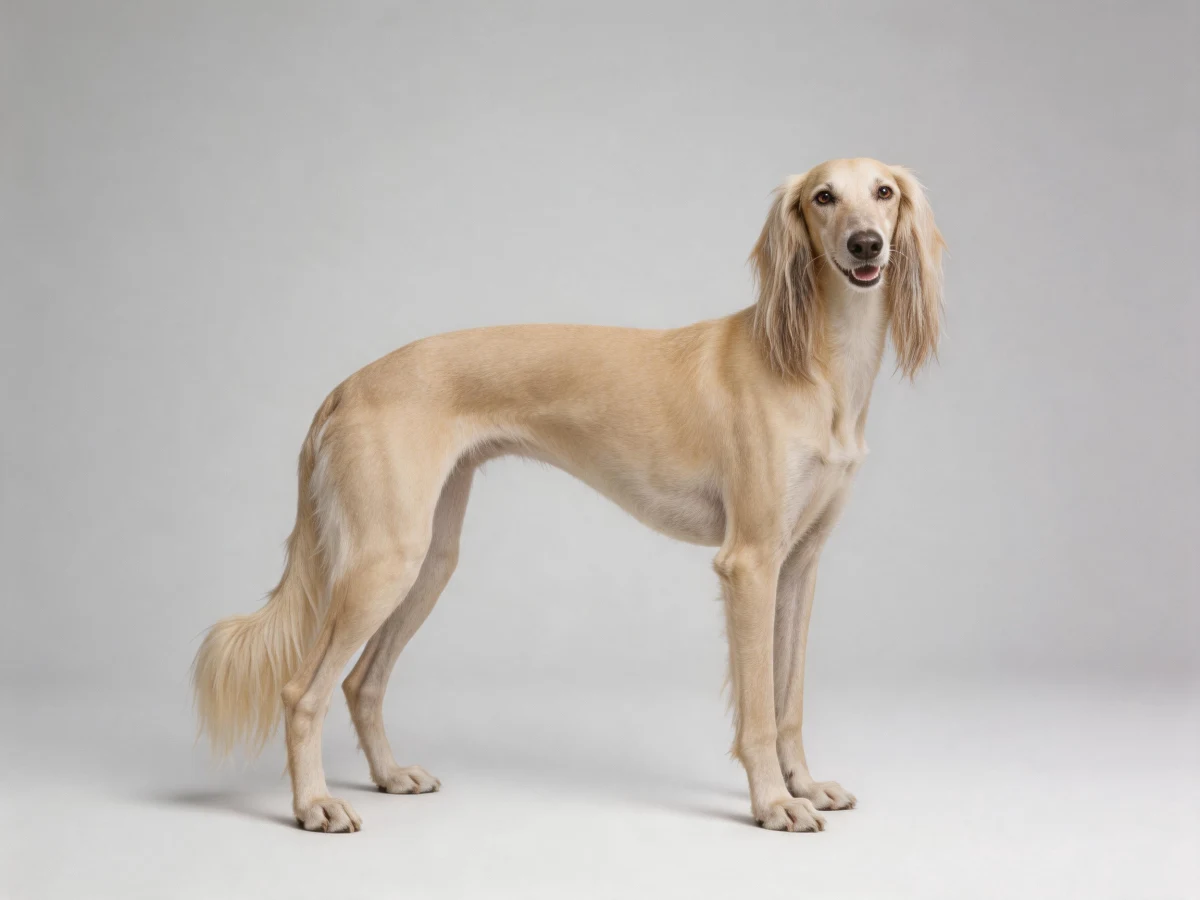
Mudhol Hound
✨ Key Takeaways
- An Indian indigenous sighthound of the Deccan plateau, centred on the town of Mudhol in Bagalkot district, Karnataka; descended from Saluki-Tazi coursing hounds brought into India along the caravan routes, which is why it is also called the Caravan Hound (from karwani, of the caravans)
- Championed by the Mudhol ruler Maloji Rao Ghorpade (1884-1937), who is credited with refining the breed and presenting a pair to King George V, who is said to have coined the name Hounds of Mudhol
- A lean, leggy, deep-chested coursing sighthound, generally about 61-80 cm tall and 22-28 kg, in a smooth-coated form (Caravan Hound) and a silky feathered form (Pashmi); colours run from fawn, fallow, cream and red through black, grey, brindle and particolour
- Registered by the Kennel Club of India as the Caravan Hound and by the Indian National Kennel Club as the Mudhol Hound; not recognised by the AKC, FCI or The Kennel Club; honoured on an India Post stamp in 2005
- The first Indian breed inducted into the Indian Army dog unit (2016-2017), later adopted by the Border Security Force and other forces for its hardiness, endurance and disease resistance
- Temperament is fiercely loyal and one-person, aloof and watchful with strangers, with a very strong prey drive; it needs secure fencing, real running exercise and gentle, sighthound-aware handling, and is calm and quiet indoors
Quick Facts
Common Names & Variants
Modern aliases
Historical names
⚖️ Pros & Cons
Advantages
Trade-offs
Physical Appearance
Recognized colors
Coat
Other
Ears: V-shaped drop. Tail: Long, low-set, curved.
🕰 History
A desert sighthound that became a Deccan native
Long before the Mudhol Hound carried that name, lean coursing dogs of the Saluki-Tazi family travelled into the Indian subcontinent at the heels of traders, mercenaries and migrating armies moving across Central Asia and Persia. As those caravans crossed the dry, scrubby uplands of the Deccan plateau, villagers in what is now Karnataka watched the dogs lope alongside the moving columns and called them karwani -- the dogs of the caravans -- a word that survives in the countryside to this day and that the Kennel Club of India later anglicised to Caravan Hound. Centuries of breeding on the hot, hard plateau, with selection for speed, stamina and an ability to live off little, turned an imported desert sighthound into something distinctly Indian: a tough, lean, drought-hardy courser shaped by the land it now belonged to rather than the deserts it came from.
The town of Mudhol and the Ghorpade rulers
The breed took its modern name and its modern shape from the small town of Mudhol, in the Bagalkot district of northern Karnataka, the seat of the princely state of Mudhol that the Ghorpade family ruled. Mudhol sat in good coursing country, and its rulers kept and bred these hounds for hunting hare, fox, deer and other game across the open scrub, prizing the dogs for the eyesight, acceleration and one-person loyalty that made them both hunters and guards. The hounds were woven into the life of the court, hunted from horseback, and bred with care over generations, so that the loose population of caravan dogs scattered across the Deccan acquired, in Mudhol, a recognised home and a recognised type.
Maloji Rao Ghorpade and a gift to a king
The figure most closely tied to the breed's rise is Shrimant Rajesaheb Maloji Rao Ghorpade, the ruler of Mudhol (1884-1937), who is credited with championing the hound, refining it through selective breeding and bringing it to wider notice. The most repeated story of the breed has Maloji Rao presenting a pair of his finest hounds to King George V of the United Kingdom; the king, examining the elegant, true-to-type sighthounds, is said to have called them the Hounds of Mudhol, and the name stuck. Whatever the precise details of that royal encounter, the episode marks the moment the dog of the Mudhol court stepped out of regional obscurity and acquired the name by which it is now known across India, carrying with it the prestige of its princely patrons.
Many names for one hound
The breed answers to a striking number of names, each a window onto a part of its story. It is the Caravan Hound from the karwani dogs of the trade routes; the Mudhol Hound from the town and state that made it famous; the Maratha Hound or Mahratta Hound from its association with the Maratha country and warriors of the western Deccan, who are said to have used such hounds in the field; and the Pashmi, a name reserved in particular for the silky, feathered-coat variety, from a Persian-rooted word for soft wool. Behind all of them stands the same dry-country sighthound, registered today by the Kennel Club of India as the Caravan Hound and by the Indian National Kennel Club as the Mudhol Hound -- two names for one dog, reflecting the breed's divided naming history rather than any real difference in the animal.
From princely kennel to national service
With the end of the princely states the breed lost its courtly patrons and declined, surviving chiefly with farmers, shepherds and hunters of the Bagalkot region who kept the dogs for coursing and guarding. Its modern revival has been deliberate and, unusually for a sighthound, official. A government-backed Canine Research and Information Centre was established at Timmapur near Mudhol to conserve and promote the breed, India Post issued a postage stamp for the Mudhol Hound on 9 January 2005 as one of four indigenous breeds honoured that day, and in 2016-2017 the hound made history as the first Indian breed inducted into the Indian Army's dog unit, trained at the Remount and Veterinary Corps centre and later taken up by the Border Security Force and other security agencies. A desert courser bred by a small Deccan court had become a symbol of indigenous Indian dog breeding.
Temperament & Personality
A one-person sighthound, devoted and aloof
The Mudhol Hound is a classic sighthound temperament concentrated and sharpened by the breed's history as a court hunter and guard: intensely loyal to its own person or family, reserved to the point of indifference with everyone else, and quietly watchful of its surroundings. With the people it has bonded to it is affectionate, sensitive and undemonstrative rather than effusive, a dog that attaches deeply to a single owner and reads that person closely. Toward strangers it is aloof and distrustful, not usually aggressive without reason but never the open, wag-at-everyone temperament of a gundog or a family Labrador. That combination of fierce loyalty and natural suspicion is exactly what made the breed valuable to the Mudhol court, where the same dog hunted by day and guarded the household by instinct, and it is why the modern hound makes such an effective, alert watchdog.
The prey drive of a courser
Underneath the dignified, faintly cat-like reserve runs a very strong prey drive, the legacy of generations bred to spot, chase and pull down hare, fox and deer across open scrub. A Mudhol Hound sights movement at a distance and is built to give instant, blistering chase, and that instinct does not switch off because the dog lives in a house: small running animals, cats, poultry and fleeing pets can all trigger the chase, and a securely fenced space and a lead in open country are not optional for this breed. The same drive makes the hound a poor fit for a busy multi-pet household unless it has been raised alongside the other animals from puppyhood, and even then the courser's reflex to chase fast movement deserves respect. This is a hunting dog first, and an owner who forgets that is the one most often surprised by it.
Sensitive, intelligent and not a pushover
For all its athleticism the Mudhol Hound is, like most sighthounds, a sensitive and somewhat independent thinker rather than a biddable, eager-to-please worker. It is intelligent and perfectly capable of learning, but it weighs a request rather than obeying reflexively, and it responds badly to harsh handling, shutting down or growing wary where a softer, more patient approach would have kept it engaged. It tends to be calm and even lazy indoors once its exercise needs are met -- a quiet, undemanding housemate that will spend hours stretched out asleep -- which surprises owners who expect a hard-driving athlete to be restless at home. Properly exercised and gently raised, it is a dignified, deeply loyal companion; under-exercised, harshly handled or treated as an ordinary easy pet, it can become nervous, destructive or unmanageably driven.
Trait Scores
All 1–5 ratings sourced from AKC breed traits. NULL = unrated for this breed.
Trainability & cognition
Personality
Activity & adaptability
Social compatibility
Grooming & physical
🏡 Living With a Mudhol Hound
Space to run and a securely fenced home
The Mudhol Hound is an athlete bred to course at speed over open country, and the single most important thing a home must provide is real opportunity to run, balanced against the safety a high-prey-drive sighthound demands. The breed needs vigorous daily exercise -- long walks, and ideally regular chances to gallop flat out in a safely enclosed space -- because a hound built for explosive coursing that never gets to stretch out becomes frustrated and restless. Equally, it must have a securely fenced garden and be kept on lead anywhere open and unfenced, since a sighted hare or cat will trigger a chase that no recall reliably interrupts. Given that combination of hard exercise and secure containment, the Mudhol Hound is paradoxically calm and quiet in the house, content to laze for hours between outings, which makes it a far more restful indoor companion than its build suggests.
Family, children and other animals
Within its own family the Mudhol Hound is loyal, gentle and affectionate, and a well-socialised dog raised with children can be good with the children of its household, though its reserve and sensitivity mean it suits considerate older children better than boisterous toddlers, and interactions with young children should be supervised as with any dog. Its aloofness with strangers makes it naturally watchful rather than sociable, so visitors should be introduced calmly. The real management point is other animals: the breed's powerful prey drive means cats, rabbits, poultry and small pets are a genuine risk unless the hound has grown up alongside them, and even dog-to-dog introductions are smoother when the Mudhol Hound has been broadly socialised young. This is a dog for a home that understands sighthounds rather than a first, easygoing family pet.
Climate, coat and a thin-skinned hound
Bred for the hot, dry Deccan, the Mudhol Hound is superbly adapted to heat and copes with India's demanding climate with a natural hardiness that is part of why security forces value it, but the flip side of a lean, thin-coated, low-bodyfat sighthound is poor tolerance of cold and damp. In a cold climate the dog needs a coat in winter and a warm, soft place to sleep -- a bony sighthound is uncomfortable on a hard floor and feels the cold keenly. The smooth-coated Caravan and the silkier, feathered Pashmi both carry very little insulation. This is emphatically an indoor dog that shares its family's space: kept outside or isolated, a breed this bonded to its person and this lightly built fares poorly, and it belongs in the house as a companion that happens to be a serious athlete.
🎓 Training & Exercise
Intelligent but independent
Training a Mudhol Hound means working with the mind of a sighthound, not a herding or gundog brain. The breed is intelligent and learns readily what it sees the point of, but it is independent and a little aloof by nature, inclined to consider a command rather than snap to it, and entirely unmotivated by drilling for its own sake. Short, varied, reward-based sessions that keep the dog interested work far better than long repetitive ones, and food and genuine praise from its bonded person are the levers that move it. Harsh corrections backfire badly with this sensitive breed, producing a wary, shut-down dog rather than a compliant one. An owner who accepts that a Mudhol Hound will never be a robotic obedience machine, and who trains with patience and consistency, will find a dog perfectly capable of good house manners and reliable basic obedience.
Recall, prey drive and the limits of training
The hardest and most important training challenge is recall against the breed's coursing instinct, and honesty matters here. A sighthound locked onto a running animal is following one of the most deeply fixed instincts in the dog, and even a well-trained Mudhol Hound may not return when the chase is on; this is why secure fencing and on-lead walking in open country are treated as non-negotiable for the breed rather than as a fallback for poor training. Recall should still be taught and rewarded heavily from puppyhood, practised first in enclosed spaces and never tested where a failure could put the dog in traffic or onto livestock. Owners do best to manage the prey drive through environment and equipment as much as through obedience, and to channel the chase instinct into safe outlets such as lure coursing where it is available.
Early socialisation for a reserved breed
Because the Mudhol Hound is naturally distrustful of strangers, early and broad socialisation does as much as any obedience work to produce a settled adult. A puppy that meets many people, dogs, places and everyday sights and sounds through its first months grows into a confident, discriminating hound that takes the unfamiliar in stride, while one raised narrowly can let the breed's natural reserve curdle into nervousness or reactivity. The aim is not to turn an aloof sighthound into a gregarious greeter -- it will never be that -- but to widen its world so that little alarms it and its caution stays measured. That groundwork, laid early, pays off across the whole of the dog's life and is far harder to install once the puppy window has closed.
✂️ Grooming & Coat Care
Two coats, both low-maintenance
The Mudhol Hound comes in two coat types, and both are easy keepers. The far more common smooth-coated form -- the dog usually meant by the name Caravan Hound -- wears a short, fine, close coat that lies flat to a lean body and asks for almost nothing: a weekly going-over with a rubber curry comb, a grooming mitt or a soft brush lifts the modest shedding, spreads the skin's natural oils and keeps the coat sleek. The silky-coated variety, the Pashmi, carries soft feathering on the ears, the backs of the legs and the underside of the tail, and that feathering benefits from an occasional comb-through to keep it from tangling, but it remains a light grooming job by any standard. Neither coat needs clipping, stripping or professional grooming, and a bath is an occasional event for when the dog is genuinely dirty rather than a routine.
The post-work check and the everyday routine
Because this is an active outdoor hound that runs through scrub and rough country, the most useful grooming habit is a hands-on check after exercise: run the hands over the coat and feel between the toes and around the ears for thorns, grass seeds, ticks and small cuts, and glance at the eyes for irritation from whipping vegetation. The breed's hanging, V-shaped ears trap a little more warmth and moisture than a pricked ear, so the ears should be inspected weekly for redness, discharge or odour and cleaned gently with a vet-approved cleaner only when needed, and dried after wet work. These quick checks catch the minor problems of an active life before they become painful ones.
Nails, teeth and feet
Nails should be checked monthly; a hound worked on hard ground may wear them naturally, but a dog exercised mostly on soft going needs trimming before the nails grow long enough to affect its gait. Dental care matters as much in the Mudhol Hound as in any dog -- regular tooth-brushing with a canine toothpaste is the most effective guard against the periodontal disease that is otherwise near-universal, supported by appropriate dental chews. Beyond that, the Mudhol Hound is essentially a wash-and-go dog whose grooming is mostly a matter of routine checks rather than salon work, which is exactly what its lean, dry-country build was meant to deliver.
🍖 Diet & Nutrition
Feeding a lean coursing athlete
The Mudhol Hound is a lean, athletic sighthound, and its feeding should both fuel that athleticism and preserve the trim, ribby outline the breed is meant to have. A good-quality complete dog food matched to the dog's life stage -- puppy, adult or senior -- and to its real activity level is the sensible baseline, with the amount adjusted to keep the hound in correct sighthound condition rather than fed to a fixed ration off the bag. The right weight on this breed looks lean to an eye used to heavier dogs: the last ribs visible or easily felt, a deep tuck-up behind the chest, and a clear waist. Hands-on body-condition scoring is a more reliable everyday guide than the bag's feeding chart, which is only a starting point.
Matching the ration to the work
A hound coursing or working hard burns far more than the same dog resting between outings, and the ration should rise and fall with the workload rather than sit at one year-round level. The commonest mistake is to keep feeding at the working rate once activity eases, letting weight creep onto a frame meant to be lean; excess weight is more than cosmetic in a sighthound, blunting the speed and agility that define the breed and loading its joints. Measured meals rather than free-choice feeding, restraint with table scraps, and counting any training treats inside the daily ration rather than on top of it keep a Mudhol Hound in its proper trim. The breed's reputation for thriving on relatively modest, simple food in its native region reflects a genuinely efficient constitution.
Schedule, bloat awareness and growing puppies
As a deep-chested breed, the Mudhol Hound is fed with the risk of bloat in mind: adults are best given two measured meals a day rather than one large one, and hard exercise should be avoided in the period immediately around feeding. Fresh water must always be available, and demand rises sharply on hot days and after hard running, so water in the field is a real requirement for a working hound. Puppies need more frequent, smaller meals appropriate to their age and a steady, unhurried growth curve -- a fast-growing large-breed pup is best kept lean to protect developing joints -- transitioning to the adult feeding pattern as they mature.
🐶 Buying & Adopting a Mudhol Hound
A regional breed concentrated in its homeland
The Mudhol Hound is overwhelmingly an Indian breed, concentrated in and around its home district of Bagalkot in northern Karnataka, and a prospective owner should understand that landscape before getting attached to the idea. Within India the breed is kept by farmers, shepherds, hunters and a growing number of enthusiasts, and its revival has been supported by official efforts including the government-backed Canine Research and Information Centre near Mudhol, which works to conserve and promote the breed and is a natural first point of reference. Outside India the breed is rare, and finding a well-bred dog abroad takes real research. Because the Kennel Club of India registers the dog as the Caravan Hound while the Indian National Kennel Club uses Mudhol Hound, a buyer should expect the same dog under either name and should focus on the breeder rather than the registry label.
Choosing a responsible breeder
A responsible Mudhol Hound breeder is producing sound, typey, well-tempered sighthounds and will be candid about the breed's demands. Expect a breeder who can show the parents, talk honestly about the breed's strong prey drive, reserve with strangers and need for hard exercise and secure fencing, and who asks searching questions about your space, experience and ability to manage a coursing hound safely. Ask which coat type the litter carries -- the smooth Caravan or the feathered Pashmi -- and about any health issues seen in the line, and about hips where the breeder screens for them. A breeder who hands over a puppy on demand, makes no enquiry into your circumstances and cannot describe the working background of their dogs is a warning sign rather than a convenience, in this breed as in any other.
Adoption and an honest assessment of fit
Mudhol Hounds and Mudhol-type dogs do turn up needing homes, very often precisely because of a mismatch this guide aims to prevent: a high-prey-drive coursing hound placed without the secure exercise space, the sighthound-aware handling or the tolerance for an aloof, one-person temperament that the breed asks for. Sighthound and Indian-breed rescues, and shelters in the breed's home region, are worth approaching for an adult dog whose temperament is already known, which can suit an experienced home well. Whether buying or adopting, the honest question is always the same: can you provide a lean, fast, fiercely loyal sighthound with secure fencing, real running exercise, gentle handling and a warm indoor place at its family's side? For the right home the Mudhol Hound is a dignified, devoted and striking companion; for a household wanting an easy, sociable, low-drive pet it is the wrong dog, and recognising that before the purchase is a kindness to everyone, the dog most of all.
📜 Breed Name Etymology — iDogNames original research
Mudhol -- a hound named for a princely town
The breed's best-known modern name comes straight from geography: Mudhol is a town in the Bagalkot district of Karnataka and was the seat of the princely state of Mudhol, ruled by the Ghorpade family, whose court kept and refined these hounds. The dog is the Hound of Mudhol -- a name popularly traced to King George V, who is said to have used the phrase on being presented with a pair by the Mudhol ruler Maloji Rao Ghorpade. The Indian National Kennel Club registers the breed under this name, tying the dog permanently to the small Deccan town that made it famous.
Caravan and Pashmi -- the road and the wool
The breed's older popular name is the Caravan Hound, an English rendering of the local karwani, meaning of the caravans -- the name villagers gave the sighthounds they saw running beside the trade caravans that first carried the dogs' Saluki-Tazi ancestors into the Deccan. The Kennel Club of India adopted Caravan Hound as its registered name, so the same dog is the Caravan Hound to one Indian registry and the Mudhol Hound to the other. The silky, feathered-coated variety carries a third name, Pashmi, from a Persian-rooted word for soft wool -- the same root that lies behind pashmina -- describing the soft feathering that distinguishes it from the smooth-coated form.
Maratha, Mahratta and the desert ancestry
Two further names point to the breed's wider history. Maratha Hound and Mahratta Hound link the dog to the Maratha country and warriors of the western Deccan, who are traditionally said to have kept and used such hounds. Behind all the names stands the dog's descent from the Saluki and the related Tazi -- the lean coursing hounds of the Middle East and Central Asia -- brought into India along the trade and military routes, so that a desert sighthound, renamed many times over by the land it settled in, became one of India's most distinctive native breeds.
Name forms at a glance
| Name | Role | Origin | Literal meaning | First recorded |
|---|---|---|---|---|
| Mudhol Hound | primary | English (after an Indian place name) | the hound of Mudhol | — |
| Caravan Hound | alias | English (from local Marathi/Kannada karwani) | the hound of the caravans | — |
| Pashmi | alias | Persian-rooted (Indian usage) | the soft, woolly (feathered-coat) variety | — |
| Mudhol Hound full name | primary | English breed-name analysis | standard full name used for the Mudhol Hound | — |
| Indian origin descriptor | origin country native | English editorial descriptor | country or regional origin cue for the Mudhol Hound | — |
🏛 Naming Traditions — iDogNames original research
Indian heritage and the breed's homeland
Because the Mudhol Hound is so completely an Indian breed -- a sighthound of the Deccan plateau, tied to the princely court of Mudhol and to the Karnataka countryside -- owners reach naturally for names that honour that heritage. Indian and Sanskrit names sit beautifully on the dog: names drawn from Indian royalty, geography and language such as Raja, Rani, Maharaja, Shiva, Arjun, Maya, Sita or Kiran carry the breed's homeland directly, and a name like Mudhol or Deccan ties the individual dog to the very place that made the breed.
The other natural vein is the sighthound's defining quality -- speed -- and the desert ancestry it shares with the Saluki. Names that evoke swiftness, the chase and the wind suit a coursing hound well, as do names that nod to its lean elegance and its far-sighted, regal bearing. The strongest Mudhol Hound names tend to honour one side or the other of that identity: the proud Indian heritage of the breed, or the fast, elegant desert courser at its heart.
🐾 Themed Names for Your Mudhol Hound — iDogNames original research
Indian heritage and royal names
- Raja -- Hindi for king, fitting a hound bred by Indian royalty
- Rani -- Hindi for queen, an elegant name for a Mudhol bitch
- Maharaja -- great king, honouring the breed's princely patrons
- Arjun -- the heroic archer of Indian epic, for a keen-eyed hunting hound
- Shiva -- a powerful name from Indian tradition
- Maya -- a graceful Sanskrit name for a female hound
- Kiran -- meaning ray of light, a bright name for a swift dog
- Sita -- a classic Indian name with a regal ring
Homeland and breed-history names
- Mudhol -- the Karnataka town and princely state the breed is named for
- Deccan -- the dry plateau where the breed was shaped
- Maloji -- for Maloji Rao Ghorpade, the ruler who championed the breed
- Ghorpade -- the ruling family of the Mudhol state
- Pashmi -- the name of the silky-coated variety
- Karwani -- the local word for the caravan dogs the breed descends from
- Bagalkot -- the Karnataka district that is the breed's home
- Tazi -- for the desert coursing ancestor behind the breed
Speed and the desert courser
- Arrow -- for a hound built to fly straight and fast
- Dash -- a plain, fitting name for a sprinter
- Zephyr -- the west wind, for a swift, light dog
- Falcon -- for a keen-eyed, fast hunter
- Comet -- for a streak of speed across open ground
- Saluki -- a nod to the breed's desert sighthound ancestry
- Simoom -- the hot desert wind of the breed's ancestral lands
- Blaze -- for a fast, fiery courser
Elegance and watchful loyalty
- Noble -- for the breed's dignified, regal bearing
- Grace -- for the hound's lean elegance
- Sentinel -- for an alert, watchful guard-hound
- Shadow -- for a devoted one-person dog that keeps close
- Hawk -- for the breed's far-sighted, piercing eyes
- Amber -- for the warm, fawn coat and amber eyes
- Sahara -- evoking the desert heritage, a fitting female name
- Zara -- a graceful name with an Indian and Persian ring
More Indian heritage names
- Indian Trail - best for a Mudhol Hound name rooted in India rather than generic style
- Mudhol, Bagalkot district, Karnataka; Deccan plateau, southern India Ridge - best for a regional landscape cue tied to the Mudhol Hound story
- Local Line - best for a name that respects local breed history
- Old Route - best for migration, trade, field or pastoral routes behind the breed
- Heritage Note - best for a page where origin should be treated as context, not decoration
- Village Path - best for rustic, local or landrace-style background
- Working Home - best for a dog whose name should remember a lean coursing sighthound bred to sight and run down hare, fox, deer and other game across the hot, dry open
- Country Mark - best for a concise country-of-origin cue
More work and purpose names
- Longstride - best for a Mudhol Hound with open-ground running style
- Windline - best for speed, outline and sighthound grace
- Secure Run - best for a dog that needs fenced speed outlets
- Slip Lead - best for careful handling around sudden movement
- Harepath - best for coursing history used with context and caution
- Lean Arrow - best for a slim athletic dog
- Quiet Chase - best for naming prey interest without encouraging risk
- Recall Field - best for training that must be proven before freedom
More coat and build names
- Fawn - best for a Mudhol Hound whose color or markings deserve a simple call name
- Smooth Or Silky (Pashmi) Coat - best for the smooth or silky (Pashmi) coat type on this breed
- White Blaze - best for a clear face or chest marking
- Dark Mask - best for a dog with a strong muzzle or face marking
- Weather Coat - best for outdoor or working-dog coat context
- Strong Frame - best for a dog whose build is part of its function
- Bright Eye - best for an alert expression
- Ground Step - best for a name tied to movement and body type
📋 Breed Standard at a Glance
An elegant, lean sighthound of the Greyhound mould
The Mudhol Hound, registered by the Kennel Club of India as the Caravan Hound, is a medium-to-large sighthound built unmistakably on the racy, aerodynamic lines of its desert ancestors -- a lean, leggy, deep-chested coursing dog whose every line speaks of speed and endurance. Males typically stand around 68 to 72 cm at the shoulder and bitches a little less, with figures across sources ranging more broadly from roughly 61 up to 80 cm, and weights generally falling in the region of 22 to 28 kg, the bitches lighter. The overall impression is of a graceful, narrow, well-muscled athlete with a long head, a deep but tucked-up body and great length of leg -- a dog with no heaviness or exaggeration anywhere, whose form follows the single function of coursing game at speed.
Head, eyes, ears and tail
The head is long, narrow and tapering in the classic sighthound mould, carried on a long, clean neck, with large, oval, piercing eyes -- usually in shades of brown, hazel or amber -- that give the breed its far-sighted, slightly aloof expression. The ears are of medium length, set moderately high and hanging close to the head in a folded, V-shaped drop rather than standing erect. The tail is long, set on rather low, carried in a natural curve and tapering to a fine, whip-like tip. The whole head and tail carriage reinforce the picture of a dog bred to sight and chase game across open ground, all reach and economy of line.
Coat, colour and the two varieties
The breed appears in two coat varieties. The common smooth coat is short, fine and close, lying flat to the body; the silky variety, the Pashmi, carries soft feathering on the ears, the backs of the legs and the underside of the tail and is otherwise the same dog. A wide range of colours is accepted, with the dun, fawn, fallow, cream and red shades that blend into the dry Indian landscape the most common and characteristic, alongside black, grey, sable, brindle and particolours marked with white. There is no formal FCI or AKC standard for the breed; the description recognised within India is the Kennel Club of India's Caravan Hound standard, and the defining feature throughout is the lean, fast, far-sighted coursing build rather than any single cosmetic point.
🏆 Recognition
Other registries
Breed clubs
❓ Frequently Asked Questions
What is a Mudhol Hound temperament like?
The Mudhol Hound is a classic sighthound: intensely loyal and bonded to its own person or family, aloof and reserved with strangers, and quietly watchful of its surroundings, which makes it a fine, discriminating guard-hound. With its people it is affectionate and sensitive but undemonstrative, and it tends to attach especially strongly to one owner. It carries a very strong prey drive from its coursing heritage, so cats, small pets and running animals can trigger an instant chase. Once its exercise needs are met it is calm and even lazy indoors, a quiet and undemanding housemate, but it is independent-minded, sensitive to harsh handling and not an open, easygoing family greeter.
How big does a Mudhol Hound get?
The Mudhol Hound is a medium-to-large sighthound built on lean, racy lines. Males generally stand around 68 to 72 cm at the shoulder and females a little less, with figures across sources ranging more broadly from roughly 61 up to 80 cm, and weights usually falling in the region of 22 to 28 kg, the bitches lighter. It is a leggy, deep-chested, narrow-bodied athlete with great length of leg, built for speed and endurance over open ground rather than for bulk, with no heaviness or exaggeration anywhere.
What health problems do Mudhol Hounds have?
The Mudhol Hound is widely regarded as a hardy, robust breed with a typical lifespan of about 12 to 15 years, a reputation earned over centuries of natural selection on the harsh Deccan plateau. As an indigenous landrace it has little formal, breed-specific health research behind it, so its profile is understood mainly through breeder and veterinary observation. The most practically important point is the sighthound one: like other lean coursing breeds it carries very little body fat and should have its anaesthesia and medication managed by a vet familiar with sighthound protocols. Hip dysplasia and, as a deep-chested breed, bloat (gastric dilatation-volvulus) are worth keeping in view. This is general educational information, not veterinary advice.
How much exercise does a Mudhol Hound need?
A great deal. The Mudhol Hound is a coursing sighthound bred to run at speed over open country, and it needs vigorous daily exercise -- long walks and, ideally, regular chances to gallop flat out in a safely enclosed space. Because its prey drive is so strong and its recall against a chase is never fully reliable, it must be exercised in a securely fenced area or kept on lead anywhere open and unfenced. Paradoxically, once that exercise need is met the breed is calm and quiet indoors, content to laze for hours, so it is a restful housemate provided it gets to stretch out and run regularly.
Are Mudhol Hounds good family dogs?
For the right home the Mudhol Hound is a loyal, gentle and devoted family companion, good with the children of its household when raised with them, though its reserve and sensitivity suit considerate older children better than boisterous toddlers. The breed is not, however, an easy first pet: it is aloof with strangers and needs early socialisation, and its powerful prey drive means cats, rabbits, poultry and small pets are a real risk unless the hound has grown up alongside them. It needs secure fencing, hard running exercise and sighthound-aware handling, and it is rare outside India, so finding a well-bred dog abroad takes research. It suits a home that understands sighthounds rather than a low-effort household.
How much grooming does a Mudhol Hound need?
Very little. The common smooth-coated Caravan Hound wears a short, fine, close coat that needs only a weekly brush with a rubber curry comb or soft brush, with an occasional bath when genuinely dirty. The silky Pashmi variety carries soft feathering on the ears, legs and tail that benefits from an occasional comb-through to prevent tangling, but it remains a light grooming job. Neither coat needs clipping or stripping. Because this is an active outdoor hound, the most useful habit is a hands-on check after exercise for thorns, grass seeds, ticks and small cuts, along with weekly ear inspection, monthly nail checks and regular tooth-brushing.
📚 Sources & Further Reading
Every load-bearing factual claim on this page is anchored to one of the sources below. iDogNames does not synthesize from secondary aggregators.
- wikipedia Mudhol Hound -- Wikipedia — Wikipedia
- breed club official Mudhol Hound -- Dogs of India — Dogs of India
- news article Karnataka Mudhol hounds may be roped into service by Special Protection Group — Deccan Herald (2022)
- news article BSF Indian-bred canine squad to showcase skills at Ekta Diwas celebration — News on AIR (All India Radio) (2025)
- other Mudhol Hound -- Caravan Hound dog breed profile — Wag!
- other Mudhol Hound (Canis lupus familiaris) -- India Post breeds of dogs stamp — The Philatelist
- veterinary org WSAVA Global Nutrition Guidelines — World Small Animal Veterinary Association (2021)
- health registry OFA CHIC Program overview — Orthopedic Foundation for Animals (2026)
- veterinary org Merck Veterinary Manual - Routine Health Care of Dogs — Merck Veterinary Manual (2026)