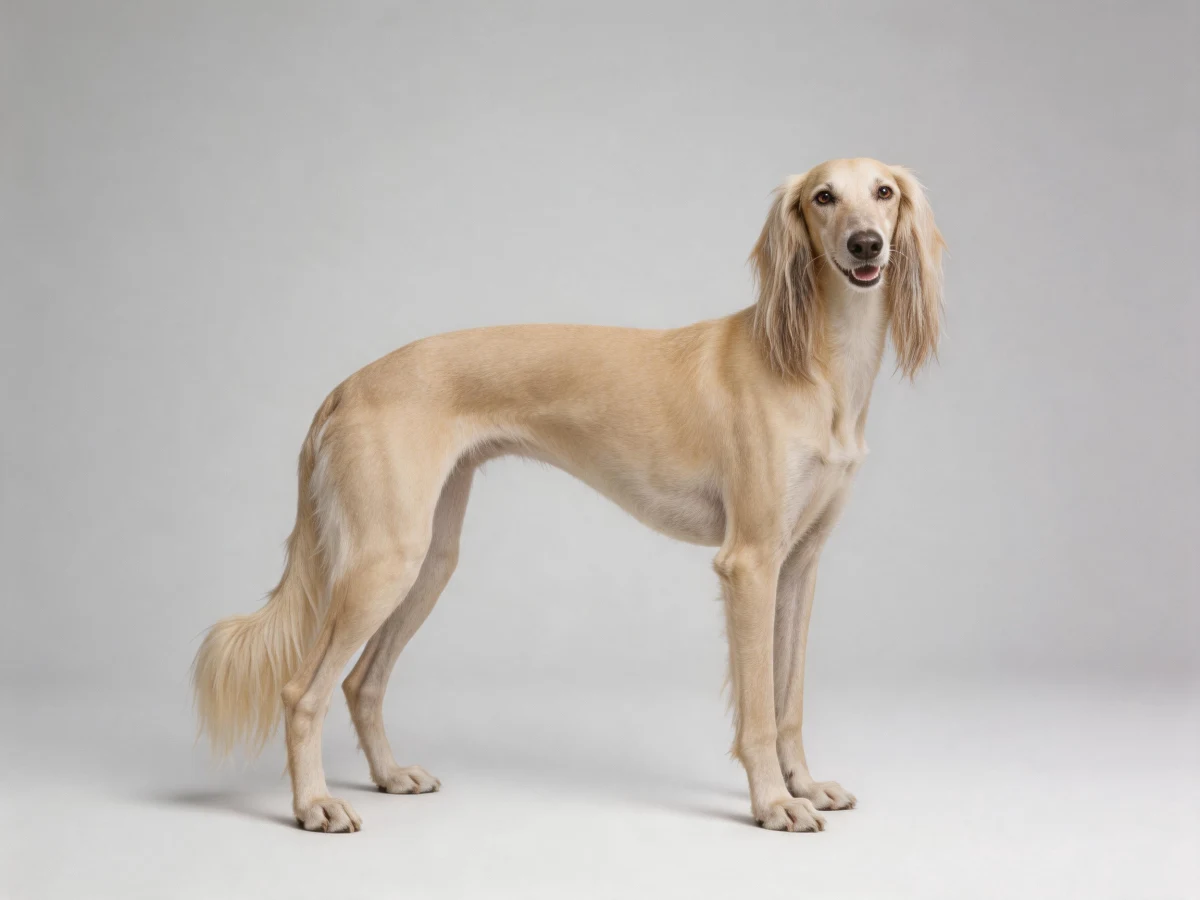
Chortai
✨ Key Takeaways
- A large, short-coated coursing sighthound of the southern Russian steppe, standing 66-76 cm (males) and weighing 18-35 kg, used by Cossack and steppe hunters to course hare, fox, and wolf across open ground -- often in the traditional style alongside raptors
- Distinct from the Borzoi (the Psovaya Borzaya) in every practical respect: short, dense, weather-hardy coat versus the Borzoi's long silky coat; steppe-working stamina dog versus aristocratic wolf-coursing specialist; Cossack village tradition versus landed estate kennel
- Named Hortaya Borzaya in Russian -- hortaya meaning short-haired, borzaya meaning swift or sighthound -- a name that directly contrasts the smooth coat with the silky Psovaya; the Western shorthand Chortai or Chortaj derives from khort, the old Slavic root word for sighthound
- Believed to descend from two now-extinct regional strains, the Krymskaja (Crimean) and the Gorskaja (mountain), shaped over centuries in the Don basin, Rostov region, North Caucasus and lower Volga; documented in Russian cynological literature from the mid-nineteenth century and first exhibited abroad in London in 1829
- Formally recognised by the Russian Kynological Federation (RKF), Russia's national kennel club and FCI member, under a standard first codified in 1950-1951 by Constantin Esmont and A.V. Lerche; not FCI-, AKC-, or KC-recognised -- stated plainly, not contested
- Robust and long-lived (13-15 years), with no documented breed-specific hereditary conditions; the deep-chested sighthound build creates a risk of bloat that is managed by split meals and no vigorous exercise around feeding time, and the sighthound physiology requires adjusted anaesthetic protocols
Quick Facts
Common Names & Variants
Modern aliases
Historical names
⚖️ Pros & Cons
Advantages
Trade-offs
Physical Appearance
Recognized colors
Other
Ears: Rose. Tail: Long, sabre-shaped, slight curve at tip.
🕰 History
A steppe sighthound that predates the Tsarist kennel by centuries
Long before the Borzoi became synonymous with Russian aristocracy, a shorter-coated, harder-built coursing hound ranged across the southern Russian grasslands — the vast open steppe that stretches from the lower Don and Rostov region through the North Caucasus foothills and down to the lower Volga. That dog is the Chortai, known in Russian as the Хортая борзая (Hortaya Borzaya), meaning literally the short-haired swift one, and its story is inseparable from the landscape that shaped it. Where the Borzoi was refined in the enclosed parks and managed woodlands of the northern nobility for dramatic wolf-coursing on horseback, the Chortai was a working dog of Cossack villages and steppe hunters, bred for the open plains and bred hard, not for spectacle.
Kievan Rus, the Cossacks and the two lost foundation breeds
The breed's ancestry reaches back to the Kievan Rus, the medieval East Slavic state, and likely further still into the continuum of short-coated Asian sighthounds that moved across the Eurasian steppe with nomadic peoples over millennia. The linguistic kinship alone makes the point: the Old Slavic word khort, the Lithuanian kurtas, and the Ukrainian khort all denote a sighthound, and they share roots with the broader family of steppe sight-hunting dogs that includes the Central Asian Tazy. The Chortai as a distinct type is believed to have been shaped from two now-extinct regional strains — the Krymskaja (Crimean sighthound) and the Gorskaja (mountain sighthound) — which were crossed with local hunting dogs and, over generations of selection for steppe conditions, produced the durable short-coated animal that became established across the Don basin and the North Caucasus.
By the nineteenth century the breed was well enough known to attract attention outside Russia: one was exhibited at the London Zoo in 1829 as a Russian Greyhound, and the first published descriptions in Russian cynological literature date from around the middle of that century. These early accounts consistently describe a dog distinct from the Borzoi — more athletic, less ornamented, coarser in coat, harder in condition — and suited to a different kind of hunting in a different kind of country. Where the Borzoi ran in matched pairs on the open wolf-coursing grounds of large landed estates, the Chortai worked in the manner typical of steppe hunting: slipped from horseback alongside a raptor, the hunter, the hound and the hawk working together across ground that offered no tree cover, no covert, no shelter from wind or heat.
Revolution, near-collapse and the Soviet rescue
The upheaval of the October Revolution in 1917 was devastating for Russian sighthound breeds. The aristocratic kennels that had sustained the Borzoi were destroyed or dispersed, and the more modest Cossack hunting tradition that had supported the Chortai was badly disrupted. In the chaotic decades after 1917 many working sighthound strains declined steeply, kept alive only in isolated villages and with individual hunters who saw the dogs as a practical hunting tool rather than a cynological heritage. The breed might have vanished entirely had it not been for the interest of Soviet-era specialists who documented the remaining types before they disappeared.
The key figure in the breed's survival was Constantin Esmont, a Soviet scientist who in the late 1940s set out to document the sighthound types he found in Cossack villages and steppe settlements. His fieldwork identified the Chortai as a distinct and viable breed that deserved formal recognition for its hunting value. He and his colleague A.V. Lerche prepared the first written breed standard, which was adopted in 1950–1951, and the breed received formal Soviet recognition at the 1952 Moscow Cynological Congress — an acknowledgement that these steppe hunting dogs formed a genuine, documentable, reproducible type. The standard's primary emphasis was practical rather than aesthetic: it evaluated dogs on their structure for endurance, their movement, and their working ability, not on show-ring points.
Regional types and the question of breed unity
One of the characteristics that makes the Chortai unusual among recognised breeds is its internal diversity. Five regional subtypes have been described, each adapted to its local landscape and hunting conditions — the dogs of the Don steppe differ in build and coat density from those of the North Caucasus or the lower Volga. This variation is a property of a genuine working landrace: over centuries, breeders selected for what worked in their specific terrain and against their specific quarry, rather than for a fixed show-ring type, and the result is a breed range rather than a single perfectly uniform template. The RKF standard sets parameters broad enough to accommodate this legitimate variation while preserving the core functional type, but this breadth is also why the FCI and the international kennel club world have not moved to recognise the Chortai under a single standard — a fact the RKF and the breed's supporters acknowledge candidly.
Recognition and the contemporary breed
Today the Chortai is maintained and recognised by the Russian Kynological Federation (RKF), Russia's national kennel club and an FCI member association. The RKF standard sets out the breed's structure, coat, and measurements, and registered breeding continues in Russia and, in small numbers, in Ukraine and neighbouring states of the former Soviet Union. The breed is not recognised by the FCI, the AKC, or the Kennel Club of Great Britain; this is not contested but stated plainly by the RKF itself, which has not submitted the breed for FCI recognition given the diversity among its regional types. First exports to western Europe took place around 2005, and the first recorded import to the United States followed in 2006. The global population outside the Commonwealth of Independent States remains very small — likely a few dozen dogs — and the breed is best understood as a living working landrace with a formal national standard rather than an internationally standardised pedigree breed in the AKC or FCI mould.
Temperament & Personality
Calm at rest, intent on the run
The Chortai has a temperament shaped by centuries of coursing work in the open steppe, and the two sides of that character are not hard to read. In the household, with sufficient exercise provided, the breed is calm, gentle, and undemanding — a quiet, settled presence that is not sharp, excitable, or nervy with its own people. It bonds closely to its family and is affectionate in the restrained way of sighthounds: not a velcro dog, but a dog that prefers to be in the same room, that greets its people with genuine warmth, and that objects to prolonged solitude. It is not aggressive toward humans by nature, and it is not a working guard.
The hunting side of the character is equally consistent. The Chortai was bred to detect quarry at long range by sight and to pursue it across open ground without handler direction — traits that translate directly into a strong, hardwired prey drive and a tendency to take its own decisions once a target is in view. A Chortai off the lead on open ground with a rabbit or a fox in sight is not responsive to a recall, and owners who understand this manage it as they would any other coursing sighthound: with secure fencing, long-lead exercise in open spaces, and respect for the instinct that the breed was built to express. This is not a fault but the design working exactly as intended.
Social character in pack and family
The breed worked traditionally in small coursing pairs rather than the large organised packs of French or English scent-hound tradition, and this is reflected in a social temperament that is generally easier with other dogs than the strongly pack-dominant scenthounds can be. Chortais kept together typically live amicably, and the breed's historical relationship with raptors — it worked alongside hawks and falcons in the traditional Russian and Central Asian hunting method — suggests a dog that can accommodate other working animals with the right early experience. With other dogs it is generally even-tempered rather than dominant, though the predatory response to small running animals is strong and cats or small pets in the household require careful management and early socialisation.
Intelligence and sensitivity
Sources consistently describe the Chortai as intelligent, alert, and trainable to a level above what the reputation of independent sighthounds might suggest. It picks up obedience exercises readily when training is consistent, fair, and reward-based, and it is not wilfully stubborn in the way some sighthound breeds can appear to inexperienced handlers. What it does not respond well to is harsh correction: it is a sensitive breed that reads its handler's mood accurately, that shuts down under pressure, and that works best for handlers who combine clear expectations with genuine patience. It is not recommended for first-time dog owners not because it is difficult but because it needs an owner who understands sighthound psychology — the combination of deep independence in the field and genuine sensitivity at home — and who will not mistake that independence for disobedience.
Trait Scores
All 1–5 ratings sourced from AKC breed traits. NULL = unrated for this breed.
Trainability & cognition
Personality
Activity & adaptability
Social compatibility
Grooming & physical
🏡 Living With a Chortai
Space and a secure perimeter — non-negotiable requirements
The Chortai is a large, fast, steppe-bred coursing hound and it cannot live comfortably without space and the ability to run. The non-negotiable requirement is a securely fenced area — and by securely fenced is meant genuinely secure: sighthounds read gaps and heights accurately, and a Chortai that catches a scent or a sight through an inadequate fence will test it. A garden or yard that would contain most dog breeds will not reliably contain a motivated Chortai. In the countryside with land and the opportunity for long off-lead runs in safe areas, the breed thrives; in a city flat without consistent access to exercise space, it will not be content. Urban living is possible for a committed owner who exercises the dog seriously every day, but it is not the natural habitat of this breed.
Exercise — quantity and type both matter
Daily exercise for a Chortai should include both structured on-lead walking and free galloping. The breed has the stamina of a working steppe hound — sources record it coursing hare across distances of several kilometres without flagging — and a brisk half-hour walk twice a day does not come close to meeting the physical need. Lure coursing, open-field running with a long lead or in a safely enclosed space, and participation in organised sighthound sports all suit the breed well. Exercise requirements remain high well into middle age; this is not a breed that becomes sedentary at five or six.
Household temperament
Within the home a well-exercised Chortai is a calm, unobtrusive companion. The breed is gentle with children it has been raised with and is not excitable or boisterous indoors. Its short coat makes it clean and low-odour in the house, and it does not tend to chew destructively when its physical needs are met. It is sensitive to cold and, unlike some of the desert sighthounds, carries a light undercoat that increases in winter — but it is not suited to outdoor kennelling in hard winters. A blanket or a raised dog bed indoors, with outdoor exercise regardless of weather, is the correct balance for this hardy but not impervious breed.
Other animals
The strong prey drive toward small, fast-moving animals means that the Chortai and cats or small pets are a combination that requires careful management. Many Chortais live with cats that have been present since the dog's puppyhood, but the introduction of unfamiliar small animals in adulthood carries real risk. Other dogs — particularly other sighthounds or larger breeds — are generally tolerated well. Small dogs may trigger prey responses and introductions should be managed thoughtfully.
🎓 Training & Exercise
A trainable sighthound with a steppe hunter's independence
The Chortai occupies an interesting position among sighthound breeds for trainability: described consistently as more tractable than many of its relatives, it picks up commands and obedience exercises more readily than its strongly independent coursing background might suggest. The breed worked in traditional steppe hunting in close partnership with its human and with a raptor, requiring a degree of cooperative responsiveness that pure greyhound-type speed breeds are not always asked to develop, and this history seems to have produced a dog that is genuinely willing when approached correctly. That said, it remains a sighthound, and the independence and self-reliance bred into it for autonomous field work does not switch off simply because training has begun.
How to train effectively
The single most important principle for training a Chortai is positive consistency. The breed responds well to reward-based methods — food treats, play, calm praise — and learns sequences and patterns readily when they are taught without pressure. It does not respond well to repetitive drilling that becomes tedious, and it does not respond at all to harsh correction: a Chortai that has been shouted at or physically corrected tends to disengage rather than comply, and rebuilding trust after that kind of handling takes patience. Short sessions, varied exercises, and a reward structure that makes learning feel like a productive game achieve results that punitive approaches never will with this dog.
Recall — the fundamental challenge
As with every coursing sighthound, recall is the skill that requires the most sustained and patient work. A Chortai in full coursing pursuit of a hare or a rabbit has its entire physiology committed to the chase and is not accessible to a verbal command in the way a herding breed or a retriever would be. The practical solution is not to expect reliable recall in open country with live quarry in view, but to build a strong recall response in controlled environments and to manage access to open spaces accordingly — long leads, securely fenced areas for off-lead running, and selective use of parks or fields after careful assessment of the risk of encountering small animals. For experienced sighthound handlers this is routine; for newcomers to the type it can come as a surprise.
Adolescence, socialisation and the adult character
Chortais are working-breed dogs and reach physical maturity relatively slowly. The adolescent period — broadly from six months to eighteen months — is the critical window for socialisation with people, other dogs, urban environments, and the domestic situations the dog will need to navigate as an adult. A Chortai puppy that is taken calmly and regularly through varied experiences in this period develops into a confident, adaptable adult. One that is kept too isolated during this window can become anxious or reactive in novel situations, and the strong prey drive, combined with that anxiety, produces an unreliable and difficult adult. Early and sustained socialisation is therefore not optional but the single most important investment an owner can make in the dog's long-term character.
✂️ Grooming & Coat Care
A low-maintenance coat by any measure
The Chortai's short, dense, smooth coat is one of the most practical aspects of owning the breed. It requires no clipping, no trimming, no stripping, and no specialist grooming appointment. The coat is roughly an inch in length, lies flat against the body, and carries a light undercoat that thickens slightly in winter — a sensible adaptation for a breed that ran in the Russian steppe where winters are harsh and summers hot. The same coat that protects the dog in the field sheds weather and mud readily and dries quickly after wet exercise, which makes the Chortai a cleanly practical dog to live with despite its size.
Brushing and coat care
Weekly brushing with a short-bristle brush, a rubber curry comb, or a grooming mitt is all the coat care this breed needs under normal conditions. During the spring and autumn moults — when the undercoat sheds and coat density adjusts to the coming season — more frequent brushing will remove the loose hair before it migrates to furniture and clothing, but even at peak moulting the volume is modest compared with a double-coated breed. Bathing should be done when the dog is genuinely dirty rather than on a fixed schedule; the coat is not prone to odour and the skin not prone to greasiness, so over-bathing is unnecessary and can dry out a coat that keeps itself in order naturally.
Ears, nails and teeth
The Chortai's semi-erect ears allow better airflow than the pendant drop ears of many scent hounds, reducing the risk of otitis externa, but the ears should still be checked weekly for debris, wax accumulation, or signs of redness and odour that might indicate infection. Nails should be checked monthly and trimmed as needed; a dog that runs regularly on hard surfaces will often wear its nails down naturally, but one kept on soft ground or grass will need more frequent trimming. Teeth are the often-neglected area: regular tooth brushing — daily if the dog accepts it, or at minimum twice weekly — substantially reduces the calculus build-up that leads to periodontal disease in middle and old age.
Post-exercise checks
For a breed that may run in scrub, long grass, or mixed terrain, a quick post-exercise check for ticks, grass seeds, and small cuts or abrasions is worthwhile. Grass seeds in particular can embed in the skin or migrate under it, and catching them early — they typically appear between the toes, in the ears, or at the axilla — prevents the kind of small abscess that requires veterinary attention to resolve. The short coat makes a visual and tactile check quick and straightforward.
🍖 Diet & Nutrition
An active breed with real caloric needs
The Chortai is a large, muscular, high-energy working sighthound, and its diet should reflect that. Feeding a dog of this type as if it were a sedentary companion breed — the same kibble quantity regardless of activity level, no adjustment through the seasons — will produce either an underweight animal that lacks stamina or, if the food is energy-dense, a dog carrying unnecessary weight on a frame not built to carry it. The starting point for any feeding plan is a high-quality commercial diet formulated for large, active breeds, with the actual daily quantity calibrated to the dog's body condition score rather than fixed at the manufacturer's guide figure. That guide figure is typically set for an average activity level; a Chortai exercised seriously every day may need more.
Meal frequency and bloat prevention
Because the Chortai's deep-chested sighthound conformation places it in the risk category for gastric dilatation-volvulus (bloat), meal management is a genuine health consideration rather than an arbitrary convention. The daily ration should be divided into at least two meals — morning and evening — rather than given as a single large serving. Vigorous exercise within an hour of either a substantial meal or a large drink of water should be avoided. A dog that eats quickly can be slowed with a puzzle feeder or a slow-feed bowl. These are simple adjustments that meaningfully reduce the window of risk for a condition that is fatal without emergency surgery.
Protein, fat and the working condition
A sighthound in working condition — lean, clean-flanked, with visible muscle definition but not visible ribs at rest — is fed differently from a show dog maintained on the heavier side. For an actively exercised Chortai, a diet with moderate to good protein content from identified meat sources, adequate fat for energy and coat quality, and a digestibility profile suited to a lean, active animal is the target. Raw feeding is common among working sighthound owners in Russia and eastern Europe, and there are pragmatic arguments for it in that context — access to slaughter offal and game meat from the hunting grounds themselves — but a well-formulated quality dry food achieves the same nutritional goals for owners without the infrastructure to feed raw safely. Whichever approach is taken, body condition should be checked by eye and hand weekly and the ration adjusted accordingly.
Puppies and growing dogs
Chortai puppies grow relatively quickly for a large breed, and rapid growth on an over-rich diet can stress developing joints and bone. A large-breed puppy formula — which moderates calcium and phosphorus ratios to support controlled skeletal development — is more appropriate than an adult working-dog formula for a Chortai under eighteen months. Protein should be adequate but not excessive; the aim is steady, even growth rather than the fastest possible gain. Puppies should receive three meals a day until around six months and two meals thereafter through adolescence and into adulthood.
🐶 Buying & Adopting a Chortai
A rare breed that requires a specific search
The Chortai is a genuinely rare breed outside Russia and the former Soviet states. Finding a reputable breeder in western Europe, North America, or Australia requires deliberate research and patience; this is not a breed available from general pet directories, and the buyer who approaches it expecting the ease of acquiring a popular AKC breed will be disappointed. First exports to western Europe took place around 2005, and the North American population remained very small as of the mid-2020s. The realistic routes to finding a puppy are direct contact with the Russian Kynological Federation (RKF) or with breeders advertising through eastern European sighthound clubs and specialist communities, combined with willingness to wait for the right litter and to import.
What a reputable breeder should offer
Responsible Chortai breeders — whether in Russia or in the small diaspora breeding programmes that have developed in western Europe — select breeding stock for both structural soundness and working ability, in keeping with the RKF standard's emphasis on functional performance rather than aesthetics alone. A good breeder will be willing to discuss the lineage and working history of both parents, will have evidence of health testing appropriate to the individual dogs (particularly for hip structure in an older breeding animal), and will ask questions of prospective buyers about the home environment, exercise provision, and prior experience with sighthound breeds. A breeder who asks no questions and offers immediate availability should be treated with caution.
The right home for a Chortai
The Chortai is not an appropriate first dog for an owner with no prior experience of sighthounds. Its combination of strong prey drive, need for significant daily exercise, sensitivity to harsh handling, and specific management requirements — particularly around recall and secure containment — are best managed by owners who already understand the sighthound temperament or who have thoroughly researched it and are prepared to apply what they have learned consistently. Active households with outdoor access, a securely fenced property, and ideally some experience in lure coursing or related sighthound sports are the natural fit. The breed can coexist in an urban environment with a committed owner, but that owner must be genuinely committed to daily serious exercise, not merely willing in principle.
Adoption and rescue
Given the breed's rarity outside its home countries, dedicated Chortai rescue in the western world is effectively non-existent. Sighthound rescue organisations in Russia and eastern Europe occasionally rehome Chortais, and general sighthound rescue groups in western countries may occasionally encounter one. For most buyers outside the former Soviet states, a puppy from a breeder willing to export is the only realistic option. Allow for import health checks, microchipping, vaccination certification, and any country-specific import requirements when planning an acquisition.
📜 Breed Name Etymology — iDogNames original research
Hortaya — the defining adjective
The Russian name Хортая борзая (Hortaya Borzaya) contains two distinct elements of which hortaya is the more characteristic. In Russian, hortaya (хортая) is an archaic adjective meaning short-haired or smooth-coated, and it distinguishes this breed directly and deliberately from the long-silky-coated Psovaya Borzaya — the breed known in English as the Borzoi, for which psovaya is the equivalent adjective meaning shaggy or silky-haired. The two terms thus form a deliberate contrast within the Russian sighthound taxonomy: the hortaya borzaya and the psovaya borzaya are the two primary Russian sighthound traditions, one smooth and steppe-bred, one silky and aristocratically bred.
Borzaya — the shared root
The second element, borzaya (борзая), is the Russian word for sighthound or swift dog, cognate with the adjective borzy (borzyi, быстрый), meaning fast or swift. The word borzaya is not specific to any one breed but generic to the whole Russian sighthound family, exactly as levrier is generic in French. What makes the combination hortaya borzaya a breed name rather than just a description is the qualifier hortaya, which specifies coat type within the broader category. This naming convention — [coat-type adjective] + borzaya — reflects the practical taxonomy of Russian hunting dogs, which classified sighthounds primarily by how the dog looked and performed rather than by region of origin or breeder.
Chortai and Chortaj — the Western spellings
The English form Chortai and the German-convention Chortaj are transliterations of khort (хорт), the old Slavic root word for sighthound from which hortaya also derives. Khort appears in Old Church Slavonic, Ukrainian (хорт), Lithuanian (kurtas), and Ruthenian, all denoting a coursing sighthound, and linguists have traced the root across the Slavic and Baltic language families as a word carried along the steppe trading and hunting routes. The forms Chortai and Chortaj are therefore informal anglicisations of this ancient root, used particularly in international sighthound communities as a more pronounceable shorthand than the full Russian name for a breed that most non-Russian speakers encounter without Cyrillic literacy.
Eastern Greyhound and South Russian Sighthound
Two English alias names appear in the historical literature: Eastern Greyhound, used by early European observers who encountered the breed and classified it within the broader greyhound family they knew from England and the Continent, and South Russian Sighthound or South Russian Steppe Hound, a descriptive geographical designation used in Soviet-era cynological writing to locate the breed within the regional typology of Russian hunting dogs. Neither has become the dominant international name; the full Russian name Hortaya Borzaya, abbreviated Chortai or Chortaj, is now the standard outside Russia.
Name forms at a glance
| Name | Role | Origin | Literal meaning | First recorded |
|---|---|---|---|---|
| Hortaya Borzaya | primary | Russian | the short-haired swift one; the smooth-coated sighthound | 1951 |
| Borzaya (Борзая) | alias | Russian (from Old Slavic borzy, swift) | the swift one; sighthound (generic term) | — |
| Khort (Хорт) | origin country native | Old Slavic / Ukrainian / Lithuanian | sighthound (ancient Slavic root) | — |
| Chortai / Chortaj | alias | English / German (Western transliterations) | Western shorthand for the Hortaya Borzaya, used in international sighthound communities | — |
| Eastern Greyhound | historical | English (early European observer usage) | a greyhound-type sighthound from the eastern steppe | 1829 |
🏛 Naming Traditions — iDogNames original research
Steppe, speed, and the open landscape
Chortais have traditionally carried names that reflect the steppe world they worked in — the vast, open, wind-swept grasslands of southern Russia that define both the breed's origin and its character. Russian hunters named their coursing dogs for qualities directly valued in the field: speed, endurance, keenness of eye, the ability to course without wavering. Names like Buran (snowstorm), Veter (wind), Sokol (falcon — their traditional hunting partner), and Molniya (lightning) appear across the historical literature of Russian steppe hunting, and they communicate instantly what the naming culture valued. These are not pet names but working epithets that a dog earns and carries as a description of what it does.
For owners outside Russia, both the traditional Russian naming register and a broader sighthound or Eastern European naming tradition offer rich material. Names drawn from the steppe landscape, from Russian and Ukrainian words for speed, wind, wildness, and open country, and from the Slavic and Turkic cultural world that surrounds the breed all sit naturally on a Chortai. The themed name lists that follow develop these directions in practical detail.
🐾 Themed Names for Your Chortai — iDogNames original research
Russian steppe and nature names
The open steppe, its weather, and its wildlife give the Chortai its most authentic naming register.
- Buran — Russian for blizzard or snowstorm; the violent winter storms of the southern steppe that this breed was built to work in
- Veter — Russian for wind; a name for a swift, light-footed dog
- Sokol — Russian for falcon; the Chortai's traditional hunting partner in the Russian style of coursing
- Oryol / Orel — Russian for eagle; a regal name for a keen-sighted hound
- Stepa — from step (steppe), the open grassland world the breed was made for
- Volna — Russian for wave; for a dog with an effortless, rolling gallop
- Zoloto / Zola — gold; for a fawn or cream-coated Chortai
- Snezhok / Snezhka — snowflake (male / female); for a white dog
- Tumba — Russian steppe word for a rounded hillock; a compact, affectionate name
- Don — the great river of the southern Russian steppe and the breed's heartland
Speed and coursing names
Names that speak directly to the breed's defining quality — the explosive burst across open ground in pursuit of hare or fox.
- Molniya — Russian for lightning; a name that needs no explanation on a coursing sighthound
- Strela — arrow; for a dog that runs in a straight, driven line
- Bystry / Bystra — Russian for swift (male / female form); the closest Russian equivalent of the idea baked into the word borzaya
- Vykhr / Vikhr — whirlwind; for a dog with explosive acceleration
- Grom — thunder; a name for a powerful, confident coursing dog
- Raketa — rocket; a playful modern name in the same speed tradition
- Zarya — dawn, sunrise; for a dog with a golden or amber-tinted coat
- Beg — Russian for run or race; simple and direct
History and culture names
Names that draw on the Cossack, steppe, and East Slavic world that produced and sustained this breed.
- Ataman — the Cossack term for a chieftain or leader; a strong, authoritative name
- Kazak / Kazachka — Cossack (male / female); the cultural world that maintained the Chortai through the post-revolutionary years
- Rostov — the southern Russian city and region central to the breed's homeland
- Khort — the ancient Slavic root word for sighthound from which the breed's name derives
- Tamara — a Caucasian Georgian royal name, reflecting the North Caucasus region that is part of the breed's territory
- Rurik — the legendary founder of the first East Slavic dynasty; a name for a dog of ancient lineage
- Orda — from horde; referring to the nomadic steppe peoples whose sighthound traditions contributed to the Chortai's ancestry
- Bayan — a legendary Slavic bard; a gentle name for a calm, expressive dog
- Lada — an old Slavic goddess of beauty and harmony; a feminine name for a graceful female
Coat and appearance names
The Chortai comes in a wide range of colours — the breed standard imposes no colour restriction — and coat colour names are a natural source of names.
- Sable / Sobol — for the dark sable-coloured dogs; sobol is the Russian word for sable (the animal), important in the steppe fur trade
- Ryzhik — Russian diminutive for red-haired; a warm, affectionate name for a red or rufous dog
- Tchorny / Tchorna — Russian for black (male / female); direct and descriptive
- Belka — squirrel in Russian; also a diminutive of white (bely); a name for a white or pale cream dog
- Tigr — tiger; for a brindle-coated dog with striking dark striping
- Mramor — marble; for a pied or piebald dog with striking patches
More Russian heritage names
- Russian Trail - best for a Chortai name rooted in Russia rather than generic style
- Southern Russian steppe — Don basin, Rostov region, North Caucasus, lower Volga Ridge - best for a regional landscape cue tied to the Chortai story
- Local Line - best for a name that respects local breed history
- Old Route - best for migration, trade, field or pastoral routes behind the breed
- Heritage Note - best for a page where origin should be treated as context, not decoration
- Village Path - best for rustic, local or landrace-style background
- Working Home - best for a dog whose name should remember Open-steppe coursing sighthound: hare, fox, and wolf; hunted traditionally in pairs alongside raptors by Cossa
- Country Mark - best for a concise country-of-origin cue
More work and purpose names
- Longstride - best for a Chortai with open-ground running style
- Windline - best for speed, outline and sighthound grace
- Secure Run - best for a dog that needs fenced speed outlets
- Slip Lead - best for careful handling around sudden movement
- Harepath - best for coursing history used with context and caution
- Lean Arrow - best for a slim athletic dog
- Quiet Chase - best for naming prey interest without encouraging risk
- Recall Field - best for training that must be proven before freedom
More coat and build names
- White - best for a Chortai whose color or markings deserve a simple call name
- Short, Dense, Smooth, Flat-lying Coat - best for the short, dense, smooth, flat-lying coat type on this breed
- White Blaze - best for a clear face or chest marking
- Dark Mask - best for a dog with a strong muzzle or face marking
- Weather Coat - best for outdoor or working-dog coat context
- Strong Frame - best for a dog whose build is part of its function
- Bright Eye - best for an alert expression
- Ground Step - best for a name tied to movement and body type
📋 Breed Standard at a Glance
RKF standard — structure and purpose
The Chortai is maintained under the Russian Kynological Federation (RKF) standard, which reflects the breed's identity as a functional working sighthound first and a show breed second. Unlike many modern kennel club standards in which physical type is the primary concern, the RKF Chortai standard was developed in 1950–1951 by specialists who had observed the breed in the field, and it retains a performance emphasis: a dog assessed against the standard is evaluated on its structural capacity for endurance, its gait, and its overall athletic build, as well as its coat and measurements.
Size and measurements
Males stand 66 to 76 centimetres at the withers and weigh in the range of 18 to 35 kilograms; females stand 60 to 71 centimetres. This is a notably wide range by the standards of most internationally recognised breeds, reflecting the legitimate internal variation across the breed's five regional subtypes. The build is consistently described as lean and sinewy — a long, flexible body with flat bones, a long neck not carried vertically, fine angulation, and a well-tucked abdomen. The tail is long and sabre-shaped with a slight curve at the tip.
Head, ears and expression
The head is relatively small in proportion to the body, with a long, tapering muzzle. The eyes are large, oval, and slightly oblique — a feature common across the Eastern sighthound family. The ears are small and narrow, set at or below eye level, and carried in a rose formation similar to the Greyhound and Borzoi ear carriage.
Coat
The coat is short, dense, and flat-lying, approximately 2.5 centimetres in length, with a light undercoat that thickens in winter. The standard permits all coat colours and patterns; the breed is not colour-restricted, and common presentations include white, cream, black, red, sable, brindle, and combinations of these.
Recognition status
The Chortai is recognised by the Russian Kynological Federation (RKF). It is not recognised by the FCI, the AKC, the Kennel Club of Great Britain, or the UKC. The RKF has not submitted the breed for FCI recognition, partly because the breadth of variation among the regional subtypes does not readily reduce to the single fixed standard that FCI recognition requires.
🏆 Recognition
Other registries
❓ Frequently Asked Questions
What is a Chortai's temperament like?
The Chortai is calm and gentle at home and driven and focused in the field -- two sides of a coursing sighthound character that are fully consistent with each other once understood. With its own people the breed is affectionate, quiet, and undemanding: it is not sharp, nervous, or boisterous indoors, and it bonds closely to its family without requiring constant attention. With strangers it tends to be reserved rather than effusive -- a sighthound trait -- but not aggressive. In the field the same dog becomes intensely focused on prey, running with full commitment and very little responsiveness to a recall command once a hare or a fox is in view. The practical implication is that the Chortai needs an owner who provides substantial daily exercise, manages off-lead time in open country carefully, and understands that the prey drive is not a training failure but the breed's core working design.
How big does a Chortai get?
The Chortai is a large sighthound. Under the Russian Kynological Federation (RKF) standard, males stand 66 to 76 centimetres at the withers and females 60 to 71 centimetres, with a weight range of approximately 18 to 35 kilograms -- a notably wide range that reflects genuine variation across the breed's five regional subtypes. The build is lean and sinewy rather than heavy: a long, flexible body with flat bones, a deep chest, a well-tucked abdomen, and fine angulation. The overall impression is of a large, athletic, economically built dog -- more muscular and weather-hardy than a Greyhound but without the bulk of a working guard breed.
What health problems do Chortais have?
The Chortai is a robust breed with no documented breed-specific hereditary conditions and a lifespan that commonly reaches 13 to 15 years -- above average for a large dog. The most significant health concern for any owner to understand is gastric dilatation-volvulus (bloat): the deep-chested sighthound build places the Chortai in the structural risk category for this acute and potentially fatal condition, managed by splitting the daily ration into two meals and avoiding vigorous exercise immediately before or after feeding. As a sighthound the breed is also sensitive to barbiturate anaesthetics, and any veterinarian treating the dog in an emergency should be informed it is a sighthound requiring adjusted protocols. Routine preventive care -- vaccinations, dental hygiene, parasite control, and annual checks -- covers most of the health agenda. This is general educational information, not veterinary advice.
How much exercise does a Chortai need?
The Chortai needs substantial daily exercise and will not thrive on a pair of short lead walks. This is a working steppe sighthound with the stamina of a dog bred to course game across several kilometres of open ground, and its exercise requirement reflects that history. Daily exercise should include both structured on-lead walking and the opportunity for free galloping in a safely enclosed or open-country environment. Lure coursing, sighthound racing, and long rural runs are natural outlets for the breed. A securely fenced garden or yard that allows the dog to move freely is valuable, but it does not substitute for active exercise that works the cardiovascular system. Exercise requirements remain high well into middle age.
How much grooming does a Chortai need?
Very little. The Chortai's short, dense, flat-lying coat is one of the most low-maintenance coats among large sighthound breeds -- it requires weekly brushing with a rubber curry comb or short-bristle brush, occasional bathing when genuinely dirty, and more frequent brushing during the spring and autumn moults to clear the loose undercoat before it reaches furniture. There is no clipping, trimming, or stripping. The coat is not prone to odour or greasiness and dries quickly after outdoor exercise. The weekly ear check, monthly nail inspection, and routine teeth brushing complete the grooming schedule -- none of it is time-consuming, and all of it is straightforward for an owner without specialist grooming experience.
Does the Chortai have prey drive?
Some Chortai lines or individuals may show strong chase, scent or hunting interest because of Open-steppe coursing sighthound: hare, fox, and wolf; hunted traditionally in pairs alongside raptors by Cossa. Owners should use secure exercise, recall practice and careful management around wildlife or small pets instead of assuming drive will disappear.
📚 Sources & Further Reading
Every load-bearing factual claim on this page is anchored to one of the sources below. iDogNames does not synthesize from secondary aggregators.
- breed club official Russian Kynological Federation (RKF) — official breed authority for the Chortai — Russian Kynological Federation (RKF) (2024)
- wikipedia Chortai -- Wikipedia — Wikipedia
- other The Chortai -- National Purebred Dog Day — National Purebred Dog Day (2019)
- breed club official The Hortaya Borzaya -- The Academic Hound — The Academic Hound (2023)
- other Chortaj: Character and Ownership -- DogBible — DogBible.com (2024)
- other Hortaya Borzaya -- Petguide — PetGuide.com (2023)
- book The New Encyclopedia of the Dog — Dorling Kindersley (2000)
- veterinary org Gastric Dilatation-Volvulus (Bloat) in Dogs — Merck Veterinary Manual (2024)
- veterinary org Anaesthesia of Sighthounds -- considerations and protocol adjustments — Merck Veterinary Manual (2024)