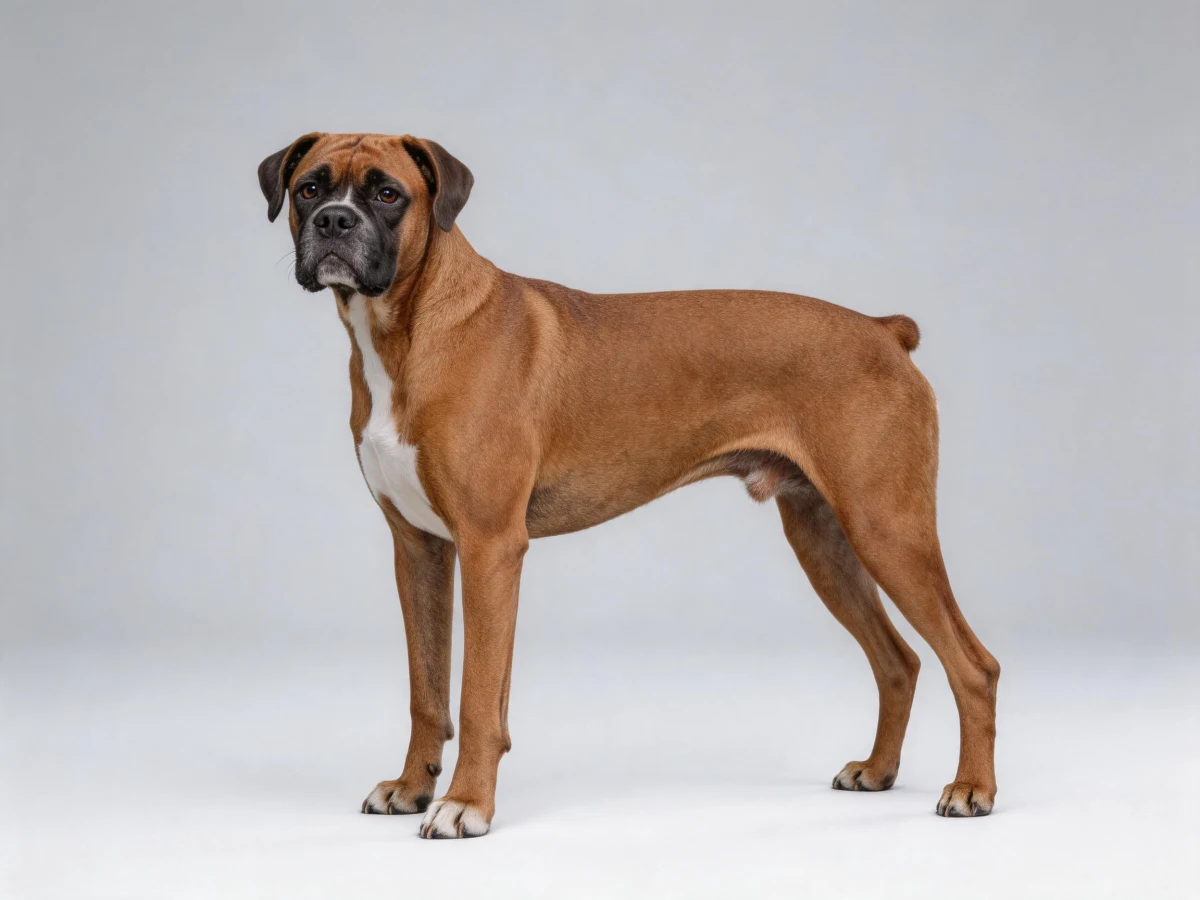
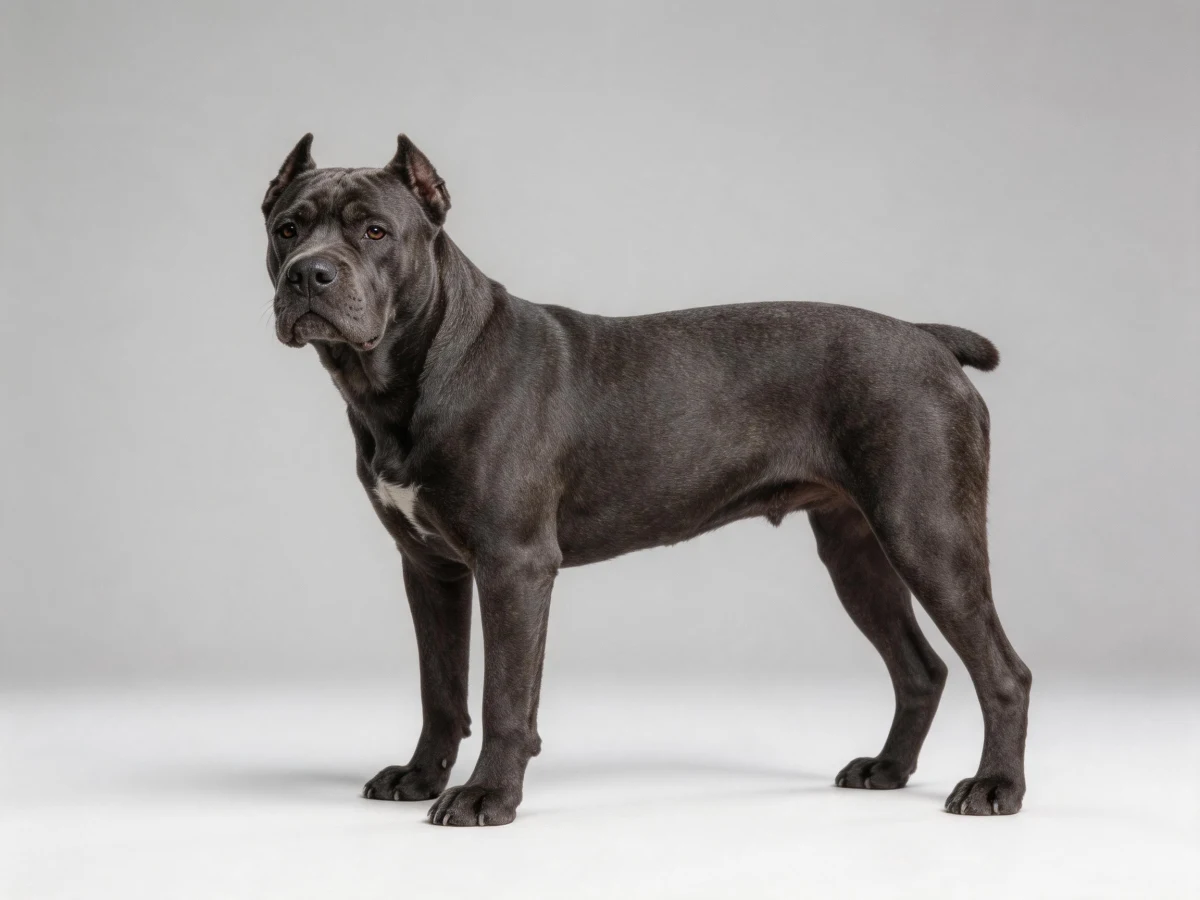
American Bulldog
✨ Key Takeaways
- The American Bulldog descends from the Old English working bulldog brought to the colonies; in the rural American South it served for two centuries as a catch dog for cattle and feral hogs, a stock dog, and a farm guardian.
- The breed nearly died out after World War II and was revived from scattered Southern stock by John D. Johnson and Alan Scott in the mid-twentieth century.
- The Johnson (Classic / Bully) type is larger, heavier-boned and shorter-muzzled; the Scott (Standard / Performance) type is leaner and more athletic; most dogs today blend the two bloodlines.
- It is recognised by the UKC (1 January 1999) and entered the AKC Foundation Stock Service in November 2019 (NOT full AKC recognition); the FCI does not recognise the breed.
- The defining health story is two serious recessive diseases that both have a direct DNA test: ichthyosis (NIPAL4) and neuronal ceroid lipofuscinosis (NCL10, CTSD); a careful breeder eliminates both by testing parents.
- This is a confident, intensely loyal, family-affectionate but assertive and powerful guarding breed that needs an experienced, active owner and thorough early socialisation; it is not a low-effort first-time dog.
Quick Facts
Common Names & Variants
Modern aliases
Historical names
Modern variants & lines
⚖️ Pros & Cons
Advantages
Trade-offs
Physical Appearance
Recognized colors
Coat
Other
Ears: Drop/rose/cropped. Tail: Natural (low-set pump-handle).
🕰 History
A working bulldog, not a show bulldog
The American Bulldog is what the English bulldog used to be before the show ring redesigned it. The breed descends from the Old English Bulldog, the athletic, functional working dog of pre-Victorian Britain that was used to bait and, more usefully, to drive and catch cattle and other large stock. When bull-baiting was outlawed in Britain in 1835, the sporting bulldog lost its public purpose, and in England the type was gradually bred down into the short-faced, heavy, exaggerated companion that the modern English Bulldog became. The working bulldog did not vanish, though — it had already crossed the Atlantic with ordinary working-class immigrants, who valued it not as a spectacle but as a tool, and on the small farms and ranches of the American South it kept doing the job it had always done.
The catch dog of the Southern frontier
In the rural South the bulldog became a genuine all-purpose utility animal. Its single most important job was as a catch dog: a powerful, fearless dog that could grip and hold large, dangerous, semi-feral animals long enough for a handler to reach them. The animal that made this skill indispensable was the feral hog. Pigs released into the woods by early colonists had gone wild and multiplied into destructive, formidable razorbacks, and catching them by hand was impossible without a dog that would seize a boar by the ear or snout and not let go. The same dog guarded the homestead, drove and held cattle, and dispatched vermin. For roughly two centuries this was a landrace rather than a breed in the modern sense — bred for function by farmers who never kept a stud book, varying farm to farm, selected by what worked.
Near-extinction after the Second World War
The American utility bulldog very nearly died out in the middle of the twentieth century. Mechanisation, the spread of fencing, changes in farming, and above all the upheaval and population shift around the Second World War stripped away the working niche the dog had filled, and by the late 1940s the old Southern bulldog survived only in scattered pockets, mostly in the backcountry of the Deep South. It was at this point, by the breed’s own well-documented history, that two men are credited with saving it.
Johnson, Scott, and the two types
John D. Johnson of Georgia, whose family had bred the dogs for generations, set out after the war to find and preserve the best surviving specimens, travelling the back roads of the South to locate sound working stock. A younger breeder, Alan Scott, became interested in Johnson’s dogs and worked alongside him for a time, drawing in additional working farm bulldogs from across the South. The two men ultimately diverged in what they wanted, and that divergence created the breed’s defining split. Johnson favoured a larger, heavier, more powerfully built dog with more bone and a shorter, more bulldog-like head, and to get it he is said to have crossed in an athletic English bulldog that had retained its pre-ban vigour; his line became the Johnson, Classic, or Bully type. Scott kept to a leaner, faster, longer-muzzled, more athletic performance dog closer to the old catch-dog template; his line became the Scott, Standard, or Performance type. Most American Bulldogs alive today are hybrids that blend the two bloodlines to varying degrees, and a buyer will hear all of this vocabulary used loosely.
Recognition without losing the job
The United Kingdom is not where this breed was finished; the United States is. The breed was recognised by the National Kennel Club and later, on 1 January 1999, by the United Kennel Club, which is the registry whose written standard most owners and breeders treat as authoritative. In November 2019 the American Kennel Club admitted the American Bulldog to its Foundation Stock Service — the recording program that is a first step toward, but is explicitly not, full AKC recognition. The breed is not recognised by the Fédération Cynologique Internationale. The throughline from the colonial catch dog to the modern dog is unusually unbroken: unlike its English cousin, the American Bulldog was never pulled into a closed show ring early enough to be redesigned away from its work, and the breed’s culture still prizes the athletic, functional, working animal over an exaggerated one.
Temperament & Personality
Confident, devoted, and bonded to its family
The American Bulldog’s core temperament is best described in three words the breed clubs themselves use: confident, loyal, and affectionate. With its own people this is a famously devoted dog — deeply attached to the family, gentle and patient with the children it is raised with, and so people-oriented that it often behaves as though it does not know its own size, leaning, lap-sitting, and following its owner from room to room. The breed’s history as a homestead guardian gave it a natural watchfulness, and a well-bred American Bulldog channels that into steady, undramatic protectiveness rather than nervous reactivity. It is, with its family, an emotionally warm and engaged companion, not an aloof one.
Assertive, strong-willed, and not for everyone
The flip side of that confidence is that this is an assertive, strong-willed, powerful dog that requires a capable owner. The American Bulldog can be naturally standoffish or reserved with strangers — the standard tolerates a degree of this, especially in young dogs — and its guarding instinct, combined with its strength and its prey and catch drive toward smaller running animals, means it is not a dog that raises itself. An under-socialised, under-led American Bulldog can become territorial, dog-aggressive, or pushy, and at this size those faults are not cosmetic. This is squarely a breed for an experienced, active owner who is comfortable being a calm, consistent leader; it is a poor match for a first-time owner who wants a low-effort pet, and several insurers and rentals treat it as a restricted breed.
Socialisation is the whole ballgame
More than almost any temperament trait, what determines whether an American Bulldog is a wonderful family dog or a liability is early, broad, and continuous socialisation. A puppy thoroughly exposed in its first months to many people, other dogs, novel places, traffic, handling, and ordinary household chaos grows into the stable, confident dog the breed is supposed to be. The same dog left isolated grows suspicious and over-reactive. Because the breed bonds so hard and reads its handler so closely, it responds extremely well to that early investment — but the investment is not optional. Responsible breeders temperament-test their lines precisely because soundness of mind matters more in a powerful guardian breed than in almost any other kind of dog.
The honest summary
Described plainly and without either sentimentality or alarm: the American Bulldog is a big, brave, intensely loyal family dog with a guarding heritage and a working drive, that rewards an experienced, committed owner with one of the most devoted companions in dogdom, and punishes a careless one. It is neither the cartoon menace its appearance suggests to strangers nor a soft lapdog; it is a serious working breed that happens also to be exceptionally affectionate with its own people.
Trait Scores
All 1–5 ratings sourced from AKC breed traits. NULL = unrated for this breed.
Trainability & cognition
Personality
Activity & adaptability
Social compatibility
Grooming & physical
🏡 Living With a American Bulldog
A powerful athlete that needs a real job
An American Bulldog is a large, muscular, high-drive working dog, and the single biggest mistake owners make is treating it as a lazy bulldog. It is not the English Bulldog; it is athletic, fast over short distances, and built to work all day. An adult needs substantial daily exercise — on the order of an hour or more — combining a real walk or jog with vigorous play, tug, fetch, and ideally a structured outlet such as weight pull, spring-pole work, scent games, or obedience and agility. A bored, under-exercised American Bulldog is a destructive one: this is a dog with the jaw strength to demolish furniture and the energy to do it. Mental work matters as much as physical — the breed is happiest with a job and a routine.
Space, climate, and the drool-and-shed reality
The breed does best in a home with a securely fenced yard; the fence needs to be solid, because a determined American Bulldog is strong, and some are climbers and jumpers. It can adapt to a smaller home if the exercise need is genuinely met, but this is not naturally an apartment dog. The short coat handles cold moderately but offers little insulation, and because the breed runs to a broad, somewhat shortened muzzle in the heavier Johnson type, hot and humid weather warrants care — exercise in the cool of the day and always provide shade and water, though the breed tolerates heat far better than a flat-faced English or French Bulldog does. Owners should also expect drool, especially from the loose-lipped Johnson type, and steady year-round shedding of the short coat.
Children, other animals, and the multi-pet question
Raised with them, an American Bulldog is typically excellent with its family’s children — tolerant, gentle, and protective — though its sheer size and exuberance mean toddlers should always be supervised so a happy dog does not bowl a small child over. With other dogs the picture is more cautious: the breed can be same-sex dog-aggressive, and its strong prey and catch drive can make it unsafe with cats and small pets unless raised with them from puppyhood and managed carefully. Early socialisation improves all of this but does not erase the instinct, and a sensible owner manages introductions and never leaves a powerful guarding breed unsupervised with unfamiliar animals.
Time, leadership, and not being left
This is a dog that wants to be with its people and does poorly shut out in a yard or left alone all day; isolation breeds anxiety, destructiveness, and exactly the over-reactivity the breed is criticised for. The ideal household is an active one that includes the dog in daily life, provides firm and consistent (never harsh) leadership, and has the time and physical capability to exercise and train a strong dog every day. Match that, and the American Bulldog repays it with extraordinary devotion; fail to match it, and the breed’s size and drive make the mismatch a genuine problem.
🎓 Training & Exercise
Smart, willing, and wired to work with you
The American Bulldog is an intelligent, capable dog that trains well in the right hands. Its working heritage as a catch and guard dog selected for biddability toward its handler under pressure, so the raw material is excellent: the breed is quick to learn, food-motivated, and genuinely eager to please the person it is bonded to. Started early and led consistently, an American Bulldog can reach a high standard of obedience and excels at structured canine sports — obedience, weight pull, agility, dock diving, and protection sports among them. The intelligence is real; the challenge is the will that comes attached to it.
Firm, calm, consistent — never harsh
This is a strong-willed, assertive breed that will test boundaries and, with a soft or inconsistent owner, will happily take charge of the household. It needs a handler who is calm, confident, and unwavering about the rules from puppyhood. The mistake to avoid in both directions: being too permissive lets a powerful dog learn it can ignore you, while being harsh or punitive backfires badly, because the American Bulldog is sensitive to its handler and meeting a guarding breed with force can damage the bond and provoke defensiveness rather than respect. Reward-based methods — clear rules, generous food and praise, firm follow-through, and absolute consistency — are what actually work. Leadership here is about steadiness, not domination.
The non-negotiables: socialisation, recall, and impulse control
Three training priorities matter more for this breed than the tricks. First, the early socialisation already described is itself the most important training a young American Bulldog receives. Second, a reliable recall and a rock-solid “leave it” are safety-critical in a dog with prey drive and the physical power to do damage if it bolts after another animal. Third, impulse control — a settled wait, calm greetings, no pulling on lead, no mouthing — turns a strong dog into a controllable one. Puppy class started early, then ongoing training through adolescence (which in this breed is a real, boundary-pushing phase), builds the manners that keep a big guarding dog welcome in public. The breed’s strength makes loose-lead walking and a dependable recall not optional niceties but the foundations of responsible ownership.
Adolescence: the make-or-break stretch
The American Bulldog goes through a long, physical adolescence, roughly from six months past the first birthday, in which a previously biddable puppy tests every boundary it has and gains the adult strength to make that testing felt. Owners who let training lapse here — figuring the foundation is laid — often find a powerful teenager that pulls, ignores recall, and barges through doors and gates. The fix is to keep training active and consistent right through this phase, reinforcing the rules calmly and rewarding the dog for getting them right, so that the adult that emerges on the far side is the controllable, confident companion the breed should be rather than a strong dog that has learned it can win.
✂️ Grooming & Coat Care
The easiest thing about the breed
If grooming is the defining burden of an American Cocker Spaniel, it is the defining relief of an American Bulldog. The short, close, smooth single coat is genuinely low-maintenance: a quick once-over with a rubber curry brush or grooming mitt once or twice a week lifts the dead hair, distributes skin oils, and keeps the coat clean and gleaming. The breed sheds steadily year-round rather than in dramatic seasonal blowouts, and regular brushing is what keeps that shed hair off the furniture. Bathing is occasional — every couple of months, or when the dog is genuinely dirty — because over-bathing strips the coat and can aggravate the breed’s sometimes-sensitive skin. For most owners the entire coat-care routine is a few minutes a week.
Skin and wrinkles: where the real attention goes
What the American Bulldog trades for an easy coat is a need for skin attention. The breed is prone to allergies and skin conditions, and the heavier Johnson type carries facial wrinkles and a deeper muzzle that hide moisture and debris. Any folds on the face should be wiped clean and dried regularly to head off the bacterial and yeast irritation that warm, damp skin invites. Owners of heavily white dogs need to watch for sun damage on thin-haired pink skin and use shade and, where a vet advises, canine sun protection. Routine skin checks — for hot spots, rashes, flaking, or the early flaking of ichthyosis — let problems be caught while they are small.
Ears, drool, nails, and teeth
The drop or rose ear should be checked weekly and cleaned with a vet-recommended product as needed, and dried after swimming, since any hanging ear traps some moisture — though the American Bulldog is nowhere near as ear-prone as a long-lobed spaniel. The loose-lipped Johnson type drools, so a household with one keeps a towel handy and wipes the lip folds. Strong nails on a heavy, hard-charging dog grow fast and should be trimmed every couple of weeks before they click on the floor or splay the foot. Teeth should be brushed several times a week from puppyhood. None of this is demanding: the American Bulldog is, overall, one of the lower-maintenance large breeds to keep looking and feeling good, with skin care — not coat care — being the one place an owner genuinely has to pay attention.
The weekly routine, start to finish
Put together, caring for an American Bulldog is a short, dependable weekly rhythm rather than a chore. Run a rubber curry brush or grooming mitt over the coat once or twice a week; wipe and dry any facial folds and the lip area on the heavier Johnson type; glance in the ears and clean them when needed; check the white skin for sun damage, hot spots, or flaking; trim the nails every couple of weeks; and brush the teeth several times a week. A full bath comes only every couple of months or when the dog is genuinely dirty. The breed is, on the whole, one of the lower-maintenance large dogs to keep in good condition — the attention simply shifts from the coat, which needs almost nothing, to the skin, which needs watching.
🍖 Diet & Nutrition
Feeding a large, muscular, active dog
The American Bulldog is a big, densely muscled, athletic dog, and its diet has to support that frame without letting it run to fat. A complete, balanced food appropriate to the dog’s life stage and built around quality animal protein suits the breed well; an active adult American Bulldog burns real calories and needs enough fuel to hold muscle and condition. The amount varies widely with the individual dog’s size, type (a heavy Johnson eats more than a lean Scott), age, and workload, so portions should be set by the dog’s ideal body condition and adjusted over time rather than fixed to a bag’s generic chart. Most adults do best on two measured meals a day rather than one large one or free-choice feeding.
Large-breed puppy growth done carefully
Puppy feeding is the part that rewards getting right. As a large breed, the American Bulldog should be raised on a diet formulated for large-breed puppies, with controlled calcium and energy so the puppy grows steadily rather than explosively. Pushing a large-breed puppy to grow as fast and big as possible — overfeeding, over-supplementing — loads developing joints and is associated with orthopaedic problems including the hip and elbow dysplasia the breed is already predisposed to. The goal is a lean, slowly-grown puppy, fed several small meals a day when young and settling to twice daily, with growth managed by body condition rather than by maximising size.
Lean is the whole point, plus a bloat note
Across the dog’s life, keeping an American Bulldog lean is the most valuable nutritional thing an owner does: excess weight strains the joints of a heavy dog, raises the cruciate-injury risk in an athlete, and shortens life. Feed measured meals, body-condition-score by feeling for ribs and a waist, and budget treats inside the daily calories rather than on top of them. As a deep-chested large breed, the American Bulldog carries some risk of gastric dilatation-volvulus (bloat), so the common-sense precautions apply — avoid heavy exercise right around large meals and consider splitting the daily ration into two feedings. Fresh water should always be available, and any diet questions tied to the breed’s skin, allergy, or joint issues belong with a veterinarian rather than a feeding chart.
Skin, allergies, and the diet connection
One breed-specific wrinkle is worth flagging: the American Bulldog is prone to allergic and atopic skin disease, and food can be part of the picture. A dog with chronic itching, recurrent ear or skin infections, or flaking that does not resolve with routine care should be worked up by a veterinarian, who may trial a controlled elimination diet to rule a food component in or out. This is a medical question rather than a feeding-chart one, and well-meaning over-supplementation or constant food-switching usually makes things harder to diagnose, not better. Feed a consistent, complete diet, change it gradually over about a week when you do, keep treats modest and inside the calorie budget, and take any persistent skin or gut problem to the vet rather than the pet-store aisle.
🐶 Buying & Adopting a American Bulldog
Start with a health-testing breeder, not a yard ad
Because the American Bulldog is a powerful guarding breed with two serious recessive diseases in its gene pool, where you get one matters enormously. The right starting point is a breeder connected to a recognised breed registry or club — the United Kennel Club, the National Kennel Club, or the American Bulldog Association — who breeds for sound temperament and health rather than for size, “rare” colour, or an exaggerated head. The breed’s popularity, intimidating looks, and use as a status dog have attracted a great many careless and backyard breeders, and a poorly bred American Bulldog — unstable in temperament, unscreened for disease, or both — is a far bigger problem in a strong guardian than in a small companion breed. This is a breed where provenance is not snobbery; it is safety.
The health clearances to demand
A responsible American Bulldog breeder tests both parents and will show you the paperwork. The clearances to ask for, by name, are: DNA tests clear (or clear-by-parentage) for ichthyosis (NIPAL4) and for neuronal ceroid lipofuscinosis (NCL10, CTSD); hip and elbow evaluations through OFA or PennHIP; a BAER hearing test, given the breed’s white-coat deafness risk; and an eye examination. Asking for these is straightforward consumer fact-finding, and a breeder who produces current results and discusses the breed’s issues openly is the one to trust. The answer to walk away from is the familiar one — “our dogs are healthy, we don’t need to test” — especially for the two DNA-testable diseases, where there is simply no excuse for an unscreened litter.
Rescue, type, price, and red flags
Adoption is a strong option for this breed. American Bulldog Rescue and general bully-breed rescues regularly take in adolescents and adults whose owners underestimated the exercise, training, and management a powerful working dog demands — a sadly common story — and for an experienced adopter, an adult of known temperament is an excellent route. Buyers should also decide which type they want, since a heavy Johnson and an athletic Scott are different dogs to live with, and discuss that honestly with the breeder. A well-bred, health-tested American Bulldog puppy in the United States typically runs in the region of USD 1,500–4,000 (2024), with the usual red flags being puppies far below that with immediate availability, no health or DNA testing, no club connection, parents you may not meet, and sellers marketing “XL,” “giant,” or exotic-colour dogs whose size or colour has been prioritised over soundness. A fair price after a wait, from a breeder who tests and stands behind the dog, is the cheapest American Bulldog you will ever own.
📜 Breed Name Etymology — iDogNames original research
A plainly descriptive name
Unlike the Cocker Spaniel, whose name encodes a vanished hunting job, the American Bulldog wears a name that is simply a description: it is the bulldog of America. There is no hidden etymology and no mystery — the name marks where this branch of the bulldog family was preserved and finished as a breed, distinguishing it from the English Bulldog, the French Bulldog, and the other national bulldog types. The qualifier “American” is doing the same work that “English” or “French” does on its cousins: it pins a shared old type to the country whose breeders shaped the modern version.
What “bulldog” actually records
The second half of the name is the old and meaningful part, and it preserves a working history the show-bred English Bulldog has otherwise erased. “Bulldog” is a job description: the original bulldogs were the dogs used in the brutal sport of bull-baiting, in which a dog was set to seize and pin a tethered bull, and more practically the same dogs were used by butchers and drovers to control and catch cattle. The American Bulldog is, of all the bulldog breeds, the one that still does the thing the name describes — gripping and holding large stock — so in this breed the word “bulldog” remains literal rather than historical. The name is a fossil of function that the American line, almost alone, kept alive.
The regional and historical aliases
Before it was tidied into “American Bulldog,” the dog was known across the South by a scatter of folk names that say a great deal about it. Old Southern White and White English record both its predominant coat colour and the memory of its English working-bulldog roots. Old Country Bulldog and Hill Bulldog place it firmly in the rural backcountry where it survived. Its direct ancestor, the working bulldog of pre-Victorian Britain, is remembered as the Old English Bulldog — the athletic baiting-and-catch dog that the modern English Bulldog descends from but no longer resembles. These names were never standardised, varying farm to farm and county to county, which is itself a sign of the breed’s landrace history.
Johnson and Scott as type-names
The most distinctive piece of the breed’s naming is that two of its “variant” names are surnames: the Johnson and Scott types are called after John D. Johnson and Alan Scott, the two mid-twentieth-century breeders who revived the breed and then pulled it in two directions. To this day a buyer chooses between, or blends, a “Johnson” (also Classic or Bully) dog and a “Scott” (also Standard or Performance) dog — a naming convention in which the men who saved the breed are embedded permanently in the vocabulary owners use to describe it.
Name forms at a glance
| Name | Role | Origin | Literal meaning | First recorded |
|---|---|---|---|---|
| American Bulldog | primary | English | the bulldog of America | — |
| bulldog | historical | English | a dog used on bulls (baiting and catching cattle) | — |
| Old English Bulldog | historical | English | the original athletic English working bulldog | — |
| Old Southern White | alias | English (regional, American South) | the old white bulldog of the South | — |
| Johnson and Scott types | alias | English (breeder surnames) | the two bloodline types named after the breed revivers | — |
🏛 Naming Traditions — iDogNames original research
A working breed with a Southern American naming spine
The American Bulldog’s naming culture is rooted not in a European stud book but in the rural American South, and it pulls from three coherent registers, all of them true to the breed’s identity as a powerful, working, all-American farm dog. The first is the strong, no-nonsense working register that fits a catch dog and guardian. The second is the Southern-American and rural-heritage register that places the dog in its homeland. The third is the bulldog’s own old tradition of dignified, slightly grand names. Choosing within one of these gives an American Bulldog a name with a real heritage behind it, rather than a generic “tough dog” cliche.
The working-dog layer
The American Bulldog is, first and last, a working dog of real strength, and the oldest naming vein is the plain, powerful, functional one. Strong single-syllable and two-syllable names that carry across a field and suit a confident, capable dog fit the breed naturally: Tank, Diesel, Bear, Boss, Bruno, Duke, Gunner, Mack. These read as exactly what the dog is — substantial, grounded, and built for work — without tipping into the cartoonish “Killer” register that a stable, family-loving breed neither needs nor deserves. The logic is the working logic: a call name should be short, unmistakable, and easy to deliver with authority to a strong dog at a distance.
The Southern and rural-heritage layer
Because the breed was preserved on the farms and in the backcountry of the Deep South, a second authentic register draws on that homeland. Place-and-heritage names — Dixie, Georgia, Scout, Colt, Banjo, Rebel, Magnolia, Huck — root the dog in the rural American landscape it comes from and pair especially well with a breed whose own folk names (Old Southern White, Hill Bulldog) are themselves geography. This is the layer that honours the American Bulldog specifically rather than bulldogs generally: it is the part of the dog’s story the English and French Bulldogs do not share.
The bulldog-dignity layer, and choosing with intent
The bulldog breeds carry an old tradition of solid, dignified, faintly grand names — Winston, Duchess, Major, Caesar, Stella, Roosevelt — that suit the breed’s steady, confident bearing and its English bulldog ancestry. Across all three layers, the heritage argues for a name that is strong and dignified rather than aggressive: a confident, deeply affectionate family guardian is honoured by a name that conveys power and steadiness, and is contradicted by one that plays up menace the breed does not actually carry. A working name (Tank, Diesel), a Southern-heritage name (Dixie, Colt), or a dignified bulldog name (Winston, Duchess) all fit; a name chosen purely to sound dangerous fits neither the temperament nor the truth of the breed.
🐾 Themed Names for Your American Bulldog — iDogNames original research
Working-dog names — the catch-dog layer
Strong, grounded, no-nonsense names that suit a powerful American working bulldog. Best for a dog whose owner wants to honour the breed’s strength without tipping into cartoon menace.
- Tank — for the breed’s sheer mass and power; a classic bulldog call name
- Diesel — engine-strong; suits a muscular, driven dog
- Bear — for size and presence; warm as well as strong
- Boss — confident and in charge; fits the breed’s bearing
- Bruno — sturdy, classic, and easy to call
- Gunner — a working name with a sharp, carrying sound
- Mack — one hard syllable; truck-solid and plain
- Titan — for a large, powerful Johnson-type dog
- Brick — squat, solid, and unpretentious
- Atlas — strength that carries the world; dignified power
Southern and rural-heritage names
Names rooted in the rural American South, where the breed was preserved on farms and in the backcountry. The layer that honours the American Bulldog specifically.
- Dixie — the South itself; a warm female-leaning heritage name
- Georgia — John D. Johnson’s home state; deep breed geography
- Colt — rural, sturdy, and easy to call
- Scout — a working farm-dog name with watchfulness built in
- Banjo — Southern, characterful, and friendly
- Rebel — spirited and regional; fits a strong-willed dog
- Magnolia — the Deep South in a name; soft and female-leaning
- Huck — backcountry-American and unfussy
- Cooter — old rural-South nickname; characterful
- Bayou — Southern landscape; distinctive and warm
Bulldog-dignity names
Solid, dignified, faintly grand names that suit the breed’s confident bearing and its English bulldog ancestry.
- Winston — the archetypal dignified bulldog name
- Duchess — titled and classic; a female bulldog standard
- Major — period-correct, easy to call, quietly authoritative
- Caesar — commanding without being aggressive
- Stella — warm, classic, and strong for a female
- Roosevelt — sturdy, American, and dignified
- Duke — titled and traditional in bulldog pedigrees
- Maple — soft, grounded, and friendly for a gentler note
- Augustus — grand and steady; suits a confident dog
- Queenie — old-fashioned, affectionate, and regal
Coat and colour names
The breed is predominantly white, often patched with brindle, red, fawn, brown, or black. These names work the palette without the obvious choice.
- Ivory — for the breed’s signature white coat
- Patch — for a white dog with coloured patches
- Brindle — the breed’s own term for the streaked pattern
- Rusty — for a white-and-red dog; warm and plain
- Fawn — the breed’s pale tan colour term
- Domino — for a bold white-and-black patched dog
- Ginger — for red patches; classic and unfussy
- Marble — for a strikingly patched white coat
- Cocoa — for the brown-patched dog
- Frost — for a clean solid-white dog
More American heritage names
- American Trail - best for a American Bulldog name rooted in United States rather than generic style
- American South (Georgia, Alabama, and the wider Southeast) Ridge - best for a regional landscape cue tied to the American Bulldog story
- Local Line - best for a name that respects local breed history
- Old Route - best for migration, trade, field or pastoral routes behind the breed
- Heritage Note - best for a page where origin should be treated as context, not decoration
- Village Path - best for rustic, local or landrace-style background
- Working Home - best for a dog whose name should remember catch dog for cattle and feral hogs, stock dog, and all-purpose farm guardian in the rural American South
- Country Mark - best for a concise country-of-origin cue
More work and purpose names
- Flockline - best for a American Bulldog rooted in catch dog for cattle and feral hogs, stock dog, and all-purpose farm guardian in the rural American South
- Gatewise - best for a dog who learns field, yard and gate routines
- Stock Sense - best for controlled work around livestock
- Steady - best for calm pressure instead of frantic chasing
- Boundary - best for fences, roads and household rules
- Marker - best for precise reward-based training
- Partner - best for a cooperative handler-dog relationship
- Settle - best for a working dog learning home calm
More coat and build names
- White - best for a American Bulldog whose color or markings deserve a simple call name
- Smooth Coat - best for the smooth coat type on this breed
- White Blaze - best for a clear face or chest marking
- Dark Mask - best for a dog with a strong muzzle or face marking
- Weather Coat - best for outdoor or working-dog coat context
- Strong Frame - best for a dog whose build is part of its function
- Bright Eye - best for an alert expression
- Ground Step - best for a name tied to movement and body type
📋 Breed Standard at a Glance
General appearance
The United Kennel Club standard, recognised on 1 January 1999, describes the American Bulldog as a powerful, athletic, well-balanced working dog — strongly muscled and well-boned, built for the catch-and-hold and stock work the breed was developed to do, and conveying great strength and agility without coarseness. The standard explicitly accommodates the breed’s range of type, from the heavier, more thickly built and shorter-muzzled Classic (Johnson) dog to the leaner, longer-legged, more athletic Standard (Scott) dog, treating both as correct expressions of one breed. The overall impression is of a confident, capable, robust dog of obvious power.
Size, coat, and colour
Mature males stand roughly 22–27 inches at the withers (about 56–69 cm) and females about 20–25 inches (about 51–64 cm), with weight expected to be proportional to height and the dog shown in hard, athletic condition rather than to a fixed number; males commonly run about 75–115 lb and females about 60–90 lb. The coat is short and close, no more than about an inch long, with texture from soft to stiff. The breed is predominantly white, very often with patches of brindle, red, fawn, brown, or black; brindle and solid colours occur as well. Solid black, solid blue, merle, and tricolour without white, along with a full black mask, are faulted or disqualifying under the standard.
Head, features, and temperament
The head is broad and powerful with strong, well-muscled jaws; the muzzle is square and, depending on type, ranges from medium-short on the Classic dog to longer on the Standard dog, with the bite typically a moderate reverse scissor or undershot. The nose is large and wide-nostrilled, black preferred but brown, red, or grey accepted; the eyes are round to almond, medium-sized, dark preferred but all colours allowed; and the natural ears — drop, rose, or semi-prick — are preferred over cropped. The tail is low-set, thick at the base, and tapering. Temperament is written into the standard as a confident, alert, and gentle family companion that is fearless; a degree of standoffishness with strangers, particularly in young dogs, is tolerated, while viciousness and excessive shyness are faults.
🏆 Recognition
Other registries
Breed clubs
❓ Frequently Asked Questions
Are American Bulldogs good family dogs?
Yes, for the right family. A well-bred, well-socialised American Bulldog is intensely loyal and affectionate with its own people and is typically gentle and protective with children it is raised with, though its size and exuberance mean small children should always be supervised. It is, however, a powerful, assertive guarding breed that needs an experienced, active owner, firm and consistent leadership, and thorough early socialisation. It is not a low-effort first-time pet.
How much exercise does an American Bulldog need?
A lot. This is an athletic working dog, not a lazy bulldog, and an adult needs an hour or more of vigorous daily exercise — a real walk or jog plus play, tug, or a structured outlet such as weight pull or scent work — together with mental engagement. An under-exercised American Bulldog becomes bored and destructive.
Do American Bulldogs shed?
Yes, the short coat sheds steadily year-round rather than in big seasonal blowouts. The good news is that grooming is minimal: a weekly once-over with a rubber curry brush lifts the dead hair and keeps shedding manageable, and baths are only occasional.
How long do American Bulldogs live?
Typically 10 to 14 years, and a well-bred, lean, health-screened dog often reaches the upper end. Keeping the dog lean to protect its joints, buying from stock DNA-tested for ichthyosis and NCL, and staying ahead of skin and orthopaedic issues are what most influence longevity.
Are American Bulldogs easy to train?
They are intelligent and eager to please their handler, which makes them very trainable — but they are also strong-willed and assertive, so they need a calm, confident, consistent owner from puppyhood. Reward-based methods work well; harsh, punitive handling backfires with this sensitive-to-its-handler guarding breed. Early socialisation and a reliable recall are the priorities.
Are American Bulldogs hypoallergenic?
No. The American Bulldog sheds year-round and is not a hypoallergenic breed. It also tends to drool, particularly the heavier Johnson type, which adds to the allergen load for sensitive people.
What health tests should an American Bulldog breeder do?
The essentials are DNA tests clear for ichthyosis (NIPAL4) and neuronal ceroid lipofuscinosis (NCL10, CTSD), hip and elbow evaluations through OFA or PennHIP, a BAER hearing test for white-coat deafness, and an eye examination. Both of the breed’s most serious diseases are recessive and DNA-testable, so a responsible breeder can guarantee no affected puppy is ever produced.
How much does an American Bulldog puppy cost?
A well-bred, health-tested American Bulldog puppy in the United States typically runs roughly USD 1,500 to 4,000 (2024). Puppies priced well below that with immediate availability, no DNA or health testing, and no club connection are the red flags to avoid.
📚 Sources & Further Reading
Every load-bearing factual claim on this page is anchored to one of the sources below. iDogNames does not synthesize from secondary aggregators.
- breed club official American Bulldog — Official UKC Breed Standard — United Kennel Club (1999)
- akc breed page American Bulldog — AKC Breed Profile (Foundation Stock Service) — American Kennel Club (2024)
- breed club official American Bulldog Association — American Bulldog Association
- breed club official National Kennel Club — American Bulldog Information — National Kennel Club
- wikipedia American Bulldog — Wikipedia — Wikipedia
- academic paper A variant form of neuronal ceroid lipofuscinosis in American Bulldogs — Journal of Veterinary Internal Medicine (via PubMed) (2005)
- academic paper A Defect in NIPAL4 Is Associated with Autosomal Recessive Congenital Ichthyosis in American Bulldogs — PLoS ONE (via PMC) (2015)
- health registry OFA — Neuronal Ceroid Lipofuscinosis (DNA test) — Orthopedic Foundation for Animals
- breed rescue org American Bulldog Rescue — American Bulldog Rescue
- veterinary org American Bulldog Breed Information — Embark Veterinary