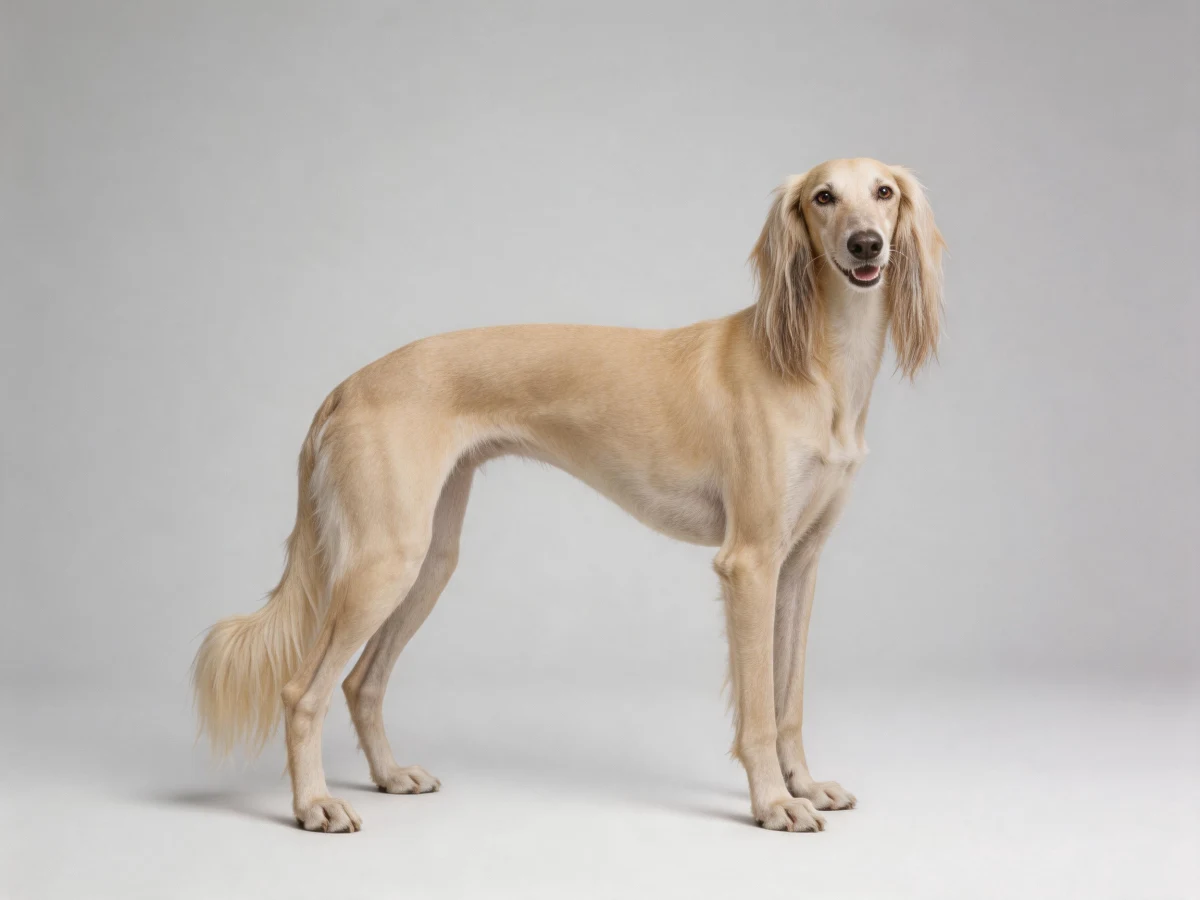
Tesem
✨ Key Takeaways
- Tesem is an ancient Egyptian dog term/type, not a modern breed with a registry standard.
- It is usually associated with lean, prick-eared, curled-tailed hunting or running dogs in Egyptian art.
- The evidence comes from art, language, and archaeology rather than a living breeding population.
- Modern temperament, health, lifespan, and price claims should not be invented.
- Comparisons to Pharaoh Hounds, podencos, Basenjis, and sighthounds can be visual aids but should not claim direct identity.
- Names should draw on Egypt, desert hunting, art, sun, Nile geography, and archive memory.
Quick Facts
Common Names & Variants
Modern aliases
Historical names
Modern variants & lines
⚖️ Pros & Cons
Advantages
Trade-offs
Physical Appearance
Recognized colors
Coat
Other
Ears: Erect. Tail: Curled or ring.
🕰 History
A dog of ancient Egyptian records
Tesem is a term used in discussions of ancient Egyptian dogs, often linked to depictions of lean, prick-eared, curled-tailed hunting or running dogs. It should be handled as an ancient type or category, not as a modern breed with a closed studbook. Egyptian art gives vivid images, but art is not the same thing as a kennel standard.
Hunting, speed, and status
The dogs associated with the Tesem type appear in a world of hunting scenes, elite households, desert movement, and symbolic animal imagery. They may have represented practical hunting dogs, valued companions, or both, depending on period and context. The safe approach is to describe what the records show and avoid pretending the whole breed can be reconstructed.
Legacy and modern comparisons
Modern writers sometimes compare the Tesem to Pharaoh Hounds, podencos, Basenjis, or sighthounds. These comparisons are useful for readers picturing a lean prick-eared dog, but they should not be turned into direct descent claims without evidence. The Tesem's real value is as a window into ancient human-dog relationships.
A word, an image, and a type
Tesem is best treated as an ancient Egyptian dog term and visual type rather than a breed in the modern registry sense. The word appears in discussions of hunting dogs, while art shows lean dogs with upright ears and curled tails. Those two kinds of evidence overlap, but they do not create a neat studbook breed.
Art is evidence, not a full standard
Egyptian art can be precise and symbolic at the same time. A painted dog may show posture, tail carriage, and social setting, but it may also follow artistic convention. That is why a Tesem page should describe visual patterns while avoiding exact modern claims about color genetics, height, weight, or temperament.
Temperament & Personality
No fixed modern temperament
A hunting or running dog type would have needed alertness, speed, endurance, and cooperation, but no one can responsibly describe a predictable modern Tesem temperament. Ancient art does not tell us whether a dog was good with children or easy to train.
Function over pet profile
The page should focus on function and evidence: hunting, movement, elite imagery, and the place of dogs in ancient Egypt. Pet personality claims would be modern projection.
Hunting function suggests ability, not personality
A dog used in hunting or running scenes likely needed speed, alertness, and responsiveness to people. That is the safe functional language. It would be irresponsible to say the Tesem was good for families, independent like a sighthound, or quiet indoors in the way modern breed guides do.
🏡 Living With a Tesem
Historical context only
There is no living Tesem breed population. A reader cannot buy, adopt, or register a Tesem. The living context is educational: ancient Egypt, hunting scenes, and dog imagery.
Modern visual relatives
Readers who like the outline may look at living primitive or sighthound breeds, but those dogs have their own histories. The Tesem should remain historically distinct.
Modern lookalikes are not proof of descent
Pharaoh Hounds, Ibizan Hounds, Basenjis, podencos, and other prick-eared dogs can help readers imagine the silhouette. They should not be presented as the Tesem under another name. Living breeds have their own histories, standards, and genetic paths.
🎓 Training & Exercise
No modern training plan
Ancient hunting dogs were shaped by work, handling, and environment, not modern obedience classes. A modern training guide would be speculation.
What function suggests
Speed, alertness, and a willingness to pursue game are reasonable functional themes, but they should not be turned into guaranteed behavior.
Ancient handling is mostly invisible
Texts and images rarely show the everyday mechanics of how dogs were trained. We can discuss hunting, restraint, companionship, and elite scenes, but not a step-by-step training program. The responsible page leaves room for what historians cannot see.
✂️ Grooming & Coat Care
Short-coated visual reconstruction
Artistic depictions usually suggest a lean, short-coated dog with upright ears and a curled or ring tail. That supports neutral visual reconstruction but not a grooming standard.
Avoid fantasy styling
A reference image should show the dog itself on a neutral background, without pharaonic costumes, temple props, people, hieroglyphic text, or cinematic fantasy staging.
Short coat does not create a care guide
Depictions suggest a short-coated dog, but that does not let us prescribe brushing frequency, bathing routines, or nail schedules for a lost ancient type. Grooming content should focus on visual reconstruction and evidence limits.
🍖 Diet & Nutrition
Ancient diet only broadly
Dogs in ancient Egypt would have eaten within human settlement and hunting systems, but exact breed diet cannot be prescribed.
No modern feeding claims
A Tesem page should not recommend modern formulas, supplements, or portions. Those belong to living breeds.
🐶 Buying & Adopting a Tesem
Not available as a breed
Tesem is an ancient historical type. It is not a modern breed to buy. Sellers using the word for a living puppy should be treated as using a historical label, not offering a verified ancient breed.
Educational value
The value of the page is history: it connects dog names, ancient art, and the long record of hunting dogs.
Historical names can be misused
If a modern seller advertises a Tesem puppy, readers should treat it as a historical label or fantasy marketing unless backed by a credible living registry and evidence. The page should direct practical buyers toward living breeds rather than imply an ancient Egyptian dog can be purchased.
📜 Breed Name Etymology — iDogNames original research
Name meaning and origin
Tesem names should sound ancient, desert-bred, and source-aware. Good names draw on Egypt, the Nile, sun, speed, hunting scenes, and archaeological memory without turning the dog into a costume.
- Tesem (Ancient Egyptian, primary) -- rooted in tSm / tesem; used on this page with the practical meaning "ancient Egyptian dog term."
- Tjesem (Ancient Egyptian, alias) -- rooted in transliteration variant; used on this page with the practical meaning "variant rendering of the ancient term."
- Ancient Egyptian hunting dog (English, alias) -- rooted in ancient Egyptian + hunting dog; used on this page with the practical meaning "functional English description."
- Pharaonic running dog (English, historical) -- rooted in pharaonic + running dog; used on this page with the practical meaning "visual/function description."
- tSm (Ancient Egyptian, origin country native) -- rooted in Egyptological transliteration; used on this page with the practical meaning "ancient Egyptian term rendered in scholarly form."
Name forms at a glance
| Name | Role | Origin | Literal meaning | First recorded |
|---|---|---|---|---|
| Tesem | primary | Ancient Egyptian | ancient Egyptian dog term | — |
| Tjesem | alias | Ancient Egyptian | variant rendering of the ancient term | — |
| Ancient Egyptian hunting dog | alias | English | functional English description | — |
| Pharaonic running dog | historical | English | visual/function description | — |
| tSm | origin country native | Ancient Egyptian | ancient Egyptian term rendered in scholarly form | — |
🏛 Naming Traditions — iDogNames original research
Naming tradition
Tesem names should sound ancient, desert-bred, and source-aware. Good names draw on Egypt, the Nile, sun, speed, hunting scenes, and archaeological memory without turning the dog into a costume.
🐾 Themed Names for Your Tesem — iDogNames original research
Egypt and Nile names
- Nile -- the central river image
- Memphis -- ancient city
- Thebes -- historic and strong
- Delta -- Nile geography
- Luxor -- monumental but usable
- Kemet -- ancient name for Egypt
- Cairo -- modern place bridge
- Aswan -- southern Nile sound
Sun and desert names
- Ra -- sun-god name, very short
- Aten -- sun disk reference
- Dune -- desert landscape
- Saffron -- warm color
- Ember -- sunset heat
- Mirage -- desert image
- Sirocco -- hot wind
- Gold -- sand and sun
Hunting and speed names
- Arrow -- running and hunting
- Fleet -- fast and lean
- Keen -- alert sight and chase
- Falcon -- Egyptian hunting imagery
- Reed -- Nile marshes
- Tracker -- functional dog name
- Sprint -- running type
- Quest -- pursuit
Archive and artifact names
- Glyph -- ancient writing image
- Papyrus -- record material
- Relic -- historical trace
- Cartouche -- Egyptian inscription frame
- Archive -- source-aware name
- Echo -- voice from history
- Obelisk -- monumental and striking
- Ink -- record and art
Ancient record names
- Akbaru -- name associated with an ancient Egyptian dog record
- Scribe -- record-keeper image
- Palette -- art and writing object
- Seal -- ancient administrative object
- Tomb -- archaeological context, stark but apt
- Reedpen -- writing tool image
- Linen -- Egyptian material culture
- Relief -- carved art reference
Lean runner names
- Stride -- long movement
- Swift -- speed without overclaiming breed
- Lithe -- lean body
- Spear -- ancient hunting image
- Horizon -- desert running line
- Keen -- alert hunting sense
- Arc -- curled tail shape
- Sable -- warm dark color name
Nile landscape names
- Papyrus -- river plant and writing material
- Lotus -- Nile plant symbol
- Reed -- marsh plant
- Silt -- Nile soil
- Oasis -- desert water place
- Dendera -- Egyptian temple-place name
- Kom -- archaeological mound word
- Delta -- Nile geography
More Egyptian heritage names
- Egyptian Trail - best for a Tesem name rooted in Egypt rather than generic style
- Ancient Egypt Ridge - best for a regional landscape cue tied to the Tesem story
- Local Line - best for a name that respects local breed history
- Old Route - best for migration, trade, field or pastoral routes behind the breed
- Heritage Note - best for a page where origin should be treated as context, not decoration
- Village Path - best for rustic, local or landrace-style background
- Working Home - best for a dog whose name should remember ancient Egyptian hunting or running dog type known from art and texts
- Country Mark - best for a concise country-of-origin cue
More work and purpose names
- Working Note - best for a Tesem name that keeps ancient Egyptian hunting or running dog type known from art and texts visible
- Focus - best for handler attention and training clarity
- Recall - best for safe outdoor freedom
- Boundary - best for household and yard rules
- Settle - best for calm between activities
- Routine - best for predictable care and exercise
- Partner - best for a cooperative human-dog relationship
- Respect - best for breed history handled without hype
More coat and build names
- Not Reliably Standardized In Surviving Records - best for a Tesem whose color or markings deserve a simple call name
- Short Historical Coat Coat - best for the short historical coat coat type on this breed
- White Blaze - best for a clear face or chest marking
- Dark Mask - best for a dog with a strong muzzle or face marking
- Weather Coat - best for outdoor or working-dog coat context
- Strong Frame - best for a dog whose build is part of its function
- Bright Eye - best for an alert expression
- Ground Step - best for a name tied to movement and body type
📋 Breed Standard at a Glance
No official standard
There is no FCI, AKC, or kennel-club standard for the Tesem. Common visual features include a lean body, short coat, prick ears, and a curled tail, but those come from depictions and scholarship, not a modern registry.
Source-limited reconstruction
Use cautious language: depicted as, associated with, often interpreted as. Avoid absolute claims where the evidence does not support them.
Use cautious verbs
The safest standard language says the Tesem is depicted as, often interpreted as, associated with, or described in scholarship as a lean hunting dog type. Those verbs matter. They keep the page credible and prevent a historical dog from being oversold as a modern standardized breed.
🏆 Recognition
Other registries
❓ Frequently Asked Questions
Is the Tesem a modern dog breed?
No. Tesem is an ancient Egyptian dog term or type, not a living standardized breed.
What did the Tesem look like?
It is often associated with lean, short-coated, prick-eared, curled-tailed dogs in Egyptian art, but exact appearance varied and should not be overstated.
What was the Tesem temperament?
No fixed modern temperament can be known. Hunting function suggests alertness and speed, but pet-behavior claims would be speculation.
What health issues did Tesem dogs have?
No modern breed-health data exist because there is no living standardized population.
Is the Tesem the ancestor of Pharaoh Hounds?
It is often compared visually with primitive hounds and sighthounds, but direct ancestry claims should be made cautiously unless supported by evidence.
What names fit a Tesem page?
Egyptian, Nile, desert, speed, and archive names fit best: Nile, Ra, Dune, Arrow, Falcon, Glyph, Papyrus, and Echo are examples.
📚 Sources & Further Reading
Every load-bearing factual claim on this page is anchored to one of the sources below. iDogNames does not synthesize from secondary aggregators.
- wikipedia Tesem — Wikipedia
- wikidata Tesem Wikidata entity — Wikidata
- other Dogs in Ancient Egypt — World History Encyclopedia (2017)
- book The Complete Gods and Goddesses of Ancient Egypt — Thames & Hudson (2003)
- book The Archaeology of Ancient Egypt — Blackwell (2008)
- book Ancient Egyptian Materials and Technology — Cambridge University Press (2000)
- other iDogNames historical-breed audit — iDogNames editorial research (2026)
- veterinary org WSAVA Global Nutrition Guidelines — World Small Animal Veterinary Association (2021)
- health registry OFA CHIC Program overview — Orthopedic Foundation for Animals (2026)