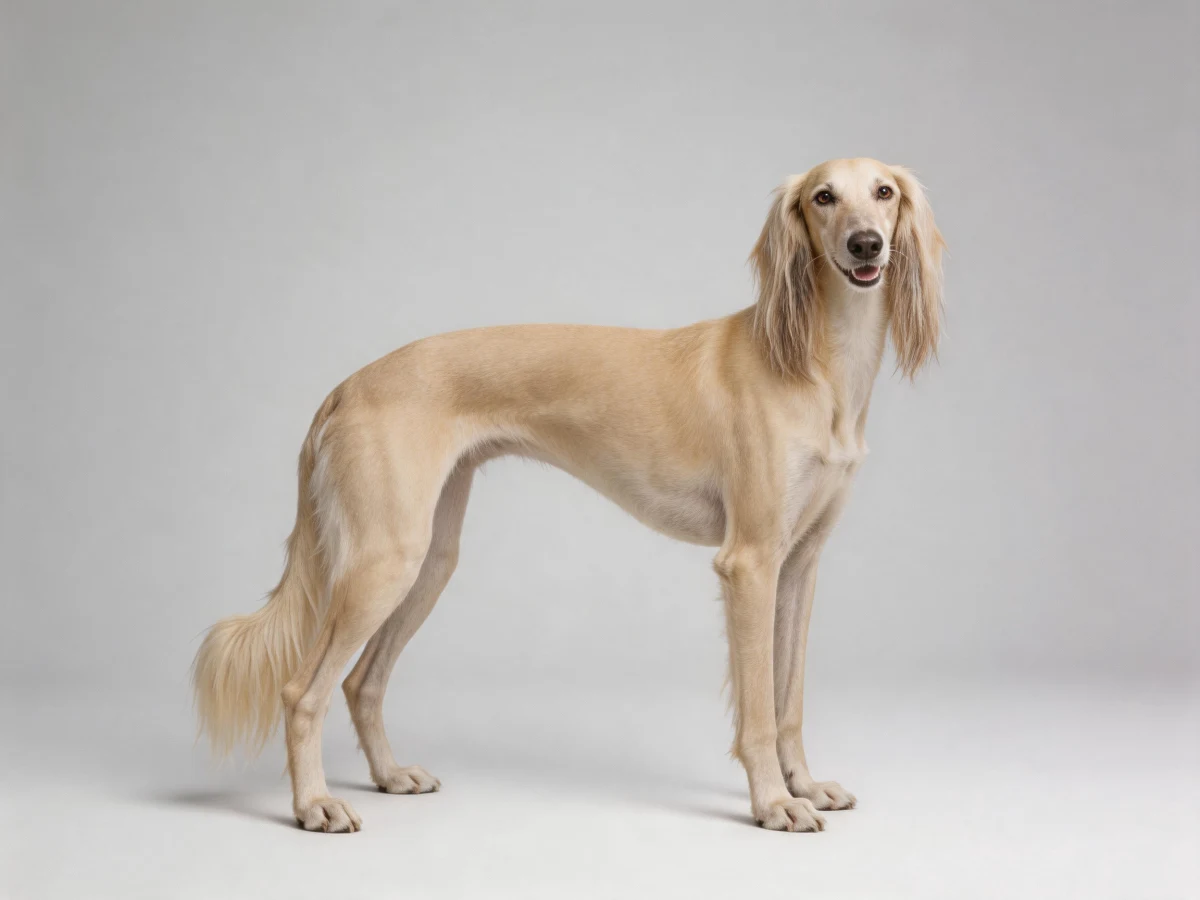
Taigan
✨ Key Takeaways
- A rare mountain sighthound (gazehound) of Kyrgyzstan, developed as a landrace on the high Tian Shan to course game at altitudes of roughly 2,000 to 4,000 metres in cold, broken terrain
- Set apart from the desert sighthounds (Saluki, Sloughi, Azawakh) by a medium-length double coat with feathering on the ears, legs and tail and a characteristic curl at the tail tip, giving real cold tolerance
- A versatile traditional hunter of marmot, hare, fox, badger, wildcat, ibex and roe deer and historically of wolf, often worked alongside golden eagles in Kyrgyz falconry-and-coursing hunts
- Belongs to the Central Asian taza/tazy sighthound family and is most closely related to the Tazy and, more distantly, the Saluki
- Not recognised by the FCI; the standard is held by the Cynological Council of the Kyrgyz Republic (current revision 1995, after the 1964 Soviet standard) and the breed is recognised by the Russian Kynological Federation
- Genuinely rare even at home after a sharp post-Soviet decline; independent, high-prey-drive and reserved with strangers, it needs space, secure fencing, cool-climate suitability and experienced handling rather than urban pet life
Quick Facts
Common Names & Variants
Modern aliases
Historical names
⚖️ Pros & Cons
Advantages
Trade-offs
Physical Appearance
Recognized colors
Coat
Other
Ears: Drop, feathered. Tail: Long, feathered, curled tip.
🕰 History
A gazehound bred for the roof of Central Asia
Few sighthounds were shaped by a harsher classroom than the Taigan, which earned its place in Kyrgyz life on the high pastures and rock screes of the Tian Shan, hunting at altitudes where the air thins and the cold bites hard. Where the desert coursing hounds of the Arab and Berber worlds — the Saluki, the Sloughi, the Azawakh — were honed on flat sand and dry heat, the Taigan was answering a different country entirely: the broken alpine terrain of Kyrgyzstan, much of it between roughly 2,000 and 4,000 metres above sea level, where game runs uphill across loose stone and a thin-coated dog would not last a winter. The result is a sighthound that looks at first glance like a heavier, woollier relative of the Saluki and behaves like one in the chase, but that carries the dense, feathered coat and the lung capacity of a true mountain animal. It is, in the most literal sense, a coursing hound built for altitude.
Part of the Central Asian taza family
The Taigan belongs to the wider family of Central Asian sighthounds usually grouped under the name taza or tazy — the long-legged, gaze-driven hunting dogs of the steppe and mountain peoples from the Caspian eastward. It is most closely tied to the Tazy, the related Kazakh and Turkmen sighthound of the lower plains, and through that line to the Saluki itself, the ancient hound of the Middle East from which the whole eastern sighthound group is generally held to descend. What separates the Taigan within that family is its environment rather than its hunting style: generations of selection on the Tian Shan produced a longer, denser coat with feathering on the ears, legs and tail, and a deeper, more capacious chest than its desert cousins, while the underlying coursing instinct — sight-hunting at speed, then seizing the quarry — stayed the same. The breed is a landrace, fixed by the needs of the hunt and the demands of the climate rather than by a studbook drawn up in a kennel club.
The hound that kept a family fed
In traditional Kyrgyz life the Taigan was not a luxury but a working asset, and the old saying that a household with a good Taigan would never go hungry captures its place exactly. A single dog might be put to marmot, hare, fox, badger and wildcat, to hoofed game such as ibex and roe deer, and, in the boldest hunting, to wolf — the predator that threatened the flocks the same families depended on. The Taigan hunted both by sight, running its quarry down across open mountainside, and with a working use of its nose on a trail, a versatility unusual among pure gazehounds and a direct product of the variable mountain terrain, where a hound cannot always keep its quarry in view. The most distinctive piece of that hunting culture was the partnership with falconry: Kyrgyz hunters worked the Taigan alongside the golden eagle, the dog flushing and coursing while the eagle struck from above, a combined hunt that remains one of the iconic images of Central Asian field sport.
From Soviet standard to post-Soviet decline
The Taigan entered the written record of cynology in the Soviet period. A first breed standard is generally credited to the cynologist S. A. Miniukhin in 1964, drawn up under the kennel structures of the USSR, which valued the Taigan as a productive hunting dog of the Kirghiz Soviet republic. After independence the breed passed into Kyrgyz hands: in 1995 the Cynological Council of the Kyrgyz Republic adopted a revised standard, approved through the hunting commission of the country's environmental ministry, and the breed is today maintained as a national hunting dog of Kyrgyzstan and recognised by the Russian Kynological Federation. The same political change that gave the breed a national identity also threatened it. The collapse of the Soviet economy, the decline of subsistence hunting, and crossing with other dogs all thinned the population, and by the late twentieth century the pure Taigan had become genuinely scarce even on its home mountains, with serious estimates putting the number of true breeding specimens very low.
A living legend, carefully counted
Modern interest in the Taigan is part conservation and part cultural pride. The dog is treated in Kyrgyzstan as a piece of national heritage — the living legend of the Tian Shan — and recent work has gone into documenting and stabilising it, including a 2025 genetic study of the surviving population aimed at understanding its diversity and supporting careful breeding. That research matters precisely because the gene pool is small and the temptation to outcross to other sighthounds for size or speed is real. The honest picture of the Taigan today is therefore double-edged: it is one of the most distinctive and historically rich sighthounds in the world, perfectly adapted to a place few breeds could work at all, and at the same time a rare landrace whose survival depends on a relatively small community of Kyrgyz hunters and conservation-minded breeders keeping the true mountain type alive.
Temperament & Personality
A sighthound mind in a mountain dog's body
The Taigan keeps the core sighthound character — independent, self-possessed and quietly affectionate — but tempers it with the seriousness of a dog bred to make life-or-death decisions on a wolf or an ibex without a handler at its shoulder. With its own family it is gentle, even-tempered and loyal, the calm, dignified companion that gazehounds tend to be indoors, content to rest for long stretches between bursts of intense activity. It bonds closely to its people and reads them well, but it is not a biddable, eager-to-please worker in the way of a herding breed; it was selected to think for itself in the field, and that habit of independent judgement runs through everything it does.
Reserved, alert and naturally wary
Toward strangers the Taigan is typically reserved rather than openly friendly, a watchful aloofness that comes from a life spent guarding the hunt and the household's animals as much as chasing game. It is alert and aware of its surroundings, and many dogs will give notice of an intruder, but this is a hunting sighthound rather than a dedicated guardian and it should not be expected to behave like a livestock-protection breed. Early, broad socialisation matters here: a Taigan introduced as a youngster to a wide range of people, places and other animals grows into a settled, confident adult, while one raised in isolation can become overly suspicious or shy.
The hunting drive that defines it
What no Taigan owner can ignore is the prey drive. This is a dog bred for centuries to spot fast-moving quarry at a distance and run it down, and that instinct is hard-wired and powerful. A Taigan that sights a cat, a rabbit or a deer can switch in an instant from a calm companion into a focused hunter, and at that point recall becomes very difficult, because a hound that could be called off a running quarry would have been useless to the people who created it. The flip side of that drive is the breed's great virtue — the stamina, courage and intelligence that let it work all day in punishing country. Owners who respect the instinct, give it a legitimate outlet, and manage the dog safely around small animals find the Taigan a deeply rewarding partner; those who expect a switched-off, off-lead pet are working against thousands of years of selection.
🏡 Living With a Taigan
Space, cool air and a secure boundary
The Taigan is at heart a country dog, and the home that suits it best reflects that. It is an athletic coursing hound that needs room and real exercise: long daily activity, and ideally regular chances to run flat out in safely enclosed ground, are not optional extras but the baseline for a settled, contented dog. A Taigan kept short of exercise becomes restless and frustrated, and its intelligence turns to mischief. Its dense, feathered double coat, bred for the Tian Shan winter, means it tolerates cold far better than the desert sighthounds and is comfortable spending time outdoors in cool weather, but the same coat makes hot, humid climates a genuine challenge, and in summer its activity should be shifted to the cooler parts of the day with shade and water always available.
Family, children and other animals
Within its household the Taigan is affectionate and even-tempered, and it can live well with children when it has been raised among them and the children have learned to treat a resting sighthound with respect. The decisive issue is the prey drive, which makes cats and small pets a real consideration: a Taigan brought up from puppyhood with a household cat may learn to accept that particular animal, but its instinct toward unfamiliar small creatures, indoors or out, never switches off, and a home with rabbits, small dogs or free-ranging poultry needs to think carefully. With other large dogs it is generally sociable, in the manner of a pack-tolerant hunting hound, though as with any breed sensible introductions matter.
Fencing and the realities of a coursing hound
Secure, substantial fencing is essential. A Taigan that sights quarry beyond the garden will give chase, and a sighthound in pursuit covers ground at remarkable speed and pays no attention to roads or boundaries; many can also jump or scramble more than an owner expects. For the same reason off-lead freedom should be confined to genuinely enclosed space or undertaken only where there is no livestock or wildlife to trigger the chase. None of this makes the Taigan a difficult housemate — indoors it is calm, clean and undemanding — but it does mean the breed belongs with owners who can provide land, security and the active outdoor life it was built for rather than a small flat and a short city walk.
🎓 Training & Exercise
Intelligent, but bred to decide for itself
Training a Taigan means working with a clever, sensitive dog that was never selected for obedience. The breed is genuinely intelligent and learns quickly what it sees the point of, but it carries the independent streak common to all sighthounds and sharpened by a hunting life in which the dog, not the handler, made the decisions on the mountain. It is not stubborn in a dull way; it is simply self-directed, and it weighs whether a request is worth its while. That makes patient, positive, reward-based handling far more effective than firmness or repetition, and harsh correction counter-productive, since a sensitive hound shuts down or grows wary under heavy-handed methods.
Recall and the limits of the possible
Reliable recall is the hardest and most important honest conversation an owner can have about this breed. A Taigan may recall well around the house and garden and then become effectively deaf the instant it sights a running animal, and treating that as disobedience misreads the dog entirely — it is the exact instinct generations of coursing selected for. The sensible approach is the standard one for a high-drive sighthound: build recall slowly, reward it richly, practise in progressively more distracting settings, and treat a long line or fully enclosed ground as the default wherever there is game to trigger the chase. An owner who accepts that off-lead reliability near quarry may never be complete, and manages the dog accordingly, keeps everyone safe.
Socialisation as the foundation
Because the breed is naturally reserved with strangers, early and wide socialisation does as much work as any formal obedience class. A Taigan puppy that meets many people, dogs, environments and — where relevant — household animals during its first months becomes a confident, well-adjusted adult, while one raised narrowly can carry that reserve into adult suspicion. Short, varied, upbeat sessions suit the breed's attention span far better than long drills.
Channelling the drive into sport
The kindest training an owner can offer is a legitimate outlet for the hunting instinct. Where it is available and lawful, lure coursing and racing let a Taigan do, in a controlled form, exactly what it was bred to do, and a dog that gets that release is calmer and more cooperative in everyday life. Scent-based games and tracking also suit the breed's surprising willingness to use its nose. The Taigan is far less suited to the instant-compliance disciplines such as competitive obedience, where its independent, sight-led nature works against the split-second responses those sports reward; match the activity to the dog's real talents and it is a willing, capable partner.
✂️ Grooming & Coat Care
A double coat built for the mountain winter
Unlike the smooth desert sighthounds, the Taigan wears a medium-length, slightly wavy double coat with distinct feathering on the ears, the backs of the legs and the underside of the tail, and a soft insulating undercoat that thickens markedly in winter. That coat is the breed's adaptation to the Tian Shan cold, and looking after it is more involved than grooming a Saluki but far from demanding. A thorough brush once or twice a week keeps the feathering free of tangles, lifts dead hair and spreads the skin's natural oils; particular attention to the longer hair behind the ears, on the legs and under the tail prevents the mats that form where feathering rubs. During the spring and autumn moults, when the heavy undercoat is shed, more frequent brushing — every second or third day — keeps the loose hair under control. Bathing is occasional, only when the dog is genuinely dirty, using a mild dog shampoo that does not strip the coat's weather resistance.
Ears, feet and the working check
The Taigan's feathered, partly pendulous ears deserve a weekly look: inspect for redness, discharge or odour, clean the outer area gently with a veterinarian-approved product when needed, and dry the ears after wet work, since trapped moisture under the feathering invites infection. The feet need particular attention in a dog bred to run on rock and scree — check the pads for cracks and cuts, the nails for length and splitting, and the hair between the toes, where the breed's protective foot feathering can collect grit, ice balls or grass seeds. After any outing in rough or brushy country, running the hands over the whole dog to feel for ticks, thorns and grass seeds belongs in the routine alongside the brush.
Nails, teeth and routine care
Nails should be checked monthly; a Taigan worked on hard mountain ground may wear them naturally, but a dog exercised mostly on soft going will need them trimmed before they grow long enough to alter its gait. Dental care matters as much in this breed as any other: regular tooth-brushing with a canine toothpaste is the most effective guard against the periodontal disease that is otherwise near-universal in dogs, supported by appropriate dental chews. Beyond that the Taigan is a clean, low-odour dog that asks comparatively little, provided its substantial coat gets the regular attention its mountain heritage built in.
🍖 Diet & Nutrition
Feeding a lean, athletic coursing hound
The Taigan is a lean sighthound built to gallop, and its diet has to support that athletic frame without padding it. A good-quality complete dog food matched to the dog's life stage — puppy, adult or senior — and to its activity level is the sensible baseline. The correct condition for the breed is genuinely lean: like all sighthounds the Taigan should carry visible muscle over a frame where the last ribs and the outline of the hips are easily felt and lightly seen, with a pronounced waist and tuck-up. Owners used to rounder breeds sometimes mistake a correctly conditioned sighthound for an underweight one and overfeed in response, which does the athletic dog no favours. Hands-on body-condition scoring, not the guide on the bag, is the reliable everyday measure.
Matching intake to a working life
A Taigan's energy needs swing widely with its workload, and the ration should move with it. A dog hunting or coursing hard across mountain country burns far more than the same dog resting between seasons, and the amount fed should rise and fall to match rather than sitting at a single year-round level. The common error with any working hound is to keep feeding at the active rate once the activity has dropped, so that weight creeps on unnoticed — a real problem in a breed whose whole value lies in its lightness and speed. Measured meals rather than free-choice feeding, restraint with scraps, and counting any training treats inside the daily ration rather than on top of it are the habits that keep the dog in racing trim.
Schedule, water and the deep-chested precaution
Adult Taigans are usually fed twice a day rather than in one large meal; splitting the ration steadies the dog and, in a deep-chested breed, is a sensible precaution against digestive upset. As a matter of routine, a hard-running hound should not be fed a heavy meal immediately before vigorous work — leaving roughly a couple of hours between a full meal and the off is the standard precaution in any deep-chested dog. Fresh water must always be available, with demand rising sharply on working days and in warm weather, where this cold-adapted breed needs particular care against overheating. Puppies need more frequent, smaller meals appropriate to their age, transitioning to the adult pattern as they mature; growth in a large sighthound should be steady rather than forced.
🐶 Buying & Adopting a Taigan
A rare national breed, hard to find abroad
The Taigan presents one of the more challenging buying pictures of any sighthound, and a prospective owner should grasp its rarity before getting attached to the idea. The breed is concentrated in Kyrgyzstan, where it is maintained as a national hunting dog by a relatively small community of breeders, and the pure mountain type is genuinely scarce even there; outside Central Asia and a handful of dedicated breeders elsewhere it is very seldom seen. A would-be owner in most of the world should set realistic expectations from the start: finding a true Taigan will usually mean approaching breeders in Kyrgyzstan or established sighthound enthusiasts directly, accepting a long wait, and budgeting for the veterinary checks, paperwork and transport that an international placement involves. There is no standardised global price for the breed, and any source advertising ready availability of a Taigan at an ordinary pet-dog price deserves scepticism rather than enthusiasm.
Finding a responsible breeder
Because the gene pool is small and the temptation to outcross for size or speed is real, the integrity of the breeder matters more than usual. A responsible Taigan breeder is breeding to preserve the true mountain landrace, is open about the relatedness of a litter's parents and about any health issues seen in the line, and is candid about the breed's demanding nature rather than eager to place a puppy with anyone. Such a breeder will ask searching questions in return — about the buyer's space, fencing, experience with high-drive hounds, and ability to provide the exercise and management the breed needs. Contacting the Kyrgyz cynological community and reputable sighthound networks is the realistic route to finding ethical breeders; conservation-minded interest in the breed has grown alongside the genetic work documenting it, and that community is the best starting point.
A sober assessment of fit
Breed-specific rescue for the Taigan is effectively non-existent outside its homeland simply because the breed is so scarce. Whether acquiring a dog from a breeder or, rarely, taking one on, the honest question is the same one the breed has always posed: can you provide a large, high-drive coursing hound with the space, the secure fencing, the cool-climate suitability and the experienced, patient handling it requires? For an active rural or semi-rural home with room to run a sighthound safely and an understanding of the breed's independence and prey drive, the Taigan is a striking, hardy and deeply rewarding companion with a piece of living Central Asian heritage behind it. For a town household wanting an easy, off-lead pet, it is the wrong dog, and recognising that before the purchase is a kindness to everyone, the dog most of all.
📜 Breed Name Etymology — iDogNames original research
A Kyrgyz word for a mountain hound
The name Taigan (also written Taygan or, with the Kyrgyz possessive, Taighany) is the native Kyrgyz term for the breed, and it belongs to a family of related sighthound names found across Central Asia and the wider Turkic and Mongolic world. The same root underlies the Tazy of the Kazakh and Turkmen plains and echoes in the broad regional terms taza and tayga used for the long-legged hunting hounds of the steppe and mountains. In Kyrgyz usage the word simply is the breed: to name a Taigan is to name the swift hunting dog of the mountains, in the same direct way that other peoples' sighthound names — Saluki, Sloughi, Borzoi — are the everyday words their cultures use for the coursing hound itself.
The Russian name and its meaning
Under the Soviet and Russian cynological systems the breed acquired its descriptive Russian name, Kyrgyzskaya Borzaya — literally "the Kyrgyz sighthound" or "Kyrgyz borzoi." Here borzaya is the Russian word for a sighthound or gazehound (the same term that gives English the breed name Borzoi for the Russian wolfhound), built on a root meaning swift, and Kyrgyzskaya simply locates it: the swift hound of the Kyrgyz. This naming is typical of how Soviet cynology recorded the hunting breeds of its republics, attaching a Russian-language descriptive label — nationality plus type — to a dog that already had a perfectly good native name. Both names remain in use today, the Kyrgyz Taigan in its homeland and the Russian Kyrgyzskaya Borzaya in the registries that adopted it from the Soviet system.
Reading the name in English
English-language usage simply borrows the Kyrgyz name unchanged, since there is no descriptive English equivalent to translate; in English the breed is the Taigan, sometimes glossed as the Kyrgyz Sighthound to tell the reader at once what kind of dog it is. The spelling varies because the name has been transliterated from a Cyrillic and originally Kyrgyz form — Taigan, Taygan and Taighany all appear — but they name one dog. A Taigan, in any language, is the feathered coursing hound of the Tian Shan.
Name forms at a glance
| Name | Role | Origin | Literal meaning | First recorded |
|---|---|---|---|---|
| Taigan | primary | Kyrgyz | the Kyrgyz mountain sighthound | 1964 |
| Kyrgyzskaya Borzaya | historical | Russian (descriptive Soviet-era name) | the Kyrgyz sighthound (Kyrgyz borzoi) | 1964 |
| Kyrgyz Taighany | origin country native | Kyrgyz (possessive form) | the Taigan of the Kyrgyz | — |
| Taygan | alias | Kyrgyz (transliteration variant) | alternative romanisation of the breed name | — |
| Kyrgyz Sighthound | alias | English (descriptive gloss) | the sighthound of Kyrgyzstan | — |
🏛 Naming Traditions — iDogNames original research
Kyrgyz and Central Asian names for a mountain hound
Because the Taigan is so completely a creature of Kyrgyzstan and the Tian Shan, owners who want a name that fits the breed reach naturally toward Central Asia — to the Kyrgyz language, the mountain landscape and the hunting culture that produced the dog. Kyrgyz words for the qualities a sighthound prizes sit well on it: names evoking speed, the wind, the mountain and the eagle that the Taigan traditionally hunted alongside all tie a name directly to what the breed is. The great peaks and rivers of the Tian Shan — and the wider geography of Central Asia — offer a rich vein of place-names with a genuine connection to the dog's homeland.
The breed's coat and hunting heritage give two further directions. Its recognised colours — black, grey, red, white — suggest descriptive names, while the falconry partnership with the golden eagle and the quarry it pursued across the mountains offer names rooted in the hunt itself. Whichever direction an owner takes, the strongest Taigan names are the ones that reflect what the dog actually is: a swift, feathered coursing hound of the high Kyrgyz mountains, bred for the chase and built for the cold.
🐾 Themed Names for Your Taigan — iDogNames original research
Kyrgyz and Central Asian names
- Manas — the hero of the great Kyrgyz epic, a name steeped in national pride
- Tian — for the Tian Shan, the mountains that are the breed's home
- Bishkek — the Kyrgyz capital, a place-name with a strong sense of homeland
- Issyk — for Issyk-Kul, the great mountain lake of Kyrgyzstan
- Khan — the Central Asian title for a ruler, fitting for a noble hound
- Talas — a river and region of Kyrgyzstan with deep historical resonance
- Aigul — a Kyrgyz girl's name meaning "moon flower", graceful for a bitch
- Batyr — the Central Asian word for a hero or brave warrior
Speed, wind and the chase
- Arrow — for the swift, straight-line speed of a coursing hound
- Comet — for a dog that streaks across open ground
- Zephyr — a name evoking the wind a fast hound seems to ride
- Dash — a simple, spirited name for a sprinter
- Falcon — for speed and for the falconry hunts the breed shared
- Swift — plain and apt for a gazehound built to run
- Bolt — for sudden, electric acceleration after quarry
- Storm — for the force of a hound in full chase
Mountain, sky and the eagle hunt
- Eagle — for the golden eagle the Taigan hunted alongside
- Berkut — the Russian and Central Asian word for the golden eagle
- Summit — for the high peaks the breed was built to work
- Sky — a light, open name for a mountain dog
- Ibex — the mountain goat that was classic Taigan quarry
- Marmot — a nod to the small game the breed pursued on the slopes
- Frost — for the cold the breed's double coat was made for
- Snow — for the high-altitude winters of the Tian Shan
Coat and colour names
- Onyx — for a black Taigan
- Ash — for a grey-coated dog
- Rusty — for a red-coated hound
- Pearl — for a white or pale dog
- Smoke — for a soft, hazy grey
- Tawny — for the warm fawn-to-red shades the breed carries
- Sable — for a dark, shaded coat
- Ember — for the glowing red of a fox-coloured hound
Additional Kyrgyz place names
- Tian Shan - best for a mountain-rooted Taigan name
- Issyk Kul - best for a major Kyrgyz lake name
- Naryn - best for a river and region cue
- Ala Too - best for a Kyrgyz mountain-range reference
- Karakol - best for a high-country place name
- Song Kul - best for an alpine lake and pasture image
- Steppe Pass - best for a dog tied to mountain and open country
- Eagle Ridge - best for a Taigan name connected to Kyrgyz hunting culture
Additional sighthound names
- Longstride - best for the Taigan mountain-running gait
- Windline - best for a fast dog with elegant outline
- Snow Sprint - best for a high-country hound with winter imagery
- Ibex Trail - best for rugged mountain hunting context used carefully
- Harepath - best for a traditional quarry reference
- Sightmark - best for a visual hunter with focused attention
- Lean Arrow - best for a slim, fast dog
- High Chase - best for a mountain sighthound with altitude in the name
Additional Kyrgyz household names
- Ayla - best for a graceful female dog with a Central Asian sound
- Bek - best for a strong, compact male call name
- Nura - best for a soft female name
- Askar - best for a sturdy male dog with mountain resonance
- Kara - best for a dark-coated Taigan
- Altyn - best for a golden or prized dog
- Temir - best for a strong dog with iron-like meaning
- Buran - best for a wind or storm name suited to mountain country
📋 Breed Standard at a Glance
General appearance and size
The Taigan is described by its Kyrgyz and Russian standards as a medium-to-large mountain sighthound of dry, robust constitution — a coursing hound built for endurance and agility over difficult terrain rather than for the extreme fine-boned elegance of the desert breeds. Males generally stand in the region of 65 to 70 cm at the withers and females around 60 to 65 cm, with weight commonly given as roughly 25 to 33 kg; sources vary, and these figures should be read as the typical range rather than a single fixed measurement. The overall impression is of a powerful but lithe gazehound with a deep chest for lung room, long legs and the balanced construction of a stayer made to work all day at altitude.
Head, coat and colour
The head is long and lean in the sighthound mould, narrower than a scent hound's, carried on a long neck, with dark, expressive eyes and feathered ears that hang folded and are set fairly high. The coat is the breed's signature and the clearest point separating it from the Saluki and Sloughi: medium in length, soft and slightly wavy, with a dense insulating undercoat and pronounced feathering on the ears, the backs of the legs and the tail. Recognised colours include black, black-and-tan, grey, red and white, frequently with white markings, and combinations of these. The tail is a distinctive feature, carried with a characteristic curl or ring at the tip — a trait the standards note as typical of the breed.
Movement, working type and recognition
In movement the Taigan is a galloping hound, covering ground with the long, efficient, ground-eating stride of a coursing dog and showing the agility needed to turn and climb on broken mountain ground. The standards emphasise working ability above show points, reflecting the breed's status as a functional hunting dog. It should be stated plainly that the Taigan is not recognised by the Fédération Cynologique Internationale; its standard is held by the Cynological Council of the Kyrgyz Republic (the current revision dating from 1995, following the earlier Soviet standard of 1964), and the breed is recognised by the Russian Kynological Federation, where it is registered among the national sighthound breeds.
🏆 Recognition
Other registries
Breed clubs
❓ Frequently Asked Questions
What is a Taigan's temperament like?
The Taigan is an independent, intelligent sighthound that is gentle, even-tempered and loyal with its own family but typically reserved and watchful with strangers. Indoors it is the calm, dignified companion gazehounds tend to be, resting for long stretches between bursts of activity. The defining trait is a powerful, hard-wired prey drive: bred for centuries to spot and run down fast quarry across the mountains, it can switch in an instant from a quiet housemate into a focused hunter, which makes recall near running animals very difficult and small pets a real consideration. It is courageous and self-directed rather than biddable, and it does best with experienced owners who respect the hunting instinct and give it a real outlet.
How big does a Taigan get?
The Taigan is a large sighthound. Its Kyrgyz and Russian standards put males in the region of 65 to 70 cm at the withers and females around 60 to 65 cm, with weight commonly given as roughly 25 to 33 kg; sources vary, so these are typical ranges rather than fixed figures. It is a powerful but lithe coursing hound -- deep-chested for lung room, long-legged and built for endurance and agility over difficult mountain terrain rather than for heavy bulk.
What health problems do Taigans have?
The Taigan is generally regarded as a hardy, sound sighthound with a typical lifespan of about 12 to 14 years, but it is a rare landrace and almost no formal, breed-specific health data exists for it, so its profile is understood through observation rather than statistics. The most important factor is its small gene pool, reduced by a sharp post-Soviet decline, which raises the general risk of recessive disorders concentrating; a 2025 genetic study has begun mapping the population to support careful breeding, and buyers should ask breeders about the relatedness of a litter. As a sighthound it shares the group's recognised sensitivity to anaesthesia and certain drugs, so any veterinarian treating it should be told it is a sighthound. This is general educational information, not veterinary advice.
Are Taigans good family dogs?
For an active rural or semi-rural home with space, secure fencing and experience of high-drive hounds, the Taigan can be an affectionate, even-tempered companion that is gentle with its own people and good with children it has been raised among. But it is not an easy first pet: it is a large coursing hound with a strong prey drive that makes cats and small pets a real concern, it needs serious daily exercise and safe room to run, and it is reserved with strangers and independent by nature. Its dense mountain coat also suits cooler climates better than hot ones. Outside Kyrgyzstan the breed is very rare, so acquiring one usually means a long wait and direct contact with breeders.
How much grooming does a Taigan need?
Moderate. Despite its medium-length double coat the Taigan is not high-maintenance: a thorough brush once or twice a week keeps the feathering on the ears, legs and tail free of tangles and lifts dead hair, with more frequent brushing during the spring and autumn moults when the heavy undercoat is shed. Bathing is occasional, only when the dog is genuinely dirty. The other priorities are the feathered ears, which should be checked weekly and dried after wet work to prevent infection, and the feet of a dog bred to run on rock and scree -- checking pads, nails and the hair between the toes for grit, ice or grass seeds. Regular tooth-brushing and monthly nail checks complete the routine.
How much exercise does a Taigan need?
A Taigan is a mountain sighthound and needs serious exercise, conditioning and safe space to move. It also needs management around prey animals and wildlife. Long walks, controlled running, recall practice and rest all matter; raw speed should be handled responsibly, not treated as a party trick.
📚 Sources & Further Reading
Every load-bearing factual claim on this page is anchored to one of the sources below. iDogNames does not synthesize from secondary aggregators.
- wikipedia Taigan -- Wikipedia — Wikipedia
- breed club official Russian Kynological Federation (RKF) -- national kennel body — Russian Kynological Federation (2024)
- wikidata Taigan -- Wikidata entity — Wikidata
- other The Taigan: a Kyrgyz sighthound bred for hunting in the mountains — Central Asia Live (2023)
- other Kyrgyzstan's Sighthound, the Taigan -- National Purebred Dog Day — National Purebred Dog Day (2019)
- academic paper Genetic diversity and population structure of the Taigan dog breed — FEBS Open Bio (Wiley) (2025)
- other The Living Legend of the Tian Shan Mountains -- National Purebred Dog Day — National Purebred Dog Day (2020)
- other Taigan Facts -- Wisdom Panel — Wisdom Panel (2024)
- veterinary org Anesthesia and sighthounds -- breed sensitivity considerations — Merck Veterinary Manual (2024)