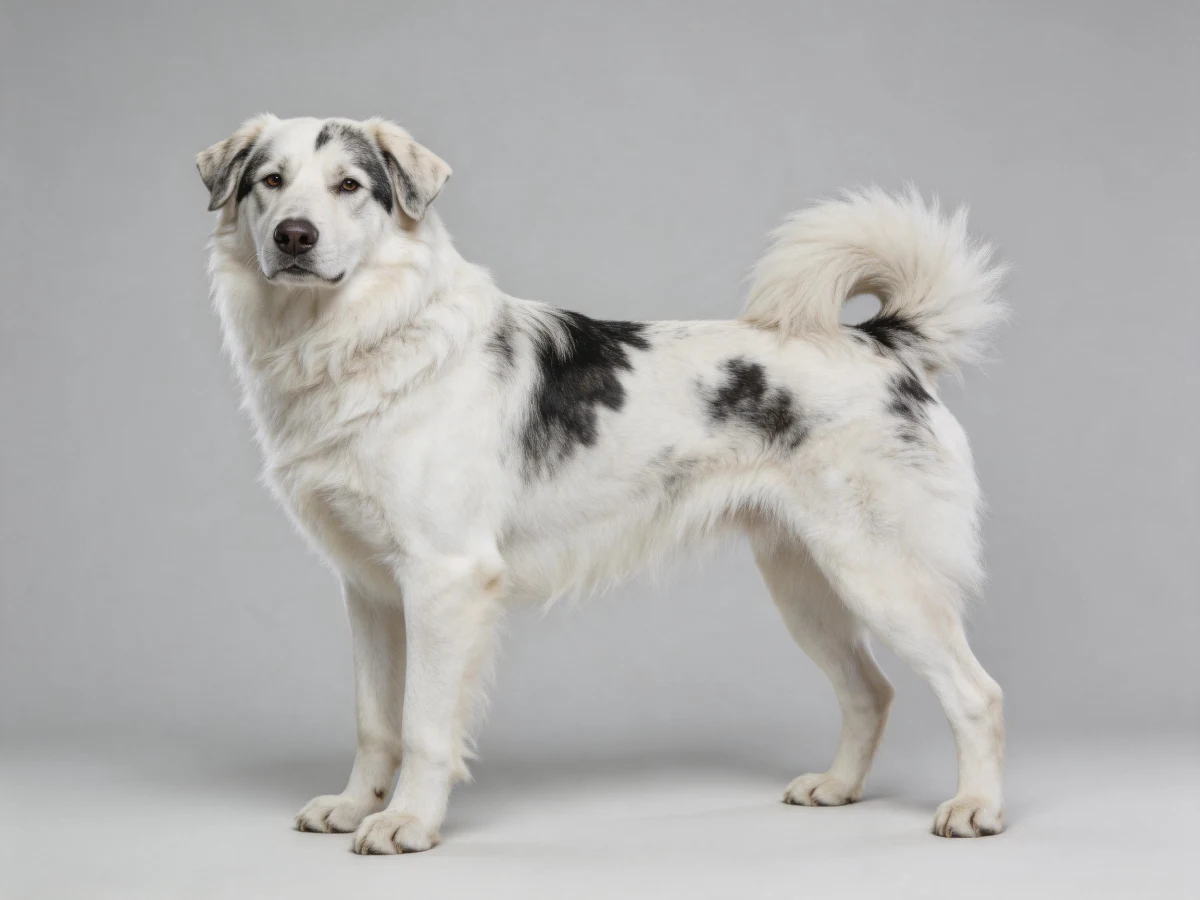
Kangal Shepherd Dog
✨ Key Takeaways
- A large-to-giant Turkish livestock-guardian dog from the Kangal district of Sivas province in Central Anatolia; a working landrace, not a kennel-made breed, that lives among the flock and stands between sheep and predators such as the wolf and bear
- The signature look is a single fawn-to-wolf-sable (dun) body under a black mask, with dark ears -- camouflage for the pale steppe; males stand 72-78 cm and weigh 48-60 kg under FCI Standard No. 331
- Temperament per the FCI standard is described as not aggressive but a good guardian: steady, bold, naturally independent, intelligent, loyal and gentle with its own people but wary of strangers when on duty -- an experienced-owner breed, not a beginner pet
- Turkey regards the Kangal as its national dog, honoured on Turkish postage stamps and a commemorative coin; since the 1990s the breed has also guarded African livestock against cheetahs, aiding predator conservation
- Recognition is split by the Anatolian naming dispute: recognised as the Kangal by the UKC (1998), the UK Kennel Club (2013), the Turkish federation KIF and the FCI (Standard 331, 2018), while the AKC registers these dogs under the broader Anatolian Shepherd Dog name
- A robust, long-lived working breed (about 11-13 years); the health priorities are those of a giant guardian -- hip and elbow screening, slow lean growth, and above all awareness of bloat (gastric dilatation-volvulus)
Quick Facts
Common Names & Variants
Modern aliases
Historical names
⚖️ Pros & Cons
Advantages
Trade-offs
Physical Appearance
Recognized colors
Coat
Other
Ears: Pendant, triangular. Tail: Long, curled at tip, raised when alert.
🕰 History
A district in Sivas gives the steppe guardian its name
The Kangal Shepherd Dog takes its name from the small district of Kangal in Sivas province, on the high, cold plateau of Central Anatolia, where centuries of pastoral life produced an unusually uniform livestock guardian: a large fawn-to-sable dog with a black mask, bred to live out among the flocks and stand between sheep and the wolf. Unlike most modern breeds, it was not designed in a kennel from documented foundation stock; it is a working landrace, shaped over generations by the demands of guarding Akkaraman sheep across an isolated, mountain-ringed grassland rather than by a studbook. The town of Kangal lent its name to the type because the dogs of that area drew wider attention for their consistency and quality, and the name has since come to stand for the whole black-masked dun guardian of the Anatolian steppe.
The honest difficulty of a landrace history
Any account of the breed's origin has to be careful, because livestock-guardian dogs rarely leave a clean historical trail and the Kangal is no exception. The FCI standard itself opens with an unusually frank admission that an accurate history is hard to reconstruct for guardian breeds, and the most defensible account is a general one: the Turkic peoples who migrated westward from Central Asia depended on nomadic animal husbandry and brought strong flock-protection dogs with them, and the dogs that guarded sheep and goats across the Central Asian range came in many colours. What set the Anatolian population apart was the gradual fixing of a more unified type, and above all a unified colour, in Turkey. The dun coat with a black mask that the breed wears today is widely read as a practical adaptation as much as an aesthetic preference, blending the dog into the pale, sun-bleached steppe so that it can hold its ground among the flock without standing out to the predators it watches for.
A working dog of the agha and the shepherd
For as long as the type has existed it has been a tool of the pastoral economy of eastern and central Turkey rather than a companion or a show dog. Both prominent landowners, the aghas, and ordinary shepherds and villagers kept the dogs and took real pride in their ability to hold off the wolf, the bear and the jackal, and the breed's whole reputation rests on that record in the field. A Kangal does not herd; it lives with the flock as one of its own, patrolling the perimeter, warning off intruders with a deep voice and an imposing presence, and engaging a determined predator only when warning fails. Generations of selection for exactly that job, and for nothing else, are what produced the calm, watchful, territorial dog the breed is known for, and why it remains first and last a working guardian rather than a general-purpose pet.
Turkey's national dog
Few breeds are as closely bound to a national identity. The Kangal is Turkey's highly prized national dog, a status reflected in the way the country has celebrated it on its postage stamps and on a commemorative coin, and in the breed festivals held in its homeland. That cultural standing is not merely sentimental: Turkey has at times restricted the export of breeding stock precisely because the Kangal is regarded as a living national treasure. The breed's prestige has also given it a second career far from Anatolia. Since the 1990s Kangals have been placed with farmers in Namibia, Kenya and elsewhere in Africa to guard livestock against cheetahs and other big cats, and their success there has spared many predators that would otherwise have been shot, turning a steppe guardian into an unexpected instrument of wildlife conservation.
Recognition and the Anatolian naming dispute
The Kangal's path to international recognition is tangled up with one of the more contentious naming arguments in the dog world, and an honest history has to lay it out plainly. In Turkey the black-masked dun guardian is regarded as a distinct native breed, the Kangal, kept separate from the all-white Akbash and from other regional guardians. In the United States, breeders from the late 1960s assembled imported Turkish guardian dogs of mixed type and colour under a new umbrella name, the Anatolian Shepherd Dog, which many Turkish authorities consider a composite rather than a single pure breed. The result is a patchwork of recognition. The United Kennel Club recognised the Kangal Dog as a separate breed in 1998; the United Kingdom's Kennel Club recognised it in 2013; and the Turkish kennel federation (KIF) maintains it as a national breed. The Fédération Cynologique Internationale issued FCI Standard No. 331 under the Turkish name Kangal Çoban Köpeği, with the valid standard dated 2018, treating the Kangal as the recognised type from Turkey. The American Kennel Club, by contrast, continues to register these dogs under the older Anatolian Shepherd Dog name. A reader should take from all of this that the dogs themselves are real and ancient, while the labels reflect competing national and organisational histories rather than a settled scientific verdict.
Temperament & Personality
Calm, bold, and built to decide for itself
The FCI standard sums the Kangal up in a single telling phrase: "not aggressive but good guardian." This is a steady, confident dog rather than a reactive or sharp one, bred for centuries to live unsupervised among a flock and to weigh threats on its own judgement. The breed standard describes it as steady and bold without aggression, naturally independent, very intelligent and tractable, proud and confident, loyal and affectionate to its own people but wary of strangers when on duty. That last clause is the key to the whole temperament: the Kangal is gentle and deeply attached within its own circle and openly suspicious of outsiders who approach what it guards, and the two faces are not a contradiction but the two halves of a guardian's mind.
Territory, suspicion, and the long fuse
A Kangal's defining instinct is territoriality. It claims its land, its flock and its family and patrols the boundary of all three, and a stranger arriving uninvited will meet a large, vocal, immovable dog that takes its time deciding whether the visitor is a threat. The breed is not quick to bite; its preferred tools are presence, a deep warning bark and a deliberate interposition of its own body between the perceived danger and what it protects. But the same independence that makes it superb alone in a field also means it will act on its own assessment rather than wait for a command, and an owner who does not understand or respect that judgement will be perpetually at odds with the dog. This is not an animal that defers automatically; it cooperates with a handler it trusts and ignores one it does not.
Why this is not a beginner's dog
The combination of great size, real strength, genuine protective drive and an independent mind makes the Kangal a serious dog that demands an experienced, confident owner and a suitable setting. It is loyal, affectionate and remarkably gentle with its own children and stock, and a well-raised, well-socialised Kangal is a stable and trustworthy companion, but its wariness of strangers and its readiness to guard mean it can be a liability in the wrong hands or the wrong home. Early, broad socialisation to people, places and situations is not optional with this breed; it is the single most important thing an owner does, because it teaches the dog to tell a genuine threat from ordinary daily life. Owners who provide that foundation, and who give the dog a job or at least a clear role and territory, get the breed at its best: a composed, devoted, formidable guardian. Those who treat it as an oversized pet with no purpose and no boundaries find a frustrated, over-protective dog that has decided the rules for itself.
🏡 Living With a Kangal Shepherd Dog
Space, a fence, and a reason to be there
The Kangal is a working livestock guardian, and the closer an owner's circumstances come to that original purpose, the better the breed does. It is at its happiest on a farm or smallholding with stock to watch and acres to patrol, and it adapts poorly to anything resembling apartment life. What it needs is not the relentless aerobic exercise of a sporting breed but room to move, a defined territory and a sense of purpose: a large, securely fenced area where it can walk its boundary, lie in view of what it guards and feel responsible for its patch. A bored, confined Kangal with nothing to protect and nowhere to range is an unhappy and often destructive one, and no amount of toys substitutes for space and a role.
Fencing is the non-negotiable
Containment deserves its own emphasis, because a Kangal will expand its idea of "its territory" outward if allowed, and a roaming guardian of this size that has appointed itself protector of the wider neighbourhood is a genuine problem. Tall, strong, well-buried perimeter fencing is essential, both to keep the dog where it belongs and to control its contact with strangers and other animals on its own terms. The breed is capable of great speed and is powerful enough to push through inadequate barriers, so flimsy fencing is worse than none. Owners should also expect a serious nocturnal voice: a guardian bred to deter predators in the dark barks at night by design, which makes the breed a poor fit for closely packed housing regardless of how much land sits behind the house.
Family, stock, and other animals
Within its own household the Kangal is affectionate, tolerant and notably gentle, and a dog raised with children and with the family's other animals typically treats them as part of the flock it protects. With livestock the bond is the whole point of the breed; a properly raised Kangal lives peaceably among sheep, goats, poultry and horses and defends them as its own. The caution is reserved for the unfamiliar. Strange dogs, especially of the same sex, and unknown people on the dog's territory are met with suspicion, and the breed's protective response toward visitors must be managed through firm control, good fencing and steady socialisation rather than wished away. This is a dog for a confident rural household that wants a guardian and can give one the space, the security and the standing it requires, not for a busy suburban home with constant foot traffic at the door.
🎓 Training & Exercise
Tractable but never servile
The Kangal occupies an interesting place in the trainability spectrum: the FCI standard calls it very intelligent and tractable in the same breath as naturally independent, and both descriptions are accurate. This is a clever dog that learns quickly and can absolutely be taught good manners, reliable basics and household rules, but it was bred to make decisions alone in a field and it will never become an eager, repetition-loving obedience competitor. It works with a handler it respects rather than for one it merely obeys, and it sees little point in drilling a behaviour it has already mastered. An owner who understands that the goal is a cooperative partnership, not push-button compliance, will find the breed far more rewarding than one expecting the instant responsiveness of a working sheepdog.
Socialisation is the real curriculum
For a guardian breed, the most important training is socialisation, and it has to start early and continue for life. A Kangal puppy needs broad, positive, controlled exposure to a wide range of people, dogs, animals, places, sounds and everyday situations during its critical early months, because that experience is what teaches an instinctively suspicious dog to distinguish the normal from the genuinely threatening. A Kangal that has met the world grows into a discriminating, stable adult; one raised in isolation grows into an over-reactive dog that treats every stranger as an enemy. No amount of later obedience work substitutes for this foundation, and it is the single area in which a Kangal owner cannot afford to be casual.
Methods: calm authority, never force
The breed responds to calm, consistent, fair leadership and to positive, reward-based methods, and it shuts down or grows resentful under harsh handling. A dog this large, strong and self-assured cannot be bullied into obedience, and attempts to do so damage the trust the breed's cooperation depends on. The most effective approach establishes clear, consistent boundaries from puppyhood, rewards the behaviour the owner wants and avoids confrontation over the behaviour it does not, while never letting a confident young dog learn that pushiness or stubbornness pays. Consistency among everyone in the household matters as much as technique, because a Kangal quickly identifies and exploits inconsistent rules.
Recall, the voice, and realistic goals
Two realistic limits should temper an owner's expectations. First, recall in a guardian with a strong territorial drive is never as crisp as in a biddable companion breed, which is one more reason secure fencing matters and off-lead freedom in unenclosed public space is unwise. Second, the breed's protective barking is hard-wired and cannot be trained away, only managed; an owner can teach a Kangal to stop barking on cue and can reduce nuisance noise through proper exercise, company and a settled routine, but the impulse to announce and challenge intruders is part of the dog's job description. The owners who do best with the breed train toward management and mutual respect rather than toward suppression of the instincts that make a Kangal a Kangal.
✂️ Grooming & Coat Care
A weatherproof double coat that does most of the work itself
The Kangal wears a practical working jacket rather than a high-maintenance show coat. Under the FCI standard the hair runs three to seven centimetres long, with a thick, harsh outer guard coat over a dense undercoat, and it grows longer and thicker on the neck, shoulders and thighs. This is a coat built to insulate the dog against both the bitter cold and the hard heat of the Anatolian plateau, and against the teeth of a predator, and it asks relatively little in day-to-day care. A weekly brush with a firm brush or a slicker keeps it clean, lifts dead hair and spreads the skin's natural oils; bathing is needed only occasionally, when the dog is genuinely dirty, since over-bathing strips the coat's weather resistance.
Surviving the seasonal shed
The one demanding period is the moult. Like most double-coated breeds the Kangal sheds heavily once or twice a year, blowing its undercoat over a few intense weeks, and during those stretches daily brushing with an undercoat rake or de-shedding tool is the only thing that keeps the loose hair under control and prevents matting where the coat is thickest. Owners who keep the dog mainly indoors should be ready for a great deal of hair at those times. A Kangal should never be shaved: the double coat regulates the dog's temperature in both directions and protects the skin, and clipping it off does real harm rather than keeping the dog cool.
Ears, nails, teeth, and the routine check
Beyond the coat, the Kangal's grooming needs are the ordinary ones of a large dog. The pendant ears should be inspected weekly for redness, odour or discharge and dried carefully after the dog gets wet, since a hanging ear traps moisture. Nails need checking roughly monthly and trimming whenever they grow long enough to click on the ground or alter the dog's stance, which matters more for a dog exercised on soft ground that does not wear them naturally. Teeth benefit from regular brushing with a canine toothpaste to hold off the periodontal disease that affects most dogs as they age. For a guardian that spends much of its time outdoors, a habit of running the hands over the whole dog regularly, checking the skin, feet, ears and eyes for ticks, grass seeds and minor injuries, is the most useful piece of husbandry an owner can adopt.
🍖 Diet & Nutrition
Feeding a giant guardian for the long haul
The Kangal is a large-to-giant working dog, and its feeding has to respect both its size and its relatively economical metabolism. Despite its bulk the breed is not a frantic calorie-burner like a sporting dog; a guardian spends much of its day on watch rather than in hard motion, and many Kangals are surprisingly efficient on a moderate amount of good food. The sensible baseline is a high-quality complete diet formulated for large or giant breeds and matched to the dog's life stage, fed in measured amounts rather than left down free-choice. The guide on the bag is a starting point, not a prescription: hands-on body-condition scoring is the better daily measure, and a Kangal in good trim has ribs that are easily felt under the coat, a visible waist from above and a clear tuck-up behind the ribs from the side.
The giant-breed puppy: slow and lean
Nutrition during growth is where the most lasting good or harm is done. A Kangal puppy is a giant-breed puppy that grows for the better part of two years, and the goal is steady, unhurried growth rather than the fastest or biggest possible puppy. Overfeeding a giant-breed youngster, or feeding a diet with the wrong calcium balance, pushes the skeleton to grow faster than it can soundly support and is linked to developmental orthopaedic disease. A large or giant-breed puppy formula with appropriate, controlled calcium, fed to keep the pup lean rather than roly-poly, is the protective choice, and an owner in any doubt should take a veterinarian's guidance on growth-stage feeding for this size of dog.
Meal schedule, bloat caution, and water
Because the Kangal is large and deep-chested, the way it is fed matters as much as what it is fed. Adults should be fed two or more smaller meals a day rather than a single large one, vigorous exercise should be avoided in the couple of hours around a full meal, and a calm setting at feeding time all reduce the risk of gastric dilatation-volvulus, the bloat emergency this build is prone to. Fresh water must always be available, with more on offer in hot weather, but a dog should not be allowed to gulp a large volume of water immediately after hard exercise. Treats should be counted inside the daily ration rather than added on top, since excess weight is a real burden on the joints of a dog this size and shortens both comfort and working life. As with any breed, dietary changes should be introduced gradually over several days to avoid digestive upset.
🐶 Buying & Adopting a Kangal Shepherd Dog
Start with the working breed clubs
Acquiring a Kangal responsibly means going to people who breed for health, temperament and working soundness rather than for a quick sale, and the right first contacts are the breed's clubs. In Turkey the type is a protected national breed maintained by the Turkish kennel federation, and in the English-speaking world the United Kingdom Kennel Club and the United Kennel Club in the United States both recognise the Kangal Dog and can point enquirers toward breed clubs and registered breeders. A prospective owner should be prepared for some availability friction: Turkey has at times restricted the export of breeding stock to protect the national breed, and good Kangal litters are not produced in the volume of a popular companion breed. Patience and direct contact with established breeders and clubs are the realistic route to a sound dog.
What a responsible breeder looks like
A good Kangal breeder behaves like the custodian of a working breed, not a vendor. Expect to be questioned closely about your property, your fencing, your experience with large guardian dogs and your reasons for wanting one, because a conscientious breeder cares more about where the dog lands than about closing a sale. On the buyer's side, the things to insist on are hip and elbow screening of both parents under a recognised scheme, the chance to meet the dam and see the puppies with her, and frank conversation about temperament and any health issues in the line. Puppies should be raised in and around the household or stock they are meant to guard, well socialised in their first weeks, and not sent home too young. A seller offering Kangal puppies on demand, with no health testing and no questions for the buyer, is a warning sign whatever the price; the naming confusion around the breed also means a buyer should confirm exactly what they are getting and from what stock.
Adoption and the honest question of fit
Breed-specific Kangal rescue exists in the countries where the breed is established, and guardian dogs do end up needing new homes, very often because they were taken on by owners who underestimated the size, the protective drive, the voice and the space the breed requires. Adopting an adult guardian can be deeply rewarding, but it calls for the same experienced, secure, rural-or-spacious home a puppy needs, plus a clear-eyed assessment of an adult dog's existing socialisation and behaviour around strangers and other animals. Whether buying or adopting, the decisive question is the same one the breed has always posed: can you give a large, powerful, independent-minded territorial guardian the space, the secure fencing, the role and the confident handling it was bred to need? For the right rural or smallholding home that wants exactly such a dog, the Kangal is a magnificent, loyal and capable partner. For a household that cannot meet those demands, it is the wrong dog, and recognising that before the purchase is the kindest decision of all.
📜 Breed Name Etymology — iDogNames original research
A place name carried into a breed
The breed's name is built from the district of Kangal in Sivas province, in central-eastern Turkey, where the type drew its reputation and from which it took its identity. The full Turkish name recorded in the FCI standard is Kangal Çoban Köpeği, which reads literally as "Kangal shepherd dog": Kangal the place, çoban the Turkish word for shepherd, and köpeği the possessive form of köpek, dog. Put together the name says plainly what the dog is, the shepherd's dog of Kangal, and it is one of the clearer breed names in this respect, naming the dog by its home and its work rather than by a colour or a founder. The English form, Kangal Shepherd Dog, is a direct translation of that Turkish original.
Karabaş and the black-masked dun
Alongside the place name the breed carries a descriptive Turkish epithet that points to its most striking feature: Karabaş, meaning "black head", from kara (black) and baş (head). The word describes exactly what the standard requires, the black mask over a dun body, and it has long been used in Turkey for this kind of black-masked guardian. Some writers have used Karabaş as a near-synonym for the Kangal and others have treated it as a slightly broader descriptive term, but in either use it records the same defining trait in the language of the dog's homeland, and it remains the most evocative of the breed's native names.
The Anatolian tangle and what the names tell us
No account of the Kangal's naming can avoid the wider terminological knot it sits in. The same dogs, or their close relatives, are registered by some bodies as the Anatolian Shepherd Dog, a broader umbrella name coined outside Turkey in the late 1960s for imported Turkish guardian stock, while Turkey and several kennel organisations keep the Kangal as a distinct named breed. The various labels, Kangal, Karabaş, Kangal Çoban Köpeği and Anatolian Shepherd, are not interchangeable synonyms so much as competing claims about how finely the Anatolian guardian dogs should be divided. For the purposes of this entry the breed is the black-masked dun guardian of the Kangal district, named for its home and its job, and that is the meaning the name carries in Turkey.
Name forms at a glance
| Name | Role | Origin | Literal meaning | First recorded |
|---|---|---|---|---|
| Kangal Çoban Köpeği | primary | Turkish | the shepherd dog of Kangal | — |
| Kangal | alias | Turkish (toponym -- Kangal district, Sivas) | the dog of the Kangal district | — |
| Karabaş | origin country native | Turkish (descriptive epithet) | black head | — |
| Turkish Kangal | alias | English (descriptive) | the Kangal dog of Turkey | — |
| Anatolian Shepherd Dog | historical | English (umbrella name coined outside Turkey) | the shepherd dog of Anatolia | 1967 |
🏛 Naming Traditions — iDogNames original research
Turkish names for a Turkish guardian
Because the Kangal is so completely a product of Turkey and so closely tied to the national identity, owners who want a name that fits the breed reach most naturally for the Turkish language and the Anatolian landscape. Names that describe the dog's looks sit especially well: Karabaş for the black mask the breed is known for, or colour and quality words drawn from Turkish, attach the name directly to what the dog is. So do names rooted in the breed's homeland and work, the place names of central and eastern Anatolia, words for the shepherd, the flock and the mountain, and the names of the rivers and towns of Sivas province all make grounded, authentic choices for a dog whose whole identity is bound up with that country.
Strong, classical Turkish given names suit the breed's dignified, imposing character, as do names that evoke its guardian role and its courage against the wolf and the bear. An owner can equally lean on the breed's stature with names that simply mean strength, nobility or watchfulness in Turkish or in English. Whichever direction the choice takes, the most fitting Kangal names are the ones that reflect what the dog actually is: a large, calm, black-masked guardian of the Anatolian steppe, bred to stand between the flock and the wolf.
🐾 Themed Names for Your Kangal Shepherd Dog — iDogNames original research
Turkish names that describe the dog
- Karabaş -- Turkish for "black head", the breed's own name for its black mask
- Aslan -- Turkish for "lion", for a brave, imposing guardian
- Pasha -- a Turkish title of high rank, dignified and commanding
- Boncuk -- Turkish for "bead", after the protective blue eye-bead, a warm name for a guardian
- Sultan -- a regal Turkish title fitting the breed's noble bearing
- Yıldız -- Turkish for "star", a handsome name for a standout dog
- Bekçi -- Turkish for "watchman" or "guard", the breed's very job
- Çoban -- Turkish for "shepherd", at the heart of the breed's name
Anatolian homeland and landscape names
- Kangal -- the Sivas district that gives the breed its name
- Sivas -- the central-eastern province that is the breed's home
- Toros -- the Turkish name for the Taurus Mountains
- Anadolu -- the Turkish name for Anatolia, the breed's homeland
- Bozkır -- Turkish for "steppe", the grassland the breed guards
- Ankara -- the Anatolian capital, a clean, recognisable Turkish name
- Efe -- a name for an Aegean folk hero, brave and Turkish
- Demir -- Turkish for "iron", for a strong, steady dog
Strength, courage, and guardian names
- Koruyucu -- Turkish for "protector", the breed in one word
- Yiğit -- Turkish for "brave" or "valiant", a heroic name
- Cesur -- Turkish for "courageous", earned by a wolf-facing guardian
- Kaya -- Turkish for "rock", for a solid, immovable dog
- Titan -- plain English for a dog of great size and power
- Sentinel -- English for a watchful guard on duty
- Atlas -- the world-bearing giant, for a powerful guardian
- Warden -- English for a keeper and protector
Colour, coat, and fawn-and-mask names
- Fawn -- plain English for the breed's pale dun body colour
- Sable -- for the wolf-sable end of the breed's colour range
- Dun -- the muted tan of the steppe-camouflaged coat
- Honey -- a warm name for the golden-fawn coat
- Sahra -- Turkish for "desert", evoking the pale, sun-bleached steppe
- Mask -- a direct nod to the breed's signature black mask
- Bozkurt -- Turkish for "grey wolf", for the wolf-sable shading
- Kum -- Turkish for "sand", for the breed's pale ground colour
- Buff -- plain English for the soft tan of the coat
- Amber -- a warm golden name for the fawn coat
More Turkish heritage names
- Turkish Trail - best for a Kangal Shepherd Dog name rooted in Turkey rather than generic style
- Kangal district, Sivas province, Central Anatolia, Turkey Ridge - best for a regional landscape cue tied to the Kangal Shepherd Dog story
- Local Line - best for a name that respects local breed history
- Old Route - best for migration, trade, field or pastoral routes behind the breed
- Heritage Note - best for a page where origin should be treated as context, not decoration
- Village Path - best for rustic, local or landrace-style background
- Working Home - best for a dog whose name should remember livestock-guardian dog of the Anatolian plateau, living among flocks of Akkaraman sheep and goats to protect t
- Country Mark - best for a concise country-of-origin cue
More work and purpose names
- Flockline - best for a Kangal Shepherd Dog rooted in livestock-guardian dog of the Anatolian plateau, living among flocks of Akkaraman sheep and goats to protect t
- Gatewise - best for a dog who learns field, yard and gate routines
- Stock Sense - best for controlled work around livestock
- Steady - best for calm pressure instead of frantic chasing
- Boundary - best for fences, roads and household rules
- Marker - best for precise reward-based training
- Partner - best for a cooperative handler-dog relationship
- Settle - best for a working dog learning home calm
More coat and build names
- Fawn (pale Dun - best for a Kangal Shepherd Dog whose color or markings deserve a simple call name
- Double, Thick And Harsh Coat - best for the double, thick and harsh coat type on this breed
- White Blaze - best for a clear face or chest marking
- Dark Mask - best for a dog with a strong muzzle or face marking
- Weather Coat - best for outdoor or working-dog coat context
- Strong Frame - best for a dog whose build is part of its function
- Bright Eye - best for an alert expression
- Ground Step - best for a name tied to movement and body type
📋 Breed Standard at a Glance
FCI Standard No. 331: classification and general appearance
The Kangal Shepherd Dog is described in FCI Standard No. 331 under its Turkish name, Kangal Çoban Köpeği, with the valid standard dated 2018 and Turkey as the country of origin. The breed is placed in Group 2 (Pinscher and Schnauzer, Molossoid breeds, Swiss Mountain and Cattle Dogs), Section 2.2 (Molossoid breeds, Mountain type), and is assessed without a working trial. The standard calls for a large, upstanding, powerfully built livestock-guarding dog with a dark mask, of molossus type and robust constitution, that is not aggressive but a good guardian and is capable of great speed. The body is compact and rectangular, covered with thick hair of medium length, and the body length runs ten to twelve per cent longer than the height at the withers.
Head, expression, and colour
The head is large but in proportion to the body, with a broad skull narrowing slightly toward a slight stop, a black nose and a blunt muzzle a touch shorter than the skull. The almond-shaped eyes range from dark to lighter brown, the darker preferred, with black rims, and the medium-sized triangular ears are pendant with the front edge close to the cheek, carried higher when the dog is alert. The colour is the breed's signature: the whole body should be a single colour, anywhere from fawn to wolf sable, and the dog must carry a black mask covering the muzzle and lightening over the skull, with dark ears; a dark line may run along part of the tail, a white tip is accepted, and less white is preferred overall. This pale, self-coloured body under a dark mask is the look that distinguishes the Kangal at a glance.
Build, coat, and size
The body is powerful and well muscled with a deep chest reaching to the elbows, a strong back and a slightly arched, very slightly higher croup, and the long tail is carried low with a curl at the tip when relaxed and high, curled over the back, when the dog is alert, especially in males. The coat is three to seven centimetres long, thick and harsh over a dense undercoat, longer on the neck, shoulders and thighs. Under the standard males stand 72 to 78 cm at the withers and females 65 to 73 cm, each with a two-centimetre tolerance, with males weighing 48 to 60 kg and females 40 to 50 kg. The movement is long-reaching and supple, giving an impression of stalking power, and the overall picture is of an imposing, balanced, weatherproof guardian rather than a heavy or exaggerated mastiff.
🏆 Recognition
FCI standard No. 331 (Section 2.2 -- Molossoid breeds, Mountain type), recognized in 2018.
Other registries
Breed clubs
❓ Frequently Asked Questions
What is a Kangal Shepherd Dog's temperament like?
The FCI standard describes the Kangal as "not aggressive but good guardian": a steady, bold, naturally independent and intelligent dog, proud and confident, loyal and affectionate to its own people but wary of strangers when on duty. It is a territorial livestock guardian that claims its land, flock and family and defends them by presence, a deep warning voice and, only when necessary, force, rather than by quick aggression. Within its household it is gentle and devoted, especially with children and stock it has been raised among, while its suspicion is reserved for unfamiliar people and dogs on its territory. Its great size, strength and independent judgement make it an experienced-owner breed that needs early, broad socialisation rather than a first-time pet.
How big does a Kangal Shepherd Dog get?
The Kangal is a large-to-giant breed. Under FCI Standard No. 331 males stand 72 to 78 cm at the withers and females 65 to 73 cm, each with a two-centimetre tolerance, with males weighing 48 to 60 kg and females 40 to 50 kg. It is powerfully built and imposing but athletic rather than heavy or exaggerated, with a compact, rectangular body and the capacity for great speed despite its bulk.
What health problems do Kangal Shepherd Dogs have?
The Kangal is generally a robust, long-lived working breed, with a typical lifespan of about 11 to 13 years for a dog of giant size, but it has not been the subject of large prevalence studies, so its health profile rests on breeder and veterinary experience. The priorities are those of any giant, deep-chested guardian: hip dysplasia and elbow dysplasia, for which radiographic screening of breeding stock is advised; sensible slow, lean rearing of the giant-breed puppy to protect growing joints; and above all awareness of bloat (gastric dilatation-volvulus), a life-threatening twisting of the stomach whose signs every owner should know. Entropion and routine ear care are minor additional considerations. This is general educational information, not veterinary advice.
Are Kangal Shepherd Dogs good family dogs?
For the right home the Kangal is a loyal, affectionate and notably gentle family guardian that is good with children and other animals it has been raised among, treating them as the flock it protects. But it is not a typical pet: it is a large, powerful, territorial and independent-minded dog that needs space, very secure fencing, a defined role and a confident, experienced owner. It is wary of strangers, can be challenging with unfamiliar dogs, and barks at night by design, which makes it unsuited to apartment or densely populated suburban life. With early, lifelong socialisation and a suitable rural or smallholding setting it is a magnificent companion; without those it can become over-protective and difficult.
How much grooming does a Kangal Shepherd Dog need?
Outside the seasonal moult, relatively little. The Kangal has a thick, harsh double coat 3 to 7 cm long over a dense undercoat; a weekly brush keeps it clean, lifts dead hair and maintains its weatherproofing, and bathing is only occasional. The demanding period is the once- or twice-yearly shed, when the dog blows its undercoat and needs daily brushing with an undercoat rake for a few weeks. The coat should never be shaved, as it insulates the dog against both heat and cold. Beyond the coat, the pendant ears should be checked weekly and dried after the dog gets wet, nails trimmed about monthly, and teeth brushed regularly; a routine hands-on check for ticks and grass seeds suits an outdoor working dog.
How much exercise does a Kangal Shepherd Dog need?
A Kangal Shepherd Dog needs exercise that matches its history and build. Plan for daily movement, training and mental work connected to livestock-guardian dog of the Anatolian plateau, living among flocks of Akkaraman sheep and goats to protect t. The right amount depends on age, health and individual temperament, so owners should balance activity with rest rather than relying on a one-size routine.
📚 Sources & Further Reading
Every load-bearing factual claim on this page is anchored to one of the sources below. iDogNames does not synthesize from secondary aggregators.
- fci standard pdf FCI Standard No. 331 -- Kangal Çoban Köpeği (Kangal Shepherd Dog) — Fédération Cynologique Internationale (2018)
- breed club official Kangal Shepherd Dog -- FCI Nomenclature Entry (Standard No. 331) — Fédération Cynologique Internationale (2024)
- breed club official Kangal Dog -- UKC Official Breed Standard — United Kennel Club (2023)
- kc uk standard pdf Turkish Kangal Dog -- Breed Standard — The Kennel Club (UK) (2013)
- wikipedia Kangal Shepherd Dog -- Wikipedia — Wikipedia
- wikidata Kangal Shepherd Dog -- Wikidata entity — Wikidata
- book The New Encyclopedia of the Dog — Dorling Kindersley (2000)
- veterinary org Gastric Dilatation and Volvulus (Bloat) in Dogs — Merck Veterinary Manual (2024)
- veterinary org Hip Dysplasia -- evaluation and screening — Orthopedic Foundation for Animals (2024)