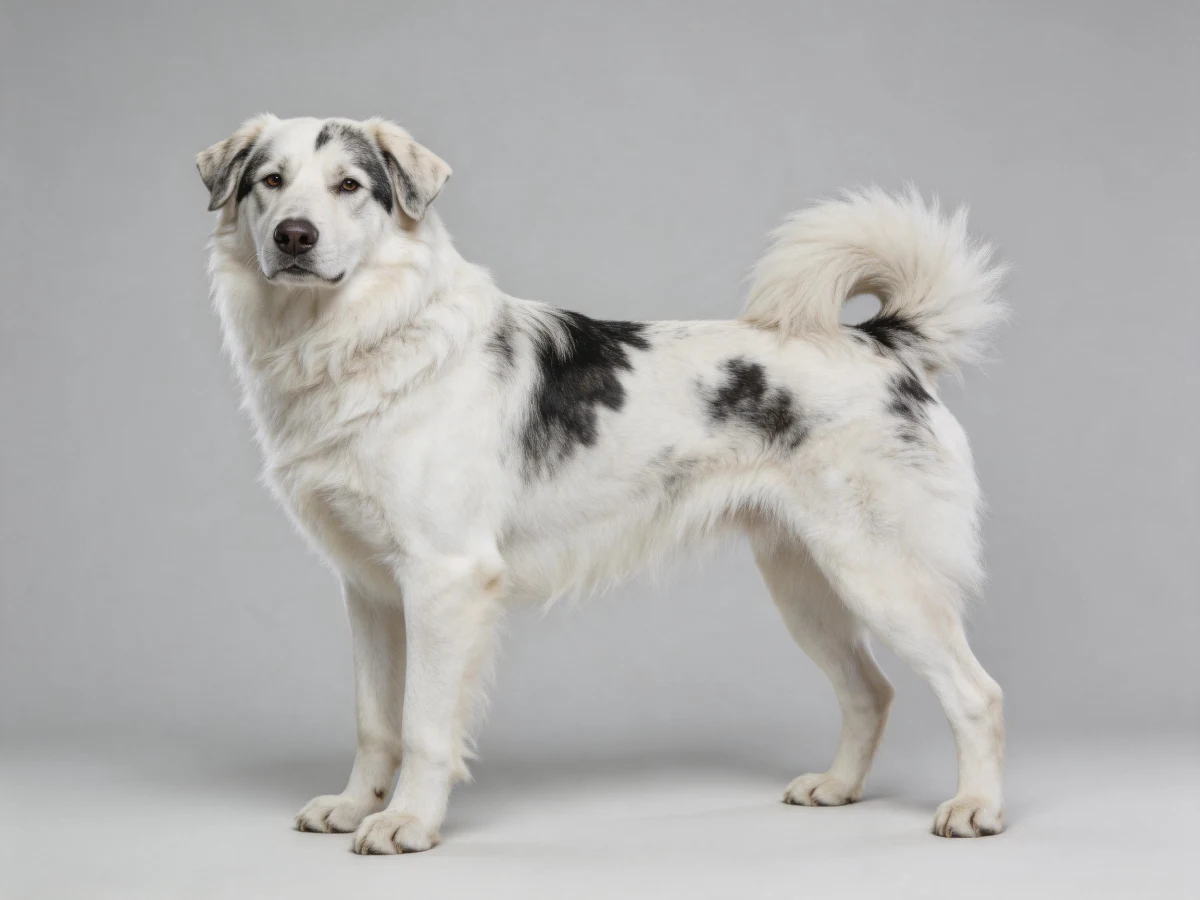
Akbash
✨ Key Takeaways
- A large-to-giant white livestock-guardian landrace of western Anatolia in Turkey; the name akbas means 'white head', distinguishing it from the fawn, black-masked karabas (the Kangal) of central Anatolia
- Unusual among flock guardians for blending mastiff size and strength with the long legs and lean, athletic frame of a gazehound, so it can both stand down and run down a predator across open rangeland
- Calm, quiet, steady and highly independent, with low baseline aggression but absolute resolve when its flock or family is threatened; devoted to its own and aloof toward strangers
- Recognised by the United Kennel Club (Guardian Dog group) on 1 January 1998 and by the Turkish Ministry of Agriculture in 2006; not recognised by the FCI, and distinct from the AKC's umbrella 'Anatolian Shepherd Dog' into which some Akbash lines were folded
- Always white under both the UKC and Turkish standards, with only light biscuit or grey shading at the ears permitted; a weatherproof double coat in two correct lengths, medium and long
- A specialised working guardian that needs land, a genuine territory or flock to mind, secure fencing and firm consistent handling -- well suited to rural and smallholding life and ill-suited to apartments or first-time owners
Quick Facts
Common Names & Variants
Modern aliases
Historical names
⚖️ Pros & Cons
Advantages
Trade-offs
Physical Appearance
Recognized colors
Coat
Other
Ears: Pendant, V-shaped. Tail: Long, curled over back when alert.
🕰 History
The white guardian of western Anatolia
On the dry plateaus and rolling rangeland of western Turkey, where shepherds have moved sheep and goats between summer and winter pasture for thousands of years, the Akbash is the pale dog that walks among the flock rather than behind it. Its name settles the question of what it is before any other description can: akbas is Turkish for "white head," and a true Akbash is white from nose to tail, the colour itself a working choice that lets a shepherd tell his own dog from a wolf at dusk and lets the flock accept the guardian as one of its own. The breed is a landrace rather than a manufactured pedigree -- a regional working type shaped over centuries by the demands of the job and by the herdsmen of provinces such as Eskisehir, Afyon, Ankara and Manisa, not by a studbook or a show committee.
A landrace, not a kennel creation
The Akbash belongs to the broad family of Anatolian flock-guardian dogs, the coban kopegi (shepherd's dogs) that Turkish villagers have bred for function across the whole plateau. Within that family the regional types are told apart largely by colour and build: the white western dog is the Akbash, while the fawn dog with a black mask of central Anatolia is the Karabash -- karabas, "black head" -- the type most of the world now meets as the Kangal. Because these are landraces rather than closed breeds, their histories are entwined and their boundaries were never policed the way a kennel club polices a pedigree; what fixed the Akbash as a recognisable type was the consistent local preference, over many generations, for an all-white, long-legged, lithe guardian in the western provinces. There is no founder and no foundation date to point to, only a long working tradition.
Mastiff power on sighthound legs
What makes the Akbash unusual among the world's livestock guardians is its construction. Most flock-guardian breeds are built on the heavy molosser pattern -- broad, deep and powerful. The Akbash carries the size and strength of that mastiff inheritance but sets it on the long legs, deep flank and lean, leggy frame of a gazehound, so that it can both stand down a wolf at close quarters and run one down across open ground. Breed authorities describe it directly as a blend of mastiff and gazehound characteristics, and that double nature is the heart of the type: a guardian quick and athletic enough to patrol wide rangeland, not merely to anchor a fold. The build is the working answer to the western Anatolian landscape, where flocks graze over long distances and predators must be met on the move.
The journey to North America
The Akbash was almost unknown outside Turkey until the second half of the twentieth century, when interest in non-lethal predator control brought it to the attention of Western researchers. The decisive figures were David and Judy Nelson, who studied Turkish guardian dogs in the field through the 1970s and began importing Akbash dogs to the United States in the early 1980s, building a foundation population from more than forty imported dogs. The timing met a practical need: in 1980 the United States Department of Agriculture took up livestock-guardian dogs in its predator-control programme, and the Akbash performed well in that work, protecting sheep from coyotes and other predators on American ranches. From that base the breed established a small but committed following in North America, where it is valued first as a working guardian and only secondarily as a companion.
Recognition at home and abroad
The Akbash occupies an honest middle ground in the recognition landscape, and a prospective owner should understand it clearly. In its homeland the breed standard was prepared by the Turkish Standards Institution and the type was formally recognised by the Turkish Ministry of Agriculture and Rural Affairs in 2006; it sits today under the Kopek Irklari ve Kinoloji Federasyonu, the Turkish dog-breed society. Abroad, the United Kennel Club recognised the Akbash on 1 January 1998 and places it in its Guardian Dog group. The breed is not recognised by the Federation Cynologique Internationale, and -- a point that causes real confusion -- the American Kennel Club does not list the Akbash at all. The AKC instead recognises a single "Anatolian Shepherd Dog," an umbrella category into which some Akbash bloodlines were folded when that breed was established in the United States. Akbash enthusiasts maintain, with good reason, that the white western dog is a distinct regional type with its own conformation and history, and the careful reader keeps the Akbash and the broader Anatolian Shepherd separate rather than treating one as a synonym for the other.
Temperament & Personality
Calm, steady and built to think for itself
The Akbash temperament was forged by a single demanding job -- guarding livestock against large predators with no shepherd standing over the dog to direct it -- and everything in its character flows from that. The breed is calm, quiet and steady by default, an animal that spends most of its day watching and patrolling rather than reacting, and that conserves itself for the moment it is genuinely needed. It is also profoundly independent: a guardian that had to wait for a command before confronting a wolf would be useless, so the Akbash was selected for centuries to assess a situation and act on its own judgement. That self-reliance is the breed's greatest working virtue and, in the wrong home, its greatest source of frustration, because it is not a dog that lives to please a handler.
Devoted to its own, reserved with the rest
With its family and its flock the Akbash is gently affectionate, loyal and remarkably patient, the same temperament that lets it live among lambs and kids without harming them extending to the children of its household. Toward strangers it is aloof and watchful rather than friendly; this is a guardian, and indiscriminate sociability would defeat the purpose. Properly raised and socialised, the Akbash distinguishes clearly between a welcomed guest and a genuine threat, but it does so on its own terms and after its own assessment, not on the strength of a stranger's good intentions. The breed bonds deeply to what it is given to protect, whether that is a flock of sheep or a human family, and treats the boundary of its territory as a serious responsibility.
Low aggression, high resolve
An important and often misunderstood point is that the Akbash is not a high-aggression dog. The breed's protectiveness is measured rather than reactive: it prefers to deter -- with presence, posture and a deep voice -- and escalates to physical confrontation only when deterrence fails. That low-key, deliberate disposition is exactly what suits it to working at a distance from the shepherd, ranging across pasture and meeting trouble with composure rather than panic. It does mean, though, that the same dog will defend its charges with absolute conviction when the moment comes, and that its size, strength and independence demand an owner who respects what the breed is. The Akbash is steady, not soft; the calm is the calm of a capable animal that knows its own power.
🏡 Living With a Akbash
A working guardian needs a job and a boundary
The Akbash is one of the clearest "right home or wrong home" breeds, and the deciding factor is whether the dog has territory to guard and space to range. This is a large, athletic guardian bred to patrol open rangeland, and it is at its best with acreage, a flock or herd to mind, or at the very least a securely fenced property large enough to give it a genuine perimeter to watch. A short walk on a lead does nothing for a dog whose instinct is to survey and patrol. The Akbash is not a hyperactive breed -- much of its day is spent lying watchfully where it can see its charges -- but it needs the room and the purpose its design assumes, and it does poorly confined to a small yard or an apartment with no territory to call its own.
Family, children and other animals
Within its household the Akbash is calm, gentle and devoted, and a well-socialised dog is typically reliable and protective with the children of its own family. It can live peaceably with the livestock it is raised to guard -- sheep, goats, poultry and the like -- because that is precisely the bond the breed was created to form, and many Akbash dogs are excellent with smaller household animals they have grown up alongside. The cautions are predictable for a guardian: the breed's protective instinct extends to visiting children and unfamiliar dogs, so visits from other people's pets and from children outside the family need supervision and clear management rather than an assumption that the dog will simply tolerate them.
Fencing, the voice and the realities of ownership
Secure, substantial fencing is non-negotiable. An Akbash regards the limit of its property as the limit of its responsibility, and a dog that can get out will expand its patrol into the neighbourhood, which serves no one. The breed is also a barker by trade: a guardian deters predators partly with a deep, carrying voice, and an Akbash that hears something at night will say so. On open ranchland that is the dog doing its job; on a suburban plot with close neighbours it can become a genuine problem, and it is one of the reasons the breed suits rural life far better than a populated street. Prospective owners should also plan for the breed's seasonal shedding and for the firm, consistent leadership an independent guardian of this size requires from the start.
🎓 Training & Exercise
Independent by design, not stubborn by fault
Training an Akbash means accepting at the outset that it is not a biddable working breed in the mould of a herding dog, and that this is a feature rather than a defect. The breed was selected for independent judgement -- the capacity to guard a flock and confront a predator with no human present to instruct it -- so it does not have the eager, handler-focused responsiveness of a dog bred to take direction. An Akbash will weigh a request, decide whether it makes sense, and comply on its own terms. Owners who read that as disobedience and reach for heavy correction get nowhere; the breed responds to calm, consistent, respectful handling and shuts down under harshness. The goal is a cooperative working relationship with a thinking dog, not push-button obedience.
Early socialisation does the heavy lifting
For a guardian breed, socialisation matters even more than formal obedience, because the temperament an Akbash carries into adulthood is largely set in its first year. A puppy that meets a wide range of people, dogs, environments and situations -- and, where it is to be a working dog, that is raised with the livestock it will protect -- grows into a settled, discerning adult that tells a genuine threat from an ordinary visitor. A poorly socialised Akbash, by contrast, can become indiscriminately suspicious, which in a dog of this size and resolve is a serious matter. Structured, positive exposure from puppyhood is the single most valuable investment an owner can make in the breed.
Foundation manners and realistic goals
Basic obedience -- a reliable recall where practical, loose-lead walking, and calm acceptance of handling for grooming and veterinary care -- is achievable and well worth establishing early, while the dog is small enough to manage easily and before adult independence is fully formed. Recall has the usual guardian-breed limit: a dog absorbed in patrolling or responding to a perceived threat may not break off on command, so secure fencing remains the real safeguard rather than a trained recall. The breed is not suited to the instant-compliance sports such as competitive obedience, where its deliberate, self-directed nature works against the split-second responses those disciplines reward. Channelled into the work it was made for -- guarding -- and handled with patience and consistency, the Akbash is a capable and rewarding partner; fought against its nature, it is simply frustrating for dog and owner alike.
✂️ Grooming & Coat Care
A weatherproof double coat that asks for little
The Akbash wears a practical working coat: a double coat of a softer, dense undercoat beneath a coarser outer layer, in one of two equally correct lengths -- a shorter to medium variety that lies fairly sleek, and a longer variety with a distinct ruff and feathering on the legs and tail. Either way it is a self-sufficient, weatherproof jacket built to keep a guardian comfortable through cold nights and hot days on open ground, and it needs no clipping, stripping or professional styling. A thorough brushing once or twice a week lifts dead hair, spreads the skin's natural oils and keeps the white coat clean; the longer-coated dogs benefit from a little extra attention behind the ears and on the feathering, where tangles can form.
Managing the seasonal shed
The Akbash sheds moderately for most of the year and then heavily during the seasonal moults in spring and autumn, when the dense undercoat is dropped in quantity. Through those weeks daily brushing with a suitable de-shedding tool or undercoat rake is the difference between a manageable coat and drifts of white hair through the house, and it keeps the dog comfortable as the old undercoat clears. Bathing is needed only occasionally -- when the dog is genuinely dirty rather than on any fixed schedule -- using a mild dog shampoo; the coat has a degree of natural dirt resistance and dries and cleans up more easily than its colour suggests.
Ears, nails, teeth and the outdoor check
The pendant ears should be checked regularly for redness, discharge or odour and cleaned gently with a veterinarian-approved product only when needed, with particular care to dry them after the dog has been wet. Nails need trimming whenever they grow long enough to click on hard ground or alter the dog's gait, monthly being a reasonable default for a dog not wearing them down naturally. Dental care matters as much in this breed as in any large dog: regular tooth-brushing with a canine toothpaste is the most effective guard against periodontal disease. For a working or outdoor-living Akbash, a quick hands-on check after time in rough country -- feeling for ticks, grass seeds, thorns and pad injuries -- belongs in the routine alongside the brush.
🍖 Diet & Nutrition
Feeding a large working guardian
The Akbash is a large to giant working dog, and its diet should match both its size and its real activity level. A good-quality complete dog food appropriate to the dog's life stage -- puppy, adult or senior -- and to its workload is the sensible baseline. Despite its size the Akbash is not a high-burning, hard-galloping breed for most of its day; a great deal of guarding is watchful stillness, so the calorie needs of an adult at maintenance are more moderate than its bulk might suggest, and the feeding guide on the bag is a starting point rather than a prescription. Hands-on body-condition scoring is the more reliable everyday measure: a dog in good condition has ribs that are easily felt under a light covering, a visible waist from above and a clear tuck-up from the side.
Large-breed puppy growth done carefully
The most consequential nutritional decisions for an Akbash are made in puppyhood. Large and giant breeds are vulnerable to developmental orthopaedic problems if they grow too fast, and the established guidance is to raise the puppy on a diet formulated for large-breed growth, with controlled calcium and energy, and to aim for steady, moderate growth rather than the biggest possible puppy at every stage. Overfeeding a giant-breed puppy to push rapid weight gain works directly against sound joint development. Keeping the young dog lean through its long growth period -- giant breeds are not physically mature until well past their first year -- is one of the best protections an owner can give its hips and elbows.
Schedule, bloat precautions and water
Because the Akbash is a deep-chested breed, the way it is fed matters as much as what it is fed. Adults are best given two or more measured meals a day rather than one large one, and vigorous exercise should be avoided in the couple of hours around a full meal -- both are standard, widely-followed precautions against gastric dilatation-volvulus in deep-chested dogs. Discouraging frantic gulping of food and water helps too. Fresh water must always be available, with demand rising sharply in warm weather and on working days for a dog living outdoors. Puppies need more frequent, smaller meals appropriate to their age, transitioning to the adult pattern as they mature. Treats should be counted within the daily ration, not added on top, to keep a large guardian from carrying weight its joints do not need.
🐶 Buying & Adopting a Akbash
An uncommon breed with a working purpose
The Akbash is a specialised working breed kept by a relatively small community, and a prospective owner should set expectations accordingly. Most breeding outside Turkey is in the hands of people who keep the dog for its job -- guarding livestock -- and who breed selectively from working stock rather than for a pet market. A serious buyer will end up talking to breeders whose first concern is whether a dog will get the space, the territory and ideally the guardian work it was made for. Finding an Akbash usually means joining a waiting list and travelling, rather than picking one from local availability, and any source advertising ready supply of Akbash puppies at an ordinary pet-shop price deserves scepticism rather than enthusiasm. There is no reliable single market price for the breed.
Where to begin and what a good breeder asks
The natural starting points are the breed's dedicated organisations and the United Kennel Club, which recognises the Akbash in its Guardian Dog group and can connect enquirers to the breed community; the breed clubs that maintain the standard are the best route to ethical, working-focused breeders. A responsible Akbash breeder will want to discuss the hip and elbow screening of the parents and any health seen in the line, and will ask searching questions of the buyer in turn -- about acreage and fencing, about whether there is livestock or at least a genuine guarding role, about experience with large independent dogs, and about the buyer's understanding that this is a guardian rather than an easy companion. A breeder who asks none of this and offers a puppy on demand is a warning sign, not a convenience. Buyers should also be careful to confirm they are getting a true Akbash rather than a generically described "Anatolian," given how often the names are blurred.
Adoption and an honest assessment of fit
Akbash and Akbash-type dogs do turn up in rescue, frequently as adolescents who proved too much for a home that underestimated a large, independent guardian -- precisely the mismatch this guide aims to prevent. Livestock-guardian-breed rescues and general large-breed rescues are the places to look, and an adopted adult of known temperament can be an excellent outcome for the right home. Whether buying or adopting, the honest question is the same one the breed always poses: can you provide a large, protective, self-directed guardian with the space, the secure fencing, the firm consistent handling and ideally the work it needs? For a rural or smallholding home with livestock or land, the Akbash is a capable, devoted and rewarding partner. For a suburban household wanting a sociable, biddable pet, it is the wrong dog, and recognising that before the purchase is a kindness to everyone, the dog most of all.
📜 Breed Name Etymology — iDogNames original research
White head -- the name says what the dog is
The name Akbash is a plain Turkish description of the dog's most defining feature. It joins ak, "white," and bas, "head," to give akbas -- "white head" -- and a correct Akbash is white throughout, the head included. Few breed names are as literal or as functional: the colour is not incidental but the whole point, the trait that lets a shepherd distinguish his guardian from a predator in poor light and that the breed has been selected to carry without exception. To name the dog is simply to describe it, and the name has travelled into English unchanged, the Turkish word adopted directly as the breed's name rather than translated.
Akbash and Karabash -- white head, black head
The name gains its full meaning in contrast with its sibling. Across Anatolia the shepherd's guardian dogs are told apart by head colour, and the pairing is built right into the language: against the white-headed akbas stands the karabas -- kara, "black," plus bas, "head," the "black head," the fawn dog with a dark mask of central Anatolia known to most of the world as the Kangal. The two names form a matched set that records how Turkish herdsmen have long classified their guardians not by pedigree but by the colour of the dog they could pick out at a distance among the flock. To understand "Akbash" is to understand that the western dog was named in deliberate opposition to its eastern cousin.
One word, carried into English intact
Unlike many breeds whose names accumulate translated forms as they spread, the Akbash has kept its single Turkish word everywhere it has gone. English speakers say "Akbash" -- and often "Akbash Dog," appending the redundant English noun -- because there is no natural English equivalent to translate and no reason to invent one; the descriptive Turkish term does the work directly. The spelling in Latin script drops the Turkish cedilla, so the s of the original akbas is written plainly, but the word is otherwise unchanged. It is one of those breed names that carries its entire meaning in a single foreign word, intact from its homeland.
Name forms at a glance
| Name | Role | Origin | Literal meaning | First recorded |
|---|---|---|---|---|
| Akbash | primary | Turkish (descriptive compound) | white head | — |
| Akbas | origin country native | Turkish (native orthography) | white head | — |
| Akbash Dog | alias | English (with redundant noun) | the white-head dog | — |
| Karabash (contrasting type) | historical | Turkish (the paired opposite) | black head -- the fawn, black-masked guardian (the Kangal) | — |
| Coban Kopegi | historical | Turkish (generic category) | shepherd dog | — |
🏛 Naming Traditions — iDogNames original research
Turkish names for a Turkish guardian
Because the Akbash is so completely a creature of the Anatolian plateau, owners who want a name that fits the breed reach naturally for Turkey -- and, more specifically, for the language of the shepherd and the flock. Turkish words tied to the dog's colour and character sit most naturally of all: Kar (snow), Beyaz (white), Pamuk (cotton) and Sut (milk) all answer to the pure white coat, while Bekci (watchman or guard), Aslan (lion) and Pasa (pasha, a title of rank) speak to the dog's job and bearing. Traditional Turkish given names such as Demir (iron), Yildiz (star) or Derya carry the homeland in a single word.
The breed's landscape and work give a second rich vein. The provinces and features of western Anatolia -- Eskisehir, the rangeland the dog patrols, the highland coban (shepherd) tradition itself -- all suggest fitting names, as do words drawn from the dog's role as protector and from its calm, watchful steadiness. Whichever direction an owner takes, the strongest Akbash names are the ones that reflect what the dog actually is: a large white Turkish guardian of the western Anatolian flocks, bred for the watch and built to be seen.
🐾 Themed Names for Your Akbash — iDogNames original research
Turkish names for the white coat
- Kar -- Turkish for "snow", for the pure white coat
- Beyaz -- Turkish for "white", the breed's defining colour
- Pamuk -- Turkish for "cotton", a soft name for a white dog
- Sut -- Turkish for "milk", for a milk-white guardian
- Inci -- Turkish for "pearl", for a pale, lustrous coat
- Bulut -- Turkish for "cloud", for a white-coated dog
- Akca -- Turkish for "whitish", echoing the ak in Akbash
- Gumus -- Turkish for "silver", for the faint grey shading some dogs carry
Guardian, strength and watch names
- Bekci -- Turkish for "watchman" or "guard", the breed's whole purpose
- Aslan -- Turkish for "lion", for a powerful guardian
- Pasa -- Turkish for "pasha", a title of rank and dignity
- Demir -- Turkish for "iron", for a strong, steady dog
- Kaya -- Turkish for "rock", for an immovable guardian
- Cesur -- Turkish for "brave", befitting a predator-stopper
- Sultan -- a name of authority for a commanding dog
- Koruyucu -- Turkish for "protector", the dog's defining role
Anatolian land and heritage names
- Anadolu -- the Turkish name for Anatolia, the breed's homeland
- Eskisehir -- the western province at the breed's heart
- Coban -- Turkish for "shepherd", the dog's lifelong partner
- Yayla -- the highland summer pasture the flocks are taken to
- Toros -- the Taurus Mountains of southern Anatolia
- Derya -- a Turkish given name meaning "sea" or "ocean"
- Yildiz -- Turkish for "star", a classic name on the plateau
- Efe -- a folk hero of the Aegean region of western Turkey
Calm-temperament and companion names
- Sakin -- Turkish for "calm", for the breed's steady nature
- Huzur -- Turkish for "peace" or "serenity"
- Dost -- Turkish for "friend", for a devoted family guardian
- Sadik -- Turkish for "loyal", the breed's lasting virtue
- Tatli -- Turkish for "sweet", for the gentle side of the dog
- Nazli -- Turkish for "gentle" or "coy", for an affectionate dog
- Bahadir -- Turkish for "valiant", an old heroic name
- Zeki -- Turkish for "clever", for a thinking guardian
- Ghost -- plain English for a pale guardian that appears at night
- Bear -- for the size and presence of a giant white guardian
More Turkish heritage names
- Turkish Trail - best for a Akbash name rooted in Turkey rather than generic style
- Western Anatolia, Turkey; concentrated in the provinces of Eskisehir, Afyon, Ankara and Manisa Ridge - best for a regional landscape cue tied to the Akbash story
- Local Line - best for a name that respects local breed history
- Old Route - best for migration, trade, field or pastoral routes behind the breed
- Heritage Note - best for a page where origin should be treated as context, not decoration
- Village Path - best for rustic, local or landrace-style background
- Working Home - best for a dog whose name should remember white livestock-guardian dog (coban kopegi) bred to protect flocks of sheep and goats from wolves and other pr
- Country Mark - best for a concise country-of-origin cue
More work and purpose names
- Flockline - best for a Akbash rooted in white livestock-guardian dog (coban kopegi) bred to protect flocks of sheep and goats from wolves and other pr
- Gatewise - best for a dog who learns field, yard and gate routines
- Stock Sense - best for controlled work around livestock
- Steady - best for calm pressure instead of frantic chasing
- Boundary - best for fences, roads and household rules
- Marker - best for precise reward-based training
- Partner - best for a cooperative handler-dog relationship
- Settle - best for a working dog learning home calm
More coat and build names
- Pure White - best for a Akbash whose color or markings deserve a simple call name
- Double Coat, Weatherproof Coat - best for the double coat, weatherproof coat type on this breed
- White Blaze - best for a clear face or chest marking
- Dark Mask - best for a dog with a strong muzzle or face marking
- Weather Coat - best for outdoor or working-dog coat context
- Strong Frame - best for a dog whose build is part of its function
- Bright Eye - best for an alert expression
- Ground Step - best for a name tied to movement and body type
📋 Breed Standard at a Glance
UKC Guardian Dog standard -- general appearance and size
The United Kennel Club recognises the Akbash in its Guardian Dog group and describes a large, powerful yet elegant flock-guardian that blends mastiff and gazehound characteristics. The standard's defining note is that combination: a dog with the height, weight and strength to confront a large predator set on the long legs, deep chest and lean, athletic frame of a gazehound, slightly longer in body than tall. Under the UKC standard males stand roughly 30 to 34 inches at the withers and females 28 to 32 inches, with males averaging about 120 pounds and females about 90 pounds; the Turkish standard cites a comparable range in metric terms. The overall impression is of a balanced, capable working guardian built for both close confrontation and ground-covering patrol.
Head, coat and colour
The head is wedge-shaped and in proportion to the body, with golden-brown to dark-brown eyes preferred and a solid dark-brown or black nose. The ears are pendant and V-shaped with slightly rounded tips, set rather high and lying flat. The coat is a double coat in two equally acceptable varieties: a shorter to medium length that lies fairly sleek, and a longer variety, often slightly wavy, with a distinct ruff and profuse feathering on the legs and tail. The colour is the breed's signature and is fixed -- the Akbash is always white, with only light biscuit or grey shading permitted around the ears or in the undercoat. The tail is uncut and thick at the base, carried low when the dog is relaxed and usually in a curl over the back when it moves or is alert.
Movement, temperament and working type
Movement under the standard is easy, free and elastic, with the feet travelling close to the ground -- the efficient, ground-covering gait of a dog made to patrol open country rather than to sprint or to plod. The standard frames temperament as part of type: a calm, quiet, steady and independent guardian, gently affectionate with its own family and aloof toward strangers, an animal whose protectiveness is measured rather than reactive. That insistence on working temperament alongside conformation is the most telling feature of the breed's description: the Akbash is defined first as a functional livestock guardian and only secondarily as a dog to be judged in a ring.
🏆 Recognition
Other registries
Breed clubs
❓ Frequently Asked Questions
What is an Akbash's temperament like?
The Akbash is a calm, quiet and steady livestock guardian with a strongly independent mind, bred to protect a flock and confront predators on its own judgement without a shepherd directing it. With its own family and the animals it is raised to guard it is gently affectionate, loyal and patient, while toward strangers it is aloof and watchful. Importantly it is not a high-aggression breed: its protectiveness is measured, preferring to deter with presence and a deep voice and escalating only when deterrence fails -- but it will defend its charges with absolute resolve when the moment comes. It needs an owner who respects its independence and handles it calmly and consistently rather than expecting eager obedience.
How big does an Akbash get?
The Akbash is a large-to-giant breed. Under the UKC standard males stand about 30 to 34 inches at the withers and females 28 to 32 inches, with males averaging roughly 120 pounds and females about 90 pounds. Its build is distinctive among flock guardians: it carries mastiff size and strength on the long legs and lean, deep-chested frame of a gazehound, so it is athletic and ground-covering rather than heavy and bulky -- powerful enough to face a wolf and fast enough to run one down across open pasture.
What health problems do Akbash dogs have?
The Akbash is generally a hardy, sound breed with a typical lifespan of about 10 to 12 years and no long catalogue of well-documented inherited diseases, but it is uncommon outside Turkey and has not been studied at scale, so "few documented problems" means "not studied", not "proven free of risk". As a large to giant breed it carries the usual orthopaedic risks -- hip and elbow dysplasia, for which breeders should screen breeding stock -- and as a deep-chested dog it is at risk of bloat (gastric dilatation-volvulus), a surgical emergency owners should learn the signs of. Its lean, gazehound-influenced build also makes careful anaesthetic management sensible. This is general educational information, not veterinary advice.
Are Akbash dogs good family dogs?
For an active rural or smallholding home with land, secure fencing and experience of large independent dogs, the Akbash can be a calm, devoted and protective companion that is gentle with its own family and reliable with children it has been raised among. But it is a specialised working guardian, not an easy pet: it needs a genuine territory or flock to mind, it is a natural night-time barker, it is protective toward visiting children and unfamiliar dogs, and it is too independent to suit owners wanting a biddable obedience dog. It is poorly suited to apartments, small suburban yards and first-time owners. Outside Turkey it is uncommon and bred mostly for work, so acquiring one usually means a waiting list and travel.
How much grooming does an Akbash need?
Relatively little. The weatherproof double coat -- found in two correct lengths, a shorter-to-medium variety and a longer one with a ruff and feathering -- needs only a thorough brushing once or twice a week and no clipping or professional styling, and it is more dirt-resistant than its white colour suggests. The exception is the seasonal moult in spring and autumn, when the dense undercoat is shed heavily and daily brushing with a de-shedding tool is needed. Beyond the coat, check and gently clean the pendant ears as required, trim nails when they grow long, and brush the teeth regularly; a hands-on check for ticks and grass seeds after work in rough country is sensible for an outdoor-living guardian.
How much exercise does a Akbash need?
A Akbash needs exercise that matches its history and build. Plan for daily movement, training and mental work connected to white livestock-guardian dog (coban kopegi) bred to protect flocks of sheep and goats from wolves and other pr. The right amount depends on age, health and individual temperament, so owners should balance activity with rest rather than relying on a one-size routine.
📚 Sources & Further Reading
Every load-bearing factual claim on this page is anchored to one of the sources below. iDogNames does not synthesize from secondary aggregators.
- breed club official UKC Akbash Breed Standard — United Kennel Club (1998)
- wikipedia Akbash -- Wikipedia — Wikipedia
- wikidata Akbash -- Wikidata — Wikidata
- breed club official Akbash Dogs International -- Breed Standards — Akbash Dogs International
- breed club official Akbash Dog Breed Standard -- UKC PDF — United Kennel Club (1998)
- book The New Encyclopedia of the Dog — Dorling Kindersley (2000)
- veterinary org Gastric Dilatation-Volvulus (Bloat) in Dogs — Merck Veterinary Manual (2024)
- veterinary org Hip Dysplasia -- evaluation and screening — Orthopedic Foundation for Animals (2024)
- other Akbash Dog Breed Information & Traits — Dogster (2024)