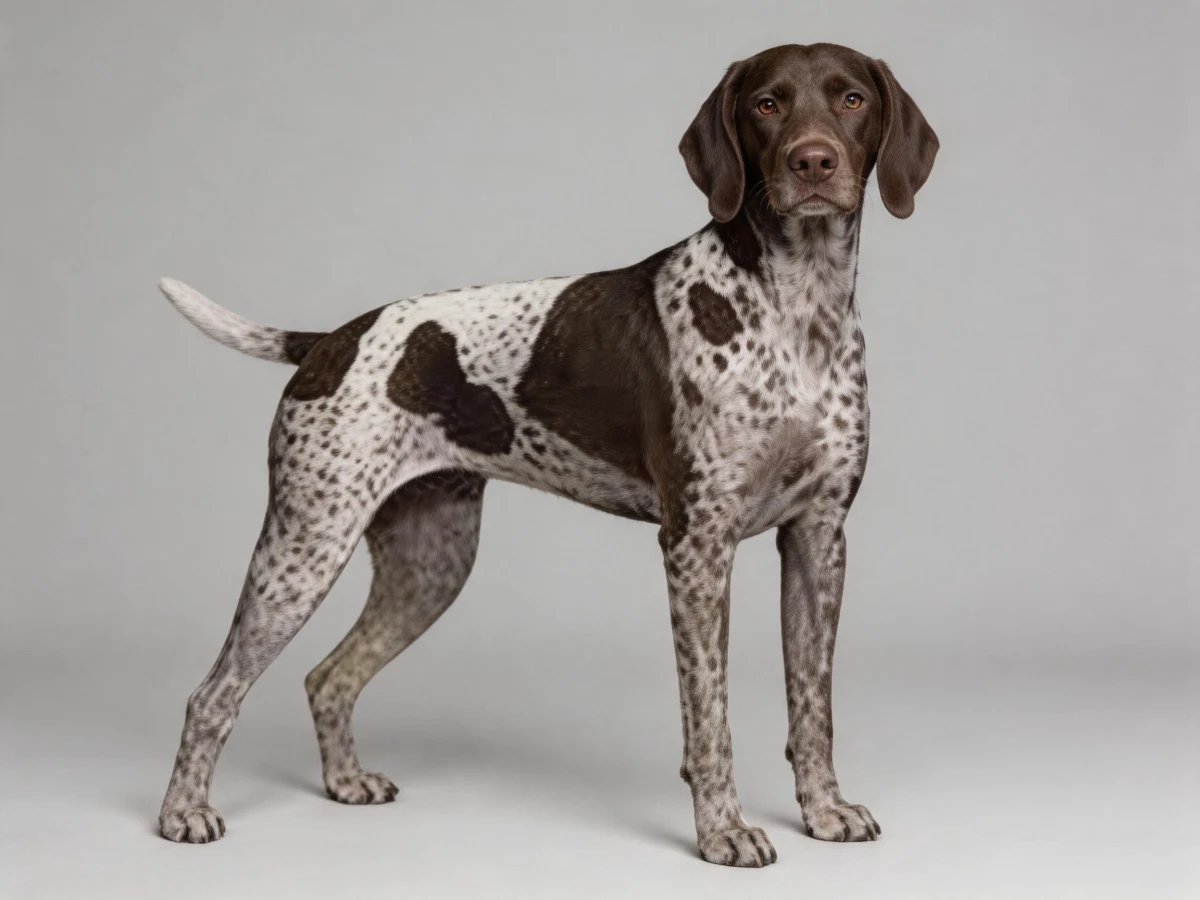
German Wirehaired Pointer
✨ Key Takeaways
- The breed was engineered around its coat: late-19th-century German breeders set out to build a harsh, wiry, water-shedding jacket as functional armour against thorn and icy water, then assembled a versatile gun dog underneath it — Drahthaar means literally wire-hair.
- Its intellectual father was Sigismund Freiherr von Zedlitz und Neukirch, who wrote under the pen name Hegewald and argued for selecting on field performance over showring beauty by blending Pudelpointer, Griffon, Stichelhaar and German Shorthaired Pointer blood.
- The Verein Deutsch-Drahthaar, founded in 1902, built a stud book gated by performance: a Drahthaar must pass demanding versatile-hunting tests (VJP, HZP, VGP) and meet hip and coat requirements before its progeny can be registered.
- The Drahthaar (DD) and the AKC German Wirehaired Pointer (GWP, recognised 1959) share one origin but split into two cultures — the DD population still gated by field tests, the GWP line registered on pedigree and conformation; the NAVHDA test culture keeps the German performance ethic alive in North America.
- The signature health issue is von Willebrand disease Type 2, a severe inherited bleeding disorder now traced to the VWF c.1657T>G variant (Vos-Loohuis et al., 2017) and screenable by DNA — a European survey of 1,855 dogs (Gavazza et al., 2012) found 7.8% carriers and 0.4% affected.
- This is an opinionated, one-family, high-drive working dog — reserved with strangers, strong prey drive, and needing a real job; the deepest naming heritage is German (Hegewald, Jager, Bruno, Sturm), naming the dog after the country, founders and field that made it.
Quick Facts
Common Names & Variants
Modern aliases
Historical names
Modern variants & lines
⚖️ Pros & Cons
Advantages
Trade-offs
Physical Appearance
Recognized colors
Coat
Other
Ears: Drop. Tail: Set high, carried level.
🕰 History
The coat was the brief: a hunting dog you could send into thorn and ice
The German Wirehaired Pointer was built around a coat. Where most breeds acquired their jacket as a by-product of climate or fashion, the late-19th-century German breeders who created the Drahthaar set out to engineer a specific kind of coat — harsh, wiry, water-shedding, dense enough to turn thorn and cold — and then assembled a versatile gun dog underneath it. The German word says it plainly: Drahthaar means "wire hair." The breed's defining trait is therefore not a temperament or a hunting style but a piece of functional armour, and almost everything else about the dog follows from the decision to clothe a hard-driving field dog in something that could survive a German winter and a bramble thicket without flinching.
This is where the breed must be separated from its smooth-coated cousin. The German Shorthaired Pointer answered the broad question of whether one dog could replace a kennel of British specialists. The Wirehair answered a narrower, later question that the wider movement had left open: what jacket should that all-round dog wear so it could work the worst cover and the coldest water without protection failing it? The men who built the Drahthaar treated the coat as the unsolved engineering problem, and the German Shorthaired Pointer — already a finished, biddable, hard-nosed dog — became one of the materials they reached for to solve it.
Hegewald and the deliberate blend
The intellectual father of the breed wrote under a pen name. Sigismund Freiherr von Zedlitz und Neukirch — a Prussian cavalry officer, hunter, and prolific cynological author — published on gun dogs under the name Hegewald through the closing decades of the 19th century, and he argued, against the rising fashion for closed-bred showring purity, that performance should be selected on function first and that several rough-coated regional strains should be combined into one rugged, wire-jacketed working breed. His program was not a single mating but a doctrine: take the coarse-coated material already scattered across Germany and weld it, by deliberate crossing and ruthless field selection, into a dog tested in the field rather than the ring.
The blend Hegewald and his allies drew on is well documented in outline, even if individual matings are not. The base was the Pudelpointer, itself a Poodle-and-Pointer cross prized for a harsh, intelligent, water-loving template. To that they added Griffon blood (the Korthals-type wirehaired pointing griffon), the old German Stichelhaar — a broken-coated pointer of long standing — and the Deutsch Kurzhaar, the German Shorthaired Pointer, brought in for nose, pointing instinct, and tractability. Out of those four streams the breeders fixed a single harsh-coated type. The exact proportions are not recorded with stud-book precision; what is firmly attested is the set of breeds reached for and the reason — each contributed a quality, and the wire coat was the unifying goal.
The Verein Deutsch-Drahthaar and the closed performance stud book
The breed was organised, not merely bred. In 1902 the Verein Deutsch-Drahthaar (VDD) was founded to consolidate the type, and it built something unusual in the dog world: a stud book gated by performance. Under the VDD system a Drahthaar does not simply have to look correct to breed on — it has to pass demanding versatile-hunting tests (the spring VJP, the autumn HZP, and the rigorous VGP utility test), be evaluated for coat and conformation, and meet hip and temperament requirements before its progeny can be registered. The doctrine that breeding stock must prove itself afield was Hegewald's in spirit, and the VDD codified it into one of the most tightly controlled, performance-policed registries in any breed anywhere. The annual Hegewald test, named for the founder, remains the showcase event for breeding hopefuls.
That closed, test-gated system carried a strong nationalist charge in its early decades. The Drahthaar was promoted as the German hunting dog — bred in Germany, proven on German game, registered under German rules — and the VDD's insistence on performance over showring beauty was framed as a rejection of the British and cosmopolitan fashion for breeding to a written standard. Whatever one makes of that framing, it produced a working population of unusual uniformity and field reliability, and it explains why the breed feels, even today, more like a job description than a show entry.
The Drahthaar and the GWP: one origin, two roads
When the breed crossed the Atlantic, it split. The American Kennel Club recognised the breed as the German Wirehaired Pointer in 1959, registering it the way the AKC registers any breed — by pedigree and conformation, judged in the ring, with no requirement that a dog pass a hunting test to breed on. Meanwhile the VDD established chapters abroad, including in North America, and kept its own dogs under the original closed, performance-tested Deutsch-Drahthaar system. The result is a genuine fork. A dog registered DD by the VDD and a dog registered GWP by the AKC share an origin and look broadly alike, but they sit in different cultures: the DD population is still gated by field tests, hip clearance and breed-warden approval, while the GWP population includes show and pet lines selected without that performance gate. Serious American versatile hunters often seek out DD breeding specifically to stay inside the test-proven pool.
The NAVHDA culture the breed helped shape
The Wirehair landed in a country that was beginning to build its own version of the German testing ethic. The North American Versatile Hunting Dog Association (NAVHDA), founded in 1969, runs natural-ability and utility tests modelled on the continental versatile-dog tradition, and the German wirehaired breeds — Drahthaar and GWP alike — became fixtures of that culture. For owners drawn to the breed, NAVHDA testing is often the point: it keeps alive, on American ground, the principle Hegewald insisted on more than a century earlier — that a versatile gun dog should be measured by what it can do in field, forest and water, not by how it stands. The history of this dog is, start to finish, the history of an idea about how breeding should be policed, wrapped in a coat designed to take a beating.
Temperament & Personality
An opinionated dog, not a biddable one
The German Wirehaired Pointer is the more strong-minded of the two famous German pointers, and prospective owners should hear that clearly before anything charming gets said. Where the German Shorthaired Pointer is generally friendly and eager with everyone, the Wirehair tends to be reserved with strangers, deeply bonded to its own family, and possessed of a self-assured, sometimes stubborn streak that traces straight back to a breeding program that selected for an independent field worker capable of making decisions far out on a hunt. This is a dog with opinions. It is not aloof or unkind, but it is discriminating about people, and it expects to be a working partner rather than a passenger.
The one-family dog
Attachment in this breed runs narrow and deep. A Wirehair typically chooses its household and gives that household its whole loyalty, which makes it an excellent companion and a naturally watchful, territorially aware presence at home. The flip side is that the breed is not a social butterfly: it can be standoffish or wary with visitors, may be assertive with strange dogs, and does best when its protectiveness is shaped early by deliberate, generous socialisation. Raised with that work done, it is a steady, affectionate, faintly comic family member. Raised without it, the same wariness can curdle into suspicion or reactivity.
A serious hunting engine
Underneath the family-dog surface is a high-stamina versatile gun dog bred to point, track a wounded animal, retrieve from land and icy water, and kill vermin — a true Vollgebrauchshund, or "full-use dog." That engine does not idle quietly in a suburban yard. The breed needs hard daily exercise and, ideally, a job: hunting, hunt tests, tracking, dock work, long off-lead running on safe ground. A Wirehair that hunts most weekends is usually a calm, satisfied dog at home. A Wirehair given two short street walks a day is, with grim reliability, a destructive, restless, vocal one that invents its own employment — and a clever, determined dog's self-assigned jobs are rarely convenient.
Prey drive, water, and the rest of the household
The vermin-dispatching part of the breed's job description left a mark. Many Wirehairs carry a pronounced prey drive toward cats, rabbits, poultry and other small animals, and that instinct is hard to train away once it is switched on — early management and realistic expectations matter more than optimism. The same dog will plunge into freezing water after a duck without hesitation, which is exactly what the wire coat and webbed feet were built for. With children in its own family the breed is generally good, though its size, bounce and intensity suit older kids better than toddlers.
Training a thinking dog
Intelligence in this breed is real and double-edged. The Wirehair learns fast, reads a handler closely, and is fully capable of the polished work the German tests demand — but it also learns what it can get away with just as fast, and it will quietly take command of a household that does not lead. Training has to be consistent, fair, and genuinely engaging; this is not a dog that drills happily for a handler it does not respect, and it bores of mindless repetition. Firm, confident, reward-based handling from puppyhood, paired with an outlet for the hunting drive, produces the breed at its best: a devoted, capable, slightly stubborn partner that is wonderful in the right home and a real handful in the wrong one.
🏡 Living With a German Wirehaired Pointer
A working partner that expects a job, not a yard
Living with a German Wirehaired Pointer means living with a versatile gundog that was bred to work hard all day and then come home and bond closely to one household. The breed attaches narrowly and deeply: it wants to be near its own people, often follows a chosen person room to room, and reads the home as territory worth watching. That loyalty is the breed at its best, but it comes packaged with intensity. A Wirehair is not a low-demand dog you keep ticking over on two short street walks — under-exercised, it becomes the restless, destructive, vocal animal that invents its own employment, and a clever, determined dog's self-assigned jobs are rarely the ones you wanted done.
The exercise floor is high and non-negotiable
Plan for at least an hour or two of real physical and mental work every day, ideally with a purpose attached: hunting and hunt tests, tracking, long off-lead running on safe ground, dock diving, retrieving drills, or scent games. This is a high-stamina athlete with genuine hunting and prey drive, and the prey drive is not a quirk you train out — many Wirehairs will fixate on cats, rabbits, squirrels and poultry, so a securely fenced space and a reliable management plan matter from day one. The breed also loves water and will plunge into cold water after a thrown bumper without hesitation, which is one of the easiest ways to drain a hot dog's energy in warm months.
Strangers, other dogs, kids, and the apartment question
Unlike the famously gregarious German Shorthaired Pointer, the Wirehair tends to be aloof and reserved with strangers and can be assertive with strange dogs, so early and generous socialisation is not optional — it is the work that decides whether the natural watchfulness settles into steady confidence or curdles into suspicion. With children of its own family the breed is generally good, though its size, bounce and drive suit older kids better than toddlers. The harsh wire double coat is genuinely weatherproof, so the breed shrugs off cold and wet far better than heat; in hot, humid climates schedule hard work for early morning or evening. Apartment life is a poor fit unless an owner is honestly committed to meeting the full exercise need every single day — this is a country-and-field dog at heart, not a flat-dweller.
🎓 Training & Exercise
An intelligent, willful dog — not a biddable one
The German Wirehaired Pointer is smart and highly trainable, but trainable is not the same as eager-to-please. This breed was selected to make decisions far out on a hunt, and that independence shows up in the living room: a Wirehair learns commands fast and learns what it can get away with just as fast, and it will quietly take charge of a household that does not lead. It is fully capable of the polished, multi-discipline work the German performance tests demand, but it gives that work to a handler it respects, not to one it can out-wait. The single biggest training mistake owners make is treating the breed's intelligence as built-in obedience and then being surprised when a bored, under-led dog edits the rules.
What motivates it and what backfires
Consistent, fair, genuinely engaging sessions are what land. The Wirehair bores quickly of mindless drilling, so keep training short, varied, and tied to something the dog actually wants — a retrieve, a sniff, a release to run. Reward-based handling works; nagging and harsh, heavy-handed correction do not, because a strong-minded dog meets pressure with resistance rather than compliance and simply tunes out a handler it has stopped respecting. Start in puppyhood, set rules early, and enforce them calmly and predictably, because a young Wirehair that learns the household has soft edges spends adolescence testing them.
The one real catch: recall over a prey drive
The hardest and most important skill to build is a reliable recall, because the breed's hunting and prey drive can override a half-trained one the instant a rabbit breaks cover. Train recall systematically on a long line, proof it against real distractions, and reinforce it for life with high-value rewards rather than assuming it is finished. Channel the hunting instinct into a legitimate outlet — formal fieldwork, tracking, or structured retrieving — so the drive has somewhere sanctioned to go; a Wirehair with a job is a focused, satisfied partner, while one with no outlet aims that same drive at the fence line, the cat, and the neighbour's chickens. "Leave it," a solid "place" or settle, and loose-lead walking round out the core curriculum for a powerful dog that pulls toward everything interesting.
✂️ Grooming & Coat Care
A harsh wire double coat that you strip, never shave
The defining grooming fact of this breed is the coat itself. The Wirehair carries a harsh, straight, wiry outer jacket roughly two to four centimetres long over a dense water-repellent undercoat, plus bushy eyebrows and a coarse beard — the whole arrangement is functional armour that lets the dog push through thorn and brush and work in icy water. That texture is the point, and it is destroyed by clipping: shaving a Wirehair leaves a soft, woolly, weatherproof-less coat that may grow back patchy. The coat is maintained instead by hand-stripping or plucking — pulling the dead outer hairs out by hand or with a stripping tool a few times a year — which keeps the harsh texture and the dirt-shedding, water-repellent quality intact. Many pet owners learn to do light tidying themselves and have a groomer who understands wire coats handle the periodic strip.
Brushing cadence, the beard, and a low-bath breed
Day to day the coat is genuinely low-maintenance: a brush once or twice a week with a slicker and a stripping comb removes dead hair and keeps the jacket clean, and shedding is modest rather than heavy. The harsh coat actively sheds dirt, so the breed needs surprisingly few baths — over-bathing softens the texture and strips the protective oils, so bathe only when the dog is genuinely dirty. The beard is the real daily chore: it traps food, water and mud, drips across floors after a drink, and benefits from a quick wipe and an occasional wash to stay clean and odour-free. After fieldwork, check the beard, eyebrows and feet for burrs, grass seeds and grit caught in the wiry hair.
Ears, nails, teeth, and skin
The breed's drop ears trap warmth and moisture, so a weekly check and a wipe of the visible ear with a vet-recommended cleaner — and careful drying after every swim or bath, of which this water-loving dog gets plenty — heads off the ear infections that pendulous-eared breeds are prone to. Trim nails every two to three weeks; if they click on the floor they are already long enough to change how the dog stands and moves. Brush the teeth several times a week from puppyhood, the highest-leverage long-term habit any owner can build. While grooming, run hands over the skin and check the eyes, since the breed's inherited eyelid faults (entropion and ectropion) and any irritation are easiest to catch early during a routine that already has you handling the dog weekly.
🍖 Diet & Nutrition
Fuel an athlete, and watch the deep chest
A working German Wirehaired Pointer is a lean, hard-muscled athlete, and the headline feeding goal is matching calories to a genuinely active dog without tipping into either extreme. A Wirehair in full hunting season burns serious energy and needs a quality, appropriately calorie-dense food to hold condition; the same dog in a quiet off-season month needs noticeably less, or it drifts to overweight that loads joints already carrying the orthopaedic risk of a large sporting breed. Feed measured meals against the dog's ideal lean weight rather than free-feeding, body-condition-score by feeling for ribs and waist, and adjust the ration up and down with the dog's real workload through the year.
Bloat awareness for a deep-chested breed
As a large, deep-chested dog the Wirehair carries some risk of bloat and gastric dilatation-volvulus (GDV), a sudden and genuinely life-threatening emergency in which the stomach distends and can twist. The sensible precautions are practical rather than alarming: split the daily ration into two meals rather than one large bowl, avoid hard exercise in the hour before and after eating, and use a slow-feeder bowl if the dog bolts its food. Owners should learn the warning signs — a swollen, hard abdomen, unproductive retching, pacing, drooling and obvious distress — and treat them as an immediate veterinary emergency rather than something to watch overnight.
Puppy growth and feeding routine
Raise a Wirehair puppy on a food formulated for large-breed growth, fed to keep the pup lean and growing steadily rather than as fast as possible, since rapid growth and excess calcium during the large-breed puppy stage are linked to developmental joint problems. Most Wirehairs move to twice-daily adult feeding once growth slows, with portion size set by ideal adult weight — broadly 55–75 lb for males and 44–64 lb for females, depending on frame — and by activity level. Make any diet change gradually over about a week to avoid digestive upset, and bear in mind the breed's reported risk of exocrine pancreatic insufficiency: persistent weight loss with a ravenous appetite and bulky, greasy stool despite normal eating is a pattern worth raising with a vet rather than simply feeding more.
🐶 Buying & Adopting a German Wirehaired Pointer
Start at the parent club, not a classified ad
The German Wirehaired Pointer Club of America (GWPCA) is the AKC parent club and the right place to begin a search. A breeder worth buying from will be a GWPCA member in good standing, will register litters with the AKC, will health-test both parents, will offer a written contract and health guarantee, and will be openly willing to discuss the breed's known issues rather than insisting their lines are simply "healthy." It is worth understanding the two traditions behind the breed: the American GWP and the German Deutsch-Drahthaar (DD), the latter bred under the Verein Deutsch-Drahthaar in a closed, performance-tested stud book where dogs must pass demanding hunting and conformation tests before they may breed. A DD breeder and a GWP breeder may emphasise different things, but both serious camps test health and prove ability.
The exact health screening to ask a breeder for
This breed has a well-defined screening floor, and a responsible breeder can show results on both parents for all of it. The CHIC profile for the German Wirehaired Pointer is four items: a hip evaluation (OFA or PennHIP), an eye examination by a boarded veterinary ophthalmologist (OFA/ACVO, screening for the inherited entropion and ectropion the breed is prone to), a von Willebrand Disease DNA test, and an autoimmune thyroiditis (OFA thyroid panel) result. The von Willebrand test matters more in this breed than in most: the Wirehair carries the severe Type 2 form of the disorder, the causal VWF c.1657T>G mutation is now precisely testable, and because it is recessive a clear-to-carrier mating produces no affected pups — so seeing the VWD DNA status of both parents should be near the top of the list. Many breeders add an OFA elbow evaluation and, where indicated, EPI (cTLI) screening. A breeder who produces the paperwork and talks frankly about these conditions is the one to trust; "all our dogs are healthy, no need to test" is the answer to walk away from.
Rescue and the realistic owner-match
The GWPCA coordinates breed rescue (the club's rescue network, reachable through gwprescue.org), and Wirehairs do turn up in rescue — frequently adolescents and young adults surrendered by owners who underestimated the exercise need, the prey drive, or the breed's strong-minded reserve with strangers. For an adopter genuinely able to meet the breed's demands, an adult with a known temperament is an excellent and ethical route, and an adult Wirehair's character is usually already an open book. This is a breed best matched to an active, often outdoor or hunting home; it is a poor fit for a sedentary household no matter how well-meaning.
Price, waiting lists, and red flags
A well-bred German Wirehaired Pointer puppy in the United States runs roughly USD 1,000–2,500 (2024 data), depending on region, lineage, and the parents' field and health credentials, and the better breeders keep waiting lists. The patterns to walk away from are the familiar ones: puppies advertised well below that range with immediate availability, no health-testing documentation, and no parent-club connection. A fair price from a health-testing, performance-proving breeder — even after a wait — is far cheaper across a 12-to-14-year life than the cost of a poorly bred dog with an untested bleeding disorder.
📜 Breed Name Etymology — iDogNames original research
A name that simply describes the dog
"German Wirehaired Pointer" is a transparent, three-part English description rather than a name with hidden roots, and that plainness is itself the point — it is a translation of a German engineering label. German states the country that built the breed; Wirehaired renders the harsh, wiry coat that was the whole design brief; and Pointer names the core hunting behaviour, the freeze-and-indicate point on game. Each word does a job, and together they spell out the dog's nationality, its defining feature, and its trade.
Deutsch-Drahthaar: the real name underneath
The English name is a calque of the German original, and the German is more precise. Deutsch is "German." Draht is "wire" — the same word used for metal wire — and Haar is "hair," so Drahthaar is literally "wire-hair," a flat description of the coat's texture. The fuller historical form, Drahthaariger Deutscher Vorstehhund, unpacks the whole thing: drahthaariger, "wire-haired"; Deutscher, "German"; and Vorstehhund — literally "stand-before dog," from vor ("before") plus stehen ("to stand") — the German term for a pointing dog, one that stands frozen before the game it has found. The English "pointer" and the German Vorsteher name the same instinct from two angles: the English from the dog's extended line toward the bird, the German from its motionless stance in front of it.
Why "Drahthaar" and "GWP" are not quite synonyms
In everyday speech people use Deutsch-Drahthaar and German Wirehaired Pointer interchangeably, and as a description of the animal they are the same dog. As registry terms they are not. Deutsch-Drahthaar (DD) properly denotes a dog bred and registered under the closed, performance-tested system of the Verein Deutsch-Drahthaar, where field-test results gate breeding eligibility; German Wirehaired Pointer (GWP) denotes the AKC/show-registry line recognised in America in 1959, registered on pedigree and conformation. So the same two-word and one-word names also mark a real institutional divide, and careful breeders use the labels deliberately. The word Drahthaar is increasingly used in North America precisely to signal membership in the VDD-tested pool.
The Griffon confusion to avoid
One naming error is worth flagging because it is common. The German Wirehaired Pointer is sometimes loosely called a "wirehaired pointing griffon," but that is a separate, recognised breed — the Korthals Griffon — whose blood contributed to the Wirehair's foundation but which is not the same dog. The shared griffon ancestry and the shared harsh coat make the slip easy; the registries treat them as distinct breeds with distinct standards. When precision matters, the German breed is the Drahthaar, and the griffon is the griffon.
Pronunciation
The English name is said as it looks: "JUR-mun WYRE-haird POYN-ter." The German Deutsch-Drahthaar is the one most English speakers stumble on — it is roughly "DOYTCH DRAHT-har," with Deutsch rhyming loosely with "poach," Draht with a long open "ah" ("DRAHT"), and haar as "HAR" with a soft trailing r. The -haar ending carries no English "hair" diphthong; it is a plain long "ah."
Name forms at a glance
| Name | Role | Origin | Literal meaning | First recorded |
|---|---|---|---|---|
| German Wirehaired Pointer | primary | English (descriptive) | the German pointing dog with the wiry coat | 1959 |
| Deutsch-Drahthaar | origin country native | German | German wire-hair | 1902 |
| Drahthaariger Deutscher Vorstehhund | historical | German | wire-haired German pointing dog | 1900 |
| Drahthaar | alias | German | wire-hair | 1902 |
| Wirehaired Pointing Griffon | alias | English (descriptive, often in error) | the wire-coated pointing griffon | 1887 |
🏛 Naming Traditions — iDogNames original research
A German hunting heritage, named honestly
The most fitting names for a German Wirehaired Pointer come from the world that actually built it: the German language, the German hunting and forestry tradition, the people and institutions of the Drahthaar story, and the field itself — the cover, the water and the game the dog was made to work. Generic "tough dog" names sit oddly on a breed whose whole identity is a documented German engineering project, so the deepest choices lean German and lean working. There are roughly five honest layers an owner can draw from, and four of them are specific enough to this breed that they will rarely collide with a neighbour's dog.
The German given-name layer
German given names are the truest fit, because this dog was conceived, bred and tested in Germany under German rules. Strong male choices include Otto ("wealth," blunt and period-German), Bruno ("brown," which doubles as a liver-coat colour note), Hans (the German John), Klaus, Fritz, Kaiser ("emperor," a nod to the imperial era the breed was forged in), Jäger (the German for "hunter" — almost a job title), and Wolf. For females the language gives Greta, Heidi ("of noble kind," and unmistakably alpine-German), Frieda ("peace"), Liesl, Mila, Elke, and Brigitte. Each plants the dog firmly in the country that made it, and several carry a working or coat-colour resonance besides.
The Drahthaar story as a naming source
This breed offers something most do not: a documented founding story full of usable names. Hegewald — the pen name of Sigismund von Zedlitz und Neukirch, the breed's intellectual father and the namesake of the great annual versatile test — is the single most apt heritage name for a German Wirehaired Pointer, and it sounds the part. Zedlitz works for an owner who wants the founder's real surname. Pudel and Stichel (after the Pudelpointer and the Stichelhaar in the breed's foundation) are insider nods. Korthals, after the griffon man whose stock fed the line, suits the same instinct. And Draht itself — "wire" — names the dog after the very feature it was built around. These are names with real documentary anchors behind them.
The German hunting and field vocabulary
For a versatile gun dog the occupational layer is the most authentic of all, and German Jagd (hunting) culture supplies a rich set. Jäger (hunter) and Förster (forester) name the trades the dog served. Wald ("forest") and Feld ("field") name its ground. Falke ("falcon") and Habicht ("hawk") borrow from the older hunting birds. Treff (a classic German gun-dog call-name meaning roughly "hit/find") and Vorsteh (from the pointing word itself) wear the dog's job openly. Schnitzel exists for owners who want the German register without the solemnity. A Drahthaar answering to Jäger or Vorsteh is wearing its own breed standard.
Coat, colour and the wire itself
Because the coat is the breed's reason for existing, colour-and-texture names land especially well here. The liver-and-white coat invites Bruno ("brown") again, Rusty, Cocoa, Whisker and Beard (for the breed's signature face furnishings), Bramble and Thorn (the cover the wire jacket was built to defeat), and Roan (the ticked coat pattern). Wire and Bristle name the texture directly. These names work because they describe what an owner is actually looking at — a bearded, harsh-coated, liver-flecked dog built for rough ground.
Water and weather — the all-weather brief
The last layer honours the part of the job that sets this breed apart from the smooth German pointer: cold-water retrieving in foul weather. Frost, Sturm (German for "storm"), Nebel ("fog"), Drake and Teal (the ducks the dog fetches), Marsh, Reed and Otter all suit a dog whose double coat and dense undercoat were specified to shrug off icy water. A name from this layer says, quietly, that the owner knows what the wire jacket was for. Between the German given names, the Drahthaar founders, the hunting vocabulary, the coat and the water, this breed gives an owner more genuinely on-point naming material than almost any other gun dog.
🐾 Themed Names for Your German Wirehaired Pointer — iDogNames original research
German names — male
German given names with real cultural roots — the truest heritage layer for a dog conceived and tested under German rules.
- Otto — "wealth"; blunt, period-German and easy to call
- Bruno — "brown"; doubles as a liver-coat colour note
- Kaiser — "emperor"; a nod to the imperial era the breed was forged in
- Jäger — German for "hunter"; almost a job title for this dog
- Fritz — a classic German short form; sharp and friendly
- Klaus — solid German given name; one crisp syllable
- Hans — the German John; plain and traditional
- Wolf — strong, woodland, unmistakably German
- Max — short for Maximilian; warm and very German
- Dieter — "people's warrior"; period-true and uncommon
German names — female
German female names from the alpine and traditional registers.
- Greta — short for Margarethe; bright and German
- Heidi — "of noble kind"; unmistakably alpine
- Frieda — "peace"; soft and old-fashioned
- Liesl — a German diminutive of Elisabeth
- Mila — easy two-syllable name with German use
- Elke — a north-German given name; short and distinctive
- Brigitte — classic German Bridget; elegant
- Ingrid — "Ing's beauty"; strong Germanic name
- Ursula — "little bear"; sturdy and traditional
- Helga — "holy, blessed"; old Germanic
The Drahthaar founders and history
Names drawn from the documented founding story — the breed's creators, its foundation stock and its institutions.
- Hegewald — the pen name of the breed's intellectual father and the namesake of the great annual versatile test; the single most apt heritage name
- Zedlitz — the founder's real surname (von Zedlitz und Neukirch)
- Korthals — after the griffon breeder whose stock fed the line
- Pudel — after the Pudelpointer, the harsh-coated base of the breed
- Stichel — after the Stichelhaar, the old broken-coated German pointer
- Draht — German for "wire"; names the dog after its defining feature
- Drahthaar — "wire-hair"; the breed's own German name
- Verein — "club/society," after the Verein Deutsch-Drahthaar
- Kaiser — for the imperial Germany the breed was assembled in
- Prinz — "prince"; a traditional German gun-dog call-name
German hunting and field vocabulary
Hunting trades, ground and call-names from German Jagd culture — the most authentic register for a versatile gun dog.
- Jäger — "hunter"; the dog's trade
- Förster — "forester"; the man the dog worked beside
- Wald — "forest"; the dog's ground
- Feld — "field"; the open cover
- Falke — "falcon"; the older hunting bird
- Habicht — "hawk"; sharp and German
- Treff — a classic German gun-dog call-name meaning "find/hit"
- Vorsteh — from the German pointing word; wears the job openly
- Beute — "quarry"; the object of the hunt
- Spur — "track/trail"; what the dog follows
Coat, cover and the wire jacket
Names from the liver coat, the signature beard, and the thorn and brush the wire jacket was built to defeat.
- Bramble — the thorny cover the coat was designed to take
- Thorn — short and sharp; the enemy the wire armour beats
- Whisker — for the breed's coarse muzzle furnishings
- Beard — the signature bearded face
- Rusty — for the liver coat's warm brown
- Cocoa — another liver-coat name
- Roan — the ticked liver-and-white coat pattern
- Bristle — names the harsh wire texture directly
- Wire — the breed's defining feature, plainly
- Flint — hard, grey-brown and rugged
Water and weather — the all-weather brief
Names honouring the cold-water, foul-weather retrieving that sets the Wirehair apart from the smooth German pointer.
- Sturm — German for "storm"; the weather the coat shrugs off
- Frost — for the icy water work the breed was built for
- Nebel — German for "fog"; atmospheric and regional
- Drake — the male duck the dog retrieves
- Teal — a small wild duck; crisp and field-true
- Marsh — the wetland ground the dog works
- Reed — the cover at the water's edge
- Otter — a water animal; suits the webbed-footed swimmer
- River — plain and fitting for a water retriever
- Brook — a gentler water name; easy to call
📋 Breed Standard at a Glance
General appearance
The AKC and FCI standards describe the German Wirehaired Pointer as a medium-to-large, muscular, versatile hunting dog of balanced, functional build — neither leggy nor heavy, with an outline kept clear by a close-lying wire jacket. The whole animal reads as a weatherproof field worker: alert, energetic, and aristocratic in bearing, built to point, track, retrieve from land and water, and work all day in punishing cover. Function, not exaggeration, drives the standard, and the distinctive harsh coat with its beard and eyebrows is treated as essential breed character rather than ornament.
Size, coat, and colour
Males stand about 24–27 inches at the withers and weigh roughly 55–75 lb; females stand about 22.5–25 inches and weigh about 44–64 lb. The coat is the breed's signature: a harsh, straight, wiry, weather-resistant outer coat roughly one to two inches long over a dense undercoat, with bushy eyebrows and a coarse beard, never soft, silky, or woolly. The standard calls for the coat to protect against weather and cover, and clipped or shaved coats lose that character. Recognised colours centre on liver and white in various patterns — ticked, roan, spotted, or solid liver — with the German registries also recognising black and white; the head is typically solid liver, often with a white blaze.
Head, movement, and temperament
The head is moderately long with a strong muzzle, a pronounced beard and brows, dark brown eyes set under bushy eyebrows, and broad, rounded drop ears. Movement is smooth, powerful, and far-reaching, with good drive from the rear and a level topline held on the move. Temperament is part of the breed's description: the Wirehaired Pointer should be intelligent, energetic, determined, and loyal to its family while being notably more aloof and reserved with strangers than the German Shorthaired Pointer — shyness and excessive aggression are faults, and confident self-possession is the desired note. Lifespan runs about 12–14 years and a typical litter averages eight puppies.
🏆 Recognition
Recognized by the American Kennel Club in 1959 as a Sporting breed. FCI standard No. 98 (Section 1.2 — Continental Pointing Dogs, Griffon type), recognized in 1954.
Other registries
Breed clubs
❓ Frequently Asked Questions
Are German Wirehaired Pointers good family dogs?
Yes, for the right family. The breed bonds deeply to its own household and is generally good with the children in it, but it is reserved with strangers, can be assertive with strange dogs, and has serious exercise and hunting drive. It suits active, often outdoor or hunting homes that can commit to daily work and early, generous socialisation; its size and intensity make it a better match for older children than toddlers.
Do German Wirehaired Pointers shed a lot?
No, shedding is modest rather than heavy. The harsh wire double coat is low-maintenance and actively sheds dirt, but it must be hand-stripped or plucked a few times a year — never shaved or clipped, which ruins the weatherproof texture. Plan on brushing once or twice a week, and wipe the beard regularly because it traps food and water.
How much exercise does a German Wirehaired Pointer need?
A great deal. This is a high-stamina versatile gundog that needs at least one to two hours of hard physical and mental work every day, ideally with a job attached such as hunting, tracking, dock work, retrieving, or long off-lead running on safe ground. An under-exercised Wirehair becomes restless, destructive, and vocal. Most love water, which is an easy way to burn energy.
How long do German Wirehaired Pointers live?
Typically 12 to 14 years. As with any large sporting breed, keeping the dog lean, well-exercised, and screened for the breed-relevant inherited conditions supports a long, healthy life.
Are German Wirehaired Pointers easy to train?
They are intelligent and highly trainable, but willful and independent rather than eager to please. A Wirehair learns fast and also learns what it can get away with, so it needs consistent, fair, engaging training from a confident handler it respects. Reward-based methods work; harsh correction backfires. A reliable recall over the breed's prey drive is the hardest and most important skill to build.
Are German Wirehaired Pointers hypoallergenic?
No. While the wire coat sheds only modestly, the breed is not considered hypoallergenic and is not a reliable choice for allergy sufferers. Anyone with a dog allergy should spend extended time around the breed before committing to one.
How much does a German Wirehaired Pointer puppy cost?
A well-bred, health-tested puppy from a parent-club breeder typically runs USD 1,000 to 2,500 (2024 data), depending on region, lineage, and the parents' field and health credentials, often with a waiting list. Be wary of puppies priced well below that with immediate availability and no health-testing paperwork — especially no von Willebrand Disease DNA results on both parents.
📚 Sources & Further Reading
Every load-bearing factual claim on this page is anchored to one of the sources below. iDogNames does not synthesize from secondary aggregators.
- akc breed page German Wirehaired Pointer — AKC Breed Profile — American Kennel Club (2024)
- fci standard pdf FCI Standard No. 98 — German Wire-haired Pointing Dog (Deutsch-Drahthaar) — Fédération Cynologique Internationale (2001)
- kc uk standard pdf German Wirehaired Pointer — Breed Standard — The Kennel Club (UK)
- breed club official German Wirehaired Pointer Club of America — parent club, breed history and health — German Wirehaired Pointer Club of America
- breed club official Verein Deutsch-Drahthaar — the German Drahthaar registry (closed, performance-tested stud book) — Verein Deutsch-Drahthaar
- academic paper A novel VWF variant associated with type 2 von Willebrand disease in German Wirehaired Pointers and German Shorthaired Pointers — Vos-Loohuis M et al., Animal Genetics 48:493–496 (PMID 28696025) (2017)
- academic paper Estimated prevalence of canine Type 2 Von Willebrand disease in the Deutsch-Drahthaar (German Wirehaired Pointer) in Europe — Gavazza A et al., Research in Veterinary Science 93:1462–1466 (PMID 22824509) (2012)
- academic paper Heritability of exocrine pancreatic insufficiency in German Shepherd dogs — Westermarck E et al., Journal of Veterinary Internal Medicine 24:450–452 (PMID 20102502) (2010)
- wikipedia German Wirehaired Pointer — Wikipedia — Wikipedia