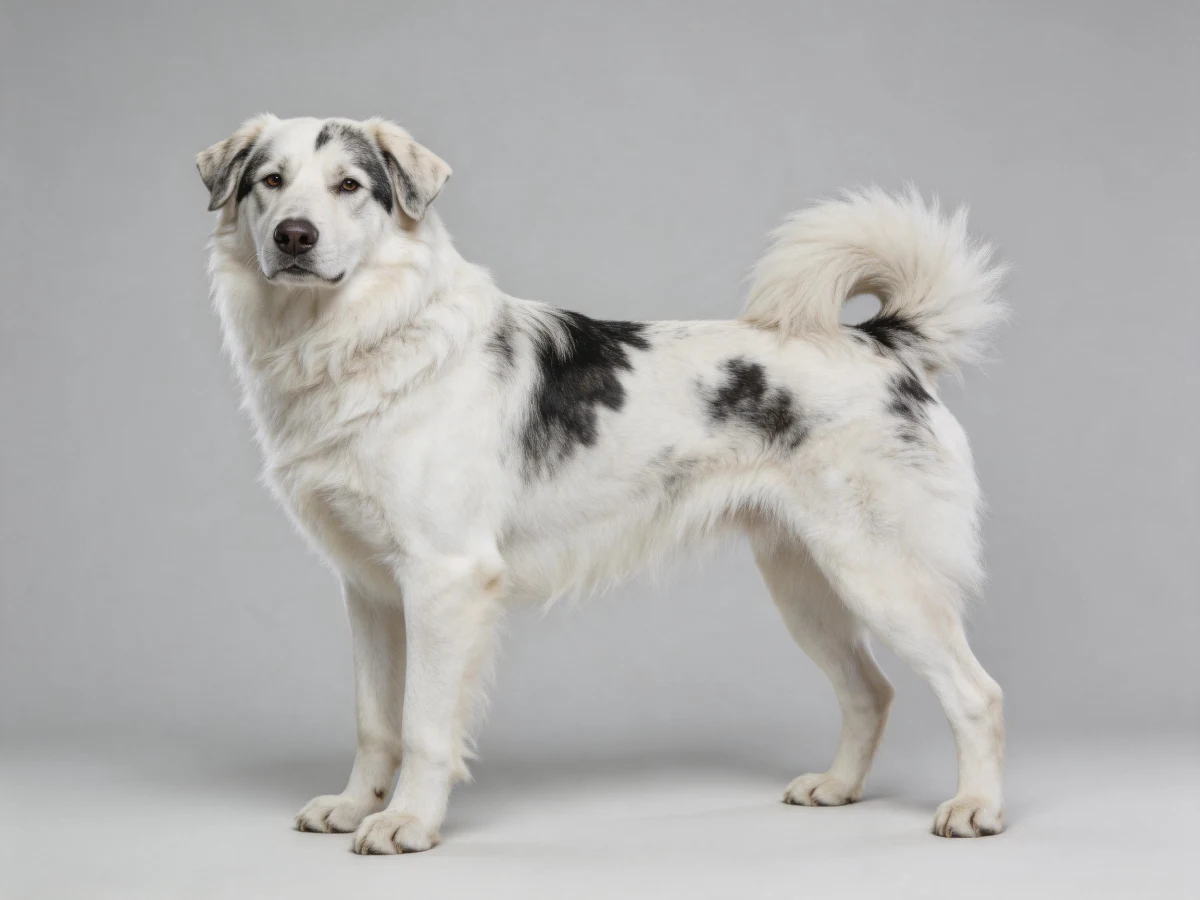
Armenian Gampr
✨ Key Takeaways
- An ancient livestock-guardian landrace of the Armenian Highlands (Armenia and the wider upland region), not a manufactured breed -- shaped by function over a very long span and kept to a descriptive rather than a prescriptive standard
- A large to giant guardian: males roughly 67-77 cm at the withers and females 63-71 cm, with weight in the tens of kilograms in proportion to build; a thick double coat in a longer and a shorter variety in almost any colour (blue and merle excluded), often with a dark mask
- Temperament is the defining trait -- a fearless but rational, self-thinking guardian that assesses before it acts; enthusiasts describe it as calmer and less sharp than the Soviet-bred Caucasian Shepherd
- Stands upstream of the standardised Caucasian Shepherd Dog and Central Asian Shepherd Dog: those Soviet breeds were assembled from native guardians like the Gampr from the 1920s, while the Gampr stayed close to its natural landrace form
- Recognition is modest and stated honestly: documented by the Armenian Kennel Union and recognised by the International Cynological Union (IKU) in 2011, but not an FCI or AKC breed
- A robust, genetically diverse working dog rather than a typical pet -- it needs land, secure fencing, early socialisation, experienced leadership and ideally a real guardian role, and is the wrong dog for an apartment or a first-time owner
Quick Facts
Common Names & Variants
Modern aliases
Historical names
⚖️ Pros & Cons
Advantages
Trade-offs
Physical Appearance
Recognized colors
Coat
Other
Ears: Drop, often cropped. Tail: Saber; some bobtail.
🕰 History
Carved into the rock of the Armenian Highlands
Among the petroglyphs scratched into the volcanic rock of the Armenian Highlands — the mountainous plateau spanning modern Armenia and the surrounding upland country — are figures of large, heavy-headed dogs standing among flocks and hunters, and it is to these images, and to the bones found beside ancient settlements, that the Armenian Gampr traces its claim to be one of the oldest working dogs of the region. The Gampr is not a created breed with a founder and a studbook but a landrace: a population shaped over a very long span of time by the practical demands of guarding sheep and goats against wolves, bears and human raiders on high, harsh pasture, and selected by shepherds for what it could do rather than for how it looked. That distinction governs everything that follows. There is no single "correct" Gampr appearance because the dogs were never bred to one; there is instead a type — a big, sound, weatherproof, self-thinking guardian — that the country and the work produced and that the shepherds maintained for as long as anyone can trace.
A landrace, not a manufactured breed
The most important thing to understand about the Gampr is what a landrace is and is not. A standardised breed is built toward a written picture: a club fixes a target appearance, and breeders select toward it. A landrace runs the other way. It is a regional population kept for function, in which variation in coat length, colour and size is normal and even useful, because a working flock guardian on the Armenian uplands needed to survive cold winters, cover rough ground and make its own decisions far from any shepherd, not match a bench standard. The Gampr therefore carries a descriptive standard rather than a prescriptive one — a document that records the breed as it actually is, across its natural range of types, instead of dictating a single ideal. Enthusiasts are emphatic on this point because the breed's whole value lies in the soundness and working sense that centuries of functional selection put into it, qualities a narrow cosmetic standard could easily breed out.
The Soviet century and the making of the Caucasian Shepherd
The Gampr's modern history cannot be told without the Soviet Union, and here a careful, honest account matters because the breed is so often confused with its better-known relatives. The native guardian dogs of the Caucasus and the Armenian Highlands — the Gampr among them — were the raw material from which Soviet cynologists, beginning in the 1920s, assembled the standardised show-and-service breed now registered worldwide as the Caucasian Shepherd Dog (Caucasian Ovcharka), blending regional mountain dogs and, by some accounts, other breeds toward a fixed, imposing type. The same standardising impulse produced the Central Asian Shepherd Dog from the aboriginal guardians of the steppe and desert further east. The Gampr is best understood as one of the older, less standardised landrace populations that stood upstream of those Soviet breeds rather than as a product of them: where the Caucasian and Central Asian Shepherds were selected and fixed by a state breeding programme, the Gampr was left, on its home ground, much closer to the natural working dog it had always been.
Survival, neglect and revival
The twentieth century was hard on the breed in its homeland. The disruption of the Soviet period, the diversion of the best regional dogs into the new standardised breeds, and the upheavals that followed the collapse of the USSR — including the wars and economic crisis of the 1990s — thinned the population of true working Gamprs and put the landrace under real pressure. The revival came from two directions. Inside Armenia, cynologists and shepherds worked from the 1990s onward to document and protect the native dog, and the Armenian Kennel Union drew up the first descriptive standard to record the breed as it existed; in the diaspora, breed clubs in North America and elsewhere took up the cause of the working Gampr, importing dogs and arguing hard for the landrace approach against the pressure to turn the Gampr into just another standardised molosser. The breed has since become a point of national pride, celebrated as a living link to the deep past of the Armenian Highlands.
Recognition — stated honestly
The Gampr's recognition picture is modest and should not be overstated. The breed is not recognised by the Fédération Cynologique Internationale, and it is not an American Kennel Club breed. Its formal standing rests on the Armenian Kennel Union, which documented the breed in its homeland, and on the International Cynological Union (IKU), a Moscow-based federation that recognised the Gampr in 2011; dedicated breed clubs such as the Armenian Gampr Club of America maintain the working landrace abroad. None of this carries the global weight of an FCI or AKC registration, and a prospective owner should know that the Gampr exists largely outside the major kennel systems. That is not a flaw in the dog; it is a consequence of the breed's nature as a functional landrace kept by shepherds and a comparatively small community of enthusiasts rather than as a show breed promoted by a large national registry.
Temperament & Personality
A guardian that thinks before it acts
The defining trait of the Gampr is judgement. Centuries of guarding flocks on open mountain pasture, often with no shepherd in sight for hours, selected for a dog that assesses a situation and chooses a measured response rather than one that reacts on a hair trigger, and that quality is what Gampr people most want a newcomer to grasp. The breed is fearless and will defend its family and stock with everything it has, but it does so deliberately, after sizing up a threat, not reflexively. This is the heart of the honest contrast with the standardised Caucasian Shepherd: enthusiasts describe the Gampr as a calmer, more rational, less sharp guardian than the Soviet-bred Ovcharka, a dog whose protectiveness is governed by an unusually steady temperament. It is a serious working guardian all the same, not a soft one — the difference is in how it carries that seriousness.
Devotion at home, suspicion at the gate
With its own people the Gampr is affectionate, loyal and notably gentle, and it is widely reported to be patient and protective with the children of its household, watching over them the way it watches over lambs. That warmth turns off at the boundary. Toward strangers the dog is reserved and watchful, slow to accept a newcomer and quick to put itself between its family and anything it reads as a threat, and it regards the protection of its territory and its people as its own responsibility rather than something it waits to be told to do. The same independence that makes it a superb unsupervised flock guardian makes it a dog that forms its own opinions about visitors, which is why early, thorough socialisation and a confident owner who can introduce guests calmly are not optional extras but core to living with the breed.
Independence is the breed, not a bug
A Gampr is not a biddable obedience dog and was never meant to be one. The breed's intelligence runs toward problem-solving and self-direction — exactly what a dog left alone with a flock needs — rather than toward eager compliance, and it will weigh a command and decide whether it agrees rather than snap to it. Owners who come to the breed expecting the responsiveness of a herding dog are repeatedly surprised; those who understand that they have taken on a self-thinking guardian, and who lead through trust and consistency rather than drill, get a deeply loyal and remarkably stable companion. The dog's protectiveness cannot be trained out — it is the centre of what the Gampr is — and the task of ownership is to channel and refine it, not to suppress it.
🏡 Living With a Armenian Gampr
A dog for land, not a flat
The Gampr is a large livestock-guardian breed built for space, and the single biggest factor in whether a home suits it is whether that home has room. This is a dog evolved to patrol a wide territory and to position itself where it can see its charges, and it is at its best on a farm, a smallholding or rural property with secure acreage where it can do a version of the job it was bred for. It is not a city dog and not an apartment dog. A Gampr confined to a small yard with nothing to guard and little to occupy its watchful mind is a frustrated animal, and a frustrated guardian of this size and independence is a problem rather than a pet. Prospective owners without land, or without genuine work for the dog, should look honestly at whether they can meet the breed's needs before falling for its impressive looks.
Family, children and other animals
Within a household it understands, the Gampr is gentle and devoted, and its strong nurturing instinct toward the young of its own family — and toward the lambs and kids it guards — is one of the breed's most appealing traits. With livestock it is, by design, trustworthy: a well-raised Gampr bonds to its stock and protects rather than chases. With unfamiliar dogs, particularly same-sex adults, a guardian of this confidence and territoriality needs careful management, and introductions should be deliberate. Cats and small household pets are generally safe with a Gampr raised among them, since the breed's instinct is to protect what belongs to its home rather than to hunt it, but as with any large dog, sensible supervision and early exposure set the pattern. This is a breed for an experienced, confident owner rather than a first-time dog household.
Fencing, climate and the realities of a guardian
Secure, substantial fencing is essential. A Gampr takes the boundary of its territory seriously and will patrol and defend it, and a dog that decides the perimeter extends beyond your land is a liability with the neighbours; a strong, high fence keeps both the dog and the public safe and gives the guardian a clear edge to its world. The breed's thick double coat makes it superbly suited to cold and to outdoor life — many working Gamprs live outside with their stock year-round — but the same coat means heat must be managed with shade and water. Owners should also be ready for a guardian's voice: a Gampr barks to warn off threats at night as part of doing its job, which suits a farm far better than a close-packed suburb. Lived with on its own terms, on land it can call its own, the Gampr is a steady, low-drama companion; asked to be something it is not, it struggles.
🎓 Training & Exercise
Lead a partner, do not drill a soldier
Training a Gampr begins with accepting what the breed is: an independent, self-directing guardian bred to make its own decisions, not a compliance machine. The dog is highly intelligent and learns quickly what an owner wants, but whether it chooses to do it is a separate question, and pushing for instant, military obedience misreads the breed and damages the relationship. The productive approach is to build a genuine partnership founded on trust, calm consistency and respect, in which the dog comes to take its cues from an owner it regards as a reliable leader. Reward-based methods that engage the Gampr's mind work far better than heavy correction, which a confident guardian tends to resent rather than yield to. Owners who lead well find the breed cooperative within the bounds of its nature; owners who try to dominate it find a dog that simply disengages.
Socialisation is the non-negotiable
If one element of raising a Gampr matters above the rest, it is early and extensive socialisation. A breed this protective and this discerning needs to meet a wide range of people, places, sounds and situations while young, so that as an adult it can tell a genuine threat from ordinary life and respond proportionately. A well-socialised Gampr is a stable, manageable guardian that accepts the family's guests once introduced; an under-socialised one can become indiscriminately suspicious, which in a dog of this power and independence is a serious matter. Socialisation does not blunt the protective instinct — nothing will, and nothing should — but it gives that instinct the broad experience it needs to be deployed with the breed's characteristic good judgement.
Boundaries early, before the dog is big
Because an adult Gampr is large, strong and self-willed, the time to establish house rules, leash manners and clear boundaries is in puppyhood, while the dog is still small enough to guide easily and forming its lifelong view of its place in the household. Consistency among everyone the dog lives with matters enormously: a guardian that gets mixed messages will make its own rules. Owners should also keep training sessions purposeful and avoid pointless repetition, which bores a problem-solving dog; short, meaningful work that the Gampr can see the sense of holds its attention far better than rote drilling. The goal throughout is not a flashy obedience résumé but a confident, well-mannered guardian that trusts its owner's lead in the moments that count.
Realistic expectations for off-territory control
An owner should be honest about recall and off-lead reliability. A Gampr's territorial and protective instincts mean it is most settled and most predictable within its own bounds, and in unfamiliar or public settings the breed should be managed on lead and in secure areas rather than trusted to a perfect recall it was never bred to offer. This is not disobedience but the design of a dog that takes responsibility for its own patch; working with it, rather than against it, means structuring the dog's freedom around the territory it understands and keeping firm, sensible control everywhere else.
✂️ Grooming & Coat Care
A weatherproof double coat built by the mountains
The Gampr wears the coat of a dog bred to live outdoors in a hard climate: a thick double coat with coarser outer hair over a dense, downy undercoat, found in both a longer and a shorter variety. It is a practical, self-sufficient jacket rather than a high-maintenance one, and for most of the year it asks only for regular brushing — roughly weekly for the shorter coat and a little more often for the longer — to lift dead hair, distribute the skin's natural oils and keep the undercoat from matting. The reward for modest routine attention is a clean, weather-resistant coat that does its own work of keeping the dog warm and dry; the coat needs no clipping, stripping or professional styling, which would only damage its insulating function.
Surviving the seasonal blow-out
Twice a year the Gampr sheds its undercoat heavily — often dramatically, in large patches — as it changes coat for the season, and this is when grooming demand spikes. Through those weeks, brushing every day or two with a suitable undercoat tool removes the loosening hair before it ends up across the house and helps the new coat come through cleanly. Outside the moult the shedding is far more moderate. Owners drawn to the breed should go in knowing that the seasonal blow-out is significant and that staying ahead of it with frequent brushing during those periods is simply part of keeping a double-coated mountain dog.
Ears, nails, teeth and the rest of the routine
Beyond the coat the Gampr's care is the standard routine of any large dog, done consistently. Ears should be checked regularly for redness, discharge or odour and cleaned with a veterinarian-approved product when needed. Nails need trimming whenever they grow long enough to click on hard ground or alter the dog's gait, which for a heavy guardian matters to the joints. Dental care is best handled by regular tooth-brushing with a canine toothpaste, the most effective guard against the periodontal disease that otherwise affects most adult dogs. Bathing is occasional, only when the dog is genuinely dirty, using a mild dog shampoo that does not strip the coat's natural water resistance. None of this is demanding, but the size of the dog makes early habituation to handling — feet, ears, mouth — well worth establishing in puppyhood.
🍖 Diet & Nutrition
Feeding a slow-growing giant
The Gampr is a large, heavy guardian, and the central principle of feeding it well is to match a good-quality complete diet to the dog's size, age and real activity level without overdoing the quantity. A working guardian living outdoors with stock in a cold climate burns considerably more than a dog leading a quieter life, and the ration should track that difference rather than sit at a fixed amount. The feeding guide on the bag is a starting point, not a rule; the more reliable everyday measure is hands-on body-condition scoring. A Gampr in good condition has ribs that are easily felt under a modest covering, a visible waist from above and a clear tuck-up from the side, and keeping the dog at that condition rather than letting it carry extra weight is one of the most important things an owner does for its long-term joint health.
The growing puppy and large-breed nutrition
Feeding the Gampr puppy correctly is a genuine responsibility, because this is a slow-maturing giant breed whose joints and skeleton form over a long growth period. A diet formulated for large-breed puppies, with appropriately controlled energy and balanced calcium, supports steady growth rather than the rapid, forced gain that predisposes large dogs to developmental orthopaedic problems. The aim is a puppy that grows at a measured pace and stays lean while doing it; an overfed giant puppy that piles on weight quickly is being set up for joint trouble later. Puppies need several smaller meals a day appropriate to their age, moving toward the adult pattern as they mature.
Meal schedule, bloat precautions and water
Because the Gampr is a large, deep-chested breed at real risk of bloat, the way it is fed matters as much as what it is fed. Adult dogs should be given two or more smaller meals across the day rather than a single large one, and hard exercise should be separated from a full meal by a reasonable gap rather than following straight after eating — both are standard, widely-followed precautions against gastric dilatation-volvulus in giant deep-chested dogs. Fresh water must always be available, and demand rises sharply for a working dog and in warm weather. Measured meals rather than free-choice feeding, restraint with table scraps, and counting any training treats inside the daily ration keep this big dog in the lean condition its joints depend on.
🐶 Buying & Adopting a Armenian Gampr
A rare landrace kept by enthusiasts
Acquiring a Gampr is not like buying a popular pedigree dog, and a prospective owner should understand the landscape before getting attached to the idea. The breed is rare outside Armenia, exists largely beyond the major kennel systems, and is maintained by a comparatively small community of dedicated breeders and clubs who care intensely about preserving the working landrace. That means availability is limited, waiting lists are common, and the right way in is through the breed's own organisations — the Armenian Kennel Union in the homeland and dedicated clubs such as the Armenian Gampr Club of America abroad — rather than through general puppy listings. A serious enquirer should expect to talk to people whose first concern is whether a dog will get the space, the work and the experienced handling the breed needs.
Choosing a breeder who breeds for function
Because the Gampr's value lies in its soundness, temperament and working sense, the most important question to ask a breeder is what they breed for. A good Gampr breeder selects for stable temperament, working ability and genetic health and is committed to the landrace — preserving the breed's natural diversity rather than chasing an exaggerated, standardised molosser look. Such a breeder will radiograph hips and elbows, be candid about any health issues in their lines, raise puppies in an environment that begins socialisation early, and ask the buyer searching questions about their property, fencing, dog-handling experience and ability to provide a guardian with a real role. A breeder who offers a Gampr puppy on demand with no questions, or who markets toward looks and size alone, is a warning sign rather than a convenience.
Adoption, honesty and a sober assessment of fit
Breed-specific rescue for the Gampr is limited simply because the breed is so scarce, though guardian dogs and guardian crosses do appear in general and livestock-guardian rescue, and a Gampr-type dog that proved too much for an unsuitable home occasionally needs replacing — exactly the mismatch this guide aims to prevent. Whether buying or adopting, the honest question is the same one the breed always poses: can you give a large, independent, protective guardian the land, the secure fencing, the early socialisation, the experienced leadership and ideally the genuine work it was bred for? For a rural home with room and a real role for the dog, the Gampr is a deeply loyal, stable and capable partner. For a household without space, work or guardian-breed experience, it is the wrong dog, and recognising that before the purchase is a kindness to everyone, the dog most of all.
📜 Breed Name Etymology — iDogNames original research
An Armenian word for the guardian dog
The breed's name is simply the Armenian word for this kind of dog: Gampr, written in the Armenian script as Գամփռ. It is not a coined breed name or a borrowing from another language but a native term, the word a shepherd of the Armenian Highlands would use for the big flock-guarding dog at his side, and the breed is named in English directly after that word. Because it is rendered from a non-Latin alphabet, the spelling in English is a transliteration, and a reader may encounter the name written slightly differently across sources — a normal feature of any word carried over from another script — but the underlying Armenian word is one and the same.
What the word carries
Glosses of Gampr in English-language sources cluster around the idea of a powerful watch-and-guard dog: the term is commonly explained as meaning a watchdog or guardian, with the related sense of strength or power, which fits a word that names the most formidable working dog of its region. The breed also carries an alternative regional name, gelkheht, sometimes applied to a Gampr kept specifically as a wolf-fighting dog; that name is built from Armenian elements meaning wolf and to choke or strangle — literally a wolf-choker — and it captures, in a single vivid word, the role the breed played against the wolves that threatened the flocks. Both names describe the same dog through the work it does.
One name, many spellings
Beyond the dictionary sense, the most useful thing to know about the name is that it is a genuine piece of the Armenian language rather than a marketing label, which is why the breed is so closely tied to national identity in Armenia and why the dog is often spoken of as a living emblem of the country's deep past. English usage simply adopts the Armenian word unchanged, since there is no descriptive English equivalent to translate; a Gampr is a Gampr in every language. The handful of spelling variants seen in print are all attempts to write one Armenian word in Latin letters, and none changes its plain meaning: the guardian dog of the Armenian Highlands.
Name forms at a glance
| Name | Role | Origin | Literal meaning | First recorded |
|---|---|---|---|---|
| Gampr | primary | Armenian | the guardian / watchdog of the Armenian Highlands | — |
| Գամփռ | origin country native | Armenian | the Armenian word for the guardian dog, in its native script | — |
| Gelkheht | historical | Armenian | wolf-choker -- a Gampr kept as a wolf-fighting dog | — |
| Watchdog / guardian (gloss) | alias | English (gloss of the Armenian term) | the meaning attached to the word in English-language sources | — |
| Armenian Gampr | alias | English (descriptive breed name) | the Gampr of Armenia -- the full English breed name | — |
🏛 Naming Traditions — iDogNames original research
Armenian names for an Armenian dog
Few breeds invite a heritage-based name as naturally as the Gampr, because the dog is so completely an emblem of its homeland. Owners who want a name that fits reach first for the Armenian language and for Armenia itself — names drawn from the country's mountains, rivers and ancient places, from Armenian words for the qualities the breed embodies, and from traditional Armenian given names. A name like Ararat, after the great mountain that looms over the Armenian Highlands and stands at the centre of national identity, ties the dog directly to the landscape that made it; Sevan, after Armenia's vast highland lake, or Aragats, after its highest peak, work the same way, rooting the dog in the country it comes from.
The breed's character offers a second rich vein. Armenian words for strength, courage and the guardian's role — and traditional names such as Vahagn, the old Armenian deity of strength and victory, or Aram and Anahit from Armenian tradition — suit a dog whose whole identity is built on watchful power. The coat gives a third: the breed's range of colours, from wolf-grey agouti to black, fawn and brindle, lends itself to descriptive names. Whichever direction an owner takes, the strongest Gampr names are the ones that reflect what the dog actually is — an ancient, powerful, self-possessed guardian of the Armenian Highlands.
🐾 Themed Names for Your Armenian Gampr — iDogNames original research
Armenian places and landscape names
- Ararat — the great mountain at the heart of Armenian identity, towering over the highlands
- Aragats — the highest peak within modern Armenia, a fitting name for a mountain guardian
- Sevan — Armenia's vast highland lake, one of the largest in the region
- Yerevan — the ancient capital of Armenia, for a dog rooted in the homeland
- Lori — a mountainous northern Armenian province of forests and gorges
- Tatev — after the medieval monastery set high on a cliff edge
- Vardenis — a highland range and town, for a dog of the uplands
- Debed — after the river that carves through northern Armenia
Armenian heritage and given names
- Vahagn — the old Armenian deity of strength, courage and victory
- Aram — a traditional Armenian male name with deep historical roots
- Anahit — an ancient Armenian goddess, a strong name for a female
- Tigran — after the great kings of Armenia, regal and commanding
- Nairi — an ancient name for the Armenian lands, poetic and historic
- Sasun — after the legendary Armenian hero-epic of David of Sasun
- Lusine — Armenian for "moon", a gentle name for a watchful night guardian
- Hayk — the legendary patriarch and founder figure of the Armenian people
Strength, guardian and working names
- Gampr — the breed's own Armenian name, for a dog that is the watchdog itself
- Garmir — Armenian for "red", for a fawn or red-shaded coat
- Sev — Armenian for "black", for a black-coated guardian
- Gayl — Armenian for "wolf", honouring the breed's old role against wolves
- Pahapan — Armenian for "guardian" or "keeper", the breed's whole purpose
- Hoviv — Armenian for "shepherd", for a dog bred at a shepherd's side
- Karot — for the rugged stone country of the highlands
- Hvirik — a warm, traditional Armenian word of fondness
Coat, colour and nature names
- Agouti — for the wolf-grey banded coat colour the breed often wears
- Brindle — for the striped coat pattern accepted in the landrace
- Storm — for a grey, powerful guardian with a commanding presence
- Bear — for the size, bone and heavy head of a male Gampr
- Boulder — for a solid, immovable dog that holds its ground
- Highland — for the upland country that shaped the breed
- Sentry — plain English for a dog that stands watch by instinct
- Titan — for the sheer scale and power of a giant guardian
- Ashes — for the smoky grey of an agouti coat
- Mask — for the dark facial mask many Gamprs carry
More Armenia heritage names
- Armenia Trail - best for a Armenian Gampr name rooted in Armenia rather than generic style
- Armenian Highlands (Armenia and the wider highland region of the South Caucasus) Ridge - best for a regional landscape cue tied to the Armenian Gampr story
- Local Line - best for a name that respects local breed history
- Old Route - best for migration, trade, field or pastoral routes behind the breed
- Heritage Note - best for a page where origin should be treated as context, not decoration
- Village Path - best for rustic, local or landrace-style background
- Working Home - best for a dog whose name should remember ancient livestock-guardian landrace of the Armenian Highlands, bred over a very long span to protect sheep and
- Country Mark - best for a concise country-of-origin cue
More work and purpose names
- Flockline - best for a Armenian Gampr rooted in ancient livestock-guardian landrace of the Armenian Highlands, bred over a very long span to protect sheep and
- Gatewise - best for a dog who learns field, yard and gate routines
- Stock Sense - best for controlled work around livestock
- Steady - best for calm pressure instead of frantic chasing
- Boundary - best for fences, roads and household rules
- Marker - best for precise reward-based training
- Partner - best for a cooperative handler-dog relationship
- Settle - best for a working dog learning home calm
More coat and build names
- Fawn / Red Shades - best for a Armenian Gampr whose color or markings deserve a simple call name
- Harsh Double Coat Coat - best for the harsh double coat coat type on this breed
- White Blaze - best for a clear face or chest marking
- Dark Mask - best for a dog with a strong muzzle or face marking
- Weather Coat - best for outdoor or working-dog coat context
- Strong Frame - best for a dog whose build is part of its function
- Bright Eye - best for an alert expression
- Ground Step - best for a name tied to movement and body type
📋 Breed Standard at a Glance
A descriptive standard for a landrace
The Gampr is unusual in that its standard is descriptive rather than prescriptive: the Armenian Kennel Union and the breed clubs set out to record the dog as it actually exists across its natural range of types, not to impose a single ideal appearance on it. The standard therefore allows real variation — in coat length, in colour and within a size range — because that variation is part of what a functional landrace is. The breed is not recognised by the FCI and is not an AKC breed; its formal standing rests on the Armenian Kennel Union and on the International Cynological Union (IKU), which recognised it in 2011. The overall impression the standard describes is of a large, powerful, well-balanced flock and family guardian, longer than tall in body, with the substance and bone of a serious working mountain dog and nothing exaggerated about it.
Size, head and coat
The Gampr is a large to giant guardian with marked difference between the sexes — dogs are noticeably bigger and heavier-headed than bitches. Males commonly stand around 67 to 77 cm at the withers and females around 63 to 71 cm, with weight running into the tens of kilograms in proportion to height; the standard expresses size as a function of build rather than as a fixed figure. The head is large and strong, especially in the male, whose cranium develops heavily with maturity; the eyes should be dark-rimmed and the nose well pigmented. The coat is a thick double coat in a longer and a shorter variety, always with a soft undercoat, and almost any colour is accepted — fawn, grey and agouti (wolf-grey), black, brindle, white and pied among them, frequently with a dark mask — with only blue and merle excluded as colours foreign to the landrace.
Body, tail, ears and temperament in the standard
The body is that of a substantial guardian: a deep chest, strong straight back and powerful, well-muscled hindquarters built for patrolling and standing its ground rather than for speed. The tail is naturally carried, and a notable feature of the landrace is that a minority of Gamprs are born with a natural bobtail. In traditional working practice the ears were cropped close in puppyhood, a working custom from the dog's flock-guarding role, though many modern Gamprs are left natural. Crucially, the standard treats temperament as a defining trait rather than an afterthought: it describes a confident, balanced, intelligent guardian that is protective without being indiscriminately aggressive — a dog whose steady, rational character is as much a part of the breed as its size and coat.
🏆 Recognition
Other registries
Breed clubs
❓ Frequently Asked Questions
Is the Armenian Gampr a good family dog?
Within its own household the Gampr is affectionate, loyal and notably gentle, and it is widely reported to be patient and protective with the children it lives with, guarding them much as it guards its flock. It is, however, a large and powerful guardian rather than an easy pet: it is reserved with strangers, independent by nature and best suited to an experienced, confident home with space and ideally a real guardian role. For an active rural family that understands livestock-guardian breeds it can be a devoted companion; for a first-time owner or an apartment household it is the wrong dog.
How is the Armenian Gampr different from the Caucasian Shepherd Dog?
The Gampr is an older, less standardised landrace, while the Caucasian Shepherd Dog is a breed that Soviet cynologists assembled from the 1920s using native guardians like the Gampr along with other dogs, selecting toward a fixed, imposing type. In practical terms the Gampr is kept to a descriptive standard that allows natural variation, and enthusiasts describe it as a calmer, more rational, less sharp guardian than the Caucasian Shepherd. The two are related but not the same dog: the Gampr stands upstream of the standardised Soviet breed rather than being a version of it.
Are Armenian Gamprs aggressive?
The Gampr is fearless and will defend its family and stock without hesitation, but it is not an indiscriminately aggressive dog. Centuries of guarding flocks unsupervised selected for a guardian that assesses a situation and chooses a measured response rather than one that reacts on a hair trigger, and a rational, steady temperament is one of the breeds defining traits. Thorough early socialisation and a confident owner are essential so that the dog learns to tell a genuine threat from ordinary life, but a well-raised Gampr is protective with sound judgement rather than reflexively dangerous.
Can an Armenian Gampr live in an apartment?
No. The Gampr is a large to giant livestock-guardian breed bred to patrol and watch over a wide territory, and it needs space, secure fencing and ideally something to guard. It is not an apartment dog and not a city dog: confined to a small space with nothing to do, a guardian of this size and independence becomes frustrated. The breed is at its best on a farm, smallholding or rural property where it can do a version of the job it was bred for.
Is the Armenian Gampr recognized by the AKC or FCI?
No. The Armenian Gampr is not recognised by the Fédération Cynologique Internationale and is not an American Kennel Club breed. Its formal standing rests on the Armenian Kennel Union, which documented the landrace in its homeland with the first descriptive standard, and on the International Cynological Union (IKU), a Moscow-based federation that recognised the breed in 2011; dedicated breed clubs such as the Armenian Gampr Club of America maintain the working landrace abroad. The breed therefore exists largely outside the major kennel systems.
How much exercise does a Armenian Gampr need?
A Armenian Gampr needs exercise that matches its history and build. Plan for daily movement, training and mental work connected to ancient livestock-guardian landrace of the Armenian Highlands, bred over a very long span to protect sheep and. The right amount depends on age, health and individual temperament, so owners should balance activity with rest rather than relying on a one-size routine.
📚 Sources & Further Reading
Every load-bearing factual claim on this page is anchored to one of the sources below. iDogNames does not synthesize from secondary aggregators.
- wikipedia Armenian Gampr — Wikipedia
- breed club official Breed Description -- Armenian Gampr Club of America — Armenian Gampr Club of America
- breed club official What is a Gampr? -- Armenian Gampr Club of America — Armenian Gampr Club of America
- breed club official Armenian Gampr Breed Standard (gampr.net) — gampr.net (Gampr research)
- other Armenian Gampr: History, Character and Breed Standards — Hatis.am
- news article Gampr: the National Dog of Armenia — Armenian National Committee of America
- other In Search of the Gampr, the Molosser of Armenia — Modern Molosser
- other Armenian Gampr Dog Breed Information and Characteristics — DogTime
- other Armenian Gampr breed overview — Dog Academy