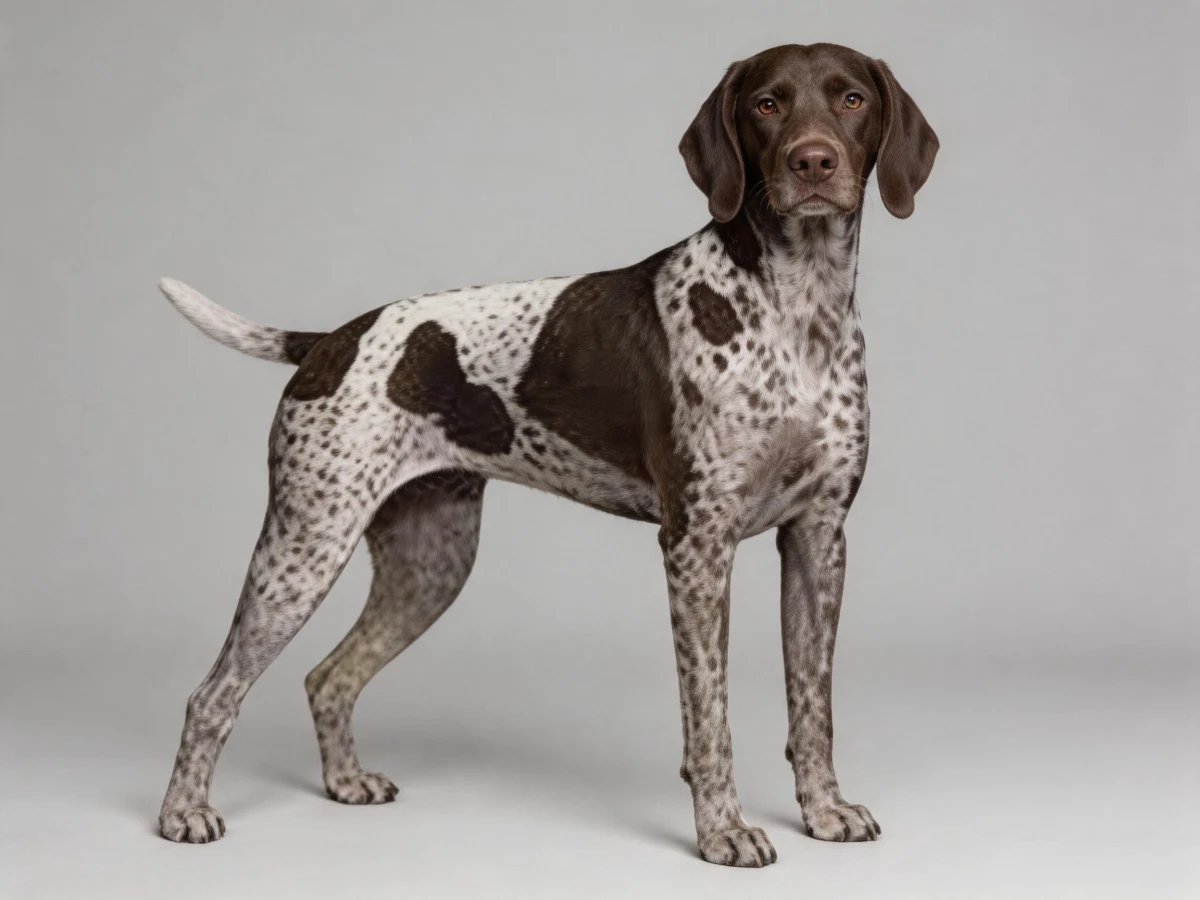
Small Münsterländer
✨ Key Takeaways
- Germany's smallest continental versatile hunt-point-retrieve gundog -- a medium, brown-and-white feathered pointer of the Münsterland in Westphalia, standing about 50-56 cm at the withers and weighing roughly 15-27 kg
- Descends from old Westphalian farm bird-dogs known as the Heidewachtel (heath quail dog) and Spion, with medieval long-haired bird-dog roots; rediscovered from 1906 by the poet Hermann Löns and his brothers, chiefly Edmund, from surviving lines including the Heitmann strain and the Dorsten strain
- Organised as a breed when 68 hunters founded the parent club at Osnabrück on 17 March 1912; Dr Friedrich Jungklaus published its first 12-point standard in 1921
- Recognised by the FCI as Standard No. 102 in Group 7, Section 1.2 (Continental Pointing Dogs, Spaniel type), on a definitive basis from 14 February 1955; also UKC and KC (UK); in the United States it is an AKC Foundation Stock Service breed (2006), not yet fully AKC-recognised
- A genuinely different breed from the Large Münsterländer (a larger black-and-white dog derived from the German Longhaired Pointer) despite the shared regional name -- different stock, different colour, different size
- Temperament is keen and driven in the field but affectionate, sensitive and unusually biddable at home; it bonds closely, needs real exercise and ideally hunting work, and does badly if isolated -- a working gundog that also makes an unusually good house dog
Quick Facts
Common Names & Variants
Modern aliases
Historical names
⚖️ Pros & Cons
Advantages
Trade-offs
Physical Appearance
Recognized colors
Coat
Other
Ears: Drop, broad. Tail: Set on high, carried with a long flag.
🕰 History
A name that points the wrong way
The Small Münsterländer and the Large Münsterländer share a region, a coat tradition and a syllable, and almost nothing else -- and the first thing to understand about the smaller dog is that the two are not a single breed in two sizes. They were developed from different stock by different people for different reasons, and modern cynology treats them as distinct breeds that happen to carry the same place name. The Small Münsterländer is a German continental pointing dog of the Münsterland in Westphalia, the smallest of the country's versatile hunt-point-retrieve gundogs, and its real history is older and more rural than its formal nineteenth-century recognition suggests. Long before any club existed, small long-haired bird-dogs of this type were kept on Westphalian and Lower Saxon farms as all-round hunting companions, and it is from those working farm dogs, not from the Large Münsterländer's longhaired-pointer ancestry, that the breed descends.
The Heidewachtel and the Spion
For centuries the breed went unnamed in any official sense, surviving as a regional working dog known by descriptive nicknames. The two that stuck were Heidewachtel -- "heath quail dog," a reference to the heathland it hunted and to the small spaniel-like Wachtelhund type it resembled -- and Spion, a local Westphalian name. These were medieval-rooted long-haired bird-dogs of the kind used in the falconry and net-hunting of small game, and they were valued precisely because a modest farmer or forester could keep one dog that would find, point and retrieve feather and fur alike. The line bred by the Burgsteinfurt schoolmaster Clemens Heitmann is the best-documented of these survivals: Heitmann kept his strain pure for some forty years and could trace it back further still, and it became one of the cornerstones of the recreated breed.
The Löns brothers and the rediscovery
The Small Münsterländer owes its modern existence to a literary accident. In 1906 the heath poet Hermann Löns placed a public appeal seeking surviving specimens of an old red Hanoverian heath hound; what he and his brothers Edmund and Rudolf Löns turned up instead were pockets of these small pointing farm dogs scattered across Lower Saxony and Westphalia. Edmund Löns, a forester by training, became the breed's chief promoter, gathering dogs from Heitmann's line and, from 1911, from a second family known as the Dorstener Schlag -- the Dorsten strain bred around Velen, Reken and Coesfeld and traceable without a break to the 1860s. By drawing these surviving pockets together the Löns circle reassembled a coherent breed from material that had been on the edge of disappearing into the general farm-dog population.
From farm dog to registered breed
Formal organisation followed quickly. On 17 March 1912 a group of sixty-eight Westphalian and Lower Saxon hunters met at Osnabrück and founded the Verband für Kleine Münsterländer Vorstehhunde, the breed's parent club, complete with regulations and a studbook. The early breeders fixed the type that the farm dogs had carried unevenly: a medium-sized, brown-and-white feathered gundog with the temperament for close, biddable work and the versatility to point and retrieve. In 1921 Dr Friedrich Jungklaus, a physician and naturalist, published a twelve-point breed standard that gave the type its first written definition and settled many of the questions of size and coat that had divided the early enthusiasts. From that point the Small Münsterländer was a breed in the modern sense -- defined on paper, registered in a studbook and bred to a working purpose rather than simply inherited from one farm to the next.
Recognition and quiet international spread
The Fédération Cynologique Internationale recognised the breed on a definitive basis on 14 February 1955 under Standard No. 102, placing it in Group 7 (Pointing Dogs), Section 1.2 (Continental Pointing Dogs of the "Spaniel" type), and listing it as a breed subject to a working trial -- the FCI's way of insisting that it be judged as a functional gundog and not a show breed alone. Outside Germany the breed spread slowly and along hunting rather than show lines. The United Kennel Club and the Kennel Club in Britain recognise it as a gundog, and in the United States it has been enrolled in the American Kennel Club's Foundation Stock Service since 2006 -- a developmental register for breeds that are not yet fully AKC-recognised, which the Small Münsterländer remains. Its custodians, in Germany and abroad, have been notably protective of its working character, and the breed has resisted the split into separate field and show lines that has overtaken many more popular gundogs.
Not the Large Münsterländer, not the German Longhaired Pointer
Because the names invite confusion, the differences are worth stating plainly. The Large Münsterländer is black-and-white, taller and heavier, and descends from the German Longhaired Pointer -- it was effectively split off when the longhaired-pointer club restricted that breed to brown and brown-and-white, leaving the black dogs to form their own breed. The Small Münsterländer is brown-and-white, smaller, and comes from the separate Heidewachtel farm-dog line; it is not a scaled-down version of either. The German Longhaired Pointer, for its part, is a larger, heavier-boned brown gundog of older Hühnerhund stock. The Small Münsterländer earns its place among them as the most compact and arguably the most house-friendly of the German continental pointers, a working gundog that happens to fit comfortably into a hunting household as a companion.
Temperament & Personality
A working gundog with an off switch
The Small Münsterländer was bred to be a hunter's all-day partner and a family's evening companion in the same body, and that dual brief explains its temperament better than any single adjective. In the field it is keen, busy and driven, with the strong prey instinct and the nose of a serious versatile gundog; at home, with its work done, it is affectionate, gentle and genuinely biddable, content to settle with its people rather than pace. This combination -- high drive paired with an unusual willingness to switch off indoors -- is the trait its admirers prize most, and it is what makes the breed more liveable as a house dog than many of the larger, harder-driving continental pointers.
Bonded, sensitive and people-focused
This is a dog that wants to be with its family. The Small Münsterländer bonds closely and does not thrive left alone in a kennel run for long stretches; it is happiest as a working dog that also shares the house. With that closeness comes sensitivity: the breed responds to its handler's mood and tone and can be set back by heavy-handed or impatient training, which the standard breed literature warns against directly. It is typically good with children it is raised among and sociable with familiar dogs, and while it will bark to announce a visitor it is too friendly to make a serious guard. The flip side of its devotion is that a Small Münsterländer denied company and occupation can become anxious and noisy.
The drive behind the gentleness
It would be a mistake to read the breed's soft household manners as low energy. Underneath the biddable surface is a hunting dog with real stamina, a powerful nose and a strong instinct to find, point and retrieve, including a marked love of water and water-work. That drive needs a genuine outlet -- ideally hunting, but failing that the structured tracking, retrieving and scent-work that engage the same instincts. A Small Münsterländer given that outlet is a calm, rewarding companion; one left to invent its own occupation will find game to chase, scent to follow and mischief to make. The breed rewards owners who treat it as the serious gundog it is and frustrates those who expected a low-maintenance pet in a pretty brown-and-white coat.
🏡 Living With a Small Münsterländer
A hunting home, or a very active one
The Small Münsterländer is at its best in a household that hunts, but its house-friendly nature means an active non-hunting home can suit it provided the owner takes its exercise needs seriously. This is a medium-sized gundog with real working stamina, and it needs substantial daily activity -- long walks, free running in safe ground, and crucially the mental work of tracking, retrieving or scent games that occupy its nose as well as its legs. A couple of short lead-walks will not satisfy it. Given enough genuine exercise it is an easy dog to live with indoors: clean, affectionate and calm in the house. Starved of it, the same dog becomes restless, vocal and prone to finding its own entertainment.
Family, children and other animals
With its own people the breed is devoted and gentle, and it is generally very good with children it has grown up alongside, matching their energy outdoors and settling with them inside. It is sociable with dogs it knows and, raised from puppyhood with a household cat, will often accept it -- but the strong prey drive toward birds, rabbits and other small moving animals is part of the working dog and never fully switches off, so small pets and free-roaming poultry are a real consideration. As a water-loving retriever it will head for any pond or ditch it can reach, which is a charm in the field and a muddy nuisance in a tidy garden.
Companionship is not optional
The single firmest rule for living with a Small Münsterländer is that it must not be isolated. This is a closely bonded dog that needs to share its family's life; left alone for long working days or shut away from the household it becomes anxious and can develop separation-related barking and destructiveness. A secure garden with good fencing matters, because a bored or under-exercised dog with this nose and prey drive will look for a way out and a scent to follow. The ideal owner builds the dog into daily life -- exercise before work, company in the evening, and a real job at the weekend -- rather than treating it as an animal that can be kept and visited.
Climate, kennelling and indoor life
The Small Münsterländer's dense, water-repellent coat makes it a hardy, weatherproof dog that takes cold and wet field work in its stride, and a fit adult is comfortable outdoors in most conditions. That hardiness is sometimes read as licence to keep the breed permanently in a kennel run, which misreads it badly: this is a social, family-oriented dog that suffers in solitary confinement however weatherproof its jacket. Where it is kennelled at all -- as some working homes do during the day -- it needs the company of people or other dogs and a clear daily rhythm of exercise and work, not long hours alone. In the house it is clean and undemanding once exercised, and the breed's compact size and off switch make it a genuinely practical indoor companion, which is part of why it has spread beyond the strictly hunting world.
🎓 Training & Exercise
Eager, clever and easy to spoil
Among the German pointing breeds the Small Münsterländer has a reputation as one of the most trainable, and the reason is its combination of high intelligence with a real desire to please its handler. It learns quickly, retains what it learns and genuinely enjoys working with its person, which makes basic obedience, gundog work and house manners come comparatively easily. The same qualities that make it easy to train, though, make it easy to train badly: a clever, sensitive dog notices inconsistency at once, and a handler who is harsh, erratic or impatient can quickly produce a worried, shut-down dog rather than a willing one. The breed asks for calm, consistent, reward-based handling and gives a great deal back to an owner who provides it.
Sensitivity sets the method
Because the Small Münsterländer is soft and people-focused, gentleness is not merely kinder but more effective. Heavy correction tends to dishearten it, while patient, positive methods that build on its eagerness produce a confident worker. Early, broad socialisation -- to people, other dogs, traffic, livestock and the everyday world -- pays off in a settled adult, and because the breed bonds so tightly, the foundation of that bond should be laid in the first months. Owners who start early, keep sessions upbeat and short, and reward generously find the breed almost over-willing; those who try to dominate it find a dog that simply stops trying.
Recall, prey drive and the long game
The honest limit on a Small Münsterländer's obedience is the same as for any high-drive gundog: a strong nose and a strong prey instinct can override recall when live game is in front of it. This is far less extreme than in the independent pack scenthounds, and a well-trained Small Münsterländer is genuinely steady to game when worked properly, but recall around birds and rabbits still has to be built deliberately, proofed in stages and never simply assumed in open country. The breed's saving grace here is that it actually wants to cooperate, so a handler who invests in a reliable recall and a clear "leave it" usually gets one.
A job, not just a class
The kindest and most successful training channels the breed's instincts rather than suppressing them. The Small Münsterländer was made to hunt, point and retrieve, and it excels in the versatile-gundog tests for which it was developed; where hunting is not an option, tracking, retrieving drills, dummy-work and formal scent sports give the dog the purposeful job its mind needs. It can do well in obedience and agility too, helped by its biddability, but a Small Münsterländer that never gets to use its nose and its retrieving drive is a dog working below its design. Give it real work and the training takes care of itself.
✂️ Grooming & Coat Care
A practical feathered coat
The Small Münsterländer carries a medium-length, dense, water-repellent coat that lies fairly close to the body, with longer feathering on the ears, the backs of the legs, the belly and the tail. It is a functional gundog jacket rather than a high-maintenance show coat: it needs no clipping, stripping or professional trimming, and a thorough brushing once or twice a week keeps it in good order, lifting dead hair, distributing the skin's natural oils and preventing the feathering from matting. The breed sheds moderately year-round with heavier moults in spring and autumn, when more frequent brushing keeps loose hair under control. Bathing is occasional -- when the dog is genuinely dirty or smells of the field -- using a mild dog shampoo that does not strip the coat's weather resistance.
Feathering, ears and the post-work routine
The feathered areas are where grooming attention concentrates. The trousers, ear fringes and tail flag pick up mud, burrs and grass seeds, so they need checking and combing out after work in cover, and the awl-shaped foxtail seeds that lodge in this kind of coat should be looked for between the toes, under the earflaps and in the leg feathering. The broad drop ears are the real priority: their close-fitting, hanging conformation invites the warmth and moisture in which ear infections begin, and a dog that swims as readily as this one is exposed often. Inspect both ears weekly for redness, discharge or odour, clean the outer canal gently with a veterinarian-approved cleaner -- never pushing anything down into the canal -- and dry the ears carefully after swimming, bathing or wet field work.
Nails, teeth and skin checks
Nails should be checked monthly; a dog worked on hard ground may wear them naturally, but one exercised mostly on soft going will need trimming before the nails grow long enough to alter its gait. Dental care matters as much in this breed as in any active dog: daily tooth-brushing with a canine toothpaste is the most effective preventive against the periodontal disease that is otherwise near-universal, supported by appropriate dental chews. Because the breed works in rough cover and loves water, a hands-on check after every outing -- running the hands over the skin and coat, feeling through the feathering for seeds, ticks or thorns, and glancing at the eyes -- belongs in the routine alongside the brush and the nail clippers.
🍖 Diet & Nutrition
Feeding an active medium gundog
The Small Münsterländer is a moderately built, energetic working dog, and its diet should track its real activity rather than a fixed year-round ration. A good-quality complete dog food matched to the dog's life stage -- puppy, adult or senior -- and to its workload is the sensible baseline. A Small Münsterländer hunted hard through the season burns far more than the same dog resting out of season, and the amount fed should rise and fall with that workload. The feeding guide on the bag is a starting point, not a prescription; hands-on body-condition scoring is the more reliable everyday measure. A dog in good condition has ribs that are easily felt under a thin covering, a waist visible from above and a clear tuck-up behind the ribs in profile.
Avoiding the off-season spread
The commonest nutritional mistake with any seasonal gundog is to keep feeding at the working rate once the work has stopped. A Small Münsterländer doing a fraction of its hunting-season activity needs noticeably less food, and if the ration is not brought down the weight creeps on before anyone notices. Excess weight is more than a cosmetic issue in an athletic breed prone to hip and elbow problems: extra load accelerates joint wear and shortens the dog's active life. Measured meals rather than free-choice feeding, restraint with table scraps, and counting any training treats inside the daily ration rather than on top of it are the habits that keep a Small Münsterländer in trim through the quiet months.
Schedule, growth and water
Adult Small Münsterländers are normally fed twice a day, morning and evening, rather than in one large meal; splitting the ration steadies the dog and is a sensible precaution against digestive upset in an active medium breed. Puppies of a slow-maturing gundog need careful feeding for steady, unforced growth -- more frequent, smaller meals appropriate to their age, a diet formulated for their size and growth rate, and no overfeeding that would push weight onto developing joints. Fresh water must always be available, with demand rising sharply on working days and in warm weather. As routine field practice, a hard-working dog should not be fed a heavy meal immediately before vigorous exercise; a gap of roughly two hours between a full meal and the off is the standard, widely-followed precaution.
🐶 Buying & Adopting a Small Münsterländer
A breed sold mostly to hunters
The Small Münsterländer is far more numerous than the truly rare continental breeds, but it is still a relatively specialist gundog kept and bred largely within the hunting community, and that shapes the buying picture. The parent clubs -- the German Verband für Kleine Münsterländer Vorstehhunde and its sister organisations abroad -- have historically expected, and in some cases formally required, that puppies go to homes that will use the dog for hunting or at least for serious gundog work. A would-be owner who does not hunt should be honest about that from the outset and should expect a careful breeder to ask searching questions about how the dog will be exercised, worked and kept. This is a breed where the breeding community actively guards the working character, which is good for the dog and means a buyer has to make a genuine case.
Finding a responsible breeder
The right starting point is the national breed club rather than a general puppy listing. A responsible Small Münsterländer breeder health-tests breeding stock -- hips, elbows and eyes at a minimum -- and will show the results for both parents; breeds from dogs that have proven their hunting aptitude in the versatile-gundog tests the breed was developed around; raises puppies in the home with early socialisation; and is as interested in vetting the buyer as in making a sale. Expect a waiting list, expect to travel, and expect a contract. Warning signs are the familiar ones: a breeder who has puppies always available, who cannot or will not produce health clearances, who sells through a third party, or who asks nothing about the home the dog is going to.
Adoption and the question of fit
Breed-specific rescue exists but is modest in scale, run mostly by the breed clubs and gundog-rescue networks; Small Münsterländers in rescue are often dogs that proved too much for an under-active home -- exactly the mismatch a prospective owner should aim to avoid creating. Whether buying a puppy or taking on an adult, the honest question is the same: can you give a high-drive, closely bonded versatile gundog the exercise, the company and ideally the real work it was bred for? For an active or hunting household that can, the Small Münsterländer is an affectionate, biddable and rewarding partner that also makes an unusually good house dog. For a quiet home wanting a low-effort pet, it is the wrong choice, and recognising that before the purchase is the kindest decision for everyone, the dog most of all.
📜 Breed Name Etymology — iDogNames original research
Münsterland, in two sizes of name
The breed's name ties it to the Münsterland, the region around the city of Münster in Westphalia, north-western Germany, where the small feathered farm gundogs that became the breed were concentrated. In German the dog is the Kleiner Münsterländer -- "Small Münsterländer" -- where klein means small and Münsterländer means, simply, "one from the Münsterland." The qualifier matters: it exists to distinguish the breed from the Grosser Münsterländer, the Large Münsterländer, the separate black-and-white breed that carries the same regional name. The two names were settled in parallel as the breeds were formally organised in the early twentieth century, and the size words do real work, because without them the names would be identical for two genuinely different dogs.
Heidewachtel and Spion -- the older names
Before the regional name was fixed, the breed went by descriptive nicknames that tell more about what it did. Heidewachtel combines Heide, "heath," with Wachtel, "quail" -- by extension the small spaniel-like Wachtelhund type -- giving "heath quail dog," a name that places the dog on the heathland hunting small feathered game. Spion was a separate local Westphalian name for the same farm gundog. These older names survived alongside the formal one and are still encountered: the breed's own founding literature, including Edmund Löns's writing, used Heidewachtel, and the term remains current among traditional breeders as a reminder of the dog's heath-hunting roots. The modern regional name and the old working nickname sit side by side, each true to a different part of the breed's story.
Reading the name across languages
In English the breed is usually written Small Münsterländer or, without the umlauts, Small Munsterlander; the umlaut on the u and the a is original to the German and is often dropped in English-language registries for convenience rather than to mark a different breed. The name needs no translation beyond the qualifier "Small," since Münsterländer is a place-based label that simply travels into English unchanged. The result is a name that does two jobs at once: it locates the breed in its Westphalian homeland and it separates it, by a single word, from the larger black-and-white dog with which it shares everything but its blood.
Name forms at a glance
| Name | Role | Origin | Literal meaning | First recorded |
|---|---|---|---|---|
| Kleiner Münsterländer | primary | German | the small dog from the Münsterland | 1912 |
| Small Munsterlander | alias | English (anglicised form) | the small Münsterland dog | — |
| Heidewachtel | historical | German (old working name) | heath quail dog | — |
| Spion | historical | German (Westphalian local name) | a Westphalian local name for the breed | — |
| Grosser Münsterländer (contrast name) | alias | German (the sister breed it is named against) | the large Münsterland dog -- a separate breed, not this one | — |
🏛 Naming Traditions — iDogNames original research
German and Westphalian names for a German gundog
Because the Small Münsterländer is so thoroughly a German hunting dog, owners who want a name that fits the breed reach naturally for Germany -- and, more specifically, for the language and landscape of the Münsterland and the German hunt. German given names such as Fritz, Greta, Heidi, Bruno or Lotte sit easily on the breed, and Heidi in particular doubles as a quiet nod to the Heide, the heathland the dog was bred to hunt. The breed's own history offers names too: Löns for the brothers who rediscovered it, Münster or Westfalen for its homeland, and Heidewachtel itself, shortened to a callable Heide or Wachtel.
The brown-and-white coat offers a second rich vein. German colour and nature words -- Braun for the brown, Schimmel for the roan-ticked pattern the standard names, Kastanie for chestnut -- tie a name to the dog's appearance, while the breed's role as a versatile gundog suggests names drawn from the hunt: Jäger (hunter), Falke (falcon, for its falconry roots) or Wild (game). Whichever direction an owner takes, the strongest Small Münsterländer names are the ones that reflect what the dog actually is -- a compact, brown-and-white German versatile gundog of the Westphalian heaths, bred to hunt, point and retrieve.
🐾 Themed Names for Your Small Münsterländer — iDogNames original research
German heritage and breed-history names
- Löns -- for the brothers who rediscovered and revived the breed
- Münster -- the Westphalian city at the heart of the breed's homeland
- Westfalen -- the German region of Westphalia the breed comes from
- Heide -- German for "heath", the country the breed was bred to hunt
- Fritz -- a classic, hearty German name for a male
- Greta -- a warm traditional German name for a female
- Bruno -- a sturdy German name suiting a brown gundog
- Lotte -- a friendly, traditional German female name
Coat and colour names (brown, roan, white)
- Braun -- German for "brown", the breed's defining colour
- Schimmel -- the German name for the roan-ticked coat pattern
- Kastanie -- German for "chestnut", for a rich brown coat
- Hazel -- plain English for a warm brown-and-white dog
- Cocoa -- for the deep brown patches on a white ground
- Speckle -- for the ticked Schimmel coat
- Pepper -- for the fine ticking flecked across the white
- Chestnut -- the English of Kastanie, for the brown mantle
Hunting, falconry and field names
- Jäger -- German for "hunter", for a born versatile gundog
- Falke -- German for "falcon", a nod to the breed's falconry roots
- Wachtel -- German for "quail", from the old name Heidewachtel
- Wild -- German for "game", the dog's quarry
- Pirsch -- German for the stalk or still-hunt
- Apport -- the gundog command to retrieve
- Marsh -- for a dog that loves water and wet cover
- Reed -- for the waterside ground a water-loving gundog works
Personality and companion names
- Otter -- for the breed's love of water and easy swimming
- Scout -- for the methodical, questing search of a pointer
- Ranger -- for a dog built to cover ground all day
- Hazelnut -- a soft, fitting name for a brown-and-white companion
- Biscuit -- a warm, friendly name for a gentle house gundog
- Buddy -- for the breed's devoted, people-loving nature
- Echo -- a light name for an attentive, responsive dog
- Pip -- a small, friendly name for the smallest German pointer
- Willow -- a gentle name suiting a soft, biddable gundog
- Sasha -- a friendly unisex name for a family companion
Additional versatile-gundog names
- Point - best for the pointing side of the breed
- Retrieve - best for a dog who brings game or training bumpers back
- Feather Find - best for bird-dog history
- Falconry Bell - best for the breed falconry associations
- Reed Fetch - best for water-edge retrieving
- Blood Track - best for tracking wounded game where legal and trained
- Search Cast - best for quartering a field
- Soft Mouth - best for gentle carrying
Additional Muensterland names
- Muenster - best for the breed region in ASCII form
- Westphalia - best for a broader regional German cue
- Heath - best for open field and moorland work
- Rhine - best for a western German river name
- Ems - best for a short river name near the region
- Lower Saxony - best for northern German landscape context
- Forest Edge - best for field-to-woodland work
- Field Lane - best for a rural gundog image
Additional field-training names
- Recall - best for a gundog who checks back reliably
- Steady - best for control around birds and shots
- Whoa - best for a traditional pointing-dog cue
- Marker - best for clear reward timing
- Settle - best for calm after field work
- Check Cord - best for controlled open-field training
- Focus - best for handler attention around scent
- Partner - best for a cooperative hunting-dog relationship
📋 Breed Standard at a Glance
FCI Standard No. 102 -- classification and size
The Small Münsterländer is classified by the FCI in Group 7 (Pointing Dogs), Section 1.2 (Continental Pointing Dogs of the "Spaniel" type), under Standard No. 102, and is a breed subject to a working trial. The standard describes a noble, harmoniously proportioned versatile hunting dog of medium size, with dry, firm musculature and the balance of a dog built to work all day. The ideal height at the withers is about 54 cm for dogs and 52 cm for bitches, with a tolerance of roughly two centimetres either way, placing the breed firmly at the smaller end of the German continental pointers; weight is in the region of fifteen to twenty-seven kilograms according to size and condition. The overall impression is of an elegant, athletic gundog rather than a heavy or cobby one.
Head, coat and colour
The head is distinguished and lean, the skull flat to slightly arched with only a slight stop, the eyes medium-sized and as dark brown as possible with a friendly expression. The ears are broad, set on high and lying close to the head, tapering to the tips. The coat is the breed's signature: of medium length, dense and water-repellent, lying close, with feathering on the ears, the backs of the legs, the belly and the tail. Colour is brown-and-white or brown roan, which may appear as brown patches, a brown mantle or brown ticking on a white ground -- the speckled pattern the Germans call Schimmel -- with tan markings permitted on the muzzle, ears, legs and tail; solid brown is also allowed. The black-and-white of the Large Münsterländer is not a colour of this breed.
Body, movement and working requirements
The body is that of a balanced, athletic worker: a deep chest with good lung room, a firm straight back, a muscular loin and well-angulated quarters built to drive the dog efficiently over varied ground. The tail is set on high and carried with a long flag, held horizontally or slightly raised in movement and downward at rest. Movement is free, ground-covering and harmonious, with good reach and drive. That the FCI lists the Small Münsterländer as a breed subject to a working trial is the most telling line in the standard: it reflects the insistence that this remains a functional versatile gundog, bred and judged for the hunt-point-retrieve work it was created to do rather than for the show ring alone.
🏆 Recognition
FCI standard No. 102 (Section 1.2 -- Continental Pointing Dogs, Spaniel type), recognized in 1955.
Other registries
Breed clubs
❓ Frequently Asked Questions
What is a Small Munsterlander's temperament like?
The Small Münsterländer is a versatile gundog with a dual nature: keen, busy and driven in the field, but affectionate, gentle and unusually biddable at home. It is one of the most trainable of the German pointing breeds, with a real desire to please, and it bonds very closely with its family -- it is good with children it is raised among and friendly enough that it makes a poor guard. The flip side of that devotion is sensitivity: harsh or inconsistent handling sets it back, and it should not be left isolated for long. Underneath the soft household manners is a serious hunting dog with a strong nose, real stamina and a love of water that needs a genuine outlet.
How big does a Small Munsterlander get?
The Small Münsterländer is a medium-sized gundog -- the smallest of the German continental pointers. Under FCI Standard No. 102 the ideal height is about 54 cm at the withers for dogs and 52 cm for bitches, with a tolerance of roughly two centimetres either way, so most dogs stand in the region of 50 to 56 cm; weight runs from about 15 to 27 kg depending on size, sex and condition. It is an elegant, athletic dog built for all-day field work rather than a heavy or cobby one, and it is noticeably smaller than the black-and-white Large Münsterländer.
What health problems do Small Munsterlanders have?
The Small Münsterländer is generally a sound, robust breed with a typical lifespan of about 12 to 14 years, helped by parent clubs that breed close to working selection. The conditions worth screening for are the ones common to active medium gundogs: hip and elbow dysplasia, for which breeding stock should be radiographed; inherited eye disease, including progressive retinal atrophy and cataract, for which current eye examinations matter; and otitis externa in the broad drop ears, which this keen swimmer is prone to and which is managed by weekly inspection, gentle cleaning and careful drying. Buy from parents with hip, elbow and eye clearances, keep the dog lean and well-exercised, and stay on top of ear care. This is general educational information, not veterinary advice.
Are Small Munsterlanders good family dogs?
For an active or hunting household, yes -- the Small Münsterländer is affectionate, gentle and closely bonded, typically very good with children it is raised among, and unusually willing to settle calmly in the house once its work is done. The conditions are real, though: it is a high-drive gundog that needs substantial daily exercise and ideally hunting or formal scent-work, it must not be left isolated for long working days, and its strong prey drive means small pets and poultry need careful management. It is unsuited to a quiet, low-effort home, and many responsible breeders prefer to place puppies in homes that will use the dog. Given the right exercise, company and ideally a real job, it makes an exceptional family companion.
How much grooming does a Small Munsterlander need?
Fairly little. The medium-length, dense, water-repellent coat needs no clipping or stripping -- a thorough brush once or twice a week keeps it in order, with more frequent brushing during the spring and autumn moults, and occasional bathing when the dog is genuinely dirty. The feathering on the legs, belly, ears and tail needs combing out after work in cover, since it collects mud, burrs and grass seeds. The broad drop ears are the real priority: they trap warmth and moisture and, with all the swimming this breed does, are prone to infection, so inspect them weekly, clean the outer canal gently with a veterinarian-approved product and dry them after wet work. Nails need monthly checking and teeth benefit from regular brushing.
How much exercise does a Small Münsterländer need?
A Small Münsterländer needs substantial daily exercise and mental work. Field training, retrieving, scent games, hiking and obedience suit the breed better than occasional short walks. Owners should build recall, steadiness and calm house manners alongside athletic outlets.
📚 Sources & Further Reading
Every load-bearing factual claim on this page is anchored to one of the sources below. iDogNames does not synthesize from secondary aggregators.
- fci standard pdf FCI Standard No. 102 -- Kleiner Münsterländer (Small Münsterländer) — Fédération Cynologique Internationale (2019)
- breed club official Small Münsterländer FCI Nomenclature Entry -- Standard No. 102 — Fédération Cynologique Internationale (2024)
- breed club official Verband für Kleine Münsterländer Vorstehhunde -- German parent club — Verband für Kleine Münsterländer Vorstehhunde e.V. (2024)
- wikipedia Small Munsterlander -- Wikipedia — Wikipedia
- wikidata Small Munsterlander -- Wikidata entity Q695256 — Wikidata
- breed club official History of the Kleine Münsterländer -- Kleine Münsterländer Group of North America — Kleine Münsterländer Group of North America (GNA) (2023)
- akc breed page Small Munsterlander -- AKC Foundation Stock Service breed page — American Kennel Club (2024)
- veterinary org Otitis Externa in Animals -- overview and management — Merck Veterinary Manual (2024)
- veterinary org Hip Dysplasia -- evaluation and screening — Orthopedic Foundation for Animals (2024)