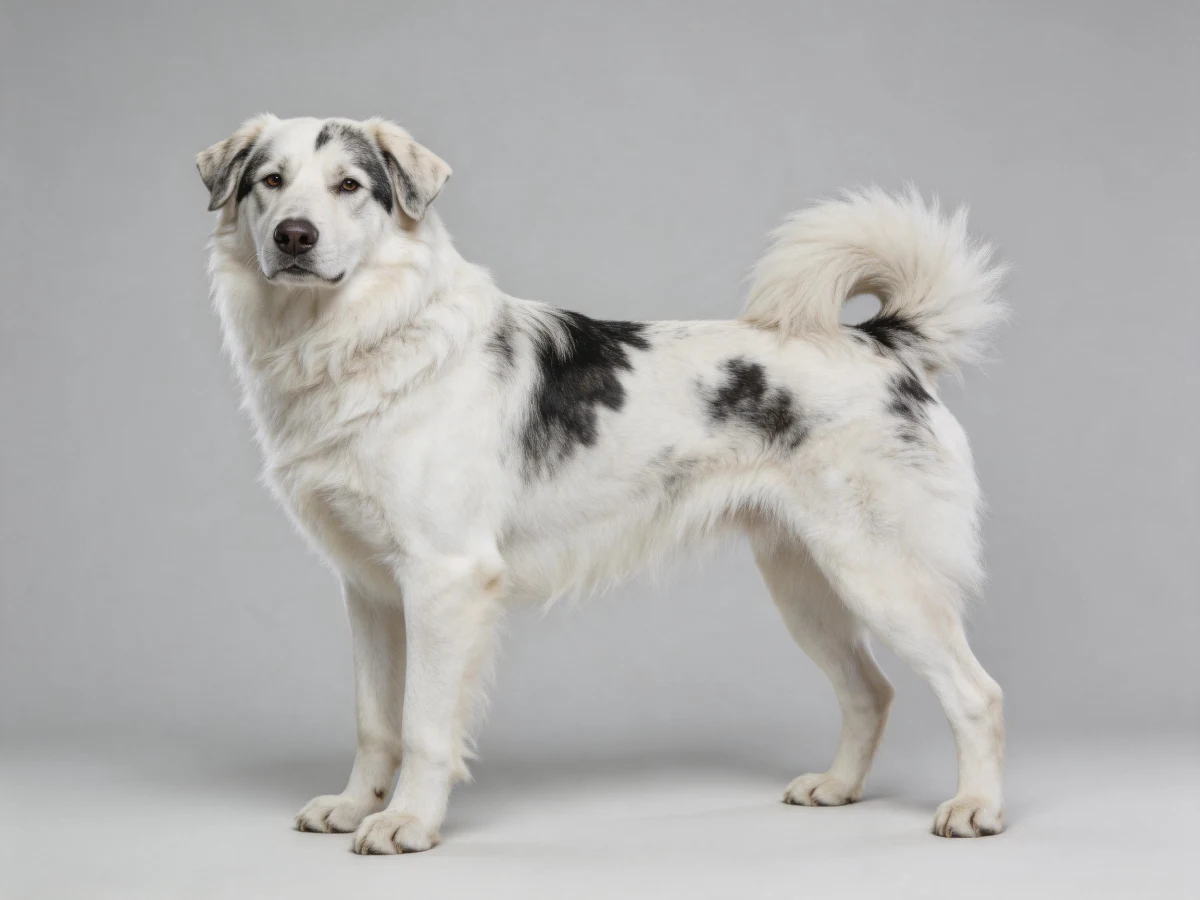
Carpathian Shepherd Dog
✨ Key Takeaways
- A Romanian livestock-guardian dog of the Carpathian Mountains — the leaner, more agile member of Romania's three native shepherd breeds, with males ideally 65-73 cm and females 59-67 cm, built powerful but never heavy
- Its full Romanian name, Ciobănesc Românesc Carpatin, means simply 'the Romanian shepherd's dog of the Carpathians'; the breed was selected for centuries from an endemic Carpathian-Danubian working type with utilization as the only criterion
- Distinguished from its cousins by its coat and build: a wolf-grey (pale fawn overlaid with black) medium-length double coat and a lupoid wolf-like head, versus the Mioritic's long white shaggy coat and the larger Bucovina's bold white-and-patched pied pattern
- The first standard was written in 1934; the FCI granted provisional recognition on 6 July 2005 and full recognition in 2015 (Standard No. 350, Group 1, Section 1, without working trial); the UKC recognised it in 2006; in the US it is only in the AKC Foundation Stock Service, not fully AKC-recognised
- Temperament is that of a natural, courageous guardian — calm, dignified and stable, deeply attached to family and flock, reserved with strangers and independent in judgement; it needs early socialisation and experienced, confident handling
- A hardy, weatherproof outdoor working dog that needs space, secure fencing and a real role; not a beginner's dog or an urban companion, with a typical lifespan of about 12-14 years
Quick Facts
Common Names & Variants
Modern aliases
Historical names
⚖️ Pros & Cons
Advantages
Trade-offs
Physical Appearance
Recognized colors
Coat
Other
Ears: Triangular drop. Tail: Bushy, low at rest, sabre.
🕰 History
One agile guardian among three Romanian shepherds
The Carpathian Shepherd Dog earned its place on the mountain by being the lighter, faster member of Romania's livestock-guardian family — the dog a shepherd chose when the flock moved far and the ground rose steeply, where a heavier guardian would tire. Its full Romanian name, Ciobănesc Românesc Carpatin, says plainly what it is: the Romanian shepherd's dog of the Carpathians. For centuries it was bred by the shepherds of the Carpathian-Danubian region for one purpose, to stand between the flock and the wolf and the bear, and the FCI standard is unusually frank that the breed was "selected from an endemic breed present in the Carpathian-Danubian area," with utilization the only criterion that ever mattered. That single-minded working history is why the modern Carpatin is built as it is: relatively large but never heavy, rectangular, agile and vigorous rather than massive, a guardian made to cover hard country and react fast.
An ancient working type, a young pedigree
The dog is far older than its paperwork. Livestock-guardian dogs have worked the Carpathian pastures for as long as transhumance has been practised there, and each shepherd simply bred to his own need, with no written standard and no studbook — the type was held in place by the job, not by a kennel club. What changed in the twentieth century was that Romanian cynologists set out to describe and fix the type formally. The first standard was written in 1934 by the Zootechnical National Institute, an early and serious attempt to record a working landrace as a recognisable breed. Two world wars and the upheavals of the communist period that followed pushed that early effort to the margins, and for decades the Carpatin survived as it always had — at the sheepfold rather than in the show ring.
The Bucharest revival and the modern standard
Organised interest revived in the late twentieth century. A turning point often cited is a 1979 dog show in Bucharest at which eighteen Carpatin dogs were presented, a small but symbolic gathering that helped re-establish the breed as a subject of formal cynology rather than a nameless mountain dog. The 1934 standard was modified and updated in 1982, in 1999 and again in 2001 by the Romanian Kennel Club, and on 30 March 2002 the Technical Committee of the R.K.C. adapted the standard to conform to the model proposed by the FCI. That work prepared the breed for the international stage.
FCI recognition and an honest account of status
The Fédération Cynologique Internationale granted the Carpathian Shepherd Dog provisional homologation on 6 July 2005 at its general assembly in Buenos Aires, and full, definitive recognition followed in 2015; the valid current standard, FCI Standard No. 350, was published on 9 June 2015 and places the breed in Group 1 (Sheepdogs and Cattle Dogs, except Swiss Cattle Dogs), Section 1 (Sheepdogs), without working trial. Outside the FCI world the United Kennel Club recognised the breed on 1 July 2006, and in the United States it is recorded in the American Kennel Club's Foundation Stock Service — a register for breeds the AKC tracks but has not yet fully recognised — so it is not, and should not be described as, a fully AKC-recognised breed. This is a breed with a deep working past and a deliberately recent pedigree.
Distinct from its Mioritic and Bucovina cousins
Romania recognises three native shepherd breeds, and they are genuinely different dogs that share a homeland and a job rather than a single type. The Romanian Mioritic Shepherd Dog is the long, white, shaggy guardian — a big, profusely coated dog whose abundant pale coat is its signature. The Bucovina Shepherd Dog is the largest and most powerfully built of the three, typically white with bold, clearly defined coloured patches (a striking pied pattern) and a deep guard-dog voice. The Carpatin is the leaner, more athletic herding-guardian of the family: medium-length wolf-grey coat over a pale-fawn ground, a lupoid wolf-like head, and a frame selected for agility and endurance over the high pastures rather than for sheer mass. A reader who pictures a heavy white dog is picturing the Mioritic or the Bucovina; the Carpatin is the grey, wolf-faced one built to move.
The same threat, the same calling, today
What has kept the breed honest is that its work never stopped. Romania still holds some of Europe's largest populations of brown bear and grey wolf, and in the Carpathian uplands flocks are genuinely guarded against genuine predators rather than merely accompanied. The Carpatin remains a working livestock-guardian dog in its homeland to this day, and the standard's insistence that it has "conserved its character intact to the present day" is not romantic boilerplate but a description of a breed still doing the precise job it was shaped for. Its growing presence at shows and, increasingly, as a guardian and companion abroad rests on that unbroken working core.
Temperament & Personality
A guardian by nature, calm by temperament
The FCI standard captures the Carpathian Shepherd Dog's character in a single dense line: "A natural guardian and courageous, he distinguishes himself by his instinctive and unconditional attachment to the herd and his master. He is a dignified, calm and stable dog." Every part of that matters. The guarding instinct is innate rather than trained, the courage is the real article — this is a dog bred to face a wolf or a bear — and the attachment runs deep and lifelong. Yet the working temperament is not nervy or frantic. A sound Carpatin spends most of its time watchful and composed, conserving energy until something genuinely warrants a response, which is exactly the disposition a flock guardian needs over long quiet hours punctuated by sudden danger.
Devoted to its own, reserved with strangers
With its family and the animals in its care the breed is affectionate, steady and deeply loyal, often forming a particularly strong bond with one person while remaining attached to the whole household. Toward strangers it is naturally reserved and discerning rather than friendly on sight; a guardian that welcomed every newcomer would be a poor guardian. Properly raised and socialised, it is not indiscriminately aggressive — the standard explicitly disqualifies dogs that are aggressive or overly shy — but it assesses people and situations on its own terms and will place itself between its family and anything it reads as a threat. Early, broad socialisation is what teaches a young Carpatin the difference between an ordinary visitor and a real intrusion.
Independent judgement and a serious voice
Centuries of working alone on the mountain, far from any shepherd's moment-to-moment direction, left the breed with strong independent judgement. It is intelligent and very capable of thinking for itself, which is a virtue in a guardian and a challenge for an owner who expects instant, unquestioning obedience. The same heritage gives it a powerful, carrying bark used to warn off predators and signal across distance; a Carpatin guarding territory will use its voice, and barking — especially at night, when a guardian is most alert — is part of the package rather than a fault to be eliminated. This is a dog that decides for itself what merits a response, and an owner earns its cooperation through trust rather than commands.
🏡 Living With a Carpathian Shepherd Dog
Space, a fence and a job to mind
The Carpathian Shepherd Dog is a working guardian, and the single biggest factor in whether ownership succeeds is whether the home can give it room and purpose. This is a large, active, territorial dog that needs space to patrol and something to watch over — a rural or semi-rural property with secure, substantial fencing suits it far better than a town flat or a small garden. The fencing is not optional: a guardian takes its territory seriously, and a Carpatin will both defend its boundary and, if that boundary is weak, expand its sense of what to guard. Within a property it understands as its own, with its family and ideally livestock or at least a settled routine to attend to, the breed is calm and content. Without space and a role it becomes frustrated, vocal and difficult.
Family, children and other animals
With a family it knows, the Carpatin is gentle, devoted and protective, and it is generally good with children of the household it has been raised alongside, watching over them much as it would the flock. Its protectiveness, though, means a child's visiting friends and the ordinary comings and goings of a busy household need managing, because the dog reads its job as keeping watch and may be wary of unfamiliar children and adults. Raised with other dogs and with the livestock it is meant to guard, it lives peaceably among them — guarding sheep, goats, poultry and other stock is its actual vocation. Toward strange dogs entering its territory it can be far less tolerant, and same-sex tension is possible, so introductions and boundaries matter.
A hardy outdoor constitution
This is a genuinely weatherproof breed. The dense double coat was built for the Carpathian winters, and the dog is entirely comfortable living and working outdoors in cold and wet conditions that would trouble many breeds; traditional guardians spend their lives out with the flock in all weathers. That hardiness does not mean it should be isolated — a guardian that bonds so strongly to its people and its charges does badly shut away from both — but it does mean the Carpatin is an outdoor-capable dog that does not need, and often does not want, to live as an indoor lap companion. Heat is more of a concern than cold: a thick-coated mountain dog needs shade and water and should not be worked hard in the hottest part of a summer day.
🎓 Training & Exercise
Train the relationship, not just the commands
The Carpathian Shepherd Dog is intelligent and learns readily, but it was selected for centuries to work without supervision and to make its own decisions, and that independence shapes everything about training it. This is not a biddable obedience breed that lives to take direction; it is a thinking guardian that cooperates with a handler it respects and trusts. Heavy-handed, confrontational methods are counter-productive and can damage the bond or provoke defensiveness in a powerful, self-assured dog. Calm, consistent, fair, reward-based handling from an experienced owner works far better, and the most useful thing a Carpatin owner can build is a relationship in which the dog chooses to defer because it trusts the person, not because it has been drilled.
Socialisation is the real curriculum
For a naturally protective guardian, early and wide socialisation is the most important training of all — more important than any sit or recall. A Carpatin puppy that meets a broad range of people, friendly dogs, environments, sights and sounds during its first months grows into a discerning adult that can tell a normal visitor from a genuine threat. One raised in isolation can become over-suspicious and harder to manage as its size and protective drive mature. Foundational manners — walking calmly on a lead, accepting handling, settling on cue, a reliable response to its name — should be taught early too, while the dog is small enough to guide, because a fully grown guardian is a large and strong animal that must be controllable in public.
Realistic goals for a guardian breed
Owners do best when they train toward what the breed actually is. Recall and instant off-lead compliance around stimulus will never match a biddable herding or sporting breed, and an owner who needs that level of control should keep the dog on a long line in open or unfenced ground rather than treat independence as disobedience. The protective instinct should be shaped and channelled, never inflamed: a well-raised Carpatin does not need encouragement to guard, and the goal of training is a stable, controllable dog whose natural watchfulness stays within bounds the owner sets. This is firmly a breed for an experienced, confident owner; it is not a beginner's dog, and the training it needs is steady leadership over years, not a quick course.
✂️ Grooming & Coat Care
A weatherproof double coat that asks for routine, not artistry
The Carpathian Shepherd Dog wears a practical working coat: a harsh, dense, straight outer coat over a dense, soft undercoat, short and flat on the head and the front of the legs and of moderate length and abundant over the body, growing longer and more profuse on the neck, the backs of the legs and the tail. It is built for the mountain, not for the grooming table, and it needs no clipping, stripping or stylised trimming whatsoever — in fact a guardian's weatherproofing depends on the coat being left intact. Regular brushing is the core of its care: once or twice a week through most of the year keeps the coat clean, lifts dead hair and distributes the skin's natural oils, with attention to the longer feathering on the neck, legs and tail where mats can form if neglected.
Seasonal shedding and bathing
Like most double-coated northern and mountain breeds, the Carpatin sheds steadily and then blows its undercoat heavily in spring and autumn. During those weeks daily or near-daily brushing with an undercoat rake or de-shedding tool removes the loosening underlayer, keeps the dog comfortable and stops drifts of hair accumulating in the home. Bathing should be occasional rather than routine — when the dog is genuinely dirty or has been working in mud — using a mild dog shampoo, because over-bathing strips the coat of the oils that make it weather-resistant. A dog living and working outdoors generally keeps itself remarkably clean and needs less bathing than an indoor companion.
Nails, teeth, ears and the hands-on check
Nails should be checked monthly and trimmed if they are not worn down naturally by work on hard ground, since overgrown nails alter the gait and stress the feet. Dental care matters as much in this breed as in any large dog: regular tooth-brushing with a canine toothpaste is the most effective guard against the periodontal disease that is otherwise near-universal in dogs, supported by appropriate dental chews. The ears should be inspected and gently cleaned when needed, and because this is an outdoor working dog, a hands-on check after time in rough country — feeling through the coat for ticks, grass seeds, thorns and cuts, and looking over the feet and ears — belongs in the routine alongside the brush.
🍖 Diet & Nutrition
Feeding a large, active mountain guardian
The Carpathian Shepherd Dog is a large, athletic working breed, and its diet should match both its size and its real activity level. A good-quality complete dog food formulated for its life stage — puppy, adult or senior — and appropriate for a large active breed is the sensible foundation. Because guarding work varies enormously, a Carpatin patrolling a property and watching livestock through long active days needs considerably more than a more sedentary dog, and the amount fed should follow the actual workload rather than sit at one fixed ration year-round. The feeding guide on the bag is a starting point, not a prescription; hands-on body-condition scoring is the more reliable everyday measure of whether the dog is getting the right amount.
Growth, joints and keeping a guardian lean
How a large-breed puppy is fed during growth has lasting consequences for its joints. Over-feeding and forcing rapid growth in a big-breed puppy is associated with developmental orthopaedic problems, so a large-breed puppy formula fed to keep the youngster lean and growing steadily — rather than as fast and large as possible — is the prudent approach, ideally guided by the breeder and the veterinarian. The same discipline applies for life: an overweight guardian carries extra load on hips, elbows and back that accelerates joint wear and shortens working life. Measured meals rather than free feeding, restraint with scraps, and counting any training treats inside the daily ration are the habits that keep the breed in the lean, powerful condition the standard describes.
Meal schedule, water and feeding around work
Adult Carpathians are normally fed twice a day rather than in one large meal, which steadies the dog and, in a deep-chested breed, is a sensible precaution against the digestive emergency of bloat. Splitting the ration and avoiding hard exercise in the couple of hours around a full meal are the standard precautions for any large, deep-chested working dog. Fresh water must always be available, and demand rises sharply on active days and in warm weather — important for a thick-coated breed that feels heat more than cold. Puppies need more frequent, smaller meals suited to their age, moving to the adult pattern as they mature; older dogs may need their intake and protein and joint support adjusted as activity declines.
🐶 Buying & Adopting a Carpathian Shepherd Dog
A rare breed best sought at its source
The Carpathian Shepherd Dog remains uncommon outside Romania and the surrounding region, and a prospective owner should set realistic expectations from the outset. The largest and soundest population is in its homeland, where it is still bred as a working guardian, and the most reliable route to a well-bred dog runs through the Romanian Kennel Club (Asociaţia Chinologică Română) and reputable breeders working under the FCI Standard No. 350. The breed's growing recognition — full FCI recognition in 2015, UKC recognition in 2006, and inclusion in the AKC's Foundation Stock Service — means a small number of breeders now exist beyond Romania, but availability elsewhere is limited and a serious buyer should expect to research carefully, possibly travel or import, and wait for the right litter rather than the first available puppy.
What a responsible breeder looks like
Because this is a powerful guardian breed with strong instincts, the breeder matters enormously. A responsible Carpatin breeder screens breeding stock for hip and elbow dysplasia and is open about the results and about any health issues in their lines; breeds to the FCI standard for sound conformation and the correct stable, courageous temperament, neither aggressive nor shy; raises puppies with early socialisation rather than in isolation; and is candid about exactly what the breed needs. Expect such a breeder to ask searching questions in return — about your property, fencing, experience with large or guardian breeds, and whether you can give the dog the space, work and steady handling it requires. A breeder who offers a puppy on demand, makes no health checks and asks nothing of the buyer is a warning sign, not a convenience.
Adoption, rescue and an honest assessment of fit
Breed-specific rescue for the Carpatin is limited outside its home region, but the breed and Carpatin-type guardians do turn up in livestock-guardian and large-breed rescue, often as dogs placed in homes that could not meet their needs — the very mismatch this guide aims to prevent. National breed clubs and livestock-guardian-dog networks are the best places to ask. Whether buying or adopting, the central question is the same: can you provide a large, territorial, independent guardian with secure space, a real role or settled routine, early socialisation and experienced, confident handling for its whole life? For a rural or semi-rural home that genuinely wants a guardian, the Carpathian Shepherd Dog is a loyal, hardy and deeply rewarding dog. For someone wanting an easygoing urban companion or a first dog, it is the wrong choice, and recognising that before bringing one home is the kindest decision for everyone, the dog most of all.
📜 Breed Name Etymology — iDogNames original research
Ciobănesc Românesc Carpatin — a name that describes the job
The breed's Romanian name, Ciobănesc Românesc Carpatin, is wholly descriptive and reads almost like a job title. Ciobănesc is the adjective from cioban, the Romanian word for a shepherd — so a câine ciobănesc is a shepherd's dog, a sheepdog. Românesc means Romanian, and Carpatin means of the Carpathians, the great mountain arc that curves through the country and gives the breed its homeland. Put together the name means, simply and exactly, the Romanian shepherd's dog of the Carpathians, naming the dog by its nation, its mountains and its work all at once. There is no founder's surname and no fanciful coinage here, which is fitting for a breed that was a working type long before it was a pedigree.
A parallel naming for three Romanian shepherds
The name follows the same pattern as those of Romania's two other native shepherd breeds, and reading them together shows how the country distinguishes its guardians by region or trait rather than by anything else. The Ciobănesc Românesc Mioritic — the Mioritic — takes its descriptor from mioriţă, a little ewe or lamb, a word made famous by the celebrated Romanian pastoral ballad "Mioriţa," tying that breed directly to the poetry of shepherd life. The Ciobănesc Românesc de Bucovina — the Bucovina Shepherd — is named for the historic Bucovina region in the country's north-east. The Carpatin is named for the Carpathian range itself. Each name shares the Ciobănesc Românesc root, "Romanian shepherd dog," and then adds the distinguishing element, so the names themselves tell a reader that these are three regional members of one national family.
The English name and the diacritics
In English the breed is usually called the Carpathian Shepherd Dog or the Romanian Carpathian Shepherd Dog, a direct translation of the Romanian. The native form should be written with its proper Romanian diacritics — Ciobănesc Românesc Carpatin, with the ă (a-breve) and the â (a-circumflex) — because those marks are part of the words, not decoration: cioban without the breve and Roman without the circumflex are simply different words. English-language sources frequently drop the diacritics for convenience, but a careful encyclopaedia keeps them, both out of respect for the language and because the breed's identity is bound up in that precise Romanian phrase.
Name forms at a glance
| Name | Role | Origin | Literal meaning | First recorded |
|---|---|---|---|---|
| Ciobănesc Românesc Carpatin | origin country native | Romanian | the Romanian shepherd dog of the Carpathians | 1934 |
| Carpathian Shepherd Dog | primary | English (translation of the Romanian name) | shepherd dog of the Carpathian Mountains | — |
| Carpatin | alias | Romanian (short form) | the Carpathian one | — |
| Romanian Carpathian Shepherd | alias | English (UKC / AKC FSS register form) | the Romanian shepherd of the Carpathians | 2006 |
| Câine ciobănesc carpatin | historical | Romanian (older descriptive form) | Carpathian shepherd dog | — |
🏛 Naming Traditions — iDogNames original research
Romanian and Carpathian names for a mountain guardian
Because the Carpathian Shepherd Dog is so completely a Romanian mountain dog, owners who want a name that fits the breed reach naturally for Romania and the Carpathians themselves. Place names from the dog's homeland sit especially well — Carpat for the mountains, Bran after the famous Transylvanian pass and castle, Maramureş or Bucovina for the shepherding regions, or the great rivers Mureş and Olt. The pastoral world that produced the breed offers a second rich vein: Cioban itself (shepherd), Mioriţa from the beloved shepherd ballad, Turma for the flock, or Lupu, the Romanian for wolf — a fitting, slightly wry name for the very dog bred to face one.
The breed's wolf-grey colouring gives a third natural direction. Romanian colour and nature words such as Argint (silver), Cenuşă (ash), Fum (smoke) or Brumă (frost) tie a name to the coat, while strong, dignified Romanian given names — Radu, Vlad, Dragomir, Sorin for a male; Ileana, Doina, Rodica, Mira for a female — suit a guardian of real presence and gravity. Whichever direction an owner takes, the names that fit the Carpatin best are the ones that reflect what it actually is: a courageous, dignified, wolf-grey shepherd's dog of the Romanian mountains.
🐾 Themed Names for Your Carpathian Shepherd Dog — iDogNames original research
Romanian and Carpathian place names
- Carpat — for the Carpathian Mountains, the breed's homeland and namesake
- Bran — the famous Transylvanian mountain pass and castle
- Bucovina — a historic shepherding region of northern Romania
- Maramureş — a mountainous northern region rich in pastoral tradition
- Mureş — a great Transylvanian river
- Olt — a major river running through the Carpathians
- Sibiu — a historic Transylvanian city in the breed's home country
- Transilvania — the heartland region of the Romanian Carpathians
Shepherd and flock-life names
- Cioban — Romanian for "shepherd", the breed's whole identity
- Mioriţa — the little ewe of Romania's beloved pastoral ballad
- Turma — Romanian for the "flock" the dog guards
- Lupu — Romanian for "wolf", the predator the breed faces
- Urs — Romanian for "bear", the breed's other great adversary
- Paznic — Romanian for "guardian" or "watchman"
- Stână — the mountain sheepfold where the breed works
- Munte — Romanian for "mountain"
Wolf-grey coat and colour names
- Argint — Romanian for "silver", for the wolf-grey coat
- Cenuşă — Romanian for "ash", for the grey shading
- Fum — Romanian for "smoke", for a darker grey dog
- Brumă — Romanian for "frost", for a pale silvered coat
- Lup — "wolf", honouring the breed's wolf-grey, wolf-faced look
- Greta — a soft play on grey for a female
- Smoky — plain English for the breed's grey tones
- Ashen — for the ash-grey overlay of the coat
Strong, dignified Romanian given names
- Radu — a classic Romanian male name with princely history
- Vlad — a strong, storied Romanian name
- Dragomir — an old Romanian name meaning "precious and peaceful"
- Sorin — a warm Romanian male name linked to the sun
- Ileana — a beloved Romanian female name from folklore
- Doina — for the Romanian doina, a soulful folk song
- Rodica — a traditional Romanian female name
- Mira — a graceful Romanian female name
- Stană — an old Romanian name suggesting steadiness
- Voicu — a sturdy traditional Romanian male name
Additional Romanian mountain names
- Carpathia - best for a direct mountain-region name
- Transylvania - best for a broad Romanian regional cue
- Bucovina - best for a northern Romanian place name
- Maramures - best for a historic mountain-region name in ASCII form
- Fagaras - best for a high Carpathian range name
- Brasov - best for a city name near the mountains
- Piatra - best for a stone-and-mountain Romanian place cue
- Sibiu - best for a short Transylvanian city name
Additional flock guardian names
- Flockline - best for a livestock-guardian role at the edge of the flock
- Night Watch - best for a dog whose work includes quiet vigilance
- Wolf Fence - best for a traditional predator-pressure context used carefully
- Ridge Patrol - best for mountain pasture movement
- Shepherd Camp - best for a dog rooted in pastoral work
- Boundary - best for a guardian who needs clear property rules
- Calm Power - best for a large dog whose steadiness matters
- Stable Gate - best for a farm guardian near yards and livestock
Additional large-guardian management names
- Leash Craft - best for a powerful dog whose handling must be thoughtful
- Visitor Plan - best for safe introductions and household management
- Secure Yard - best for containment that matches guardian instincts
- Slow Growth - best for a large-breed puppy-care reminder
- Respect - best for a guardian dog whose instincts should not be minimized
- Settle - best for calm routines away from patrol work
- Routine - best for predictable duties and rest
- Handler - best for a dog that needs capable guidance
📋 Breed Standard at a Glance
FCI Standard No. 350 — appearance, size and classification
The FCI places the Carpathian Shepherd Dog in Group 1 (Sheepdogs and Cattle Dogs, except Swiss Cattle Dogs), Section 1 (Sheepdogs), without working trial, with Romania as country of origin and the valid standard published on 9 June 2015. The standard describes a relatively large-sized dog, agile and never heavy, of vigorous general appearance, with a rectangular body, a broad slightly sloping croup, and a large, deep chest. Sexual dimorphism is well defined: males stand ideally 65 to 73 cm at the withers and females 59 to 67 cm (each with a tolerance of about two centimetres), with weight in harmony with size to give the impression of a powerful but not heavy dog. The standard stresses that overall balanced impression matters more than any single measurement.
Head, coat and colour
The head is of lupoid (wolf-like) type, mesocephalic, powerful but not heavy, with a wide slightly domed forehead, a moderate stop and a powerful muzzle of roughly oval section. The eyes are almond-shaped and slightly oblique, in various shades of brown — never yellow — and the ears are triangular, not too big, set a little above eye level with slightly rounded tips and carried close to the cheek. The coat is the breed's working signature: harsh, dense and straight over a dense soft undercoat, short on the head and front of the legs and abundant and longer over the body, the neck, the backs of the legs and the tail. The colour is pale fawn overlaid with black, giving the characteristic wolf-grey of varying tones — often lighter on the sides and darker over the back — with white markings permissible but not predominant.
Body, movement and disqualifications
The body is vigorous and slightly rectangular, with a straight firm topline, a deep well-developed chest reaching to the elbows, strong well-sprung ribs and a moderately tucked-up belly. The tail is set relatively high and bushy, carried low and sabre-like at rest and raised in action but never curled over the back. Movement is free and long-reaching, a vigorous sustained trot with parallel limbs — the gait of an enduring mountain worker. The skin carries ash-grey pigmentation, with black nose, eye rims and lips. The standard's disqualifying faults are telling about the breed's purpose: aggressive or overly shy dogs are disqualified, as are dogs of an untypical heavy molossoid appearance and coats coloured brown, brindle, yellow or flecked — the standard guards the agile, stable, wolf-grey working type against drift toward a heavier guardian.
🏆 Recognition
FCI standard No. 350 (Section 1 -- Sheepdogs), recognized in 2015.
Other registries
Breed clubs
❓ Frequently Asked Questions
What is a Carpathian Shepherd Dog's temperament like?
The FCI standard describes the Carpathian Shepherd Dog as a natural, courageous guardian, dignified, calm and stable, with an instinctive and unconditional attachment to its herd and its master. With its own family it is loyal, affectionate and deeply protective; toward strangers it is naturally reserved and discerning rather than friendly on sight. Centuries of working alone on the mountain left it intelligent but strongly independent, and it has a powerful guarding bark. It is not indiscriminately aggressive when well bred and socialised -- the standard actually disqualifies aggressive or overly shy dogs -- but it assesses people and situations on its own terms and needs early socialisation and an experienced, confident owner.
How big does a Carpathian Shepherd Dog get?
It is a large but agile breed, powerful without being heavy. Under FCI Standard No. 350 males ideally stand 65 to 73 cm at the withers and females 59 to 67 cm, each with a tolerance of about two centimetres, and weight is in harmony with size -- broadly in the region of 30 to 45 kg depending on the individual. The standard stresses that the dog should look vigorous and athletic, built as a rectangular, enduring mountain worker rather than a massive molossoid guardian.
What health problems do Carpathian Shepherd Dogs have?
The breed has a reputation as a hardy, sound, long-lived working dog with a typical lifespan of about 12 to 14 years, but it is relatively rare and lightly studied, so little large-scale, breed-specific health data exists. As with every large, active breed the screening priorities are hip and elbow dysplasia, and responsible breeders radiograph breeding stock under a recognised scheme. Being deep-chested, it carries the general large-breed risk of bloat (gastric dilatation-volvulus), so split meals and care around exercise are sensible, and owners should know the emergency signs. Routine ear checks, parasite control for an outdoor dog, and keeping the dog lean round out sensible care. This is general educational information, not veterinary advice.
Are Carpathian Shepherd Dogs good family dogs?
For the right home, yes. With a family it knows the Carpathian Shepherd Dog is gentle, devoted and protective, and it is generally good with children of its own household, watching over them as it would the flock. But it is a large, territorial, independent guardian, not an easygoing companion: it needs space, secure fencing, a real role or settled routine, early socialisation and experienced handling, and it can be wary of unfamiliar people and strange dogs. It is well suited to a rural or semi-rural home that wants a guardian, and poorly suited to apartment living, first-time owners or anyone wanting a sociable, biddable pet.
How much grooming does a Carpathian Shepherd Dog need?
Moderate and straightforward. The harsh, dense double coat needs brushing once or twice a week through most of the year to keep it clean and free of mats, with attention to the longer feathering on the neck, legs and tail, and it requires no clipping, stripping or professional trimming. During the spring and autumn moults the dog blows its undercoat heavily, and daily brushing with an undercoat rake helps through those weeks. Bathing is occasional, only when the dog is genuinely dirty, to preserve the coat's weather resistance. Nails, teeth and ears need routine attention, and a hands-on check for ticks, grass seeds and cuts after time outdoors is sensible for this working breed.
Is the Carpathian Shepherd Dog a casual pet?
The Carpathian Shepherd Dog is best understood as a serious livestock guardian and mountain shepherd dog, not a casual status pet. It needs space, secure management, socialization, experienced handling and a realistic job. Prospective owners should avoid vague claims and focus on temperament, health records and working suitability.
📚 Sources & Further Reading
Every load-bearing factual claim on this page is anchored to one of the sources below. iDogNames does not synthesize from secondary aggregators.
- fci standard pdf FCI Standard No. 350 -- Ciobănesc Românesc Carpatin (Romanian Carpathian Shepherd Dog) — Fédération Cynologique Internationale (2015)
- breed club official Ciobănesc Românesc Carpatin -- FCI nomenclature entry, Standard No. 350 — Fédération Cynologique Internationale (2024)
- breed club official Asociaţia Chinologică Română (Romanian Kennel Club) — Asociaţia Chinologică Română (2024)
- wikipedia Carpathian Shepherd Dog -- Wikipedia — Wikipedia
- breed club official Romanian Carpathian Shepherd Dog -- UKC Breed Standard — United Kennel Club (2006)
- akc breed page Romanian Carpathian Shepherd -- AKC breed information — American Kennel Club (2024)
- veterinary org Hip Dysplasia -- evaluation and screening — Orthopedic Foundation for Animals (2024)
- veterinary org Gastric Dilatation-Volvulus (Bloat) in Dogs — Merck Veterinary Manual (2024)
- book The Encyclopedia of Dog Breeds — Barron's Educational Series (2005)