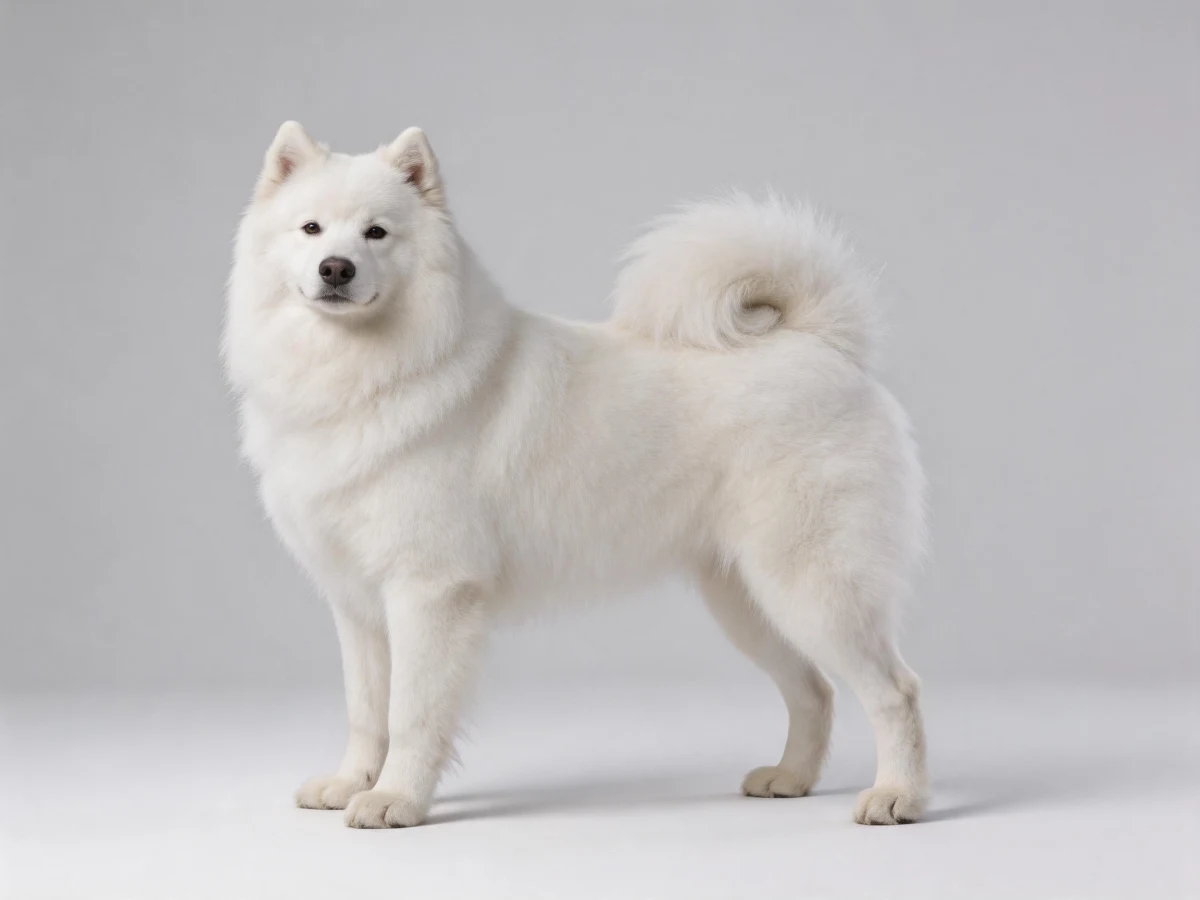
Indian Spitz
✨ Key Takeaways
- A Spitz-type companion dog developed in India from German Spitz stock introduced during the British Raj; adapted by selective breeding and natural acclimatisation to the Indian climate over the late nineteenth and early twentieth centuries
- Recognised exclusively by the Kennel Club of India (KCI) in two size varieties: the Lesser Indian Spitz (approximately 22–25 cm at the withers) and the Greater Indian Spitz (approximately 35–45 cm); NOT FCI-recognised, NOT AKC-recognised in any category
- India's most popular pet dog through the 1980s and into the early 1990s, a position created by import restrictions that made foreign breeds effectively inaccessible — a unique demographic episode in any breed's history
- Visually similar to but distinct from the Pomeranian (which is a FCI/AKC breed miniaturised from German Spitz stock in a separate European development) and the American Eskimo Dog (a separate North American development); they share a common deep ancestor in the German Spitz family but are three different breeds
- Carries a thick double coat that provides genuine heat adaptation compared with unacclimatised European Spitz relatives, but the coat should never be shaved in hot weather — it functions as a two-way insulator and the dog manages heat through shade, water and modified exercise scheduling
- An intelligent, alert and affectionate companion; a natural apartment dog suited to urban Indian life, with a watchdog bark that needs active training management in multi-unit buildings, and Spitz-typical independence that rewards positive, motivational training over correction-based approaches
Quick Facts
Common Names & Variants
Modern aliases
Historical names
⚖️ Pros & Cons
Advantages
Trade-offs
Physical Appearance
Recognized colors
Other
Ears: Prick. Tail: Curled over back.
🕰 History
A colonial introduction that became a national companion
During the decades of British rule in India, European dog breeds arrived alongside European officials, soldiers and merchants — and one that took root with lasting consequence was the German Spitz. Brought in by British officers and settlers during the nineteenth century, German Spitz dogs were crossed selectively with native Indian stock and allowed to adapt, over successive generations, to a climate far hotter and more humid than anything their forebears had known in central Europe. The result of that gradual acclimatisation, pursued through the late nineteenth and early twentieth centuries, was an animal distinct enough from its German ancestor to be recognised as its own breed on the Indian subcontinent: the Indian Spitz. The breed carries the physical hallmarks of the Spitz family — the thick double coat, the foxy pointed muzzle, the prick ears and the tail curled over the back — but in a body tuned by decades of natural and selective pressure to survive and thrive in Indian summers.
The 1980s and 1990s: India's most popular pet dog
The Indian Spitz's moment of genuine mass popularity came not from any deliberate promotion but from a policy decision that had nothing to do with dogs. India's strict foreign-exchange and import regulations, which restricted the import of foreign goods well into the 1980s, made acquiring an imported Western pedigree breed effectively impossible for ordinary Indian families. The Indian Spitz — abundant, locally bred, and costing a fraction of the few foreign dogs that did circulate — became by default the dog that filled every apartment, bungalow and market-town house across the country. Photographs and films of the 1980s and early 1990s bear this out: wherever a dog appears in an Indian domestic setting of the period, it is very often a small, white, fox-faced animal that is unmistakably an Indian Spitz. The breed's starring role in Rajkumar Santoshi's 1994 Bollywood film Andaz Apna Apna, in which a white Indian Spitz named Bhajanlal became a running comic device, is a reliable cultural marker of how ubiquitous the dog was in that era.
The opening of the market and the eclipse of the 1990s
The liberalisation of the Indian economy after 1991, and the progressive relaxation of import restrictions through the 1990s, changed the landscape entirely. Foreign breeds — Labrador Retrievers, German Shepherd Dogs, Golden Retrievers, and eventually smaller Western breeds — became available to Indian buyers, and the same aspirational middle-class households that had kept Indian Spitzes through two decades of scarcity turned to the newly accessible imports. The Indian Spitz, which had thrived precisely because there was little else to choose from, lost its position rapidly. By the early 2000s the breed that had been in virtually every Indian neighbourhood was a fraction of its former presence, in a pattern that dog historians recognise from other native or adapted breeds displaced by the arrival of fashionable international competition. The Indian Spitz did not disappear — it remains a recognised KCI breed and is still bred and kept across India — but it passed from the default dog of a nation to a choice made by owners who specifically want it.
German Spitz ancestry and the distinction from European relatives
The Indian Spitz's ancestry lies squarely in the German Spitz family, which itself belongs to the broad ancient grouping of Spitz-type dogs that developed across northern Europe and Asia over thousands of years. The German Spitz brought to India in the colonial period was the same wide-ranging type that also gave rise to the Keeshond, the Pomeranian (a miniaturised German Spitz variant), and, at the other end of the continent, contributed to the general Spitz population that the Japanese Spitz was later bred from — though the Japanese Spitz is a distinct twentieth-century development. It is important to be precise about where the Indian Spitz fits in this family: it is not a feral or street dog, and it is not the same animal as the Indian Pariah Dog, which is a genuinely ancient landrace of Southeast Asian origin. The Indian Spitz is a deliberately maintained purebred developed from European working stock introduced during the colonial period, standardised and registered by the Kennel Club of India.
Relationship to Pomeranian and American Eskimo Dog — and why the distinction matters
The Indian Spitz is routinely confused with the Pomeranian by casual observers, and the confusion is understandable: both are white, both are double-coated and fox-faced, and both descend from German Spitz stock. The differences are real and meaningful. The Pomeranian, developed from larger German Spitz dogs by selective miniaturisation in Pomerania in the eighteenth and nineteenth centuries and popularised in England partly through Queen Victoria's enthusiasm for the breed, is governed by the FCI (Standard No. 97) and the AKC (Toy Group) and has been bred to a progressively smaller, rounder and more compact type with a very short muzzle and an extremely dense, rounded coat. The Indian Spitz, by contrast, was developed in the opposite climatic direction — selected for heat tolerance rather than miniaturisation — and it is a distinctly different size. The Greater Indian Spitz variety (see breed standard) is a medium-sized dog of 35 to 45 cm at the withers; even the Lesser variety, at 22 to 25 cm, is built on longer-legged, finer-boned lines than the Pomeranian and carries a coat that is dense but not as cotton-ball profuse. The muzzle is longer and more pointed than the Pomeranian's, the overall structure more moderate and functional. The American Eskimo Dog, though it also descends from German Spitz and looks similar to the Indian Spitz in its standard and miniature sizes, is an entirely separate North American development with no historical connection to India. These are three distinct breeds with a common deep ancestor; they are not interchangeable.
KCI recognition and the two size varieties
The Kennel Club of India is the national kennel club that maintains the studbook and breed standard for the Indian Spitz. KCI recognition is the breed's formal pedigree framework, and it defines two varieties by height. The Lesser Indian Spitz stands approximately 22 to 25 cm at the withers; the Greater Indian Spitz stands approximately 35 to 45 cm. Neither variety is recognised by the FCI or the AKC — the breed's formal status is national rather than international — which places it in the company of other well-developed national breeds that have not pursued or achieved FCI or AKC entry. The Indian Spitz is not an AKC FSS breed, not an AKC Miscellaneous breed, and not an AKC-recognised breed in any category. Buyers outside India should understand that the dog they are acquiring carries KCI papers, not FCI or AKC papers, and that the standard they are buying to is the KCI breed standard.
Temperament & Personality
A lively, intelligent companion with a watchdog's alertness
The Indian Spitz is, at its core, a companion dog that grew up in close quarters with Indian families over generations, and its temperament reflects that shaping. It is animated, alert and curious — a dog that wants to know what is happening, that investigates the perimeter with purpose and that announces arrivals with a sharp, carrying bark before deciding the visitor is welcome. That watchfulness, inherited from the Spitz family's general alertness, made the breed a reliable apartment guard-and-alarm well before it became fashionable; it is one reason Indian families in city flats took to it so readily during the import-restriction era. The bark can become compulsive in an under-occupied dog, so the watchfulness needs to be managed with training and not encouraged into perpetual reactivity.
Affectionate and deeply family-oriented
Beneath the alert exterior is a dog that bonds strongly to its household. Indian Spitzes are genuinely affectionate — they follow their people around, seek physical contact and are sensitive to the emotional climate of a home in the way many companion-bred dogs are. The breed's long history of apartment and bungalow life across every economic register of the Indian middle class has selected for a dog that fits comfortably into domestic routine, tolerates the noise and flux of a busy household and adjusts to different schedules without difficulty. This is not a breed that does badly on its own for a working day, provided it has had exercise and stimulation before being left; but it is a breed that genuinely enjoys company and can become anxious if chronically isolated.
Intelligent and adaptable — with a Spitz-typical independence
The Indian Spitz is quick to read its environment and its people, and its intelligence shows in the speed with which it picks up household routines and the ease with which it learns basic commands when motivated. The Spitz family qualification applies here: this is not a breed that trains in the eager-to-please style of a Labrador or a Border Collie. It retains the independent character that the Spitz group evolved over centuries of semi-independent work, and it will weigh up whether compliance is worth its while. Positive, reward-based handling that makes training feel like a cooperative exchange rather than an imposed drill produces far better results than correction-heavy methods, to which the breed tends to respond with resistance or withdrawal rather than obedience. The intelligence is real and exploitable; the cooperation requires earning.
With children and other animals
Raised alongside children from puppyhood, the Indian Spitz is generally tolerant and playful, though the usual Spitz caveat applies: very young children who do not yet understand how to interact with a small dog can provoke a sharp response if they grab, squeeze or startle the animal. Supervision during the early years of a child-dog relationship, and teaching children the basics of respectful handling, resolves this. With other dogs the Indian Spitz is sociable when introduced appropriately and tends not to the dominance-toward-canines trait that characterises some pack-bred hounds and terriers. With cats and small animals there is mild prey interest, manageable in a household where the animals have been introduced carefully, though individual variation exists and a young puppy raised with a cat will almost always do better than an adult dog meeting one for the first time.
🏡 Living With a Indian Spitz
A natural apartment dog that needs more than four walls
Decades of urban Indian life have made the Indian Spitz genuinely suited to apartment and smaller-home living in a way that few breeds can claim from actual demographic history rather than breed-club aspiration. This is a dog that was physically present in millions of Indian flats and bungalows through the 1980s and 1990s, and the selection pressure of that era favoured animals that were manageable in confined space, tolerant of domestic noise and not destructive when the household was busy. The breed does not have the overwhelming exercise requirement of a working hound or a herding dog. That said, "apartment-suited" is not the same as "needs nothing": an Indian Spitz left without daily exercise and mental engagement becomes vocal, restless and prone to the compulsive barking and chewing that boredom produces in any intelligent dog.
Exercise: moderate, consistent, varied
The Greater Indian Spitz needs at least one brisk daily walk of thirty to forty-five minutes, supplemented by a second shorter outing or a play session. The Lesser variety is satisfied with somewhat less, but the mental stimulation component matters for both — scent-led exploration, a training session, a game of fetch in a secure garden or a neighbourhood patrol on lead all address the alert, curious mind as well as the legs. Neither variety is a jogging or hiking partner in the way a Vizsla or a Siberian Husky is, but both are active, energetic dogs that should not be confused with toy-breed lapdogs that need minimal exercise. The coat's double-layer structure also means the breed should not be exercised vigorously in the hottest part of an Indian afternoon; the same adaptation that allows the dog to tolerate heat better than its European Spitz relatives has limits.
Climate tolerance and coat management in the Indian summer
The Indian Spitz's adaptation to the subcontinent's climate is genuine but partial. It handles Indian conditions better than an unacclimatised German Spitz or Samoyed would, but its double coat is still a thermoregulatory burden in peak summer heat, and the dog will seek shade, cool floors and minimal exertion during the hottest periods. Indian owners typically walk the dog early in the morning and in the evening, a sensible schedule that the breed self-enforces by simply refusing to move with enthusiasm in the midday sun. Air-conditioned living provides relief but also removes the natural hardening; a dog that has always lived in an air-conditioned environment and is suddenly expected to exercise outdoors in a June afternoon will struggle more than a dog accustomed to the ambient temperature. Fresh water must always be available, and shade at all times in outdoor settings.
Noise, neighbours and the watchdog habit
The breed's alert, watchdog temperament means it is vocal by nature, and in an apartment building this is the most significant management challenge. An Indian Spitz that is trained from early puppyhood to stop barking on command, that has a reliable "enough" cue and that receives sufficient exercise and mental engagement will be a manageable apartment resident. One that is allowed to bark freely at every door, elevator sound and passing person will become a neighbourhood problem. The breed is not difficult to train in this respect — it is intelligent and responsive to positive methods — but the habit forms quickly in a young dog, and preventing it is substantially easier than curing it once established. Owners in shared housing should treat early bark-control training as a non-negotiable first task.
🎓 Training & Exercise
Quick and willing with the right motivation
The Indian Spitz is not a difficult dog to train for everyday life. It is intelligent, curious and — when the relationship with its handler is warm and the rewards are good — genuinely willing to engage. Generations of apartment life have shaped a dog that observes its people closely and takes social cues well, and that combination of observation and social sensitivity is a training asset. Basic obedience — sit, stay, come, heel on lead, leave it — comes quickly to most Indian Spitzes when taught with short, positive sessions and clear reinforcement. The breed is not the stoic, patient, repetition-tolerant working dog type; it learns fast and then loses interest in drills it has already mastered, so varying the training session and raising criteria progressively works better than repetitive runs through the same sequence.
The independence question
The Spitz family's characteristic independence requires the trainer to think about motivation from the dog's point of view rather than assuming that a command issued once will be obeyed because the owner has issued it. An Indian Spitz will respond reliably to a cue that has been reinforced often enough and that the dog associates with something it values — food, play, the owner's attention — but the reinforcement history needs to be built deliberately rather than assumed. Recall, in particular, should be trained with genuine patience and excellent rewards and tested incrementally in progressively more distracting environments before the owner relies on it in open ground. A dog that has only been trained to recall in the garden will not recall from a street or a park until that has been specifically practised. This is not a character flaw; it is the independent Spitz temperament operating as designed.
Socialisation: early and consistent
The Indian Spitz's alertness — the quality that makes it a good watchdog — can tip into excessive reactivity or timidity if the dog is not exposed to a wide variety of people, dogs, environments, sounds and situations during its first months. Early socialisation is the investment that buys a confident, manageable adult. A puppy that has been carried through markets, met children of different ages, encountered traffic noise, ridden in vehicles, visited the vet without incident, and met calm adult dogs of various breeds grows up with a social confidence that under-socialised puppies never quite develop. In India's urban environment this socialisation is often unusually rich by default — the sheer density and variety of stimulation in an Indian city means a puppy that goes out regularly meets more novelty in a week than many Western urban dogs encounter in a month — but it still needs to be deliberate and positive rather than accidental and overwhelming.
Bark management and apartment manners
Given the breed's urban living history, the most practically important training task for most Indian Spitz owners is bark management. The dog's alertness produces a hair-trigger bark at unfamiliar sounds, and in an apartment building that can quickly become a problem. The most effective approach is to teach a reliable "quiet" or "enough" cue early, reward compliance generously and avoid inadvertently reinforcing barking by responding to it with attention or scolding — both of which the dog reads as engagement. Pairing the cue with a calm, confident owner response to whatever triggered the bark ("I heard it, it is fine, quiet now") helps the dog understand that the owner has taken responsibility for the situation. The habit of barking at every stimulus should be managed before it is established; retraining a compulsive barker is considerably more work than shaping appropriate alertness from the start.
Advanced engagement: a genuinely trainable dog
Beyond everyday manners, the Indian Spitz is capable of more demanding training that makes genuine use of its intelligence. The breed can learn tricks readily and enjoys the interactive quality of trick-training sessions, which become a form of cognitive engagement as much as a performance. Nose-work and scent-discrimination games play to the Spitz family's general capacity for scent work and give the dog a satisfying job in limited space. Agility suits the Greater Indian Spitz well — it is an athletic, quick, light-footed dog of exactly the right size for agility work — and the combination of physical challenge and handler communication makes a very good fit for an intelligent companion breed that needs occupation. These are not breeds that reach the highest levels of competitive obedience, but they are thoroughly capable of being engaged, stimulated dogs rather than bored, reactive ones.
✂️ Grooming & Coat Care
A handsome double coat that is less demanding than it looks
The Indian Spitz wears a thick double coat — a dense, soft undercoat beneath a longer, straight outer coat — that gives the breed its characteristic fluffy, fox-like silhouette. It is a coat that reads as high-maintenance to anyone unfamiliar with double-coated dogs, but in practice the Indian Spitz is considerably less work than the coat's appearance suggests. The outer coat has a natural tendency to shed dirt and does not mat as readily as a silky or wavy coat does; regular brushing keeps it in good order without any trimming, clipping or professional parlour work. The breed is shown untrimmed and should be kept that way by pet owners as well — the double coat functions as the dog's weather management and heat management system, and interference with it by clipping or shaving, well-intentioned as it may be in Indian summer, removes that system without providing an equivalent. A clipped Indian Spitz is not a cooler Indian Spitz; it is one that has lost its coat's natural insulating properties.
Brushing: the core routine
Brushing two to three times a week with a slicker brush, followed by a finishing pass with a medium-width metal comb, is the maintenance routine that keeps an Indian Spitz coat in good order for most of the year. Work section by section, brushing down to the skin rather than skimming the surface, to lift dead undercoat and keep it from matting against the skin. During the twice-yearly moult — the seasonal coat change that Spitz-family dogs go through in spring and autumn — the undercoat is shed in large quantities over a period of two to four weeks, and daily brushing or even twice-daily brushing during peak shed is not excessive. An undercoat rake or a deshedding tool used gently through the blow-coat period substantially reduces the amount of hair that ends up on furniture and clothing and prevents the dead coat from compressing into mats behind the ears and in the leg feathering. After the moult period passes, the lighter two-to-three-times-per-week schedule is sufficient until the next seasonal change.
Bathing and coat care
Bathing every four to six weeks, or when the dog is genuinely dirty, with a mild shampoo formulated for double-coated dogs keeps the coat clean without stripping the natural oils from the skin that protect the coat's integrity. Thorough rinsing is important — shampoo residue left in the dense undercoat irritates the skin and promotes dandruff. Drying after a bath needs to be complete: a damp undercoat on a warm Indian day is an invitation to bacterial skin infection (hot spots, or acute moist dermatitis), so towel-drying followed by a low-heat blow-dry or air-drying in a well-ventilated space should leave no residual moisture in the coat. White-coated dogs may benefit from an occasional whitening shampoo to address the yellowing that saliva, environmental dust and UV exposure can cause on the legs, paws and around the muzzle over time.
Ears, nails and teeth
The Indian Spitz's prick ears, which stand upright and allow good air circulation, are considerably less prone to the chronic moisture and infection problems of pendant-eared breeds. Weekly visual inspection for redness, discharge or odour is the appropriate routine; gentle cleaning of the visible outer canal with a veterinarian-approved ear cleaner on a cotton pad is needed only when debris is visible or the dog shows signs of irritation. Never insert anything into the ear canal itself. Nails should be checked monthly and trimmed as needed — a dog walked regularly on hard surfaces may wear them adequately, but most Indian Spitzes whose exercise is on soft ground or tiles will need nail trimming to prevent the nails from growing long enough to alter the foot's posture and gait. Teeth need daily brushing with a canine toothpaste; the breed's susceptibility to periodontal disease makes this genuinely important, not optional. Introduce tooth-brushing as early as possible in puppyhood so the dog accepts it as a normal part of being handled.
🍖 Diet & Nutrition
Feeding a compact, active companion
The Indian Spitz is a compact, energetic companion dog — not a high-performance working athlete, but not a sedentary toy breed either — and its dietary needs reflect that middle position. A good-quality complete commercial dog food matched to the dog's life stage and size variety (the Lesser Indian Spitz sits in the small-breed category; the Greater sits at the lower end of medium) provides a sensible baseline. Small and medium breeds have a higher metabolic rate per kilogram than large breeds and need a calorie density that reflects this; foods formulated specifically for small and medium breeds typically account for this by offering higher calorie density in a smaller kibble size suited to the dog's jaw. The feeding guide on the packaging is a starting point calibrated for an average activity level; actual amounts should be adjusted up or down by monitoring the dog's body condition score rather than adhering rigidly to the printed quantity.
Portion control and the overweight risk
The Indian Spitz's double coat makes it easy to underestimate body condition: a fluffy, well-coated dog that is in fact overweight can look simply "fluffy" rather than fat until the problem is examined hands-on. The standard body-condition check applies regardless of coat: ribs should be easily felt under a thin covering but not visible; a waist should be discernible from above; a tuck-up behind the ribcage should be visible from the side. A dog that fails any of these checks needs a dietary assessment. Overweight in a small or medium dog accelerates joint deterioration, increases the effort of thermoregulation in hot weather, and is a risk factor for the patellar luxation to which the breed is predisposed. Measured meals — a specific cup or gram quantity served twice daily — rather than free-choice feeding are the simplest way to maintain appropriate weight. Training treats and table scraps should be counted inside the daily food budget rather than added on top of it.
Traditional Indian diets and the roti question
Through the 1980s and 1990s, when the Indian Spitz was at peak popularity, many dogs were fed what the household ate: rice, roti, dal, vegetables, milk and occasional meat or fish. These dogs evidently survived, and many lived full lives, but the nutritional picture was inconsistent — some diets were adequate or even good by accident, others were chronically protein-deficient or unbalanced in micronutrients. Modern veterinary nutrition in India, as elsewhere, recommends complete commercial dog food as the most reliable way to ensure all nutritional requirements are met without guesswork. Owners who prefer home-prepared diets should formulate them with veterinary nutritional guidance rather than by extrapolating from human recipes, as several commonly fed foods — including onion, garlic and grape products — are toxic to dogs at doses that may be present in ordinary Indian cooking. Fresh water must always be available, and demand rises with exercise and in hot weather.
Puppies, adults and seniors
Indian Spitz puppies grow fast in their first six months and need a diet formulated for puppies or for small and medium breeds' growth phase, fed in three to four small meals daily to maintain steady blood glucose and support developing musculoskeletal systems. After six months, meals can reduce to twice daily; adult feeding frequency of twice daily suits the breed throughout its working life. The transition to adult food is typically made between nine and twelve months for the Lesser variety and twelve months for the Greater variety. Senior Indian Spitzes — generally considered to be dogs over eight to nine years — may benefit from foods formulated for older dogs, which typically offer reduced calorie density (useful if the dog is less active) and joint-supporting ingredients such as glucosamine and chondroitin. A veterinarian is the right person to advise on when and whether a dietary transition to a senior formula is warranted for an individual dog.
🐶 Buying & Adopting a Indian Spitz
Finding an Indian Spitz today
Within India, the Indian Spitz is accessible without the extreme scarcity that characterises rare Western breeds: it is a recognised KCI breed that is bred by dedicated breeders in most major Indian cities and across many states. The breed's eclipse by imported Western breeds from the mid-1990s onward reduced its numbers significantly from the mass-market peak of the 1980s, but it did not vanish, and a new owner who approaches the task with care can find a well-bred, registered puppy within a reasonable timeframe. Outside India the breed is very scarce — it is not exported in any volume and has minimal presence in Western pedigree circles — and an owner outside India who specifically wants an Indian Spitz may face a genuinely difficult search or need to accept an import from India with all the veterinary and logistical requirements that entails.
Choosing a responsible KCI breeder
The Kennel Club of India is the relevant registering authority and the right first point of contact for finding breeders of registered Indian Spitzes. A responsible breeder will register litters with the KCI, will keep breeding stock in good condition and will be prepared to discuss the health of the parents — specifically asking about patellar luxation assessment and any history of idiopathic epilepsy in the line is reasonable and appropriate. Puppies should be wormed and vaccinated to an age-appropriate schedule before leaving the litter, and the breeder should provide documentation of vaccinations given and the puppy's pedigree or KCI registration application. A puppy that is offered with no health history, no documentation and at a price designed primarily to look attractive is a warning sign. The mass-market puppy trade in India, as elsewhere, produces dogs whose early environment and health management are inadequate and whose adult health costs can substantially exceed any apparent savings on purchase price.
What to look for in a puppy
Visit the litter at the breeder's premises rather than accepting delivery of a puppy sight-unseen. A healthy Indian Spitz puppy is alert, curious, engaged with its environment and with visitors, clean in its eyes and nose, free from any discharge, moving on straight legs without any skip-step or lameness in its gait, and carrying a coat that is clean and free from parasites. Observe the mother if she is present — her temperament gives a reliable indication of what the puppies' adult temperament is likely to be. A mother that is fearful, reactive or aggressive toward a visitor is a significant caution. The litter's social environment matters as much as individual puppy appearance: a litter that has been raised in the house, handled by adults and children, and exposed to normal domestic sounds from early puppyhood will be substantially more confident and adaptable as adults than one raised in isolation in an outdoor pen.
Adoption and rescue
Indian Spitz and Indian Spitz-type dogs appear regularly in animal shelters and rescue organisations across India, particularly in the major cities. Many of these dogs are former family pets displaced by their owners' acquisition of a fashionable foreign breed — exactly the pattern the breed's post-1990s history would predict — and they arrive at shelters as adult dogs with existing temperament and manners that can be assessed before adoption. Adoption from a shelter is a legitimate and often rewarding route to an Indian Spitz, particularly for experienced dog owners who can read an adult dog's behaviour and who understand that a shelter dog may need a settling-in period before showing its full personality. KCI breed rescue organisations specifically focused on the Indian Spitz are limited, but general rescue organisations with familiarity with the breed exist in several cities and are worth approaching alongside shelter enquiries.
📜 Breed Name Etymology — iDogNames original research
The name explains the breed's entire history in three words
Indian Spitz is a name that does exactly what a breed name should: it identifies where the dog was developed and what family it belongs to. The "Indian" component records the fact that this is a Spitz-type dog that was bred and adapted on the Indian subcontinent, distinct from the European Spitz varieties that were its original source material. The "Spitz" component places it firmly in the ancient, geographically wide-ranging family of pointed-muzzled, prick-eared, curly-tailed dogs that spread across northern Eurasia and gave rise to dozens of distinct breeds — from the Alaskan Malamute and the Samoyed at the working-sled end to the Pomeranian and the Japanese Spitz at the companion end. The name is straightforwardly descriptive in English, the language of the colonial administration under which the breed was developed, and it has no equivalent native name established in any Indian language, unlike older Indian dog types such as the Rajapalayam or the Kanni.
The German word Spitz and its meaning
The word Spitz is German, meaning "pointed" or "sharp," and it entered the description of this dog family through the German Spitz breeds that were the breed's foundation stock. In German the word describes the characteristic pointed muzzle — the foxy, wedge-shaped face that is the family's signature — and by extension came to name the family as a whole. When British officers and administrators in nineteenth-century India referred to the dogs they had brought out from Europe, the German designation Spitz was already the recognised term for the type; the name carried over into colonial English usage and thence into the name of the Indian derivative. The German Spitz family itself is thought to derive from ancient Spitz-type working and herding dogs that migrated with human populations across northern Europe and Asia, making the "pointed-dog" name one with very deep roots.
Colonial naming and the absence of a Sanskrit equivalent
Unlike breeds that developed organically within a single culture over centuries and accumulated native-language names before formal naming, the Indian Spitz was a product of deliberate colonial breeding and was named descriptively in English from the outset. There is no established Sanskrit, Hindi, or regional-language breed name for the Indian Spitz in the way there are for older indigenous Indian breeds — the Chippiparai is Tamil, the Kanni is Tamil, the Rajapalayam is named for a town in Tamil Nadu — because the Indian Spitz was not a pre-colonial indigenous breed. It is instead a colonial-era hybrid that was named in the administrative language of the period. The KCI's use of the English name "Indian Spitz" reflects this history accurately.
Everyday nicknames in Indian households
In the era of the breed's mass popularity in the 1980s and 1990s, Indian Spitzes were so ubiquitous and so similar in appearance to the Pomeranian — which most Indian families knew by name even if they could not easily acquire one — that the two breeds were often conflated in everyday speech, with the Indian Spitz being called "Pomeranian" or "Pom" in many households even when what was present was demonstrably an Indian Spitz. This vernacular confusion persists in parts of India to this day and is one reason breeders and the KCI emphasise the breed's distinct identity. The dog's white colour and foxy face also earned it the informal family nickname "kuttu" (small one) or simply "Spitz dog" in urban Indian usage, functional descriptors that were never formalised but that record the breed's genuine popular presence across decades of Indian domestic life.
Name forms at a glance
| Name | Role | Origin | Literal meaning | First recorded |
|---|---|---|---|---|
| Indian Spitz | primary | English (colonial administrative language of British India) | the pointed-muzzled dog of India | — |
| Spitz | origin country native | German (Spitz = pointed) | pointed, sharp — describing the characteristic foxy muzzle of the Spitz family | — |
| German Spitz (colonial foundation) | historical | German (foundation stock designation) | the pointed-muzzled German dog — the foundation stock from which the Indian Spitz was derived | — |
| Pomeranian (vernacular misnomer) | historical | English (via Pomerania, a Baltic coastal region) | dog from Pomerania — a misnomer widely applied to Indian Spitzes in Indian vernacular usage | — |
| Bhajanlal | historical | Hindi/Sanskrit (devotional name: one immersed in prayer) | the beloved one who sings devotional songs — used ironically as the name of the comic Indian Spitz character in the 1994 Bollywood film Andaz Apna Apna | 1994 |
🏛 Naming Traditions — iDogNames original research
India's most popular dog of its era — and how it was named
During the Indian Spitz's peak decade from the mid-1980s to the mid-1990s, naming traditions for the breed reflected the same cross-section of Indian culture that the dog itself occupied: a mix of mythological names drawn from Hindu tradition, plain English names picked up from Bollywood and Western cultural influence, and affectionate diminutives tied to the dog's white colour or foxy appearance. A white Indian Spitz was very often named Moti (pearl or marble), Shero or Sher (lion, an ironic name given the dog's small size), Bholu (the simpleton, used affectionately), or Tuffy — the last a holdover from the English-named pet tradition of the colonial period that persisted strongly in urban Indian English-speaking households. The name Bhajanlal, given to the Indian Spitz character in the 1994 Bollywood film Andaz Apna Apna, briefly became a cultural touchstone for the breed; it is a devotional name meaning "one absorbed in prayer," used here as a comic contrast with the dog's energetic character.
Colour, character and cultural names
The breed's most common colour — white — feeds directly into a whole family of names across Indian languages. Gaura or Gauri (fair, light, a name of the goddess Parvati in her fair-complexioned form), Hima or Himani (snow, ice, from the Sanskrit for the Himalayas), Chandan (sandalwood — creamy and pale), and the straightforward Safed or Shweta (white in Hindi and Sanskrit respectively) are all names that generations of Indian families have attached to white Indian Spitzes. The breed's fox-like face has also generated names playing on the idea of sharpness and quickness: Chatur (clever, cunning), Chanchal (lively, restless) and Bijli (lightning) are used for the more animated members of the breed. These naming patterns give the Indian Spitz a naming tradition that is entirely its own — rooted in the languages and mythologies of the subcontinent rather than borrowed from European breed conventions.
🐾 Themed Names for Your Indian Spitz — iDogNames original research
White and colour names — Hindi, Sanskrit and English
- Moti — Hindi for "pearl"; the classic white Indian Spitz name across generations
- Hima — Sanskrit root for "snow" or "ice", as in Himalaya; pure and cool
- Gauri — Sanskrit for "the fair one"; an epithet of the goddess Parvati in her light form
- Shweta — Sanskrit for "white"; dignified and directly descriptive
- Chandan — Hindi/Sanskrit for "sandalwood"; warm creamy-white with a ceremonial quality
- Safed — Hindi for "white"; plain, honest and entirely apt
- Ivory — English; warm off-white, softer than pure white
- Pearl — English; lustrous and classic for a pale dog
- Cloud — English; light, floating, perfectly suited to the fluffy double coat
Mythological and devotional names from Hindu tradition
- Arjuna — the great archer of the Mahabharata; white-skinned in iconography, noble and capable
- Nandi — Shiva's sacred bull, the devoted companion and gatekeeper; for a loyal, watchful dog
- Indra — king of the gods; commanding, alert, worthy of respect
- Devika — Sanskrit for "little goddess"; elegant and gentle
- Tara — Sanskrit for "star"; bright, constant, luminous
- Chandra — the moon god; silver-white, calm and steady
- Prabha — Sanskrit for "radiance" or "light"; for a bright, shining dog
- Kiran — Sanskrit/Hindi for "ray of light"; quick and brilliant
Character and personality names
- Chanchal — Hindi for "restless" or "lively"; precisely captures the breed's animated temperament
- Chatur — Sanskrit/Hindi for "clever" or "quick-witted"; apt for an intelligent, alert dog
- Bijli — Hindi for "lightning"; for a fast, electric, endlessly energetic individual
- Jugnu — Hindi for "firefly"; bright, quick, a tiny light in the dark
- Tuffy — a classic pet name from the colonial English tradition, still widely used for Indian Spitzes
- Chhotu — Hindi affectionate diminutive for "the little one"; warmly appropriate for the Lesser variety
- Raja — Hindi for "king"; the imperious self-assurance of a Spitz in miniature
- Rani — Hindi for "queen"; the female counterpart, dignified and spirited
Bollywood and cultural heritage names
- Bhajanlal — the celebrated Indian Spitz character from the 1994 film Andaz Apna Apna; a name with genuine breed-cultural resonance
- Raju — a beloved everyman name from Hindi cinema; unpretentious and affectionate
- Munna -- Hindi affectionate term for a small boy or child; widely used for small, lively pets
- Sheru — affectionate derivative of Sher (lion); ironic lionhood for a fox-faced companion
- Gabbar — after the iconic Sholay villain; for the dog that rules the house with intensity
- Dhanno — the name of Gabbar's horse in Sholay, now broadly used as a playful pet name
Nature and landscape names from the subcontinent
- Ganga -- the sacred river; flowing, life-giving, the heart of the subcontinent
- Neem -- the tough, aromatic tree; resilient, deeply Indian, entirely distinctive
- Champa -- the fragrant champak flower; golden-cream and sweet-scented
- Basant -- Hindi for "spring"; the season of renewal and colour
- Pahari -- Hindi for "one from the hills" or "of the mountains"; Spitz-type with high-altitude heritage
- Baraf -- Hindi for "snow"; direct, cold and white
- Dhruv -- the Pole Star in Sanskrit; fixed, steady, a reliable point of reference
- Kumud -- Sanskrit for the white lotus; pure, beautiful, rooted in water
More Indian heritage names
- Indian Trail - best for a Indian Spitz name rooted in India rather than generic style
- Indian subcontinent; developed from German Spitz stock under British Raj, late 19th – early 20th c. Ridge - best for a regional landscape cue tied to the Indian Spitz story
- Local Line - best for a name that respects local breed history
- Old Route - best for migration, trade, field or pastoral routes behind the breed
- Heritage Note - best for a page where origin should be treated as context, not decoration
- Village Path - best for rustic, local or landrace-style background
- Working Home - best for a dog whose name should remember companion dog and household watchdog; adapted from German Spitz introduced during the British Raj to serve as
- Country Mark - best for a concise country-of-origin cue
More work and purpose names
- Night Watch - best for a Indian Spitz with guardian or watchdog context
- Visitor Plan - best for safe introductions and household management
- Secure Yard - best for containment that matches size and instinct
- Calm Power - best for a large dog whose steadiness matters
- Boundary - best for property rules, gates and thresholds
- Handler - best for a dog that needs capable guidance
- Respect - best for instincts that should not be minimized or hyped
- Routine - best for predictable work, rest and socialization
More coat and build names
- White (most Common) - best for a Indian Spitz whose color or markings deserve a simple call name
- Double Coat - best for the double coat type on this breed
- White Blaze - best for a clear face or chest marking
- Dark Mask - best for a dog with a strong muzzle or face marking
- Weather Coat - best for outdoor or working-dog coat context
- Strong Frame - best for a dog whose build is part of its function
- Bright Eye - best for an alert expression
- Ground Step - best for a name tied to movement and body type
📋 Breed Standard at a Glance
KCI recognition and two varieties by size
The Indian Spitz is recognised by the Kennel Club of India with a breed standard that defines two distinct size varieties: the Lesser Indian Spitz, standing approximately 22 to 25 cm at the withers, and the Greater Indian Spitz, standing approximately 35 to 45 cm. These are not shown in the same class and are considered separate varieties of the same breed rather than simply large and small ends of a single continuous range. The breed is not recognised by the FCI or the AKC. Buyers acquiring a KCI-registered Indian Spitz should not expect FCI or AKC pedigree papers; the KCI registration is the appropriate credential for this national breed.
General appearance and type
The Indian Spitz is a compact, well-proportioned dog of Spitz type with a bright, alert expression. The overall impression is of a lively, sturdy, moderately built dog — neither cobby and short-legged in the Pomeranian fashion nor rangy. The body is well balanced, with a level topline and a moderately deep chest. The tail is set high and carried curled over the back in the characteristic Spitz posture. The gait is free, light and energetic.
Head, coat and colour
The head is wedge-shaped when seen from above, with a distinct but not abrupt stop, a pointed muzzle that is longer and finer than the Pomeranian's, dark almond-shaped eyes with an alert, friendly expression, and small, triangular, fully erect ears carried close together. The double coat consists of a short, dense, soft undercoat and a longer, straight, stand-off outer coat that forms a mane around the neck and chest and feathering on the legs and tail. White is the most commonly seen colour, but the standard recognises other colours including brown, black, and various shades and combinations. The coat is shown in natural condition without trimming.
The distinction from the Pomeranian — standard level
At the standard level the Indian Spitz and the Pomeranian differ in size (the Greater Indian Spitz is a medium dog; even the Lesser is built on longer-legged, less extreme lines than the Pomeranian), in muzzle length (the Indian Spitz muzzle is distinctly longer and less foreshortened), in coat type (the Pomeranian's coat is bred to extreme profusion; the Indian Spitz's coat is full but more moderate), and in the overall silhouette (the Indian Spitz presents a more functional, less ball-shaped outline). The American Eskimo Dog, though also derived from German Spitz and visually similar, is a separate North American breed with no historical connection to India and is not shown or registered under the KCI standard.
🏆 Recognition
Other registries
❓ Frequently Asked Questions
What is the Indian Spitz's temperament like?
The Indian Spitz is alert, lively and affectionate — a companion dog that bonds closely to its household, watches its environment with attentive curiosity and announces visitors with a sharp, carrying bark before settling once a stranger is accepted. It is not an aggressive or sharp-tempered breed, and its fundamental disposition toward people is warm and sociable. The Spitz family's characteristic independence is present: the dog is intelligent and reads its people well, but it retains the self-reliant streak of a dog family that was not bred exclusively for close human direction, and training works best when motivation and positive reinforcement make cooperation feel worthwhile. The alertness that makes it a natural watchdog can tip into compulsive barking in an under-exercised or under-stimulated dog, which is the most practically significant temperament management challenge for apartment owners.
How big does an Indian Spitz get?
The Indian Spitz exists in two size varieties under the KCI breed standard. The Lesser Indian Spitz stands approximately 22 to 25 cm at the withers — a small dog comparable in stature to a Miniature Pomeranian but built on somewhat longer-legged and less extreme lines. The Greater Indian Spitz stands approximately 35 to 45 cm at the withers, making it a small-to-medium dog distinctly larger than the Lesser variety and significantly larger than the Pomeranian. Weight ranges proportionally with height: the Lesser variety typically weighs 4 to 7 kg; the Greater variety somewhat more depending on individual build. The breed is not the same size or shape as the Pomeranian, which is a separate FCI/AKC breed selectively miniaturised from German Spitz stock in Europe; the two breeds share an ancestor but are distinct.
What health problems do Indian Spitzes have?
The Indian Spitz is considered a generally robust breed, with a documented lifespan of approximately 10 to 14 years. The most commonly noted heritable concern is patellar luxation — slipping of the kneecap — which is common in small and medium companion breeds generally; a skip-step or intermittent lameness in any leg warrants prompt veterinary assessment. Dental crowding and the periodontal disease it promotes are a practical priority in a breed with a relatively compact jaw: daily tooth-brushing is the most effective preventive. Idiopathic epilepsy has been reported in the breed and should be disclosed by breeders who are aware of it in their lines. The double coat makes heat management important in Indian summers: exercise should be scheduled for cooler parts of the day, and fresh water and shade should always be available. The coat should never be shaved — it insulates in both directions and its removal increases rather than reduces heat risk. This is general educational information and is not veterinary advice for any individual dog.
Are Indian Spitzes good family dogs?
The Indian Spitz has one of the best-documented records of actual family life of any breed: it spent roughly twenty years as India's default family dog, living in apartments and bungalows across the country alongside children, multigenerational households and varying daily routines, and the selection pressure of that experience produced a genuinely adaptable companion. It is good with children it has been raised with — tolerant and playful — though the standard guidance applies that very young children should be supervised in any interaction with a dog of this size. It is generally sociable with other dogs and manageable with cats and small animals when introduced appropriately. The exercise requirement is moderate — daily walks and play sessions rather than the demanding work-load of a herding or hunting breed — which suits the realistic life of an urban Indian family. The breed's most significant family-life management challenge is bark control in apartment settings.
How much grooming does an Indian Spitz need?
The Indian Spitz's double coat needs brushing two to three times a week with a slicker brush and metal comb for most of the year — less work than its fluffy appearance suggests, because the outer coat resists matting and sheds dirt readily. During the twice-yearly seasonal moult, daily brushing for two to four weeks prevents the dense undercoat from compacting into mats and keeps shed hair manageable in the home. Bathing every four to six weeks with a mild dog shampoo, followed by thorough drying to prevent hot-spot bacterial infections in the dense undercoat, is the appropriate bathing routine. The coat should never be clipped or shaved: it functions as a two-way insulator and its removal damages heat management rather than improving it. Beyond the coat, the main priorities are monthly nail checks and trimming, daily tooth-brushing to prevent the periodontal disease to which the breed is predisposed, and weekly ear inspection — the prick ears are self-ventilating and far less prone to infection than drop ears, but should still be checked regularly.
Who is the Indian Spitz best suited for?
The Indian Spitz is best suited to owners who understand its original purpose, activity level and management needs. A good match depends on space, time, training skill, grooming or health care, and realistic expectations rather than looks or rarity alone.
📚 Sources & Further Reading
Every load-bearing factual claim on this page is anchored to one of the sources below. iDogNames does not synthesize from secondary aggregators.
- breed club official Kennel Club of India — Official Website — Kennel Club of India (2024)
- wikipedia Indian Spitz — Wikipedia — Wikipedia
- wikidata Indian Spitz — Wikidata entity Q2356956 — Wikidata
- wikipedia German Spitz — Wikipedia — Wikipedia
- wikipedia Andaz Apna Apna — Wikipedia — Wikipedia
- book The New Encyclopedia of the Dog — Dorling Kindersley (2000)
- veterinary org Patellar Luxation in Small and Toy Breeds — overview — Merck Veterinary Manual (2024)
- veterinary org Periodontal Disease in Dogs — prevention and management — Merck Veterinary Manual (2024)
- other Indian Dog Breeds — History and Present Status — Canine India (2023)