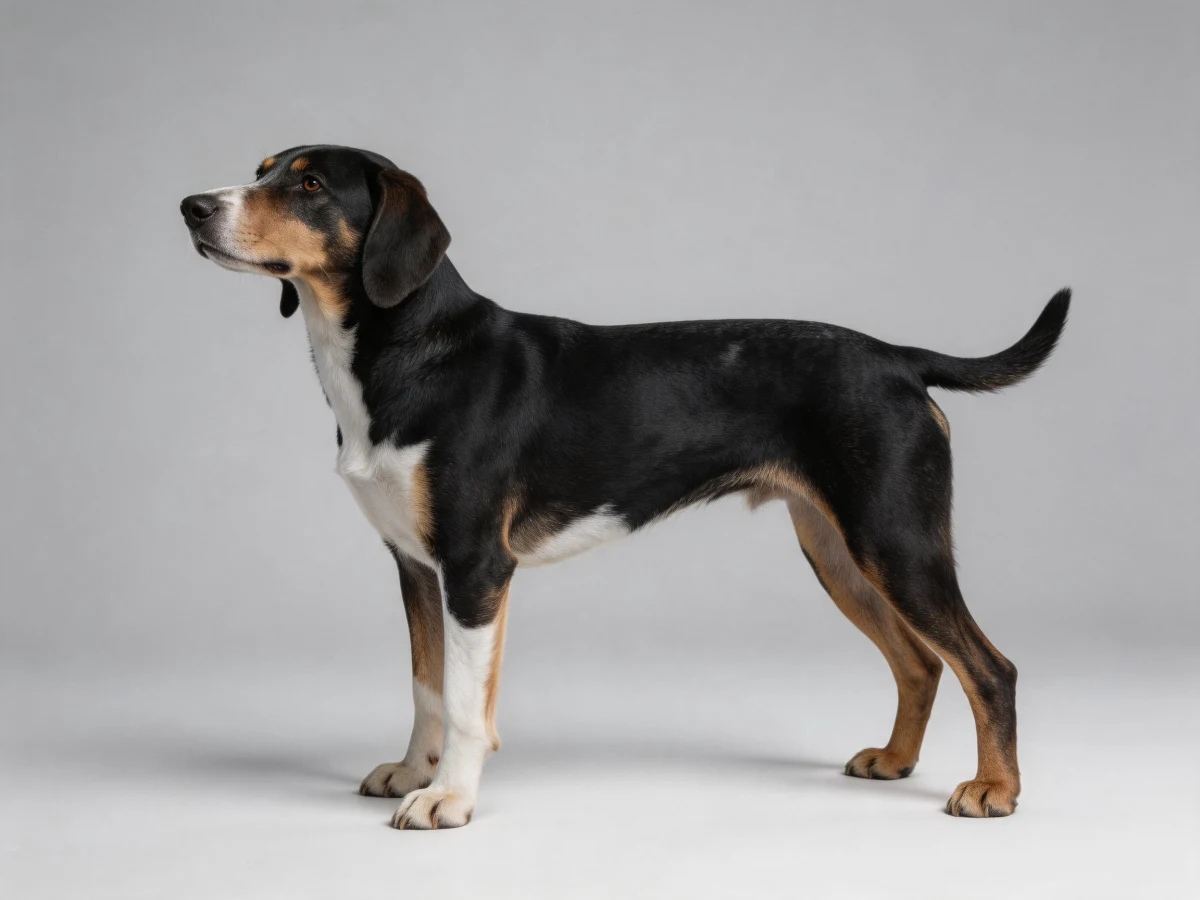
Hygen Hound
✨ Key Takeaways
- A Norwegian scenthound from eastern Norway — the Romerike and Ringerike districts north of Oslo — bred from the 1830s onward by procurator Hans Fredrik Hygen from Ringerike Hound stock crossed with Holsteiner Hounds from northern Germany.
- One of three native Norwegian harehound breeds, alongside the Dunker and the Halden Hound; all three are FCI Group 6 Section 1.2 solo or pair-hunting scenthounds built for the same Norwegian winter terrain.
- FCI Standard No. 266, Group 6 (Scent Hounds and Related Breeds), Section 1.2 (Medium-sized Hounds); definitively recognised by FCI on 10 June 1965; standard text published 9 August 1999; subject to working trial requirement; not AKC-recognised.
- The breed was merged with the Dunker into a single 'Norwegian Harehound' registry by the NKK in 1925, restored as a distinct breed in 1934; an authorised genetic rescue outcross programme (Norwegian Hound, Finnish Hound, Hamiltonstövare) ran from 1976 to 2012 to widen the gene pool.
- Coat colours include red-brown or yellow-red with or without black shading, black and tan, and white with red or black patches and ticking — a wider colour range than either the tricolour Halden Hound or the merle Dunker.
- Temperament described in FCI Standard No. 266 as calm and earnest; trainable, hardworking, friendly, and loyal; a close-bonding solo-hunting hound that settles well at home when its exercise needs are met.
- Rare even in Norway: NKK registers approximately 27-44 puppies per year, placing the breed on the NKK list of six endangered native Norwegian dog breeds; no established population exists outside Scandinavia.
Quick Facts
Common Names & Variants
Modern aliases
Historical names
⚖️ Pros & Cons
Advantages
Trade-offs
Physical Appearance
Recognized colors
Coat
Other
Ears: Pendant. Tail: Medium; carried slightly curved.
🕰 History
Hans Fredrik Hygen and the founding of a Norwegian breed
In the 1830s a Norwegian procurator named Hans Fredrik Hygen set out to build a working harehound suited to the particular demands of eastern Norway — the long ridges, dense spruce forests and deep winter snow of the Romerike and Ringerike districts north of Christiania (present-day Oslo). Hygen was an informed and methodical breeder. He began with the Ringerike Hound, an established regional Norwegian scenthound type, and introduced blood from Holsteiner Hounds he had acquired in Germany — heavy-boned, vigorous tracking dogs from Schleswig-Holstein that brought persistence and nose. In 1839 Hygen settled in Romerike and expanded his programme to include the local hound varieties of that district, crossing and back-crossing over the following decades to fix a type that was compact, strongly built, hardy in cold weather and capable of trailing hare over the uneven ground and through the deep snow of a Norwegian winter. The resulting dog was clearly of Hygen's own making, and it bore his name — the Hygenhund — from the beginning, though formal written codification would not come for another generation.
The 1902 standard and the separation from the Dunker
By the time of Hans Fredrik Hygen's death, his breeding programme had produced a recognisable type that the Norwegian hunting community valued and propagated. In 1902 his son A. B. Hygen was among the founding members of the Special Club for Norwegian Scent Hounds, the organisation that drafted the first written breed standard for the Hygenhund that same year. The 1902 standard formally defined the Hygenhund as a distinct breed separate from the Norwegian Hound (Dunker), a distinction that the breeders of both types considered important: the two breeds had been developed by different men in different districts, and although they shared a common Norwegian harehound background, they differed in head shape (the Hygenhund's skull and muzzle are somewhat shorter and broader than the Dunker's), in coat pattern and colour, and in the specific hound stock from which each was derived. The distinction lasted only as long as the NKK's administrative patience held: in 1925, with Hygenhund registration numbers falling, the Norwegian Kennel Club combined both breeds into a single "Norwegian Harehound" registry classification, a move the Special Club for Norwegian Scent Hounds opposed formally and consistently. After nearly a decade of lobbying, the separation was restored in 1934, with distinct standards for the Dunker and the Hygenhund re-established and the two breeds once again recorded separately in the NKK studbook. This administrative episode left a gap in the Hygenhund's continuous pedigree record during the merger years, a complication that breeders working to reconstruct clear bloodlines after 1934 had to navigate carefully.
FCI recognition and the international record
The Fédération Cynologique Internationale recognised the Hygenhund on a definitive basis on 10 June 1965, classifying the breed in Group 6 (Scent Hounds and Related Breeds), Section 1.2 (Medium-sized Hounds), as Standard No. 266, with Norway as the country of origin. The current version of FCI Standard No. 266, with the standard text published in English, was issued on 9 August 1999 — the same date as the related Norwegian hound standards for the Halden Hound and the Dunker, reflecting the NKK's coordinated revision of all three native harehound standards at that time. The United Kennel Club in North America extended recognition to the Hygenhund in 2006, placing the breed in its Scenthound Group with a standard consistent with the FCI text. The American Kennel Club has not recognised the breed at any point in its history; the Hygenhund has never been registered with the AKC.
Population decline, gene-pool management, and the outcross programme
The decades after the 1934 re-separation were relatively stable for the Hygenhund, and the breed maintained a modest working population in Norway through the mid-twentieth century. After the Second World War, however, the same demographic shift that hit the other Norwegian harehound breeds — rural depopulation, changing hunting customs, and growing competition from faster Finnish hounds — began to erode Hygenhund registrations steadily. By the final quarter of the twentieth century, annual registration numbers had fallen to a level that alarmed the breed's custodians. The NKK's response was a carefully managed genetic rescue programme: Norwegian Hound (Dunker) blood was introduced in six authorised outcrosses between 1976 and 2012, and Finnish Hound and Hamiltonstövare blood was each used in two additional outcrosses during the same period. These infusions broadened the genetic base, reduced inbreeding coefficients and appear to have prevented the catastrophic collapse that the Nordic Kennel Union's population monitoring had identified as a real risk. Annual registrations in recent years have ranged from approximately 27 to 44 puppies — low enough to keep the breed on the NKK's list of six endangered native Norwegian dog breeds, but higher than the single-digit counts of the Halden Hound. The Hygenhund is not recovering toward viability in any robust sense; it is being held in place by active, conservation-minded breeding within a framework of ongoing genetic management.
The Hygenhund and its two Norwegian relatives: a comparison
Three native Norwegian harehound breeds — the Dunker, the Halden Hound and the Hygenhund — were all shaped by the same cultural and environmental context: foot hunters working alone with a single dog, trailing hare through deep snow and cold spruce forest in a terrain that demanded endurance above pace. All three are FCI Group 6, Section 1.2 medium-to-medium-large scenthounds; all three carry dense, weatherproof coats; none were ever intended for mounted pack hunting of the kind that shaped the English and French hound traditions. The differences between them are those of foundation stock and physical type. The Dunker, bred by Wilhelm Dunker from a Russian Harlequin Hound cross, carries the blue-marbled merle coat pattern unique among Norwegian breeds. The Halden Hound, shaped by the breeders of south-eastern Ostfold county from English Foxhound, Beagle and German hound crosses, is a tricolour of white, black and tan and is the largest of the three. The Hygenhund, built from Holsteiner and Ringerike hound stock in central eastern Norway, is the most compact and broad-headed of the trio, and its coat pattern — red-brown or yellow-red with or without black shading, or black-and-tan, usually with white markings — reflects the different hound genetics Hygen worked with. All three share the defining character of the solo Norwegian foot-hunting hound: calm and affectionate at home, focused and persistent in the field, with a clear, carrying voice that reports the scent line to a hunter following on foot through forest.
Current status: rare, conserved and entirely Norwegian
The Hygenhund remains a breed found almost exclusively in Norway. No established breeding population exists outside Scandinavia. The Nordic Kennel Union lists the breed as a Norwegian conservation priority alongside the Dunker, the Halden Hound, the Norwegian Elkhound (black), the Norwegian Lundehund and the Norwegian Buhund. Annual NKK registrations hover between 27 and 44 puppies — enough to sustain a technically viable but genuinely fragile gene pool, dependent on continued careful management and on a small community of committed working hunters and breeders maintaining the type. The NKK's active oversight, the authorised outcross programme and the involvement of the Nordic Kennel Union's conservation monitoring have given the Hygenhund a more stable short-term trajectory than the critically low numbers of the Halden Hound, but the breed cannot be described as secure. It is a working harehound that has survived because Norwegian hunters value it for what it does in the field, and its future depends on that valuation remaining alive in the next generation of Norwegian hunting culture.
Temperament & Personality
Calm, earnest, and built for solo work
The FCI Standard No. 266 describes the Hygenhund's expression as "calm and earnest" — a phrase that speaks to more than eye shape. The breed's working history is one of a dog operating closely with a single hunter on foot, tasked with holding a cold hare scent through difficult terrain and reporting its progress by voice. That working relationship, sustained over many generations of selection, has produced a dog with a particular temperament profile: steady and composed at home, capable of settling quietly between hunting days, and attentive to its owner in a way that pack-bred hounds often are not. Owners of the breed consistently describe a dog that is friendly and approachable, not nervous or reactive, and that integrates comfortably into household life when its exercise needs are met. The calm that the FCI standard identifies in the expression extends to the disposition: this is not a high-strung, over-reactive hound but a dog that carries its working intensity as a controlled reserve, available in the field and quiet in the home.
In the field: persistent, self-directed and vocal
The same dog on a scent line is a different creature. The Hygenhund was bred specifically for endurance in cold northern terrain, and the working sources consistently characterise the breed as an "endurance hunter" capable of covering difficult ground for extended periods without fatigue. On a hare trail in snow the breed works at the steady, sustained pace that a foot hunter can follow, not the flat-out sprint that a sighthound brings to an open field. The hound voice is part of the working system: the Hygenhund calls on the trail to keep its handler informed of the quarry's position and direction, and this clear, carrying bay is as much a selection criterion as nose or stamina. A Hygenhund that is silent on a live trail is useless to a hunter working in dense forest; the voice is the communication channel, and the breed has been kept that way deliberately. This has the practical consequence that a Hygenhund living as a companion in noise-sensitive housing or a dense urban setting will use its voice in ways the standard intended for forest hunting, and that use does not diminish because the context has changed.
With family, children and other animals
The Hygenhund's origin as a close working companion to a single hunter produces a dog with a genuine attachment to its people that is somewhat stronger than is typical of pack-bred hound breeds. It is sociable and friendly without being demanding, and it is characteristically patient with children in the household. The breed has no history of guarding or territorial behaviour, and its reaction to strangers tends toward calm assessment rather than alarm. With other dogs it is cooperative rather than dominant; the breed's working history alongside its hunting partner, and its occasional field work in pairs, left a disposition that is at ease in multi-dog households without the friction that more competitive or territorially driven breeds can produce. The prey drive toward small, fast-moving animals is intact and active — this is, after all, a hare-hunting breed — and households with cats or small pets should manage introductions with care. A Hygenhund raised alongside cats from early puppyhood typically learns to distinguish household companions from quarry; an adult dog making that acquaintance for the first time requires thoughtful, supervised introduction over an extended period.
Energy and mental engagement
The Hygenhund's energy level is high by companion-dog standards and moderate by working scenthound standards. The breed needs genuine daily physical and mental work to settle well at home; a well-exercised Hygenhund that has had its nose engaged is a calm and easy companion. A Hygenhund that has been under-stimulated for several days becomes restless, vocal and inclined to find its own occupation, which in a garden usually means following a scent trail of some kind regardless of the gardener's preference. The breed's eagerness to learn and its cooperative disposition with its owner make it a trainable dog in structured contexts, but the intelligence it brings is the intelligence of a working nose-hound — problem-solving in the service of scent-following — and it is deployed in the field rather than on a training flat.
🏡 Living With a Hygen Hound
Environment and exercise requirements
The Hygenhund was shaped by the demands of Norwegian harehound work: full days on foot through deep snow, rough forest floor and rolling Romerike countryside in autumn and winter cold. In a companion household, that working background translates to a genuine need for substantial daily exercise and access to outdoor space that provides room for a hound to move and use its nose. A rural or semi-rural setting with secure outdoor area and ready access to fields, forest or other scent-rich terrain is the most appropriate environment. An apartment in a city, even with twice-daily pavement walks, does not meet the breed's fundamental physical and mental requirements, and a Hygenhund kept in those conditions will not be the calm, settled dog the breed is capable of being. The minimum realistic daily exercise for an adult Hygenhund is an hour to ninety minutes of genuine off-lead activity in a safe area; more is better, and the addition of structured nose-work — trailing games, hidden-object exercises, mantrailing — turns physical exercise into the combined physical-and-mental engagement the breed thrives on.
Fencing and containment
Any outdoor space used by a Hygenhund must be securely contained. The breed's scenting instinct is not a preference but a drive, and a detected hare scent near a gap in a fence, an open gate or a low hedge will be pursued with the same focused persistence the dog brings to the hunting field. Standard domestic garden fencing of adequate height — at least 1.8 metres — with no gaps at the base and a securely fastened gate is the practical requirement. The Hygenhund is not a dedicated escape artist by temperament in the way that some terrier and sight-hound breeds are, but it is a purpose-bred nose-hound and a live scent overrides most learned restraint. Managing the containment properly from the outset is simpler than managing the consequences of a hound that has learned it can follow a scent out of the garden.
Climate and cold-weather suitability
The Hygenhund's dense, straight, slightly rough coat was designed for Norwegian winter conditions: cold, wet, snow-covered terrain at temperatures that would compromise a less insulated dog. The breed handles cold and damp with ease and is energetically suited to outdoor activity in sub-zero conditions. In warm or humid climates, the same dense coat becomes a thermal management challenge; owners in warmer regions must be attentive to heat load during exercise and should avoid demanding physical work in the heat of the day during summer months. Adequate shade, fresh water and restricted activity timing during peak heat are basic precautions, and any signs of heat distress — heavy panting, disorientation, reluctance to move — require immediate cooling and veterinary attention. Indoors the breed settles well when its exercise quota has been met. It is not a clingy or anxious dog that demands constant company, but it is social enough that extended periods of isolation produce restlessness and vocalisation that daily exercise alone does not fully resolve.
Children, cats, and multi-dog households
With children the Hygenhund is patient and gentle. The breed carries no guarding instinct that translates into defensive snapping, and its size — medium, not large — means that accidental knock-downs during enthusiastic greeting are less of a risk than with the bigger Norwegian harehound breeds. Supervision with very young children is always sensible with any working hound, but the Hygenhund does not present specific temperament difficulties with children. With cats and smaller pets, the working prey drive requires thoughtful management: fast-moving small animals are a trigger for a hare-hunting instinct that is not switched off by household life. Early socialisation from puppyhood and supervised introductions give the best chance of a peaceful multi-species household. With other dogs the breed is cooperative and undemanding; it integrates well into multi-dog households and manages calmly with unfamiliar dogs in public settings, which is consistent with a breed that worked occasionally alongside other hounds without the competitive friction that guarding-bred dogs can bring to canine encounters.
🎓 Training & Exercise
Trainability and realistic expectations
The Hygenhund is described in multiple working sources as "trainable" and "eager to learn," and those descriptions are accurate within appropriate expectations. The breed is cooperative by nature, attentive to its owner in the way that a solo working hound needs to be, and it lacks the dominant or hard-tempered resistance that makes some working breeds difficult for everyday owners. Basic commands, household routines, lead manners and a working recall in low-distraction environments all come without exceptional difficulty when training is reward-based, consistent and started early. What the Hygenhund does not offer is the moment-to-moment handler-focus and instant response that herding breeds and gun-dog retriever types provide; its intelligence is deployed in the service of scent-following, and once a nose is down on an interesting trail, attention to the handler moves significantly down the priority list. This is not a character deficit; it is the working design the breed was selected for over generations, and training that ignores this reality will produce frustration on both sides.
Recall in scent-rich environments
Reliable off-lead recall in open terrain with active scents is the single most demanding training challenge with any scenthound, and the Hygenhund is no different. Recall can be substantially improved through careful, patient training from early puppyhood — building value for returning to the handler, working in progressively more distracting environments, using high-value food rewards that genuinely compete with environmental interest — but the honest position of experienced Nordic hound owners is that a working Hygenhund following a live hare scent in open country will not reliably break off that trail on a verbal recall. The practical arrangement for companion owners is to use securely enclosed areas for free running, exercise in scent-rich country on a long line, and reserve off-lead work for environments where recall failure has manageable consequences. This is not a failure of training; it is the well-considered arrangement that intelligent, experienced scenthound owners maintain for the life of the dog.
Socialisation and the critical window
Early socialisation is as important for the Hygenhund as for any working hound with a strong independent streak. The critical socialisation window before sixteen weeks should be used for systematic positive exposure: varied people of different ages, appearances and behaviours; different surfaces and environments; traffic sounds, household machinery and outdoor noise; other animals including, where manageable, cats and small pets if the household includes them. A Hygenhund puppy that moves through this window with broad, positive exposure develops into a confident, calm adult that is not startled by novelty and that settles easily in varied contexts. An under-socialised puppy can develop anxiety-driven reactivity or excessive alarm behaviour that is more difficult to manage than any amount of recall-training. The investment in the first four months pays dividends for the lifetime of the dog, and there is no substitute for it in later remedial training.
Nose work as training foundation
The most effective and rewarding training investment for any Hygenhund owner is structured nose-work: trailing games, hidden-object searches, mantrailing classes or, for owners with access to appropriate land and licences, actual drag-line or live-scent work in controlled conditions. A Hygenhund whose nose has been properly exercised is mentally satisfied in a way that physical exercise alone does not achieve, and a mentally satisfied hound is a calm, easy companion. Channelling the breed's outstanding scenting ability into owner-directed nose-work gives both dog and owner a shared activity that matches the breed's genuine talents, builds the dog-owner working bond and satisfies the drive that will otherwise be expressed unilaterally. Crate training, house-settling and lead manners are all straightforward with positive methods. The breed has no history of aggression or dominant behaviour that complicates training; it is, fundamentally, a cooperative dog built to work with a human partner, and that cooperative foundation is the trainer's most useful starting asset.
✂️ Grooming & Coat Care
A working coat: description and care
The Hygenhund's coat is short to medium in length, straight, dense and slightly rough to the touch — a functional construction that sheds water, mud and snow without accumulating them, and provides enough insulation for a dog working through Norwegian winter conditions without the bulk of a long or profusely coated breed. The FCI standard specifies "straight and preferably somewhat rough to the touch, dense, shiny and not too short," with the possibility of slightly longer hair on the back of the thighs and the underside of the tail. This is a coat that requires genuinely minimal grooming: weekly brushing with a rubber grooming mitt, a firm-bristle brush or a medium-toothed comb is sufficient to remove dead hair, distribute skin oils and maintain the coat's condition and appearance. There is a seasonal shed, typically more pronounced in spring as the winter coat releases, during which brushing every two to three days manages loose hair in the home. Bathing is needed only occasionally, when the dog is genuinely dirty after field work or has acquired an odour that regular brushing does not resolve; over-bathing diminishes the natural protective quality of the coat without benefit, and a clean, properly cared-for Hygenhund does not need frequent washing.
Ear care: the primary routine priority
Like all pendant-eared scenthound breeds, the Hygenhund requires consistent attention to its ears. The drop-ear flap closes off air circulation to the canal and creates a warm, moist environment that encourages the overgrowth of yeast and bacteria. A dog that works regularly in wet undergrowth, through snow, or in water is exposing that already-susceptible environment to additional moisture and debris after every outing, which significantly increases the risk of otitis externa if ears are not inspected and dried after field work. The routine is straightforward: weekly inspection of both ear canals for redness, odour, dark discharge or evidence of irritation; gentle cleaning of the outer canal with a veterinarian-approved ear cleaner applied to cotton wool (never inserting anything into the canal itself); and a brief drying check after every wet-conditions outing. Any persistent head-shaking, repeated ear-scratching or strong odour from the ears should prompt a veterinary consultation rather than continued home treatment — ear infections that are managed at home when they need professional attention become established infections that are harder to resolve.
Nails, teeth and general checks
Nail length varies with exercise surface: a Hygenhund that works regularly on hard natural ground tends to self-regulate nail length through normal wear, while a companion dog on primarily soft or indoor surfaces will need nails trimmed approximately every three to four weeks. A nail allowed to grow to the point of audible clicking on hard floors has already reached the length at which it affects gait; the target is nails that just clear the floor when the dog stands. Dental hygiene is the most routinely neglected preventive care in medium-sized dogs and among the most consequential for long-term health; daily tooth-brushing using a dog-formulated toothpaste is the single most effective preventive measure, supplemented by appropriately sized dental chews and, if the dog tolerates it, a veterinary-formulated oral rinse. A regular hands-on inspection covering the skin, coat, eyes and between the toes after field work establishes a baseline for normal appearance and allows early detection of grass seeds, thorns, minor lacerations and skin changes before they develop into problems that need veterinary management.
🍖 Diet & Nutrition
Feeding for the working dog's variable output
The Hygenhund's caloric requirement varies substantially with activity level, and managing that variation is the practical foundation of good feeding. A dog worked actively in Norwegian harehound conditions — full hunting days in cold terrain through autumn and winter, requiring sustained aerobic output over many hours — needs meaningfully more food than the same dog in the rest-and-conditioning phase between hunting seasons, and both states require different amounts than a companion Hygenhund whose daily exercise is a structured ninety-minute off-lead run. The most practical ongoing feeding guide is the dog's own body condition rather than any fixed daily amount: ribs should be easily felt under a light cover of subcutaneous tissue but not visible from a distance; a defined waist should be apparent from above; the belly should show a slight tuck from the side. Using body condition to guide meal quantity — adjusting up or down over two to three weeks in response to what the condition shows — is more reliable than following bag guidelines, which are general and designed for average activity levels the individual dog may not match.
Meal structure and the deep-chest precaution
Adult Hygenhunds feed best on two measured meals per day rather than one large daily meal. Dividing the daily ration reduces the amount consumed in any single sitting, moderates blood glucose fluctuation and is a sensible precaution with any medium-sized breed that carries a moderately deep chest. The deep-chest structure that the Hygenhund shares with similar-type hounds raises the same precautionary awareness around gastric dilatation-volvulus that applies to other athletic breeds of comparable build: feeding two smaller meals rather than one large one, avoiding hard exercise for at least an hour before and after eating, and seeking urgent veterinary attention for sudden abdominal distension, unproductive retching or restless distress are standard precautions that cost nothing and are widely practised with working hound breeds. There is no published prevalence data establishing bloat risk specifically for the Hygenhund, and the precaution is a general one rather than breed-specific evidence. Fresh water should be available at all times and replenished after exercise; a working dog in cold conditions drinks less visibly than one exercising in heat but still loses fluid through exertion, and hydration is easily overlooked in winter hunting conditions.
Life-stage considerations and weight management
Puppies and young dogs growing through the medium-breed developmental phase benefit from a large-breed or medium-breed puppy food formulation in which the calcium-to-phosphorus ratio is calibrated for controlled skeletal growth rather than maximal weight gain. Overfeeding a growing Hygenhund accelerates growth rate in a way that can compromise joint development, and the breed's working soundness in later years depends on joints that developed correctly. Senior dogs and those recovering from injury or illness have reduced caloric needs and may benefit from formulations designed to support joint health through appropriate omega fatty acid levels. Training treats and reward snacks should be factored into the daily total rather than added on top of regular meals; the Hygenhund's cooperative disposition and food motivation make treats an effective training tool, and unmeasured treat use adds calories that accumulate without the owner noticing over weeks and months. Diet changes should be made gradually over five to seven days to avoid digestive upset. Feeding choices should be confirmed and periodically reviewed with a veterinarian, and adjusted over time in response to the individual dog's condition, activity level, age and health status.
🐶 Buying & Adopting a Hygen Hound
Rarity and the realistic acquisition path
Acquiring a Hygenhund is an undertaking that requires patience, realistic expectations and a genuine willingness to engage with a small, specialist Norwegian breed community. Annual NKK registrations of 27 to 44 puppies make this one of the rarest registered breeds in Norway, and the number available to buyers outside Norway in any given year is a fraction of that already small total. The overwhelming majority of Hygenhund litters are bred by Norwegian hunters for use in the field; puppies are not surplus commodity production but planned working-dog litters in which every placement matters to the breeder. A buyer outside Norway should plan for a waiting period of one to several years, budget for import costs and veterinary health requirements, and approach the process as an engagement with a conservation project as much as a puppy purchase. There is no established Hygenhund breeding population in North America, the United Kingdom or mainland Europe. Any Hygenhund advertised through general commercial puppy platforms without a direct, verifiable link to an NKK-registered breeding programme should be approached with the caution warranted by a rare breed easily subject to misrepresentation.
Finding a responsible breeder
The correct starting point for a prospective Hygenhund buyer is the Norsk Kennel Klub's breed register and its network of breed club contacts, supplemented by the Nordic Kennel Union's Hygen Hound breed page, which provides current Norwegian contact details and background on the breed's conservation status. A responsible Hygenhund breeder will be working within the NKK's active genetic management framework — aware of the inbreeding coefficient of the planned litter, able to speak to the health status of both parents, and conducting the breed's authorised outcross programme in the manner the NKK has sanctioned. Expect to be questioned carefully about your fencing, exercise provision, hunting access or nose-work plans, prior experience with scenthound breeds and your long-term commitment to a rare breed that may require active advocacy and international logistics to place properly. A breeder who asks no questions and can provide a puppy immediately on request is not a sign of welcome convenience; it is a warning sign in a breed this carefully managed. Buyers should request documentation of both parents' health evaluations — at minimum hip radiographic assessment and, where the vWD concern applies to the breeding line, DNA test clearance.
Adoption and early weeks at home
Rehoming adult Hygenhunds outside Norway is essentially theoretical given current population levels. Within Norway, retired hunting dogs occasionally become available through direct breeder contact and the NKK's breed network, which is the appropriate channel for any such placement. A dog coming from an active working background will be physically fit, nose-driven and comfortable in field conditions; it will adapt to household companion life with patient introduction to new routines, indoor sounds and a less structured daily pattern. The first weeks at home should be calm and predictable: a fixed sleeping place, regular feeding times, a consistent exercise loop and gradual introductions to household novelty. For a puppy, the socialisation work of the first sixteen weeks is the most important investment an owner can make: varied environments, people, animals, surfaces and sounds during this critical window produce the confident, calm adult dog that is the Hygenhund at its best. The long-term commitment is to a healthy, athletic, rare Norwegian harehound with a lifespan of 10 to 12 years — a breed that asks for genuine outdoor exercise, secure containment, nose-work engagement and a living situation that can accommodate the clear, carrying voice of a working hound.
📜 Breed Name Etymology — iDogNames original research
Hygenhund: what the Norwegian name contains
The Norwegian name Hygenhund is an eponymous compound of two elements. Hygen is the surname of Hans Fredrik Hygen, the Norwegian procurator who developed the breed in the 1830s and 1840s in eastern Norway; the word carries no meaning beyond the family name. Hund is the ordinary Norwegian and German word for dog, from Old Norse hundr and Proto-Germanic *hundaz, the root shared by English hound, German Hund, Dutch hond and all the Scandinavian cognates. The compound therefore means simply "Hygen's dog" — a direct eponymous naming in the tradition of the Dobermann, the Russell Terrier and the Weimaraner, where the founder's name becomes the breed's permanent identifier. This is consistent with Norwegian harehound naming practice of the period: the Dunker likewise takes its name from its founder, Captain Wilhelm Conrad Dunker, while the Halden Hound takes its name from the town in which it was developed. Hygen's name, unusually, preserves the individual breeder's family identity across nearly two centuries of breed history.
The English name and its relationship to the Norwegian
The English form Hygen Hound is a partial translation of the Norwegian: Hygen is retained as a proper noun identifying the founder, while hound, from Old English hund, translates the Norwegian hund. The translation follows the same pattern as Halden Hound (from Haldenstøver) and Dunker (where the founder's name is retained as the entire English name without a type-noun). The word hound, in its modern English use, specifically implies a dog used in hunting — tracing the prey, giving tongue on the trail — rather than the generic canine of the simpler word dog. Calling the breed the Hygen Hound rather than the Hygen Dog places it correctly in the tradition of the working scenthound, where voice, nose and stamina on a scent line are the defining virtues. Both the Norwegian Hygenhund and the English Hygen Hound appear in international cynological literature; the Norwegian form is authoritative under FCI Standard No. 266 and in all NKK records.
Name forms at a glance
| Name | Role | Origin | Literal meaning | First recorded |
|---|---|---|---|---|
| Hygen Hound | primary | English (eponymous compound) | the hunting dog bred by Hygen | 1902 |
| Hygenhund | origin country native | Norwegian | Hygen's dog | 1902 |
| Hygen | historical | Norwegian (personal surname) | the Hygen family name (meaning uncertain) | 1839 |
| Norwegian Harehound | historical | English / Norwegian administrative | Norwegian hound for hunting hare | 1925 |
| Ringerike Hound | historical | Norwegian (place name) | the hound of Ringerike | 1830 |
🏛 Naming Traditions — iDogNames original research
Norwegian working-dog names and the hound tradition
Naming conventions for the Hygenhund have always been rooted in the working hunting culture of eastern Norway — Romerike, Ringerike and the broader district north of Oslo where the breed was developed. Norwegian foot-hunters working alone with a single hound favoured names that were short, clear and vowel-strong: two syllables is the practical maximum for a name called across open terrain or through dense spruce forest, and longer names collapse to a shortened form in the field anyway. Traditional Norwegian harehound names draw on the natural landscape (mountains, rivers, forest, the seasons), on Norse mythology and old Scandinavian given names, and on the dog's coat colour and pattern. The three Norwegian harehound breeds — the Hygenhund, the Dunker and the Halden Hound — share this naming pool, reflecting a shared hunting culture rooted in the same cold, forested landscape. Names honouring working virtues — persistence, nose, voice, stamina — recur across all three breeds' stud books. The Hygenhund's colour range (reds, yellows, black-and-tan, white with patches) offers a different naming palette from the Halden Hound's tricolour or the Dunker's blue-grey merle, giving the Hygenhund a distinct set of colour-derived naming options that connect the dog's appearance to its identity.
🐾 Themed Names for Your Hygen Hound — iDogNames original research
Names from the red and amber coat palette
The Hygenhund's signature colour — red-brown, yellow-red or amber, often with black shading — generates a strong natural naming vocabulary that connects the dog's appearance to its working identity in the tradition of Norwegian harehound naming. Rust suits a deep red-brown dog perfectly; Amber and Topaz fit the warmer yellow-red shades. Ginger and Saffron work for paler yellow-red coats. Copper and Bronze fit the metallic red-brown shades with black shading. For the black-and-tan colouring: Jet (the black) and Tawny (the tan) can be used individually or as a pair for littermates. The white-and-patches dogs give Flekk (Norwegian for patch or spot, a classic hound name), Pied or simply Hvit (Norwegian for white). Ravn (raven, black in Norwegian) suits the darker dogs with heavy black shading; Solbrun (sun-brown) is a more lyrical option for a warm-coated male.
Names from eastern Norway: Romerike, Ringerike and the breed's home district
The Hygenhund's geographic origin — the rolling farmland, forest ridges and river valleys north and west of Oslo — provides a strong pool of place-based names with direct breed connection. Romerike, the district where Hans Fredrik Hygen settled in 1839, is a powerful two-syllable name. Ringerike, the older district where Hygen began his work and where the Ringerike Hound originated, gives Ringe as a shortened form. Tyrifjord, the great lake at the heart of Ringerike, gives Tyri for a female. Nitelva, the river running through Romerike, gives Nita. Mjosa (Lake Mjosa, Norway's largest lake, at the edge of the district) is a strong, open-vowel name. For the huntsman's world of eastern Norway: Elv (river), Eng (meadow), Rog (from Rogaland — not geographically related but carrying the hard Norwegian consonant sound traditional in working-dog names), Aker (field, ploughed land — the root of Akershus, the county surrounding Oslo).
Norse mythology and old Scandinavian names
The full Norse mythological pantheon is available to any Norwegian breed, and the Hygenhund wears it well. Odin — the Allfather, associated with wisdom, hunting and the wild hunt — gives any male a sense of ancient authority. Freyr is the Norse god of nature, hunting and prosperity. Skadi — the goddess of skiing, winter hunting and the mountains, always depicted on skis with a bow in snow-covered terrain — is the single most apt mythological name for a Norwegian winter harehound, male or female. Tyr, Vidar and Njord are strong male names from the same tradition. Freyja, Sif and Ragnhild suit females. Old Scandinavian given names with genuine Norwegian pedigree use: Bjorn, Gunnar, Leif, Sigurd for males; Astrid, Sigrid, Vigdis, Ingrid for females. Garm — the hound of Hel in the Norse Prose Edda — carries the most direct mythological connection to the concept of the hound itself.
Hunting-tradition and working-virtue names
Norwegian hunting vocabulary gives names that honour what the Hygenhund does in the field. Spor (scent trail, track) is the central noun of Norwegian harehound work — the dog follows the spor. Jeger (hunter) works equally well for either sex. Nese (nose) celebrates the instrument the breed lives by. Røst (voice, sound) honours the hound bay that connects dog to hunter through dense forest. Stamina used directly suits the breed's defining endurance quality. Jakt (hunt), Vilt (game, wild), Sti (trail, path) and Havre (oats, a traditional crop of the Romerike farming district where the breed was developed) connect the dog to the landscape of its origin. For pairs or litters from the same register: Spor and Røst, Rust and Amber, Skadi and Odin — matched names from the same tradition reinforce breed identity across a litter and carry the cultural weight of the Hygenhund's working heritage.
More Norwegian heritage names
- Norwegian Trail - best for a Hygen Hound name rooted in Norway rather than generic style
- Romerike and Ringerike districts, eastern Norway (north of Oslo) Ridge - best for a regional landscape cue tied to the Hygen Hound story
- Local Line - best for a name that respects local breed history
- Old Route - best for migration, trade, field or pastoral routes behind the breed
- Heritage Note - best for a page where origin should be treated as context, not decoration
- Village Path - best for rustic, local or landrace-style background
- Working Home - best for a dog whose name should remember Solo or paired scenthound for trailing hare over forested Norwegian terrain in cold-weather conditions; bred b
- Country Mark - best for a concise country-of-origin cue
More work and purpose names
- Cold Nose - best for a Hygen Hound tied to older scent trails
- Track Bell - best for a hound whose voice marks the trail
- Scent Check - best for a dog that confirms track direction
- Long Trail - best for endurance over rough or wooded country
- Forest Cast - best for methodical search through cover
- Leash Rule - best for wildlife and road-safety management
- Checkback - best for a trail dog who learns to return to the handler
- Settle - best for calm at home after scent work
More coat and build names
- Red-brown Or Yellow-red - best for a Hygen Hound whose color or markings deserve a simple call name
- Short, Straight, Dense, Slightly Rough Coat - best for the short, straight, dense, slightly rough coat type on this breed
- White Blaze - best for a clear face or chest marking
- Dark Mask - best for a dog with a strong muzzle or face marking
- Weather Coat - best for outdoor or working-dog coat context
- Strong Frame - best for a dog whose build is part of its function
- Bright Eye - best for an alert expression
- Ground Step - best for a name tied to movement and body type
More training and management names
- Recall - best for a Hygen Hound whose safe freedom depends on training
- Focus - best for handler attention around distractions
- Marker - best for clear reward timing
- Settle - best for calm at home after activity
- Boundary - best for doors, yards, roads or stock rules
- Neutral Walk - best for calm public behavior
- Checkback - best for a dog learning to return to the handler
- Rest Day - best for balancing drive with recovery
More history-aware names
- Source Note - best for a name that invites accurate breed history
- Old Job - best for remembering Solo or paired scenthound for trailing hare over forested Norwegian terrain in cold-weather conditions; bred b without turning it into a slogan
- Modern Fit - best for a dog whose current home should match real needs
- Care Plan - best for a name tied to grooming, exercise and health records
- Steward - best for rare or local breeds where preservation matters
- Plain Record - best for choosing documented facts over myths
- Breed Context - best for readers comparing names, history and suitability
- Respect - best for a culturally or regionally rooted breed story
More comparison-aware names
- Halden Hound Link - best for readers comparing with the Halden Hound
- Dunker Link - best for readers comparing with the Dunker
- Hamiltonstövare Link - best for readers comparing with the Hamiltonstövare
- Schillerstövare Link - best for readers comparing with the Schillerstövare
- Shared Job - best for comparing related breeds without merging their histories
- Different Role - best for comparing related breeds without merging their histories
- Same Region - best for comparing related breeds without merging their histories
- Name Bridge - best for comparing related breeds without merging their histories
More daily-life names
- Morning Walk - best for a Hygen Hound whose day needs real routine
- Trail Check - best for safe outdoor movement and handler awareness
- Home Base - best for a dog that needs a calm place to reset
- Good Fit - best for matching the breed to the right household
- Clear Cue - best for training that avoids confusion
- Slow Intro - best for polite introductions and confidence building
- Calm Door - best for visitor and threshold manners
- Rest Point - best for balancing activity with recovery
More care-aware names
- Vet Record - best for a dog whose health notes should be documented
- Sound Start - best for careful puppy or adoption evaluation
- Coat Check - best for grooming after weather, burrs or field work
- Nail Day - best for routine body handling
- Ear Check - best for breeds whose ears need regular inspection
- Weight Watch - best for keeping structure and joints in mind
- Water Break - best for active dogs working or walking in heat
- Shade Rest - best for climate-aware breaks and recovery
📋 Breed Standard at a Glance
FCI Standard No. 266 in brief
Under the Fédération Cynologique Internationale, the Hygenhund is classified in Group 6 (Scent Hounds and Related Breeds), Section 1.2 (Medium-sized Hounds), as Standard No. 266, with Norway as the country of origin. The FCI granted definitive recognition on 10 June 1965; the current English-language standard was published on 9 August 1999. The standard is subject to a working trial requirement in accordance with the FCI Breeds Nomenclature, reflecting the NKK's insistence that the Hygenhund be maintained as a functional hunting breed. The FCI's Group 6 Section 1.2 classification places the Hygenhund alongside its two Norwegian relatives, the Dunker (Standard No. 203) and the Halden Hound (Standard No. 267), and among the other Nordic and Continental medium-sized scenthounds.
Physical description in the standard
The ideal height at the withers is 54 cm for males (range 50-58 cm) and 51 cm for females (range 47-55 cm). Weight is not specified in the FCI standard; working dogs typically weigh in the range of 20-25 kg. The general appearance is of a medium-sized dog that is "strongly built, but not heavy" with a compact, rectangular body outline. The head is moderately wedge-shaped, somewhat shorter and broader than the Dunker's — a difference that experienced breeders use to distinguish the two breeds — with a moderate stop, a broad nose and medium-length pendant ears that hang flat against the head. The eyes should have a calm and earnest expression. The neck is of medium length, clean and muscular. The body is rectangular with a deep chest providing ample room for sustained aerobic work, well-sprung ribs, a straight strong back and a broad, muscled loin. The tail extends to the hock joint and is "carried slightly curved" — a characteristic tail carriage that differs from the Halden Hound's level tail. Feet are described as strong and tight with well-arched toes.
Coat, colour and gait
The FCI standard specifies a coat that is "straight and preferably somewhat rough to the touch, dense, shiny and not too short," with slightly longer hair permitted on the back of the thighs and tail underside. Three colour groups are accepted: red-brown or yellow-red, often with black shading, with or without white markings; black and tan, usually with white markings; and white with red-brown, yellow-red or black-and-tan patches and ticking. The standard requires that the colours be "clearly defined from each other." The gait required is free and ground-covering, consistent with a hound built for extended work rather than sprint performance. Disqualifying faults include any form of aggressiveness. The UKC recognised the Hygenhund in 2006 under the Scenthound Group, using a standard consistent with the FCI text. The AKC does not recognise the breed. This summary is for general orientation; FCI Standard No. 266 and the NKK breed standard are the authoritative technical references for judges, breeders and health registries.
🏆 Recognition
FCI standard No. 266 (1.2), recognized in 1965.
Other registries
❓ Frequently Asked Questions
How big does a Hygen Hound get?
The Hygen Hound is a medium-sized breed. FCI Standard No. 266 sets the ideal height at the withers at 54 cm for males (range 50-58 cm) and 51 cm for females (range 47-55 cm). Weight is not specified in the FCI standard; working dogs typically fall in the range of 20-25 kg. The build is compact and strongly built without being heavy — notably more square-headed and compact than the taller, more rectangular Halden Hound. The body is rectangular in proportion, with a deep chest providing the lung volume needed for full-day harehound work in Norwegian terrain.
What is the Hygen Hound's temperament like?
The FCI standard describes the Hygenhund's expression as "calm and earnest," which extends to its overall character. The breed is steady, friendly and cooperative at home — attentive to its owner in the way that a close solo-hunting hound needs to be — and it integrates well into household life when its exercise needs are met. In the field on a scent, the same dog is focused, persistent and self-directed, working at a sustained pace and giving voice on the trail to communicate with its hunter. The breed is not territorial or aggressive; it is sociable with people and other dogs. Its trainability is genuine: sources consistently describe it as "hardworking, calm, friendly and eager to learn," though the independence that makes it a capable solo hunter means that off-lead reliability in scent-rich terrain requires consistent management.
How much grooming does a Hygen Hound need?
The Hygenhund is a low-maintenance breed in the grooming sense. The coat is short to medium, straight, dense and slightly rough; it sheds mud and snow readily and needs only weekly brushing with a rubber mitt or firm-bristle brush to stay in good condition. There is a more pronounced seasonal shed in spring when the winter coat releases. Bathing is occasional rather than routine. The ears are the highest-maintenance feature: the pendant ear flap closes off air circulation to the canal, favouring bacterial and yeast growth — weekly inspection and prompt gentle cleaning after field work in wet conditions is essential. Nails need trimming every three to four weeks for a companion dog; working dogs on hard natural surfaces tend to self-regulate. Daily tooth-brushing is the most effective preventive dental care.
How much exercise does a Hygen Hound need?
Exercise requirements are substantial. The Hygenhund was developed as an endurance harehound capable of working full hunting days in Norwegian winter conditions, and a companion dog requires at minimum an hour to ninety minutes of genuine off-lead activity per day. Structured nose-work — trailing games, hidden-object exercises, mantrailing — is the most effective form of exercise because it engages both the physical and the mental needs of a breed that hunts primarily by nose. A properly exercised Hygenhund whose nose has been worked is calm and settled at home; one that has been under-exercised becomes restless, vocal and increasingly inventive about finding its own occupation. Secure fencing is essential: the breed's scenting instinct will override recall once a live trail has been found.
How rare is the Hygen Hound and where can I find one?
The Hygenhund is one of Norway's six officially endangered native dog breeds. The Norwegian Kennel Club records approximately 27 to 44 registered puppies per year — a critically low but slightly more stable figure than the even rarer Halden Hound, a consequence of the NKK's authorised genetic outcross programme (Norwegian Hound, Finnish Hound, Hamiltonstovare, 1976-2012). There is no established breeding population outside Scandinavia and no international rescue or rehoming network. Finding a puppy requires direct engagement with NKK-affiliated breeders through the Norsk Kennel Klub's breed register and the Nordic Kennel Union's Hygen Hound breed page; waiting times for international buyers are typically measured in years. Any Hygen Hound advertised through casual commercial platforms without a verifiable NKK programme link should be treated with caution.
Does the Hygen Hound have prey drive?
Some Hygen Hound lines or individuals may show strong chase, scent or hunting interest because of Solo or paired scenthound for trailing hare over forested Norwegian terrain in cold-weather conditions; bred b. Owners should use secure exercise, recall practice and careful management around wildlife or small pets instead of assuming drive will disappear.
📚 Sources & Further Reading
Every load-bearing factual claim on this page is anchored to one of the sources below. iDogNames does not synthesize from secondary aggregators.
- fci standard pdf FCI Standard No. 266 -- Hygenhund (Hygen Hound) — Federation Cynologique Internationale (1999)
- breed club official Norsk Kennel Klub -- Hygenhund breed page — Norsk Kennel Klub (NKK) (2024)
- breed club official Nordic Kennel Union -- Hygen Hound breed profile — Nordic Kennel Union (NKU) (2024)
- breed club official United Kennel Club -- Hygen Hound breed standard — United Kennel Club (UKC) (2006)
- breed club official FCI Nomenclature -- Group 6 Section 1.2 entry for Hygenhund (No. 266) — Federation Cynologique Internationale (2024)
- wikipedia Hygen Hound -- Wikipedia — Wikimedia Foundation
- other Norway Today -- The reliable Hygen Hound: Norway's hare hunting hound — Norway Today (2022)
- academic paper Genetic Rescue of the Highly Inbred Norwegian Lundehund — Genes (Basel) (2022)
- other NIBIO -- Hygenhund (Norwegian Institute of Bioeconomy Research, native breed record) — Norwegian Institute of Bioeconomy Research (NIBIO) (2024)